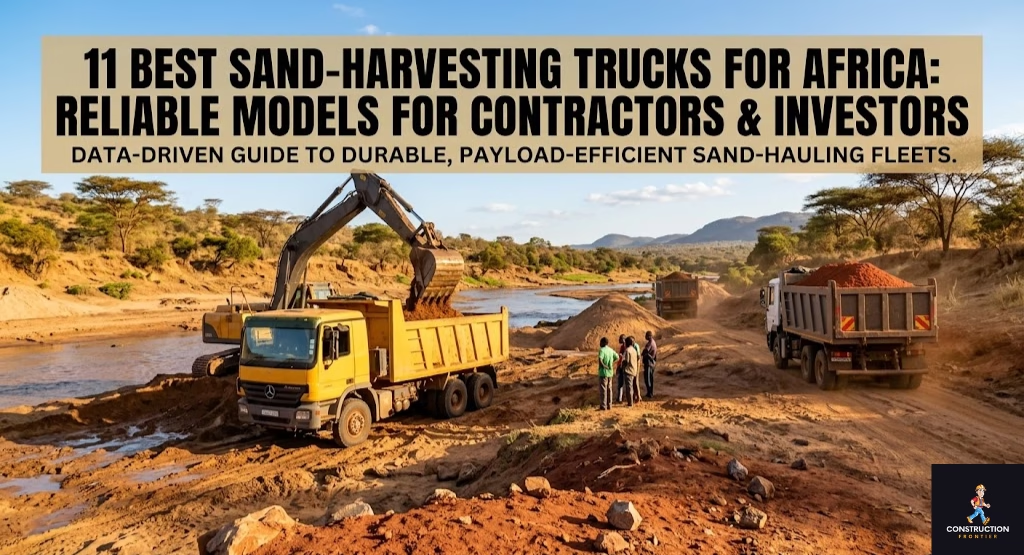
11 Best Sand-Harvesting Trucks for Africa: Reliable Models for Contractors & Investors
The best sand-harvesting trucks for Africa must perform under extreme operating conditions, from unstable riverbeds to long-haul logistics corridors. Contractors and investors across Africa prioritise durability, payload efficiency, and lifetime cost performance when selecting sand harvesting trucks.
This detailed guide provides a data-driven breakdown of the best sand-harvesting trucks for the African market, highlighting proven models used across East, West, and Southern Africa. It also evaluates fuel-efficient, durable sand-hauling trucks in Africa, compares performance metrics, and outlines how to build scalable fleets of heavy-duty sand-hauling trucks.
Technical Snapshot: Operational Benchmarks for Sand Harvesting Trucks
- Average payload capacity (medium-duty): 10–18 tonnes.
- Heavy-duty transport capacity: 20–40+ tonnes.
- Fuel consumption range: 25–45 litres per 100 km (depending on load and terrain).
- Fleet utilisation benchmark: ≥70% for profitability.
- ROI cycle: 24–48 months for high-utilisation fleets.
Introduction: Understanding Sand Harvesting Operations in Africa
The construction trucks for sand harvesting operate across two distinct but interconnected activities: extraction and transport. Contractors in Africa who understand this operational split optimise fleet performance and maximise returns.
Sand harvesting involves direct extraction from riverbeds, quarries, or coastal deposits. This stage requires manoeuvrability, traction, and durability. In contrast, sand transport focuses on moving bulk volumes to construction sites or urban markets, requiring payload capacity and fuel efficiency.
The best sand-harvesting trucks for Africa must adapt to three core environments:
- Riverbeds with soft, unstable terrain that challenge traction and axle stability.
- Rural access roads with uneven surfaces and limited infrastructure.
- Urban delivery routes that require compliance with axle load regulations and traffic constraints.
Truck selection directly affects productivity. A mismatch between equipment and operating environment increases fuel consumption, accelerates wear, and reduces profitability. This study explains why contractors in Africa increasingly differentiate between sand-harvesting trucks in Africa and dump trucks for sand transport.
What Defines the Best Sand Harvesting Trucks for Africa
Selecting the best sand-harvesting trucks for Africa requires a structured evaluation of multiple technical and operational factors. Contractors who prioritise performance metrics, lifetime costs, and regulatory suits outperform those who focus solely on acquisition costs.
1. Durability and Structural Integrity
Durability remains the primary criterion for sand harvesting operations. Trucks must withstand continuous heavy-load cycles over harsh riverbeds, quarries, and rural access roads. Key technical aspects include the following:
- Frame strength: Reinforced chassis to resist torsion and bending under high payloads.
- Suspension system: Heavy-duty leaf or multi-stage suspension for stability on uneven terrain.
- Drivetrain reliability: Engines and transmission systems designed for long operational hours with minimal downtime.
Trucks such as Isuzu FVZ/FVR and Mitsubishi Fuso Fighter exemplify durability, maintaining consistent performance in African sand extraction conditions.
2. Payload Efficiency vs Fuel Consumption
Payload capacity directly affects revenue per trip, but efficiency must balance fuel consumption:
- Optimal payload-to-fuel ratio: Ensures maximum tonnage without excessive fuel expenditure.
- Fuel-efficient sand transport trucks in Africa reduce operating expenses while maintaining high throughput.
- Engine performance metrics: Torque curves, fuel injection systems, and emission controls determine operational efficiency.
High-performing trucks achieve 12–18% higher payload efficiency than lower-tier models while maintaining fuel consumption below 4 km/l in heavy-duty transport operations.
3. Maintenance and Spare Parts Availability
Long-term operational success hinges on maintenance ease and parts accessibility:
- Dealers and service networks: Trucks with strong regional support minimise downtime.
- Spare parts standardisation: This approach reduces inventory costs and enables rapid component replacement.
- Technical support and training: Operator and mechanic training ensures proper handling and reduces wear.
Japanese brands like Isuzu and Hino 500 Series benefit from established service networks across East and Southern Africa.
4. Lifecycle Return on Investment (ROI)
Contractors and investors evaluate trucks based on lifecycle economics rather than purchase price alone:
- Lower maintenance frequency reduces total operating cost.
- High resale value provides secondary capital recovery.
- Consistent performance under varying loads ensures predictable revenue streams.
Using a mix of Japanese extraction trucks and Chinese transport models in hybrid fleet strategies delivers quicker returns on investment while remaining dependable.
Further Reading: Global Tipper Truck Market Report 2020–2025: Strong Growth
Categories of the Best Sand Harvesting Trucks for Africa
Selecting the right truck for sand harvesting in Africa requires understanding the operational context, payload demands, and logistical requirements. Trucks can be classified according to their primary functions: extraction from riverbeds and quarries, long-distance bulk transportation, and hybrid fleet strategies that optimise both processes.
Each category below addresses distinct challenges in African environments, including unstable terrain, rural access roads, urban delivery routes, and high-volume logistics. By analysing these categories, contractors, investors, and procurement officers can make informed decisions that maximise efficiency, reduce operational risks, and improve the long-term return on investment.
Category 1: Best Trucks for Sand Harvesting (River Extraction Work)
Extraction operations demand agility, reliability, and cost efficiency. The top sand transport trucks in Africa differ significantly when applied to harvesting environments. Medium-duty trucks dominate this segment due to their balanced power and manoeuvrability.
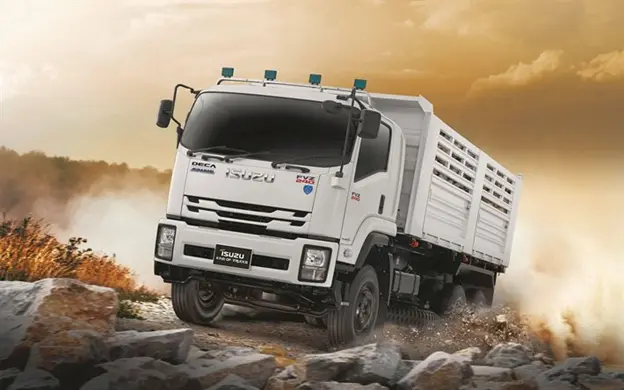
1. Isuzu FVZ Series
Overview
The Isuzu FVZ Series is among the best sand-harvesting trucks for Africa, widely deployed across East Africa for river extraction and quarry operations. Contractors prefer it because of its durability and consistent performance under repetitive loading conditions.
Engine & Performance Specs
- Engine: 6-cylinder turbocharged diesel.
- Power Output: ~240–280 HP.
- Transmission: Manual, 6–9 speed.
- Drivetrain: 6×4 configuration.
- Torque: 981 Nm (100.0 kg · m)/1,450 rpm. High low-end torque for incline performance.
- GVW: 26.5 tonnes.
Payload Capacity
- Typical payload: 14–18 tonnes.
Key Advantages
- Proven reliability across harsh terrain.
- Strong chassis suited for uneven riverbeds.
- Widely available spare parts across Africa.
- Lower long-term maintenance expenses.
Limitations
- Higher upfront costs than Chinese alternatives.
- Lower payload compared to heavy-duty trucks.
Best Use Case
Ideal for contractors focused on sand-harvesting trucks in Africa, i.e., Kenya, for riverbank extraction and mid-scale quarry operations.
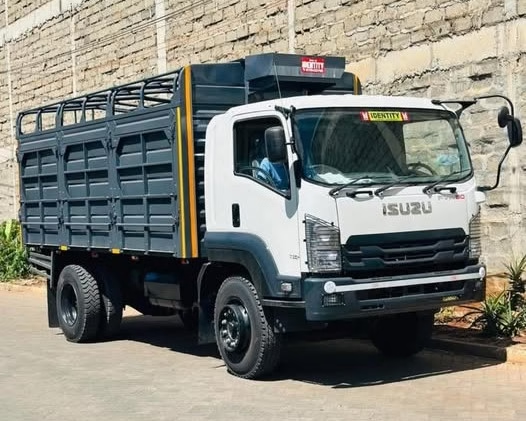
2. Isuzu FVR
Overview
The Isuzu FVR offers a lower-cost alternative while maintaining reliability. Contractors operating mid-scale sand-harvesting operations often select this model due to its affordability and operational efficiency in construction trucks for the sand-harvesting segment.
Engine & Performance Specs
- Engine: 6-cylinder diesel.
- Power Output: ~210–240 HP.
- Torque: 706 Nm (72.0 kg · m)/1,450 rpm.
- Transmission: Manual.
- Drivetrain: 4×2 or 6×4.
- GVW: 16-18 tonnes.
Payload Capacity
- Typical payload: 10–14 tonnes.
Key Advantages
- Lower acquisition cost than FVZ.
- Reliable fuel efficiency.
- Easy maintenance and serviceability.
Limitations
- Lower payload capacity.
- Less suited for extreme terrain.
Best Use Case
Best for contractors seeking affordable equipment for sand harvesting in moderate terrain conditions.
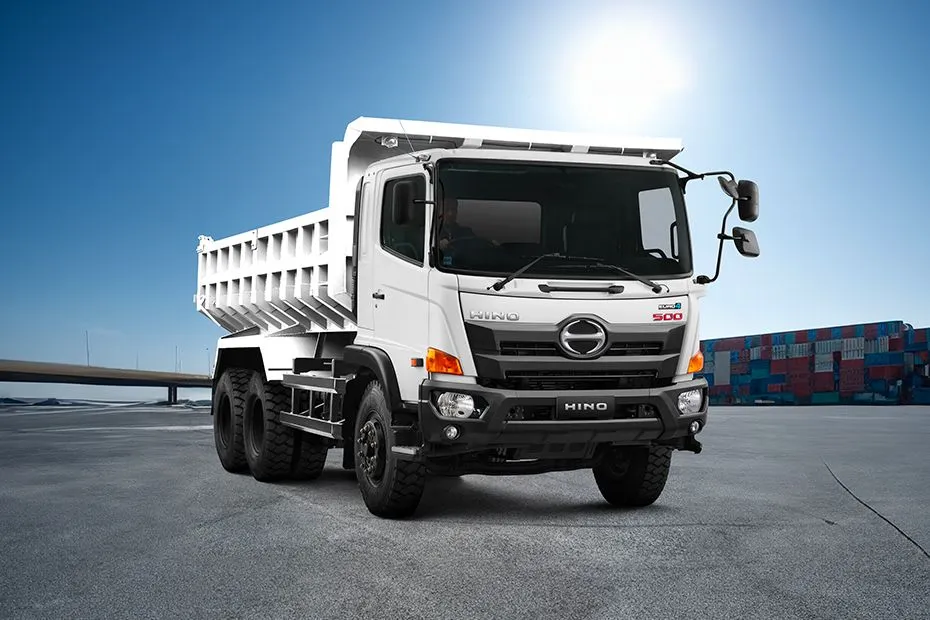
3. Hino 500 Series
Overview
The Hino 500 delivers strong suspension performance, making it ideal for repetitive loading cycles. Its durability supports long-term use in demanding environments. The Hino 500 Series delivers strong structural integrity and suspension performance, making it one of the most durable sand-hauling trucks in Africa.
Engine & Performance Specs
- Engine: 6-cylinder diesel.
- Power Output: ~260–300 HP.
- Transmission: Manual.
- Suspension: Reinforced heavy-duty.
- GVW: 16-28 tonnes.
Payload Capacity
- Typical payload: 15–20 tonnes.
Key Advantages
- Excellent suspension for repetitive loading.
- Strong engine reliability.
- High durability in long-term use.
Limitations
- Higher consumption and maintenance expenses compared to Isuzu.
- Limited availability in some regions.
Best Use Case
Suitable for high-cycle sand harvesting operations with frequent loading and unloading.
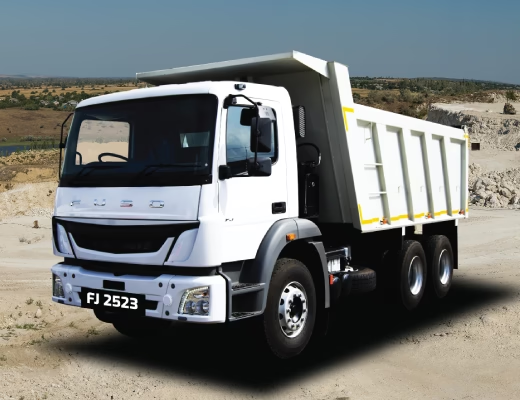
4. Mitsubishi Fuso Fighter
Overview
The Mitsubishi Fuso Fighter performs well in muddy and unstable conditions. Its engine reliability and balanced load capacity position it among the most durable sand-hauling trucks in Africa.
Engine & Performance Specs
- Engine: 6-cylinder turbo diesel.
- Power Output: ~240–270 HP.
- Drivetrain: 6×4.
- GVW: 13,500 kg (13.5 tonnes).
Payload Capacity
- Typical payload: 7-8 tonnes.
Key Advantages
- Strong traction in muddy terrain.
- Reliable drivetrain performance.
- Moderate fuel consumption.
Limitations
- Less payload than competitors.
- Parts availability varies by region.
Best Use Case
The Fuso Fighter is particularly well-suited for sand-harvesting operations in riverbeds and wet-terrain environments in Africa.
5. Nissan UD Croner
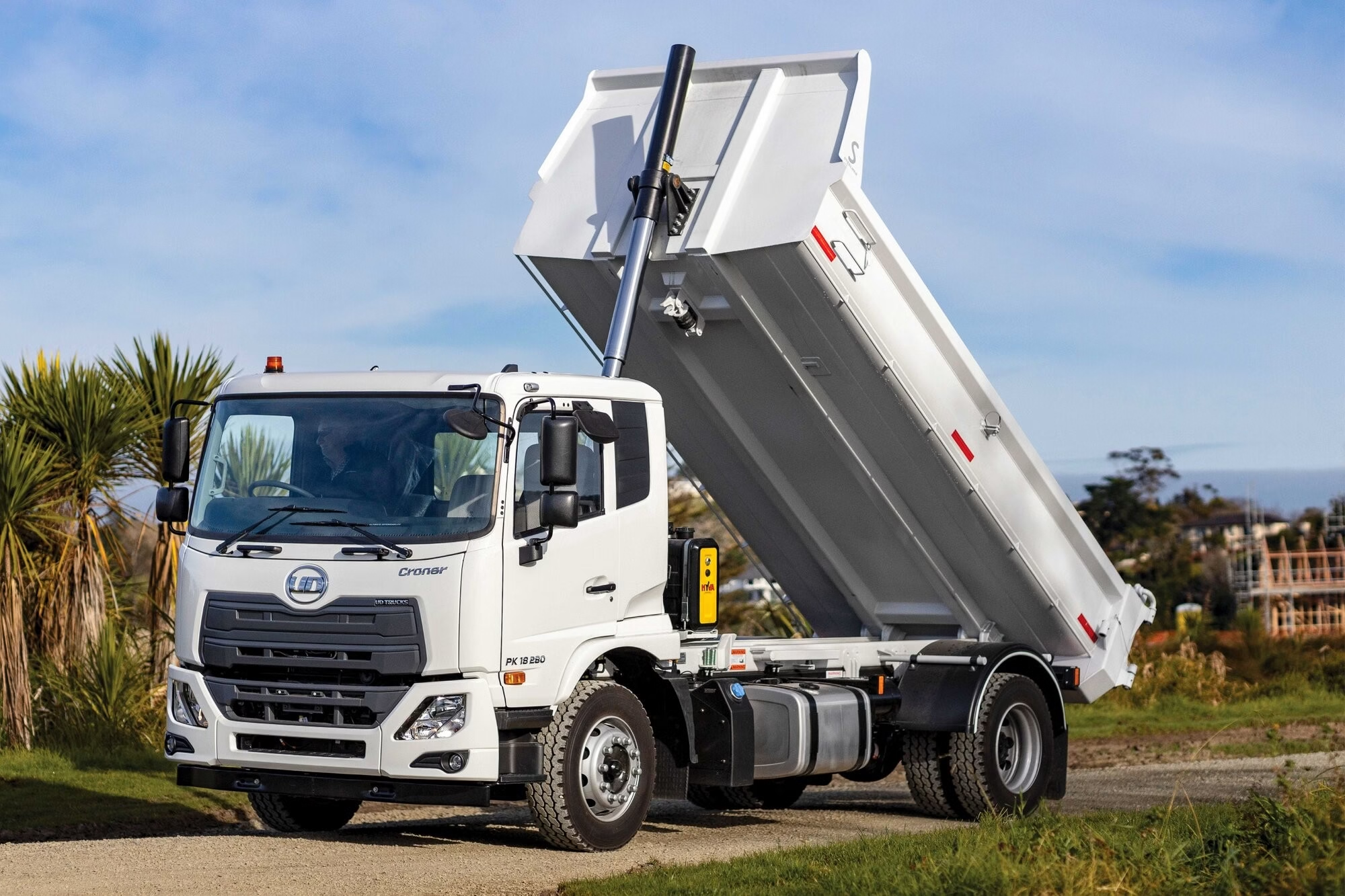
Overview
The Nissan UD Croner offers consistent reliability and operational efficiency, making it a trusted option for sand-harvesting construction trucks.
Engine & Performance Specs
- Engine: 6-cylinder diesel.
- Power Output: ~250 HP.
- Transmission: Manual.
- GCW: 10.4-19 tonnes.
Payload Capacity
- Typical payload: 12–16 tonnes
Key Advantages
- Long operational lifespan.
- Fuel-efficient for medium-duty operations.
- Comfortable cabin for operators.
Limitations
- Limited dealer network in some regions.
- Moderate resale value.
Best Use Case
This product is ideal for contractors who prioritise longevity and steady performance.
6. FAW JK6
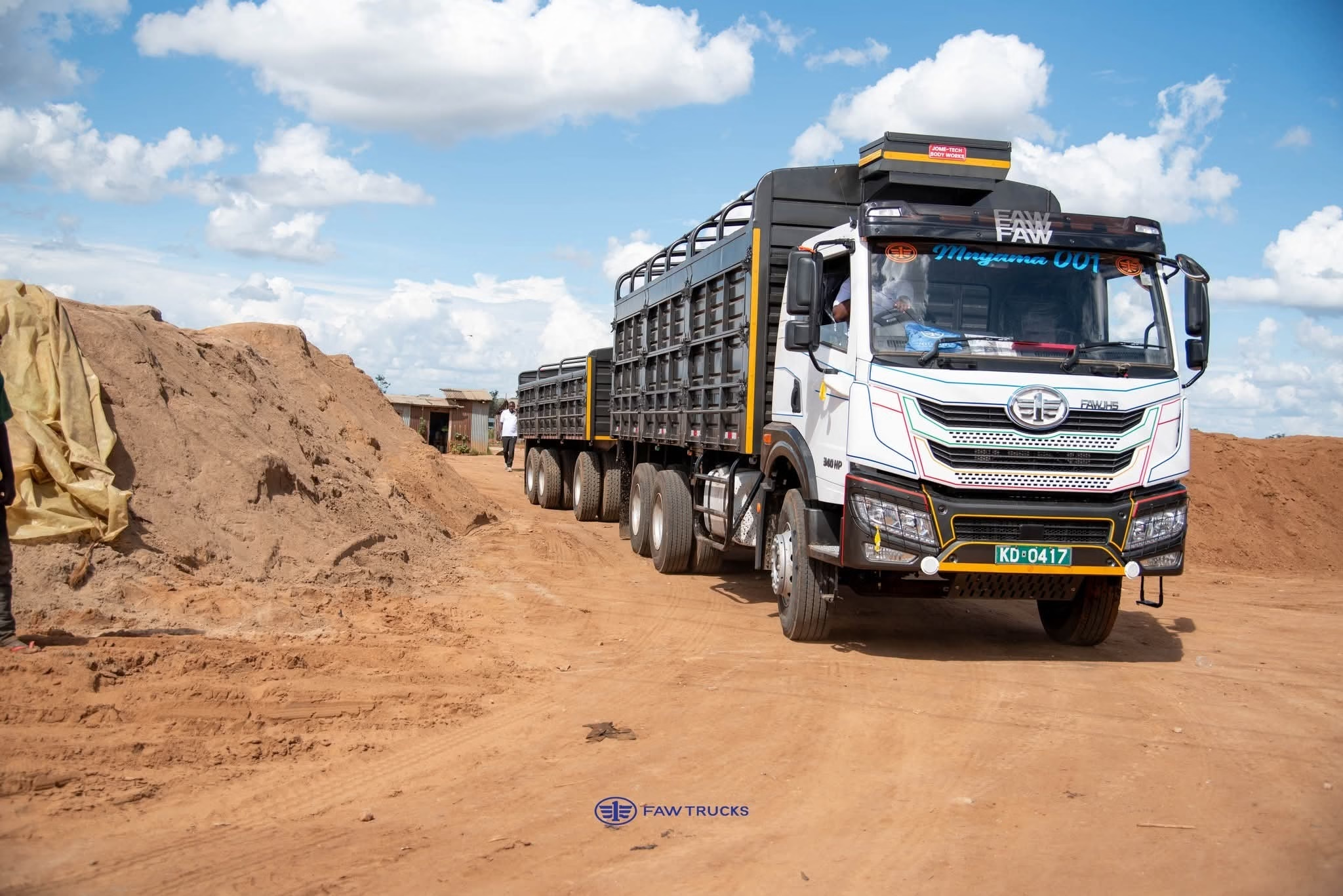
Overview
The FAW JK6 is a rising contender for the best sand-harvesting truck in Africa 2026, offering competitive pricing and improved reliability.
Engine & Performance Specs
- Engine: 6-cylinder turbo diesel.
- Power Output: ~240–280 HP.
- Transmission: Manual.
- GVW: 25,000 kg and 29,000 kg (25-29 tonnes).
Payload Capacity
- Typical payload: 20 tonnes.
Key Advantages
- Lower acquisition cost.
- Competitive payload capacity.
- Growing spare parts availability.
Limitations
- Perceived lower durability versus Japanese brands.
- Resale value is still developing.
Best Use Case
Best for cost-conscious contractors scaling operations who care more about work output rather than brand reputation.
Key Takeaway for Contractors
Japanese trucks dominate this segment due to reliability, while the FAW JK6 introduces cost efficiency into the market. Contractors seeking the best sand harvesting trucks for Africa increasingly combine these options to balance performance and affordability.
Category 2 – Best Trucks for Sand Transport (Bulk Hauling & Logistics)
Transport operations require high payload capacity, long-distance efficiency, and scalability. The best tipper trucks for sand transport operate under heavy loads across extended routes, often under demanding conditions.
1. SINOTRUK HOWO Series (336/371/A7/TX/NX)
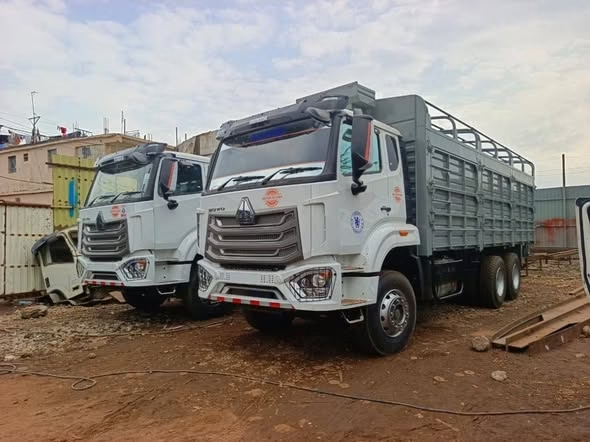
Overview
The HOWO Series dominates dump trucks for sand transport in Africa, widely used in large-scale hauling operations.
Engine & Performance Specs
- Engine: 6-cylinder turbo diesel.
- Power Output: 336–420 HP.
- Drivetrain: 6×4, 8×4.
Payload Capacity
- Typical payload: 25–40 tonnes.
Key Advantages
- High payload capacity.
- Affordable acquisition cost.
- Strong presence across Africa.
Limitations
- Higher maintenance frequency.
- Fuel consumption is higher under load.
Best Use Case
The Sinotruk HOWO series is an ideal choice for bulk sand transport and large fleet operations.
2. SHACMAN F3000
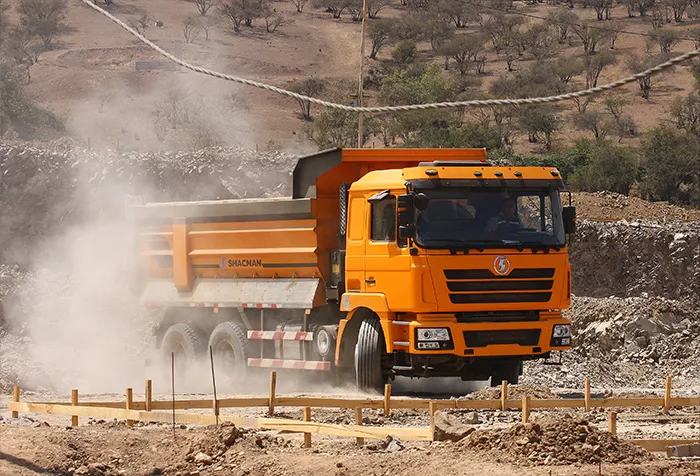
Overview
The SHACMAN F3000 offers durability and off-road strength, making it a top choice for heavy-duty sand hauling.
Engine & Performance Specs
- Engine: 6-cylinder diesel WP12.430E201 or WP12.430E22.
- Power Output: 340–400 HP.
- Drivetrain: 6×4/8×4.
Payload Capacity
- Typical payload: 30–40 tonnes.
Key Advantages
- Strong off-road capability.
- Durable chassis design.
- Reliable under heavy loads.
Limitations
- Moderate fuel efficiency.
- Requires structured maintenance.
Best Use Case
The best use case is for construction and mining transport routes across Africa, such as in Zambia and Gambia.
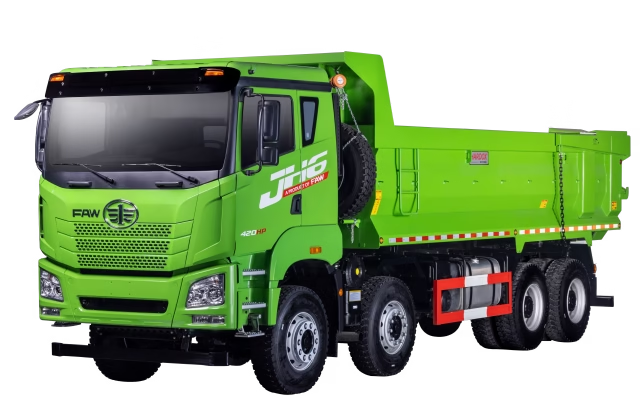
3. FAW J6/JH6
Overview
The FAW J6/JH6 series balances cost and performance, gaining traction across the construction equipment market in Africa.
Engine & Performance Specs
- Engine: 6-cylinder diesel.
- Power Output: 350–420 HP.
- Drivetrain: 6×4/8×4.
Payload Capacity
- Typical payload: 25–35 tonnes.
Key Advantages
- Competitive pricing.
- Balanced performance.
- Expanding support network.
Limitations
- Lower brand perception compared to premium OEMs.
- Variable resale value.
Best Use Case
FAW trucks are suitable for mixed-use transport operations.
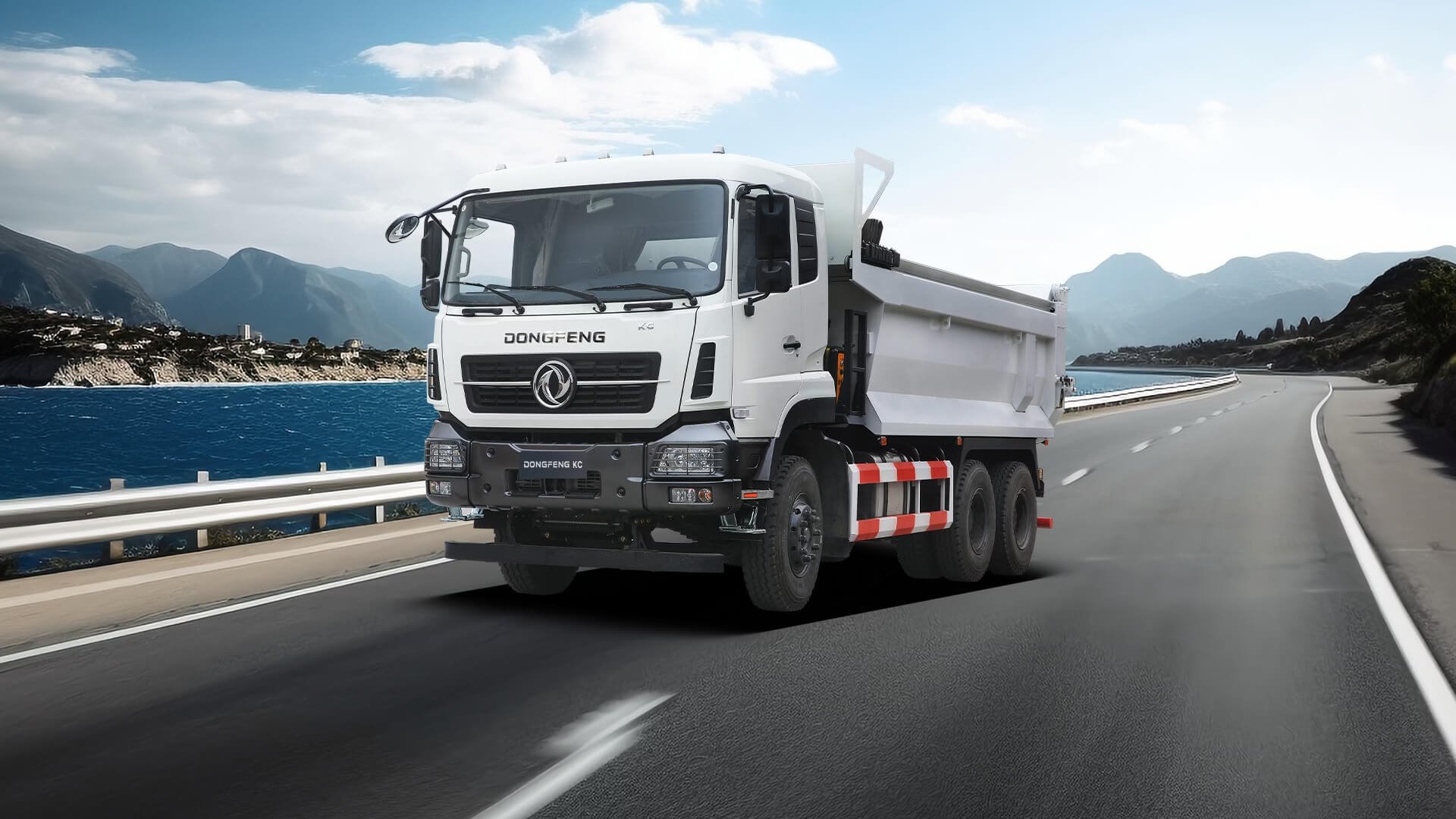
4. Dongfeng KC Series
Overview
The Dongfeng KC Series emphasises fuel efficiency, positioning it among the fuel-efficient sand transport trucks in Africa.
Engine & Performance Specs
- Engine: 6-cylinder diesel.
- Power Output: 300–385 HP.
Payload Capacity
- Typical payload: 25–35 tonnes.
Key Advantages
- Lower fuel consumption.
- Competitive pricing.
- Reliable logistics performance.
Limitations
- Less robust in extreme terrain.
- Moderate durability under overload.
Best Use Case
It is ideal for long-distance transport operations.
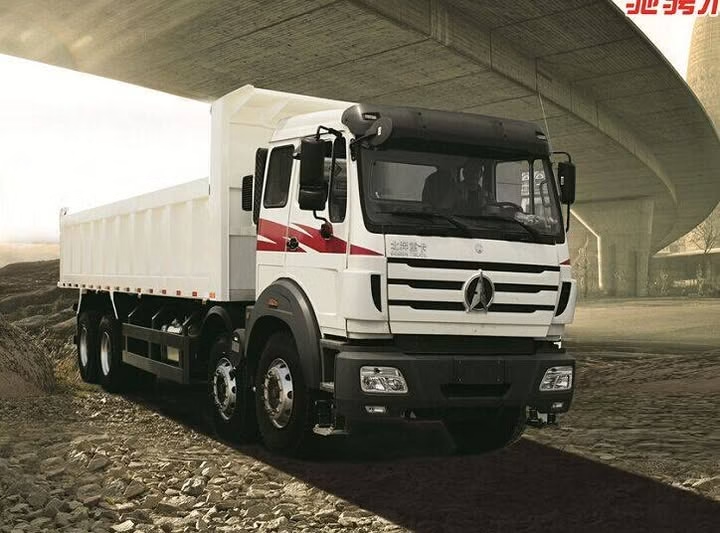
5. Beiben NG80
Overview
The Beiben NG80 delivers high-strength performance in extreme environments, ranking among the most durable sand-hauling trucks in Africa.
Engine & Performance Specs
- Engine: Weichai 6-cylinder diesel (Mercedes-Benz technology).
- Power Output: 340–420 HP.
- Transmission: Fuller 12JS200T.
- GVW: 40,000 kg (40 tonnes).
Payload Capacity
- Typical payload: 30–40 tonnes.
Key Advantages
- Exceptional durability.
- High load capacity.
- Strong performance in rugged terrain.
Limitations
- Higher maintenance cost.
- Limited availability in some markets.
Best Use Case
Beiben trucks are usually ideal for extreme terrain and high-load operations, such as in DRC.
Key Takeaway for Construction Investors
Chinese trucks dominate this segment due to the following:
- Lower acquisition costs.
- Higher payload capacity.
- Scalability for fleet operations.
These factors position them as the top sand transport trucks in Africa, particularly for large-scale logistics operations.
Further Reading: Financing Construction Equipment in Africa: 7 Proven Options
Category 3: Best Fleet Strategy (Contractors & Investors)
The best sand harvesting trucks for Africa do not operate as isolated assets. They function within integrated fleet systems designed to optimise productivity, reduce operational risk, and maximise returns on investment. Contractors and investors who treat fleet composition as a strategic decision consistently outperform those who rely on uniform or opportunistic equipment acquisition.
The reality across construction trucks in the sand harvesting segment is that profitability depends on aligning equipment capabilities with specific operational stages. Extraction and transport require fundamentally different performance characteristics. A single truck category cannot efficiently serve both roles without compromising cost efficiency and asset lifespan.
This is why leading operators across East, West, and Southern Africa adopt structured fleet strategies. These strategies reflect emerging trends in the construction equipment industry in Africa, where fleet optimisation, usage rates, and lifecycle cost management define competitive advantage.
The Proven Hybrid Fleet Model
The most effective strategy for deploying the best sand-harvesting trucks for Africa involves a hybrid fleet structure that separates extraction and transport functions. This model aligns equipment performance with operational demands, ensuring that each truck operates within its optimal efficiency range.
1. Extraction Fleet (Primary Harvesting Units)
These trucks operate in highly stressful environments, such as rivers and quarries, where manoeuvrability, traction, and durability take precedence over payload capacity.
- Isuzu FVZ / FVR.
- FAW JK6.
- Mitsubishi Fuso Fighter.
These models dominate sand-harvesting trucks in Africa because they provide the following:
- Better control on unstable terrain.
- Reduced risk of axle damage under uneven loading conditions.
- Lower fuel consumption during short-haul, high-frequency operations.
2. Transport Fleet (Bulk Hauling Units)
Transport trucks focus on high-volume, long-distance movement, often connecting extraction sites to urban construction markets.
- HOWO 371/A7.
- SHACMAN F3000.
- FAW J6.
These represent the top trucks for sand transport in Africa, offering:
- High payload capacity for fewer trips per volume delivered.
- Scalability for fleet expansion.
- Strong performance across long-haul logistics routes.
Why the Hybrid Model Works
The hybrid fleet structure directly addresses the inefficiencies that arise when contractors use a single truck category for all operations. It improves both operational performance and financial outcomes across the entire value chain.
- Optimises equipment utilisation: Extraction trucks operate in short cycles with frequent loading and unloading, while transport trucks focus on continuous long-distance hauling. Separating these functions ensures that each asset has a higher utilisation rate.
- Reduces wear and tear: Heavy-duty transport trucks experience accelerated degradation when used in river extraction environments. By assigning medium-duty trucks to harvesting, contractors extend the lifespan of high-value assets.
- Improves fuel efficiency: Fuel-efficient sand transport trucks in Africa perform best under steady load conditions on established routes. Using them in extraction environments increases fuel consumption without delivering proportional productivity gains.
- Enhances operational flexibility: Contractors can scale transport capacity independently of extraction capacity, enabling them to respond to demand fluctuations.
These advantages align with broader African construction industry trends, where contractors are increasingly prioritising operational efficiency over expanding fleet sizes.
Fleet Cost Structure and ROI Dynamics
Understanding the financial structure of a hybrid fleet is critical for maximising returns in Africa’s construction equipment market. Each truck category contributes differently to revenue generation and cost distribution.
Capital Allocation
- Medium-duty harvesting trucks require lower upfront investment.
- Heavy-duty transport trucks represent the largest capital expenditure.
- Hybrid fleets distribute capital across asset classes, reducing risk concentration.
Operating Costs
Operating costs for dump trucks for sand transport in Africa typically include the following:
- Fuel (30–40% of total operating cost).
- Maintenance and spare parts (10–20%).
- Driver wages and logistics coordination.
Medium-duty trucks generally incur lower fuel and maintenance costs, while heavy-duty trucks generate higher revenue per trip due to payload capacity.
Revenue Optimisation
Revenue depends on:
- Volume transported per day.
- Distance between the extraction site and the delivery location.
- Market price of sand per tonne.
Hybrid fleets maximise revenue by ensuring that high-capacity trucks operate under optimal conditions and deliver maximum payload efficiency.
Utilisation and Productivity Benchmarks
Fleet performance in the best sand-harvesting trucks in Africa depends heavily on utilisation rates. Underutilised trucks increase capital cost per tonne and reduce profitability.
Industry benchmarks across African markets show:
- High-performing fleets achieve utilisation rates that exceed 70%.
- Transportation trucks operate at a higher utilisation rate than extraction trucks.
- Downtime due to maintenance or logistics inefficiencies directly reduces ROI.
Contractors improve utilisation by:
- Implementing structured maintenance schedules.
- Optimising route planning for transport trucks.
- Organise loading and unloading operations to minimise idle time.
These practices reflect the latest trends in the construction equipment industry in Africa, where data-driven fleet management increasingly replaces manual coordination.
Risk Management in Fleet Strategy
Fleet investment carries inherent risks, particularly within the construction of trucks for the sand-harvesting sector. Contractors and investors must actively manage these risks to protect capital and maintain operational continuity.
Operational Risk
Equipment failure, poor maintenance, and operator error can disrupt operations. Contractors mitigate this risk through:
- Preventive maintenance programmes.
- Driver training and performance monitoring.
- Access to reliable spare parts networks.
Financial Risk
Currency fluctuations and financing costs affect acquisition and operating expenses. Contractors address this risk through the following:
- Diversifying funding sources.
- Prioritising cost-efficient equipment models.
- Structuring repayments to align with cash flow cycles.
Regulatory Risk
Axle load limits and licensing requirements vary across regions. Non-compliance results in fines and operational disruptions. Contractors mitigate this risk by selecting compliant truck configurations and adhering to local regulations.
Scaling Strategies for Contractors and Investors
Scaling operations within the best sand-harvesting trucks for the African market requires a phased approach that balances growth with financial discipline.
Phase 1: Entry-Level Operations
- Focus on 2–5 medium-duty harvesting trucks.
- Use subcontracted transport services where necessary.
Phase 2: Expansion
- Introduce heavy-duty transport trucks.
- Build a balanced hybrid fleet.
Phase 3: Full-Scale Operations
- Optimise fleet compositions based on demand patterns.
- Integrate logistics systems and route optimisation tools.
- Expand into multiple extraction and delivery sites.
This structured approach aligns with the top-trucks-for-sand-transport-in-Africa strategy, where scalability depends on efficient capital deployment rather than rapid fleet acquisition.
Investor Perspective: Capital Efficiency and Returns
From an investment standpoint, the best sand-harvesting trucks for Africa are income-generating assets within a broader infrastructure supply chain. Investors evaluate fleets based on predictable cash flow, asset durability, and market demand.
Hybrid fleets provide:
- Diversified revenue streams across extraction and transport.
- Reduced exposure to operational inefficiencies.
- Faster capital recovery due to higher utilisation rates.
Investors also consider secondary market value. Trucks with strong resale demand improve exit strategies and reduce long-term capital risk.
The construction equipment market in Africa continues to favour fleet models that balance reliability, cost efficiency, and scalability. This trend reinforces the importance of strategic fleet composition.
Further Reading: Used Chinese Tipper Truck Maintenance Checklist: 9 Valuable Steps
Cost vs Performance Comparison: Africa Market Reality
The best sand-harvesting trucks for Africa must be evaluated using a lifecycle cost-performance framework that reflects actual operating conditions across African markets. Contractors and investors increasingly prioritise total cost of ownership, fuel efficiency, maintenance intensity, and revenue output per tonne rather than acquisition cost alone. Within the construction trucks for the sand harvesting segment, three dominant truck categories define performance outcomes: Japanese medium-duty trucks, Chinese heavy-duty trucks, and hybrid-range trucks.
Across sand harvesting trucks in Africa, cost-performance efficiency directly correlates with operational alignment. Medium-duty trucks deliver superior performance in extraction environments due to lower mechanical stress and fuel consumption under short-cycle operations. Heavy-duty trucks dominate long-haul logistics due to their higher payload efficiency and lower cost per tonne/kilometre. Hybrid-range trucks offer operational flexibility but require structured deployment to avoid performance inefficiencies.
| Truck Category | Cost Range (USD) | Maintenance Profile | Fuel Efficiency | ROI Potential | Best Use Case |
| Japanese Medium Duty | 35,000–65,000 | Low | High | Stable long-term | Sand harvesting |
| Chinese Heavy Duty | 45,000–90,000 | Moderate | Moderate | High-volume | Transport |
| Hybrid Range | 40,000–70,000 | Moderate | Balanced | Flexible | Mixed operations |
Japanese trucks maintain dominance among the best sand-harvesting trucks in the Africa category due to predictable maintenance cycles and extended service life under repetitive loading. Heavy-duty Chinese dump trucks lead sand transportation in Africa through payload optimisation and scalability. Hybrid trucks such as the FAW series bridge operational gaps, particularly in mixed-use environments where contractors balance cost efficiency with flexibility.
Strategically, contractors must align the truck category with the operational role. Misalignment increases fuel consumption, accelerates wear, and reduces return on investment. Within the construction equipment market in Africa, this cost-performance framework determines fleet profitability and long-term sustainability.
Regional Insights on Sand Harvesting Trucks Across Africa
Regional dynamics play a decisive role in determining the deployment and performance of the best sand harvesting trucks for Africa, as operating environments vary significantly across the continent. Differences in terrain conditions, infrastructure quality, regulatory enforcement, and supply chain maturity directly influence fleet composition and performance outcomes for sand-harvesting trucks in Africa.
1. East Africa – Infrastructure-Led and River-Based Operations
East Africa, particularly Kenya and Tanzania, presents a structured but terrain-sensitive operating environment driven by ongoing infrastructure expansion and urban construction demand. Contractors in this region rely heavily on medium-duty Japanese trucks for extraction due to their durability, ease of maintenance, and strong dealer support networks. These trucks perform efficiently in riverbed environments, where soft soil conditions and repetitive loading cycles demand high reliability and manoeuvrability.
For transport operations, Chinese heavy-duty trucks such as HOWO and FAW dominate due to their lower acquisition cost and superior payload capacity. The region’s logistics patterns, characterised by short-to-medium-haul distances, favour a combination of extraction efficiency and scalable transport capacity. As a result, the best sand-harvesting trucks for East Africa typically form part of hybrid fleets that balance durability with cost efficiency.
2. West Africa – High-Volume, Cost-Driven Transport Demand
West Africa, particularly Nigeria and Ghana, reflects a high-demand environment driven by rapid urbanisation and large-scale construction. Within this region, contractors prioritise volumetric throughput and rapid capital recovery, leading to the widespread adoption of heavy-duty trucks for sand hauling. Chinese manufacturers dominate due to competitive pricing and accessibility across major markets.
However, infrastructure limitations, including poor road conditions and congestion, introduce higher mechanical stress and maintenance frequency. Trucks operating in this environment must maintain high utilisation rates while dealing with increased wear and tear. Consequently, dump trucks for sand transport in West Africa must balance payload capacity with durability under challenging operating conditions.
3. Southern Africa – Mature Market with Structured Fleet Systems
Southern Africa represents a more mature, regulated segment of the African construction equipment market, with structured fleet management practices and higher compliance standards. Countries like South Africa and Zambia have more stable business environments because they have better infrastructure and established dealer networks.
FAW and Beiben remain strong players thanks to regional integration and strong after-sales support. Mining logistics significantly influence demand patterns, particularly for high-capacity transport trucks capable of handling continuous heavy loads. Contractors in this region place greater emphasis on lifecycle costs, maintenance planning, and regulatory compliance, reflecting a more institutionalised approach to construction truck sand harvesting.
4. Continental Insight – Fleet Strategy Convergence
Despite regional differences, a consistent pattern defines the deployment of the top trucks for sand transport in Africa. Japanese medium-duty trucks dominate extraction due to their reliability and long service life, while Chinese heavy-duty trucks dominate transport due to their scalability and cost efficiency. Across the construction equipment market in Africa, hybrid fleet strategies that combine these strengths consistently deliver the highest operational efficiency and return on investment.
Common Mistakes Buyers and Contractors Must Avoid
Operational inefficiencies in construction trucks used for sand harvesting often stem from avoidable procurement and deployment errors. These errors directly affect utilisation rates, increase lifecycle costs, and reduce profitability for sand-harvesting trucks in Africa.
1. Using Heavy-Duty Trucks for Extraction
Heavy-duty trucks are made to drive long distances on flat surfaces. When contractors deploy them in riverbeds or quarries, the trucks experience excessive torsional stress, increased fuel consumption, and accelerated wear on suspension and chassis components. This misapplication reduces asset lifespan and undermines performance across sand-transport dump trucks in Africa, particularly in high-frequency loading environments.
2. Ignoring Spare Parts Availability
Fleet performance in the construction equipment market in Africa depends heavily on the availability of spare parts and maintenance support. Contractors who prioritise low acquisition costs over supply chain reliability often experience prolonged downtime. In high-utility operations, even short delays in parts replacement can significantly reduce daily output and revenue continuity. Reliable access to parts and service networks remains essential for maintaining productivity across sand-harvesting trucks in Africa.
3. Overloading Beyond Axle Limits
Overloading introduces both mechanical and regulatory risks that undermine long-term efficiency. Excessive loads accelerate structural fatigue, increase fuel consumption, and lead to frequent breakdowns. In addition, regulatory enforcement in several African markets continues to tighten, exposing operators to hefty fines and operational disruptions. This practice reduces the efficiency and durability of heavy-duty sand-hauling trucks, ultimately increasing the total cost of ownership.
4. Prioritising Purchase Price Over Lifecycle Cost
Selecting trucks based solely on acquisition cost remains one of the most critical strategic errors. Contractors must evaluate their total lifecycle performance, including fuel efficiency, maintenance frequency, utilisation rate, and resale value. The best sand harvesting trucks for Africa generate value through sustained operational performance rather than initial cost savings. Lifecycle cost analysis provides a more accurate basis for decision-making within the construction equipment market in Africa.
Future Trends in Sand Harvesting Trucks in Africa
The evolution of sand harvesting trucks in Africa reflects wider trends in the construction equipment industry, driven by cost efficiency, localisation, and technological advancement. These trends are reshaping procurement strategies and operational models across the sand-harvesting construction truck sector.
Expansion of Chinese Manufacturers Across Segments
Chinese tipper truck manufacturers continue to expand their presence across both the extraction and transport segments within the best sand-harvesting trucks for the African market. Their competitive advantage lies in lower acquisition costs, improved product quality, and integrated financing solutions. This expansion remains particularly evident in dump trucks for sand transport in Africa, where cost efficiency drives fleet-scale adoption.
Growth of Local Assembly and CKD Operations
Local assembly through CKD (Completely Knocked Down) models is transforming equipment supply chains across Africa. These operations reduce import duties, shorten delivery timelines, and strengthen after-sales support systems. As a result, contractors gain improved access to construction trucks for sand harvesting at more competitive price points, supporting broader growth within the construction equipment market in Africa.
Rising Demand for Fuel Efficiency
Fuel costs remain the largest operational expense for heavy-duty sand-hauling trucks, accounting for a significant share of total operating expenses. Contractors increasingly prioritise fuel efficiency through improved engine performance, optimised transmission systems, and better route planning. This shift drives demand for fuel-efficient sand transport trucks in Africa, particularly in high-volume logistics operations.
Technology Integration and Fleet Digitisation
Digital technologies have transformed fleet management for sand-harvesting trucks in Africa. Telematics systems enable real-time tracking of usage, fuel consumption, and maintenance requirements, while predictive maintenance reduces downtime and extends an asset’s lifespan. These systems support data-driven decision-making and improve operational control, aligning with global best practices in construction logistics.
Choosing the Best Sand Harvesting Trucks for Africa: Final Verdict
Selecting the best sand harvesting trucks for Africa requires a disciplined approach that aligns equipment capability with operational requirements and long-term investment objectives. Contractors must prioritise role-specific performance, whereas investors must evaluate capital efficiency and scalability.
For extraction-focused operations, medium-duty trucks such as Isuzu FVZ and FVR provide consistent reliability, durability, and cost efficiency. FAW JK6 offers a competitive alternative with lower acquisition costs and increasing adoption across African markets. These trucks remain central to efficient sand harvesting operations.
For transport-focused operations, heavy-duty trucks such as HOWO, SHACMAN, and FAW J6 deliver superior performance through high payload capacity and reduced cost per tonne transported. These models define the top sand transport trucks in Africa, particularly in high-demand markets where throughput volume determines profitability.
For investors, hybrid fleet strategies that combine Japanese reliability with Chinese scalability provide the most effective path to maximising utilisation rates, reducing operational risk, and improving the return on investment. This approach reflects the evolving dynamics of the construction equipment market in Africa, where strategic fleet composition increasingly determines long-term success.
Technical Snapshot: Fleet Economics for Sand Harvesting in Africa
This technical snapshot guides contractors, investors, and procurement officers to optimise sand harvesting and transport operations by balancing acquisition costs, operational efficiency, and total lifecycle economics.
1. Fleet Composition
- Extraction Fleet: Medium-duty trucks such as Isuzu FVZ/FVR, FAW JK6, and Mitsubishi Fuso Fighter. Operate in riverbeds, quarries, and rural access routes.
Key focuses: manoeuvrability, durability, and reliability.
- Transport Fleet: Heavy-duty trucks such as HOWO 371/A7, SHACMAN F3000, and FAW J6. Handle bulk hauling over long distances.
Key focus: payload capacity, fuel efficiency, and scalability.
- Optimal Ratio: ~40% extraction trucks/60% transport trucks.
2. Utilisation Benchmarks
- Minimum target: 75% fleet utilisation to maximise revenue and minimise idle costs.
- Operational Efficiency: Achieved via route optimisation, staggered scheduling, and predictive maintenance.
- Performance Impact: Telemetry-based fleet management can improve utilisation by 12–18%, boosting ROI.
3. Fuel Consumption & Cost Management
- Share of Total OPEX: 30–45% depending on truck class and route conditions.
- Medium-Duty Extraction Trucks: Lower fuel per kilometre but higher idle costs in riverbeds.
- Heavy-Duty Transport Trucks: Higher fuel per kilometre, but consistent road conditions yield efficiency.
- Savings Potential: Optimised driving, load management, and engine selection can reduce fuel expenditures by up to 15%.
4. Maintenance & Lifecycle Costs
- Annual Maintenance Benchmark: 10–20% of asset value, including servicing, wear part replacement, and repairs.
- Key Considerations: Robust suspension, spare part availability, and dealer support networks.
- Impact of Poor Maintenance: Can reduce truck lifespan by 20–25%, negatively affecting total ROI.
5. ROI & Payback Cycle
- Typical ROI: 24–48 months based on usage, region, and truck type.
- Medium-Duty Extraction Trucks: Lower acquisition cost, quicker breakeven.
- Heavy-Duty Transport Trucks: Higher upfront cost, higher revenue per tonne.
- Hybrid Fleet Advantage: Combining Japanese extraction trucks with Chinese transport trucks maximises ROI and fleet longevity.
6. Strategic Recommendations
- Align truck types with route and terrain characteristics.
- Implement predictive maintenance using telematics to reduce downtime.
- Prioritise fuel-efficient models and operator training.
- Evaluate the total cost of ownership rather than just the purchase price.
7. Key Metrics at a Glance
| Metric | Extraction Trucks | Transport Trucks | Notes |
| Average Payload | 10–16 tons | 20–35 tons | Dependent on the truck model |
| Fuel Efficiency | 4–6 km/l | 2–4 km/l | Route-dependent |
| Target Utilisation | ≥75% | ≥75% | Measured monthly |
| Maintenance Cost | 12–15% of asset value | 15–20% of asset value | Includes parts & service |
| ROI Period | 24–36 months | 36–48 months | Hybrid fleets optimise payback |
Further Reading: Best Equipment Financing Banks in Africa: 15 Trusted Banks
Conclusion: Strategic Direction for Sand Harvesting Trucks in Africa
The best sand-harvesting trucks for Africa go beyond equipment choice. They represent strategic decisions that determine operational efficiency, cost structure, and long-term profitability. Contractors whose truck selection aligns with terrain, workloads, and lifecycle costs consistently achieve higher usage rates and stronger returns. In Africa, the construction market continues to favour sand harvesting trucks, moving beyond hybrid fleet strategies that combine reliability in extraction with scalability in transport.
Looking ahead, capital allocations will increasingly prioritise efficiency, adaptability, and data-driven fleet management. Investors and contractors who integrate insights from trends in the construction equipment industry in Africa, adopt fuel-efficient sand transport trucks, and respond to evolving demand patterns will lead the next phase of growth. The best sand-harvesting trucks for Africa in 2026 will not only move material. They will define the economics of construction supply chains across the continent.
Explore and Build Smarter Equipment Strategies
Stay ahead with expert insights on the best construction machinery and equipment, including sand-harvesting trucks for Africa, fleet strategies, and market trends. Make smarter investment decisions with Construction Frontier.