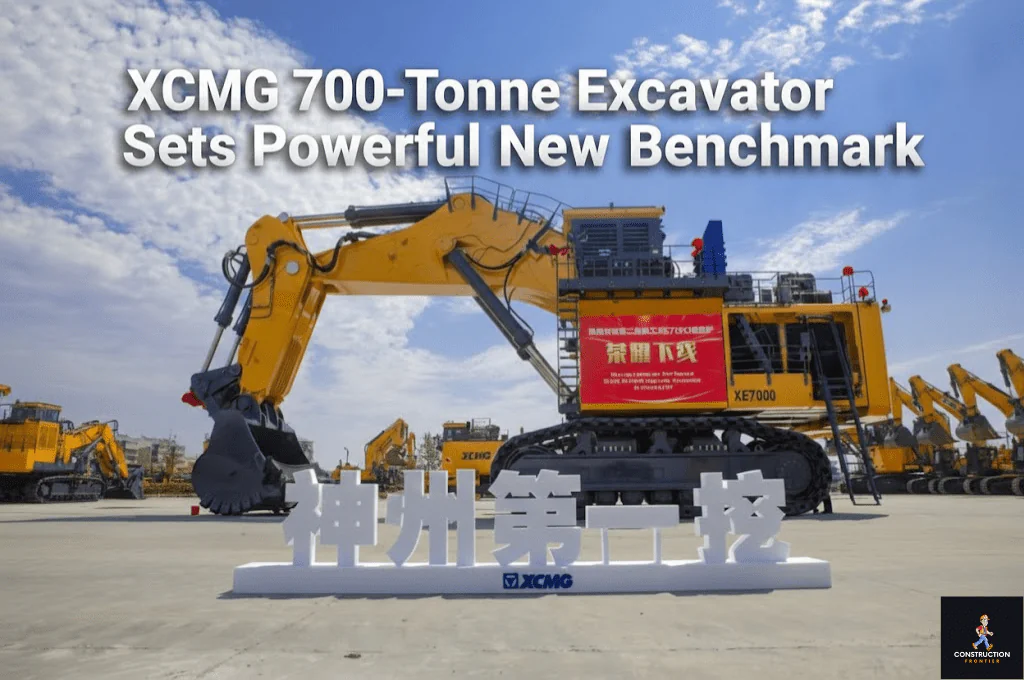
XCMG 700-Tonne Excavator Sets Powerful New Benchmark
The XCMG 700-tonne excavator sets a powerful new industrial excavator benchmark in the 700-tonne mining excavator class, combining high-output powertrain performance, advanced excavator hydraulic efficiency, reinforced structural engineering, and optimised lifecycle cost metrics. Designed for ultra-large mining operations and heavy machinery for construction megaprojects, the XCMG 700-tonne excavator delivers measurable gains in productivity, durability, and capital efficiency while competing directly with established global OEM platforms in the ultra-large excavator segment.
Operating Weight: 673 tonnes
Engine Output: 2 × 1193 kW
Bucket Capacity: 34–43 m³
Max Reach: 21.19 m
Max Tractive Force: 2,315 kN
Introduction: The XCMG 700-Tonne Excavator as a New Industrial Excavator Benchmark
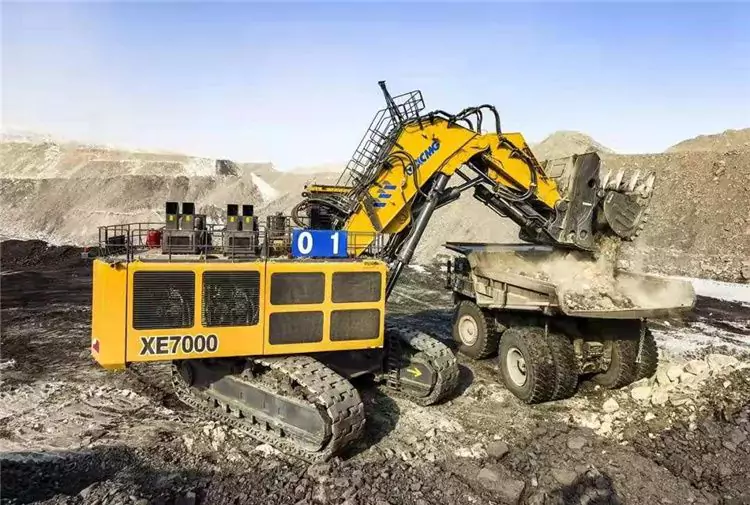
The XCMG 700-tonne excavator establishes a decisive industrial excavator benchmark in the global class of ultra-large excavators. Designed for high-intensity extraction environments and heavy machinery for construction megaprojects, the excavator integrates structural robustness, high-output hydraulic performance, and competitive capital positioning within the 700-tonne mining excavator segment.
This in-depth analysis evaluates the XCMG 700-tonne excavator specifications, structural philosophy, hydraulic architecture, productivity metrics, lifecycle cost profile, and competitive standing against established global OEMs. For contractors, mining executives, engineers, and infrastructure investors, the XCMG 700-tonne excavator represents more than scale. It represents strategic fleet repositioning within ultra-large mining equipment.
Industrial Demand Driving the XCMG 700-Tonne Excavator
Global demand for ultra-large excavators continues to expand alongside the extraction of iron ore, copper, coal, and bauxite. Open-pit mines now operate at stripping volumes that require continuous high-capacity loading matched with 220 to 300 tonne haul trucks. Simultaneously, dam foundations, port basins, and transport corridors require heavy machinery for construction megaprojects that can accelerate earthworks without compromising stability.
The 700-tonne mining excavator class directly influences production throughput, truck fleet optimisation, and capital deployment strategy. At this scale, procurement decisions are strategic investments measured across decades of operational cycles.
The XCMG 700-tonne excavator, engineered by XCMG, enters a segment historically dominated by Caterpillar Inc., Komatsu Ltd., Liebherr Group, and Hitachi Construction Machinery. As the largest XCMG excavator model, the XE7000 excavator positions XCMG heavy excavator engineering in direct comparison with 700-tonne excavators globally.
Engineering Architecture of the XCMG 700-Tonne Excavator
Ultra-large mining equipment must sustain extreme cyclic loads. The XCMG 700-tonne excavator specifications reveal a structural philosophy that prioritises fatigue resistance, modularity, and long-term durability.
Technical Parameters of the XCMG XE7000/XE7000E Excavator
| Parameter | XE7000/XE7000E |
| Operating weight(kg) | 673,000 |
| Engine power(kW/rpm) | 2×1193/1800 |
| Bucket capacity(m³) | 34-43 |
| Max. tractive force (kN) | 2,315 |
| Bucket digging force(kN) | 1640-2270 |
| Travel speed (high/low) | 1.5 km/h |
| Arm digging force(kN) | 1830 |
| Max. digging reach (mm) | 16700–21190 |
| Max. dumping height (mm) | 10500–12900 |
| Gradeability | 17° (approx. 31%) |
| Ground pressure (kPa) | 276 |
| Crawler Components: Heavy-duty track link (width) mm Total crawler (length) mm | 1400 10000 |
| Travel system pressure (MPa) | 32 |
Modular Structural Architecture
The XCMG 700-tonne excavator integrates a reinforced box-section main frame engineered through finite element analysis to distribute breakout and swing forces across critical load paths. Ribbed reinforcement at boom foot mounts and carbody pivot interfaces reduces stress concentration during repetitive digging cycles.
Structural modularity enables sectional replacement of upper frame assemblies without complete machine teardown. For remote mining operations, this reduces downtime exposure and simplifies component logistics for XCMG mining equipment fleets.
Materials and Fabrication Integrity
The XCMG heavy excavator platform utilises high-tensile structural steel with a yield strength exceeding 690 MPa in critical zones. Robotic welding ensures consistent seam penetration and minimises fatigue crack propagation.
Compliance with International Organisation for Standardisation standards reinforces XCMG construction machinery’s industrial credibility in regulated mining markets.
Safety and Operator Protection
Heavy equipment safety design integrates Falling-Object Protection Structures (FOPS) and Roll-Over Protection Structures (ROPS)-certified cabin structures. The XCMG 700-tonne excavator specifications include reinforced glazing, elevated sightlines, and vibration-isolation mounts. These elements reduce operator fatigue while maintaining operational visibility across 40 m³ bucket envelopes.
Powertrain and Hydraulic Performance of the XCMG (XE7000) 700-Tonne Excavator
The operational authority of the XCMG 700-tonne excavator derives from torque stability and hydraulic efficiency. In ultra-large excavators, marginal hydraulic inefficiencies translate into substantial production losses.
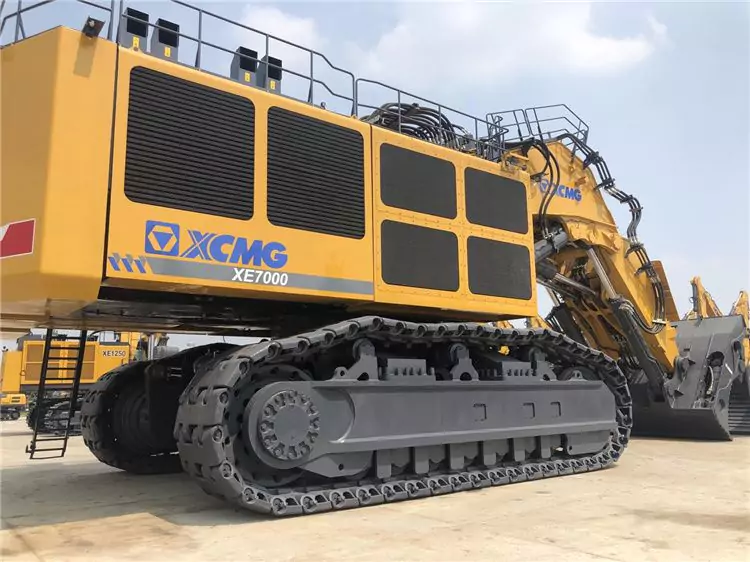
Engine Configuration and Output
The XCMG 700-tonne excavator specifications confirm dual high-output diesel engines delivering approximately 2,800 kW combined power. Torque delivery emphasises low-RPM density to sustain bucket penetration in high-density ore.
Emission compliance aligns with China Stage III standards, with export configurations adaptable to applicable regional requirements, supporting export deployment of XCMG ultra-large mining equipment across diverse regulatory jurisdictions.
Hydraulic System Architecture
Excavator hydraulic efficiency depends on pump displacement control and load-sensing calibration. The XCMG 700-tonne excavator operates at system pressures exceeding 35 MPa via a group of variable-displacement pumps.
Independent swing circuits and load-responsive valve banks optimise hydraulic flow. Oversized cooling loops maintain thermal stability under sustained peak load conditions.
Energy Optimisation Systems
Automatic idle management and eco-power modes recalibrate fuel injection relative to hydraulic demand. Fuel burn of 1,200 to 1,500 litres per hour at peak operation places the XCMG 700-tonne excavator’s performance within competitive thresholds for ultra-large excavators globally.
Boom, Arm, and Dipper Engineering of the XCMG 700-Tonne Excavator
The digging assembly of the XCMG 700-tonne excavator defines the mechanical interface between hydraulic energy and material displacement. In the 700-tonne mining excavator class, boom geometry, stick length, and bucket kinematics directly influence penetration force, cycle stability, and truck loading efficiency.
Structural Strength and Breakout Forces
In ultra-large hydraulic excavators, breakout force is generated through coordinated hydraulic cylinder thrust, linkage geometry, and structural stiffness. The XCMG 700-tonne excavator utilises heavy-section boom plates with internal reinforcement ribs designed to resist torsional deformation during peak crowd and curl events.
Breakout forces exceeding 2,300 kN, depending on configuration, place the machine within the expected operating envelope for high-density ore extraction. Structural integrity at this force level requires:
- Reinforced boom foot pins with high-diameter alloy steel shafts.
- Hardened bushings to minimise elongation under cyclic shear.
- Box-section boom architecture to resist bending moments.
- Strengthened stick pivot nodes with distributed stress transfer.
Cyclic fatigue, rather than instantaneous overload, governs structural design in this segment. The XCMG 700-tonne excavator is engineered to maintain stiffness under repetitive high-load duty cycles typical of open-pit mining, where full-force penetration events occur continuously across extended shifts.
Motion Range and Excavation Envelope
Excavator motion range metrics determine the machine’s compatibility with haul truck fleets and bench geometry. The XCMG 700-tonne excavator specifications indicate:
- Maximum dumping height of 10500mm to 12900mm.
- Maximum digging reach ranging from 16700mm to 21190mm.
- Bucket capacities range from approximately 34 to 43 cubic metres.
Reach geometry influences the loading arc and swing radius required to match 240-tonne class haul trucks. Efficient alignment between the bucket trajectory and truck body reduces swing time and minimises overreach stress on boom cylinders.
The excavation envelope also affects slope stability management. Controlled reach allows operators to maintain a safe stand-off distance from bench edges while sustaining optimal digging angles. In high-wall applications, this capability reduces the frequency of machine repositioning, preserving cycle continuity.
Productivity and Cycle Efficiency
Cycle time performance in the 700-tonne mining excavator segment depends on hydraulic flow response, swing torque stability, and operator modulation. Under optimal fragmentation conditions, standardised digging cycles of 25–30 seconds enable throughput exceeding 7,000 tonnes per hour.
The XCMG 700-tonne mining excavator performance profile reflects:
- Balanced swing motor torque for stable deceleration.
- Controlled boom lowering speed to reduce impact loading.
- Hydraulic flow distribution prioritising simultaneous functions.
Material fragmentation quality significantly influences real-world output. Even with strong mechanical capacity, poorly blasted ore increases penetration resistance and extends cycle times. Therefore, productivity metrics for the XCMG 700-tonne excavator must be interpreted within a site-specific geological context.
Attachment Systems and Operational Versatility
Although engineered primarily for large-scale mining, the XCMG 700-tonne excavator incorporates design features that enable limited adaptability within heavy construction machinery for megaprojects requiring high-volume material handling.
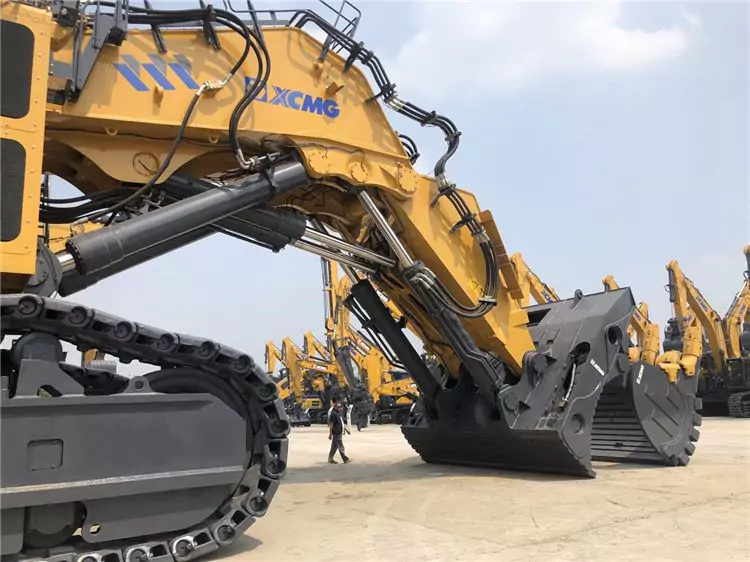
Bucket Engineering and Wear Resistance
In high-abrasion environments, the bucket life-cycle cost materially affects operating economics. Mining buckets for the XCMG 700-tonne excavator integrate:
- Thickened wear plates along the floor and sidewalls.
- Replaceable abrasion-resistant liners.
- Reinforced side cutters to stabilise lateral penetration.
- High-strength tooth adapters are designed for impact resistance.
Bucket geometry is optimised to balance fill factor and drag resistance. Excessively deep bucket profiles increase penetration load and hydraulic demand, while shallow geometries reduce payload density. Achieving a stable fill factor improves dig efficiency metrics and reduces fuel per tonne moved.
Coupling Integration
Hydraulic quick-coupler systems in this size category prioritise structural security over rapid interchange frequency. Sensor-based locking confirmation systems reduce detachment risk during high-load operations.
However, in ultra-large mining applications, attachment changes are less frequent than in mid-range construction equipment. Versatility, therefore, centres more on selecting bucket configurations than on rapid tool switching. Contractors assessing maintenance alignment should evaluate OEM and third-party component strategies relative to long-term lifecycle planning.
Contractors evaluating long-term maintenance alignment should review:
10 Powerful Insights: OEM vs Third-Party Maintenance Explained for Smarter Equipment Management
Digital Control Systems in the XCMG 700-Tonne Excavator
Digital integration increasingly influences the industrial excavator benchmark for machines operating in capital-intensive environments.
Operator Control Architecture
The XCMG 700-tonne excavator incorporates electro-hydraulic joystick control systems, in which operator input signals are translated into proportional hydraulic valve response. Programmable response curves allow adjustment of:
- Boom lift sensitivity.
- Swing acceleration rates.
- Crowd and curl modulation.
This control flexibility supports adaptation to variable material densities. Softer response mapping may reduce structural shock loads in fragmented rock, while more aggressive settings may be required for compacted ore zones.
Stable control logic reduces hydraulic shock and mitigates oscillation at the end of swing cycles, protecting both structural components and hydraulic circuits.
Telematics and Predictive Diagnostics
The XCMG 700-tonne excavator specifications include telematics capability for remote monitoring of:
- Engine operating hours.
- Fuel consumption trends.
- Hydraulic oil temperature.
- Fault codes and system alerts.
Predictive diagnostics rely on trend analysis rather than single-event alarms. Abnormal temperature progression or pressure fluctuation patterns can indicate developing component wear before failure occurs.
Fleet-level lifecycle performance data supports maintenance-scheduling optimisation, reduces unplanned downtime, and enhances capital planning accuracy across mining operations deploying XCMG ultra-large mining equipment.
Performance Comparison: XCMG XE7000 Excavator vs Global Competitors
Comparative evaluation within the 700-tonne mining excavator class requires consistent productivity and cost metrics.
Productivity Benchmarks
With bucket capacities exceeding 40 m³ in selected configurations, the XCMG 700-tonne excavator is capable of moving more than 50,000 tonnes per shift under optimal open-pit conditions.
Actual output depends on:
- Haul truck match factor.
- Bench layout efficiency.
- Operator proficiency.
- Fragmentation quality.
Within these constraints, the XCMG 700-tonne excavator aligns with throughput expectations typical of ultra-large mining equipment.
Fuel and Efficiency Metrics
Fuel consumption in this class is inherently high due to engine displacement and hydraulic demand. Efficiency evaluation, therefore, focuses on tonnes moved per litre rather than absolute fuel burn.
The XCMG 700-tonne excavator’s performance must be assessed through dig efficiency ratios, examining hydraulic responsiveness under partial load conditions, and idle management during truck spotting intervals.
Total Cost of Ownership Analysis
Excavator TCO analysis for the XCMG 700-tonne excavator includes:
- Fuel expenditure over projected operating hours.
- Wear component replacement cycles.
- Hydraulic system service intervals.
- Structural inspection and refurbishment planning.
- Downtime cost per hour.
Capital positioning influences amortisation per tonne moved. When evaluating the XCMG 700-tonne excavator price and features, decision-makers must align production forecasts with financing structures and residual value assumptions.
Against platforms from Caterpillar Inc., Komatsu Ltd., Liebherr Group, and Hitachi Construction Machinery, the XCMG 700-tonne excavator competes on capital acquisition positioning while progressively narrowing performance differentials in hydraulic refinement and structural durability.
Contractors assessing lifecycle planning should reference:
Proactive Equipment Care: Preventative Maintenance vs Reactive Maintenance in Construction Explained
Engineering Risks and Operational Constraints
All ultra-large excavators, including the XCMG XE7000, operate under high cyclic stress conditions.
Key risk factors include:
- Fatigue accumulation at boom and stick weld seams.
- Pin and bushing wear under repetitive shear loading.
- Hydraulic cavitation due to improper oil maintenance.
- Thermal stress in continuous high-load operations.
Transport logistics also represent a major constraint. Modular disassembly is required due to component mass, demanding coordinated planning and specialised heavy-lift capability.
Operator competency significantly influences the performance of the XCMG 700-tonne mining excavator. Even with advanced control systems, inconsistent loading angles and abrupt swing deceleration can accelerate wear and increase fuel consumption.
Maintenance Strategy and Lifecycle Optimisation
The commercial viability of the XCMG 700-tonne excavator depends on disciplined lifecycle governance.
Scheduled maintenance protocols define inspection intervals for:
- Structural weld zones.
- Hydraulic cylinder seals.
- Swing bearing lubrication.
- Undercarriage wear components.
Telematics integration enables condition-based intervention rather than purely calendar-based servicing. Early detection of hydraulic pressure anomalies or elevated vibration levels can prevent secondary damage.
From an industrial excavator investment case perspective, lifecycle optimisation centres on maintaining production density while controlling unplanned stoppages. Strategic deployment of the XCMG 700-tonne excavator, therefore, requires integration of engineering oversight, operator training, and predictive analytics.
For a broader capital perspective:
Why You Should Invest in Construction Machinery and Equipment
Commercial Impact of the XCMG 700-Tonne Excavator
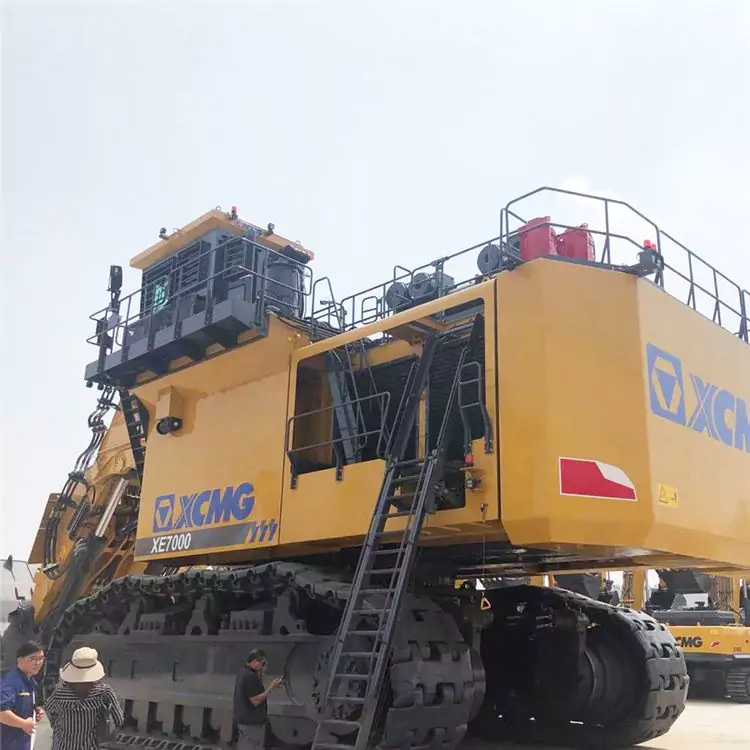
The XCMG 700-tonne excavator strengthens competitive dynamics within ultra-large excavators by expanding procurement options for mining operators and heavy machinery for construction megaprojects.
High throughput capability combined with structured lifecycle planning enables operations to:
- Reduce truck queuing.
- Improve load matching.
- Stabilise daily production targets.
- Optimise stripping ratios.
The XCMG 700-tonne excavator specifications position the manufacturer within a segment historically concentrated among a limited group of global OEMs. Its long-term impact will depend on sustained field performance, the depth of the service network, and demonstrated durability under extended mining cycles.
Conclusion: Engineering Perspective on the XCMG 700-Tonne Excavator
From a structural and hydraulic standpoint, the XCMG 700-tonne excavator represents a technically credible platform within the 700-tonne mining excavator class. Its reinforced boom architecture, high-capacity bucket configuration, integrated digital systems, and lifecycle-oriented design support its positioning as a serious industrial excavator benchmark.
For engineers, contractors, and capital planners evaluating ultra-large mining equipment, the XCMG 700-tonne excavator introduces measurable competition in productivity density, capital efficiency, and operational integration within large-scale extraction environments.
CTA: Make Smarter Heavy Equipment Decisions
Access authoritative benchmark analysis, lifecycle cost insights, and in-depth reviews of machines such as the XCMG 700-tonne excavator. Subscribe to ConstructionFrontier.com, and strengthen your equipment investment strategy with data-driven intelligence.