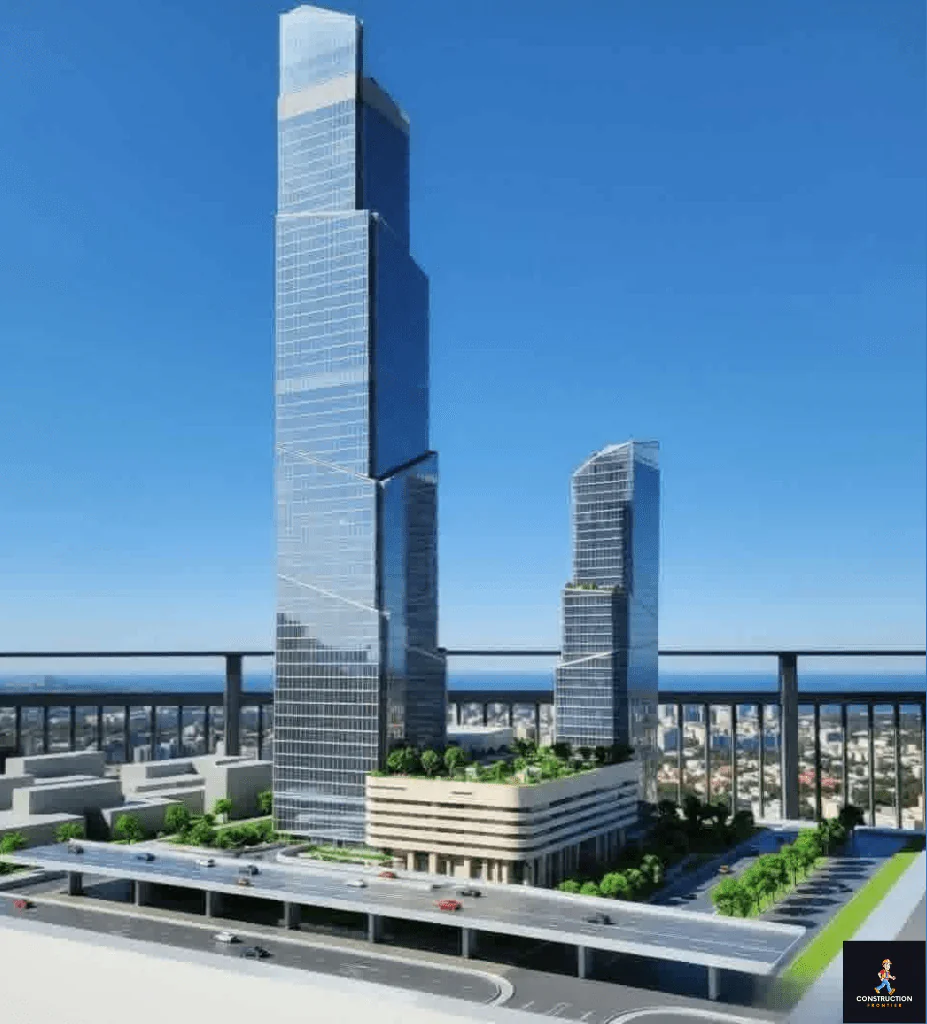
NSSF 60-Storey Skyscraper: Monumental Twin Towers Project
The NSSF 60-storey skyscraper (Tower A) and 35-storey (Tower B) in Nairobi represent East and Central Africa’s tallest confirmed high-rise development. Located at Kenyatta Avenue and Uhuru Highway junction in Nairobi CBD, the project is a KSh 30 billion (USD 232.5 million) mixed-use complex including offices, a luxury hotel, serviced apartments, and a 56th-floor public observation deck. The development will occupy a 3.88-acre site and is expected to be completed in 24 months. The main contractor is China Road and Bridge Corporation (CRBC).
NSSF 60-storey skyscraper: Technical Snapshot
| Parameter | Details |
| Tower A | 60 floors, ~260 m |
| Tower B | 35 floors, ~140 m |
| Project Cost | KSh 30 billion (USD 232.5 million) |
| Site Area | 3.88 acres |
| Location | Nairobi CBD, Kenyatta Avenue/Uhuru Highway |
| Use | Mixed-use (office, hotel, serviced apartments, parking) |
| Parking Capacity | 1,150+ cars |
| Observation Deck | 56th floor, Tower A |
| Contractor | China Road and Bridge Corporation (CRBC) |
| Proposed Timeline | 24 months |
| Status | EIA submitted |
Introduction: Institutional Capital Meets Vertical Urbanisation in NSSF 60-Storey Skyscraper in Nairobi
The NSSF 60-storey skyscraper Twin Towers project is among the largest high-rise developments publicly confirmed in Kenya. Tower A, at approximately 260 metres, will surpass the Britam Tower and Global Trade Centre Tower to become the tallest building in East and Central Africa. Tower B complements the primary tower with 35 floors (~140 m), integrating additional office, residential, and hospitality spaces.
Located at the Kenyatta Avenue and Uhuru Highway junction in the heart of the Nairobi CBD, the project exemplifies vertical urban densification, maximizing limited CBD land for high-yield mixed-use development.

Key strategic points:
- Institutional asset allocation by the National Social and Security Fund (NSSF) into high-density, income-generating real estate.
- Delivery of Nairobi’s tallest building, setting a regional benchmark.
- Integration of mixed-use functions: offices, serviced apartments, a luxury hotel, and parking.
- Public accessibility via the 56th-floor observation deck.
Strategic Rationale Behind the NSSF 60-Storey Skyscraper in Nairobi
The NSSF 60-storey skyscraper is more than an architectural landmark; it represents a strategic institutional capital deployment within Nairobi’s CBD. By developing a twin-tower complex comprising 60- and 35-floor towers, NSSF aligns with national urbanisation trends, institutional investment goals, and high-density commercial real estate demand.
Nairobi’s Verticalisation Trend
Nairobi’s commercial real estate market has historically favoured horizontal expansion, with mid-rise developments concentrated in Upper Hill, Westlands, and surrounding nodes. The proposed NSSF skyscraper in Nairobi signals a paradigm shift towards vertical urban densification due to:
- Land Scarcity in the CBD: Prime parcels in Nairobi’s CBD are increasingly limited. The 3.88-acre NSSF Twin Towers site exemplifies a high-value constrained urban plot ideal for vertical development.
- Commercial Clustering Benefits: Vertical mixed-use projects improve tenant accessibility and reduce commuting inefficiencies, offering agglomeration benefits for multinational companies and regional headquarters.
- Benchmarking against Existing High-Rises: The NSSF 60-storey skyscraper project will eclipse existing structures:
- Britam Tower: 200 m, 32 floors.
- Global Trade Centre Tower: 184 m, 42 floors.
This scale introduces new engineering benchmarks for East Africa, requiring advanced structural, geotechnical, and vertical transport solutions.
Institutional Capital Strategy
The NSSF 60-storey skyscraper in Kenya project exemplifies how pension fund capital can be strategically deployed into tangible assets:
- Asset-Liability Matching: Long-duration real estate income aligns with pension obligations.
- Portfolio Diversification: Beyond equities and bonds, mega-scale commercial property provides tangible value, rental income, and potential capital appreciation.
- Stability & Inflation Hedge: High-quality CBD office and hospitality assets offer resilient income in volatile markets.
By committing KSh 30 billion to the twin towers, NSSF demonstrates institutional confidence in Nairobi’s high-rise commercial sector.
Alignment with National Policy
The NSSF Twin Towers support Kenya’s broader urban and economic strategies:
- Kenya Vision 2030: Supports urban modernisation, investment-grade infrastructure, and economic competitiveness.
- CBD Revitalisation: Encourages vertical densification, enhanced skyline aesthetics, and mixed-use infrastructure.
- Urban Land Use Planning: Maximises land efficiency while integrating parking, hotels, serviced apartments, and a public observation deck.
Technical and Structural Scope of the NSSF 60-Storey Skyscraper
The NSSF 60-storey skyscraper project represents a major leap in East African high-rise construction. Tower A will reach approximately 260 metres across 60 floors, making it the tallest building in East and Central Africa, while Tower B will complement the site with 35 floors (~140 metres). The NSSF 60-storey skyscraper Kenya project details reflect a fully integrated mixed-use development, including premium offices, a luxury business hotel, serviced apartments, parking, and a public observation deck on the 56th floor.
Core Specifications
| Parameter | Tower A | Tower B |
| Floors | 60 | 35 |
| Height | ~260 m | ~140 m |
| Use | Mixed-use: offices, hotel, serviced apartments | Offices, hotel support |
| Parking | Integrated silo for 1,150+ cars | Shared parking |
| Observation Deck | 56th floor | N/A |
| Developer | NSSF | NSSF |
| Contractor | China Road and Bridge Corporation (CRBC) | China Road and Bridge Corporation (CRBC) |
The mixed-use program demands a high-capacity vertical transport system, integrated MEP (mechanical, electrical, plumbing) services, and reinforced structural engineering suitable for Nairobi’s volcanic and black cotton soils.
Structural Engineering Considerations
Although detailed design is not publicly disclosed, standard practices for a 260-metre high-rise indicate:
- Lateral Load Resistance: Reinforced concrete core with composite framing; possible outrigger systems or belt trusses to minimise building drift. Wind tunnel testing is critical due to Nairobi’s urban turbulence.
- Floor Systems: Post-tensioned concrete slabs or composite steel decks to minimise floor thickness and weight. Vibration control is essential for mixed-use occupancy, particularly luxury hotel floors and observation decks.
- Seismic & Wind Considerations: Nairobi lies in a low-to-moderate seismic zone; designs incorporate ultimate limit-state checks and comply with wind load requirements per ISO 4354 and local building codes.
Foundation & Geotechnical Engineering
The NSSF Twin Towers will require robust foundation systems:
- Deep pile foundations or piled raft systems to transfer Tower A’s axial loads to competent strata.
- Settlement mitigation strategies to prevent differential settlement between the 60-storey and 35-storey towers.
- Groundwater management and waterproofing are required due to proximity to utilities and dense urban infrastructure.
- Construction sequencing to minimise impact on adjacent properties, traffic, and existing urban utilities.
Material Selection Strategy
Material strategy ensures durability, sustainability, and structural efficiency:
- High-Strength Concrete: For cores and slabs to withstand vertical loads.
- Structural Steel Reinforcement: Per regional availability and international standards.
- Façade System: Unitised curtain wall or stick system resistant to Nairobi’s urban pollution, UV exposure, and wind loads.
- MEP Integration: Advanced vertical shafts for HVAC, water, electricity, and fire safety systems.
Efficient materials coordination is essential given Tower A’s mixed-use nature (offices, hotel, observation deck).
Preliminary Construction Engineering Challenges
The scale of the NSSF 60-storey skyscraper in Kenya project introduces significant challenges:
- Logistics: Transport and staging of large materials in Nairobi CBD’s limited space.
- Vertical Transport: High-capacity elevators and service lifts for offices, hotels, and observation decks.
- MEP Coordination: Complex integration across mixed-use floors.
- Foundation Risk: Piling over variable soils without disturbing neighbouring structures.
Construction Methodology and Equipment Strategy for the NSSF 60-Storey Skyscraper
Delivering the NSSF 60-storey skyscraper project alongside Tower B, a 35-storey building in Nairobi’s CBD, requires advanced high-rise construction strategies, meticulous sequencing, and specialised equipment. The NSSF Nairobi skyscraper construction timeline is planned over 24 months, leveraging the China Road and Bridge Corporation’s (CRBC) international expertise, adapted to local urban conditions.

Phasing and Programme
The construction programme is divided into sequential phases:
- Site Mobilisation & Enabling Works
- Site clearance, temporary access roads, and utility relocation.
- Groundwater management, soil stabilisation, and site safety preparation.
- Foundation Works
- Installation of deep bored piles or piled raft systems for both towers.
- Continuous monitoring for settlement and adjacent property safety.
- Superstructure Erection
- Climbing formwork systems for Tower A’s reinforced concrete core.
- Optimisation of floor cycle time to maintain vertical construction rhythm.
- Integration of post-tensioned concrete slabs or composite steel decks.
- Façade Installation
- Unitised curtain wall panels installed floor-by-floor.
- Coordination with vertical MEP shafts to prevent clashes and ensure efficiency.
- MEP Systems Integration
- Simultaneous vertical installation of HVAC, plumbing, electrical, and fire safety systems.
- Coordination across office, hotel, and observation deck floors for operational reliability.
- Final Fit-Out & Commissioning
- Interior fit-out for a luxury hotel and serviced apartments.
- Public observation deck systems finalised, including elevators, safety barriers, and lighting.
High-Rise Delivery Systems
Efficient delivery in a congested CBD depends on strategic equipment deployment:
| System | Purpose | Notes |
| Climbing Formwork | Core walls | Allows continuous vertical cycle without crane dependency |
| Tower Cranes | Material lifting | Multiple cranes for simultaneous Tower A & B operations, partially internal to cores |
| Concrete Pumping | Floor slab pours | High-capacity pumps reaching 260 m; precise scheduling is critical |
| Just-in-Time Material Logistics | Reduce site congestion | Ensures timely delivery in a limited urban staging area |
| Vertical Transport & Hoists | Construction personnel & materials | Separate hoists for Tower A, Tower B, and service/MEP shafts |
China Road and Bridge Corporation’s (CRBC) experience ensures efficient crane layout, concrete delivery, and formwork sequencing tailored to Nairobi’s high-density urban environment.
Digital Construction & BIM Integration
The NSSF 60-storey skyscraper in Kenya relies heavily on digital construction tools:
- BIM Level 2/3 Integration:
- 3D modelling for clash detection across structural, MEP, and façade systems.
- Real-time progress tracking and visualisation for stakeholders.
- 4D Scheduling:
- Construction sequences linked to the project timeline.
- Simulates core jump rates, façade installation, and MEP integration to avoid bottlenecks.
- Digital Procurement & Logistics Coordination:
- Tracks high-strength concrete pours, steel deliveries, and curtain wall fabrication.
- Enables on-schedule construction despite constraints in the Nairobi CBD.
This digital approach reduces delays, improves cost predictability, and allows advanced risk mitigation for East Africa’s tallest high-rise.
Further Reading: Why BIM (Building Information Modelling) Matters in Africa: An Essential Guide to Smarter Construction
Construction Challenges & Risk Mitigation
Despite CRBC’s expertise, several construction challenges are anticipated:
- Urban Constraints: Limited staging space and heavy traffic on Kenyatta Avenue and Uhuru Highway.
- Material Handling: Lifting large steel elements and concrete to 260 m requires precise planning and redundancies.
- MEP Coordination: Integration across office, hotel, and observation deck floors increases complexity.
- Safety & Compliance: Ensuring compliance with high-rise construction safety, fire regulations, and crane operation standards is critical.
Mitigation Strategies:
- Use of modular prefabrication where possible.
- Employ just-in-time delivery for critical materials.
- Leverage BIM for pre-construction simulations to avoid clashes and sequencing issues.
Contractors and Stakeholder Ecosystem for the NSSF 60-Storey Skyscraper
The NSSF 60-storey skyscraper project represents a complex collaboration between an institutional developer, international contractors, and local partners, ensuring technical excellence, governance, and delivery quality in Nairobi’s CBD. Understanding the stakeholder ecosystem is critical for evaluating project execution, risk management, and urban integration.
Main Contractor & Engineering Partners
Main Contractor:
- China Road and Bridge Corporation (CRBC) is responsible for delivering both Tower A (~260 m, 60 floors) and Tower B (~140 m, 35 floors).
- CRBC brings proven experience in mega high-rise projects across Africa, such as the Nairobi expressway and the Mombasa-Nairobi SGR, and in Asia, applying advanced construction techniques in dense urban environments.
Key Engineering Roles:
- Structural Engineering: Designs reinforced concrete cores, composite framing, lateral load resistance systems, and foundations suitable for Nairobi volcanic soils.
- MEP Consultancy: Coordinates electrical, HVAC, plumbing, fire protection, and data systems integration across mixed-use floors.
- Façade Consultancy: Advises on unitised curtain wall performance, installation sequencing, and long-term durability under urban pollution and UV exposure.
- Project Management Consultancy: Oversees sequencing, schedule adherence, cost control, and quality assurance across the twin towers.
The collaboration ensures that all structural, mechanical, and façade systems are fully integrated, optimising safety, efficiency, and functionality in a high-density CBD context.
NSSF as Institutional Developer
The National Social Security Fund (NSSF) is the institutional developer overseeing the NSSF 60-storey skyscraper project:
- Allocates KSh 30 billion of pension fund capital into a landmark high-rise asset.
- Approves design specifications, monitors construction progress, and ensures compliance with fiduciary and public accountability standards.
- Provides governance benchmarks for institutional-backed high-rise projects, with rigorous cost oversight and long-term yield management.
Through NSSF’s leadership, the project signals confidence in Nairobi’s CBD as a high-potential investment destination and demonstrates best practices in institutional project governance.
Local Contractor and Subcontractor Participation
Local subcontractors play a critical role in the NSSF Nairobi skyscraper construction timeline:
- Participate in civil works, finishing, landscaping, and MEP support.
- Facilitate knowledge transfer and capacity building within Kenya’s construction sector.
- Support CRBC’s integration model, sourcing concrete, steel, and façade support locally to optimise logistics and compliance with regional quality standards.
This approach strengthens local employment, enhances technical skillsets, and ensures sustainable industry development alongside international expertise.
Governance and Procurement Framework
Delivering a mega-project like the NSSF 60-storey skyscraper requires robust governance and transparent procurement mechanisms:
- Procurement Transparency: Selection of CRBC followed international tender standards; milestone-based contracts reduce performance and budget risks.
- Regulatory Compliance: Submission of the Environmental Impact Assessment (EIA) to the National Environment Management Authority (NEMA) and approvals from Nairobi County ensure alignment with zoning, building codes, and urban infrastructure requirements.
- Oversight Mechanisms: NSSF maintains internal monitoring teams and engages external auditors to ensure accountability and compliance with fiduciary responsibilities.
Risk Implications for Stakeholders
| Stakeholder | Key Considerations | Mitigation Measures |
| Developer (NSSF) | Institutional capital deployment, cost control, and governance | Regular audits, milestone-based payments, and independent review |
| Main Contractor (CRBC) | Execution of technical high-rise challenges, schedule adherence | Experienced EPC contractor, BIM integration, digital monitoring |
| Consultants | Accurate structural, MEP, and façade design | Peer review, clash detection, 4D scheduling |
| Local Subcontractors | Skills capacity, timely material delivery | Training programs, strict QA/QC protocols |
| Investors & Public | Market absorption, rental yield expectations | Diversified mixed-use program, phased leasing, transparency |
The NSSF 60-storey skyscraper project demonstrates a high-functioning collaboration between institutional capital, international construction expertise, and local stakeholders, ensuring technical delivery, regulatory compliance, and sustainable urban integration.
Financial Architecture and Capital Allocation of the NSSF 60-Storey Skyscraper
The NSSF 60-storey skyscraper Kenya project is a landmark institutional investment that demonstrates sophisticated capital deployment, risk mitigation, and long-term value creation for East Africa’s largest pension fund. With a confirmed project cost of KSh 30 billion, this skyscraper is among the tallest mixed-use developments in Nairobi, combining premium office space, serviced apartments, a hotel, and an observation deck. For investors, developers, civil engineers, and urban planners, understanding its financial architecture provides critical insights into mega-project management, funding, risk allocation, and market positioning in African high-rise construction.
Funding Structure and Capital Deployment
- Developer: National Social Security Fund (NSSF)
- Project Cost: KSh 30 billion (equity-funded)
- Funding Source: Fully financed with NSSF pension capital; no external debt has been publicly confirmed.
- Debt Exposure: Minimal to none, which eliminates exposure to interest rate fluctuations and currency devaluation risk, a critical factor for long-duration real estate assets.
Capital Allocation Rationale:
- Portfolio Diversification: NSSF strategically channels institutional pension funds into long-term tangible assets, reducing reliance on equities and government bonds, thereby stabilising portfolio returns.
- Inflation-Resistant Cash Flows: Rental income from high-quality office space, serviced apartments, and hotel operations provides predictable, inflation-linked revenue, strengthening NSSF’s ability to meet pension obligations.
- Asset-Liability Alignment: The skyscraper’s long-term lease structures and premium tenancy agreements align with NSSF’s liabilities, ensuring consistent cash flow over the long term.
- Benchmark Institutional Investment: Establishes Nairobi CBD as a credible target for large-scale, institutional-grade real estate, signalling NSSF’s capability to manage multi-billion-shilling projects with robust governance.
Commercial Real Estate Metrics and Market Dynamics
While exact tenancy rates remain confidential, Nairobi CBD market trends contextualise the financial strategy:
- Office Vacancy Rates: Nairobi’s Grade A office stock is increasingly absorbed, driven by multinational firms and institutional tenants seeking high-security and modern amenities.
- Rental Yield Potential: Premium office space in the CBD typically commands KSh 120–180 per square foot per month; serviced apartments and hotel suites yield complementary income streams.
- Mixed-Use Revenue Diversification: Tower A (~260 m) integrates office, residential, and hospitality uses, reducing dependence on any single market segment and smoothing cash flow volatility.
- Market Positioning: The NSSF 60-storey skyscraper establishes a landmark asset, enhancing NSSF’s leverage in long-term lease negotiations and positioning Nairobi CBD as East Africa’s commercial epicentre.
Sensitivity and Risk Analysis
| Risk Factor | Potential Impact | Mitigation Measures |
| Office Oversupply | Reduced rental income due to market saturation | Phased leasing strategies targeting multinational corporations and blue-chip tenants |
| Interest Rate Volatility | Affects debt servicing if financing were used | Project is equity-funded, mitigating exposure |
| Currency Depreciation | Imported equipment and MEP systems cost escalation | Emphasis on local sourcing, selective hedging of foreign procurement |
| Construction Cost Escalation | Increased capital expenditure | Fixed-price EPC contracts, milestone-based payments, and strict project monitoring |
| Market Absorption Risk | Delayed rental revenue and reduced occupancy | Mixed-use integration, diversified tenancy mix, pre-lease agreements with anchor tenants |
This structured risk analysis ensures the skyscraper is resilient to both market and macroeconomic shocks, a necessity for mega-project finance in Nairobi.
Capital Efficiency and Value Optimisation
- High-Density Land Use: The 3.88-acre site maximises floor area ratio (FAR) to deliver one of Nairobi’s tallest towers, optimising return per square metre.
- Vertical Integration: Combining offices, residential apartments, and hotel facilities within a single footprint reduces land-use inefficiencies, while shared infrastructure (MEP systems, elevators, parking) enhances operational efficiency.
- Lifecycle Cost Management: Institutional ownership prioritises long-term value and sustainable operations over short-term speculative gains, ensuring stable returns for pension beneficiaries.
- Revenue Diversification: Mixed-use design mitigates occupancy risk by tapping into multiple revenue streams – office leases, hotel operations, residential rentals, and observation deck tourism.
Strategic Significance for Institutional Investment
The financial architecture of the NSSF 60-storey skyscraper Kenya project positions it as a strategic benchmark for Africa:
- Institutional High-Rise Investment: Demonstrates how pension funds can mobilise multi-billion shilling capital into landmark urban infrastructure.
- Urban Densification Policy Alignment: Supports Nairobi County’s integrated urban development plan by promoting vertical mixed-use growth, enhancing cityscape efficiency.
- Signal to International Investors: Confirms Nairobi CBD’s stability and institutional-grade investment viability, reinforcing Kenya’s regional prominence in commercial real estate.
- Governance and Transparency: Strong internal controls, milestone-based expenditure monitoring, and regulatory compliance provide a model for future African high-rise investments.
Urban Planning and Infrastructure Implications of the NSSF 60-Storey Skyscraper
The NSSF 60-storey skyscraper project in Kenya will significantly reshape Nairobi’s CBD skyline while creating a model for integrated urban infrastructure planning. The project will set new benchmarks in vertical urbanisation, mixed-use densification, and urban infrastructure coordination.
Impact on Nairobi’s Skyline
The Proposed NSSF skyscraper in Nairobi will redefine the city’s vertical profile:
| Building | Floors | Height | Market Position |
| Tower A (NSSF) | 60 | ~260 m | Tallest in East/Central Africa |
| Tower B (NSSF) | 35 | ~140 m | Prominent mid-rise CBD asset |
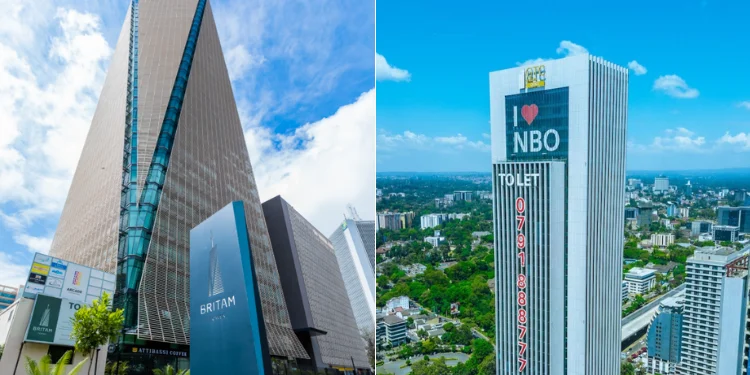
| Global Trade Centre (GTC) | 42 | 184 m | Premium office tower |
| Britam Tower | 32 | 200 m | Existing landmark |
The NSSF 60-storey skyscraper project will surpass existing high-rises, establishing a visual and functional benchmark for Nairobi and the region.
Infrastructure Stress and Capacity Planning
High-density vertical projects demand careful planning of transport, utilities, and emergency systems:
- Traffic & Parking: A 1,150+ car parking silo addresses tenant, hotel, and visitor demand, but peak-hour congestion on Uhuru Highway and Kenyatta Avenue will require traffic management strategies, possibly including shuttle services and smart parking integration.
- Utilities & MEP Systems: High-rise MEP requirements (HVAC, water supply, sewerage, electricity) will necessitate robust vertical distribution and redundancy to support mixed-use operations.
- Emergency & Safety Planning: The 56th-floor observation deck and mixed-use occupancy require comprehensive fire safety, egress planning, and crowd management systems, coordinated with Nairobi County emergency services.
Regional Competitiveness and Urban Positioning
The NSSF 60-storey skyscraper in Kenya project enhances Nairobi’s standing relative to regional peers:
| City | Benchmark Tower | Height | Regional Significance |
| Nairobi | Tower A (NSSF) | 260 m | East/Central Africa’s tallest |
| Kigali | Kigali Heights | ~120 m | Emerging commercial hub |
| Addis Ababa | Commercial Bank HQ | ~150 m | Landmark CBD building |
The twin towers position Nairobi as a premier East African commercial and vertical development hub.
Governance and Risk Management in the NSSF 60-Storey Skyscraper Project
Mega high-rise projects, such as the NSSF 60-storey skyscraper, carry inherent regulatory, construction, and market risks. Robust governance and structured risk management are critical for stakeholders.
Procurement and Oversight
- Contractor Selection: China Road and Bridge Corporation (CRBC) was selected in accordance with international procurement standards, demonstrating transparency and technical capability.
- Milestone-Based Contracts: Payments linked to verified progress mitigate performance and budget risks.
- Institutional Oversight: NSSF exercises fiduciary control with internal monitoring, external audits, and project management consultants overseeing compliance, quality, and schedule adherence.
Construction Risk and Mitigation
| Risk | Potential Impact | Mitigation Measures |
| Material Price Volatility | Cost escalation | Long-term procurement contracts, local sourcing where feasible |
| Contractor Performance | Delays, quality risks | Experienced EPC contractor, digital monitoring, milestone payments |
| Schedule Overruns | Extended exposure | Detailed phasing, 4D BIM scheduling, proactive risk planning |
| Urban Logistics Constraints | Congestion, crane conflicts | Pre-planned tower crane positioning, just-in-time material delivery |
Advanced digital construction tools (BIM, 4D simulation, digital twins modelling) allow proactive coordination, minimising schedule slippage and risk exposure in dense urban environments.
Market & Macroeconomic Risks
- Office Space Oversupply: Mixed-use strategy (hotel + serviced apartments + office) mitigates exposure to single-segment fluctuations.
- Hybrid Work Trends: Post-pandemic remote work may reduce office demand; diversification across hospitality and residential ensures income stability.
- Regulatory Compliance: EIA approval and Nairobi County permits provide legal and environmental safeguards.
- Inflation and Interest Rates: An equity-funded project reduces sensitivity to fluctuations in financing costs.
Strategic Regional Impact of the NSSF 60-Storey Skyscraper
The NSSF skyscraper project represents more than a high-rise development; it functions as a regional economic signal and infrastructural benchmark. Beyond Nairobi’s skyline, the project conveys institutional investor confidence, stimulates GDP growth, and establishes Kenya as a hub for East and Central African commercial real estate.
Institutional Confidence Signal
The KSh 30 billion capital allocation by NSSF signals confidence in Nairobi’s long-term CBD market, attracting attention from sovereign wealth funds, pension funds, and international investors seeking institutional-grade African real estate.
GDP Multiplier and Economic Stimulus
- Direct Employment: Civil works, MEP installation, fit-out, and project management create substantial jobs for both international specialists and local subcontractors.
- Indirect Economic Activity: Concrete, steel, and façade supply chains benefit; hospitality, retail, and office services see increased economic activity.
- Long-Term Revenue: Stable recurring income from offices, hotel operations, and serviced apartments contributes to taxation and local GDP growth.
Urban Policy Alignment
- Supports Kenya Vision 2030 objectives for urban densification, economic diversification, and investment-grade infrastructure.
- Creates a benchmark for future East African skyscrapers, in both engineering and institutional governance.
- Enhances Nairobi’s competitiveness relative to Kigali, Addis Ababa, and regional CBDs.
Lessons for Future African High-Rise Projects
The NSSF Twin Towers Nairobi offers critical lessons for developers, engineers, and institutional investors across Africa. Beyond its height, cost, and mixed-use design, the project demonstrates how institutional capital deployment, engineering innovation, and urban policy alignment can define successful mega high-rise projects.
Institutional Investor Governance
- Pension Fund Leadership: NSSF demonstrates that institutional investors can drive large-scale, complex real estate projects with robust governance frameworks.
- Risk Allocation: Clear delineation of responsibilities between NSSF, CRBC (main contractor), consultants, and local subcontractors reduces construction and financial uncertainty.
- Transparency & Oversight: Milestone-based reporting and adherence to fiduciary standards set a benchmark for public accountability in high-value infrastructure projects.
Engineering Best Practices
- Structural Design Integration: Reinforced concrete cores, composite framing, and lateral load systems provide insights for tall building stability under Nairobi’s volcanic soil conditions.
- Foundation Strategy: Deep pile or piled raft foundations demonstrate best practices in settlement mitigation and geotechnical risk management.
- Construction Technology: BIM-based digital modelling, 4D scheduling, and just-in-time material logistics showcase efficiency and accuracy in high-rise delivery.
Urban Density & Policy Integration
- High-Density Land Use: Maximising a 3.88-acre site through a twin-tower configuration illustrates optimal land utilisation in CBDs.
- Mixed-Use Benefits: Combining offices, a hotel, an observation deck, serviced apartments, and parking reduces market risk and ensures continuous revenue streams in skyscrapers.
- Urban Planning Alignment: Close coordination with Nairobi County urban policies and Kenya Vision 2030 frameworks demonstrates the importance of policy compliance in mega projects.
Financial & Market Insights
- Equity Deployment: Fully funded by NSSF’s institutional capital, the project reduces interest rate and debt exposure, serving as a model for risk-conscious financing.
- Market Absorption Strategies: Diversified tenant profiles mitigate oversupply risks and offer lessons in occupancy planning for mixed-use towers.
- Benchmarking for Future Projects: Sets a precedent for valuation, ROI expectations, and commercial strategy in East African high-rise developments.
Regional and Industry Implications
- Encourages institutional investors across Africa to consider CBD high-rise projects as viable, long-term assets.
- Provides contractors and engineers with a reference for managing vertical construction logistics, urban coordination, and advanced MEP integration.
- Offers policymakers evidence that private institutional capital can support public urban densification goals, reducing infrastructure strain while enhancing the skyline.
Further Reading: Discover 10 Project Management Challenges Facing African Infrastructural Projects
Long-Term Outlook: Transformational Asset or Prestige Symbol?
The NSSF 60-storey proposed skyscraper represents a defining moment for East and Central Africa’s real estate and construction sectors. Beyond architectural prominence, the project serves as a capital deployment, urban densification, and institutional confidence signal. Its long-term impact depends on market absorption, engineering performance, and integration with Nairobi’s CBD ecosystem.

Economic and Market Sustainability
- Premium Office Absorption: With Nairobi CBD’s limited Grade A office supply, Tower A and B provide high-demand commercial space. Success depends on occupancy by multinational tenants and long-term rental stability.
- Mixed-Use Revenue Diversification: Hotel, serviced apartments, and observation deck operations reduce dependency on single-market segments, mitigating vacancy and ensuring recurring income.
- Institutional Stability: NSSF’s equity-backed funding reduces financial risk, making the towers a reliable long-term asset for pension fund beneficiaries.
Engineering and Construction Legacy
- Tallest Building Benchmark: Tower A will be the tallest structure in East and Central Africa, setting standards for structural design, geotechnical planning, and vertical logistics.
- Innovation Integration: Use of BIM, climbing formwork, and high-strength concrete demonstrates best-in-class high-rise engineering practices.
- Urban Infrastructure Coordination: Coordination with Nairobi County for traffic management, utilities, and emergency systems ensures operational sustainability.
Urban Transformation and Regional Competitiveness
- Skyline Impact: Twin towers redefine Nairobi’s skyline, symbolising CBD revitalisation and creating a visual landmark for business and tourism.
- Regional Benchmarking: Surpasses Kigali and Addis Ababa in height and mixed-use functionality, positioning Nairobi as East Africa’s premier vertical commercial hub.
- Urban Policy Alignment: Supports Kenya Vision 2030, demonstrating how private institutional capital can drive public urban development objectives.
Strategic Investor Perspective
- Capital Allocation Insight: The project illustrates how large-scale institutional capital can be deployed in high-density, long-duration assets, offering lessons in risk mitigation, governance, and market timing.
- Benchmark for African Mega Projects: NSSF Twin Towers becomes a model for engineering, governance, financial structuring, and urban integration, guiding future high-rise developments across the continent.
The proposed NSSF 60-storey skyscraper project confirms Nairobi CBD as a safe, high-potential market for mixed-use, institutional-grade real estate.
Conclusion: The NSSF 60-Storey Skyscraper as a Transformational Urban Asset
The NSSF 60-storey skyscraper Kenya project represents a strategic convergence of institutional capital, advanced engineering, and high-density urban planning within Nairobi’s CBD. By committing KSh 30 billion in equity to the skyscraper, NSSF positions itself as an active developer of landmark mixed-use infrastructure rather than a passive investor. The 260-metre Tower A and complementary 35-storey Tower B demand sophisticated structural systems, deep foundation engineering, coordinated high-rise MEP integration, and disciplined construction logistics within a constrained urban environment. The mixed-use configuration strengthens revenue resilience by combining premium office space, hospitality, serviced apartments, and tourism components into a single vertical asset.
At the metropolitan scale, the NSSF 60-storey skyscraper Nairobi project accelerates vertical densification, reinforces CBD revitalisation, and elevates Nairobi’s competitiveness among East and Central African commercial hubs. The equity-funded structure reduces exposure to financing volatility while institutional governance and milestone-based oversight improve risk control and delivery accountability. More than simply one of the tallest buildings in Kenya, the skyscraper will establish a replicable benchmark for future African mega high-rise developments grounded in financial sustainability, engineering precision, and strategic urban transformation once completed.
Stay Ahead of Africa’s Mega Projects
For in-depth analysis on major Kenyan infrastructure projects and other transformative infrastructure developments in Africa and globally, visit ConstructionFrontier.com. Get expert insights on engineering, investment strategy, and urban development shaping the world’s future.