COBOD BOD2 3D Printer in Construction: 5 Breakthrough Uses
The COBOD BOD2 3D printer is redefining how structures are built by enabling automated, layer-by-layer construction of concrete buildings at scale. As 3D-printed construction technology advances globally, contractors and developers are increasingly adopting the COBOD BOD2 3D printer to improve productivity, reduce material waste, and accelerate project delivery. Designed as a modular gantry system, the COBOD BOD2 3D printer supports large-scale 3D printing construction across residential, commercial, and infrastructure projects. Its integration into modern construction 3D printing machines signals a broader transition toward automated construction printing, particularly in regions facing labour shortages and housing deficits.
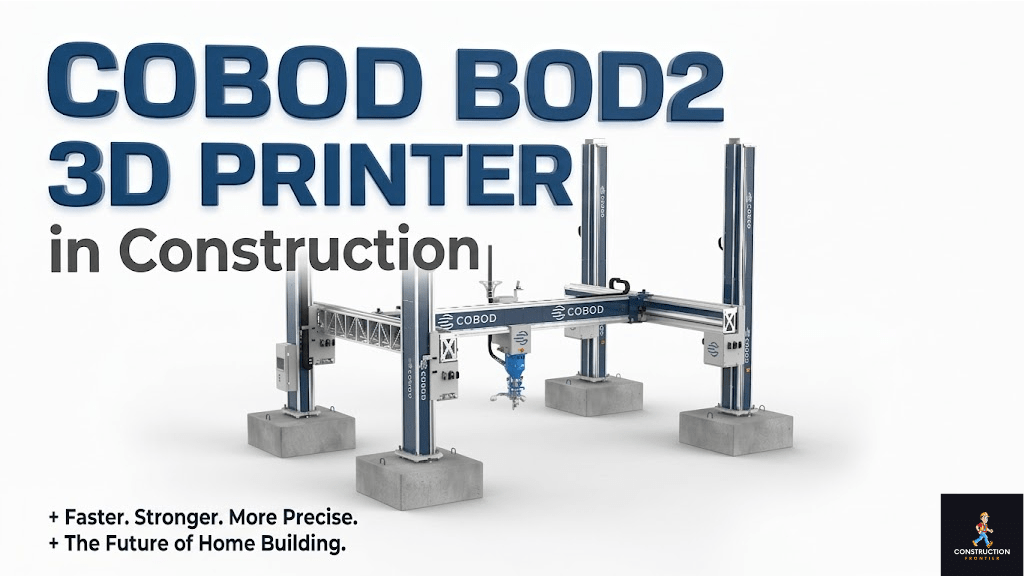
Technical Snapshot: COBOD BOD2 3D Printer System
System Component | Function |
| Modular gantry frame | Scalable structure for large project footprints |
| Concrete extrusion system | Deposits material layer by layer |
| Printhead control system | Ensures dimensional accuracy |
| Software interface | Controls geometry and printing paths |
| Pumping system | Delivers printable concrete mix |
According to COBOD International, the COBOD BOD2 3D printer is currently one of the most widely deployed construction 3D printers, used across multiple continents for real-world building applications.
Introduction: The Rise of Automated Construction Printing
The construction industry is undergoing a structural transformation driven by automation, digital fabrication, and material innovation. Among the most disruptive technologies is the COBOD BOD2 3D printer, a system specifically engineered to deliver scalable and repeatable building processes.
Unlike conventional construction methods, which rely heavily on labour-intensive workflows, the COBOD BOD2 3D printer in construction enables automated deposition of concrete structures directly from digital models. This approach eliminates formwork, reduces labour demand, and significantly improves construction speed.
The adoption of 3D-printed construction technology has accelerated in recent years, with projects ranging from residential housing to schools and commercial buildings. The global shift toward large-scale 3D printing in construction projects reflects the need for faster, more cost-efficient building methods.
Understanding How the COBOD BOD2 3D Printer Works
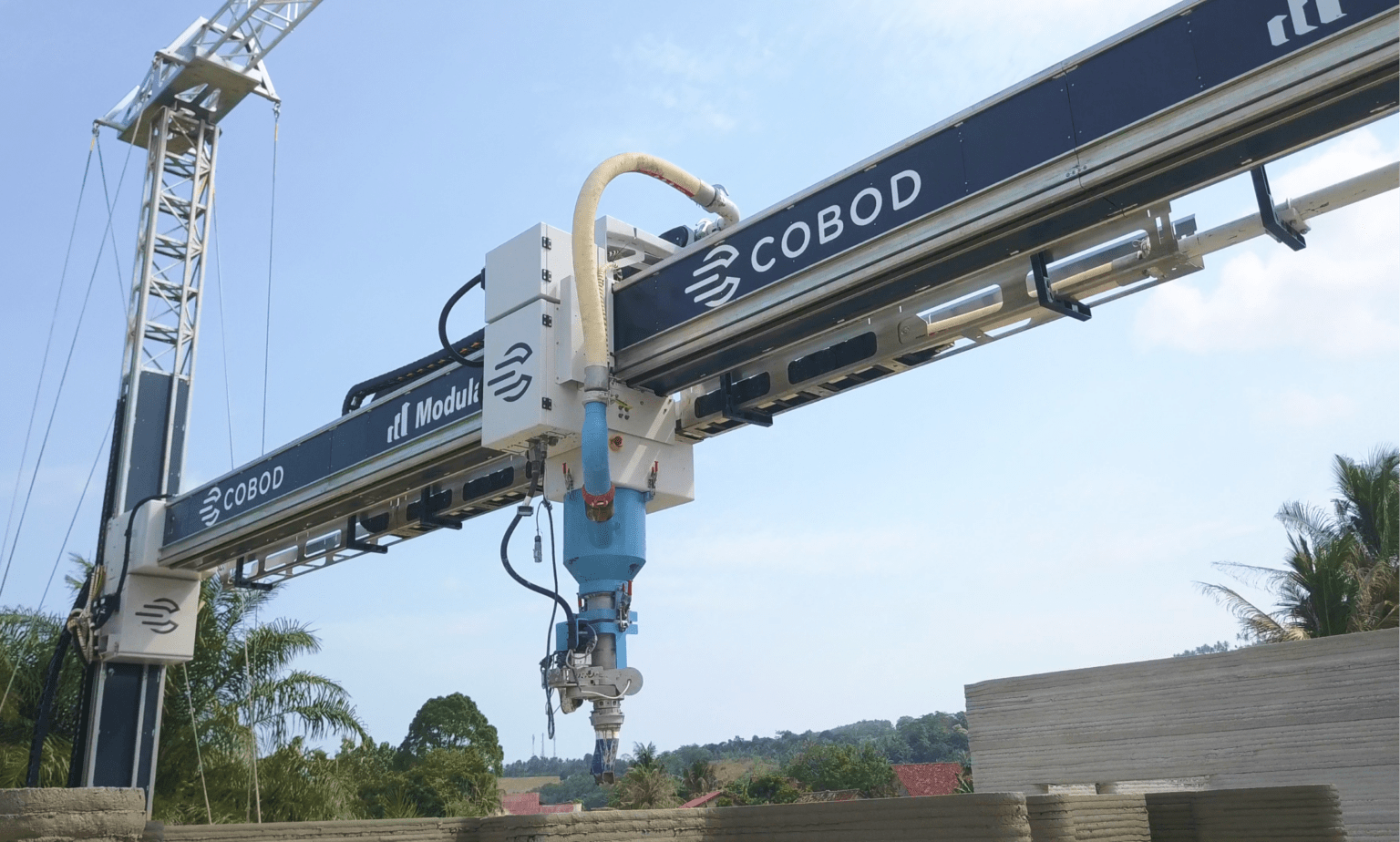
The COBOD BOD2 3D printer uses a gantry system that moves along three axes to deposit concrete material in precise layers. Understanding how the COBOD BOD2 3D printer works in construction requires examining its mechanical and digital components. Let’s have a deep dive into it.
Structural Gantry System
The COBOD BOD2 is engineered as a modular truss-based gantry system, allowing for massive scalability. It operates in a three-axis Cartesian coordinate system (x, y, z), where the x-axis represents width, the y-axis length, and the z-axis height.
According to official COBOD specifications, the system is modular in increments of 2.5 metres, enabling it to be configured for projects ranging from small residential units to structures up to 12 metres wide and of unlimited length (by adding more-axis rails).
The gantry is designed to withstand outdoor construction environments and maintains a precision tolerance of less than 1 mm across its entire operating envelope. This mechanical stability enabled the construction of the first 3D-printed school in Malawi and the three-storey complex in Wallenhausen, Germany, which stands as a benchmark for multi-storey 3D-printed residential buildings.
Concrete Extrusion Technology
The heart of the BOD2 is its specialised extrusion head, which is fed by a continuous mixing and pumping unit. Technically, the process relies on the material’s thixotropic properties. The concrete must be fluid enough to be pumped through the hose and extruded, yet it must “set” almost instantly to support the weight of the subsequent layers without collapsing, a property known as green strength.
COBOD’s system typically uses a D-shaped nozzle to ensure smooth layer bonding. Official project data from the 14Trees school in Malawi confirm that the material used, TectorPrint by Holcim, achieved high early-age strength, allowing the robot to print at a vertical speed of up to 10 cm per hour. This extrusion process eliminates the need for vibration or manual tamping, as the layer-by-layer deposition naturally compacts the material under its own weight.
Digital Control and Precision
The BOD2 is a fully digitised construction machine that operates via the COBOD Configurator and proprietary control software. The workflow begins with a Building Information Modelling (BIM) file, which is converted into G-code, the same numerical control language used by industrial CNC machines. The software translates architectural blueprints into a precise path for the printhead, including specific instructions for wall thickness, infill patterns, and openings for windows and doors.
Since the system is digitally driven, it can achieve millimetre-level accuracy, ensuring that structural components match the digital twin exactly. This precision reduces human error in layout and measurement, a leading cause of rework in traditional construction, and enables seamless integration of MEP (Mechanical, Electrical, and Plumbing) services into the printed cavities.
5 Breakthrough Uses of the COBOD BOD2 3D Printer
The applications of the COBOD BOD2 3D printer in construction are no longer experimental. Contractors and developers now deploy this system across multiple asset classes, driven by measurable gains in productivity, material efficiency, and design flexibility. The COBOD BOD2 3D printer has moved from pilot projects into scalable delivery models, particularly in regions with constrained labour markets and high infrastructure demand.
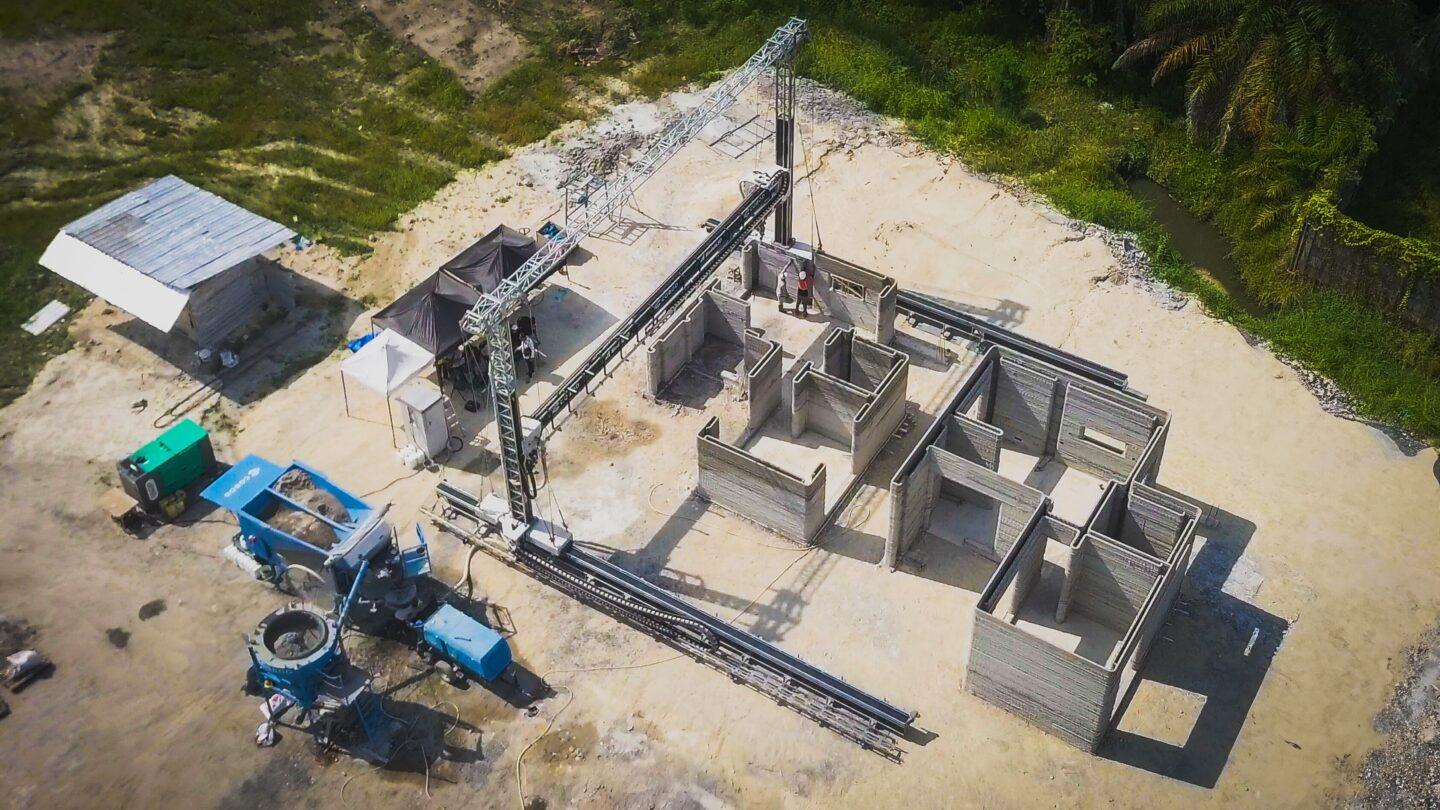
1. Affordable Housing Construction
The COBOD BOD2 3D printer addresses one of the most persistent global challenges: cost-effective delivery of housing at scale. Using 3D-printed construction technology, the printer fabricates structural wall systems directly from digital models, eliminating formwork and significantly reducing construction timelines.
From an engineering standpoint, the process relies on the extrusion of cementitious materials with controlled rheology. The mix design must achieve:
- High early-age strength to support subsequent layers.
- Pumpability for continuous flow through delivery systems.
- Shape retention to prevent deformation during deposition.
The COBOD BOD2 3D printer in construction enables continuous wall printing with integrated cavities for insulation, conduits, and reinforcement placement. This reduces downstream trades and compresses project schedules.
A proven example is the world’s first 3D-printed school in Malawi, by 14Trees, demonstrating real-world uses of 3D printing in construction in low-resource environments.
In emerging markets, the benefits of the COBOD 3D construction printer include:
- Reduced reliance on skilled labour.
- Lower material waste compared to blockwork.
- Faster project delivery cycles.
This positions large-scale 3D printing in construction projects as a viable solution for housing deficits across Africa and Asia.
Read more: World’s First 3D-Printed School: Revolutionary Construction
2. Large-Scale Infrastructure Components
The COBOD BOD2 3D printer is increasingly used to produce infrastructure elements, including retaining walls, culverts, bridge components, and utility chambers. These applications require high-dimensional accuracy and repeatability, both of which are inherent strengths of construction 3D printing machines.
In infrastructure projects, the COBOD BOD2 3D printer in construction operates as an on-site fabrication system, reducing dependency on precast supply chains. This shift has several engineering implications:
- Elimination of transportation constraints for oversized elements.
- Reduction in crane lifting requirements.
- Improved alignment with project-specific geometries.
The system supports large-scale 3D printing construction by enabling modular or continuous printing of structural components. For example, printed retaining walls can be optimised with internal lattice structures to reduce material usage while maintaining load-bearing capacity.
The applications of the COBOD BOD2 3D printer in infrastructure also extend to customised formwork printing for complex geometries, further enhancing efficiency. Some of the projects the printer has been successfully used in include:
- Wind Turbine Bases: COBOD printers were used to create the world’s first 3D-printed wind turbine bases in partnership with GE Renewable Energy (now GE Vernova), enabling taller, more efficient towers.
- Multifunctional Construction Robot: In collaboration with TU Braunschweig, a BOD2 system was converted into a multifunctional robot capable of shotcreting (spraying concrete) for complex structures like tunnels and retaining walls.
3. Commercial and Industrial Buildings
The COBOD BOD2 3D printer is now deployed in the construction of warehouses, logistics centres, and industrial facilities. These projects benefit from repetitive layouts and large footprints, making them ideal for automated construction printing.
From a structural engineering perspective, the printer is typically used to construct:
- External and internal load-bearing walls.
- Partition systems with integrated service voids.
- Structural cores for low- to mid-rise buildings.
The COBOD BOD2 3D printer in construction improves project economics by reducing labour intensity and shortening build cycles. This directly impacts cost planning and procurement strategies for contractors and developers. The scalability of construction 3D printing machines allows large floor areas to be completed within compressed timelines, supporting fast-track project delivery.
The benefits of the COBOD 3D construction printer in this sector include:
- Predictable cost structures due to reduced labour variability.
- Improved safety by minimising manual handling.
- Enhanced quality control through digital fabrication.
4. Complex Architectural Designs
The COBOD BOD2 3D printer removes one of the biggest constraints in traditional construction: formwork limitations. Complex geometries, curved walls, and non-standard architectural elements can be printed directly without the need for bespoke moulds.
This capability is a defining feature of 3D-printed construction technology, enabling architects and engineers to explore design possibilities that were previously cost-prohibitive.
Technically, the printer achieves this through:
- Precise control of printhead movement across three axes (x, y, z).
- Layer-by-layer deposition with controlled bead width.
- Integration with BIM models for accurate geometry translation.
The COBOD BOD2 3D printer in construction supports parametric design workflows, where building geometry can be optimised for structural performance and material efficiency.
In high-end projects, this enables:
- Lightweight structural forms with reduced material usage.
- Optimised load paths through geometry rather than mass.
- Integration of architectural and structural functions.
These capabilities expand the real-world uses of 3D printing in construction, particularly in landmark projects and bespoke developments.
5. Disaster Relief and Rapid Construction
The deployment of the COBOD BOD2 3D printer in disaster response scenarios demonstrates its ability to deliver rapid, scalable construction under time constraints. In such applications, the printer is used to construct emergency shelters, medical facilities, and temporary infrastructure. The speed of automated construction printing is critical in reducing response times following natural disasters.
Engineering considerations in these scenarios include:
- Rapid mobilisation and assembly of the printer system.
- Use of locally available materials for printable concrete mixes.
- Simplified structural designs for quick execution.
The COBOD BOD2 3D printer in construction enables continuous operation, allowing structures to be completed within days rather than weeks.
The benefits of the COBOD 3D construction printer in disaster relief include:
- Reduced dependency on complex supply chains.
- Minimal workforce requirements in hazardous environments.
- High repeatability for standardised shelter units.
This reinforces the role of large-scale 3D printing in construction projects as a critical tool in humanitarian and emergency response operations.
For a broader view of how automation is reshaping construction, check: 6 Innovative Technologies in Modern Construction Projects
Advantages of the COBOD BOD2 3D Printer
The COBOD BOD2 3D printer delivers measurable performance improvements across construction workflows, particularly when integrated into digitally managed projects.
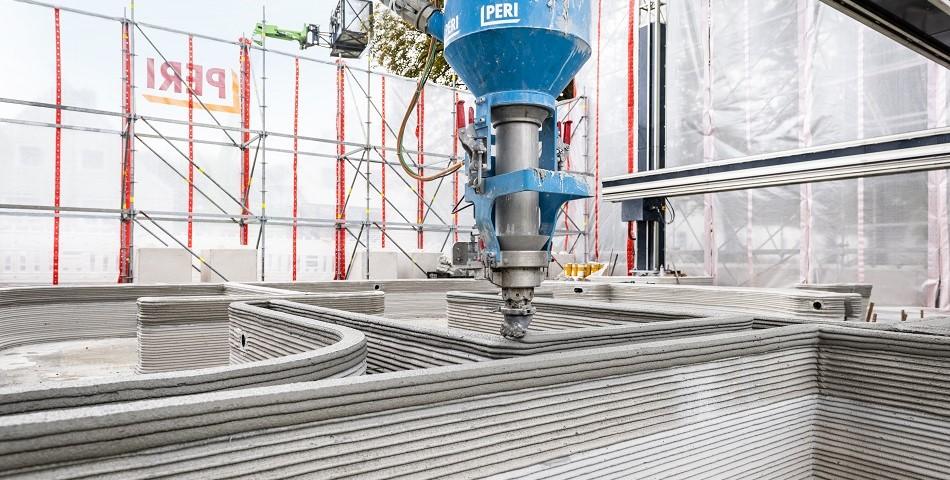
1. Efficiency and Speed
The COBOD BOD2 achieves high-speed construction through a maximum print velocity of 1,000 mm/s, though it typically operates at a functional speed of 25 cm/s for structural stability. This automation enables continuous layer deposition without the need for traditional formwork, which typically accounts for 50% to 60% of the total time in conventional concrete projects.
A primary example of this efficiency is the 14Trees school project in Malawi, where the structural walls were completed in just 18 hours. Compared to the four to five days required for manual bricklaying of a similar footprint, the BOD2 provides a 75% reduction in wall-building timelines, allowing projects to move from foundation to finishing much faster.
2. Material Optimisation
The printer utilises topology optimisation, a digital design process that ensures material is deposited only where it is structurally necessary. In traditional construction, roughly 25% to 30% of materials delivered to a site end up as waste due to over-ordering or cutting materials to fit; however, the BOD2 reduces this waste to less than 1% by extruding precise amounts based on a 3D model.
Furthermore, when paired with specialised low-carbon mortars like Holcim’s TectorPrint, the system can achieve a 50% to 70% reduction in embodied carbon. By creating hollow-core walls that provide natural insulation without extra mass, the BOD2 uses significantly less concrete than solid-poured walls while maintaining equivalent load-bearing strength.
3. Labour Reduction
The transition to the BOD2 system shifts the construction site from a labour-intensive environment to a tech-managed one, requiring only a small crew of 3 to 4 technicians to oversee the print. This represents an 80% reduction in manual labour hours per square metre when compared to traditional masonry or reinforced concrete crews, which often require 12 to 15 workers.
This reduction is not just about cutting costs; it addresses the global construction labour shortage by replacing physically taxing, high-risk tasks like heavy lifting and repetitive manual bricklaying with digital monitoring and system calibration. This shift improves site safety and allows a smaller, more specialised workforce to produce more housing units in less time.
Technical Benchmark: COBOD BOD2 vs Traditional Construction
| Metric | Traditional Construction | COBOD BOD2 3D Printer |
| Construction speed | Moderate | High |
| Labour requirement | High | Low |
| Material waste | Significant | Minimal |
| Design flexibility | Limited | High |
| Cost efficiency | Variable | Improved |
Future of the COBOD BOD2 3D Printer in Construction
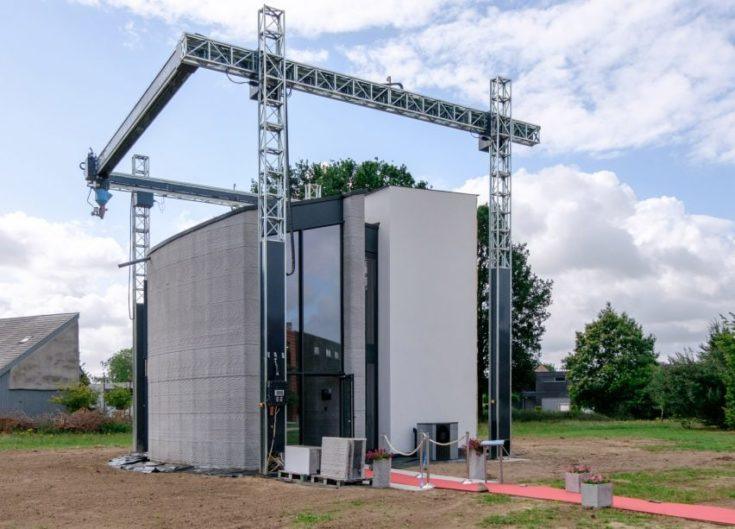
The future of the COBOD BOD2 3D printer lies in its integration with advanced materials, digital workflows, and smart construction ecosystems. As adoption increases, the technology will move beyond pilot projects into mainstream construction delivery.
One of the most significant developments is the integration of the COBOD BOD2 3D printer in construction with Building Information Modelling (BIM) and digital twins. This enables real-time coordination between design, fabrication, and facility management.
Emerging trends in large-scale 3D printing in construction projects include:
- Development of high-performance printable concrete with improved durability and strength.
- Integration of reinforcement systems within printed structures.
- Hybrid construction approaches combine printing with prefabrication.
According to the World Economic Forum, automation and digital fabrication technologies will play a central role in meeting global infrastructure demand and improving construction productivity. The applications of the COBOD BOD2 3D printer will continue to expand as contractors gain experience and regulatory frameworks evolve to accommodate 3D-printed construction technology.
In regions such as Africa, where rapid urbanisation is driving demand for housing and infrastructure, the COBOD BOD2 3D printer offers a scalable and efficient solution. Its ability to deliver automated construction printing at scale positions it as a critical tool for future development.
For a broader context on robotics in construction, explore: 3D-Printing Robots in Construction: 5 Remarkable Types
Technical Block: Operational Performance of 3D Construction Printing
| Parameter | COBOD BOD2 System |
| Printing speed | Up to 1000 mm/s (depending on mix) |
| Layer height | Typically 20–50 mm |
| Material type | Specialised printable concrete |
| Automation level | High |
| Project scalability | Modular system |
Conclusion: A Transformational Shift in Construction
The COBOD BOD2 3D printer represents a major shift in how buildings are designed and constructed. Its ability to automate concrete placement, reduce labour dependency, and improve efficiency positions it as a critical tool for the future of construction.
Across residential, commercial, and infrastructure projects, the COBOD BOD2 3D printer in construction demonstrates how 3D-printed construction technology can address some of the industry’s most pressing challenges. From reducing construction time to enabling complex designs, the technology continues to expand its applications globally.
As adoption increases, particularly in emerging markets, the COBOD BOD2 3D printer will play a central role in advancing large-scale 3D printing construction. Its integration into modern construction workflows signals the beginning of a more automated, efficient, and sustainable built environment.
Explore Construction Innovation at Construction Frontier
Stay ahead of construction innovation with Construction Frontier. Discover expert insights on automated construction printing, robotics, infrastructure development, and emerging technologies shaping the global construction industry.