World’s First 3D-Printed School: Revolutionary Construction
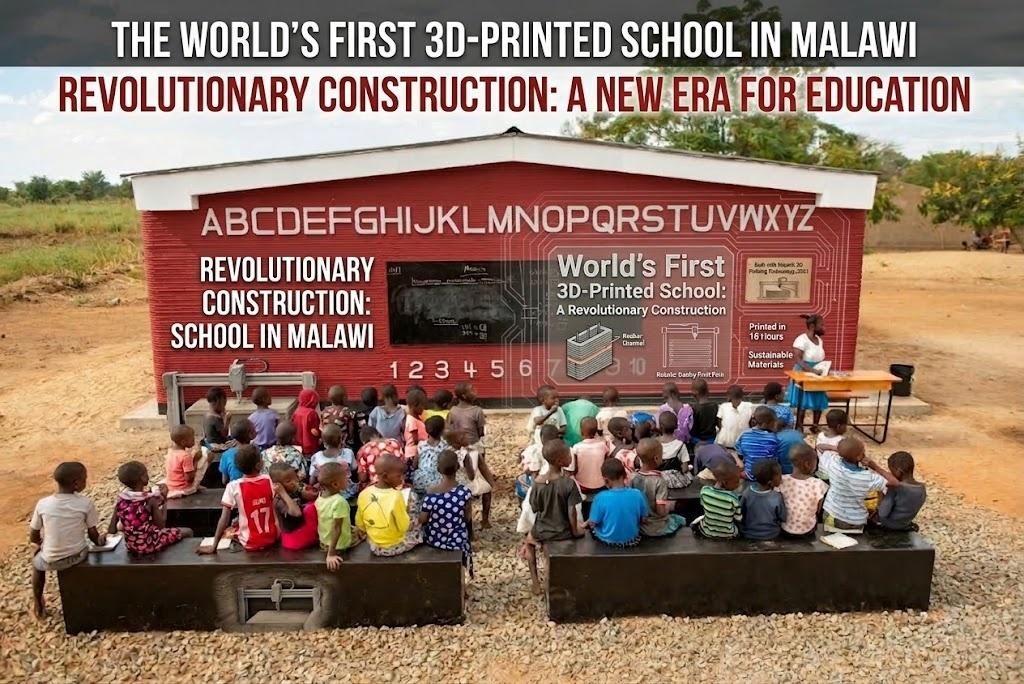
The world’s first 3D-printed school project represents a milestone in additive manufacturing in construction, demonstrating how 3D-printed building technology can deliver critical education infrastructure faster, cheaper, and with fewer resources than traditional methods. Built in Malawi through a partnership involving global technology firms and humanitarian organisations, the 3D-printed school addresses severe classroom shortages while showcasing the potential of 3D-printed construction projects in developing economies.
The project uses robotic construction printers to deposit specialised concrete layer by layer, creating structural walls directly from digital design models. The resulting 3D-printed school building provides a safe, durable learning environment and demonstrates how 3D printing in education infrastructure can transform public infrastructure delivery in regions where traditional construction struggles to meet demand.
Technical Snapshot
| Parameter | Project Detail |
| Project Type | Education Infrastructure |
| Technology | Additive manufacturing construction |
| Construction Method | Robotic 3D concrete printing |
| Location | Malawi |
| Key Partners | 14Trees (Holcim & CDC Group initiative) |
| Structure | Single-storey classroom facility |
| Key Objective | Rapid, scalable school infrastructure |
Introduction: A New Era in Construction Technology
The construction industry has historically been slow to adopt radical technological change. However, the world’s first 3D-printed school project signals a significant shift toward digital construction methods that can transform how infrastructure is designed and built.
In Malawi, where overcrowded classrooms remain a persistent challenge, the development of the world’s first 3D-printed school demonstrates how 3D-printed building technology can rapidly deliver critical education facilities. By combining robotics, digital design, and specialised concrete materials, the project illustrates how additive manufacturing in construction is evolving from experimental prototypes to real-world infrastructure solutions.
The implications extend far beyond education. Governments, contractors, and development agencies increasingly view 3D-printed construction projects as a potential solution to infrastructure shortages in emerging markets. For engineers, investors, and policymakers, the 3D printed school building offers a compelling case study of how construction technology can accelerate project delivery while improving efficiency and sustainability.
What Is 3D-Printing in Construction?
Understanding the 3D-printed school requires examining the underlying technology that enables this construction method.
3D printing in construction, also known as additive manufacturing, is a construction technique in which structural components are produced by depositing material layer by layer using automated robotic systems. Instead of assembling bricks, blocks, or formwork, a construction printer extrudes a specially formulated cement-based material following instructions derived from digital building models.
In a typical 3D printed construction project, engineers begin by designing the structure using Building Information Modelling (BIM) or parametric design software. This digital model is then converted into machine instructions that guide the robotic printer across the construction site.
As the printer moves along predetermined paths, it deposits material through a controlled nozzle system. Each layer bonds with the previous one, gradually forming structural walls and architectural elements. This approach enables a 3D-printed building to emerge directly from digital instructions, without the need for traditional masonry or formwork.
Because the process is highly automated, 3D printing building technology can significantly reduce the number of workers required on site while increasing geometric precision and design flexibility.
Key Technologies Behind 3D-Printed Buildings
The delivery of a 3D-printed building relies on several integrated technologies that combine robotics, digital modelling, and materials engineering. Each of these systems plays a critical role in enabling the success of 3D printing building technology.
1. Robotic Printing Systems
Large-scale robotic printers form the backbone of 3D printed construction projects. These machines typically operate as gantry systems or robotic arms that can move along multiple axes across the building footprint.
Guided by digital instructions, the printer extrudes a cement-based mixture layer by layer, following the exact geometry defined in the digital design model. This precision allows engineers to create curved walls, optimised structural shapes, and complex architectural features that would be difficult to achieve through conventional masonry construction.
Research highlighted by the World Economic Forum identifies robotic fabrication as one of the innovations most likely to improve productivity in the construction industry.
2. Digital Design Models
Digital design tools play an equally important role in 3D printed construction projects. Engineers typically use BIM platforms and parametric design software to develop the digital models that guide the printing process.
These models allow construction teams to simulate structural performance before printing begins. For example, in a 3D-printed school building, engineers can evaluate load paths, material distribution, and structural stability directly in the digital design environment.
Once verified, the model is converted into machine instructions that control the construction printer’s movement. This digital workflow reduces design errors and improves the precision of 3D printed buildings worldwide.
3. Specialised Printing Materials
Materials used in 3D printing building technology differ from traditional concrete mixtures. Because the material must flow through a printing nozzle and maintain its shape after deposition, engineers design specialised mixes with carefully controlled rheological properties.
These mixes typically contain cement, fine aggregates, additives, and chemical accelerators that allow the material to achieve rapid early strength. The mixture must remain pumpable during extrusion but gain stiffness quickly enough to support the layers above it.
Research institutions and construction companies continue to develop improved materials for additive manufacturing in construction. Advances in material science will play a critical role in expanding the capabilities of 3D printed construction projects, including future 3D printed schools and other public infrastructure
Further Reading: Brick-Laying Robot: Transforming Construction with Advanced Automation and Speed
Differences Between Traditional and 3D-Printed Construction
The emergence of 3D printing building technology introduces several major differences compared with conventional construction.
1. Labour Requirements
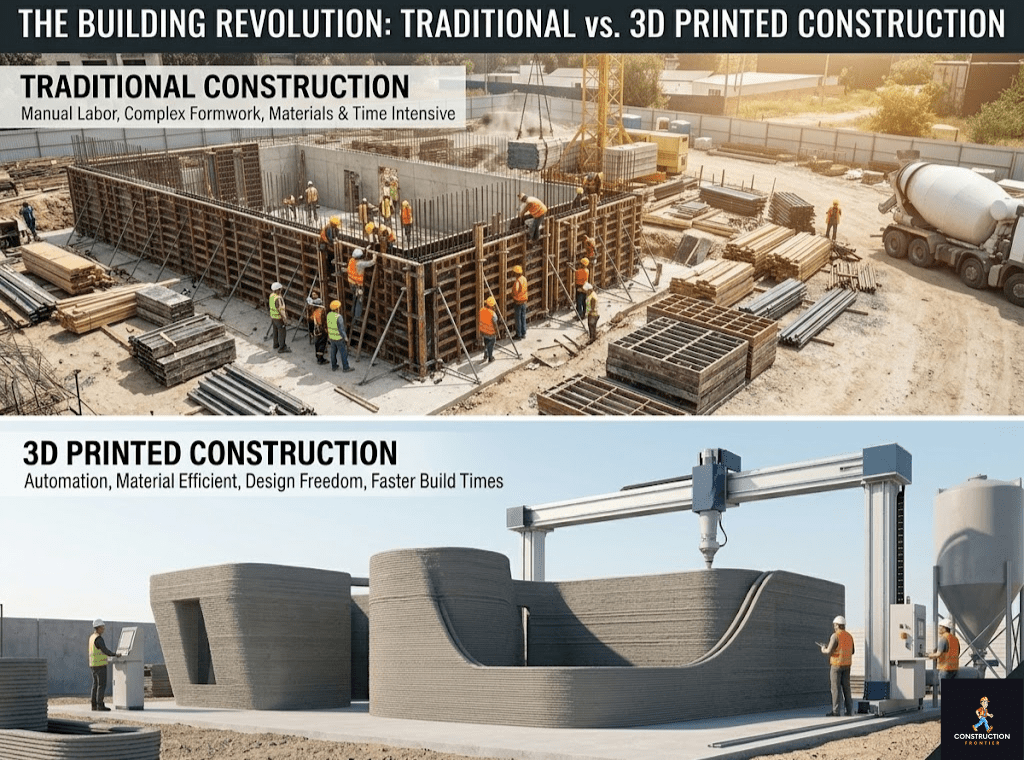
Traditional construction typically requires large teams of skilled labourers, including masons, carpenters, and formwork specialists. In contrast, 3D printed construction projects rely on smaller teams composed mainly of engineers, technicians, and machine operators.
This shift reflects a broader trend toward automation in the construction industry. The McKinsey & Company has identified automation technologies as a key pathway for improving productivity across the global construction sector.
2. Construction Speed
Speed represents one of the most significant advantages of additive manufacturing (AM) in construction. Because robotic printers can operate continuously without many of the interruptions associated with manual construction, structural walls can be produced much faster.
In the world’s first 3D printed school project, the classroom walls were printed in a matter of hours rather than weeks. This efficiency enables 3D-printed buildings worldwide to address urgent infrastructure needs, such as classroom shortages.
3. Material Efficiency
Traditional construction processes often generate considerable waste through excess concrete, formwork removal, and material offcuts. By contrast, 3D printing building technology deposits material only where it is required.
This precision significantly reduces material waste and improves resource efficiency. For projects such as 3D printed construction for education infrastructure, reduced material consumption can lower environmental impact while improving cost efficiency.
The World’s First 3D-Printed School Project
The world’s first 3D printed school project was developed to demonstrate how additive manufacturing could address infrastructure shortages in developing regions, such as in African countries. Sub-Saharan Africa faces one of the world’s most severe shortages of classrooms. According to UNESCO, over 250 million children and youth in the region lack access to adequate learning facilities, with half of that number in Sub-Saharan Africa.
The initiative was led by 14Trees, a joint venture between Holcim and the development finance institution CDC Group, aimed at accelerating infrastructure delivery through digital construction technologies. The 3D-printed school was developed specifically to explore whether additive manufacturing in construction could provide a scalable solution to this challenge.
Project Overview
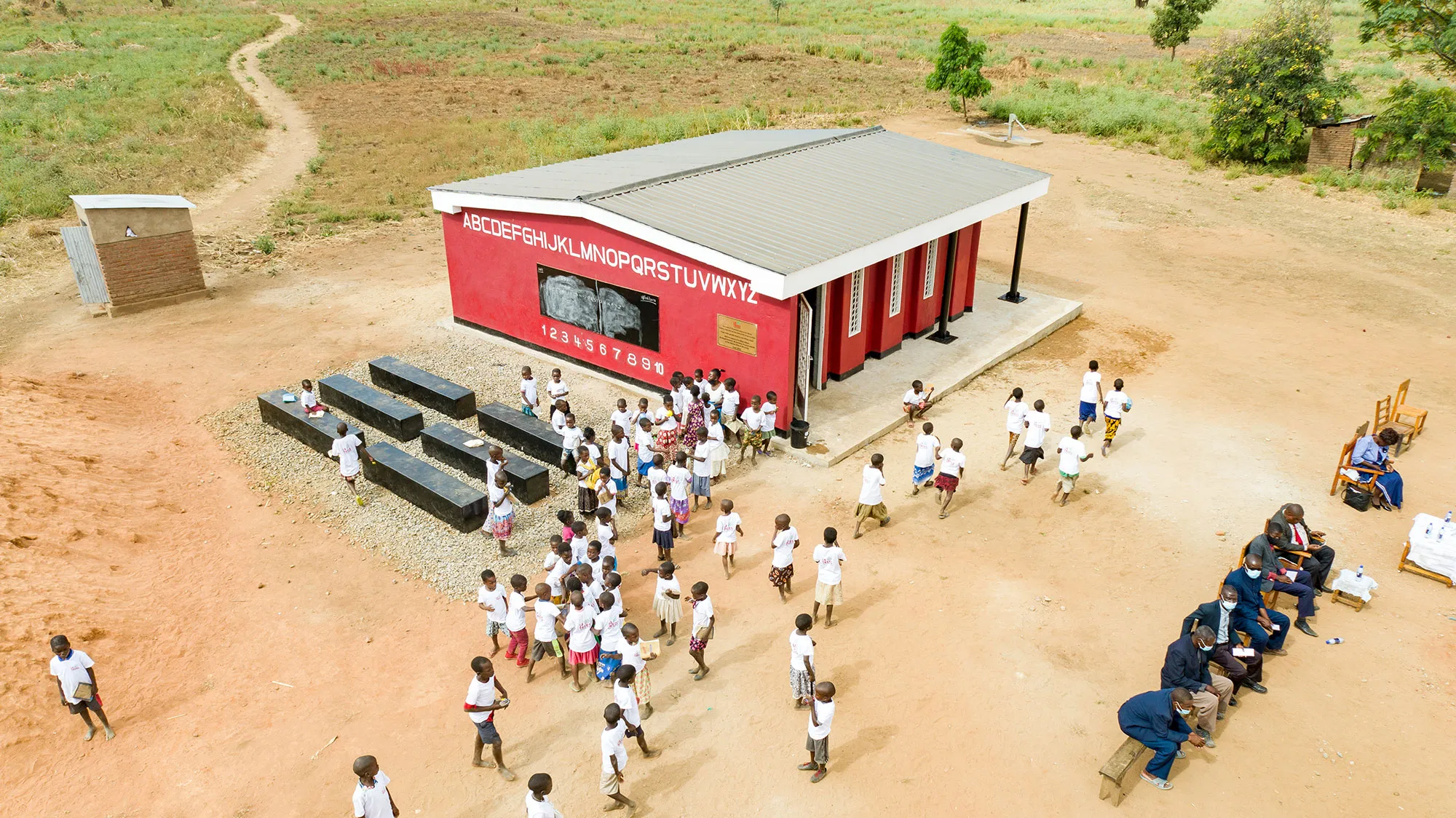
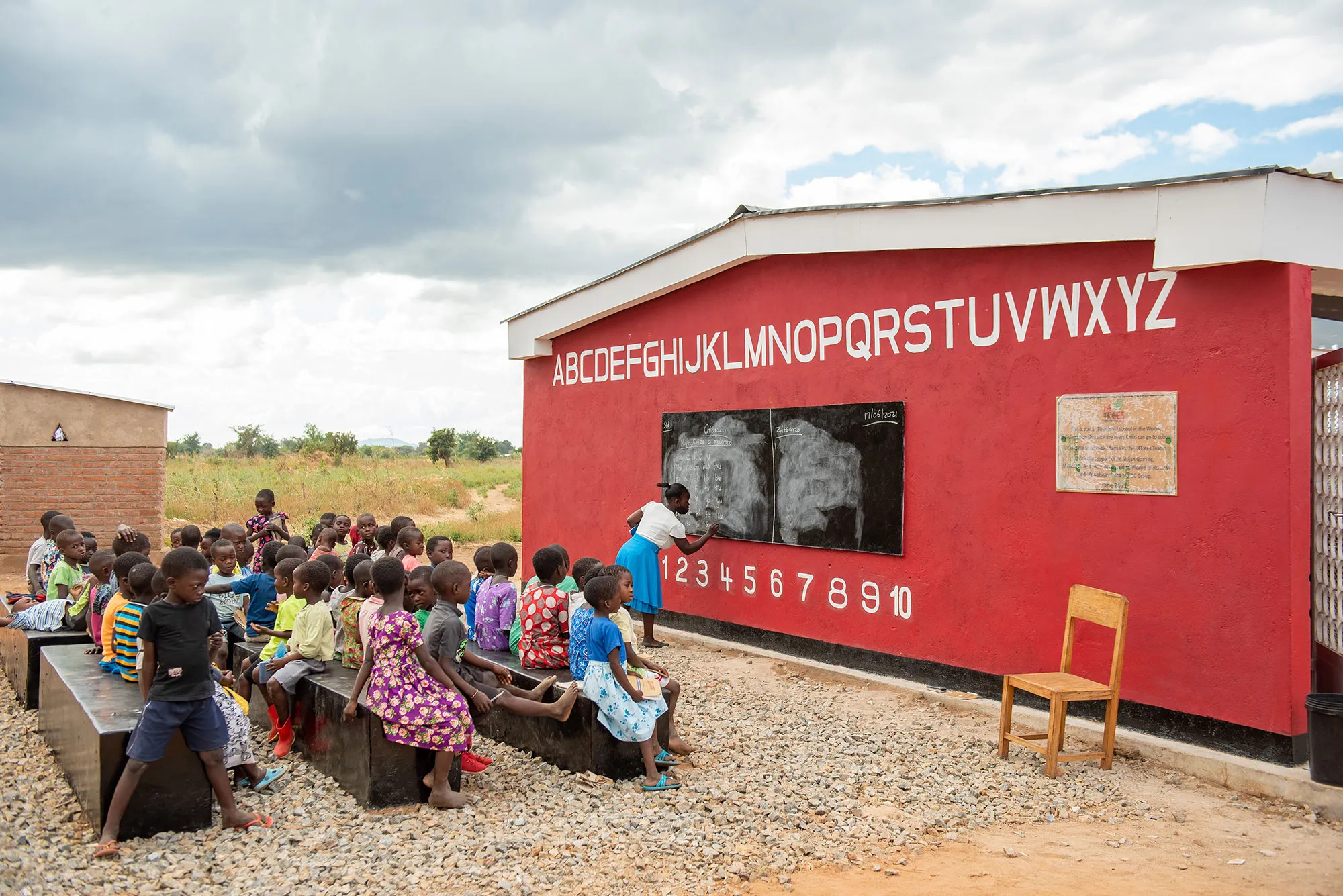
The 3D-printed school was constructed in Malawi, a country facing significant pressure on its education infrastructure. The project demonstrated how 3D-printed construction could deliver classroom facilities faster than traditional building methods. Engineers and construction teams collaborated to design a digitally optimised classroom structure suitable for robotic fabrication.
Key milestones in the world’s first 3D-printed school project included digital architectural design, the installation of construction-printing equipment, and the automated fabrication of structural walls.
The successful completion of the 3D-printed school building demonstrated that 3D printing in educational infrastructure can function effectively even in challenging construction environments. For policymakers and infrastructure planners, the project provided a tangible example of how 3D-printed buildings worldwide could address infrastructure shortages.
Design and Architectural Features
The 3D-printed school building was designed as a compact, single-storey classroom optimised for rapid construction and functional learning.
The printed walls incorporate curved structural geometry that enhances stability while allowing greater interior space. Such geometries are difficult to produce using conventional masonry but are easily fabricated using robotic printing systems.
Following the printing phase, conventional construction elements such as roofing, doors, windows, and interior finishes were installed.
Construction Process
The construction process combined traditional site preparation with automated fabrication. The project began with foundation construction using conventional reinforced concrete. Once the foundation was completed, engineers installed the robotic printing system.
The printer then deposited a specialised cement-based material layer by layer, forming the structural walls of the 3D-printed school building according to the digital design model. After printing was completed, contractors installed the roof structure and finishing components, resulting in a fully operational classroom facility that demonstrated the viability of additive manufacturing for school construction.
Engineering Technology Behind the 3D Printed School
Delivering a 3D printed school requires advances in robotics, materials science, and structural engineering.

1. Printing Equipment
Most 3D-printed buildings worldwide rely on large-scale gantry printers and robots that fabricate walls on site. These machines move across the construction footprint while extruding material through a nozzle controlled by digital instructions.
The project utilised COBOD BOD2 gantry systems, which operate on a three-axis (X-Y-Z) coordinate system to automate the extrusion-based additive manufacturing (EAM) process. Unlike robotic arms with limited reach, gantry printers provide a stable, scalable frame that covers the entire building footprint. The printer interprets G-code derived from a 3D BIM model to control the print head velocity and volumetric flow rate, ensuring precise layer deposition and geometric accuracy with minimal tolerance deviations.
For projects such as the 3D-printed school, these robotic gantry machines can fabricate structural walls on site. The automation reduces manual labour while maintaining consistent material placement.
2. Construction Materials
The materials used in 3D printing building technology are carefully engineered to meet both structural and operational requirements. Unlike traditional concrete mixes, the material must possess rheological properties that allow smooth extrusion through the printer nozzle.
At the same time, the material must rapidly gain strength to support the weight of subsequent layers during printing. Engineers therefore used a proprietary cementitious mortar (LafargeHolcim’s TectorPrint) designed to balance flowability, structural strength, and durability. Key technical requirements included:
- Extrudability: Maintaining low viscosity under pressure for smooth flow through the nozzle.
- Buildability: High yield stress and rapid “green strength” development, allowing the bottom layers to resist compressive deformation from the weight of subsequent wet layers.
- Thixotropy: The material’s ability to transition from a fluid state during extrusion to a semi-solid state immediately upon deposition.
These material properties enable 3D-printed construction projects to achieve structural integrity while maintaining the efficiency advantages of automated fabrication.
As research continues globally, improvements in material performance will likely expand the range of applications for additive manufacturing in construction, including larger public infrastructure projects.
3. Structural Integrity
Ensuring structural safety remains a fundamental requirement for any 3D printed school building, engineers must verify that printed structures meet established building standards and structural performance criteria.
Testing typically includes evaluation of load-bearing capacity, material strength, and long-term durability. Structural engineers analyse and evaluate how structural performance depends on anisotropic properties, as 3D-printed walls are essentially a series of cold joints, printed layers that interact under load to ensure the building can withstand environmental forces such as wind and seismic activity.
Engineers also focused on inter-layer adhesion (the bond strength between printed beads) to prevent shear failure. In Malawi, the walls act as stay-in-place formwork or load-bearing shells, often reinforced with traditional steel rebar in dedicated cavities to manage tensile loads and ensure compliance with local seismic and wind-loading codes.
Research conducted by universities and engineering laboratories worldwide on 3D-printed buildings continues to refine structural design guidelines for additive manufacturing systems.
Further Reading: AI in Civil Engineering: Powering a New Era of Innovation
Advantages of 3D Printed Schools
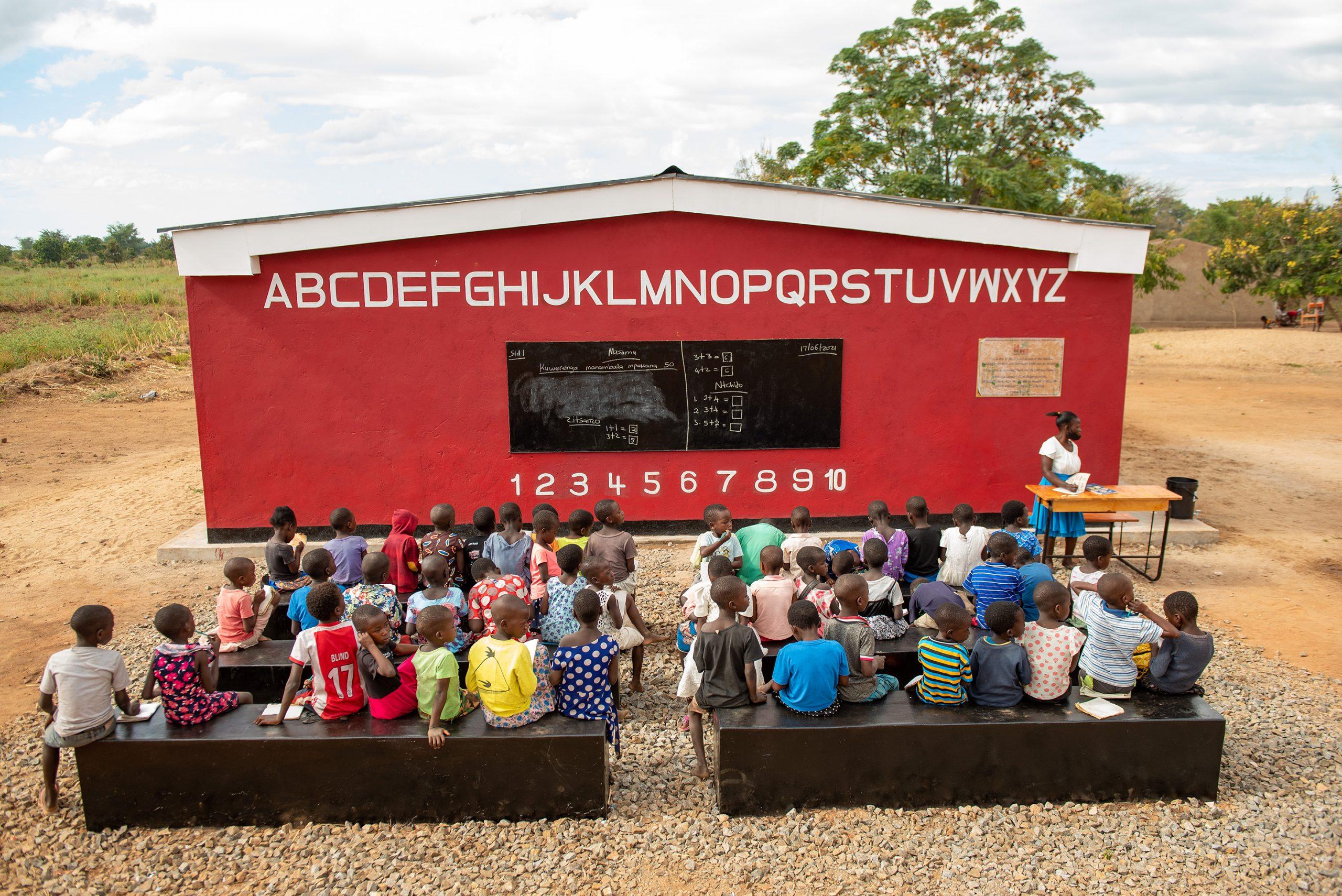
The development of the 3D-printed school demonstrates how 3D-printed building technology can fundamentally change the economics and speed of delivering education infrastructure. Unlike conventional construction, which depends heavily on labour-intensive processes such as masonry, formwork, and scaffolding, additive manufacturing in construction automates the creation of structural elements through robotic deposition of cement-based materials.
1. Faster Construction
One of the most significant advantages of a 3D printed school is the dramatic reduction in construction timelines. Traditional school construction projects typically involve sequential stages, including formwork fabrication, reinforcement placement, concrete pouring, curing, and masonry installation. Each of these phases requires manual labour and coordination between multiple subcontractors.
In contrast, 3D printing building technology uses robotic systems that deposit structural material layer by layer according to computer-controlled design models. For the world’s first 3D-printed school project, the classroom wall structure was printed in approximately 18 hours. This speed represents a major productivity gain compared with conventional masonry construction, which can take several weeks to complete similar structural elements.
2. Cost Efficiency
Cost control in construction remains one of the most important factors influencing infrastructure investment decisions. In conventional construction, labour costs often account for a significant share of project expenditure, particularly in urban environments where skilled labour commands higher wages.
Automation reduces labour requirements, while precise material deposition reduces waste. According to the World Economic Forum, digital construction technologies could reduce project costs by up to 20% in certain scenarios.
3. Sustainability
Sustainability has become a central priority in global infrastructure development. The construction industry currently accounts for nearly 40% of global energy-related carbon emissions, according to the International Energy Agency. Technologies that improve construction efficiency and reduce material waste, therefore, play an important role in reducing the sector’s environmental footprint.
The 3D-printed school building in Malawi illustrates how 3D printing in education infrastructure can contribute to sustainability goals. Because additive manufacturing in construction eliminates much of the material waste associated with traditional building methods, fewer raw materials are required to produce the same structural components.
Impact of 3D-Printing on Global Infrastructure Development
The 3D-printed school building illustrates how construction automation and additive manufacturing could help address infrastructure deficits.
1. Solving Classroom Shortages
In regions where millions of students lack adequate learning facilities, students in some countries are forced to learn in overcrowded classrooms or temporary structures that lack adequate safety and ventilation. These conditions undermine educational outcomes and place significant pressure on governments to deliver new school facilities quickly.
Rapid construction methods, such as 3D printing, in education infrastructure offer a scalable solution. The 3D-printed school offers a potential solution to this challenge. By significantly reducing construction time, 3D printed construction for education infrastructure enables governments and development organisations to deliver new classrooms more rapidly than traditional construction methods allow.
2. Emerging Market Applications
Emerging markets represent one of the most promising environments for 3D printed construction projects. Regions such as Africa, Southeast Asia, and Latin America face enormous infrastructure deficits but often lack the financial and logistical capacity to build infrastructure on a scale required by traditional methods.
The 3D-printed school project in Malawi demonstrates how 3D-printed building technology can operate effectively in developing contexts. By reducing reliance on large construction workforces and complex supply chains, additive manufacturing allows infrastructure to be built even in regions with limited construction resources.
3. Disaster Recovery
Natural disasters often destroy critical public infrastructure, including schools and hospitals. Rebuilding these facilities quickly is essential to restoring community services and supporting economic recovery.
The speed and automation of 3D-printed construction projects make the technology particularly well-suited for disaster recovery. Mobile construction printers can be deployed rapidly to disaster-affected areas and used to construct replacement buildings within days or weeks.
Challenges of 3D Printed Construction
Despite its transformative potential, 3D printing building technology remains in the early stages of global adoption. Several technical, regulatory, and economic challenges must be addressed before 3D printed construction projects become a mainstream infrastructure delivery method. The experience of the world’s first 3D-printed school project offers valuable insights into these barriers and how the industry can overcome them.
1. Regulatory and Building Code Barriers
One of the biggest obstacles to the adoption of additive manufacturing in construction is the lack of established regulatory frameworks. Most building codes were developed for traditional methods such as reinforced concrete and masonry.
Because 3D-printed buildings rely on diverse structural configurations and material-deposition processes, regulators must determine how these systems comply with existing safety standards. In many jurisdictions, approvals still require detailed engineering analysis and case-by-case review.
Organisations such as the International Organisation for Standardisation (ISO) and ASTM International have begun developing standards for additive manufacturing in construction, but comprehensive global regulations are still evolving.
2. Technology Adoption Challenges
The infrastructure required to support 3D printed buildings worldwide remains limited. Large-scale construction printers are expensive and require specialised transportation, installation, and operational expertise. Material supply chains are also still developing. The concrete used in 3D printing building technology must meet strict requirements for flowability, extrusion consistency, and rapid strength gain.
For many contractors, the high capital investment needed to acquire printing systems and train personnel remains a barrier. Until costs decline and the technology matures, 3D printed construction projects will likely remain concentrated in pilot and demonstration initiatives.
3. Skills and Workforce Requirements
The workforce required to deliver a 3D-printed project differs significantly from traditional construction labour models. Instead of large crews of masons and labourers, additive manufacturing projects rely on engineers, robotics specialists, and digital construction technicians.
These professionals require expertise in computer modelling, materials science, and the operation of robotic systems. Developing this specialised workforce will require investment in training and education. As 3D-printed construction for educational infrastructure expands, universities and engineering institutions are expected to introduce programmes focused on digital construction technologies.
Future of 3D Printed Infrastructure
The successful completion of the world’s first 3D printed school project signals the beginning of a broader transformation in the construction industry. As 3D printing technology in construction matures, engineers increasingly view additive manufacturing as a viable tool for delivering large-scale infrastructure.
For governments and developers, the key significance of the 3D-printed school lies in its scalability. Once robotic printers, material supply chains, and digital design workflows are established, the same technology can be deployed across multiple project types.
Expansion into Housing Projects
One of the most immediate opportunities for 3D printing building technology lies in the global housing sector. Rapid urbanisation has created severe housing shortages, particularly in emerging economies. According to the United Nations, more than one billion people live in informal or inadequate housing conditions. Delivering housing at the required scale using conventional construction methods remains difficult.
This is where 3D printed construction projects could offer major benefits. By automating structural wall construction and reducing labour dependency, additive manufacturing in construction can accelerate housing production while maintaining structural durability.
Projects across Europe, the United States, and the Middle East already demonstrate this potential. These developments show how the principles used in the 3D printed school building could be applied to large-scale residential programmes.
Large Infrastructure Possibilities
Beyond housing and schools, 3D printing building technology could eventually support a wide range of public infrastructure. Engineers are exploring applications in hospitals, transportation facilities, and government buildings.
Healthcare facilities are particularly promising. Hospitals often require rapid deployment in regions experiencing population growth or public health emergencies. 3D printed construction projects could significantly reduce delivery timelines.
Public buildings such as community centres, administrative facilities, and emergency response structures may also benefit from 3D-printed structures. The digital design flexibility of additive manufacturing in construction allows architects to create complex geometries without increasing construction difficulty.
Researchers are also investigating 3D printed bridges and structural infrastructure, suggesting the technology could extend beyond buildings into broader civil engineering applications.
Integration with Smart Construction Technologies
The future of the 3D-printed school model will depend heavily on its integration with other digital construction technologies. The most promising opportunities involve combining 3D printing building technology with Building Information Modelling (BIM), artificial intelligence, and robotics.
BIM platforms allow engineers to develop detailed digital models that can be translated directly into printing instructions for robotic systems. This ensures 3D printed construction projects maintain precise dimensional accuracy and structural performance. Artificial intelligence may also optimise printing operations. Machine learning algorithms can analyse construction data to improve material deposition, structural efficiency, and energy use.
Meanwhile, robotic automation will continue to enhance the precision and reliability of additive manufacturing in construction, gradually creating a fully integrated digital construction ecosystem.
Further Reading: 3 Revolutionary Automation and Autonomy Trends: Human Replacement?
Global Outlook for 3D Printed Construction
The 3D-printed school has attracted global attention because it demonstrates how 3D-printed building technology can address real-world infrastructure challenges. Governments, development agencies, and construction firms are increasingly exploring how additive manufacturing in construction could reshape infrastructure delivery.
The construction industry has historically struggled with productivity growth. Studies by McKinsey & Company show the sector has lagged behind other industries in efficiency improvements. Technologies such as 3D printed construction projects, therefore, represent a major opportunity to modernise the sector. As the technology matures, 3D-printed buildings worldwide may become increasingly common.
Growing Investment in Construction Automation
Investment in construction automation has grown rapidly over the past decade. Governments and private investors recognise that digital technologies can improve project delivery efficiency and reduce risk.
Several countries have introduced strategies to modernise construction through digitalisation and automation. Many of these initiatives include research support for 3D printing, new building technology to cut costs for builders, and additive manufacturing in construction.
Infrastructure funds and development finance institutions have also shown interest in 3D printed construction projects, recognising their potential to accelerate infrastructure delivery and improve project economics. The world’s first 3D printed school project illustrates how public-private partnerships can accelerate innovation in construction technology.
Industry Adoption Trends
Construction companies are gradually incorporating 3D printing building technology into their innovation strategies. Although traditional methods remain dominant, many contractors are testing additive manufacturing in construction through pilot projects.
Engineering firms and technology startups are collaborating to develop advanced 3D printers capable of producing larger, more complex structures. These developments are expanding the potential applications of 3D-printed construction projects.
Universities and research institutions also play a key role by studying the structural behaviour of 3D printed school buildings and other printed structures to improve design standards and material performance. As more projects demonstrate the feasibility of 3D printed buildings worldwide, industry adoption is expected to accelerate.
Long-Term Potential for Infrastructure Development
The long-term potential of 3D printing building technology lies in its ability to fundamentally reshape infrastructure delivery. By combining automation, digital design, and advanced materials, additive manufacturing in construction could significantly increase productivity across the sector.
For developing economies, the implications are especially significant. Countries facing large infrastructure deficits could use 3D printed construction for education infrastructure and housing to deliver essential facilities faster and at lower cost.
The 3D-printed school, therefore, represents an early demonstration of a technology that could eventually transform how governments deliver schools, hospitals, and housing to rapidly growing populations.
Lessons from the World’s First 3D Printed School
The world’s first 3D-printed school project offers valuable insights for engineers, architects, contractors, and infrastructure planners exploring the future of 3D-printed building technology. Although modest in size, the project demonstrates how additive manufacturing in construction can deliver practical infrastructure.
1. Proof of Real-World Viability
The project confirms that 3D printed construction projects can move beyond experimental prototypes to deliver functional infrastructure. The 3D-printed school building demonstrates that additive manufacturing can meet real engineering and safety requirements.
Key takeaways include:
- 3D printing building technology can deliver operational public buildings.
- Printed structures can meet engineering performance standards.
- Construction can occur in real project environments.
2. Collaboration Drives Innovation
Delivering 3D printed buildings worldwide requires expertise across several disciplines. Successful projects depend on collaboration between:
- Construction firms.
- Robotics and technology companies.
- Structural engineers and architects.
- Materials science specialists.
- Government and development organisations.
3. Addressing Infrastructure Gaps
The 3D-printed school also highlights how innovation can help address global infrastructure shortages. 3D printing in education infrastructure can:
- Accelerate emergency facilities construction.
- Reduce building costs.
- Expand classroom access in underserved regions.
As 3D-printed construction projects expand, lessons from this project will help engineers improve materials, refine printing techniques, and develop regulatory frameworks that support the wider adoption of additive manufacturing in construction.
Technical Benchmark: 3D Printed School Development Model
| Component |
Strategic Insight |
| Technology | Uses large-scale robotic additive manufacturing systems that deposit specialised concrete mixtures layer-by-layer based on digital CAD/BIM models, reducing reliance on traditional formwork and manual masonry. |
| Construction Speed | Structural wall systems can be printed within 18–48 hours, depending on building size, significantly faster than the timelines for conventional masonry or cast-in-place concrete construction. |
| Cost Efficiency | Reduces labour requirements by up to 50–70% and minimises material waste through precise automated deposition, improving overall construction efficiency. |
| Infrastructure Impact | Enables rapid and scalable delivery of public infrastructure, particularly schools and housing, helping address construction deficits in fast-growing regions and emerging markets. |
Construction: The Strategic Future of Additive Construction
The world’s first 3D printed school project represents a significant milestone in the evolution of the construction industry. By demonstrating how 3D printing building technology can deliver essential infrastructure quickly and efficiently, the project provides a practical example of how additive manufacturing in construction could reshape global building practices.
For governments, engineers, and investors, the implications extend far beyond education infrastructure. As 3D printed construction projects continue to evolve, they may become a central tool for addressing infrastructure shortages in housing, healthcare, and public facilities. The 3D printed school building, therefore, stands not only as a technological innovation but also as a blueprint for how digital construction methods can support sustainable infrastructure development worldwide.
CTA – Construction Technology Insights
Explore more construction technology innovations at Construction Frontier. Stay informed about 3D printing building technology, global megaprojects, and engineering breakthroughs shaping the future of infrastructure. Construction Frontier delivers expert analysis and industry intelligence for engineers, contractors, developers, and infrastructure decision-makers.