

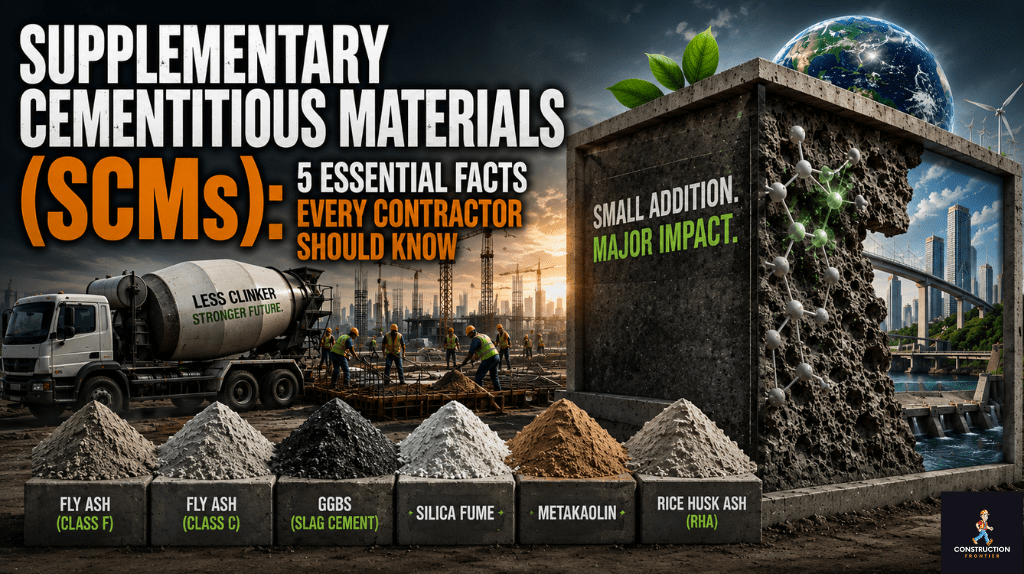
Supplementary Cementitious Materials (SCMs): 5 Valuable Facts Every Contractor Should Know
Supplementary cementitious materials (SCMs) are inorganic cement-replacement materials added to concrete to partially replace Portland cement, providing strength, durability, and sustainability benefits through their pozzolanic or hydraulic activity. Used on every continent and across infrastructure sectors from bridges to marine structures, SCMs reduce clinker demand, cut CO₂ emissions, and produce denser, longer-lasting concrete. Global cement manufacturing accounts for roughly 8% of total CO₂ emissions, making SCMs one of the most technically immediate sustainable cement materials available to contractors and specifiers.
Technical Snapshot: Core SCM Specifications
| SCM Type | Typical Cement Replacement | Primary Mechanism | Key Benefit |
| Fly Ash (Class F) | 15–30% | Pozzolanic | Long-term strength, ASR mitigation |
| Fly Ash (Class C) | 15–40% | Pozzolanic + Hydraulic | Early strength, workability |
| GGBS (Slag Cement) | 30–70% | Latent hydraulic | Durability, low heat of hydration |
| Silica Fume | 5–10% | Pozzolanic (highly reactive) | High strength, chloride resistance |
| Metakaolin | 10–20% | Pozzolanic | Microstructure densification |
| Rice Husk Ash (RHA) | 10–20% | Pozzolanic | Sustainability, permeability reduction |
From housing schemes to heavy infrastructure, specifying the right supplementary cementitious materials transforms project economics and concrete service life. Understanding their chemistry, dosage limits, and interaction effects is a non-negotiable competency for contractors competing on quality and carbon performance.
Introduction: Supplementary Cementitious Materials (SCMs)
Concrete performance begins long before the first pour. The binder system selected at the mix design stage determines how a structure resists chemical attack, thermal stress, and long-term loading, which is why supplementary cementitious materials have moved from niche additives to mainstream specification tools. Whether a contractor is casting a foundation slab, a bridge deck, or a coastal retaining wall, the choice between pure Portland cement and a blended system incorporating SCMs in concrete carries measurable consequences for strength development, permeability, heat generation, and project cost.
Cement manufacturing accounts for roughly 8% of global CO₂ emissions, and pressure on the construction industry to reduce that figure is intensifying. Supplementary cementitious materials sit at the intersection of structural performance and sustainability: they improve the concrete while reducing the clinker content that drives emissions. For African and emerging-market contractors operating under tightening procurement standards and green finance requirements, understanding these materials is no longer optional.
For engineers who need to understand how cement choices translate into structural performance across different applications, the article explaining types of cement and their applications in construction provides an essential reference framework for the decisions that precede SCM selection.
What Every Contractor Needs to Know About SCMs
Not every contractor encounters supplementary cementitious materials on the same terms. Some meet them first through a client sustainability specification; others discover them when a mix design targets low heat of hydration or chloride resistance. In all cases, the knowledge gap between familiarity and confident application carries real risk. Under-dosing wastes the durability benefit; over-dosing without adjusting curing extends programme timelines. Specifying the wrong SCM type for the exposure environment results in concrete that meets 28-day strength targets but fails in service.
The five facts below address the gaps that most commonly create problems on site and at the specification stage: what SCMs actually are and how they react, which types are available and at what dosages, how they improve concrete durability, what sustainability advantages they deliver, and why dosage and mix design discipline determine whether those advantages materialise.
Fact 1: What Supplementary Cementitious Materials Actually Are
The term ‘supplementary cementitious materials’ covers any inorganic material that contributes to the properties of a cementitious mixture through hydraulic or pozzolanic activity, or both. That definition, codified in ASTM C125 Standard Terminology Relating to Concrete and Concrete Aggregates, separates SCMs from inert fillers and from chemical admixtures. The distinction matters because SCMs chemically participate in the hardening process rather than simply modifying workability or accelerating set time.
Two reaction pathways define SCM behaviour. Hydraulic SCMs, primarily ground granulated blast-furnace slag (GGBS), react directly with water to form cementitious products. Pozzolanic SCMs, including fly ash, silica fume, metakaolin, and rice husk ash, require calcium hydroxide (CH) as a co-reactant. When Portland cement hydrates, it produces both calcium silicate hydrate (C-S-H) gel (the primary strength-giving compound) and calcium hydroxide as a by-product. Pozzolans consume that CH and convert it into additional C-S-H. The result: a denser paste matrix, reduced porosity, and improved durability without increasing clinker content.
Understanding what supplementary cementitious materials are in concrete is the first step toward confident specification.
The National Academies 2025 synthesis on SCM use in concrete provides one of the most comprehensive recent assessments of how these reaction pathways translate into infrastructure performance across thousands of documented applications. This pozzolanic conversion explains several SCM characteristics that confuse contractors encountering them for the first time. Strength gain is slower at early ages because the reaction depends on CH availability, which builds as Portland cement hydrates. At 28 days and beyond, pozzolanic concretes typically match or exceed the performance of straight Portland cement mixes at equivalent water-to-binder ratios.
Contractors specifying SCMs for the first time should also understand the difference between binary and ternary blends. A binary blend incorporates one SCM alongside Portland cement. A ternary blend uses two SCMs simultaneously, allowing their respective strengths to compensate for each other’s limitations. For example, slag cement provides long-term durability and thermal control; adding a small proportion of silica fume compensates for its slower early strength gain. Understanding how cement grades and types are classified provides important context for matching SCM blends to specification requirements.
Fact 2: The Main Types of Supplementary Cementitious Materials and Their Properties
Each SCM carries a distinct chemical fingerprint that determines how it performs in concrete. Selecting the right type demands more than familiarity with generic categories: it requires understanding reactivity, dosage limits, and how specific materials interact with cement chemistry. The types of SCMs used in cement production fall into two broad categories, pozzolanic and hydraulic, with most commercially available options belonging to the former. The American Cement Association’s cement and concrete FAQ provides a practical overview of how blended cements and SCMs are categorised under current North American standards.
1. Fly Ash
Fly ash, the fine residue captured from coal-fired power plant exhaust, ranks as the most widely used SCM globally, and it falls into two classes based on its behavior. Class F fly ash, derived from bituminous and anthracite coals, contains a combined silica, alumina, and iron oxide content exceeding 70% and exhibits purely pozzolanic properties. Class C fly ash, from sub-bituminous and lignite coals, contains higher calcium oxide levels and demonstrates both pozzolanic and self-cementing hydraulic activity.
Class F is typically used at 15 to 30% cement replacement; Class C at up to 40%. Both classes must conform to ASTM C618, the Standard Specification for Coal Fly Ash and Natural Pozzolan for Use in Concrete. Fly ash improves workability, reduces water demand, delays set time (an advantage in hot-weather concreting), and delivers superior long-term strength development and alkali-silica reaction (ASR) mitigation.
2. Ground Granulated Blast-Furnace Slag (GGBS)
GGBS originates as a by-product of iron manufacture. Molten slag quenched rapidly with water produces glassy granules that, when ground to a fine powder, exhibit latent hydraulic properties. Without activation, GGBS reacts slowly; in combination with Portland cement, the alkaline environment accelerates its hydration. Replacement levels range from 30 to 70% of total binder content. Slag cement concrete achieves higher long-term compressive strength, significantly reduced permeability, superior sulphate and chloride resistance, and lower heat of hydration: a critical advantage in mass concrete pours where thermal cracking is a genuine design risk.
3. Silica Fume
Engineers recover silica fume from the exhaust gases of electric arc furnaces used in silicon and ferrosilicon alloy production. Its particle size, roughly 100 times finer than Portland cement, generates enormous specific surface area and exceptional pozzolanic reactivity. Replacement levels typically sit at 5 to 10%; above 10%, workability penalties become significant without a corresponding superplasticiser dose. Even at low dosages, silica fume dramatically reduces chloride permeability and fills capillary pores in the cement paste.
Research by Academia’s SCM Research Database and the Science Space Civil Engineering Archive, comparing binary mixes, confirms that silica fume at 10% replacement achieves higher compressive strength than equivalent GGBS or fly ash substitutions in short-term tests. For contractors working in coastal environments, silica fume is the primary defence against chloride-induced reinforcement corrosion. Those decisions also connect to cement type selection; the article covering OPC versus PPC cement differences examines how base cement choice shapes the overall binder system.
4. Metakaolin
Calcining kaolinite clay at temperatures between 600 and 800 degrees Celsius produces metakaolin (MK), a manufactured SCM with highly controlled chemistry. Unlike fly ash and GGBS, its consistent composition makes it attractive where predictable performance is essential. Replacement levels of 10-20% by cement mass improve early- and long-term compressive, tensile, and chloride-resistance strengths. Research confirms that ternary blends incorporating metakaolin and GGBS at 25% and 50%, respectively, deliver significant microstructural densification and reduced permeability. Metakaolin suits markets where fly ash or slag cement supply is constrained.
5. Rice Husk Ash (RHA)
Controlled combustion of rice husks yields rice husk ash (RHA), an agricultural by-product with a silicon dioxide content exceeding 85%. At 10-20% replacement, RHA enhances the formation of C-S-H gel, reduces concrete porosity, and improves resistance to chloride ingress and chemical attack. Its relevance in African and Asian markets stems from agricultural abundance and low cost compared to imported silica fume. RHA typifies the category of agro-industrial sustainable cement materials that offer viable pathways for cement replacement in regions where conventional SCM supply chains are underdeveloped.
Further Reading: 6 Cement Grades: The Ultimate Guide to Types, Strengths and Uses in Construction
Fact 3: How Supplementary Cementitious Materials Improve Concrete Durability
Durability performance separates competently designed SCM concrete from plain Portland cement mixes in nearly every aggressive exposure category. The mechanisms are interconnected, operating at the microstructural level to restrict the movement of water, ions, and reactive species through the paste. The benefits of SCMs in construction projects with harsh exposure conditions are most evident when specifiers select the appropriate SCM type for the dominant deterioration mechanism. A peer-reviewed review of SCM effects on hydraulic concrete durability confirms that fly ash, GGBS, silica fume, and rice husk ash each address distinct deterioration pathways through the same underlying mechanism: pore structure refinement.
1. Permeability Reduction
The pozzolanic reaction converts calcium hydroxide into additional C-S-H gel, consuming the most soluble and leachable compound in the paste matrix while filling capillary pores. The result is a measurable reduction in water and gas permeability. Rapid chloride permeability test (RCPT) data illustrate this clearly: fly ash concrete tested at 40 days of curing achieves passing charges as low as 567 coulombs, classifying as very low permeability, compared to 2,224 coulombs at 1 day of curing, which rates as moderate. Silica fume concrete reaches similarly low values.
2. Chloride Resistance
Chloride ingress is the dominant durability threat to reinforced concrete in coastal zones, marine environments, and de-icing salt exposure. Fly ash, silica fume, and GGBS all substantially reduce chloride diffusion coefficients. Research on ternary blends confirms that the most effective combinations for chloride resistance pair silica fume with either GGBS or fly ash, as the fume’s pore-blocking effect compounds the slag’s sustained permeability reduction over time.
3. Alkali-Silica Reaction Mitigation
ASR occurs when reactive silica in certain aggregates reacts with alkalis in Portland cement pore solution, producing an expansive gel that cracks concrete from within. SCMs dilute the alkali content of the binder and consume calcium hydroxide, starving the reaction of both its trigger and its product. Class F fly ash is particularly effective, with research on rhyolite aggregate concrete showing that 20% fly ash replacement delivers the most significant ASR expansion reduction and the highest electrical resistivity among the SCMs tested.
4. Sulphate Resistance
Sulphate attack dissolves and disrupts hydrated cement compounds through expansive secondary reactions. GGBS and fly ash both reduce the content of reactive aluminate phases and calcium hydroxide in the paste, lowering the concentrations of sulphate ions required to initiate destructive ettringite formation. External sulfate resistance improves with proper proportions of silica fume, fly ash, natural pozzolans, and slag cement, operating through dual mechanisms: permeability reduction and reactive-phase dilution.
5. Thermal Cracking Control
Mass concrete placements generate heat as cement hydrates. When the temperature differential between the core and surface exceeds roughly 20 degrees Celsius, thermal cracking occurs. GGBS and fly ash both lower the rate and peak of hydration heat, reducing that risk without sacrificing long-term strength. This property makes them essential in dam walls, bridge piers, raft foundations, and other mass concrete elements. The selection of bulk or bagged cement supply also affects mix design feasibility, as explored in the analysis of bulk versus bagged cement for project preferences.
Fact 4: SCMs Deliver Measurable Sustainability Benefits
Cement manufacturing generates approximately 8% of global CO₂ emissions, with process-related emissions from clinker calcination accounting for roughly 60% of that total. SCMs address this directly by reducing the clinker-to-cement ratio: every tonne of clinker replaced by a cement replacement material eliminates the associated calcination emissions and the energy consumed in kiln operation.
The International Energy Agency’s cement sector analysis identifies increased SCM use alongside carbon capture as one of the two primary levers to put cement sector emissions on a net-zero trajectory by 2050. Industry projections confirm that meaningful clinker substitution, combined with efficiency improvements, is more economically immediate than full carbon capture deployment. Production costs for early commercial near-zero-emission cement plants using CCS are estimated to be 75 to 150% above those of conventional facilities, while SCM blending requires no new production infrastructure.
Beyond carbon, SCMs redirect industrial waste streams. Fly ash would otherwise be landfilled from coal power plants. GGBS is a by-product of iron production. Silica fume exists in the electric arc furnace exhaust. Deploying these materials in concrete converts industrial waste into performance inputs, reducing landfill volumes while strengthening the concrete that receives them. The broader trend toward green cement technologies in Africa and emerging markets reinforces this trajectory, with sustainable cement materials occupying a central role in decarbonisation strategies across rapidly urbanising economies.
For contractors, the financial case for SCMs extends beyond reduced cement purchase cost. Specification of high-SCM mixes increasingly unlocks green building certification credits, satisfies public procurement sustainability criteria, and aligns with lender requirements tied to environmental, social, and governance performance. Projects seeking EDGE, LEED, or BREEAM credits treat SCM content as a quantifiable input, not an optional consideration. The GCCA Cement Industry Net Zero Progress Report documents how SCM adoption integrates with the global cement sector’s decarbonisation commitments, a framework increasingly referenced by infrastructure lenders and green procurement bodies.
Further Reading: Top 15 Green Building Materials: Sustainable Choices for a Better Future
Fact 5: Correct Dosage and Mix Design Are Non-Negotiable
SCMs deliver their documented benefits only within specific dosage windows and under appropriate curing conditions. Misapplication produces concrete that is weaker at critical early ages, more susceptible to plastic shrinkage cracking, or slower to achieve demoulding strength. All of those outcomes create programme and cost exposure on site.
1. Dosage Limits and Optimum Replacement Levels
Research across 136 publications and 1,456 mix designs confirms consistent trends. SCM-to-binder ratios above 0.80 to 0.85 reduce the positive influence on chloride resistance and freeze-thaw durability. Fly ash at 25 to 30% replacement and slag cement (GGBS) at 50 to 55% by cement weight represent the safe operating ranges for most structural applications, as cited in peer-reviewed literature. Silica fume above 10% without a superplasticiser significantly reduces workability. These are not theoretical limits: they reflect the point at which unreacted SCM particles begin acting as filler rather than contributing to the binder matrix.
2. Curing Regime
Pozzolanic reactions are moisture-dependent and slower than Portland cement hydration. Concrete incorporating fly ash or natural pozzolans requires extended moist curing to achieve full pozzolanic reactivity. Premature drying interrupts the reaction chain, producing a surface layer that is weaker than the design intent. For high-SCM mixes in hot or arid climates, curing duration should extend beyond the standard 7 days, particularly for formed surfaces and slabs.
3. Compatibility with Cement Type
The performance of any SCM depends partly on the Portland cement it blends with. Cement alkali content, C₃A phase proportion, and fineness all affect the rate at which pozzolanic reactions begin and the extent to which they develop. Contractors specifying blended systems for the first time should trial mixes and confirm workability, set time, and early strength against project requirements before committing to production batching. The question of how supplementary cementitious materials improve concrete durability also depends on matching the cement type to the exposure environment: the article examining the best cement for home construction covers this trade-off in practical residential and light commercial contexts.
4. Binary vs Ternary Blends in Practice
Bridge deck specifications frequently call for ternary blends precisely because single-SCM binary systems involve trade-offs. GGBS reduces permeability and heat of hydration but slows early strength gain. Adding silica fume at 5-8% compensates for that early weakness, while the GGBS fraction provides long-term durability. Ternary formulations allow specifiers to target a specific performance envelope rather than accepting the limitations of any individual cement replacement material.
Conclusion: SCMs Are a Specification Decision, Not an Afterthought
Supplementary cementitious materials have earned their place at the centre of modern concrete specification, not as a sustainability gesture, but as a technically superior approach to building durable, cost-effective structures. The evidence across thousands of mix designs is unambiguous: the right SCM at the right dosage, in the right curing environment, outperforms plain Portland cement concrete in permeability, chloride resistance, sulphate resistance, and long-term strength. It does so while cutting clinker consumption and redirecting industrial waste from landfill into the built environment.
The contractor who treats SCMs as interchangeable fillers or selects them solely on cost, without accounting for curing requirements and cement compatibility, will not capture those benefits. Fly ash, GGBS, silica fume, metakaolin, and rice husk ash each solve a specific problem in concrete. Matching the material to the exposure condition, specifying the correct replacement level, and maintaining extended moist curing are the three non-negotiable disciplines that convert SCM chemistry into field performance.
Africa’s infrastructure pipeline demands concrete that lasts. Coastal highways, bridge decks over aggressive soils, water treatment structures, and mass concrete dam walls all operate in environments where plain Portland cement concrete reaches its durability limits within a fraction of its design life. Supplementary cementitious materials close that gap. Contractors and specifiers who build fluency with these materials now position themselves ahead of the procurement and regulatory curve that is already tightening across the continent’s major markets.
Build Stronger and More Sustainable Concrete Systems
Explore Construction Frontier: Construction & Building Materials for expert insights, technical guidance, and practical analysis on cement, supplementary cementitious materials, concrete technology, and sustainable construction materials.

One Comment