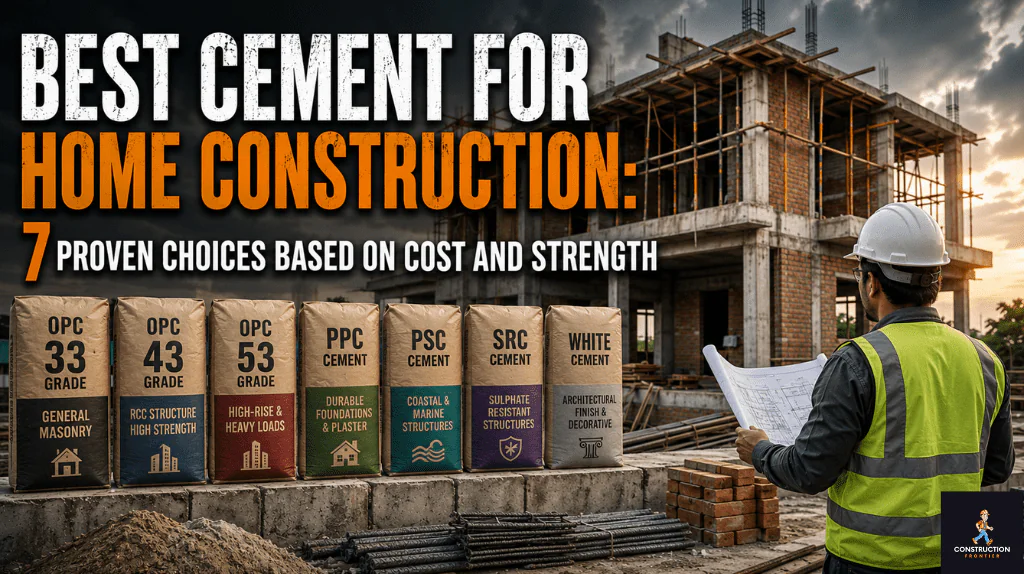
Best Cement for Home Construction: 7 Proven Choices Based on Cost and Strength
The best cement for home construction is not a single product but a set of technically matched choices determined by structural elements, site conditions, and project budget. Portland Pozzolana Cement dominates residential foundations and plasterwork across humid and tropical markets, while OPC 43 anchors structural RCC frames; together, they account for the majority of material demand in a standard residential build. Seven cement types serve distinct roles in residential construction, with compressive strengths ranging from 33 N/mm² at 28 days for general masonry grades to over 53 N/mm² for high-load structural elements. Selecting the wrong type increases long-term repair liability and can reduce structural service life by a decade or more.
Technical Snapshot: Core Cement Specifications for Home Construction
| Topic | Best cement for home construction |
| Cement Types Covered | OPC 33, OPC 43, OPC 53, PPC, PSC, SRC, White Cement |
| Strength Range | 33 N/mm² (OPC 33 / PPC / PSC) to 53+ N/mm² (OPC 53) at 28 days |
| Primary Structural Use | OPC 43 for RCC frames; PPC for foundations and masonry |
| Best for Foundations | PPC (standard soils) / PSC (coastal) / SRC (sulphate-aggressive soils) |
| Cost Positioning | PPC and PSC: 5–10% below OPC; SRC and White Cement carry a premium |
| Applicable Standards | IS 269:2015 (OPC), IS 1489:2015 (PPC), IS 455:2015 (PSC), IS 12330 (SRC) |
| Primary Markets | Emerging markets, Africa, South Asia, tropical and coastal regions |
Choosing the best cement for home construction on a structural and environmental basis rather than brand preference or price alone is the single highest-impact material decision in residential project delivery. The seven types covered here give engineers, self-builders, and procurement teams a verified reference for matching cement type to every element of a residential structure.
Introduction: Cement Technology, Types & Applications
Every structural failure in residential construction traces back to a decision made before the first mix was poured. The best cement for home construction determines whether a house survives forty years of load cycling and weather exposure or begins cracking within a decade. Cement selection is not a procurement formality; it is a structural decision with consequences that outlast the project team. Understanding how cement types govern structural performance establishes the technical foundation for every subsequent cement choice.
Seven cement types serve the full range of residential construction needs. Each carries a distinct strength profile, chemical-resistance characteristics, cost position, and application envelope. This article maps all seven against the structural demands of a home build so that selection becomes a verified technical decision rather than a commercial default.
Why Cement Choice Defines Residential Structural Performance
Residential structures impose specific, layered demands on the cement used to build them. Foundations resist continuous groundwater pressure and soil chemical attack. Slabs absorb cyclic live loads from occupancy. Columns and beams transfer axial and lateral forces through reinforced concrete frames. Plastered walls and tile finishes are subject to moisture, thermal cycling, and mechanical wear. Each element requires a cement matched to its performance profile, not simply one that achieves adequate compressive strength at 28 days. The Bureau of Indian Standards classifies OPC, PPC, and PSC under separate specifications precisely because each type addresses a fundamentally different performance requirement in construction.
The cost of cement for home building depends directly on the type selected. Blended cements such as PPC and PSC undercut OPC pricing by 5 to 10 per cent per bag, a margin that compounds across the 400 to 600 bags a standard three-bedroom build typically consumes. Understanding how the bulk vs bagged cement procurement format affects unit cost and project logistics further extends the budget impact of type selection across the full project life cycle.
7 Types of Best Cement for Home Construction
The seven cement types below span the complete range of residential construction requirements, from high-load structural RCC work to decorative finishing. Each entry covers compressive strength benchmarks, primary application zones, cost positioning, and the conditions under which that cement type outperforms alternatives. Applying this analysis to a specific project means matching element type to cement type rather than defaulting to a single product across the entire build.
1. OPC 33 Grade: General Plastering and Masonry Mortar
Ordinary Portland Cement at 33 grade achieves a minimum compressive strength of 33 N/mm² at 28 days. Its lower-strength ceiling is a functional advantage in nonstructural work: the slower-setting, more workable mix extends plasterer working time, reduces shrinkage in masonry joints, and produces surface finishes that higher-grade OPC cannot match without the risk of cracking from the elevated heat of hydration. BS EN 197-1 classifies Portland cement (Type CEM I) into 32.5, 42.5, and 52.5 strength classes with distinct compressive-strength requirements, confirming that the lowest class was standardised specifically for workability-sensitive applications where excess strength contributes nothing structurally.
Primary applications: external and internal plaster, masonry mortar for brick and blockwork, floor screeds, and pathway concrete where concrete grades do not exceed M20. The relationship between cement grade and concrete mix performance confirms that over-specifying grade in finishing applications increases the risk of shrinkage cracking without improving structural performance. OPC 33 has the lowest price point in the OPC family, making it the cost-effective choice for finishing-intensive projects with high volume consumption.
2. OPC 43 Grade: The Residential Structural Workhorse
OPC 43 reaches 43 N/mm² at 28 days and achieves approximately 27 MPa within 7 days, allowing early formwork removal without the delays associated with slower blended products. This combination of workability, strength gain rate, and cost positions it as the default structural choice for residential RCC frames across emerging markets. It handles concrete grades from M20 to M25 competently without the thermal cracking risk that higher-grade OPC introduces in mass pours.
Structural applications: floor slabs, precast lintels, low-rise reinforced concrete frames up to G+2, internal columns, and staircase construction. For self-build projects without a dedicated structural engineer, OPC 43 covers the widest range of residential conditions within a single product. OPC is the standard specification for reinforced concrete buildings, bridges, and elements under normal soil conditions, making OPC 43 the appropriate starting specification for standard residential structural RCC work.
Table 1: Cement strength comparison and cost positioning across residential construction types
| Cement Type | 28-Day Strength | Primary Use | Relative Cost |
| OPC 33 | ≥33 N/mm² | Plastering, masonry, mortar | Low |
| OPC 43 | ≥43 N/mm² | General RCC, flooring, precast | Medium |
| OPC 53 | ≥53 N/mm² | Columns, beams, prestressed work | Medium-High |
| PPC | ≥33 N/mm² (gains post-28 days) | Foundations, masonry, coastal | Low-Medium |
| PSC | ≥33 N/mm² (gains to 90 days) | Marine, coastal, chemical zones | Low-Medium |
| SRC | ≥33 N/mm² | Sulphate-rich soils and foundations | High |
| White Cement | Below the OPC structural grades | Decorative finishes, tile grout | Very High |
3. OPC 53 Grade: High-Strength Structural Elements
OPC 53 delivers a minimum of 53 N/mm² at 28 days and targets concrete grades above M25. In residential construction, its application zone is narrow but non-negotiable: heavily loaded columns in multi-storey structures, transfer beams, prestressed lintels, and high-density slabs where the structural engineer specifies M30 or above. The speed of strength gain also justifies its use where formwork must cycle rapidly across multiple floors on a tight construction programme.
The primary technical limitation is the elevated heat of hydration. Thick, continuous pours using OPC 53 accumulate internal thermal stress, which initiates cracking when curing is inadequate. Construction Frontier’s research on OPC vs PPC performance differences for contractors in construction projects confirms that a higher grade does not mean a better outcome across all elements: it produces a narrower, more demanding application window. Residential builders who extend OPC 53 to plastering or masonry waste budgets increase the risk of surface cracking with no compensating structural benefit.
4. Portland Pozzolana Cement (PPC): Durability-First Residential Construction
Portland Pozzolana Cement blends OPC clinker with pozzolanic materials, typically fly ash, at 15 to 35 per cent by mass, producing a cement that develops strength more gradually than OPC but reaches comparable or superior long-term performance while maintaining a significantly lower heat of hydration. The BS EN 197-1 governs fly ash-based Portland-composite cement (Type CEM II/B-V), specifying both the permissible fly ash content range and the minimum strength and durability requirements that make it a code-compliant choice for structural residential applications.
The best cement for foundation slabs and walls in humid climates is PPC across the majority of residential site conditions. Its reduced permeability and chemical resistance extend foundation service life where OPC would require expensive admixtures to achieve equivalent durability. Peer-reviewed research demonstrates that fly ash incorporation reduces chloride ingress by approximately 26.6 per cent compared with plain Portland cement systems, a durability advantage with direct implications for the service life of reinforced residential foundations in humid and coastal environments.
PPC’s workability advantage in masonry and plaster applications, where spherical fly ash particles reduce mix-water demand and improve surface finish, makes it a full-build product on standard projects. It’s a 5 to 10 per cent cost advantage over equivalent OPC grades, further strengthening the economic case. The technical picture confirms that PPC is the preferred specification for non-prestressed residential elements under most market conditions.
Further Reading: 6 Cement Grades: The Ultimate Guide to Types, Strengths and Uses in Construction
5. Portland Slag Cement (PSC): Marine and Aggressive Chemical Environments
Portland Slag Cement (PSC), also known as Blast Furnace Cement (Type CEM III), incorporates granulated blast furnace slag at 25 to 70 per cent by mass alongside OPC clinker and gypsum. BS EN 197-1 sets the constituent requirements for blast furnace cement (Type CEM III), including the minimum slag content threshold that triggers the latent hydraulic reaction responsible for the cement’s durability advantage in aggressive environments. This reaction produces a denser, lower-permeability concrete matrix that resists chloride penetration and alkali-silica reaction more effectively than standard OPC or PPC.
Initial strength development in PSC runs below OPC at 7 days, but the cement continues to gain strength through to 90 days. Research on ternary cements incorporating ground granulated blast-furnace slag confirms superior chloride diffusion resistance over plain Portland cement concrete across both 28-day and 90-day test periods, validating the use of PSC for coastal residential foundations where long-term reinforcement protection outweighs the convenience of faster early strength gain.
The best cement, based on strength and cost for coastal residential builds, is PSC in most markets where it is available because the durability benefit comes at a lower unit price than OPC. The best cement for foundation slabs and walls in areas with high groundwater salinity is PSC or SRC, depending on whether chloride or sulphate attack dominates the site exposure class.
6. Sulphate-Resisting Cement (SRC): High-Sulphate Soil Conditions
Sulphate-Resisting Cement (SRC) restricts tricalcium aluminate to below 5 per cent, preventing the expansive ettringite formation that occurs when standard cement reacts with sulphate ions in aggressive soils or groundwater. Published research on sulphate attack mechanisms confirms that secondary ettringite formation generates crystallisation pressures that exceed the tensile strength of hardened cement paste, causing cracking and spalling in foundations exposed to sulphate-bearing ground conditions when chemical-resistant cement is not used.
BS EN 197-1 Type CEM I-SR 3 (or Type CEM I-SR 0) governs sulphate-resisting cement specifications, setting strict chemical composition limits, such as restricting the tricalcium aluminate clinker content C3A to ≥ 3% or 0% by mass to define the cement’s sulphate-resistance mechanism. Where a site investigation identifies sulphate class 3 or above, SRC in foundation elements is not optional: standard OPC deteriorates through this expansion mechanism within 10 to 15 years. Studies on mineral admixtures and sulphate resistance confirm that concrete made with sulphate-resistant formulations shows significantly lower permeability than standard OPC, with direct implications for the long-term structural integrity of residential foundations on chemically aggressive sites.
SRC commands a price premium over OPC and blended cements, so its use is restricted to elements in direct contact with aggressive ground. One critical limitation: SRC does not perform well where chloride and sulphate attack combine. In that combined-exposure scenario, OPC with a C3A content of 5 to 8 per cent provides a more balanced level of resistance than a pure SRC specification.
7. White Cement: Decorative and Finishing Applications
White cement is manufactured from raw materials with very low iron and manganese content, eliminating the grey colouration of standard Portland cement. The thermal energy consumption of white cement production is approximately twice that of grey cement manufacture, which directly drives a 300-500 per cent price premium over standard grades. That cost reflects purity and process complexity, not superior structural performance.
Correct application: tile grout, decorative wall finishes, architectural façade elements, terrazzo flooring, and pigmented render where visual consistency matters as much as function. White cement provides the clean base colour that grey OPC cannot produce for tinted or exposed finishes. Specifying it for foundations, slabs, or columns is a category error that introduces unnecessary cost for no structural gain.
How to Choose the Best Cement for Home Construction
Choosing the best cement for home construction involves considering four decision variables in sequence: structural demand, environmental exposure, construction timeline, and project budget. No single cement scores optimally across all four simultaneously, which is why professional residential specifications typically call for two or three cement types across different element categories. The subsections below address each variable and provide a direct selection matrix for on-site application.
Match Cement to Structural Element
Foundation and raft slabs on standard soil: PPC for chemical resistance at a lower cost than OPC. Columns, beams, and transfer slabs in multi-storey frames: OPC 53 where M30 or above is specified; OPC 43 for M20 to M25 work. Masonry mortar and plaster: OPC 33 or PPC, with PPC preferred where workability and finish quality are priorities. Coastal or marine-exposure foundations: PSC or SRC, depending on whether chloride or sulphate attack dominates. Decorative grout and surface finishes: white cement where appearance justifies the premium.
Table 2: Cement selection guide by residential structural element
| Structural Element | Recommended Cement | Concrete Grade | Key Reason |
| Raft/strip foundation | PPC or PSC | M20–M25 | Chemical resistance, low heat of hydration |
| Columns and beams | OPC 43 or OPC 53 | M25–M35 | Early and ultimate strength |
| Suspended slabs | OPC 43 or OPC 53 | M25–M30 | Strength under cyclic load |
| Masonry mortar | OPC 33 or PPC | M5–M10 mortar | Workability, bond strength |
| External plaster | OPC 33 or PPC | N/A | Crack resistance, surface finish |
| Coastal foundations | PSC or SRC | M20–M25 | Chloride and sulphate resistance |
| Decorative finishes | White Cement | N/A | Aesthetic finish quality |
Evaluate Site and Environmental Conditions
When selecting the best cement for home construction, environmental exposure governs long-term durability more than the compressive strength grade does. A PPC foundation achieving 30 N/mm² on a moderate site outperforms a 53 N/mm² OPC foundation on sulphate class 3 ground without chemical resistance. The American Concrete Institute’s (ACI’s) guidance on durable concrete identifies sulphate attack through ettringite and gypsum formation as a primary deterioration mechanism, confirming that site chemistry must inform foundation cement specification before strength grade is even considered.
Coastal and high-humidity sites require PSC or PPC, both of which deliver chloride resistance that standard OPC cannot achieve without admixtures. Sulphate-aggressive soils demand SRC for elements in direct soil contact. Tropical climates with prolonged wet seasons favour PPC to reduce moisture-driven degradation in above-grade elements. How to choose the best cement for home construction in these conditions reduces to one principle: site conditions determine chemical-resistance requirements, and understanding how OPC and PPC differ in their responses to environmental exposure is central to ensuring the cost of cement for home building delivers long-term structural value.
Factor in the Budget and Timeline
Timeline pressure favours OPC grades, where faster strength gain allows earlier formwork removal and faster floor cycles on multi-storey residential projects. When the construction schedule is relaxed, PPC and PSC deliver structural performance equivalent to or superior to that of conventional construction at a lower unit cost, freeing up budget for other project components.
The best cement for home construction, based on strength and cost for standard residential construction across emerging markets, is PPC for all non-prestressed elements and OPC 43 for structural RCC work. This combination optimises material cost and structural performance without over-specifying. Grade selection within a cement type carries as much weight as the type choice itself.
OPC vs PPC Cement for Residential Projects: The Core Decision
The OPC vs PPC cement debate for houses governs the largest share of material procurement in standard home builds. Both types satisfy core residential RCC requirements when used at the correct grade and concrete mix ratio. The performance differences emerge over time and under environmental stress, which is why short-term project outcomes rarely reveal the gap that long-term structural assessment confirms.
OPC delivers faster early strength, removes formwork sooner, and suits projects where the construction programme drives commercial value. PPC delivers lower heat of hydration, better long-term durability under moisture exposure, and a consistent 5 to 10 per cent cost advantage per bag. Research confirms that PPC’s pozzolanic reaction reduces sulphate expansion rates to below 0.1 per cent, compared to 0.2 per cent measured in OPC concrete, a material difference for residential foundations in chemically active soils or groundwater environments.
The practical specification for the best cement for home construction is OPC 43 for structural RCC elements where early strength matters, and PPC for all foundations on moderate soil conditions, masonry mortar, external plaster, and floor screeds. This split specification captures the speed advantage of OPC, where the programme requires it while taking the durability and cost benefit of PPC across the higher-volume substructure and finishing elements.
Further Reading: OPC vs PPC Cement: 9 Valuable Differences Contractors Should Know
Common Mistakes Contractors Make in Residential Cement Selection
Residential builders across emerging markets repeat a consistent set of errors when selecting the best cement for home construction, often choosing cement specifications that inflate costs, reduce durability, or both. The four mistakes below represent the highest-frequency failures across residential project categories, each with a direct technical correction.
Using OPC 53 for all elements is the most widespread error. The assumption that the highest-grade product produces the best outcome leads builders to apply OPC 53 to plastering, masonry, and screeds, where its elevated heat of hydration increases shrinkage cracking with no compensating structural benefit. The correct approach is to specify by element type, not by the maximum available grade.
Ignoring site investigation before foundation specification can lead to standard OPC being used in sulphate-rich soils, where it deteriorates due to ettringite expansion. Ettringite formation from sulphate attack generates internal crystallisation pressures that cause dimensional changes, cracking, and structural deterioration in hardened concrete. The symptom appears 5 to 10 years post-construction, by which point remediation costs vastly exceed the original specification premium for SRC or PSC.
Mixing different cement types within a single structural element results in inconsistent setting times and unpredictable strength development. Each pour in a structural element requires a single cement type from a single verified batch. Buying on price without checking the manufacturing date exposes you to the performance risks of aged cement. Cement loses reactivity within three months of manufacture. Bags purchased from slow-moving stockists may be six to twelve months old and will underperform their grade specification in the mix, regardless of the label.
Conclusion: Cement Selection as a Structural Decision
The best cement for home construction is a set of informed, element-specific choices matched to structural demand, site conditions, and project economics. OPC 43 anchors structural RCC work on standard residential projects. PPC delivers durability and cost efficiency for foundations, masonry, and plaster across most climatic conditions. PSC and SRC address chemical exposure conditions that standard OPC cannot handle without premium admixtures. White cement belongs only in finishing schedules. Builders and engineers who treat cement selection as a technical variable build structures that outlast their design lifespan without generating structural remediation costs. Cement accounts for a fraction of the total construction budget but determines a disproportionate share of the structural outcomes.
Build Stronger Homes with Smarter Material Choices
Explore Construction Frontier: Construction & Building Materials for expert insights, technical comparisons, and practical guidance on choosing the best cement, concrete, and building materials for durable residential construction.