
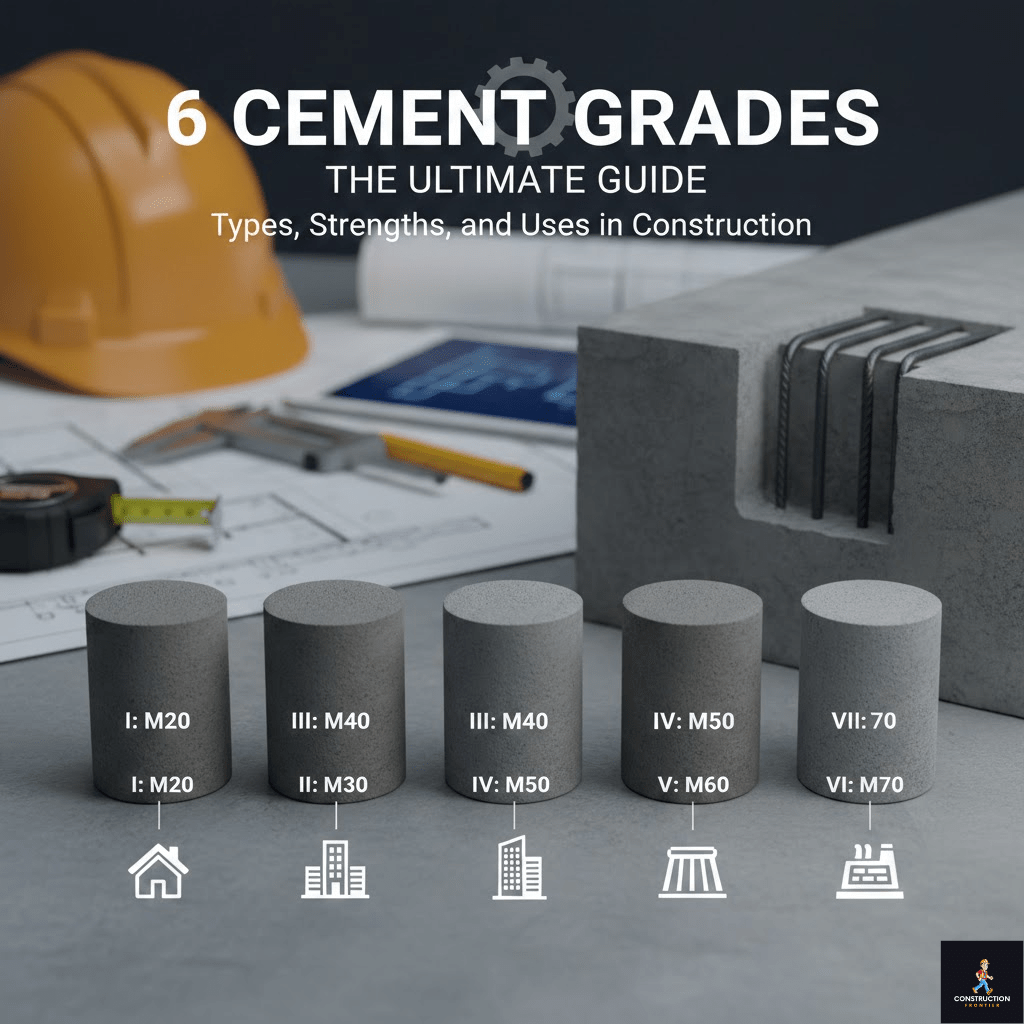
6 Cement Grades: The Ultimate Guide to Types, Strengths, and Uses in Construction
Understanding cement grades is critical for structural safety, durability, capital efficiency, and regulatory compliance. This executive-level guide explains the six main cement grades, their strength classifications, alignment with standards, applications, lifecycle implications, and selection strategies for engineers, contractors, developers, and institutional investors.
Technical Snapshot
- Cement grades are defined by 28-day compressive strength in MPa.
- Common OPC grades: 33, 43, 53.
- EN 197-1 strength classes: 32.5, 42.5, 52.5 with N or R early strength categories.
- Key blended cements: PPC, PSC.
- Standards: EN 197-1, ASTM C150, ASTM C595, IS 269, IS 8112, IS 12269.
- Cement grade affects concrete performance, but does not alone determine structural capacity.
- Lifecycle cost impact extends beyond material price to durability, maintenance, and carbon exposure.
Introduction: Why Cement Grades Matter in Modern Construction

Cement is the binding foundation of modern infrastructure. Yet within procurement discussions, it is often treated as a uniform commodity. This is a strategic error. Cement grades define compressive strength, durability performance, thermal behaviour, and ultimately the structural reliability of assets valued in billions.
For contractors and structural engineers, selecting appropriate cement grades and their uses directly influences load-bearing performance and code compliance. For financiers and asset managers, cement grade selection influences lifecycle maintenance cost, carbon exposure, insurance risk, and asset resilience under environmental stress.
Compressive strength is the primary classification metric. It determines the ability of cement mortar to resist axial loads after standardised curing periods. However, compressive strength also correlates with hydration kinetics, heat evolution, permeability, and long-term durability.
Wrong cement selection contributes to:
- Early-age cracking due to thermal stress.
- Sulfate attack in aggressive soils.
- Chloride ingress leading to reinforcement corrosion.
- Reduced the service life of marine and infrastructure assets.
- Overdesign that inflates costs without delivering performance gains.
Regulatory frameworks ensure baseline quality control. Key standards include:
- EN 197-1: Cement composition, specifications and conformity criteria.
- ASTM C150: Standard specification for Portland cement.
- ASTM C595: Blended hydraulic cements.
- IS 269, IS 8112, IS 12269: Ordinary Portland cement grades.
- National building codes referencing compressive strength classes.
Global classification systems differ in naming conventions but converge on strength thresholds. The difference between cement strength classes under EN and national grading systems often maps directly across 32.5, 42.5, and 52.5 MPa equivalence bands.
In rapidly growing markets such as East Africa, cement demand trends are reshaping procurement and pricing strategies. Industry leaders tracking the Kenya Cement Market: Strong Growth Outlook 2026–2030 understand that grade selection is intertwined with supply dynamics and price volatility.
Cement grade decisions, therefore, sit at the intersection of structural engineering, procurement risk management, and long-term capital allocation.
Further Reading: Kenya Cement Market: Strong Growth Outlook 2026–2030
What Are Cement Grades? Technical Definition and Standards Alignment
Cement grades refer to the minimum compressive strength of standard mortar cubes at 28 days, measured in megapascals (MPa) under controlled laboratory conditions.
1. Compressive Strength and Testing Protocols
Under EN 196-1 testing procedures:
- Mortar mix: 1 part cement to 3 parts standardised sand.
- Water-to-cement ratio defined per standard.
- Cubes typically 40 mm x 40 mm x 160 mm prisms.
- Curing at controlled humidity and temperature.
- Compressive strength measured at 2, 7, and 28 days.
Under ASTM C109:
- Cube size: 50 mm (2-inch).
- Controlled curing environment.
- The compression testing machine is calibrated to specification.
The 28-day result determines classification. However, early strength performance at 2 or 7 days influences construction sequencing and formwork removal decisions.
2. Grade vs Type of Cement
The grade of cement refers to the strength class, while the type of cement refers to its chemical composition and additives.
For example:
- 53 Grade OPC refers to a minimum strength of 53 MPa.
- Portland Pozzolana Cement PPC refers to blended cement containing fly ash.
- Portland Slag Cement PSC refers to cement blended with granulated blast furnace slag.
In EN classification:
- CEM I: Portland cement
- CEM II: Portland composite cement
- CEM III: Blast furnace cement
- CEM IV: Pozzolanic cement
- CEM V: Composite cement
Strength classes 32.5, 42.5, and 52.5 apply across these categories. Therefore, understanding cement grades requires distinguishing mechanical strength from chemical composition.
3. Relationship Between Cement Grades and Concrete Strength
Concrete grades, such as M20 or M40, indicate the compressive strength of concrete, not the strength of cement.
Concrete performance depends on:
- Cement grade.
- Aggregate grading and quality.
- Water-cement ratio.
- Admixtures.
- Curing regime.
A high cement grade increases the potential strength ceiling, but cannot compensate for poor mix design or neglect of curing.
The 6 Main Cement Grades Used in Construction
The following 6cement grades dominate global construction. Each serves distinct structural, environmental, and economic functions. Let’s delve deeper into the various cement grades, exploring their properties and applications in construction.
1. 33-Grade Cement
The 33-grade cement achieves a minimum compressive strength of 33 MPa at 28 days.
Technical Characteristics
- Moderate early strength.
- Lower heat of hydration compared to higher grades.
- Longer setting profile.
- Suitable for non-load-bearing applications.
Cement Applications
- Masonry mortar.
- Plastering.
- Tiling works.
- Low-rise rural construction.
Engineering Perspective
The 33-grade cement is increasingly phased out in high-compliance markets due to stronger performance demands. However, in cost-sensitive regions, such as Africa, it remains relevant for non-structural applications.
Limitations
- Not suitable for reinforced concrete in structural members.
- Slower early strength delays construction sequencing.
- Reduced performance margin under heavy loading.
2. 43-Grade Cement
The 43-grade cement achieves 43 MPa at 28 days and is widely used for general structural applications.
Strength Development
- Balanced early and long-term strength.
- Lower heat production than 53-grade cement.
- Suitable for reinforced concrete.
Cement Applications
- Residential buildings.
- Mid-rise commercial developments.
- Slabs, beams, and footings.
- Precast blocks.
Cost-Performance Position
In the 32.5 vs 42.5 vs 52.5 cement grades debate under EN standards, the 43 grade aligns approximately with the 42.5 MPa class. It offers structural reliability without excessive heat from hydration.
For investors benchmarking cement procurement across African markets, understanding supplier quality consistency is critical. The top 7 best cement companies in Kenya, discussed in the market leaders, illustrate how grade stability affects large-scale project outcomes.
Further Reading: Top 7 Best Cement Companies in Kenya for Quality and Reliability
3. 53-Grade Cement
The 53-grade cement achieves a minimum compressive strength of 53 MPa at 28 days and demonstrates high early strength.
Performance Profile
- Rapid strength gain.
- Early formwork removal is possible.
- Suitable for high-load structural members.
Best Cement Grades for Structural Work
- High-rise buildings.
- Bridges and flyovers.
- Industrial floors.
- Prestressed concrete.
Engineering Considerations
Higher heat of hydration increases the risk of thermal cracking in mass concrete. Temperature control measures such as staged pouring and cooling pipes may be necessary. Structural engineers must evaluate whether the performance premium justifies cost escalation.
Further Reading: Revolutionary Smart Sensors in Concrete: 10 Key Metrics They Monitor to Improve Structural Performance
4. Portland Pozzolana Cement PPC
Portland Pozzolana Cement (PPC) is produced by blending clinker with pozzolanic materials, typically fly ash.
Chemical Mechanism
Pozzolanic reaction consumes calcium hydroxide and produces additional calcium silicate hydrate gel, enhancing long-term strength and reducing permeability.
Durability Advantages
- Improved resistance to sulfate attack.
- Lower permeability.
- Reduced heat of hydration.
- Enhanced long-term compressive strength.
Applications
- Mass concrete foundations.
- Hydraulic structures.
- Marine works.
- Large raft slabs.
Environmental Impact
Reducing clinker content lowers embodied carbon. As sustainability pressures intensify, PPC plays a major role in decarbonising cement supply chains. The shift toward lower-carbon alternatives aligns with strategies outlined in a detailed analysis by Construction Frontier of the top 15 green building materials.
Further Reading: Top 15 Green Building Materials: Sustainable Choices for a Better Future
5. Portland Slag Cement PSC
Portland Slag Cement (PSC) uses granulated blast furnace slag as its primary cement constituent.
Performance Characteristics
- Superior resistance to chloride ingress.
- High sulfate resistance.
- Enhanced long-term durability.
Cement Applications
- Coastal infrastructure.
- Ports and harbours.
- Sewage treatment plants.
- Industrial foundations exposed to chemicals.
PSC is widely specified for corrosive environments due to its improved durability.
6. Rapid Hardening Cement
Rapid hardening cement develops strength faster than conventional Ordinary Portland Cement (OPC).
Technical Advantages
- High early compressive strength.
- Suitable for fast-track projects.
- Effective in cold weather.
Applications
- Road pavement repairs.
- Airport runway restoration.
- Precast manufacturing.
- Emergency structural repairs.
Cost Implications
The material cost of rapid-hardening cement is higher than that of OPC. Return on Investment (ROI) must be calculated based on scheduled savings and reduced downtime.
Cement Strength Classes Explained: MPa Ratings and Testing Process

When discussing cement grades, professionals must clearly distinguish between strength labels used in different regulatory systems. According to EN 197-1, cement strength classes are defined as 32.5, 42.5, and 52.5, expressed in megapascals (MPa). These correspond broadly to what many markets describe as 33-grade, 43-grade, and 53-grade cement.
Each of these cement strength classes may carry an additional suffix: N for normal early strength or R for rapid early strength. The distinction matters in scheduling and sequencing decisions. A 42.5R cement, for example, will develop higher early strength within the first two days compared to 42.5N, even though both must achieve at least 42.5 MPa at 28 days.
This is where the debate around 32.5 vs 42.5 vs 52.5 cement becomes technically significant. The numerical value represents the minimum compressive strength at 28 days, not an average or target value. For a cement to qualify as 52.5, its mortar cubes must consistently exceed 52.5 MPa at 28 days under standardised laboratory conditions.
Testing Timeline and Performance Benchmarks
The strength verification process follows strict laboratory protocols. Under EN 196-1 and ASTM C109, mortar cubes are cast using standardised sand and controlled water-cement ratios. They are cured in temperature- and humidity-controlled environments before being tested in calibrated compression machines.
For R-class cements, 2-day strength is critical because rapid strength development enables early formwork removal and accelerated construction cycles. Seven-day tests provide an intermediate performance check. However, the 28-day compressive strength remains the official benchmark that determines cement classification.
Understanding the difference between cement strength classes is essential for structural engineers. A project designed around 52.5 cement assumes a higher compressive performance envelope. Substituting 32.5 without recalculating the mix design introduces unacceptable structural risk.
On-Site Quality Control and Curing Impact
Laboratory strength is only part of the equation. On-site, quality control becomes the determining factor in translating cement grades and their uses into real structural performance.
Key control measures include:
- Slump testing under ASTM C143 to assess workability.
- Casting concrete cubes or cylinders for 7- and 28-day compressive strength tests.
- Documentation of batch proportions and curing conditions.
Curing in concrete is frequently underestimated. Inadequate curing interrupts hydration, leading to incomplete strength development. In hot climates, poorly cured concrete can lose 20% to 40% of its potential compressive strength. For high-grade cement used in structural applications, this performance loss can compromise safety margins built into design calculations.
Tolerance limits under EN (European Norms) and ASTM (American Society for Testing and Materials) standards specify minimum strength thresholds. Cement that fails to meet the declared performance cannot be certified. In institutional projects, third-party laboratory verification is standard practice to protect capital investment.
Cement Grades vs Concrete Grades: A Critical Technical Distinction
Confusion between cement grades and concrete grades remains common even among experienced contractors. The two are not interchangeable concepts.
Cement grade refers to the compressive strength of cement mortar at 28 days. Concrete grade, such as M20, M30, or C40/50 under EN classification, refers to the compressive strength of the finished concrete mix.
An M30 or C30/20 concrete must achieve a compressive strength of 30 MPa at 28 days. That performance depends on several variables:
- Cement grade.
- Aggregate grading and strength.
- Water-cement ratio.
- Admixture chemistry.
- Compaction and curing.
Using higher cement grades does not automatically produce higher concrete grades. A poorly designed mix with 53-grade cement can underperform a well-designed mix with 43-grade cement.
For capital-intensive infrastructure, misunderstanding this distinction can inflate procurement budgets. Over-specifying cement strength without optimising the mix design results in unnecessary cost escalation without corresponding performance gains. A disciplined cement-grade selection guide must therefore integrate structural design rather than rely solely on strength labels.
Cement Mix Ratios Based on Cement Grades
Concrete mix proportioning is where theory meets execution. While laboratory-designed mixes are always preferable for structural works, nominal ratios are still widely referenced on site.
1. Masonry Applications
For brickwork and plastering, typical mix ratios are 1:4 or 1:6 cement to sand. In these cement applications, 33 or 43-grade cement is generally adequate. The objective is bond strength and workability rather than high compressive capacity.
2. Slabs and Beams
For moderate structural members, a nominal (C20/20) 1:2:4 ratio of cement, sand, and aggregate may be used in small-scale construction. However, for engineered projects, design mixes targeting specific concrete grades, such as M25 or M30, are calculated based on laboratory trials.
Higher cement strength classes, such as 42.5 or 52.5, support stronger structural members, but the water-cement ratio remains the decisive factor. Ratios exceeding 0.6 significantly reduce compressive strength and increase permeability, regardless of cement grade.
3. Columns
Columns carry axial loads and bending stresses. Here, the best cement grades for structural work are typically 43 or 53 grade equivalents, depending on structural calculations. Design mixes are mandatory, and cube testing is routine.
4. Foundations
Foundation concrete must be designed to account for soil bearing capacity and environmental exposure. In sulfate-rich soils, PSC or PPC may outperform pure OPC despite lower early strength. Durability often outweighs rapid strength development in substructure works.
Ready-mix concrete plants offer greater batching precision and consistent quality control than site mixing. For institutional investors overseeing large portfolios, ready-mix reduces variability and lowers the risk of structural defects.
How to Choose Cement Grades: A Strategic Framework

Selecting the right cement grades requires more than checking a strength label. A structured cement grade selection guide aligns engineering performance with cost discipline and regulatory compliance.
1. Load Requirements
High-rise buildings, bridges, and heavy industrial slabs demand higher cement strength classes. In such cases, 52.5 or 53-grade cement provides structural reliability, particularly when targeting higher concrete grades such as C40/50.
2. Environmental Exposure
Marine environments, chloride exposure, and sulfate-rich soils significantly influence cement selection. Portland slag cement offers superior resistance to chemical attack, while Portland pozzolana cement reduces permeability and heat of hydration in mass concrete.
Understanding cement grades and their uses in aggressive environments is critical for extending asset life and minimising maintenance costs.
3. Budget and Procurement Discipline
Over-specifying cement grades can inflate project budgets. For residential housing, 33-grade or 32.5-class cement, or 43-grade or 42.5-class cement, is usually sufficient. Using 53-grade indiscriminately for plastering or masonry wastes capital without adding structural value.
4. Regulatory Compliance
National building codes and structural engineer approval govern the final specification. Institutional projects often require documentation proving compliance with ASTM or EN standards, including batch certificates and third-party testing reports.
Knowing how to choose cement grades, therefore, demands coordination between designers, procurement teams, and site engineers.
Common Mistakes in Cement Grade Selection
Despite clear standards, recurring errors appear across projects:
- Using high-strength cement where lower grades suffice.
- Ignoring environmental exposure conditions.
- Neglecting curing protocols.
- Selecting suppliers based solely on price.
- Storing cement in humid or poorly ventilated environments.
Moisture contamination reduces cement reactivity and its potential strength. Once partially hydrated, cement cannot regain performance, regardless of grade.
Another frequent misunderstanding concerns the distinction between cement strength classes and concrete durability. Strength does not equal durability. A 53-grade cement mix with poor curing and high permeability may fail sooner than a properly cured PPC mix with lower early strength but better long-term resistance.
Cement Grades and Sustainability
Cement manufacturing contributes approximately 7% to 8% of global carbon dioxide emissions. The clinker production process is energy-intensive and chemically releases CO2 during limestone calcination.
Blended cements such as PPC and PSC reduce clinker content, directly lowering carbon intensity per tonne. As carbon-pricing mechanisms expand and ESG reporting becomes mandatory for institutional investors, cement-grade selection increasingly intersects with sustainability metrics.
Lifecycle costing models now incorporate:
- Embodied carbon per cubic meter of concrete.
- Long-term maintenance frequency.
- Durability under aggressive exposure.
- Carbon tax exposure scenarios.
For large infrastructure portfolios, selecting blended cement grades can reduce embodied carbon without compromising performance. The shift toward low-carbon materials is no longer reputational; it is financial.
Understanding the 6 cement grades and their uses in construction must therefore extend beyond compressive strength to include environmental performance and regulatory trajectory.
Frequently Asked Questions
1. What are the 6 cement grades and their uses in construction?
The six commonly referenced categories are 33-grade, 43-grade, 53-grade, Portland Pozzolana Cement (PPC), Portland Slag Cement (PSC), and Rapid Hardening Cement. Each serves distinct cement applications ranging from masonry and plastering to high-rise structural work and marine infrastructure.
2. Which are the best cement grades for structural work?
For reinforced concrete structures such as columns, beams, bridges, and high-rise buildings, 43 or 53 grade equivalents, corresponding to 42.5 or 52.5 cement strength classes, are typically specified depending on structural calculations.
3. Is a 53-grade cement stronger than a 43-grade cement?
Yes. At 28 days, 53-grade cement must achieve at least 53 MPa compressive strength, compared to 43 MPa for 43-grade cement. However, final concrete performance still depends on mix design and curing.
4. What is the difference between cement strength classes?
Cement strength classes, such as 32.5, 42.5, and 52.5, indicate minimum compressive strength at 28 days. Higher classes support higher structural capacity but may generate more heat during hydration.
5. How to choose cement grades for a project?
Selecting cement grades involves assessing load requirements, environmental exposure, budget constraints, regulatory compliance, and structural engineer recommendations. A disciplined cement grade selection guide integrates all these variables rather than relying solely on price or strength label.
Conclusion: Making Smart Decisions About Cement Grades

Cement grades sit at the foundation of structural safety and long-term asset performance. From understanding cement strength classes and the 32.5 vs 42.5 vs 52.5 cement comparison, to recognising the difference between cement grades and concrete grades, disciplined specification protects both engineering integrity and capital investment. The six cement grades and their uses in construction reflect distinct performance profiles, thermal behaviour, and durability characteristics. Selecting the best cement grades for structural work demands technical clarity, rigorous testing, and alignment with environmental exposure conditions.
In today’s construction environment, where infrastructure assets must deliver decades of performance under tightening regulatory and carbon constraints, cement selection is no longer a routine procurement choice. It is a strategic engineering and financial decision. A robust cement grade selection guide ensures that cement applications match load requirements, exposure risks, and lifecycle cost models. When specified correctly, cement becomes not just a binding agent in concrete, but a stabilising force in project economics and long-term structural credibility.
Explore Construction & Building Materials Insights
The performance of every project begins with informed material selection, from cement grades and concrete strength optimisation to steel pricing trends, green building innovation, and regional supply chain dynamics that directly influence capital efficiency and long-term asset performance; explore the Construction Frontier Construction & Building Materials section for executive-level analysis, verified technical insights, market outlooks, and procurement benchmarks tailored for engineers, contractors, developers, and institutional investors seeking to make better material decisions, reduce structural risk, and strengthen lifecycle return.