5 Proven Green Cement Impacts Driving Sustainable Construction in Africa & Emerging Markets
Green cement is rapidly transforming the construction industry in Africa and emerging markets by reducing carbon emissions, improving material efficiency, and supporting sustainable infrastructure development. As governments tighten environmental regulations and developers pursue greener building standards, green cement technologies are becoming essential for roads, housing, energy projects, and mega infrastructure developments. This article examines five proven impacts of green cement, highlighting its environmental benefits, economic advantages, and long-term role in sustainable construction across fast-growing regions where the future of green cement in African construction is increasingly tied to climate policy, infrastructure finance, and industrial innovation.
Technical Snapshot
| Parameter | Conventional Cement | Green Cement |
| Average CO₂ Emissions | 0.8–0.9 tonnes per tonne of cement | 0.3–0.6 tonnes depending on blend |
| Clinker Content | 90–95% | 40–75% |
| Key Materials | Limestone, clay | Fly ash, slag, calcined clay |
| Primary Benefit | Structural strength | Lower carbon footprint + durability |
| Strategic Impact | Standard infrastructure material | Core driver of low-carbon construction |
Understanding Green Cement and Its Role in Modern Construction
The global construction sector stands at a pivotal moment. Rapid urbanisation across Africa and emerging economies is driving unprecedented demand for cement and concrete, yet the traditional production of Portland cement remains one of the most carbon-intensive industrial processes. In response, green cement in Africa is gaining attention as governments, developers, and infrastructure investors seek low-carbon cement solutions for Africa that maintain structural performance while significantly reducing environmental impact.
What Is Green Cement?
Green cement refers to cement formulations designed to reduce environmental impact by lowering carbon emissions during production and improving resource efficiency throughout the material lifecycle.
Unlike conventional Portland cement, which relies heavily on clinker produced by limestone calcination at temperatures exceeding 1450°C, eco-friendly cement initiatives in Africa typically reduce clinker content by incorporating alternative materials. These materials, commonly known as supplementary cementitious materials SCMs, partially replace clinker while maintaining or improving concrete performance.
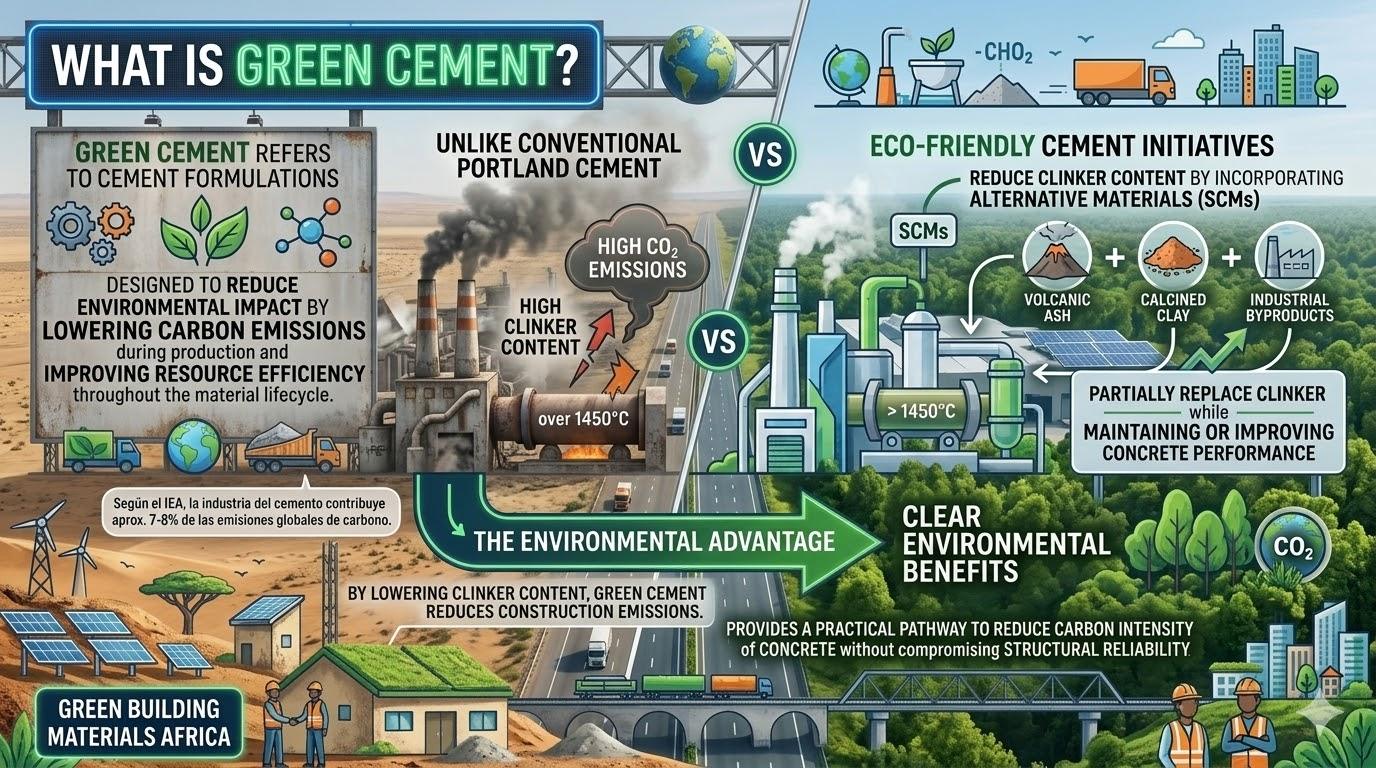
The environmental advantage is clear. The manufacturing process for clinker releases significant carbon dioxide from both fuel combustion and chemical reactions during limestone decomposition. According to the International Energy Agency, the cement industry contributes roughly 7–8 percent of global carbon emissions. By lowering clinker content, green cement can reduce construction emissions at both the project and national infrastructure levels.
In practical terms, green building materials Africa strategies increasingly rely on these low-carbon formulations. From residential developments to major transport corridors, green cement provides a practical pathway to reduce the carbon intensity of concrete without compromising structural reliability.
Why Green Cement Matters for Africa and Emerging Markets
Africa is experiencing one of the fastest rates of urban growth globally. The United Nations projects that 68% of the world’s population will live in urban areas in 2050, and likewise, in Africa, the urban population will nearly double by 2050, requiring enormous expansion of housing, transportation networks, energy infrastructure, and water systems.
Meeting that demand using conventional cement would significantly increase industrial emissions. As a result, sustainable cement in Africa is becoming a strategic priority for policymakers and investors.
Several factors drive the increasing relevance of green cement in emerging markets initiatives:
- Rapid urbanisation and infrastructure expansion.
- Climate commitments under global agreements.
- Pressure from international financiers to reduce carbon intensity.
Major development banks, including the World Bank, increasingly prioritise financing for low-carbon infrastructure, hence banking on cities with low-carbon urbanisation initiatives. For contractors and developers, this means green cement adoption in emerging markets is no longer optional but an important component of project eligibility and sustainability compliance.
Technologies Behind Green Cement Production
The transition toward green cement in Africa is driven by advances in material science, industrial energy efficiency, and carbon management technologies. Traditional cement production relies heavily on clinker, the most carbon-intensive component of cement. Modern sustainable cement technologies in Africa aim to reduce this dependency by substituting clinker, using alternative energy sources, and integrating carbon capture solutions into cement plants. These innovations are central to green cement adoption in emerging markets, where infrastructure demand is expanding rapidly while governments and investors push for low-carbon cement solutions for Africa that maintain structural performance while reducing emissions.
1. Supplementary Cementitious Materials (SCMs)
Supplementary cementitious materials (SCMs) form the technical backbone of low-carbon concrete in Africa. These materials partially replace clinker in cement blends and participate in secondary hydration reactions that enhance concrete performance. When Portland cement hydrates, calcium silicates react with water to form calcium silicate hydrate (C-S-H) gel and calcium hydroxide. SCMs react with the calcium hydroxide through pozzolanic reactions, producing additional C-S-H gel that densifies the concrete microstructure, lowers permeability, and improves durability.
Because SCMs replace part of the clinker content, they directly reduce emissions associated with cement manufacturing. In many eco-friendly cement formulations in Africa, the clinker content falls from conventional levels of about 90–95 percent to 50–70 percent, depending on the cement blend, delivering significant environmental benefits of green cement in infrastructure projects.
Several SCMs are widely used across green cement emerging markets:
- Fly ash, a fine powder from coal combustion in power plants, improves workability and long-term strength. In sustainable construction materials in Africa, it can replace 15–30 percent of clinker while increasing resistance to sulphate attack and alkali–silica reactions.
- Ground granulated blast furnace slag (GGBFS), produced during steel manufacturing, reacts hydraulically with water and significantly improves resistance to chloride penetration, making it ideal for coastal infrastructure and marine structures using low-carbon concrete in Africa.
- Calcined clay is gaining prominence as a scalable component of low-carbon cement solutions for Africa, particularly where fly ash or slag availability is limited. Kaolinite-rich clays are calcined at 700–850°C to produce metakaolin, which reacts strongly with calcium hydroxide. Cement systems such as LC3 limestone calcined clay cement can reduce carbon emissions by up to 40 percent compared with conventional Portland cement while maintaining similar compressive strength.
- Natural pozzolans, including volcanic ash and siliceous sediments, also contribute to green building materials Africa strategies, particularly in regions where volcanic deposits provide locally available pozzolanic resources.
The integration of SCMs, therefore, underpins the green cement market in emerging economies, enabling large-scale production of durable, low-carbon cement solutions for Africa while reducing the environmental footprint of cement manufacturing.
2. Alternative Fuels and Raw Materials
Energy use in cement kilns is another major contributor to emissions. Conventional clinker production depends on coal or petroleum coke to reach temperatures above 1400°C. Modern sustainable cement technologies in Africa increasingly replace these fossil fuels with alternative energy sources.
Alternative fuels used in cement plants include biomass residues, agricultural waste, municipal solid waste, and industrial by-products processed into refuse-derived fuel. Cement kilns operate at extremely high temperatures and long residence times, allowing them to safely combust these materials while recovering energy for clinker production.
Substituting fossil fuels with alternative fuels can significantly reduce the carbon intensity of cement manufacturing. In advanced cement plants, alternative fuels can replace 30–60 percent of traditional fuels, strengthening the environmental benefits of green cement.
Another strategy involves substituting conventional raw materials with industrial residues and construction waste. By incorporating these materials into clinker production, cement manufacturers reduce the need for limestone quarrying and decrease emissions from raw material extraction. In green cement markets in emerging economies, these approaches also enable cement producers to utilise local waste streams, supporting sustainable construction materials in Africa while reducing landfill disposal.
3. Carbon Capture and Utilisation
While clinker substitution and fuel switching significantly reduce emissions, deep decarbonisation of the cement sector requires additional solutions. Carbon capture and utilisation (CCU) technologies are therefore becoming an important component of the future of green cement in African construction.
Carbon capture systems extract carbon dioxide from cement plant exhaust gases before it is released into the atmosphere. Technologies used include chemical absorption with solvents, membrane separation, and adsorption processes designed to isolate CO₂ from kiln flue gases.
Captured carbon dioxide can then be compressed and used in industrial applications. One promising use is mineralisation within concrete products. During this process, CO₂ reacts with calcium compounds to form stable calcium carbonates, permanently storing carbon within the material.
This approach not only reduces emissions but can also improve concrete’s microstructure, supporting the development of durable, low-carbon concrete in Africa. Although large-scale deployment is still emerging, carbon capture systems are expected to become increasingly important for green cement adoption in emerging markets as governments introduce stricter climate regulations.
Combined with clinker substitution and alternative fuel technologies, carbon capture represents a critical pathway for expanding the green cement market in emerging economies. Together, these innovations form the technical foundation of modern low-carbon cement solutions for Africa, enabling the cement industry to meet rising infrastructure demand while significantly reducing construction-related emissions.
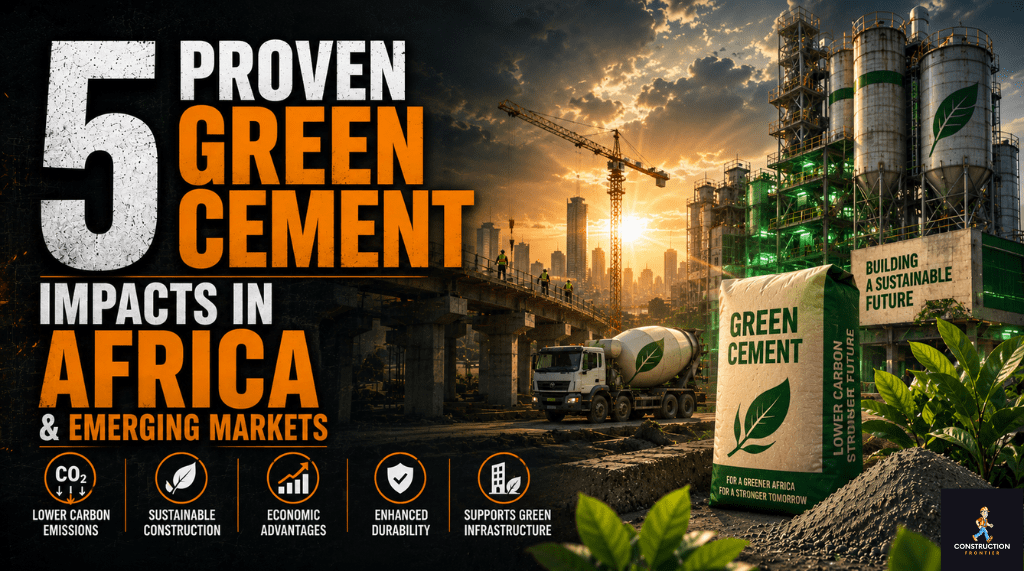
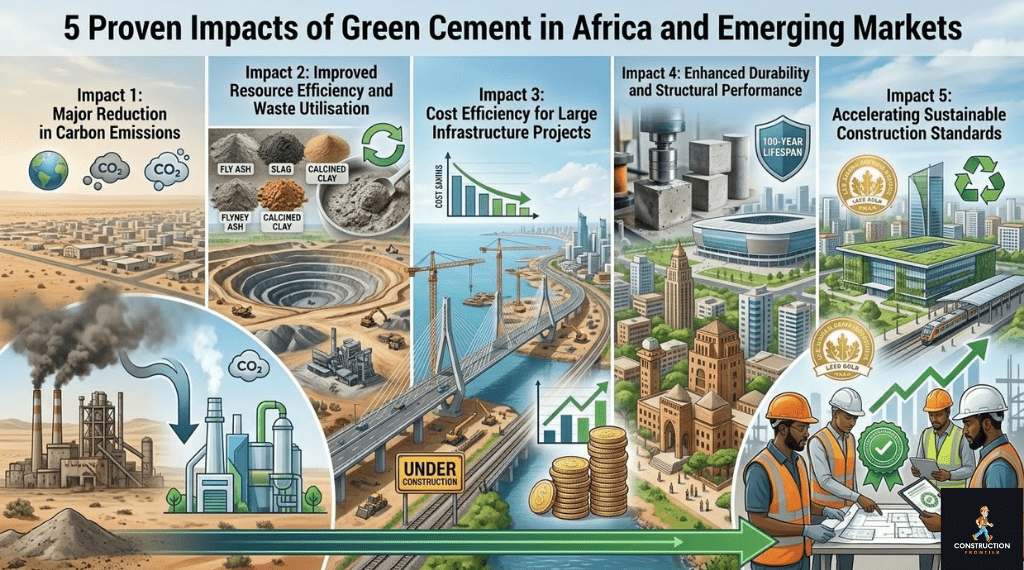
5 Proven Impacts of Green Cement in Africa and Emerging Markets
The construction industry across Africa and other developing economies is entering a period of rapid transformation as sustainability moves from policy discussion to engineering practice. As governments expand infrastructure, housing, transport corridors, and energy systems, the choice of construction materials is becoming a critical factor in balancing economic development with environmental responsibility. Green cement in Africa is therefore gaining momentum as a strategic solution that can reduce emissions, improve resource efficiency, and strengthen long-term infrastructure resilience.
The following sections examine five proven impacts of green cement in Africa and emerging markets, focusing on measurable outcomes that matter to engineers, project developers, policymakers, and infrastructure investors. These impacts range from significant reductions in carbon emissions and improved waste utilisation to lifecycle cost advantages, enhanced structural durability, and the acceleration of sustainable construction standards. Together, they illustrate how low-carbon cement solutions, supported by advances in sustainable cement technologies, are reshaping the green cement market in emerging economies and defining the future of green cement in African construction.
Impact 1: Major Reduction in Carbon Emissions
Reducing carbon emissions is the primary driver behind the global shift toward green cement technologies. Infrastructure expansion across Africa is expected to require billions of tonnes of cement in the coming decades. Without significant innovation in material production, emissions from cement manufacturing would increase dramatically.
Cement Industry’s Contribution to Global CO₂ Emissions
Traditional cement production relies heavily on clinker manufacturing, an energy-intensive process involving high-temperature kilns. Two major sources generate emissions:
- Combustion of fuels used to heat the kiln.
- Chemical decomposition of limestone during calcination.
It is estimated that cement production accounts for approximately 7–8 percent of global CO₂ emissions. Therefore, as infrastructure demand grows, particularly in emerging green cement markets, reducing cement’s carbon intensity becomes essential.
How Green Cement Cuts Carbon Footprint
Green cement reduces emissions primarily by lowering clinker content and replacing it with alternative materials. Blended cements such as Portland Pozzolana Cement and slag cement significantly reduce the carbon intensity of production.
Key materials include:
- Fly ash.
- Blast furnace slag.
- Calcined clay.
These materials enable low-carbon cement solutions for Africa that maintain structural performance while dramatically reducing emissions.
As a result, the environmental benefits of green cement extend beyond manufacturing. Lower emissions during production translate directly into lower lifecycle carbon footprints for infrastructure projects.
Carbon Reduction Potential in African Infrastructure
Large infrastructure projects such as railways, highways, and dams require vast quantities of concrete. By integrating low-carbon concrete into projects in Africa, developers can significantly reduce total embodied carbon.
Many governments now incorporate sustainability requirements into infrastructure procurement. This shift ensures the impact of green cement in Africa becomes measurable at a national scale, aligning infrastructure development with climate commitments.
Impact 2: Improved Resource Efficiency and Waste Utilisation
Beyond emissions reduction, green cement introduces important improvements in resource efficiency. By incorporating industrial by-products into cement formulations, the industry reduces waste while conserving natural resources.
Circular Economy in Cement Production
Green cement production aligns closely with circular economy principles. Materials previously considered waste become valuable inputs in cement manufacturing.
For example:
- Fly ash from power plants.
- Slag from steel manufacturing.
- Agricultural ash residues.
These materials replace clinker while improving the sustainability profile of cement production. The environmental benefits of green cement, therefore, extend to waste management and resource conservation.
Key Materials Used in Green Cement
Several industrial by-products play a central role in sustainable cement technologies in Africa.
- Calcined clay has gained global attention as a scalable alternative to clinker, particularly in regions where slag availability is limited.
- Fly ash improves workability and long-term strength development.
- Ground granulated blast furnace slag (GGBFS) enhances durability and chemical resistance.
These materials support the growth of the green cement market in emerging economies while reducing dependence on virgin raw materials.
Environmental Benefits for Emerging Economies
The environmental benefits of these technologies are particularly significant in developing regions.
They include:
- Reduced landfill waste.
- Lower extraction of limestone.
- Reduced environmental degradation from quarrying activities.
As a result, green building materials initiatives in Africa increasingly emphasise the use of local industrial by-products to support sustainable construction.
Further Reading: Hydrogen Infrastructure: The Backbone of the Global Green Energy Transition
Impact 3: Cost Efficiency for Large Infrastructure Projects
Sustainability is often perceived as an additional cost. However, many low-carbon cement solutions for Africa actually improve long-term economic efficiency for infrastructure projects.
Lower Production Costs Through Alternative Materials
Reducing clinker content directly lowers energy consumption during cement manufacturing. Because kiln operation represents the most energy-intensive step in production, clinker reduction significantly lowers operational costs.
Additionally, many SCMs are locally available industrial by-products. Their use supports the adoption of green cement in building green in emerging markets while reducing dependence on imported materials.
Lifecycle Cost Benefits for Construction Projects
Green cement often improves the durability of concrete structures. Enhanced resistance to chemical attack and reduced permeability contribute to longer service life.
For infrastructure assets such as bridges and ports, these durability improvements translate into lower maintenance costs and extended lifecycle performance.
These advantages reinforce the impact of green cement in Africa, particularly for public infrastructure, where long-term durability directly affects government budgets.
Economic Advantages for Developing Markets
In rapidly growing economies, cost-effective construction materials are essential for expanding infrastructure networks.
By enabling affordable yet durable concrete, eco-friendly cement, African initiatives support large-scale infrastructure programmes. The green cement market in emerging economies is therefore expanding alongside transport corridors, energy projects, and urban housing developments.
Impact 4: Enhanced Durability and Structural Performance
Performance remains a critical requirement for any construction material. While sustainability is important, infrastructure must still meet rigorous engineering standards. Fortunately, many green cement formulations provide superior durability compared with conventional Portland cement.
Strength and Performance Characteristics of Green Cement
Blended cements incorporating SCMs often exhibit improved long-term strength development and resistance to aggressive chemical environments.
Research published by the American Concrete Institute demonstrates that slag and pozzolanic materials significantly enhance resistance to sulphate attack and chloride penetration, hence increasing the life expectancy of concrete structures.
These improvements are particularly valuable in low-carbon concrete in Africa, where infrastructure is frequently exposed to challenging environmental conditions.
Performance in Challenging African Conditions
Infrastructure projects across Africa often face demanding environmental factors.
These include:
- Coastal environments with high chloride exposure.
- Extreme temperatures and thermal cycling in concrete.
- Sulphate-rich soils.
Blended cement systems improve durability under these conditions. As a result, sustainable construction materials initiatives in Africa increasingly specify blended cement formulations for major infrastructure projects.
Applications in Critical Infrastructure
Green cement is already being used in numerous large-scale projects.
Typical applications include:
- Highway pavements.
- Port infrastructure.
- Hydropower dams.
These applications demonstrate the future of green cement in African construction, where sustainability and structural reliability increasingly go hand in hand.
Impact 5: Accelerating Sustainable Construction Standards
Green cement also plays a key role in the global transition toward sustainable building practices.
Role of Green Cement in Green Building Certifications
Green building certification systems encourage the use of low-carbon construction materials. Programmes such as the U.S. Green Building Council LEED certification award credits for materials with reduced environmental impact. Using eco-friendly cement in Africa helps developers meet these sustainability requirements.
Government Policies Driving Green Cement Adoption
Government regulations increasingly support the use of low-carbon construction materials.
Policies promoting sustainable cement in Africa include:
- Carbon emission targets.
- Green procurement policies.
- Infrastructure sustainability standards.
These frameworks accelerate green cement adoption in emerging markets while encouraging innovation within the cement industry.
Adoption by Major Infrastructure Developers
Major infrastructure developers are already incorporating green building materials into their projects.
Smart city developments in Africa, sustainable housing initiatives, and green transport corridors in emerging markets increasingly rely on low-carbon concrete to reduce environmental impact while maintaining structural performance.
Further Reading: 6 Cement Grades: The Ultimate Guide to Types, Strengths and Uses in Construction
Challenges Slowing Green Cement Adoption in Emerging Markets
Despite the technical and environmental advantages of green cement in Africa, adoption across many emerging economies remains uneven. The barriers are not primarily technological; they are institutional, supply-chain, and regulatory in nature. In regions where infrastructure demand is accelerating, the shift toward low-carbon cement solutions for Africa requires alignment between manufacturers, engineering standards, and procurement frameworks. Without these structural adjustments, the expansion of the green cement market in emerging economies will progress more slowly than projected.
1. Limited Awareness and Technical Knowledge
One of the most persistent barriers to green cement adoption in emerging markets is limited technical familiarity among engineers, contractors, and procurement authorities. Many construction professionals remain accustomed to conventional Ordinary Portland Cement specifications embedded in historical building codes and engineering practices.
In practical terms, this affects project specification and tender documentation. Engineers often specify CEM I Portland cement rather than blended systems such as Portland limestone cement, slag cement, or limestone calcined clay cement LC3. Without explicit design guidance, contractors may hesitate to adopt sustainable cement technologies in Africa even when performance data demonstrates comparable compressive strength and durability.
Technical institutions are gradually addressing this gap. The LC3 Technical Resource Centre Africa at the Institute of Cement and Concrete in Kenya has launched demonstration structures and training programmes showcasing the performance of limestone calcined clay cement in structural elements. A pilot structure built with LC3 cement demonstrates its viability for flooring and plastering applications, helping engineers familiarise themselves with the technology and its structural properties.
Scaling the green cement market in emerging economies, therefore, depends not only on production capacity but also on professional training and the integration of new cement systems into engineering curricula and construction guidelines.
2. Supply Chain and Production Constraints
Supply availability remains another structural constraint. Many low-carbon cement solutions for Africa rely on supplementary cementitious materials such as slag, fly ash, or calcined clay. However, the availability of these materials varies significantly across regions.
For example, blast furnace slag is only available near steel manufacturing centres. Similarly, fly ash supply depends on coal-fired power plants, which are limited in several African countries. This uneven distribution complicates the large-scale production of eco-friendly cement in Africa.
To overcome this constraint, several manufacturers are investing in calcined clay technology, which uses locally available clay deposits as a clinker substitute. One notable project is the CBI Ghana LC3 facility in Tema, which operates the world’s largest flash calciner for limestone calcined clay cement. The plant can produce approximately 400,000 tonnes of calcined clay annually, enabling partial clinker substitution and reducing carbon emissions from cement production.
Similarly, the CIMAF calcined clay project in Burkina Faso, supported by a €45 million green loan from the International Finance Corporation, is designed to supply LC3 cement across the Sahel region while reducing clinker use and energy consumption in cement manufacturing.
Such projects demonstrate how targeted investment can strengthen supply chains and accelerate the adoption of green cement in emerging markets, particularly when local raw materials enable scalable production.
3. Regulatory and Standardisation Barriers
Another major barrier involves outdated building codes and cement classification standards. Many national standards in developing markets were drafted decades ago and primarily recognise traditional Portland cement types.
Modern sustainable cement in Africa often relies on blended systems with reduced clinker content. Without updated national standards, these materials may face delays in obtaining approval for infrastructure tenders or public procurement processes.
Ghana recently addressed this challenge by introducing GS PAS 5:2024, one of the first standards globally designed specifically for LC3 cement. The new framework allows the formal specification of calcined clay cement in construction projects, providing regulatory certainty for contractors and developers.
Standardisation bodies such as the International Organization for Standardization are also working to harmonise cement classification systems that accommodate blended cement technologies. Updating national codes to reflect these standards is essential for scaling sustainable construction materials across large infrastructure programmes.
Future Outlook for Green Cement in Africa and Emerging Markets
Despite the current barriers, the long-term trajectory for green cement in Africa is strongly positive. Infrastructure demand continues to rise, climate regulations are tightening, and investors increasingly prioritise low-carbon materials in construction supply chains. These forces are collectively accelerating the shift toward sustainable cement technologies in Africa.
Rapid Growth of Sustainable Construction
Urbanisation across Africa is generating large-scale demand for housing, transport infrastructure, and energy facilities. Governments and developers are increasingly integrating sustainability requirements into project design and procurement.
As a result, demand for green building materials in Africa is expanding rapidly. Low-carbon cement systems are becoming central to achieving sustainability targets in major infrastructure projects. Financial institutions such as the World Bank Group and the International Finance Corporation are increasingly financing projects that incorporate low-carbon concrete in Africa, reinforcing the economic incentives for adoption.
These trends are strengthening the impact of green cement in Africa, particularly in transportation corridors, housing developments, and renewable energy infrastructure.
Innovation in Low-Carbon Cement Technologies
Technological innovation is accelerating across the cement industry. Research and industrial pilot projects are exploring new binders, advanced SCM combinations, and carbon capture systems integrated into cement plants.
Calcined clay technology has become one of the most promising solutions. LC3 cement systems can replace a large portion of clinker with calcined clay and limestone while maintaining structural strength and durability. Studies indicate that these systems can reduce cement production emissions by approximately 20–30 percent, depending on the clinker substitution ratio.
Other innovations include carbon mineralisation technologies that permanently store captured CO₂ in concrete. Some emerging systems claim potential reductions of up to 80 percent in emissions when combined with carbon-sequestering materials, illustrating how advanced technologies could reshape the green cement market in emerging economies.
These developments are expanding the portfolio of low-carbon cement solutions for Africa, enabling cement producers to meet both infrastructure demand and climate targets.
Role in Achieving Net-Zero Construction
Achieving net-zero infrastructure requires substantial reductions in the embodied carbon of construction materials. Because cement is the most widely used material in the built environment, decarbonising its production is central to climate mitigation strategies.
The future of green cement in African construction, therefore, lies at the intersection of industrial policy, infrastructure financing, and technological innovation. As governments introduce carbon reduction targets and developers integrate lifecycle carbon accounting into project design, sustainable cement in Africa will become a core component of infrastructure planning.
Over the next decade, continued investment in calcined clay production, alternative fuel systems, and carbon capture technologies is expected to accelerate green cement adoption in emerging markets. This transformation will not only reduce emissions but also strengthen the resilience and sustainability of infrastructure across Africa’s rapidly growing economies.
Further Reading: Top 15 Green Building Materials: Sustainable Choices for a Better Future
Strategic Metrics: Green Cement Performance Snapshot
| Performance Indicator | Conventional Cement | Green Cement |
| Clinker Factor | 90–95% | 40–75% |
| CO₂ Emissions | High | Reduced by up to 40% |
| Durability | Standard | Improved chemical resistance |
| Resource Efficiency | Limited | High use of recycled materials |
| Lifecycle Cost | Higher maintenance | Lower maintenance |
These metrics reinforce the growing importance of low-carbon cement solutions for Africa as governments and investors prioritise sustainable infrastructure development.
Conclusion: Green Cement as a Strategic Material for Sustainable Infrastructure
Green cement is emerging as a critical solution for balancing infrastructure expansion with environmental responsibility across Africa and emerging economies. By lowering clinker content, incorporating industrial by-products, and improving energy efficiency in cement production, the industry is significantly reducing emissions associated with construction materials. These innovations deliver tangible environmental benefits while supporting the development of low-carbon concrete in Africa capable of meeting the structural demands of roads, ports, dams, and urban infrastructure. As a result, the impact of green cement in Africa is already evident in large-scale infrastructure projects where sustainability targets are increasingly integrated into procurement and design.
Looking ahead, the future of green cement in African construction will be shaped by a combination of policy reforms, technological innovation, and growing demand for sustainable infrastructure. Governments are strengthening climate commitments, international lenders are prioritising low-carbon materials, and developers are adopting green building materials in Africa to meet evolving environmental standards. As green cement adoption in emerging markets accelerates, the industry is moving toward a more resilient, environmentally responsible construction ecosystem where infrastructure growth and carbon reduction can advance together.
Construction Materials Analysis by Construction Frontier
For more expert insights into cement technologies, construction materials, heavy equipment, and infrastructure engineering, explore Construction Frontier. Our platform delivers in-depth technical analysis, industry trends, and professional reviews of construction and building materials, helping engineers, contractors, and project developers make informed decisions in an evolving global construction industry.