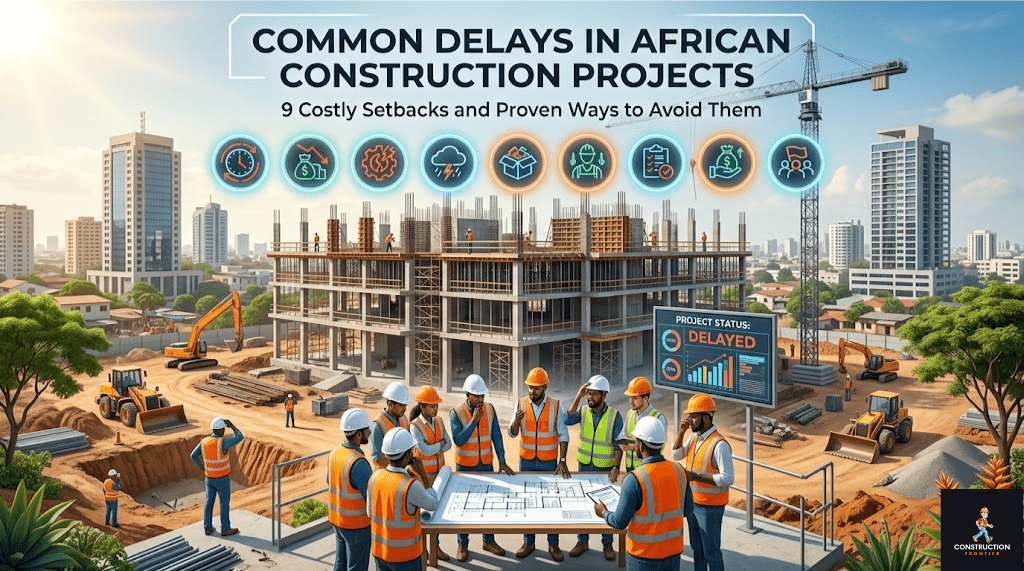
Common Delays in African Construction Projects: 9 Costly Setbacks and Proven Ways to Avoid Them
Common delays in African construction projects cost governments and investors billions every year, pushing completion dates back by years and eroding investor confidence across the continent. From Nairobi to Lagos and Addis Ababa to Dakar, the same structural setbacks recur across energy, transport, and social infrastructure projects: funding gaps, regulatory gridlock, land disputes, and chronic skills shortages. Industry studies indicate that more than 70% of construction projects in Africa experience significant delays, with average time overruns of 20-30% beyond the original completion date. For any project team or public authority seeking to break that pattern, understanding the root causes is the indispensable first step.
Technical Snapshot: Key Delay Statistics Across Africa
| Indicator | Data Point |
| Projects experiencing significant delays | Over 70% across sub-Saharan Africa (industry studies) |
| Average time overrun | 20 to 30% beyond the original schedule |
| PPP projects cancelled in Africa (2007-2020) | Approximately 60, valued at USD 1 billion+ |
| ILO skills gap classification (2024) | Major contributor to cost escalation and rework |
| Nigeria Lagos construction cost inflation (2024) | 45% in USD terms |
| Kenya’s labour-to-building cost ratio (2022) | 25%, up from 20% two years prior |
These figures reflect a continent where infrastructure ambition is outpacing delivery capacity. The common delays in African construction projects examined in this article are not isolated failures; they represent systemic patterns that, once identified and addressed, can transform project outcomes across every sector.
Introduction: Why Construction Delays in Africa Demand Urgent Attention
Africa’s infrastructure pipeline has never been larger. With the African Development Bank estimating a financing deficit of USD 68 to 108 billion annually, and flagship projects spanning transnational energy corridors, smart ports, and multi-billion-dollar road networks, the stakes of delivering on schedule are immense. Yet construction delays in Africa remain among the most persistent threats to project value, national economic growth, and social development outcomes.
A delay to a cross-border transport corridor stalls regional trade. A slipped timeline on a power generation project deepens energy poverty. Cost overruns in public infrastructure stretch already-fiscal-pressure-stricken sovereign budgets. The consequences are not confined to spreadsheets: delayed hospitals deny communities healthcare, deferred schools constrain human capital formation, and stalled water infrastructure worsens public health crises.
This article identifies the nine most common delays in African construction projects and sets out actionable mitigation strategies for each, which builds on our extensive analysis of managing mega construction projects. It draws on academic research, industry data, and project case studies spanning South Africa, Nigeria, Kenya, Ghana, Ethiopia, and the Democratic Republic of Congo. The goal is practical: equip project owners, EPC contractors, development finance institutions, and public-sector clients with the diagnostic framework to prevent delays before they occur.
Effective delivery starts well before a contractor mobilises. Understanding how risk is allocated and managed throughout the project lifecycle is the foundation on which every delay-mitigation strategy in this article rests.
The 9 Most Common Delays in African Construction Projects
The following delays are the most frequently identified causes across research conducted in South Africa, Ghana, Nigeria, Kenya, Ethiopia, and broader sub-Saharan Africa. Each delay type carries a distinct set of drivers, contextual amplifiers specific to the African operating environment, and proven mitigation pathways. The summary table below maps all nine for rapid reference before each is examined in depth.
| # | Delay Type | Primary Cause | Mitigation Priority |
| 1 | Inadequate Pre-Construction Planning | Skipped feasibility and site studies | Critical |
| 2 | Funding Gaps and Payment Failures | Sovereign budget volatility, late payment chains | Critical |
| 3 | Land Acquisition and Resettlement | Disputed tenure, compensation fraud, litigation | High |
| 4 | Regulatory and Permitting Bottlenecks | Multi-agency approvals and corruption in licensing | High |
| 5 | Skilled Labour Shortages | Weak TVET pipelines, artisan brain drain | High |
| 6 | Supply Chain Disruptions | Import dependency, port congestion, and forex volatility | Medium |
| 7 | Scope Creep and Design Changes | Weak initial brief, political scope additions | Medium |
| 8 | Community and Stakeholder Resistance | Poor engagement, inadequate compensation | High |
| 9 | Geopolitical and Security Instability | Cross-border conflicts, governance uncertainty | Context-Specific |
1. Inadequate Pre-Construction Planning and Feasibility
Poor planning sits at the root of most common delays in African construction projects. When feasibility studies are superficial or ignored entirely, the downstream consequences compound across every project phase. In Kenya, the Kimwarer and Arror Dam projects offer one of the continent’s most cited examples: an earlier 1991 geological study had identified a structural fault across the proposed dam sites, yet the warning went unheeded when the projects were revived decades later. Contractors were awarded tenders before land acquisition was finalised and environmental approvals secured, triggering legal injunctions that halted works midstream. The result was a multi-million-dollar scandal, zero construction, and years of legal proceedings.
Across Africa, political urgency routinely trumps technical due diligence. Feasibility reports are either commissioned after contract award or written to justify a predetermined political decision rather than to identify genuine project viability. McKinsey’s multi-project investigation across the continent found that weak feasibility studies and poorly developed business plans rank among the leading reasons African infrastructure projects fail to reach financial close or commence construction.
Mitigation Measures:
-
- Independent Feasibility Studies: Commission multidisciplinary studies as a non-negotiable precondition for project launch.
- Mandatory Pre-Tender Investigations: Complete environmental and social impact assessments, geotechnical surveys, and detailed site investigations before issuing tenders, rather than after.
- Enforced Conditionality: Development finance institutions must enforce this logical sequencing as a firm condition of disbursement.
2. Funding Gaps and Payment Chain Failures
Financial instability is the single most pervasive cause of construction delays in Africa. Owner-side payment delays, mid-project funding shortfalls from government budget reallocations, and the cascading failure of payment chains down to subcontractors and materials suppliers are identified as top-ranked delay factors across research conducted in South Africa, Ethiopia, Ghana, and Nigeria.
Public-sector clients frequently award contracts before confirming multi-year budget commitments, leaving projects stranded when national budgets are revised. In Ethiopia, studies found that delayed payment by owners and suspension of work were among the fifteen most critical causes of building project delays in Addis Ababa. In South Africa, liquidated damages for delayed projects can reach R50,000 per day on major contracts, leading to a self-reinforcing spiral of cost escalation and contractor insolvency.
The broader financing landscape compounds these pressures. With sub-Saharan Africa’s average public debt-to-GDP ratio rising from 32% in 2010 to 57% in 2022, fiscal headroom for capital projects is shrinking. Understanding how infrastructure lifecycle costs accumulate when projects start late or run over budget makes the financial stakes of payment delays concrete.
Mitigation Measures:
- Financial Security: Structure contracts with verified escrow accounts or payment guarantees from development finance institutions before works commence.
- Payment Tracking: Introduce electronic payment-tracking systems and enforceable statutory payment windows by contract.
- Budget Ring-Fencing: Public clients must ring-fence infrastructure budgets across fiscal years to ensure continuous funding.
3. Land Acquisition and Resettlement Disputes
Land acquisition failures are among the most distinctly African contributors to construction delays. Complex customary tenure systems, overlapping formal and informal land rights, inadequate compensation frameworks, and outright corruption in the valuation and disbursement process combine to create protracted disputes that freeze construction mobilisation for months or years.
In Kenya, the National Land Commission has been repeatedly scrutinised for holding compensation funds of KSh 4 billion as of September 2024 while project-affected persons await settlement. Senate investigations revealed that construction of the Mombasa Gate Bridge had not commenced due to delayed compensation disbursements, despite the Kenya National Highways Authority releasing over Sh10 billion to the commission. The LAPSSET Corridor linking Kenya, Ethiopia, and South Sudan has faced repeated delays, partly attributable to resettlement disputes and security concerns along the route.
Corruption amplifies the problem. Research in Kenya’s development corridor projects documents fraudulent compensation claims, double allocation of resettlement plots, and elite capture of land payments, all of which trigger community grievances and legal challenges that paralyse access to sites.
Mitigation Measures:
- Proactive Planning: Begin land acquisition and resettlement action plans at project inception, rather than after contractor mobilisation.
- Transparency Systems: Use independent valuation panels, digital land registries, and direct beneficiary payment systems to reduce exposure to corruption.
- Community Engagement: Ensure robust community liaison structures are in place before any physical survey work begins.
4. Regulatory and Permitting Bottlenecks
Multi-layered regulatory approval processes impose severe delays on construction projects across Africa. Building permits, environmental authorisations, heritage approvals, utility connection consents, and water use licences are typically administered by separate agencies with no statutory obligation to coordinate timelines. In Kenya, the National Construction Authority has acknowledged that construction approvals involve a chain of agencies, where a single weak link can cause months of delay. Delays in pre-construction permitting have a particularly damaging effect on project finances, as overhead costs and loan interest continue to accumulate while no physical work advances.
Research spanning South Africa, Ghana, and Nigeria consistently ranks regulatory approval delays among the top causes of project time overruns. In Ghana, transparent procurement processes are specifically identified as a reform priority, with studies finding that political connections moderate the relationship between consultant performance and project outcomes, a pattern that points to systemic governance weaknesses rather than individual project mismanagement.
Mitigation Measures:
- Consolidated Approvals: Advocate for one-stop approval centres that consolidate environmental, building, and land-use permits under a single agency with mandatory turnaround timelines.
- Parallel Submission: Project teams should submit permit applications in parallel with design development rather than sequentially.
- Specialist Regulatory Teams: EPC delivery models can compress approval timelines through specialist regulatory engagement teams.
Further Reading: Construction Risk Management: 10 Crucial Facts You Must Know to Avoid Costly Project Failures
5. Skilled Labour Shortages
Africa’s skilled construction labour crisis is structural, not cyclical. A 2024 International Labour Organisation (ILO) report identified the skills gap as a major contributor to substandard construction work and escalating project costs across the continent, affecting the entire construction value chain from design through to maintenance. When contractors cannot access qualified artisans, two outcomes follow: subpar work requires costly rework, and supervisory responsibilities fall to insufficiently experienced personnel, compounding quality and safety failures.
In South Africa, the average skilled artisan in the Western Cape is 57 years old, with few new entrants into the trade. Construction firms are increasingly forced to place newly qualified workers in supervisory roles before they are ready. In Kenya, the Institute of Quantity Surveyors estimates the labour-to-building cost ratio has climbed to 25% as scarcity drives wages upward. Nigeria’s construction firms have been documented paying premiums for skilled labour while still experiencing schedule delays. Meanwhile, Gulf employment markets continue to drain the most experienced African artisans abroad.
Mitigation Measures:
- Government-Industry Partnerships: Establish joint programmes to fund Technical and Vocational Education and Training (TVET) initiatives aligned with project workforce plans.
- Prequalification Criteria: Major project owners should build explicit workforce development commitments into contractor prequalification documents.
- Structured Skills Transfer: Build skills transfer and local capacity-building requirements directly into the EPC contract framework to accelerate the development of the regional workforce.
6. Supply Chain Disruptions and Material Shortages
Construction material supply chains in Africa are characterised by high import dependency, inadequate port handling capacity, poor road and rail connectivity to construction sites, and significant foreign exchange volatility. These structural weaknesses convert minor global supply disruptions into major project delays. In Nigeria, construction cost inflation reached 45% in Lagos in 2024 when measured in USD terms, driven by currency weakness and import procurement costs. South Africa’s construction sector has faced critical shortages of cement, steel, bricks, and timber, with inflation compounding the impact of supply constraints.
Turner and Townsend’s 2025 analysis of the African construction market identifies labour and logistics as the two defining challenges for project delivery, with clients needing to take a more direct role in bridging supply shortfalls, including investing in training local skills or importing international expertise where necessary. Long logistics chains from the port of entry to remote construction sites in landlocked countries add weeks to material delivery cycles, making accurate scheduling extremely difficult.
Mitigation Measures:
- Early Procurement: Lock in material orders and freight capacity well before site mobilisation to avoid delivery bottlenecks.
- Supplier Diversification: Diversify the supplier base to reduce single-source exposure and supply chain risks.
- Localised Sourcing: Use local procurement where quality-assured products are available to shorten supply chains and reduce forex exposure.
- Buffer Stock Management: Maintain a minimum on-site material buffer to protect against sudden logistical disruptions.
7. Scope Creep and Design Changes
Scope creep, the incremental expansion of project requirements beyond the original brief, is a major driver of delays in African construction projects. It manifests in two forms: client-driven changes, in which project owners add scope after design is complete, and politically driven additions, in which elected officials attach new requirements to projects during implementation to respond to constituency pressures. Both forms disrupt procurement, force redesign, and trigger variations that extend the programme and inflate the budget.
Research across South Africa and Ethiopia identifies client change orders and variations as leading causes of project delays. In South Africa specifically, delays in approving changes to the scope of works, and mistakes and discrepancies in design documents are among the most frequently cited country-specific causes by contractors, consultants, and clients. The problem is compounded when feasibility and design stages are compressed or underfunded, leaving gaps that only become apparent during construction.
Managing scope and programme changes requires contractual discipline from the outset, an area where the role of EPC contractors in holding design-build accountability within a single delivery entity has proven particularly effective in reducing variation-driven delays on African mega-projects.
Mitigation Measures:
- Pre-Award Design Maturity: Invest in thorough design development before contract award to minimise information gaps that lead to costly variations.
- Formal Change Control: Introduce a dedicated change control board requiring mandatory timeline and cost impact assessments before any scope change is approved.
- Structured Variation Procedures: Include clear variation management procedures with strictly defined approval timelines directly within the contract conditions.
8. Community and Stakeholder Resistance
Community opposition and inadequate stakeholder engagement have emerged as major causes of construction delays in Africa, particularly on road, energy, and water projects that affect rural and peri-urban populations. In South Africa, road construction research found that unrest by local communities and work stoppages by the construction mafia or neighbouring ward groups ranked as the top two overall causes of project delays, above regulatory and payment factors. Inadequate engagement with affected communities before and during construction creates grievances that escalate into physical site blockades, legal interdicts, and sustained work stoppages.
Community resistance frequently stems from perceived inequity in employment allocation, insufficient compensation for assets affected by construction, and exclusion from project decision-making. In East Africa, infrastructure corridor projects have faced community opposition over concerns about land loss, impacts on cultural heritage, and developers’ failure to honour commitments made during consultation processes.
Mitigation Measures:
- Continuous Engagement: Launch structured community engagement at project inception and maintain active communication throughout the construction phase.
- Internal Liaison Function: Establish a dedicated Community Liaison Officer (CLO) within the project team, rather than outsourcing it to periodic consultations.
- Transparent Local Targets: Publicly disclose and independently verify local employment and procurement targets to reduce the perception of exclusion that typically drives community-led stoppages.
9. Geopolitical and Security Instability
Cross-border construction projects and those in frontier markets face an additional layer of delay risk due to political instability, governance disruptions, and security threats. The LAPSSET Corridor has faced repeated schedule setbacks linked to security concerns in northern Kenya and political disagreements among the three partner governments. The Grand Inga hydropower project in the DRC illustrates how political interference at the ownership level can freeze multilateral funding: the World Bank suspended financing in 2016 after President Kabila restructured project oversight to bring it under direct presidential control, a move donors considered incompatible with governance requirements.
For transnational infrastructure, geopolitical dynamics introduce an additional risk layer that standard project risk registers rarely capture at sufficient granularity. Security threats to construction camps, workforce movement restrictions, and disruptions to supply lines caused by conflict or civil unrest can halt months of progress in a matter of days.
Mitigation Measures:
- Geopolitical Feasibility: Incorporate geopolitical and security risk assessments into the feasibility phase, utilising scenario-based contingency planning for project suspension.
- Multilateral Anchors: Engage regional bodies like the African Union and the African Development Bank to increase the political cost for host governments considering unilateral disruption of project governance.
- Political Risk Insurance: Require standardised insurance instruments covering political risk and force majeure events for all cross-border infrastructure projects.
Further Reading: Discover 10 Critical Project Management Challenges in African Infrastructure
Building a Delay Prevention Framework for African Construction Projects
Addressing common delays in African construction projects requires more than reacting to problems as they arise. A structured delay prevention framework integrates risk identification, contractual protections, and programme management into a single operational system active from project inception through to final delivery.
The most effective prevention frameworks share four characteristics:
- Front-Loaded Risk Identification: Score all nine delay types against project-specific conditions during the feasibility phase, producing a ranked risk register with assigned mitigation owners.
- Contractual Risk Allocation: Use specialised contract mechanisms to allocate risk to the party best placed to manage it, applying principles that underpin the NEC and FIDIC contract families commonly used on African mega-projects.
- Explicit Schedule Float: Build deliberate schedule float directly into critical path activities rather than relying on contractor optimism.
- Early Warning System: Establish a structured reporting mechanism that escalates emerging delays to senior decision-makers before they become critical.
Digital project management tools are accelerating this shift. Building Information Modelling, digital twins, and integrated programme management platforms are improving transparency and reducing rework across African construction projects. Tanzania has begun mandating BIM for select public projects, a signal that policy support for digital delivery is strengthening. These tools generate the real-time programme visibility that early warning systems depend on.
Ultimately, avoiding costly construction delays in Africa is a matter of institutional capacity as much as technical execution. Owners who invest in project preparation, maintain payment discipline, and engage communities substantively from the outset consistently deliver better schedule outcomes than those who attempt to accelerate past these foundational requirements.
Technical Reference: Delay Prevention Across the Project Lifecycle
Preventing schedule overruns requires shifting from reactive troubleshooting to proactive, phase-specific controls. Up to 80% of project delays originate from decisions made during the planning and procurement stages. This technical reference provides a structured framework of controls across the three primary project phases to protect the critical path and ensure on-time delivery.
1. Pre-Construction Phase Controls
The pre-construction phase carries the highest leverage over final project outcomes. Executing the following steps before contractor mobilisation prevents cascading delays during physical execution.
- Independent Feasibility Studies: Commission multidisciplinary studies as a non-negotiable precondition for project launch.
- Mandatory Pre-Tender Investigations: Complete environmental and social impact assessments, geotechnical surveys, and detailed site investigations before issuing tenders.
- Proactive Land Acquisition: Initiate land acquisition and resettlement processes at project inception, rather than after mobilisation.
- Parallel Permitting: Project teams should submit regulatory permit applications in parallel with design development rather than sequentially.
- Financial Close Verification: Confirm multi-year budget commitments and achieve complete financial close before releasing the contractor to the site.
2. Procurement and Contracting Controls
Strategic procurement and balanced risk allocation in contracts create a legally binding framework for delay accountability.
| Control Mechanism | Implementation Strategy | Objective |
| Competency-Based Tendering | Assess technical capacity, financial stability, and past project track record. | Prevents award to underqualified or financially unstable contractors. |
| Early Warning Mechanisms | Use standard contract forms (like NEC or FIDIC) with mandatory risk escalation. | Surfaces emerging schedule threats before they impact the critical path. |
| Formal Change Boards | Require timeline and cost impact assessments before any scope change is approved. | Prevents unauthorised scope creep and uncontrolled variations. |
| Milestone-Based Payments | Link interim payments strictly to verified physical progress, not calendar dates. | Incentivises the contractor to maintain the target production rate. |
3. Construction Phase Controls
During physical execution, project management controls must shift to real-time monitoring and active mitigation of site-level bottlenecks.
- Dedicated Community Liaison: Establish a permanent Community Liaison Officer (CLO) directly within the project team to mitigate social stoppages.
- Float Consumption Tracking: Monitor the critical path weekly. Escalate any float consumption above the defined threshold to project sponsors immediately.
- Supply Chain Buffers: Enforce minimum material buffer stock requirements on site and diversify supplier relationships before shortfalls occur.
- Schedule Health Checks: Conduct rigorous monthly schedule reviews against the approved baseline programme.
| Delay Threshold | Corrective Action Required |
| Cumulative Delay of elapsed time | Mandatory submission of a formal recovery and re-baselined program. |
Conclusion: Breaking the Cycle — 9 Critical Delay Factors and Strategic Remedies for African Infrastructure
The common delays in African construction projects documented in this article are neither inevitable nor unique to any single country or project type. They are structural patterns produced by identifiable institutional, financial, and logistical conditions, and they respond to systematic intervention. Projects that invest adequately in pre-construction preparation, contractual discipline, community engagement, and workforce development consistently outperform those that treat these elements as optional overhead.
Africa’s infrastructure pipeline represents one of the most significant economic development opportunities of the twenty-first century. Meeting that opportunity requires the construction industry to treat delay prevention not as a reactive crisis-management function but as a core project-delivery discipline applied from the first day of feasibility to the last day of defects liability. Every month saved on a major infrastructure project is economic activity unlocked, revenue generated, and communities served sooner. The nine mitigation pathways outlined here provide a practical foundation for achieving exactly that.
Stay Updated on Africa’s Infrastructure Megaprojects
Stay ahead of Africa’s infrastructure transformation with Construction Frontier: Civil Engineering & Construction Practices. Explore deep technical insights, expert analysis, and investment intelligence shaping the future of African construction and infrastructure delivery.