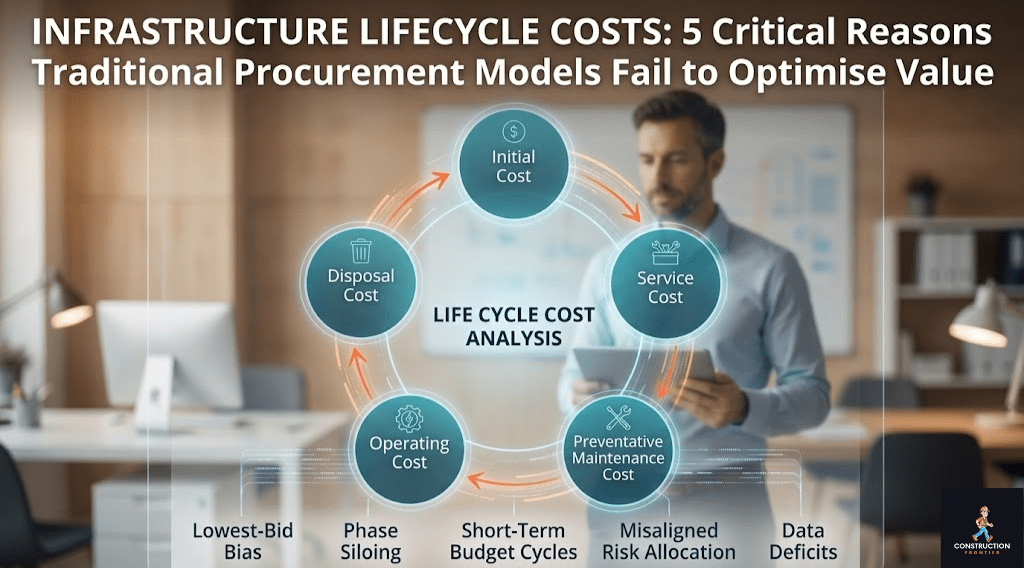
Infrastructure Lifecycle Costs: 5 Critical Reasons Traditional Procurement Models Fail to Optimise Value
Infrastructure lifecycle costs encompass all financial obligations an asset incurs from initial planning through decommissioning, including capital construction, operations, maintenance, rehabilitation, and disposal. Across roads, bridges, energy networks, water systems, and mass transit systems, these cumulative costs routinely reach three to four times the original construction budget over a 30-to-50-year service life. Traditional procurement models, which evaluate contractors predominantly on the lowest upfront price, systematically ignore this reality. The result is infrastructure that delivers short-term budget optics at the cost of long-term value destruction.
Technical Snapshot: Core Concept Specifications
| Attribute | Detail |
| Concept | Infrastructure Lifecycle Cost Optimisation |
| Scope | Planning, design, construction, O&M, rehabilitation, decommissioning |
| Primary failure driver | Lowest-bid procurement separates design from long-term operation |
| O&M share of lifecycle cost | Up to 80% of the total facility lifecycle expenditure |
| Cost overrun prevalence | 9 in 10 major infrastructure projects exceed initial budget estimates |
| Key optimisation models | Design-Build, DBOM, PPP, Integrated Project Delivery, PFI |
| Core standard | ISO 15686: Buildings and constructed assets; service life planning |
Optimising infrastructure lifecycle costs demands procurement strategies that align contractor incentives with long-term performance rather than just delivery-day milestones. The sections below analyse five structural failures embedded in traditional procurement and the models that resolve them.
Introduction: The Value Leak — 5 Systemic Blind Spots in Traditional Project Procurement
Every major infrastructure project carries two price tags: the construction cost visible at contract award and the infrastructure lifecycle costs that accumulate invisibly across decades of operation. For most public and private asset owners, the second figure dwarfs the first. Research from the Whole Building Design Guide confirms that up to 80% of a facility’s total lifetime expenditure falls under operations and maintenance, rather than the 20% on initial capital delivery. Yet the dominant global approach to infrastructure project delivery continues to select contractors primarily on the basis of the lowest construction bid, creating a structural disconnect between procurement incentives and long-term fiscal outcomes.
The scale of this misalignment is significant. A 2024 study by the American Society of Civil Engineers estimated that systematically applying formal lifecycle cost analysis to major infrastructure programmes could save up to USD 1 trillion over 30 years in the United States alone. Similar findings from OECD research across 13 countries confirm that traditional procurement models consistently yield suboptimal outcomes in terms of cost certainty, maintenance quality, and operational performance. The wrong procurement framework does not merely affect the upfront price; it shapes every financial decision taken for the asset’s entire service life.
This article examines five critical structural failures embedded in traditional procurement models, explains why each one undermines lifecycle cost optimisation, and identifies the procurement strategies that offer a more complete approach to value. It supports the broader analysis presented in Construction Frontier’s main article on managing mega construction projects and connects with related deep dives on EPC contractor roles, contract types in construction, and EPC project delivery model works.
Reason 1: The Lowest-Bid Bias Severs the Link Between Construction Quality and Operational Cost
The foundational failure of traditional procurement models is structural: evaluation criteria that reward the lowest upfront bid treat capital cost as a proxy for value. This logic breaks down when applied to infrastructure lifecycle costs, where construction accounts for only a minority of total long-term expenditure. Procurement decisions made at the tender stage lock in material specifications, structural tolerances, and system choices that define maintenance burdens for 30 to 50 years, yet the winning contractor bears none of those downstream financial consequences.
1.1 How Low Bids Generate High Lifecycle Costs
Contractors competing on the lowest price or the “lowest bid bias” face a straightforward incentive: reduce specification quality, substitute cheaper materials, or compress tolerances to the minimum compliant level. The asset owner accepts delivery, the contractor exits, and a different organisation, often a public agency with a fragmented budget, absorbs decades of elevated maintenance. Challenges of traditional procurement in construction are acute here: operations and maintenance expenditure across facilities can account for 20% to 60% of total operating expenditure, while delaying maintenance due to early underinvestment compounds the problem, with deferred costs reaching three to four times their original scale if capital renewal is required.
In the water engineering project database, records by the IRC WASH Technical Report show that operations and maintenance expenditure can reach four times the original construction cost over the asset’s life. A bridge or water main procured at the lowest possible capital cost but specified to minimum durability standards does not save public money; it defers private-sector costs into public maintenance budgets, disaggregated across future fiscal years where accountability is diffuse.
1.2 Why Cost Overruns Begin at the Bid Stage
Research by the World Bank on policy and planning for large infrastructure projects, covering 258 organisations across 20 countries and five continents, found that 9 in 10 infrastructure projects experience cost overruns. A significant proportion of these overruns originates not in construction execution but in the bidding structure: aggressive underpricing at tender, followed by change orders, contract renegotiation, and claims once the contractor is locked into the project. Improving lifecycle cost efficiency in infrastructure projects, therefore, demands that procurement frameworks evaluate total value rather than entry-level price, using structured methodologies such as ISO 15686 or whole-life cost modelling to score bids against 30-year cost projections rather than day-one contract values.
Reason 2: Phase Siloing Destroys Value by Separating Design from Operation
The design-bid-build (DBB) model, the dominant form of traditional procurement, executes design, procurement, and construction as three legally and organisationally separate phases, each managed by a different entity under separate contracts. This structure provides competitive pricing at each stage but systematically prevents lifecycle cost considerations from flowing between phases. The designer has no contractual responsibility for maintenance outcomes. The constructor has no visibility into operational cost modelling. The operator inherits an asset they had no role in configuring.
2.1 The Contractor Exclusion Problem
In a standard DBB process, the general contractor is legally prohibited from providing input during the design phase, which is precisely when 70 to 80% of an asset’s lifecycle cost profile is locked in. Constructability reviews, systems integration decisions, material durability trade-offs, and mechanical plant specifications all occur before any construction expertise is brought into the process. The Australian Constructors Association, commissioned to review mega-project performance, concluded that traditional management and procurement practices cannot accommodate the political, social, economic, and environmental complexities of large-scale infrastructure programmes.
The consequence is compounding: designs that lack construction input result in higher-than-necessary change orders; change orders lead to delays; delays generate additional claims; and the final cost diverges substantially from the bid price. This entire chain originates in a procurement structure that treats design as a completed input rather than a collaborative output.
2.2 The Maintenance Budget Disconnection
Phase siloing or silo mentality also disconnects the team responsible for delivering the infrastructure project from the team responsible for operating the finished asset. Under DBB, the operator, whether a public authority or a concessionaire, has no seat at the design table. The result is infrastructure specified for construction efficiency rather than operational economy. Procurement strategies in construction that bundle design with long-term operations and maintenance, including design-build-operate-maintain (DBOM) and public-private partnership (PPP) models, resolve this by binding a single entity to both delivery and lifecycle cost performance. When the builder must also maintain the asset for 20 or 30 years, specifications change materially.
Reason 3: Short-Term Budget Cycles Conflict with Long-Term Lifecycle Cost Horizons
Public sector infrastructure procurement operates within annual or biennial budget cycles that create systematic pressure to minimise visible capital expenditure at the cost of future, invisible liabilities. How to optimise infrastructure lifecycle costs cannot be answered within a framework that measures procurement success at financial year-end rather than at the end of the asset’s service life. This temporal mismatch is one of the most structurally embedded failures in public infrastructure finance.
3.1 The Political Economy of Capital Minimisation
Decision-makers who select contractors, approve budgets, and manage procurement processes typically hold roles with tenure of 3 to 5 years. The financial benefits of higher upfront capital investment in more durable specifications, better systems integration, or superior maintenance provisions accrue over 20 to 40 years, well beyond any individual decision-maker’s accountability window. The International Institute for Sustainable Development (IISD) identifies this as a principal structural barrier to whole-life costing in public procurement: the financial gains from lifecycle cost analysis are likely to materialise after the original procurement decision-maker has left their role.
The perverse outcome is that cost efficiency in infrastructure measured against short-term capital budgets produces long-term cost inefficiency measured against whole-life expenditure. An asset specified to save $50 million in construction costs but to generate $200 million in elevated maintenance over 30 years is recorded as a procurement success in the year of delivery and as a fiscal burden in each of the three subsequent decades.
3.2 Life-Cycle Cost Analysis as a Countermeasure
Lifecycle cost analysis (LCCA) directly addresses this by discounting all future cash flows, including maintenance, rehabilitation, energy, and decommissioning, back to present value and comparing total-cost scenarios at the point of procurement. The RICS professional guidance on life cycle costing establishes that many private sector organisations now mandate LCCA for capital procurement decisions, using real discount rates (approximately 3% in many national markets) applied across a 20-to-50-year analysis period. Governments adopting similar frameworks embed long-term fiscal accountability into infrastructure project delivery from the outset rather than inheriting it as an unbudgeted operational burden.
Reason 4: Risk Allocation Structures Under Traditional Models Generate Renegotiation and Cost Escalation
Traditional procurement assigns construction risk to the contractor and operational risk to the owner, a division that appears logical but creates powerful incentives for opportunistic behaviour at the construction-to-operation handover. Contractors who bear no post-completion liability have no financial incentive to specify durable systems, invest in commissioning quality, or resolve latent defects before they manifest as operational problems. Why traditional procurement models fail in infrastructure projects is partly a risk allocation problem: the party best positioned to control long-term costs is insulated from bearing them.
4.1 Change Orders as a Revenue Model
Under fixed-price DBB contracts, an underpriced bid is not necessarily a financial loss for the contractor; rather, it serves as an entry mechanism. Change orders, claims for unforeseen conditions, and renegotiations conducted after contract award, when the owner has no competitive alternatives, allow contractors to recover the margin that was not priced into the original bid. OECD procurement research identifies errors and omissions in design documentation as the second-most-frequent direct cause of cost overruns in road infrastructure DBB projects, triggering costly, time-consuming renegotiations for the procuring entity.
A well-structured incentive-based contract or a bundled delivery model with performance guarantees eliminates this mechanism. When the contractor’s payment is linked to operational performance rather than completion milestones, the incentive to cut specification quality inverts: underspecification costs the contractor money in future maintenance rather than saving it.
4.2 Procurement Model Comparison
| Procurement Model | Lifecycle Cost Alignment | Risk Allocation | Best Suited For |
| Design-Bid-Build (DBB) | Low: price-focused, siloed | The owner bears all O&M risk | Simple, low-complexity works |
| Design-Build (DB/EPC) | Moderate: single contract, no O&M | Shared design-construction risk | Complex capital projects |
| DBOM (Design-Build-Operate-Maintain) | High: lifecycle incentive built in | The contractor retains O&M risk | Long-service infrastructure assets |
| PPP/PFI | High (where structured correctly) | Long-term performance risk of the private partner | Major national infrastructure |
| Integrated Project Delivery (IPD) | Very High: all parties share risk/reward | Shared across all participants | High-complexity, high-value assets |
4.3 PPP Limitations and the Complexity Caveat
Public-Private Partnerships (PPPs) and Private Finance Initiative (PFI) models carry their own structural risks. OECD analysis of bundled delivery models, including PPPs, found that fixed-date and fixed-price delivery requirements increase bidders’ uncertainty, leading to excessive contingencies that push project costs above those of traditional procurement approaches even before financing costs are added.
Infrastructure lifecycle costs alignment does not automatically follow from bundled contracts; it requires well-drafted performance specifications, independent verification of whole-life cost modelling, and competitive pressure maintained through multiple credible bidders. Where these conditions are absent, PPP structures can replicate the value destruction of traditional procurement at higher transaction costs.
Reason 5: Data Deficits in Traditional Procurement Prevent Informed Lifecycle Decision-Making
Effective infrastructure lifecycle costs optimisation depends on access to reliable operational data: energy consumption profiles, maintenance frequency and unit costs, systems failure rates, rehabilitation cycle data, and end-of-life decommissioning estimates. Traditional procurement models structurally obstruct this data flow by fragmenting asset ownership, operation, and maintenance across separate contractual entities with no obligation to share performance information. The result is that each new procurement decision is made with the same information deficit as the last.
5.1 The Absence of Feedback Loops
In a DBB or separately contracted maintenance model, the data generated during asset operations rarely reaches the design and procurement teams responsible for the next capital investment. Maintenance providers record failure events, but this data sits within their systems rather than informing future specifications. Designers working on the next generation of the same asset type repeat the same specification decisions without the corrective signal that operational experience should provide.
The International Institute of Sustainable Development (IISD) notes that a lack of competence in conducting lifecycle cost analysis, combined with insufficient tools and data, makes its adoption far less attractive in public procurement. The data gap is not merely technical; it reflects a procurement structure that lacks a mechanism to convert operational learning into improvements to capital specifications. Improving lifecycle cost efficiency in infrastructure projects requires that procurement contracts impose data-sharing obligations, that operational performance is tracked against pre-construction benchmarks, and that asset registers capture whole-life cost data in formats usable at future procurement stages.
5.2 BIM and Digital Asset Management as Solutions
Building Information Modelling (BIM) and digital asset management platforms, such as AI-based predictive maintenance of public infrastructure, are closing this gap in progressive procurement frameworks. BIM plug-ins integrated with lifecycle cost analysis tools allow asset owners to track quantities, maintenance intervals, and asset metadata across the full service life. When procurement contracts mandate BIM adoption with operational data-sharing requirements, the information asymmetry between designers, constructors, and operators narrows substantially. McKinsey & Company research indicates that digitising maintenance operations through enterprise resource planning and computerised maintenance management systems can cut maintenance costs by 15 to 30%, a saving that compounds over an asset’s lifetime.
Further Reading: Contract Types Explained: 5 Essential Models from FIDIC to Design-Build for Successful Project Delivery
How to Optimise Infrastructure Lifecycle Costs: Strategic Procurement Approaches
Addressing the five structural failures above on infrastructure lifecycle costs does not require abandoning competitive procurement; it requires restructuring what procurement competition rewards. The following procurement strategies in construction are supported by evidence as effective tools for lifecycle cost optimisation.
1. Whole-Life Cost Tender Evaluation
The most direct intervention is to replace the lowest-price bid evaluation with a whole-life cost scoring methodology. Under this approach, bidders are required to submit not only a construction price but a lifecycle cost model covering operations, maintenance, rehabilitation, and decommissioning over a defined period, typically 25 to 30 years.
The CIPS whole-life costing framework and ISO 15686 provide standardised methodologies for structuring these models. The procuring entity evaluates the present value of the total cost profile, not the day-one contract value, as the primary selection criterion. This approach is now mandated under public procurement regulations in several European jurisdictions for high-value infrastructure assets.
2. Outcome-Based and Performance-Specified Contracting
Rather than specifying inputs, outcome-based contracts define the performance standard the asset must achieve, such as pavement condition indices for roads, uptime guarantees for power infrastructure, or water quality parameters for treatment assets, and allow the contractor to determine how to meet those standards. This model transfers specification risk to the party best placed to manage it while aligning contractor incentives with long-term asset performance. Performance-specified contracts require robust monitoring frameworks and independent verification, yet consistently deliver better cost efficiency in infrastructure over the full asset life cycle.
3. Early Contractor Involvement
Early contractor involvement (ECI) programmes bring construction expertise into the design phase before tender, resolving the constructability gap that drives change orders and specification errors under DBB. Design-build and EPC models formalise this integration at the contractual level, while collaborative delivery models such as integrated project delivery extend shared risk and reward to all project participants. The Federal Highway Administration (FHWA) design-build guidance confirms that ECI programmes work best when design is in the 10-15% completion range at contractor engagement, preserving sufficient design latitude for construction innovation while providing adequate scope definition for competitive pricing.
4. Maintenance-Bundled Delivery
Design-build-operate-maintain contracts remain the most effective single mechanism for aligning infrastructure lifecycle costs with procurement incentives. By requiring the entity that designs and constructs an asset to also maintain it for 20 to 30 years, these models create a direct financial incentive to invest in durable specifications, quality commissioning, and systems that minimise future maintenance costs. The FHWA cites multiple US highway examples where design-build contracts bundled with maintenance agreements of 20 to 30 years produced measurable whole-life cost savings relative to separately procured equivalents.
Further Reading: ISO Certification for Construction Companies: 6 Benefits, Requirements, and Powerful Business Impact
Technical Reference: Infrastructure Lifecycle Costs and Procurement Optimisation
Delivering sustainable infrastructure requires moving beyond short-term capital expenditure (CAPEX) to account for the full lifecycle costs. Up to 80% of an asset’s total cost is determined during the initial planning and procurement phases, making strategic model selection vital for long-term project bankability. This technical reference provides a benchmark for understanding lifecycle cost distributions across primary asset classes, the fundamental variables required for accurate whole-life cost modelling, and the core criteria for selecting the most efficient procurement framework.
Technical 1: Infrastructure Lifecycle Costs Breakdown for Major Projects Asset Classes
| Asset Class | Typical Capital Cost Share of LCC | O&M Cost Share Over 30 Years | Key Cost Drivers |
| Highway/Road | 30-45% | 55-70% | Pavement rehabilitation, drainage, and traffic management |
| Bridge | 35-50% | 50-65% | Structural inspection, deck replacement, bearing maintenance |
| Water/Wastewater | 20-35% | 65-80%+ | Energy (pumping), chemical dosing, pipe rehabilitation |
| Power Transmission | 25-40% | 60-75% | Line maintenance, transformer cycles, grid modernisation |
| Urban Rail Transit | 35-50% | 50-65% | Rolling stock, signalling, track maintenance, station O&M |
Technical 2: Whole-Life Cost Modelling Key Variables
A complete infrastructure lifecycle costs model must capture the following:
- Initial capital expenditure, including design, land acquisition, and commissioning.
- Annual operations and maintenance costs escalated at sector-specific rates.
- Periodic rehabilitation and major component replacement cycles, discounted to present value at a real discount rate of approximately 2 to 4%.
- Energy consumption profiles across the asset’s operational life.
- Risk-adjusted contingencies for unplanned maintenance events, with probability weighting based on historical failure data.
- End-of-life decommissioning and disposal or residual value.
ISO 15686 and AACE provide standardised methodologies for structuring these models in a consistent, auditable format.
Technical 3: Procurement Model Selection Criteria
The selection of the appropriate procurement model for a specific infrastructure asset should be driven by five factors:
- Project Complexity: Simple, repetitive work suits Design-Bid-Build (DBB); highly complex or integrated assets require bundled delivery.
- Asset Service Life: Assets with 30-plus-year horizons justify the higher transaction cost of Design-Build-Operate-Maintain (DBOM) or Public-Private Partnership (PPP) structures.
- Owner Capacity: Procuring entities with limited technical staff benefit from bundled delivery that transfers specification responsibility.
- Risk Appetite: Incentive-based contracts and performance specifications require robust monitoring capacity.
- Market Depth: Bundled delivery models require a minimum of three to five credible bidders to maintain competitive pricing and avoid excessive contingencies.
Conclusion: Infrastructure Value Requires Lifecycle-Aligned Procurement
The five failures examined in this article, lowest-bid bias, phase siloing, short-term budget cycles, misaligned risk allocation, and data deficits, are not isolated defects in infrastructure lifecycle costs. They are interconnected symptoms of a procurement philosophy that treats infrastructure as a capital event rather than a long-duration financial commitment. Infrastructure lifecycle costs account for the overwhelming majority of what public and private asset owners will ultimately spend on the assets they procure. Optimising those costs requires procurement frameworks that extend accountability beyond delivery day, align contractor incentives with operational performance, and build the data infrastructure to inform future investment decisions.
The transition from traditional procurement models to infrastructure lifecycle costs-aligned delivery is already underway in many advanced infrastructure markets. Design-build, DBOM, performance-specified contracting, and integrated project delivery are each gaining ground as asset owners accumulate evidence of the long-term cost penalties embedded in lowest-bid selection. For public authorities, development finance institutions, and private concessionaires managing Africa’s infrastructure build-out, the lesson is clear: the most expensive procurement decision is one that optimises for the price on bid day rather than the value across the asset’s full service life.
Stay Updated on Africa’s Infrastructure Megaprojects
Stay ahead of Africa’s infrastructure transformation with Construction Frontier: Civil Engineering & Construction Practices. Explore deep technical insights, infrastructure lifecycle costs, expert analysis, and investment intelligence shaping the future of African infrastructure procurement and project delivery.