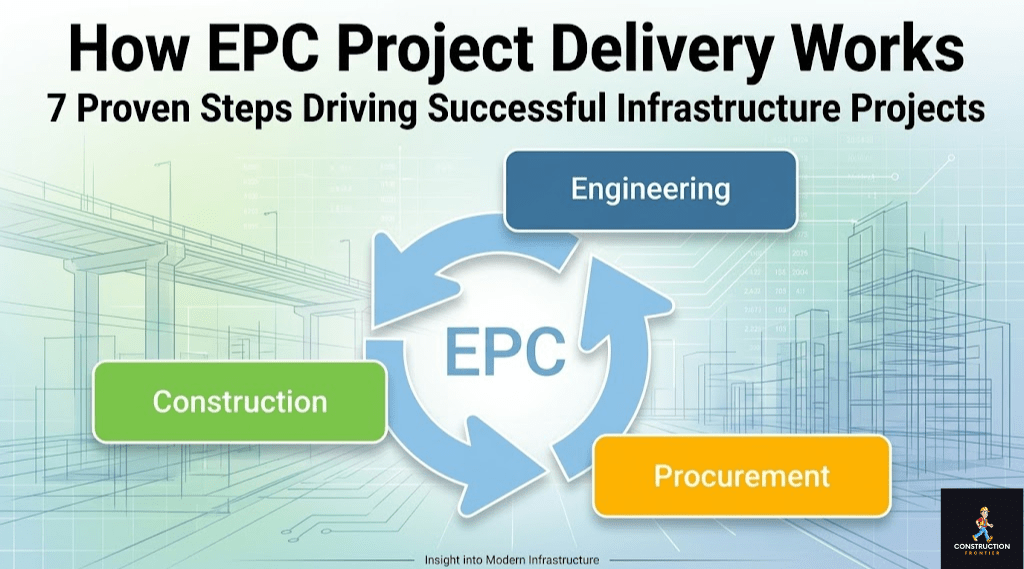
How EPC Project Delivery Works: 7 Proven Steps Driving Successful Infrastructure Projects
How EPC project delivery works is the central question behind every bankable infrastructure investment. Under the Engineering, Procurement, and Construction (EPC) model, one contractor assumes complete responsibility for design, sourcing, and physical construction, delivering a fully operational asset to the owner. The engineering, procurement, and construction process consolidates accountability that fragmented contracting leaves scattered, eliminating interface disputes that drive overruns and schedule collapse on complex projects. With the global EPC market valued at USD 8.12 trillion in 2024 and forecast at USD 13.79 trillion by 2033 at a 6.1% CAGR, the model now defines how energy, transport, and industrial infrastructure are financed, structured, and built worldwide.
Technical Snapshot: Core EPC Project Specifications
| Contract Type | Lump Sum Turnkey (LSTK) — Fixed-Price EPC |
| Governing Standard | FIDIC Silver Book, EPC/Turnkey Projects, 2nd Ed. 2017 |
| Single-Point Responsibility | The contractor owns design, procurement, construction, and commissioning |
| FEED Duration | 4–8 months (sub-USD 500M); 12–18 months (USD 1B+) |
| Cost Estimate Accuracy | ±10–15% (Class 2/3 post-FEED) |
| Typical Construction | 18–48 months, depending on scale and complexity |
| Procurement Share | 50–60% of total contract value |
| Risk Allocation | Design, cost, and schedule risk transferred to the contractor |
| Global EPC Market (2024) | USD 8.12 trillion |
| Africa Power Gap (annual) | ~USD 25–30 billion below SDG7 requirement (AfDB, 2024) |
The EPC project delivery model remains the contractual backbone of infrastructure investment in Africa and globally, where delivery certainty directly determines a project’s bankability and long-term commercial viability.
Introduction: How EPC Project Delivery Works; The Contract Model Powering Global Infrastructure
In modern infrastructure delivery, understanding how EPC project delivery works sits at the centre of every capital investment decision. The engineering, procurement, and construction process consolidates engineering design, equipment procurement, and physical construction under a single fixed-price contract, eliminating interface disputes that occur when separate firms manage each phase.
For project owners and development finance institutions, this structure translates directly into execution certainty, simplified lender security packages, and the performance guarantee provisions that make complex projects bankable.
Across Africa, where the continent must add roughly 26 GW of power capacity per year through 2030 against a historical average of 7–8 GW, the EPC model is the delivery vehicle for the vast majority of the pipeline. From hydropower in the Congo Basin to solar farms in North Africa and rail corridors in East Africa, EPC contracts underpin the region’s most consequential infrastructure programmes.
This article traces the full EPC project lifecycle through seven steps, examines benefits and risks, and explores what the model means in practice for Africa’s development trajectory. It supports our in-depth analysis of managing mega construction projects across their full lifecycle.
EPC Project Delivery Explained: Core Concepts and Structure
Before tracing the seven steps, it is worth establishing the foundational mechanics: what the EPC contract entails, how the EPC project lifecycle is structured, and the critical distinction between EPC and turnkey delivery that practitioners often conflate.
EPC Contract Meaning and Key Principles
The EPC contract’s meaning rests on one principle: a single contractor delivers a complete, operational facility for a guaranteed price by a fixed date. Under the FIDIC Silver Book, the contractor bears design liability, cost certainty, schedule performance, and site condition risk, shifting the execution risk envelope away from the owner and onto a specialist entity. Failure to meet price, date, or performance criteria triggers monetary liabilities, including liquidated damages, making contractor accountability contractually enforceable rather than merely aspirational.
EPC Project Lifecycle Overview
The EPC project lifecycle runs from feasibility through Front End Engineering Design (FEED), detailed engineering, procurement, construction, commissioning, and handover as overlapping workstreams managed under a single delivery authority. Procurement can begin once engineering reaches sufficient definition, and construction can start on completed scopes while engineering of the remaining elements continues. This phase overlap is the primary mechanism by which the engineering, procurement, and construction process compresses overall schedules by 20–30% relative to sequential design-bid-build delivery.
EPC vs Turnkey Projects: Key Differences
The distinction between EPC and turnkey projects is often misunderstood because the FIDIC Silver Book uses both terms in its title. In practice, all EPC contracts under the Silver Book are turnkey in nature (the contractor hands over a ready-to-operate facility), but not all turnkey arrangements carry the full risk profile of the Silver Book. A design-build contract under the FIDIC Yellow Book can have turnkey characteristics without assuming the contractor-side risk transfer that defines EPC. Owners choosing between the two should assess technical complexity, contractor financial strength, and lender requirements before selecting the appropriate standard form.
How EPC Project Delivery Works: Step-by-Step Process Explained
Understanding exactly how EPC project delivery works in execution requires following each step from pre-investment through operational transfer. The step-by-step EPC project delivery process below is not merely sequential; it is the framework that distinguishes projects that close financing and deliver on schedule from those that stall due to claims, rework, and lender disputes.
Step 1: Project Concept and Feasibility Analysis
Every EPC project begins before a drawing is produced. Technical assessments cover site conditions, technology selection, and permitting requirements, while financial viability studies model capital expenditure, operating costs, and return on investment at a Class 4 estimate accuracy of ±30–50%. Resolving land acquisition, environmental permitting, and offtake agreement structures at this stage is determinative: projects that proceed to FEED without these anchors routinely encounter the scope changes during execution that EPC contracts are structured to prevent.
Step 2: Front-End Engineering Design (FEED)
FEED is the highest-leverage investment an owner makes before contract award. Completing 20–30% of engineering upfront refines cost estimates from Class 4 to Class 2/3 accuracy of ±10–15%, which is the precision required for final investment decision approval and project finance underwriting. Industry data confirms that projects with poor front-end definition suffer 20% more cost growth on average, which is why the cost-of-change curve alone justifies FEED as an operational necessity rather than overhead.
Step 3: Procurement Strategy and Supply Chain Setup
Procurement accounts for 50–60% of total EPC contract value, making supply chain management the highest-leverage operational discipline. Long-lead equipment, including gas turbines, transformers, and specialised valves, has manufacturer lead times exceeding 18 months, requiring procurement actions to begin well before detailed engineering is complete. For African projects, supply chain constraints, including port capacity, limited local fabrication, and inland logistics corridors, must be planned into the strategy from FEED rather than managed reactively on site.
Step 4: Detailed Engineering and Design Execution
Detailed engineering converts the FEED package into a construction-ready package for construction documents across civil, structural, mechanical, electrical, and instrumentation disciplines simultaneously. BIM-federated models identify design clashes before they become costly on-site conflicts, while digital twin simulation validates system integration and operability before the first steel is erected. The digital twin market is projected to reach USD 110 billion by 2029, with EPC contractors among the primary drivers of adoption in heavy industrial applications.
Step 5: Construction and On-Site Project Execution
Site mobilisation is the phase in which the upstream discipline either holds or begins to unravel. Civil works, structural erection, mechanical installation, and electrical terminations must be sequenced against the construction schedule and the procurement delivery plan, with real-time coordination between engineering documentation, arriving equipment, and construction crews. HSE compliance under the Silver Book is a contractual liability of the EPC contractor, and most development finance institutions now impose independent HSE monitoring as a condition of disbursement, adding an external accountability layer throughout execution.
Step 6: Testing, Commissioning, and Quality Assurance
Commissioning bridges construction completion and operational readiness, running from mechanical completion through pre-commissioning checks, loop testing, and final performance testing under live load conditions. The EPC contractor must demonstrate that the facility meets the output, efficiency, and reliability benchmarks defined at contract award before receiving the taking-over certificate. This incentive structure is one of the clearest expressions of how EPC project delivery works as a risk transfer mechanism: the contractor does not receive final payment until the facility performs to specification.
Step 7: Project Handover and Operational Readiness
The final handover delivers not just a physical facility but also a complete operational package: as-built drawings, equipment manuals, spare parts inventories, maintenance schedules, and training programmes for operations staff. This step is frequently underinvested in, particularly where the owner’s technical capacity is limited, yet it is the phase that determines whether the asset performs to contract specification across its operational life. Contractors who execute handover rigorously build the track record that wins repeat EPC mandates on Africa’s expanding infrastructure pipeline.
EPC Project Lifecycle: Summary Table
| Phase | Core Objective | Key Deliverables & Accuracy | Critical Risk Factors |
| 1. Concept & Feasibility | Establish technical and financial viability. | Class 4 Estimate (±30–50%); land & permitting anchors. | Scope creep if land and offtake are not secured early. |
| 2. FEED | Refine engineering to secure project financing. | Class 2/3 Estimate (±10–15%); 20–30% of engineering complete. | Poor definition leads to an average cost growth of ~20%. |
| 3. Procurement | Manage the supply chain for high-value items. | Long-lead equipment orders; logistics & port strategy. | 18+ month lead times; local African logistical constraints. |
| 4. Detailed Engineering | Produce construction-ready documents. | BIM-federated models; Digital twin simulations. | Design clashes; lack of multi-disciplinary synchronisation. |
| 5. Construction | Execute physical works and site mobilisation. | Sequential installation; real-time field coordination. | HSE liabilities; coordination between arrivals and crews. |
| 6. Commissioning | Verify facility performance against specs. | Performance testing and mechanical completion certificates. | Failure to meet output benchmarks delays final payment. |
| 7. Handover | Transition asset to operational status. | As-builts; maintenance schedules; staff training. | Underinvestment leads to long-term performance drops. |
Benefits of EPC Contracts in Infrastructure Development
The structural case for EPC project delivery is well supported by evidence from major programmes worldwide. The four core benefits of EPC contracts in infrastructure development that consistently drive adoption are cost certainty, schedule acceleration, single-point accountability, and risk transfer, all of which are foundational to the project management disciplines examined in our pillar resource on managing mega construction projects.
1. Cost Certainty and Financial Control
Lump-sum pricing converts variable project execution risk into a fixed financial obligation, simplifying project finance modelling and reducing the contingency reserves that lenders and equity sponsors must hold against uncertain outcomes. Additional costs from design errors, procurement overruns, or construction inefficiencies are absorbed by the contractor. Owners who understand the full EPC project delivery advantages recognise the lump-sum premium as the rational price of budget certainty, not an avoidable overhead.
2. Accelerated Project Timelines
Phase overlap compresses the overall programme by 20–30% compared to sequential delivery. On projects with tight PPA commissioning deadlines or government delivery mandates, schedule compression has direct financial value: an earlier commercial operations date means earlier revenue, which can be worth tens of millions in discounted cash flow terms, often exceeding the cost premium of EPC contracting by a material margin.
3. Single-Point Accountability
Fragmented responsibility is the most persistent source of cost and schedule disputes in large construction projects. When a designer, procurement agents, and constructors operate under separate contracts, interface disputes consume years of management resources and tens of millions in legal costs. Under an EPC arrangement, the contractor owns all interfaces, eliminating contractual ambiguity that generates claims and streamlining the owner’s project oversight burden to performance monitoring rather than coordination.
4. Risk Transfer to Contractors
The FIDIC Silver Book’s comprehensive risk allocation to the contractor is the defining commercial feature of EPC contracting. Design liability, cost and schedule performance, and site condition risk all sit with the contractor, with the owner retaining scope change and force majeure residuals. This balance benefits both parties when calibrated correctly: owners gain execution certainty; contractors are compensated through the lump-sum premium. Miscalibration, typically from aggressive risk transfer onto a poorly defined scope, is the leading cause of contractor financial distress and project failure under EPC structures.
EPC Project Delivery Advantages and Risks
A rigorous assessment of EPC project delivery advantages and risks must address both dimensions equally. The same structural features that create efficiency also create vulnerabilities when the model is improperly structured or assigned to undercapitalised counterparties.
Key Advantages of EPC Project Delivery
Beyond the four core benefits, EPC delivers scalability across sectors, procurement leverage through established supply chain relationships, and integrated project controls that would be prohibitively complex to replicate across multiple separate contracts. EPC contractors with long-standing supply sources procure long-lead equipment faster and at better commercial terms than owners managing the same process independently, a procurement advantage particularly significant for African projects where access to qualified suppliers is constrained.
Common Risks in EPC Projects
The concentration of responsibility that creates EPC’s advantages also concentrates its failure modes. An undercapitalised or technically weak contractor leaves the owner without a functional accountability mechanism: contractor insolvency has caused multi-year delays and hundreds of millions of write-downs on energy and transport projects globally. Design rigidity under lump-sum contracts is a parallel risk: once the price is fixed, post-award scope changes required by the owner trigger costly amendments, and projects where requirements were not fully defined before award experience the most severe commercial disputes in EPC delivery.
Risk Mitigation Strategies
Robust contract structuring, comprising performance bonds, parent company guarantees, lender step-in rights, and liquidated damages provisions, creates enforceable financial accountability for underperformance. Independent technical monitoring by the owner or lender’s technical adviser provides early warning when contractors slip on schedule or quality. Pre-award due diligence on contractor balance sheet strength, technical track record, and supply chain depth is equally critical: the best contract cannot compensate for a contractor that lacks the capacity to execute.
Africa and Emerging Markets: EPC Project Delivery in Practice
Africa’s infrastructure pipeline, spanning power generation, transmission, transport, water, and industrial facilities, is overwhelmingly structured around EPC contracts. Understanding the specific dynamics of how EPC project delivery works in African markets is therefore central to any serious analysis of the region’s development trajectory.
Rising Adoption and Why EPC Works in Emerging Markets
Africa’s power sector alone requires a radical acceleration of capacity. Under a least-cost SDG7 pathway, the continent must add roughly 182 GW of new generation between 2023 and 2030, with 88% from solar and wind, against a historical buildout of 7–8 GW per year. Nearly every IPP in that pipeline is structured as an EPC contract because fixed-price delivery simplifies development bank appraisal and enables straightforward offtake structuring. When the owner’s technical capacity is limited, transferring engineering and procurement risk to a specialist contractor directly addresses gaps in the owner’s project management infrastructure.
Key Challenges in African EPC Projects
Financing remains the primary bottleneck: the AfDB estimates an annual funding gap of USD 25–30 billion for African power infrastructure, meaning much of the pipeline cannot proceed without additional capital mobilisation. Regulatory and political risk, currency controls, permitting delays, and policy shifts add execution uncertainty that is difficult to price into a fixed lump sum. Supply chain limitations, including inadequate port capacity, limited local fabrication, and long inland logistics corridors, drive procurement costs above international benchmarks and extend equipment delivery timelines beyond those encountered in mature markets.
Localisation and Capacity Building
Governments across Nigeria, South Africa, Kenya, and others now mandate minimum local content thresholds, creating both contractual obligations and genuine development opportunities. EPC contractors who deliver credible localisation plans, covering local subcontracting, workforce training, and materials sourcing, gain a competitive advantage in tender evaluation and build the domestic supply chain depth that future project cycles depend on. Over multiple EPC programme cycles, this translates into the emergence of local contractor capability, progressively reducing the continent’s reliance on international EPC firms for infrastructure delivery.
Global Applications: Where EPC Delivery Dominates
How EPC project delivery works is best understood through the sectors where it has become the established norm. Three domains account for the majority of global EPC contract volume.
Energy: Oil, Gas, and Renewables
The energy sector represents approximately 42% of global EPC contracts, driven by renewable expansion and ongoing hydrocarbon infrastructure investment. Power plants, LNG facilities, refineries, and utility-scale solar farms all share the characteristics that favour EPC: high technical complexity, long construction durations, significant long-lead procurement, and strict performance guarantees tied to commercial operations. The USD 48 billion Tengizchevroil expansion in Kazakhstan and the USD 2.5 billion Az-Zour dual-purpose power and desalination facility in Kuwait both demonstrate how the model manages complexity and maintains cost predictability at scale.
Transport, Industrial, and Manufacturing
Transport infrastructure, accounting for 21% of global EPC demand, and industrial facilities at 12%, share the same integration requirements that make EPC the preferred delivery structure. Rail corridors, airports, ports, cement plants, steel mills, and petrochemical complexes all require multidisciplinary coordination across engineering, procurement, and construction that only single-point contractual accountability can reliably govern. In Africa, transport EPC projects carry multiplier significance: infrastructure connectivity determines the commercial viability of resource extraction, agricultural exports, and regional trade routes, linking EPC delivery performance directly to broader economic outcomes.
Future Trends Shaping EPC Project Delivery
How EPC project delivery works is evolving in response to digital transformation, sustainability requirements, and construction industrialisation. Three shifts are reshaping the model’s execution profile.
Digital Transformation
BIM, AI-driven project analytics, and digital twin technologies are embedding themselves across the EPC project lifecycle. Federated BIM models identify design clashes before site mobilisation; IoT sensors feed real-time performance data into digital twin environments for predictive infrastructural maintenance planning; and AI forecasting platforms flag schedule and cost risk earlier and with greater precision than traditional earned value methods. 41% of EPC companies now integrate digital twin technologies into their execution frameworks, and contractors who build these competencies now will hold structural delivery advantages within a single project cycle.
Sustainability, Modular Construction, and ESG
ESG compliance is becoming a contractual requirement rather than a reputational consideration, with DFIs and commercial lenders imposing environmental and social governance conditions as prerequisites for disbursement. Simultaneously, modular construction adoption has risen by 33% across EPC firms, driven by improvements in quality, schedule compression, and reduced on-site labour dependency. For African projects where skilled site labour is scarce and logistics are complex, modular fabrication strategies offer a practical pathway to delivery certainty that aligns with both ESG requirements and host-country capacity constraints.
Technical Block Outlook: EPC Delivery Performance Metrics
The following performance metrics define how EPC project delivery works across its critical commercial and operational dimensions, providing the reference benchmarks practitioners need for contract structuring, feasibility assessment, and investment due diligence.
Project Lifecycle and Cost Structure
| Phase / Component | Benchmark | Notes |
| Concept & Feasibility | 3–6 months | Site access, resource data, stakeholder alignment |
| FEED (sub-USD 500M) | 4–8 months | Cost estimate ±10–15% (Class 2/3) |
| FEED (USD 1B+) | 12–18 months | Regulatory permits, FID requirements |
| Detailed Engineering | 6–18 months | Overlaps with procurement |
| Construction | 18–48 months | Scale, site complexity, logistics |
| Commissioning & Testing | 3–12 months | System validation, performance testing |
| Engineering (cost share) | 10–15% | FEED + detailed engineering + vendor engineering |
| Procurement (cost share) | 50–60% | Equipment, materials, long-lead items |
| Construction (cost share) | 25–35% | Labour, plant, temporary works |
FIDIC Silver Book Risk Allocation Matrix
| Risk Category | Allocated To | Mechanism |
| Design errors and omissions | EPC Contractor | Design liability warranty |
| Cost overruns (base scope) | EPC Contractor | Lump-sum fixed price |
| Schedule overruns | EPC Contractor | Liquidated damages |
| Site and ground conditions | EPC Contractor | The contractor accepts site data risk |
| Performance shortfalls | EPC Contractor | Performance guarantee/LD |
| Scope changes by the owner | Owner | Contract amendment/variation order |
| Force majeure / political | Shared | Defined force majeure clauses |
| Regulatory approvals | Owner | Owner procurement obligation |
EPC Delivery: Global and Africa Benchmark Indicators
| Global EPC Market CAGR (2025–2033) | 6.1% (USD 8.12T → USD 13.79T) |
| Renewable EPC contract share | 42% of total EPC contracts globally |
| Digital twin EPC adoption | 41% of EPC firms integrate DT for execution |
| Modular construction growth | +33% adoption across EPC firms |
| Africa’s power investment gap | USD 25–30B annually below the SDG7 requirement |
| FEED savings vs. cost growth | Well-executed FEED cuts cost growth by up to 20% |
| EPC contracts with delivery delays | 28% impacted by schedule overruns |
| EPC firms with supply chain overruns | 31% experience cost overruns from supply chain failures |
Conclusion: How EPC Project Delivery Works – The Delivery Model Africa’s Infrastructure Depends On
How EPC project delivery works has always been fundamentally about the rational allocation of execution risk. The model endures because it addresses the coordination failure at the heart of complex infrastructure delivery: when engineering, procurement, and construction are fragmented across separate contracts, the gaps between them become the primary source of cost overruns, legal disputes, and schedule delays.
The FIDIC Silver Book’s consolidation of those gaps into a single contractual framework transforms them into internal management challenges for the contractor, which is precisely the certainty that owners, lenders, and development financiers pay a premium to secure. As the global EPC market moves toward USD 13.79 trillion by 2033, digital integration is deepening the model’s execution sophistication. Contractors who build BIM, digital twin, and AI project analytics into their delivery infrastructure now are compressing the 28% delay rate that still characterises the industry’s underperformers, establishing a benchmark that will increasingly determine which firms win mandates on the continent’s largest programmes.
For capital allocators assessing Africa’s infrastructure pipeline, the strategic implication runs deeper than contract selection. The continent’s ability to close its USD 25–30 billion annual infrastructure financing gap depends not just on mobilising capital but also on structuring projects to make that capital deployable at scale. The EPC model, when properly executed with strong FEED, experienced contractors, and independent monitoring, is the most effective instrument for converting project risk into investable certainty.
As Africa’s pipeline of energy, transport, and industrial projects accelerates through the remainder of this decade, the depth of the EPC contracting ecosystem, spanning local contractor capacity, supply chain development, and owner-side technical competence, will increasingly determine which projects cross the FID threshold, which assets perform through their operational life, and ultimately which markets attract the sustained private capital that drives economic transformation.
Stay Updated on Africa’s Infrastructure Megaprojects
Stay ahead of Africa’s infrastructure transformation with Construction Frontier: Civil Engineering & Construction Practices. Explore deep technical insights, expert analysis, and construction intelligence shaping the future of African construction and engineering infrastructure.