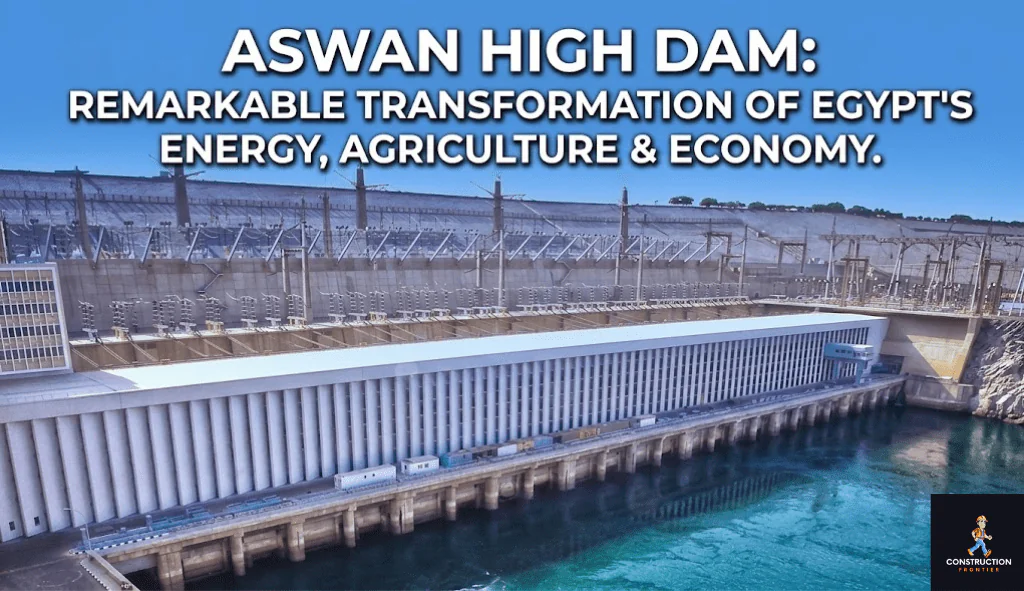
Aswan High Dam: Remarkable Transformation of Egypt’s Energy, Agriculture & Economy
The Aswan High Dam stands as one of the most consequential Nile River dam projects ever completed, a rock-fill colossus that permanently ended millennia of uncontrolled Nile flooding, converted a vast desert nation into a year-round agricultural power, and placed Egypt’s energy infrastructure on a hydropower foundation that still generates 10 billion kWh annually. Built between 1960 and 1970 across the Nile at Aswan, it created Lake Nasser, one of the world’s largest artificial reservoirs, and powered Egypt’s first industrial revolution.
| Technical Snapshot: Core Project Specifications | |
| Project Name | Aswan High Dam (Al-Sadd al-Aali) |
| Location | Nile River, Aswan, southern Egypt — northern border with Sudan |
| Type | Rock-fill embankment dam with clay core |
| Height | 111 m (364 ft) |
| Crest Length | 3,830 m (12,570 ft) |
| Base Width | 980 m (3,215 ft) |
| Crest Width | 40 m (131 ft) |
| Dam Volume | 43,000,000 m³ (56 million cu yd) of fill material |
| Spillway Capacity | 11,000 m³/second |
| Reservoir | Lake Nasser — 550 km long, up to 35 km wide |
| Gross Capacity | 169 billion m³ (169 km³) |
| Live Storage | ~90–91 km³ (active, usable capacity) |
| Dead Storage | ~31–32 km³ (sedimentation zone) |
| Power Plant | 12 Francis turbines × 175 MW each |
| Installed Capacity | 2,100 MW |
| Annual Energy Output | ~10 billion kWh (design); avg ~7–8 billion kWh (operational) |
| Irrigated Area | ~33,600 km² (including ~1 million ha reclaimed) |
| Construction Period | 1960–1970 (commenced January 1960) |
| Inauguration | January 15, 1971 |
| Total Project Cost | ~USD 1 billion (Soviet loans covered ~USD 425 million) |
| Owner / Operator | Egyptian Electricity Holding Company / High Dam & Aswan Reservoir Authority |
| Designer | Hydroproject Institute, Moscow (lead: Nikolai Malyshev), with Egyptian engineers |
| Main Contractor | Arab Contractors (Osman Ahmed Osman) — Egyptian companies under the High Dam Authority |
| Project Status | Operational; active rehabilitation programme under the Egypt Energy Strategy 2035 |
Built to be permanent, the Aswan High Dam reshaped every dimension of Egyptian civilisation, from the farmer’s field to the factory floor. Yet its future viability depends on decisions made today: across turbine halls, diplomatic tables, and climate modelling labs.
Introduction: The Legendary Aswan High Dam in Egypt
Few engineering projects in the twentieth century altered a nation as completely as the Aswan High Dam. Completed in 1970 and formally inaugurated on January 15, 1971, it sits across the Nile River in Aswan, southern Egypt, the product of a decade of construction, Cold War geopolitics, and Egypt’s urgent need to tame a river that had governed the rhythm of its civilisation for 6,000 years.
This Nile River dam project ended the era of annual flooding, created one of the world’s largest artificial lakes, and powered a hydroelectric facility that, at its 1970 peak, supplied roughly half of Egypt’s electricity. In doing so, the Aswan High Dam became the cornerstone of modern Egypt’s energy infrastructure, agricultural expansion, and industrial ambition.
The dam’s construction was not merely a hydraulic engineering challenge. It was a political statement, a Soviet-Egyptian joint venture, and the centrepiece of President Gamal Abdel Nasser’s vision for modernisation. Western funding was withdrawn in 1956 after Egypt nationalised the Suez Canal, an act partly motivated by the desire to finance the dam, and the Soviet Union stepped in with USD 425 million in technical credits and 1,000 engineers. The result was the world’s largest embankment dam at the time of its completion: a structure that consumed 43 million cubic metres of fill material, permanently converting the unpredictable Nile into a managed, year-round resource.
Decades on, the Aswan High Dam still defines Egypt’s hydraulic identity. It provides controlled irrigation to more than 33,600 km² of agricultural land, supports the livelihoods of tens of millions, and anchors Egypt’s hydropower contribution within a national energy mix now competing with solar and gas. This article provides an authoritative deep-dive into its engineering architecture, economic contribution, agricultural transformation, environmental costs, operational challenges, and future trajectory, drawing on verified technical data and peer-reviewed research for the professional reader.
| Project Overview: Aswan High Dam | |
| Country | Egypt |
| River | Nile River (First Cataract zone) |
| Sector | Hydropower, Irrigation, Flood Control |
| Dam Type | Rock-fill embankment with clay and grout curtain core |
| Height | 111 m |
| Installed Capacity | 2,100 MW (12 × 175 MW Francis turbines) |
| Reservoir | Lake Nasser — 169 billion m³ gross capacity |
| Construction | 1960–1970 |
| Inauguration | January 15, 1971 |
| Status | Operational — active rehabilitation programme |
Overview of the Aswan High Dam
Understanding what the Aswan High Dam achieves today requires grounding in the strategic logic that drove its construction. The project emerged from a confluence of hydrological necessity, national politics, and development ambition—circumstances that shaped not just its location and design but also the scale of its ambitions. This section covers the dam’s geographic and strategic position within the broader system of Nile River dams, its historical journey from planning table to operational powerhouse, and the defining objectives its designers set out to meet.
1. Location and Strategic Importance on the Nile River
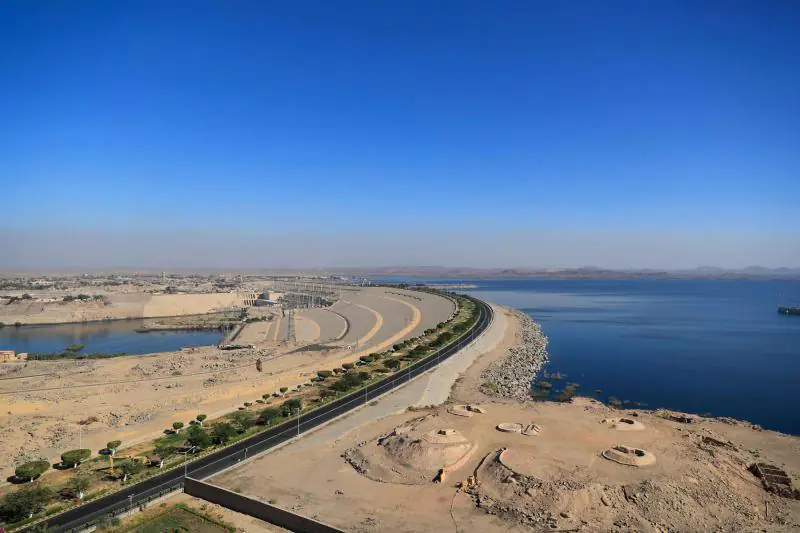
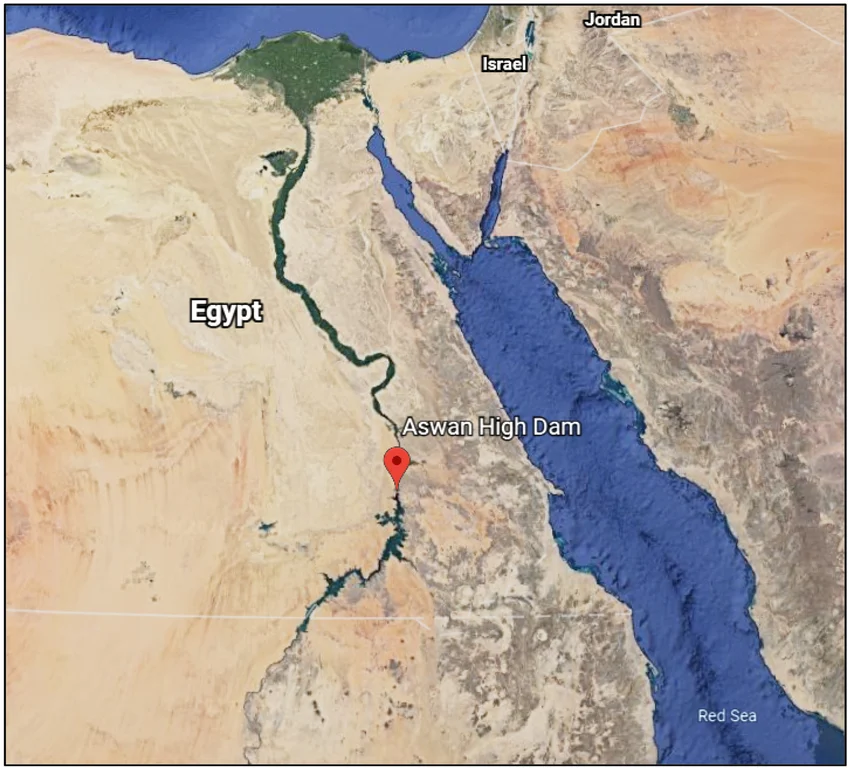
The Aswan High Dam is strategically located on the Nile River, specifically at the First Cataract, near the city of Aswan, in Egypt’s southernmost governorate, approximately 13 km south of the original Aswan Low Dam. This location sits at the natural pinch point where the Nile narrows before entering the broad valley running north to the Mediterranean, making it the single most effective point for intercepting, storing, and regulating the entire discharge of Africa’s longest river. The site’s underlying Nubian granite basement provides the structural foundation needed to anchor a rock-fill dam of this mass.
Strategically, the dam marks the boundary between Egypt and Sudan, with Lake Nasser extending approximately 550 km south, 350 km within Egypt, and a further 200 km into Sudanese territory, where it is called Lake Nubia. This cross-border reach reflects the dam’s regional significance: the 1959 Nile Waters Treaty between Egypt and Sudan allocated 55.5 billion m³ annually to Egypt and 18.5 billion m³ to Sudan, with the Aswan High Dam’s reservoir serving as the primary instrument of that allocation.
No other structure in the Nile basin exercises comparable control over water that more than 100 million people depend on, positioning it as the operational heart of Egypt’s energy infrastructure and the primary buffer against the hydrological extremes that once determined agricultural success or failure.
2. Historical Background and Construction Timeline
Egypt’s engineers and planners had discussed the need for a high dam above Aswan since at least the 1940s, but the project gained political urgency after the 1952 revolution brought Nasser to power. The Egyptian government formally announced the project in 1952. Initial design work proceeded with West German and French consultants, and by the mid-1950s, a financing package involving the United States, the United Kingdom, and the World Bank was taking shape before collapsing entirely in July 1956 when the US withdrew its offer in response to Egypt’s overtures to the Soviet bloc.
Nasser’s subsequent nationalisation of the Suez Canal, partly to capture revenue for dam financing, triggered the 1956 Suez Crisis and irreversibly embedded the Aswan High Dam in Cold War politics. The Soviet Union extended its first credit of USD 100 million in 1958 to fund cofferdam construction, followed by a USD 225 million tranche in 1960 for the main structure and power plant. Construction began on January 9, 1960.
The Hydroproject Institute in Moscow, led by chief designer Nikolai Aleksandrovich Malyshev, delivered the engineering concept, while Egypt’s Arab Contractors, led by the then-young Osman Ahmed Osman, won the domestic construction contract by underbidding the sole competitor by half. Approximately 34,000 workers, 25,000 of them Egyptian, constructed the dam over ten years.
The dam’s rock-and-clay structure reached its design crest by 1968, and power generation commenced in 1967. The project was formally completed in July 1970, with the official inauguration ceremony held on January 15, 1971, hosted by Soviet Premier Alexei Kosygin and Egyptian President Anwar Sadat. Reservoir filling to full capacity was not achieved until 1976. All twelve turbines were installed and tested ahead of schedule, a logistics and engineering achievement that established Egyptian construction capabilities and the Arab Contractors’ regional reputation.
3. Objectives of the Aswan High Dam Project
The designers and planners of the Aswan High Dam identified three foundational objectives that shaped every structural and operational decision. First was absolute flood control: the Nile’s annual inundation, historically the source of fertile silt that sustained Egyptian agriculture for millennia, had become a catastrophic risk to a rapidly growing, increasingly urbanised population.
The dam’s 169-billion-m³ reservoir was sized to absorb the most extreme flood event on historical record. The second was a year-round irrigation supply: controlled water releases from Lake Nasser would enable Egypt to shift from flood-recession farming, confined to a single season, to perennial irrigation capable of producing two or three crops annually on the same land. The third was large-scale electricity generation in Egypt: the 12-turbine, 2,100-MW power plant was designed to double Egypt’s national generating capacity overnight and supply the industrial base Nasser’s modernisation program required.
Navigation improvement above and below Aswan was a secondary but significant objective. By regulating river levels, the dam removed the seasonal extremes that made year-round navigation difficult, benefiting both commercial freight and a rapidly growing tourist sector. Together, these objectives framed the Aswan High Dam as the principal lever through which Egypt’s development planners intended to industrialise the country, feed its population, and electrify its villages, ambitions that were largely fulfilled within the first decade of operations.
The Aswan High Dam Engineering Design and Technical Specifications
The Aswan High Dam belongs to a category of infrastructure where structural audacity and operational precision are inseparable. Its engineering must be understood through both its physical mass, as one of the largest rock-fill embankments ever constructed, and its hydraulic systems, which regulate an entire continental river. The following subsections examine the dam’s structural composition and reservoir geometry, its power generation architecture, and the mechanisms by which it manages flow, flood, and irrigation release.
1. Dam Structure and Reservoir (Lake Nasser)
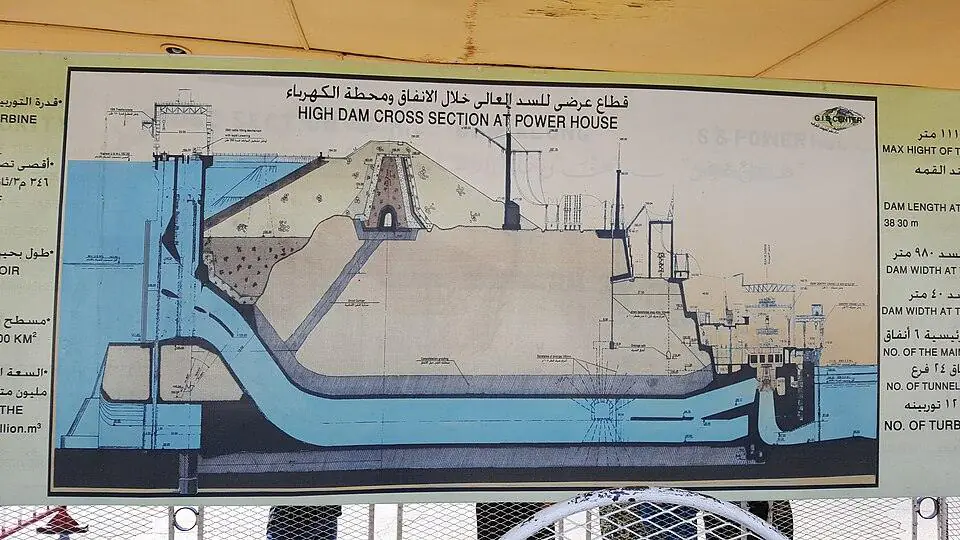
The Aswan High Dam is a zoned rock-fill embankment dam; its cross-section comprises an impervious clay-and-grout curtain core flanked by shoulders of compacted rock and sand. The structure measures 111 m in height, 3,830 m in crest length, 980 m in base width, and 40 m in crest width. The total fill volume reaches 43 million cubic metres of material, a quantity that surpasses the Cheops Pyramid by a factor of seventeen. The base rests on the Nubian granite bedrock that provides the Aswan region with geological stability, and a grouted cut-off wall extends into the foundation to prevent seepage.
The resulting reservoir, Lake Nasser, is among the largest artificial lakes in the world by surface area and water volume. It extends 550 km south from the dam face, with an average width of 22 km and a maximum depth of approximately 90 m near the dam. Its gross storage capacity of 169 billion m³ is divided operationally into three zones:
Dead Storage Zone: approximately 31–32 km³ at the lowest elevations, designed to absorb sedimentation over a projected 300–400-year period.
Live Storage Zone: approximately 90–91 km³ for year-round irrigation and hydropower supply, and a flood buffer zone of roughly 41–43 km³ to absorb exceptional Nile surges without releasing damaging downstream flows.
The Spillway: built parallel to the main dam, has a discharge capacity of 11,000 m³/s, sufficient to pass extreme flood events without overtopping.
Aswan High Dam: Infrastructure at a Glance
| Feature | Engineering & Operational Summary |
| Structure | A massive rock-fill embankment standing 111m high, containing 17 times the material of the Great Pyramid. |
| Foundation | Anchored into solid Nubian granite with a deep grout curtain to stop water seepage. |
| Reservoir | Lake Nasser spans 550 km and serves as a global-scale water battery for Egypt. |
| Capacity | 169 billion m³ total storage, divided into active use, flood protection, and long-term sediment zones. |
| Durability | Designed with a 300-400-year lifespan for sediment accumulation before impacting operations. |
| Flood Control | Equipped with a spillway capable of discharging 11,000 m³/sec to prevent downstream damage. |
2. Installed Capacity and Power Generation Systems
The power station at the Aswan High Dam houses twelve Francis turbines, each with a nameplate capacity of 175 MW, delivering a combined installed capacity of 2,100 MW. The turbines were supplied by Soviet manufacturer Power Machines (formerly part of the Leningrad Metallic Works), with Electrosila providing the generators.
Upon completion, the installation made the Aswan High Dam the largest power station in Africa and the sixth-largest hydroelectric facility in the world. It more than doubled Egypt’s total national generating capacity in 1960. Francis turbines were selected for their efficiency across the available moderate head range. The gross hydraulic head at Aswan is approximately 74 metres, and they are suitable for the variable flow conditions of a heavily managed reservoir.
Power generation began incrementally from 1967, with all twelve units operational by 1970. The design’s annual output of 10 billion kWh (10,000 GWh) has been achieved under optimal water conditions, though operational output fluctuates with Lake Nasser levels and the competing demands of summer irrigation. In practice, seasonal conflicts between irrigation water demand and electricity generation reduce effective output: heavy summer irrigation releases leave insufficient water in the reservoir to maintain full-capacity winter generation.
Technical studies have indicated a sustained maximum output of approximately 5 billion kWh under certain flow scenarios, though average annual generation has historically ranged between 7 and 10 billion kWh, depending on Nile hydrology.
Aswan High Dam: Generation & Power Capacity
| Feature | Technical & Operational Summary |
| Installed Capacity | 2,100 MW total; delivered by twelve 175 MW units. |
| Turbine Technology | Francis Turbines optimised for a 74m hydraulic head and variable flows. |
| Historical Significance | Doubled Egypt’s national power in 1960; formerly Africa’s largest plant. |
| Annual Energy Yield | Targets 10 billion kWh; typical range is 7–10 billion kWh. |
| Operational Impact | Faces seasonal trade-offs between summer irrigation and winter power needs. |
| System Reliability | Proven 50-year track record with a sustained 5 billion kWh minimum output. |
3. Water Regulation and Flow Control Mechanisms
The Aswan High Dam regulates Nile flow through a system of 180 sluice gates embedded within the dam structure, alongside the main power intakes and separate bottom outlet conduits. These allow operators to modulate releases for irrigation, power generation, and flood management independently – a hydraulic flexibility that was entirely absent under the pre-dam seasonal flooding regime.
The dam’s operational logic follows a seasonal pattern: Lake Nasser absorbs the Blue Nile’s August–September flood surge, then releases water gradually from November through June to maintain irrigation canal supply and power generation. Bottom outlets provide emergency drawdown capacity and allow sediment flushing operations.
Flood control logic is embedded in reservoir operating rules maintained by the High Dam and Aswan Reservoir Authority. The 41–43 km³ flood buffer area remains deliberately empty at the start of the flood season to receive incoming surge volumes. This design proved its value dramatically during the 1972–73 Sahel drought, when Egypt’s Aswan High Dam reservoir provided water security, preventing the crop failures that devastated other nations in the region. It similarly protected Egypt during the near-record Nile floods of 1975 and 1988, absorbing surge volumes that would have catastrophically inundated the densely inhabited Nile Delta floodplain.
Further Reading: Cahora Bassa Dam: Remarkable Powering of Southern Africa’s Energy Network
Egypt’s Energy Production from the Nile River
Electricity generation in Egypt before the Aswan High Dam was limited, fragmented, and insufficient to power industrial growth. The dam changed this structural deficit overnight, and its influence on Egypt’s energy infrastructure. Though diminished relative to decades of fossil fuel expansion, it remains embedded in the national grid’s architecture and renewable energy ambitions.
Contribution to Electricity Generation in Egypt
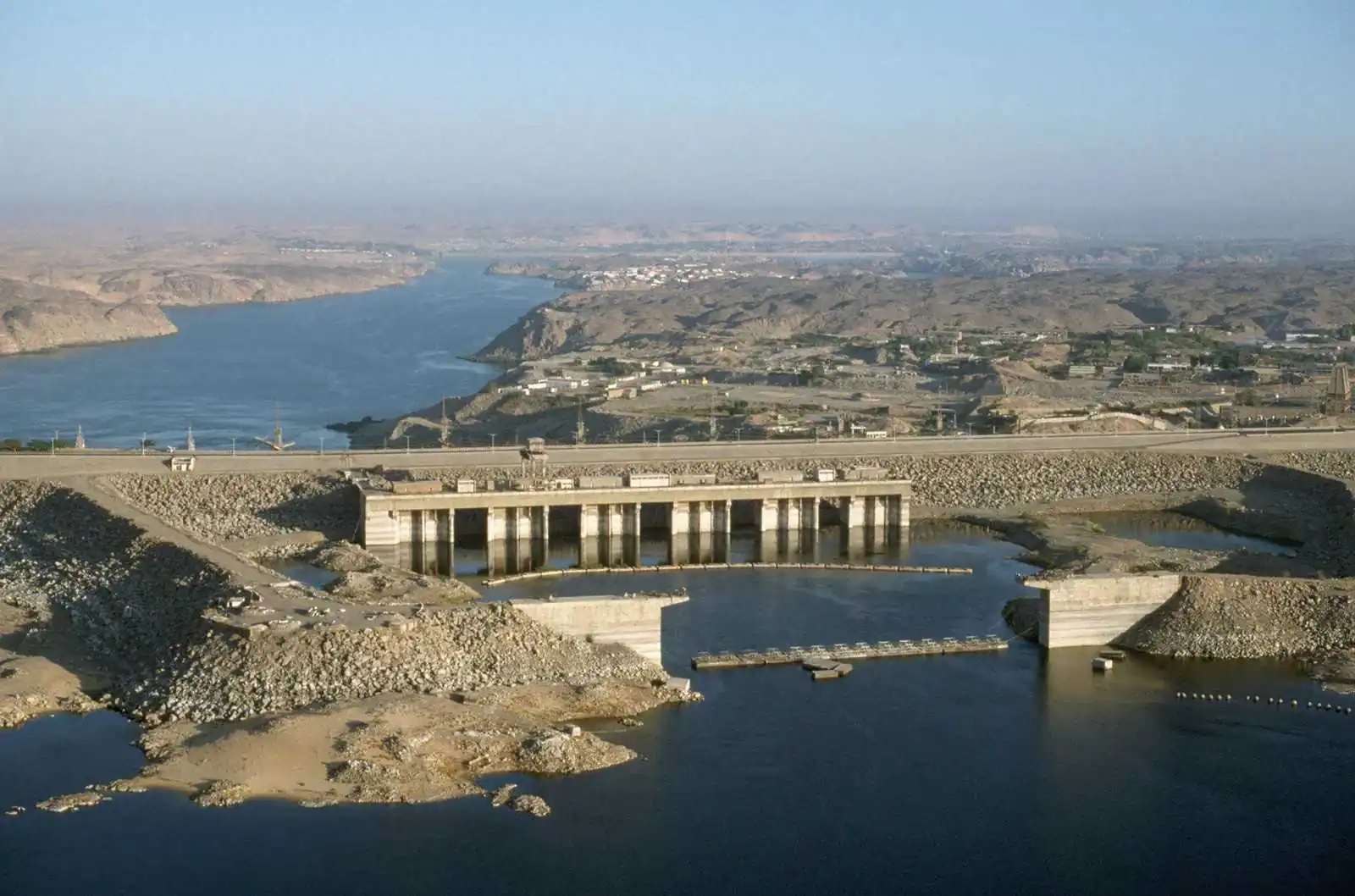
When the Aswan High Dam reached peak output in 1970, it produced approximately 50% of Egypt’s total electricity. For millions of rural Egyptians, this was the first experience of electric light. The dam’s 2,100 MW installed capacity represented more than twice the national total in 1960, a leap that compressed decades of normal grid development into a single infrastructure project. The social consequences were profound: electrification of villages, mechanisation of industry, and the expansion of educational and health facilities that required reliable power.
The dam’s share of national electricity production has declined over the decades as Egypt’s population and industrial base have grown. By 1998, the contribution of the Aswan High Dam had fallen to approximately 15% of the national supply. Current estimates suggest the dam provides around 6–7% of Egypt’s total electricity needs, a reduction driven by the enormous expansion of gas-fired generation, not by any decline in the dam’s absolute output. The dam still generates approximately 10 billion kWh annually under optimal conditions. In the context of Egypt’s hydropower projects, it remains the dominant contributor, producing roughly 94% of the country’s total hydroelectric output.
Integration into Egypt’s Energy Infrastructure
The power station at the Aswan High Dam connects to Egypt’s national grid via a 500 kV high-voltage transmission corridor running north to Cairo and the Delta, a backbone line installed during the dam’s original construction and subsequently upgraded. The dam also enhanced the efficiency of the older Aswan I (280 MW) and Aswan II (270 MW) power stations located downstream of the Aswan Low Dam because the high dam’s regulated releases provide those facilities with a steadier, more predictable hydraulic head than the pre-dam seasonal Nile flow ever permitted. Together, these three facilities in the Aswan complex contribute approximately 2,650 MW to Egypt’s energy infrastructure, making Upper Egypt the country’s single most concentrated renewable energy hub.
Egypt’s energy planners now recognise the Aswan complex as the foundation of a renewable energy corridor. The 1,465 MW Benban Solar Park, located just 50 km from the dam in the desert west of Aswan, was specifically cited as complementing hydropower generation, with Egyptian officials describing Benban as a ‘new high dam of solar energy’. The proximity of the Benban project to the dam’s transmission infrastructure reduces grid integration costs and allows solar and hydro dispatch to be balanced through the same transmission corridor, strengthening the case for co-located renewable investment around the Aswan High Dam site.
Role Within Egypt Hydropower Projects
Within Egypt’s hydropower constellation, the Aswan High Dam serves as the system anchor. The other hydropower barrages, Esna (84 MW), Naga Hammadi (64 MW), and the New Asyut Barrage (40 MW), depend on regulated river flows from the Aswan High Dam. Without the reservoir’s year-round discharge management, these downstream run-of-river facilities would generate far less reliably, as they did before 1970.
The Aswan High Dam thus multiplies the output of the entire Egyptian hydropower cascade, not just its own 2,100 MW nameplate. According to a ScienceDirect review of Egypt’s renewable energy sector, the six major hydroelectric facilities collectively generate approximately 2,832 MW, with the Aswan High Dam accounting for the dominant share. Egypt’s Renewable Energy Strategy to 2035 targets a 42% share of renewables in the electricity mix, and hydropower, anchored by the Aswan High Dam, forms the dispatchable backbone that solar and wind cannot yet provide.
Further Reading: Grand Inga Dam in the DRC: Africa’s Ambitious Mega Project Set to Transform Energy
Impact of the Aswan High Dam on Agriculture and Irrigation
Agriculture in Egypt is existentially dependent on the Nile. More than 95% of the country’s fresh water comes from the river, and the Aswan High Dam’s management of that resource fundamentally reordered what was possible: which crops could be grown, where, and in which seasons. The transformation from flood-dependent agriculture to perennial irrigation reshaped the rural economy and opened large tracts of previously uncultivable land to production.
1. Year-Round Irrigation and Water Security
Before the Aswan High Dam, Egyptian agriculture operated on a basin irrigation system that flooded fields once a year, deposited silt, and then drained, producing a single crop cycle and leaving fields fallow through the dry season. The dam’s conversion to perennial canal irrigation allowed farmers to maintain soil moisture year-round, enabling two or three crop cycles annually on the same land. The dam releases approximately 55 km³ of water annually, of which roughly 46 km³ enters irrigation canals, and around 38 km³ effectively reaches farmland in the Nile Delta and Valley after conveyance losses.
The impact of the Aswan High Dam on agriculture and irrigation, in terms of water security, is most evident in drought years. The dam’s 40 km³ flood buffer serves as an emergency reserve that releases controlled volumes during deficient Nile years, a role it played critically in 1972, 1984, and again in the early 1990s. Egypt’s farmers shifted from the anxiety of seven-year drought cycles described in biblical accounts to the relative certainty of contracted irrigation allocations. This predictability allowed investment in permanent infrastructure, including canals, pumping stations, and drainage networks, that would have been economically irrational under the pre-dam seasonal regime.
2. Expansion of Arable Land and Crop Productivity
The Aswan Dam’s impact on arable land is quantified in a striking figure: approximately 1 million hectares of desert land along the Nile valley have been reclaimed since the dam’s completion, in addition to the 2 million feddan (840,000 hectares) already converted from seasonal to perennial irrigation. The total irrigated area served by the Aswan High Dam system now exceeds 33,600 km². Crops that could not survive without controlled summer irrigation, most notably rice, cotton, sugar cane, and maize, expanded dramatically. Egypt became a significant exporter of cotton and a major rice producer, dependent on a level of water management that only the Aswan High Dam made possible.
The expansion of crop productivity was not unlimited, however. The loss of annual Nile silt, which the dam traps entirely in Lake Nasser, forced Egyptian farmers to substitute chemical fertilisers at high cost. Before the Aswan High Dam, the Nile deposited approximately 100 million tonnes of silt annually on farmland, maintaining soil fertility without external inputs.
After 1970, fertiliser imports grew substantially, partially offsetting the economic gains from expanded irrigation. Nevertheless, the net agricultural and economic contribution of the dam remains strongly positive: research estimated that the dam’s static agricultural and transport productivity effects were worth EGP 4.9 billion annually in 1997, with total economic value including investment effects and risk reduction estimated at 2.7% to 4.0% of Egypt’s GDP that year.
3. Aswan Dam Agriculture’s Impact on the Rural Economy
The Aswan Dam’s impact on Egypt’s rural communities extends well beyond crop production statistics. Agriculture currently accounts for approximately 15% of Egypt’s GDP and employs roughly one-fifth of the national workforce, a contribution made structurally possible by the Aswan High Dam’s year-round water supply. The shift to perennial irrigation supported the growth of rural enterprises, including food processing, agricultural chemical distribution, irrigation equipment manufacturing, and rural transport networks. The dam’s controlled releases enabled the resettlement of 500,000 farming families on newly reclaimed land, reducing population pressure in the overcrowded Nile Delta.
The Lake Nasser fishery is a frequently overlooked dimension of the Aswan Dam’s agricultural impact. The reservoir hosts a productive commercial fishery centred on Nile perch (Nile bass), Nile catfish, and carp. Government estimates have projected annual sustainable catches of up to 60,000 tonnes, a significant contribution to food security. It partially compensates for the loss of the pre-dam Mediterranean sardine fishery, which collapsed when the silt-rich nutrient plume that fed the eastern Mediterranean nearshore ecosystem ceased following dam closure.
How the Aswan High Dam Transformed Egypt’s Economy
The question of how the Aswan High Dam transformed Egypt’s economy is best answered not through individual-sector statistics but through the structural shift it enabled: from a subsistence agrarian economy vulnerable to hydrological extremes to an industrialising nation with a stable energy platform, an expanded agricultural base, and investable infrastructure. This section analyses the macroeconomic dimensions of that transformation.
1. Industrial Growth and Electrification
The Aswan High Dam’s immediate industrial impact was the supply of affordable, large-volume electricity. Aluminium smelting, steel manufacturing, fertiliser production, and textile milling are all energy-intensive industries that Egypt’s planners identified as development priorities and became economically viable once the 2,100 MW power station came online. The Egyptian aluminium smelter, Egyptalum at Nag Hammadi, established in the 1970s, was directly powered by the power station. The cement and fertiliser industries expanded on the same basis. These industries generated tax revenues, export earnings, and skilled employment that had no precedent in pre-dam Egypt.
Electrification of rural villages was equally transformative. Prior to the Aswan High Dam, most Egyptian villages had no reliable access to electricity. The dam’s output, transmitted through the expanding national grid, reached villages throughout Upper and Lower Egypt through the 1970s and 1980s, enabling refrigeration, water pumping, lighting, and eventually communication. This rural electrification programme supported improvements in literacy rates, healthcare delivery, and agricultural productivity, as mechanised irrigation equipment became accessible at the village level.
2. Job Creation and Infrastructure Development
The Aswan High Dam’s direct construction workforce of 34,000 represented one of the largest single labour mobilisations in Egypt’s industrial history. Beyond the construction phase, the dam generated permanent employment in water management, hydropower operations, irrigation authority administration, and fisheries management. The reclamation of one million hectares of agricultural land created demand for tens of thousands of additional farm workers and the rural service industries that support them.
Infrastructure investment accelerated in sectors directly unlocked by the dam. Research data confirms that after the Aswan High Dam’s completion, investment in agriculture and transport rose 50% and 120%, respectively, while total investment across the economy grew by only 14%, indicating that the dam served as a targeted catalyst rather than a general macroeconomic stimulus. The long-term effects of the Aswan High Dam on infrastructure are visible in Egypt’s irrigation canal network, the road and rail links serving the Aswan region, and the navigational infrastructure that supports Nile cruise tourism, one of Egypt’s most significant foreign currency earners.
3. Long-Term Economic Stability and Growth
Among the least quantified but arguably most important benefits of the Aswan High Dam project is the elimination of risk. Before the dam, Egypt’s agricultural output was low, and therefore a significant proportion of GDP varied year to year with Nile flood volumes. Poor flood years meant food shortages, reduced tax revenue, and pressure on foreign exchange reserves. The dam’s reservoir permanently removed that variability.
The computable general equilibrium model by Strzepek et al. found that accounting for flood risk reduction adds an additional EGP 1.1 billion per year in certainty-equivalent value to Egypt’s economy, rising to EGP 4.4 billion under higher risk-aversion assumptions. This risk premium reflects the value of the economic certainty that underpins long-term capital allocation decisions by Egyptian businesses and foreign investors.
The long-term effects of the Aswan High Dam on Egypt’s economy are also evident in the evolution of the agricultural sector. The shift from rain-fed and flood-dependent farming to irrigated commercial production attracted agribusiness investment, supported export-oriented horticulture, and enabled the cotton, sugar, and rice sectors to scale to national significance. Agriculture’s current 15% contribution to GDP in a country with almost no rainfall would not exist without the controlled water management provided by the Aswan High Dam system.
Benefits of the Aswan High Dam Project
A structured assessment of the benefits of the Aswan High Dam project requires disaggregating its contributions across three distinct value categories: risk mitigation through flood control, renewable energy generation, and the long-term resilience it has built into Egypt’s energy infrastructure. Each is examined below within its technical and economic context.
1. Flood Control and Disaster Prevention
The most decisive benefit of the Aswan High Dam is the one hardest to see: the floods that did not happen. Before 1970, Egypt experienced catastrophic Nile floods approximately every decade. The 1946 flood, for example, peaked at over 800 million m³/day at the Aswan measurement station. After the dam’s closure, no flood-related crop or infrastructure damage has been recorded downstream.
The 41–43 km³ flood buffer zone within Lake Nasser absorbed surge events in 1975 and 1988 that would have been catastrophic under pre-dam conditions. The economic value of this protection, measured in avoided damage to agricultural land, urban property, transport infrastructure, and human life, is substantial but unquantifiable in conventional GDP terms.
Drought protection has been equally significant. The 1972–73 Sahel-wide drought, which caused widespread famine across West Africa, was absorbed by Egypt through the controlled drawdown of Lake Nasser, with minimal impact on food production, an outcome impossible without the Aswan High Dam’s reservoir storage. The 1984 and 1987–88 drought sequences, during which Lake Nasser’s level dropped to dangerous lows before recovering, demonstrated both the system’s resilience and its limits, providing a planning baseline for climate-stress scenarios now applied to the dam’s future operating protocols.
2. Reliable Renewable Energy Generation
As a renewable energy asset, the Aswan High Dam generates zero-carbon electricity with no fuel cost, no combustion emissions, and a design lifespan measured in centuries rather than decades. Egypt’s energy production from the Nile River through this facility averages approximately 7–10 billion kWh annually, electricity generated entirely from the gravitational potential energy of water stored in Lake Nasser. The marginal cost of each kilowatt-hour is among the lowest of any generating technology in Egypt’s portfolio.
The dam’s renewable generation has acquired strategic importance beyond its absolute volume. As Egypt pursues its target of 42% renewable energy by 2035, the Aswan High Dam’s dispatchable hydropower provides grid-balancing capability that intermittent solar and wind cannot. Hydropower operators can increase or decrease output within minutes in response to grid frequency fluctuations, a service that gas peakers perform at high fuel cost. The dam’s operational flexibility, therefore, magnifies the value of the solar parks being built around Aswan, enabling the grid to absorb variable generation that would otherwise require expensive battery storage or gas backup capacity.
3. Strengthening Egypt’s Energy Infrastructure
The Aswan High Dam’s enduring contribution to Egypt’s energy infrastructure lies in the transmission and generation ecosystem it anchored. The 500 kV corridor from Aswan to Cairo established the backbone of Egypt’s national grid, a network subsequently expanded to carry power from the Benban Solar Park, the Gabal El-Zeit wind farm on the Red Sea coast, and the Zafarana wind complex. The Aswan power station’s long-term maintenance and rehabilitation programme, currently targeting transformer replacements and bearing system upgrades across the High Dam, Aswan I, and Aswan II facilities, will sustain the 2,650 MW of generation capacity that Upper Egypt contributes to the national supply well into the 2040s.
Environmental and Social Impacts
The Aswan High Dam’s environmental and social record is the most contested dimension of its legacy. It eliminated catastrophic flood events and enabled massive agricultural expansion, while simultaneously disrupting one of the world’s most productive riverine ecosystems and forcibly displacing approximately 90,000 people. Professional assessment of these impacts requires both precision and balance.
1. Ecological Changes Along the Nile River
The most significant ecological consequence of the Aswan High Dam is the complete interception of Nile sediment transport. Before the dam, the Nile carried approximately 100 million tonnes of silt annually from the Ethiopian Highlands to the Delta, depositing a layer of nutrient-rich alluvium on farmland and sustaining a productive coastal and nearshore ecosystem in the eastern Mediterranean.
The dam’s reservoir traps this sediment; approximately 109 million m³/year accumulates in Lake Nasser, effectively releasing clear water downstream. The consequences have been extensive: farmland fertility loss requiring chemical fertiliser substitution; accelerating coastal erosion of the Nile Delta at rates now estimated at 8–30 m/year at certain headlands; salinisation of formerly productive agricultural land below the dam due to inadequate drainage infrastructure; and the near-total collapse of the eastern Mediterranean sardine fishery, which lost its nutrient-rich silt plume.
Waterborne diseases, particularly bilharzia (schistosomiasis), expanded significantly following the dam’s closure. The conversion from seasonal irrigation, which dried canals between flood cycles, interrupting the snail host’s habitat, to perennial irrigation created permanent canal ecosystems where the bilharzia parasite’s intermediate host thrives year-round. Egyptian health authorities have managed this through large-scale drug treatment programmes, but the disease burden persists as a public health cost directly attributable to the change in irrigation regime enabled by the Aswan High Dam.
2. Displacement and Resettlement of Communities
The creation of Lake Nasser required the inundation of ancient Nubia, a region of continuous human settlement for thousands of years. Approximately 90,000 people were displaced: around 50,000 Egyptian Nubians were transported to the Kawm Umbu valley, 50 km north of Aswan, to a resettlement zone called Nubaria, and approximately 40,000 Sudanese Nubians were resettled around Khashm al-Qirbah in eastern Sudan. The resettlement was carried out without adequate consultation, compensation, or cultural accommodation, in line with the standards now applied to infrastructure displacement. Many Nubian communities lost not only their homes but their land, livelihoods, sacred sites, and communal cohesion in ways that three generations of government resettlement programs have not fully addressed.
The cultural loss extended beyond living communities. The rising waters of Lake Nasser threatened numerous ancient Egyptian temple complexes and archaeological sites. UNESCO coordinated an extraordinary international rescue operation between 1960 and 1980 that relocated or dismantled and rebuilt twenty-two ancient monuments, including the iconic Abu Simbel temples of Ramesses II and Nefertari, moved 65 m higher and 200 m further from the river between 1964 and 1968 at a cost of approximately USD 80 million and involving engineering from Swedish, German, Italian, and Egyptian firms. This operation remains one of the most ambitious heritage conservation projects in history, enabled by the Aswan High Dam’s construction timeline.
3. Long-Term Effects of the Aswan High Dam on the Environment
The long-term effects of the Aswan High Dam on the environment extend across multiple ecological systems. Nile Delta subsidence has accelerated as the river no longer deposits sediment to replenish land lost to sea erosion and compaction: parts of the Delta now sit below sea level, making them acutely vulnerable to sea-level rise under climate change scenarios. Groundwater salinity in the Delta has increased as reduced Nile freshwater flow allows seawater intrusion to extend farther inland.
The large surface area of Lake Nasser, approximately 5,250 km², generates annual evaporation losses of 10–11.8 billion m³/year, representing roughly 18–21% of Egypt’s total annual water allocation under the 1959 Nile Waters Treaty. This loss represents the single most significant operational inefficiency of the Aswan High Dam system: water that could otherwise irrigate agricultural land or generate additional hydropower is lost to the desert atmosphere. Research from the Fraunhofer Institute for Solar Energy Systems (2024) has demonstrated that floating photovoltaic panels installed over as little as 10% of Lake Nasser’s surface could reduce evaporation losses while simultaneously generating electricity equivalent to Egypt’s entire current renewable portfolio, a finding that has direct implications for the dam’s future operational strategy.
Challenges and Limitations of the Aswan High Dam
Any rigorous assessment of the Aswan High Dam’s operational record must acknowledge the structural constraints that reduce its effectiveness relative to design capacity. Three challenges, which are sedimentation, evaporation, and hydrological variability, represent chronic limitations that operational management must continuously address.
1. Sedimentation and Reduced Reservoir Efficiency
The Aswan High Dam’s dead storage zone, approximately 31–32 km³, was engineered specifically to accumulate sediment over a 300–400 year design life. At a deposition rate of approximately 109 million m³/year, the dead zone fills slowly, and the live storage capacity available for irrigation and power has not yet been materially compromised. However, the distribution of sediment within the reservoir is uneven: silt accumulates most heavily at the lake’s southern end, near Wadi Halfa and the former site of the Second Cataract, where deposits exceeding 30 m in thickness were measured as early as 1992. This concentration creates localised capacity loss and complicates future dredging strategies.
The Grand Ethiopian Renaissance Dam (GERD), now operational on the Blue Nile, introduces a significant secondary effect: by trapping the majority of Blue Nile silt upstream, GERD substantially reduces the sediment load reaching the Aswan High Dam. This effectively extends the reservoir’s sediment capacity, a benefit that partially offsets the GERD’s potential impact on water volumes. However, clearer water released from GERD will carry greater erosive energy, potentially accelerating bed degradation in the Sudanese Nile between the GERD site and Lake Nasser.
2. Evaporation Losses from Lake Nasser
Lake Nasser loses an estimated 10–11.8 billion m³ of water per year to evaporation, representing between 18% and 21% of Egypt’s annual water allocation under the 1959 treaty. The lake’s vast surface area, Aswan’s intense solar radiation (averaging 6+ kWh/m²/day), low humidity, and persistent desert winds combine to produce one of the highest evaporation rates of any large reservoir globally. This loss is effectively irrecoverable under current management practices and materially reduces the water available for irrigation and power generation.
The scale of this loss has prompted research into technological mitigation. A 2024 study published in the Hydrological Sciences Journal by researchers from Germany’s Fraunhofer ISE and the University of Wisconsin-Madison calculated that a floating photovoltaic system covering 90% of the reservoir surface could reduce evaporation by up to 49.7%, saving approximately 5.9 billion m³/year while simultaneously generating 1,431–1,459 TWh of electricity annually. Even a modest 10% FPV coverage could raise Egypt’s share of renewable electricity from 12% to 95%. These figures represent a transformative opportunity for the Aswan High Dam’s operational future if capital, regulatory frameworks, and technical implementation can be aligned.
3. Dependence on Hydrological Variability
Despite controlling the most severe interannual Nile variability, the Aswan High Dam remains hostage to the hydrological conditions in its upper catchment, principally the Blue Nile headwaters in Ethiopia and the White Nile system in Uganda and Sudan. Extended multi-year droughts, such as those recorded in 1979–88, can draw Lake Nasser to critically low levels, triggering proportional reductions in both irrigation releases and hydropower generation. Climate change projections for the upper Nile basin indicate increased precipitation variability: more intense flood years combined with more severe drought years, a pattern that will test the reservoir’s operating buffer more frequently than the historical record suggests.
The GERD adds a new hydrological interdependency. Under adversarial or uncoordinated GERD operation scenarios modelled by researchers published in IWA Water Policy (2025), Egypt’s annual releases from the Aswan High Dam could be reduced by up to 2.72 billion m³ under the most extreme scenarios, though the study notes that adversarial operation would also cost Ethiopia significant hydropower revenue. The more probable risk lies in compounding: a low-Nile year coinciding with GERD-filling phases could simultaneously deplete Lake Nasser and reduce Ethiopia’s releases, creating the first genuine hydraulic stress test of the Aswan High Dam’s design capacity.
Comparison with Other Nile River Dam Projects
The Aswan High Dam’s position within the broader landscape of Nile River dam projects has changed fundamentally since 1970. What was built as the system centrepiece now operates within a cascade of dams extending from Lake Victoria to the Mediterranean, a cascade whose architecture is still evolving with Ethiopia’s GERD programme and Sudanese power projects.
1. How the Aswan High Dam Compares to Other Nile Projects
The Aswan High Dam remains the largest storage reservoir on the Nile by gross capacity at 169 billion m³ a figure that dwarfs the GERD’s 74 billion m³ and Sudan’s Merowe Dam at 12.5 billion m³. In power generation terms, however, the GERD has eclipsed it: with over 5,000 MW of installed capacity, the GERD is now Africa’s largest hydroelectric facility compared to the Aswan High Dam’s 2,100 MW.
The GERD also benefits from a considerably higher hydraulic head (approximately 145 m versus Aswan’s 74 m), enabling more efficient power conversion per cubic metre of water. Sudan’s Merowe Dam on the Fourth Cataract generates 1,250 MW and was completed in 2009, adding further hydropower capacity to the Nile basin. The cumulative installed capacity of the Nile system now substantially exceeds what the Aswan High Dam contributed alone, yet Egypt’s water security still depends entirely on the High Dam’s storage management.
2. Strategic Importance in Regional Water Management
In regional water governance terms, the Aswan High Dam represents the downstream terminus of a continental hydrological system. Its reservoir must receive, buffer, and release water from upstream sources across ten Nile basin countries, a responsibility encoded in the 1959 Nile Waters Treaty between Egypt and Sudan but contested by upstream nations, particularly Ethiopia, which was excluded from that agreement.
The GERD’s completion fundamentally alters the power balance: Ethiopia now controls the upstream regulation of the Blue Nile, which contributes approximately 86% of the Nile’s total annual flow and virtually all the flood-season surge that Lake Nasser was designed to absorb. The Aswan High Dam’s strategic importance in regional water management has therefore shifted from being an active controller of the Nile system to a dependent receiver within an upstream-managed cascade; a position with profound implications for Egypt’s long-term water sovereignty and the operational logic of the dam itself.
Further Reading: Grand Inga Dam in the DRC: Africa’s Ambitious Mega Project Set to Transform Energy
Future Outlook of the Aswan High Dam
The Aswan High Dam enters its second half-century facing a set of challenges that its designers could not have anticipated: upstream dam competition, climate-driven hydrological instability, and a national energy transition that simultaneously needs the dam to do more and accepts it can contribute less. The infrastructure is sound, but its operational environment is changing faster than at any point since commissioning.
1. Modernisation and Efficiency Improvements
Egypt’s Hydro Plants Generation Company (HPGC) and the Egyptian Electricity Holding Company have launched a formal rehabilitation programme for the Aswan High Dam and the downstream Aswan I and Aswan II power plants. The scope, confirmed through a 2023 prequalification call for implementation consultancy services, includes replacement of power transformers that have reached the end of operational life and replacement of thrust bearing cooling systems at Aswan II.
The rehabilitation aligns with Egypt’s Renewable Energy Strategy and Action Plan to 2035 and is partly financed through climate finance mechanisms targeting CO₂ emission reductions. As Egypt’s ministers of electricity and water resources confirmed in November 2025, the government regards the Aswan High Dam as one of its most cost-effective and sustainable energy assets, with ongoing upgrading and modernisation of all major hydropower stations in the complex.
The floating photovoltaic concept represents the most transformative modernisation opportunity currently under scientific evaluation. If implemented at even 10% of Lake Nasser’s surface, roughly 525 km², it would simultaneously reduce annual evaporation losses, generate renewable electricity, and reduce the thermal load on the reservoir’s surface, potentially improving the operational efficiency of the underlying hydropower turbines. Implementation at this scale would require a capital investment and regulatory framework that Egypt has not yet committed to, but the Aswan High Dam’s existing transmission infrastructure provides a unique enabling advantage.
2. Role in Egypt’s Future Energy Mix
The Aswan High Dam’s role in Egypt’s future energy mix is not that of a primary generator but of a grid-balancing anchor. As Egypt installs increasing volumes of solar and wind capacity, with the Benban Solar Park alone at 1,465 MW and the 500 MW Abydos and 200 MW Kom Ombo projects completing nearby, the need for dispatchable, ramping-capable generation grows proportionately. The Aswan High Dam’s turbines can adjust output within minutes, providing frequency regulation and peak load support that solar panels cannot. Egypt’s energy production from the Nile River through the Aswan High Dam will therefore retain strategic value even as its percentage contribution to national supply continues to decline in absolute share.
Egypt’s energy planners have also identified pumped storage hydropower as a potential future investment at sites along the Red Sea escarpment, a technology that uses surplus solar generation to pump water uphill for later release through turbines. The operational and institutional experience accumulated through five decades of managing the Aswan High Dam’s power systems positions Egypt well for this next generation of hydropower technology.
3. Long-Term Sustainability and Policy Direction
The long-term sustainability of the Aswan High Dam as a water management and energy system depends fundamentally on three policy tracks converging:
- Diplomatic resolution of the GERD impasse.
- Domestic adaptation of irrigation efficiency to reduce per-hectare water demand.
- Climate resilience investment in the reservoir operating rules.
Egypt’s government has moved along all three axes. Irrigation modernisation programmes, such as canal lining, drip irrigation subsidies, and water metering, target a reduction in the estimated 20–30% of irrigation water lost to conveyance in unlined earthen canals. The benefits of the Aswan High Dam to agriculture cannot be sustained if conveyance losses erode the usable fraction of the 55.5 billion m³ annual allocation.
On the diplomatic front, trilateral negotiations between Egypt, Sudan, and Ethiopia over GERD operating rules have proceeded without a binding agreement since 2015. Egypt has shifted from outright opposition to the GERD to a position seeking coordinated multi-reservoir operation, a practical recognition that the Aswan High Dam and the GERD function most efficiently as complementary elements of a single basin management system. The scientific case for this position is supported by modelling that shows a coordinated filling and drought recovery protocol would protect Egypt’s water allocation while allowing Ethiopia to maximise power generation, a potential win-win that geopolitical tensions have so far prevented from being formalised.
Technical Reference Block: Advanced Operational Data
| Advanced Technical & Operational Intelligence: Aswan High Dam | |
| Turbine Type | Francis turbines (12 units), each rated at 175 MW, Soviet-supplied by Power Machines / Electrosila |
| Hydraulic Head | Gross head: 74 m |
| Peak Historical Output | ~50% of Egypt’s national electricity in early 1970s; ~15% by 1998; ~6–7% current share |
| Sedimentation Rate | ~109 million m³/year deposited; dead storage zone estimated at ~31–32 km³ over 300–400 years |
| Annual Evaporation Loss | ~10–11.8 billion m³/year from Lake Nasser (one of the highest evaporation rates globally) |
| Egypt’s Water Allocation | 55.5 billion m³/year (under the 1959 Egypt-Sudan Nile Waters Treaty) |
| Sudan’s Water Allocation | 18.5 billion m³/year (1959 Nile Waters Treaty) |
| Abu Simbel Relocation | UNESCO coordinated rescue (1964–1968); temples relocated 65 m higher and 200 m inland |
| Displaced Persons | ~90,000 (50,000 Egyptian Nubian + ~40,000 Sudanese Nubian communities resettled) |
| Nile Navigation | Improved year-round navigability above and below Aswan; tourism and freight benefits |
| Lake Nasser Fishery | Annual fish catch estimates up to 60,000 tonnes; bass, Nile catfish, carp |
| Rehabilitation Status | Active: power transformer replacements, thrust bearing cooling upgrades (Aswan I & II); consultancy invited 2023 |
| FPV Research | Fraunhofer ISE/Univ. Freiburg (2024): 10% FPV coverage could raise Egypt’s RE share from 12% to 95%; 90% FPV saves 5.9 BCM/year evaporation |
| GERD Risk Exposure | Potential reduction of 2.72 billion m³ annual releases under adversarial operation scenarios (IWA Policy, 2025) |
| GDP Contribution | Dam valued at 2.7%–4.0% of Egypt’s annual GDP (Strzepek et al., 2008, CGE model, 1997 baseline) |
| Agricultural Reclamation | ~1 million hectares reclaimed from desert; 2 million feddan (840,000 ha) opened to perennial irrigation |
| Egypt RE Strategy 2035 | Target: 42% electricity from renewables; AHD rehabilitation central to baseload hydropower retention |
Conclusion: Capital Allocation, Long-Term Positioning, and the Aswan High Dam’s Enduring Market Logic
The Aswan High Dam is one of the most consequential infrastructure investments ever made on the African continent, a USD 1 billion project that generated economic returns conservatively estimated at 2.7%–4.0% of Egypt’s annual GDP in its fourth decade alone. For capital allocators and development finance institutions evaluating infrastructure in emerging markets, this performance benchmark remains instructive.
The dam’s return profile was not derived from a single revenue stream but from the compounding interaction of flood risk elimination, agricultural productivity expansion, industrial electrification, and transport efficiency improvement across an economy of more than 100 million people. Future-scale hydropower investments in the Nile basin, whether through GERD-linked cascade management, pumped storage development, or floating photovoltaic augmentation of Lake Nasser, will be evaluated against this benchmark, and the Aswan High Dam’s operating history provides the most comprehensive longitudinal dataset available for that assessment.
Looking forward, the Aswan High Dam’s strategic value is evolving from a standalone generation and storage asset into the pivot point of a regional energy and water governance system that spans three nations and six decades of contested hydraulic politics. Egypt’s long-term energy infrastructure resilience and its ability to meet a 42% renewable electricity target by 2035 depend on the dam performing not merely as its Soviet designers intended but as an adaptive component of a changing grid: balancing solar intermittency, reducing evaporation through emerging photovoltaic technologies, and preserving water allocations within a multilateral basin framework that has yet to reach consensus.
The institutions, engineering knowledge, and operational capability that Egypt has built around the Aswan High Dam over five decades represent an asset class that capital markets have consistently undervalued, one whose full return will only be realised when diplomatic resolution of the Nile water dispute matches the technical sophistication of the dam itself.
| Stay Updated on Africa’s Infrastructure Megaprojects Stay ahead of Africa’s infrastructure transformation with Construction Frontier: Africa Mega Projects. Explore deep technical insights, expert analysis, and investment intelligence shaping the future of African energy and water infrastructure. Follow our coverage of Egypt hydropower projects, Nile River dam projects, and Africa’s energy mega projects driving continental transformation. |