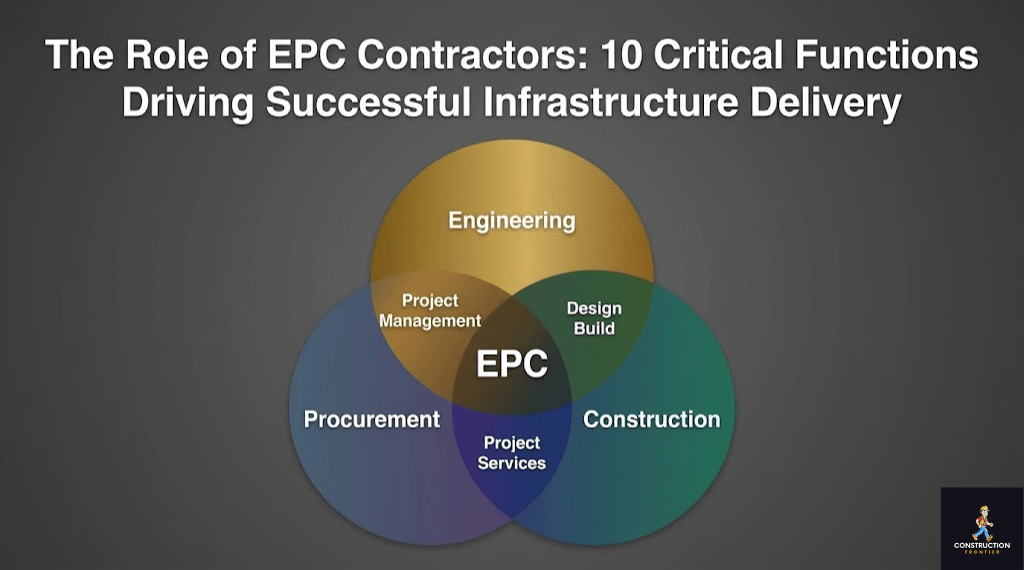
The Role of EPC Contractors: 10 Critical Functions Driving Successful Infrastructure Delivery
The role of EPC contractors is singular in modern infrastructure: one entity, one contract, complete accountability from design through operational handover. Engineering, procurement, and construction contractors assume total technical, commercial, and schedule responsibility for some of the world’s most complex projects, including power plants, refineries, rail corridors, and desalination facilities. The EPC project delivery model consolidates what fragmented contracts leave ungoverned, placing design risk, procurement exposure, and construction liability under a single FIDIC Silver Book framework. For project owners and development financiers, this structure converts variable execution risk into fixed contractual certainty, which is the condition most multilateral lenders require before committing long-tenor debt to capital-intensive infrastructure.
Technical Snapshot: EPC Contractor Profile
| Contract Structure | Single lump-sum contract covering engineering, procurement, and construction |
| Governing Framework | FIDIC Silver Book, EPC/Turnkey Projects (2nd Ed. 2017) |
| Risk Ownership | Design, cost, schedule, and performance risk carried by the contractor |
| Procurement Role | Full supply chain ownership: vendor qualification, purchase, logistics |
| Subcontractor Management | The EPC contractor is legally liable for all subcontractor performance |
| Performance Guarantee | The contractor must meet specified output and efficiency benchmarks at handover |
| Security Instruments | Performance bonds, parent company guarantees, retention (typically 10%) |
| Key Sectors | Power generation, oil and gas, water, transport, and industrial facilities |
| Differentiator vs GC | EPC owns design and procurement; the general contractor executes only |
| Primary Owner Benefit | Single accountability interface; fixed budget; reduced management burden |
The role of EPC contractors extends well beyond physical construction. These firms are the technical, commercial, and legal integrators of complex infrastructure delivery, making contractor selection one of the highest-stakes decisions a project owner will make.
Introduction: The Role of EPC Contractors —The Firm That Owns Every Phase
In infrastructure delivery, the role of EPC contractors is defined by a principle that distinguishes the model from other forms of construction contracting: one firm assumes design liability, procurement accountability, construction risk, and performance obligation simultaneously. Where a general contractor executes what an architect designs and an owner procures, engineering, procurement, and construction contractors are responsible for the technical and financial success of the entire project, from feasibility studies through commissioning and handover.
This integration is not an administrative convenience. It is a deliberate contractual structure that eliminates the interface gaps that generate disputes, delays, and cost overruns in fragmented delivery models. Project finance lenders favour EPC project delivery specifically because the contractor’s comprehensive obligations, backed by performance bonds and parent company guarantees, provide the security package that makes long-tenor debt viable. Understanding the full scope of EPC contractor roles and responsibilities is therefore essential knowledge for quantity surveyors, project financiers, government clients, and engineering managers who structure, appraise, or oversee major infrastructure programmes. This article supports our Construction Frontier in-depth pillar resource, managing mega construction projects.
EPC Contractors vs. General Contractors: Where the Role Diverges
The distinction is foundational to understanding the role of EPC contractors correctly. Both manage construction sites and coordinate subcontractors, but the similarity ends there. The key differences in scope, risk, and accountability define which delivery structure a project demands.
Scope and Technical Accountability
A general contractor executes a construction scope defined by a separately appointed designer, working to drawings and specifications the owner procures independently. The role of EPC contractors covers the full technical lifecycle: they develop the engineering design, own the procurement of all equipment and materials, manage construction, commission the completed facility, and hand over a tested, operational asset. Design errors, procurement failures, and construction defects cannot be isolated from one another; all remain the EPC contractor’s liability throughout the project.
Risk Allocation and Financial Exposure
Under the FIDIC Silver Book, the EPC contractor assumes design liability, cost certainty, schedule performance, and, in most formulations, site condition risk. The general contractor’s risk profile is narrower: cost and schedule risk is typically shared with the owner, and design liability sits with the design team rather than the builder. This distinction has a direct pricing implication: EPC lump-sum bids carry a risk premium that reflects the contractor’s comprehensive exposure, which owners accept as the rational cost of execution certainty.
Key Responsibilities of EPC Contractors Explained: 10 Critical Functions
As explained, the key responsibilities of EPC contractors span far beyond the three disciplines in their name. The ten functions below represent the complete operational mandate that engineering, procurement, and construction contractors carry from contract award through the Taking Over Certificate.
Function 1: Feasibility Assessment and Scope Definition
Before detailed engineering begins, EPC contractors frequently conduct feasibility studies assessing the technical, financial, and logistical viability of a project. The Procore EPC Contractor: The Role of Engineering, Procurement & Construction Firms article confirms that these studies evaluate whether engineering requirements can be achieved within site, budget, and schedule constraints. Scope definition at this stage sets the contractual baseline against which all subsequent change orders, claims, and performance assessments are measured.
Function 2: Engineering Design and Technical Documentation
Engineering is the foundational phase in which project requirements are transformed into construction-ready technical documents. EPC contractors deploy multidisciplinary teams covering civil, structural, mechanical, electrical, and instrumentation disciplines to produce detailed designs, specifications, and issued-for-construction drawings. Every design decision carries downstream costs and programme consequences: errors identified in engineering cost a fraction of what the same correction would require during construction, which is why the quality of this phase determines the trajectory of the entire project.
Function 3: Procurement and Supply Chain Management
Procurement accounts for 50–60% of total EPC contract value, making supply chain management the highest-leverage operational discipline. EPC contractors qualify vendors, negotiate contracts, issue purchase orders, manage logistics, and ensure the timely delivery of long-lead equipment with manufacturer lead times exceeding 18 months. For African infrastructure projects, where port capacity constraints and limited local fabrication add complexity, the EPC contractor’s supply chain relationships and logistics capability directly determine whether equipment arrives on schedule or triggers programme-wide delay.
Function 4: Subcontractor Selection and Management
EPC contractors are legally liable for every subcontractor they appoint. They issue Request for Proposals (RFPs) and Invitations to Bid (ITBs), evaluate bids on quality, cost, and delivery performance, and structure back-to-back subcontracts that mirror the obligations of the main EPC agreement. Engineering, Procurement, and Construction (EPC) — Wikipedia notes that EPC firms may or may not perform physical site work directly; many execute through specialist subcontractors while retaining full contractual liability for their performance, quality, and safety compliance.
Function 5: Construction Execution and Site Management
During the build phase, the role of EPC contractors encompasses workforce deployment, site establishment, sequencing of civil, mechanical, and electrical works, and coordination of multiple trade packages running simultaneously. The contractor maintains real-time alignment between engineering documentation, procurement deliveries, and site progress because any misalignment among these three workstreams results in rework and waiting time that erode the schedule advantages the EPC model exists to protect.
Function 6: Health, Safety, and Environmental Compliance
Health, Safety, and Environment (HSE) liability rests entirely with the EPC contractor under the FIDIC Silver Book. The contractor implements and enforces site safety protocols; maintains regulatory compliance across all jurisdictions; and manages environmental obligations, including controls for waste, emissions, and community impacts. Most development finance institutions impose independent HSE monitoring as a disbursement condition, adding an external accountability layer that reinforces the contractor’s internal obligations throughout execution.
Function 7: Risk Identification and Mitigation
EPC contractors carry a continuous risk management mandate from contract award through handover. They identify, evaluate, and mitigate schedule, cost, quality, safety, and environmental risks across all project phases. Risk registers, early warning systems, and contingency drawdown protocols are standard tools; the most capable firms integrate real-time project analytics and digital monitoring platforms that flag emerging risks before they become contractual claims or construction incidents.
Function 8: Quality Assurance and Control
The contractor bears sole responsibility for quality assurance and quality control across all work scopes, including subcontractor work. This means implementing QA programmes, conducting inspections and material testing, validating that all completed works meet contractual specifications and applicable codes, and promptly remedying deficiencies before they become handover disputes. Quality failures in one phase compound in subsequent phases, making early and rigorous QA a direct financial protection mechanism for the contractor.
Function 9: Testing and Commissioning
Commissioning bridges, construction completion and operational readiness. The EPC contractor conducts mechanical completion checks, pre-commissioning inspections, loop and system testing, and final performance testing under live-load conditions. How EPC contractors manage construction projects through this phase is governed by the contractual performance benchmarks set at award: output capacity, process efficiency, and reliability thresholds must all be demonstrated before the taking-over certificate is issued. Until performance is verified, the contractor remains financially exposed.
Function 10: Handover, Documentation, and Operational Transition
Final handover transfers not only a physical facility but also a complete operational knowledge base: as-built drawings, equipment manuals, spare parts registers, maintenance schedules, and training programmes for the owner’s operating team. The importance of EPC contractors in project delivery is most tangible at this final stage, because the quality of the handover package determines whether the owner can operate the asset at the contracted performance level throughout its operational life. Contractors who invest in thorough handover execution build a reputation that wins repeat mandates on Africa’s expanding infrastructure pipeline.
Further Reading: How EPC Project Delivery Works: 7 Proven Steps Driving Successful Infrastructure Projects
EPC Contractor Performance: Benchmark Reference
The following tables provide the quantitative benchmarks that define contractor performance expectations, risk distribution, and sector application across major EPC programmes.
EPC Contractor Responsibility Matrix
| Function | Contractor Obligation | Owner Exposure |
| Engineering Design | Full design liability; IFC documentation | Approval of employer requirements |
| Procurement | Vendor qualification; purchase; logistics | Local content requirements |
| Construction | All site works; subcontractor management | Site access; land clearance |
| HSE Compliance | Implement and enforce all protocols | Regulatory permit acquisition |
| Quality Assurance | QA/QC across all scopes, including subcontractors | Independent technical monitor |
| Risk Management | Identify, mitigate, and own execution risks | Force majeure; scope changes |
| Testing & Commissioning | Performance verification against contract benchmarks | Operational readiness planning |
| Handover | As-built docs, training, spares, manuals | Acceptance and operations staff |
EPC vs. General Contractor: Key Differentiators
| Criterion | EPC Contractor | General Contractor |
| Design Responsibility | Full design and engineering liability | Executes owner/designer drawings |
| Procurement | Owns all supply chain and vendor contracts | Owner or separate agent |
| Risk Profile | Lump sum: absorbs cost and schedule risk | Shared; owner retains design risk |
| Accountability | Single-point across all phases | Construction phase only |
| Subcontractor Liability | Legal liability for all sub-performance | Varies; often shared with owner |
| Commissioning | Included: performance guarantee required | Not typically included |
| Best Suited For | Complex, multi-disciplinary mega projects | Residential, commercial, and civil works |
Role of EPC Contractors: Sector Application and Security Instruments
| Primary Sectors | Power generation, oil and gas, water, rail, ports, and industrial facilities |
| Performance Bond Value | Typically 10% of contract price; higher for complex/high-risk projects |
| Retention | ~10% withheld per milestone until substantial completion |
| Advance Payment Guarantee | Required where upfront payments are made before construction commences |
| Parent Company Guarantee | Ultimate holding entity is liable for the contractor’s full EPC obligations |
| Liquidated Damages Rate | Per-day or per-week penalty for schedule and performance shortfalls |
| Defects Liability Period | Typically 12–24 months post-handover; contractor responsible for remediation |
| Design Life Warranty | The facility must perform to specification across the contracted operational life |
Conclusion: The Role of EPC Contractors — The Accountability Architecture That Makes Infrastructure Bankable
The role of EPC contractors in infrastructure delivery is ultimately about accountability architecture. The ten functions examined in this article do not exist in isolation; they form an integrated system in which design decisions shape procurement requirements, procurement timing determines construction sequencing, and construction quality governs commissioning outcomes. That systemic integration is what the EPC contract purchases on behalf of the owner and what the FIDIC Silver Book enforces through performance bonds, liquidated damages, and parent company guarantees. When a development finance institution underwrites a power plant or a transport corridor, the contractor’s ability to carry all ten functions simultaneously and absorb the financial consequences of failure is the condition that makes the project lendable.
For capital allocators evaluating Africa’s infrastructure pipeline, the effectiveness of the EPC contracting ecosystem is as crucial as financing availability; a strong project can fail without capable EPC partners, just as a funded project can fail without technical soundness. As African governments, Development Finance Institutions (DFIs), and private sponsors advance infrastructure initiatives, the role of EPC contractors will become increasingly vital. Enhancing local contractor capacity, supply chain strength, and technical expertise to effectively manage EPC contracts is essential for achieving the continent’s energy, transportation, and water infrastructure goals.
Stay Updated on Africa’s Infrastructure Megaprojects
Stay ahead of Africa’s and emerging markets’ infrastructure transformation with Construction Frontier: Civil Engineering & Construction Practices. Explore deep technical insights, expert analysis, and investment intelligence shaping the future of African construction and engineering infrastructure.