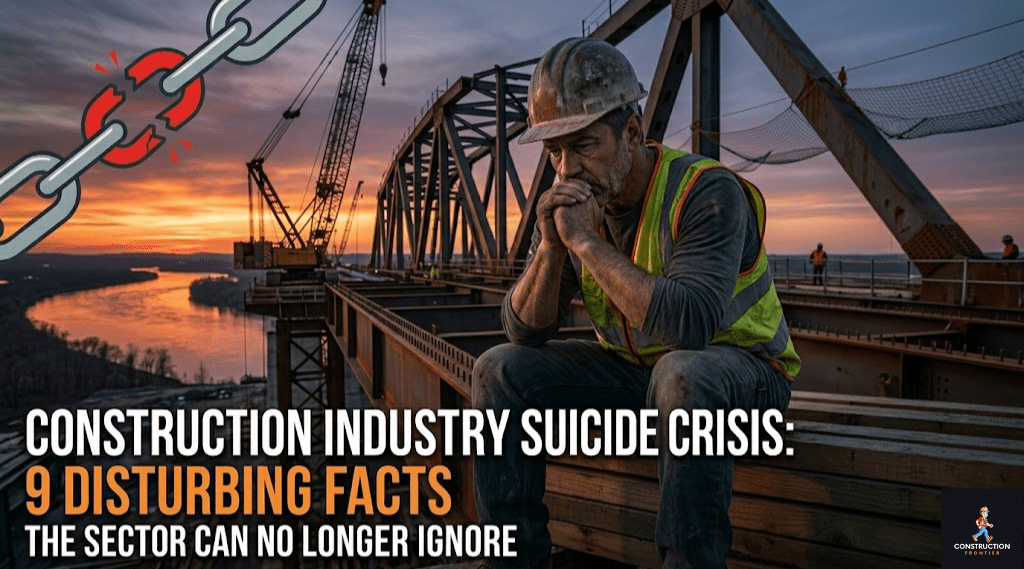
Construction Industry Suicide Crisis: 9 Disturbing Facts the Sector Can No Longer Ignore
The construction industry suicide crisis is not a peripheral welfare concern. It is a systemic, sector-wide emergency that kills more workers each year than falls, electrocutions, and equipment accidents combined. In the United States alone, construction workers die by suicide at a rate more than four times higher than the general population, with over 5,000 deaths recorded annually. Globally, from the UK to Australia, the pattern holds: construction persistently ranks among the deadliest industries for mental health outcomes. What follows are nine evidence-backed facts that expose the true scale of this crisis and why the sector must treat suicide prevention with the same urgency it applies to physical safety.
| Key Statistics: Construction Industry Suicide Crisis | |
| Global ranking | 2nd-highest suicide rate of all major industries (CDC, 2021) |
| US suicide rate | 56 per 100,000 male workers vs 32 per 100,000 across all industries |
| Annual deaths (US) | ~5,000+ construction workers die by suicide per year |
| vs. jobsite fatalities | 5x more suicides than fatal on-site accidents annually |
| General population comparison | The suicide rate is more than 4x higher than the general population |
| UK benchmark | 3x the national male average for low-skilled construction workers |
| Australian benchmark | 2x the rate of men in other professions |
| Workforce affected | 83% of construction workers report experiencing a mental health issue |
| Opioid link | Construction has the highest overdose death rate of any occupation (CDC) |
The construction industry suicide crisis demands more than awareness campaigns and helpline posters. Workforce wellbeing in construction must become a board-level priority, embedded into safety management systems, procurement decisions and leadership culture before thousands more lives are lost to a preventable and largely unaddressed occupational hazard.
Introduction: A Safety Emergency the Industry Has Failed to Name
The construction industry suicide crisis has reached a point where silence is no longer defensible. Across every major construction market, the data tells the same story: workers in this sector are dying by their own hand at rates that dwarf on-site accident statistics, yet the industry continues to invest orders of magnitude more in hard-hat safety than in mental health provision. Understanding why suicide in the construction sector has reached epidemic proportions requires confronting a set of uncomfortable truths about how the industry is structured, how its workers are treated, and how deeply ingrained attitudes about masculinity and toughness have suppressed help-seeking for generations.
This article presents nine of the most disturbing facts driving the construction industry suicide crisis, drawing on data from the US Centers for Disease Control and Prevention, the Bureau of Labor Statistics, the UK Office for National Statistics, and peer-reviewed occupational health research. Each fact carries operational implications for every contractor, project manager, safety officer, and industry body that employs people in this sector. The mental health crisis in the construction industry is not a soft issue. It is a safety issue, a productivity issue, a legal issue, and ultimately a moral one.
Fact 1: Construction Kills More Workers Through Suicide Than Through All On-Site Accidents
The most arresting statistic in the construction industry suicide crisis is not the rate; it is the absolute number. In 2022, an estimated 6,000 construction workers in the United States died by suicide, compared to approximately 1,000 who died from on-site construction work-related injuries. A separate CPWR analysis for 2023 recorded 5,095 construction suicides against 982 fatal on-site injuries. By whichever dataset is used, the conclusion is the same: suicide is five times more lethal to construction workers than falling off scaffolding, being struck by equipment, or suffering any of the hazards that consume the bulk of the industry’s safety budget.
This inversion of the risk profile should fundamentally reorder priorities. For decades, the sector has organised its safety architecture around the so-called Fatal Four: falls, struck-by incidents, electrocution, and caught-in/between accidents. These remain critical. But the construction industry suicide crisis now constitutes a sixth category of fatal risk that eclipses all four of the traditional hazards combined. Any safety management system that does not include a structured mental health and suicide prevention component is, by definition, incomplete.
Fact 2: Construction Workers Are Four Times More Likely to Die by Suicide Than the General Population
The construction industry suicide crisis is not simply a reflection of baseline societal trends. Construction worker mental health outcomes are dramatically worse than those of comparable demographics in other sectors. According to the Bureau of Labor Statistics and CDC data, the suicide death rate for construction workers was 46.1 per 100,000 full-time employees in 2022, compared to 19.5 per 100,000 across all industries. For male construction workers specifically, the figure rises to 56 per 100,000, against 32 per 100,000 for working men overall, making their risk almost 75% higher than the male workforce average.
The international picture is equally alarming. In the UK, according to the Office for National Statistics, suicide risk among low-skilled male construction labourers is three times the national male average. In Australia, construction workers die by suicide at twice the rate of men in other professions. In the US, nearly one in five suicides occurs within the construction sector, despite the workforce representing approximately 7% of total employment. These figures confirm that the construction industry suicide crisis is a structural occupational problem, not a statistical coincidence.
Fact 3: The Sector’s ‘Tough-Guy’ Culture Is Actively Suppressing Help-Seeking
One of the most persistent drivers of the construction industry suicide crisis is the cultural architecture of the industry itself. Construction has long prized physical endurance, stoicism, and self-reliance, qualities that translate into productivity on a jobsite but become life-threatening when they prevent workers from acknowledging mental health problems in construction workers and seeking professional support.
Research published in peer-reviewed occupational health journals consistently identifies stigma as the primary barrier to help-seeking among construction workers. The masculine workplace norm that defines seeking psychological help as weakness is particularly entrenched in a sector where 90% of the US workforce is male. This issue is explored in depth in our Construction Frontier analysis of construction worker suicide rates and their causes, which examines the psychosocial mechanisms behind the industry’s chronic under-reporting of mental distress.
A 2024 qualitative study of UK construction workers found that workers perceived it far easier to discuss physical ailments than psychological ones, with stigma acting as a systemic filter that routes genuine distress underground. Survey data from Australia’s Bluehats suicide prevention programme revealed that even when workers trusted a peer mental health advocate on their jobsite, many still avoided engaging for fear that colleagues or supervisors would discover their struggles and that their employment prospects would suffer. Construction industry stress is not just generated by workload. It is amplified by a culture that punishes vulnerability.
Further Reading: Construction Workers’ Suicide Rates: 8 Critical Causes and Proven Prevention Strategies
Fact 4: Almost Half of Construction Workers Experience Symptoms of Anxiety or Depression
Mental health problems in construction workers extend far beyond the headlines about suicide. A 2020 survey found that 83% of construction workers had struggled with a mental health issue at some point, while a separate analysis cited by KFF Health News found that almost half of construction workers had experienced symptoms of anxiety and depression, at a rate higher than the general US working population. These figures point to the vast hidden layer of mental health in the construction industry: the workers who are suffering but are not yet in crisis and whose condition may deteriorate without early intervention.
The construction workforce’s wellbeing deficit is compounded by how rarely these symptoms are diagnosed or treated. Construction workers are less likely than peers in other industries to access healthcare routinely, partly due to the transient nature of project-based employment and associated gaps in health insurance coverage and partly because the culture actively discourages health-seeking behaviour. Construction industry stress accumulates across seasons, projects, and careers, and the absence of any structured monitoring or early intervention mechanism means the gap between symptom onset and crisis is rarely bridged before it becomes a tragedy.
Fact 5: Job Insecurity and Seasonal Unemployment Are Structural Suicide Risk Factors
Why suicide rates are high in construction is, in part, a structural economic question. Unlike most professional sectors, construction employment is inherently cyclical, project-bound, and precarious. Workers move between sites, companies, and contracts, often with no guarantee of continuity. Seasonal layoffs, market downturns, and project cancellations create repeated cycles of financial anxiety that are directly linked to elevated suicide risk in the occupational health literature. Job insecurity and precarious work are associated with worse mental health outcomes and increased suicidal ideation, a relationship that has been demonstrated across multiple peer-reviewed studies examining psychosocial workplace hazards.
The construction industry suicide crisis is therefore partly a consequence of how the sector is commercially structured. Unlike a salaried office worker who faces redundancy as an exceptional event, a construction worker may face multiple involuntary work interruptions per year, each carrying financial stress, disrupted social connections, and a sense of loss of professional identity. For older workers facing automation-driven displacement, these pressures are intensified further: the rapid adoption of building information modelling, prefabrication, and AI-assisted project management is generating deep anxiety among experienced tradespeople who fear that decades of physical skill are being made redundant.
Fact 6: Chronic Pain and Opioid Dependence Create a Compounding Suicide Risk Loop
One of the most clinically significant facts in the construction industry suicide crisis is the relationship between physical injury, chronic pain, opioid prescriptions, and mental health outcomes. The construction injury rate is 77% higher than the national average, and injured workers are nearly four times more likely to be prescribed opioid pain medication than workers in other sectors.
A 2018 CPWR survey found that 20% of the construction industry’s total prescription drug spending went on opioids, and approximately 15% of those prescribed opioids became long-term users. The CDC has confirmed that the construction trades have the highest opioid overdose death rate of any occupation. The link to the construction industry suicide crisis is direct and clinically established. Opioid-dependent men are twice as likely to die by suicide as those who are not addicted. Chronic pain, independently, is associated with significantly elevated rates of depression, anxiety, and suicidal ideation.
The pathway from a musculoskeletal injury on a construction site to opioid dependence, depression, and suicide is well-documented in the literature. In 2023, CPWR recorded 15,910 fatal overdoses among construction workers against 5,095 suicides and 982 on-site fatal injuries, illustrating a triangulated mental health crisis in which pain management and substance use are deeply intertwined with suicide risk. Preventing suicide in the construction industry, therefore, requires treating injury prevention, pain management, and mental health support as an integrated continuum rather than separate departmental responsibilities.
Fact 7: Construction Industry Suicide Statistics Reveal a Global, Not Regional, Crisis
The construction industry suicide crisis is sometimes discussed as if it were a US-specific phenomenon, driven by American healthcare gaps and cultural norms. The international data removes any such comfort. In the UK, where the National Health Service provides universal healthcare access, the suicide risk for low-skilled male construction labourers remains three times the national male average.
In Australia, where mental health infrastructure is relatively well-developed and suicide prevention programmes such as MATES in Construction have operated for over a decade, construction workers still die by suicide at twice the rate of men in other professions. In the US, despite growing industry awareness and initiatives from organisations including the Construction Industry Alliance for Suicide Prevention and Bechtel’s $7 million commitment to the cause, the suicide fatality rate for construction workers dropped only 1.7% between 2023 and 2024.
These construction industry suicide statistics confirm that the crisis is not a function of healthcare access alone. It is driven by the structural, cultural, and psychosocial characteristics of construction work itself: physical injury risk, masculine workplace norms, employment precarity, social isolation, and inadequate mental health integration into safety management systems. The sector-wide nature of the problem means that country-level policy responses are necessary but insufficient. International benchmarking, cross-border research collaboration, and the adoption of evidence-based suicide prevention frameworks at the project-delivery level are required to produce meaningful population-level change.
Fact 8: Workers’ Mental Health in Construction Is Undermined by Systematic Isolation
Construction workforce wellbeing is challenged not only by workplace pressures but also by the structural isolation that project-based employment creates. Construction workers frequently relocate between projects, disrupting social networks, family relationships, and community ties. Long working hours, remote site locations, and the transient nature of jobsite communities mean that many workers arrive at crisis points without adequate social support. The fly-in, fly-out employment model used extensively in major infrastructure projects intensifies this dynamic: research from Australia found that for FIFO workers in male-dominated industries, including construction, fear of negative employment consequences was the primary barrier preventing workers from seeking mental health support.
Construction industry stress in these contexts is compounded by prolonged physical separation from families, irregular communication, and the absence of consistent peer relationships. Understanding the broader context of mental health in the construction industry requires reading these dynamics alongside the pressures discussed in our exploration of construction worker suicide rates, where the intersection of demographic vulnerability, isolation, and workplace culture is analysed in detail.
Project-level isolation also undermines the effectiveness of standard mental health interventions. Employee Assistance Programmes (EAPs), mental health helplines, and general practitioner referrals are all predicated on workers having stable access, consistent employment relationships, and sufficient privacy to seek help without fear of professional consequences. For the mobile, subcontracted, site-based construction workforce, none of those conditions reliably hold. This is why suicide in the construction sector persists despite growing industry awareness: the delivery mechanisms for mental health support are, in most cases, not designed for the environments in which construction workers actually operate.
Fact 9: The Industry Has the Tools to Prevent Construction Suicide, But Lacks Systemic Adoption
Perhaps the most disturbing fact in the construction industry suicide crisis is that the solutions are known. Preventing suicide in the construction industry is not a research problem; it is an implementation problem. Peer support programmes, mental health first aid training, toolbox talks on psychological wellbeing, injury management protocols that flag opioid dependency risk, flexible working arrangements, and supervisor training in early distress recognition have all been shown to reduce suicide risk in construction workforce populations. The MATES in Construction programme in Australia, the Bechtel ‘Hard Hat Courage‘ initiative in the US, and Skanska’s on-site mental health advocate model in the UK each demonstrate that structured, sector-tailored interventions can shift culture and reduce harm.
The barrier is not knowledge; it is priority and accountability. A 2021 survey by the Centre for Workplace Mental Health found that 93% of construction industry respondents agreed that addressing mental health at work is sound business practice. Yet only 25% of the same organisations offered supervisor mental health training, and only 63% had an Employee Assistance Programme.
The gap between stated priority and operational investment characterises the construction industry suicide crisis as much as any risk factor. Construction workforce wellbeing will not improve until mental health is given the same budget allocation, senior sponsorship, and contractual obligation as physical safety. Every project specification that mandates a fall prevention plan but contains no mental health provision is, in effect, a document that accepts preventable suicide as an operational externality.
Further Reading: 20 Best Construction Podcasts to Inspire and Educate Industry Professionals
Conclusion: Confronting the Construction Industry Suicide Crisis Requires Industry-Wide Action
The nine facts presented here are not intended to generate despair. They are intended to generate accountability. The construction industry suicide crisis is measurable; it is understood, and it is preventable. The sector has demonstrated repeatedly that when it sets a safety standard, it can organise around it: injury rates have fallen significantly over decades through structured regulation, training, and cultural change. The same trajectory is possible for mental health in the construction industry, but only if the same institutional will is applied.
Contractors, project owners, procuring authorities, insurers, and industry bodies all have a role to play. Mental health in the construction industry must move from the margins of occupational health into the mainstream of project delivery. Safety management plans must include mental health provisions. Procurement standards must reward employers who can demonstrate workforce wellbeing commitments. Leadership training must include psychological safety alongside physical hazard awareness. And the industry’s most powerful cultural asset, its peer networks and site-level camaraderie, must be deliberately harnessed for early intervention rather than left to operate as an informal barrier to help-seeking.
The construction industry suicide crisis is the sector’s most urgent and least addressed safety challenge. The data is clear. The solutions exist. What remains is the decision to act.
Stay Updated on Construction Workforce Safety and Industry Trends
The construction industry suicide crisis highlights a growing need for safer, healthier, and more sustainable workplaces across the global built environment sector. Stay informed with Construction Frontier: Construction Workforce Safety, Mental Health & Human Performance for expert analysis, workforce safety insights, infrastructure intelligence, and emerging trends shaping the future of construction worldwide.