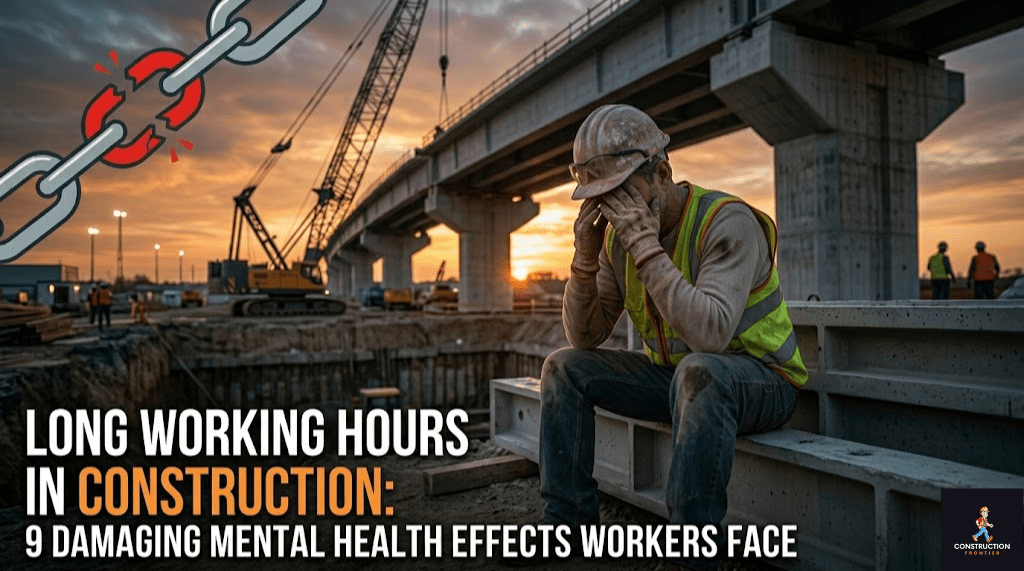
Long Working Hours in Construction: 9 Damaging Mental Health Effects Workers Face
Long working hours in construction are among the most underreported occupational hazards in the industry. Across the globe, construction workers routinely log 50 to 60 or more hours per week under relentless schedule pressure, budget constraints, and deadline-driven site culture. The consequences are not just physical: mental health in the construction industry is deteriorating at a measurable and alarming rate, with fatigue, burnout, and chronic stress now embedded in the daily reality of millions of workers.
Technical Snapshot: Effects of Long Working Hours in Construction
| Workforce at risk | 10+ million construction workers in the US alone; tens of millions more globally |
| Average weekly hours | 50-60+ hours routinely logged on active construction projects |
| Mental distress prevalence | Up to 50% of construction workers experience substantial mental distress (meta-analysis) |
| Depression and anxiety (US) | 64% of US construction workers report depression or anxiety (Clayco, 2025) |
| Substance use disorder rate | 14.3% of construction workers vs 9.5% across all full-time workers (SAMHSA) |
| Suicide risk | Construction workers are 6x more likely to die by suicide than from a site accident (UK data) |
| Primary driver | Poor work-life balance, driven by excessive hours, is the leading organisational risk factor |
Long working hours in construction do not merely drain physical reserves; they systematically erode construction workers’ mental health across nine distinct and compounding dimensions. Understanding these effects is the first step towards building a workforce that is as psychologically resilient as it is technically skilled. Construction worker mental health, when neglected under relentless overtime, does not stabilise; it deteriorates in direct proportion to the hours and conditions workers face week after week.
Introduction: Why Long Working Hours in Construction Demand Urgent Attention
Long working hours in construction are not a new phenomenon, but the mental health consequences are only now receiving the industry-wide scrutiny they deserve. Site-based professionals, labourers, project managers, and tradespeople alike spend extended shifts in physically demanding, high-hazard environments where the culture of endurance overrides the science of recovery. The effects of long working hours in construction extend well beyond tiredness: they restructure workers’ cognition, emotions, relationships, and long-term health outcomes in ways that standard occupational health frameworks have been slow to capture.
Research published by the National Library of Medicine in a systematic review of psychological harm in construction, drawing on 68 studies spanning three decades, identifies long working hours as one of the five primary drivers of psychological harm in the sector. A separate meta-analysis found that substantial mental distress affects up to 50% of construction workers globally. These are not marginal findings; they describe an industry in which the construction worker mental health crisis has become a structural casualty of project delivery norms. Understanding how overtime impacts construction workers is now a prerequisite for any serious safety or well-being strategy.
Construction fatigue and burnout in construction are the most visible downstream effects, but the full damage runs deeper. Construction fatigue and burnout symptoms, ranging from chronic exhaustion and emotional withdrawal to cognitive dysfunction and relationship breakdown, surface across the full spectrum of construction roles. This article examines nine specific mental health consequences that long working hours impose on construction workers’ mental health, with implications for site managers, employers, industry bodies, and policymakers committed to sustainable workforce practices.
For a broader perspective on why the industry has reached this point, our analysis of the construction industry suicide crisis sets out the systemic failures that have turned overwork into a precursor to some of construction’s most preventable deaths.
The 9 Damaging Mental Health Effects of Long Working Hours in Construction
Each of the nine effects below is directly attributable to, or significantly worsened by, long working hours in construction. They do not operate in isolation: fatigue feeds anxiety, anxiety accelerates burnout, and burnout dismantles the cognitive and relational capacities workers rely on to function safely and effectively on site.
1. Chronic Fatigue and Sleep Deprivation
Construction fatigue is the most immediate effect of long working hours in construction, and it operates as the gateway to every other mental health consequence on this list. Workers who consistently log more than 50 hours per week face a statistically measurable deterioration in sleep quality. Research published in peer-reviewed journals establishes that working 55 or more hours per week is independently associated with short sleep duration, defined as under seven hours per night, and with significant sleep disturbance.
The National Safety Council’s fatigue data shows injury rates peak among workers who regularly sleep fewer than five hours per night (7.89 injuries per 100 employees) and among those working more than 60 hours weekly (4.34 injuries per 100 employees). Construction fatigue caused by long hours operates simultaneously as a mental health condition and a physical safety risk. Workers describe a persistent cognitive fog, impaired reaction time, and reduced emotional regulation that no amount of weekend rest fully resolves when the pattern is entrenched over months or years. Construction fatigue and burnout symptoms emerging from sleep deprivation alone are enough to classify many worksites as chronic health-risk environments.
2. Anxiety and Chronic Workplace Stress
Construction workplace stress driven by extended hours ranks as one of the most documented mental health risks in the construction industry. A peer-reviewed systematic review of stress, anxiety, and fear among construction workers identifies high workload and long working hours as primary conditioning factors for anxiety disorders. The research confirms that construction workplace stress functions through both direct mechanisms, the cognitive overload of managing complex, deadline-driven tasks without adequate recovery time, and indirect mechanisms, including financial pressure, relationship strain, and physical pain compounding over time.
Long working hours in construction create a state of perpetual activation in workers’ stress response systems. Sustained cortisol elevation, the physiological fingerprint of chronic stress, impairs immune function, disrupts sleep architecture, and, over time, contributes to cardiovascular disease. The WHO and ILO’s joint estimates confirm that long working hours contributed to more than 745,000 deaths globally from heart disease and stroke in 2016 alone, making construction workplace stress driven by overtime a lethal occupational hazard, not merely an inconvenience. Mental health risks in the construction industry stemming from anxiety and stress are therefore measurable in both human suffering and preventable mortality.
3. Clinical Depression
The relationship between how overtime impacts construction workers and the development of clinical depression is now well-established in the research literature. A 2025 survey by design-build firm Clayco found that 64% of US construction workers had experienced depression or anxiety in the past year, up from 54% the year prior. The upward trajectory reflects a workforce increasingly unable to recover from the psychological toll of long working hours in construction.
Depression in construction workers is not simply sadness; it manifests as withdrawal from site communication, reduced decision-making capacity, increased error rates, and, in severe cases, the suicidal ideation that drives the industry’s catastrophic suicide statistics. Over 50% of UK builders reported struggling with mental health problems, with fatigue cited by 28% as a primary cause. Mental health in the construction industry cannot improve while depression incidence continues rising in direct correlation with working hours that have not meaningfully reduced across much of the sector.
The relationship between overwork, depression, and the industry’s suicide epidemic is explored in detail in our article on construction workers’ suicide rates and causes, which documents how untreated depression, shaped in part by excessive hours, becomes a lethal condition in a workforce that has historically discouraged help-seeking.
4. Burnout in Construction
Burnout in construction is a clinical state of chronic occupational stress that has not been successfully managed. It is characterised by emotional exhaustion, depersonalisation, and a reduced sense of personal accomplishment. Research confirms that long working hours are among the primary drivers of burnout in construction, with a poor work-life balance identified as the single most common organisational risk factor for compromised mental health in the sector.
The effects of long working hours in construction on burnout are progressive: workers who initially cope with overtime through determination and commitment gradually lose the psychological reserves required to sustain that effort. Construction fatigue and burnout symptoms co-develop and reinforce each other, creating a cycle where exhausted workers perform less effectively, attract more criticism or pressure, and burn out faster as a result. A global review of mental health in the construction industry confirms that poor work-life balance, driven by the long hours and irregular schedules inherent to construction projects, induces anxiety, sadness, chronic stress, exhaustion, and feelings of isolation in workers.
Further Reading: Construction Burnout: 7 Critical Causes, Warning Signs, and Proven Prevention Strategies
5. Cognitive Impairment and Reduced Decision-Making
The cognitive consequences of long working hours in construction are acute and directly relevant to site safety. Burnout in construction, which develops from sustained overwork, is associated with measurable deficits in working memory, executive function, attention, and problem-solving. Construction fatigue and burnout symptoms at the cognitive level develop incrementally, which means supervisors rarely perceive the deterioration until performance has already fallen to a safety-critical threshold. These are not minor inconveniences on a desk job; on a construction site, they represent the difference between a safe lift sequence and a fatal incident.
Research on how overtime impacts construction workers at the cognitive level confirms that burnt-out workers demonstrate reduced visuospatial functioning, impaired prospective memory, and diminished processing speed. Workers in this state are operating complex machinery, reading structural drawings, coordinating lifts, and making real-time safety judgments with neurological resources that are measurably compromised. Construction fatigue and burnout symptoms at the cognitive level are invisible to supervisors focused on physical output, making them among the most dangerous mental health risks in the construction industry. How overtime impacts construction workers neurologically is therefore inseparable from how safely those workers perform.
Key Mental Health Risks in the Construction Industry: Prevalence Data
| Mental Health Risk | Prevalence / Impact Indicator |
| Depression or anxiety (US, 2025) | 64% of construction workers (Clayco survey) |
| Substantial mental distress | Up to 50% of workers globally (meta-analysis) |
| Monthly mental health struggles (UK) | 73% of construction workers consistently |
| Fatigue as a reported cause | 28% of UK builders cite it as the primary factor |
| Burnout-linked cognitive deficits | Working memory, executive function, attention |
| Substance use disorder | 14.3% vs 9.5% all full-time workers (SAMHSA) |
| Heavy alcohol use | 16.5% vs 8.7% all full-time workers (SAMHSA) |
6. Relationship Breakdown and Social Isolation
Long working hours in construction systematically erode the personal relationships that protect workers’ mental health. The research literature identifies work-family conflict as a direct consequence of the excessive hours, irregular schedules, and frequent off-site working that characterise the industry. A study of 407 construction workers established that work-family conflict depletes self-control resources and reduces both job satisfaction and life satisfaction simultaneously.
Construction workers who consistently miss family events, school commitments, and social occasions describe feelings of guilt, disconnection, and progressive alienation from the domestic life that provides psychological grounding outside of work. Over time, strained family relationships remove one of the most powerful buffers against mental health deterioration. Several studies confirm that long working hours for construction professionals directly and negatively impact relationship quality, a finding that holds across cultural and geographic contexts. The resulting social isolation creates conditions in which construction workplace stress has no outlet, and mental health risks in the construction industry go unmanaged.
7. Substance Abuse as a Coping Mechanism
The link between long working hours in construction and elevated rates of substance abuse is one of the most consequential and least openly acknowledged effects in the industry. According to the Substance Abuse and Mental Health Services Administration (SAMHSA), construction workers have a substance use disorder rate of 14.3%, compared to 9.5% across all full-time workers. Heavy alcohol use affects 16.5% of construction workers, nearly double the 8.7% rate for the broader workforce.
Substance abuse in construction functions, at least initially, as a coping mechanism for the construction workplace stress and construction fatigue that accumulate through sustained overtime. Workers turn to alcohol or other substances to decompress after physically and mentally depleting shifts, to manage chronic pain that long hours exacerbate, and to navigate the emotional numbness that develops in the later stages of burnout in construction. The industry’s cultural normalisation of heavy drinking at site events and post-shift gatherings makes the behaviour harder to identify and address. Substance abuse then compounds all other mental health effects, deepening depression, worsening sleep quality, and accelerating cognitive decline.
8. Post-Traumatic Stress and Heightened Anxiety Sensitivity
Long working hours in construction increase the probability that workers will be present during, or in the aftermath of, serious site incidents. Research identifies occupational injury and site hazard exposure as contributors to post-traumatic stress disorder among construction workers, and PTSD in turn amplifies pre-existing depression and anxiety. Construction workplace stress from overwork lowers the psychological threshold at which traumatic events cause lasting damage; a worker who is already fatigued and burnt out has fewer cognitive and emotional resources to process and recover from trauma.
The effects of long working hours in construction on trauma susceptibility are rarely framed in this way, but the connection is direct. Fatigue impairs emotional regulation, which determines how effectively workers process distressing experiences. Construction fatigue and burnout symptoms that include emotional blunting and detachment mirror PTSD symptomatology, making clinical assessment and intervention more complex. How overtime impacts construction workers at the neurological level, therefore, extending into the long-term architecture of trauma response.
9. Eroded Professional Identity and Loss of Meaning
The ninth and often overlooked effect of long working hours in construction is the gradual erosion of professional identity and occupational purpose. Burnout in construction does not just exhaust workers physically; it hollows out the sense of craft, pride, and contribution that sustains motivation in a physically demanding career. Workers who entered the industry with genuine skill and commitment describe a progressive detachment from their work as overtime compounds over the years: the job becomes something to survive rather than something to take pride in.
This loss of meaning is both a symptom and an accelerant of poor mental health in the construction industry. Workers who no longer find purpose in their role are less likely to engage with safety protocols, less likely to support colleagues in distress, and less likely to seek help when their own mental health deteriorates. Mental health risks in the construction industry are therefore self-reinforcing at the cultural level: the norms that produce long hours also produce the disengagement that prevents the industry from addressing them. Understanding how overtime impacts construction workers in this existential dimension is essential for any serious intervention strategy.
Our investigation into construction burnout: causes and prevention examines the organisational and individual strategies that can interrupt this cycle before professional identity collapses entirely.
Further Reading: Construction Industry Suicide Crisis: 9 Disturbing Facts the Sector Can No Longer Ignore
Technical Block: Understanding the Compounding Mechanics of Overwork
The nine effects documented above do not operate as isolated conditions. They form an interconnected system in which each effect amplifies the others, producing outcomes that are disproportionately severe relative to any single factor. This technical section examines the mechanisms through which long working hours in construction generate compounding mental health deterioration and the evidence thresholds at which intervention becomes critical. The implications for construction worker mental health are cumulative: each mechanism reinforces the others, and mental health in the construction industry cannot meaningfully improve until these compounding pathways are addressed at source.
1. The Fatigue-Cognition-Safety Cascade
The physiological pathway from long working hours in construction to acute safety risk runs through sleep deprivation and its neurological effects. Working more than 55 hours per week is associated with short sleep duration. Reduced sleep of under seven hours per night impairs prefrontal cortical function, the brain region responsible for risk assessment, impulse control, and real-time decision-making. On a construction site, this translates directly to elevated incident probability. Workers with sleep problems face a 1.62 times higher risk of occupational injury. Approximately 13% of all work injuries are attributable to sleep problems, a proportion that increases significantly in sleep-deprived, overtime-exposed workforces such as construction.
The WHO/ILO Joint Estimates confirm that long working hours, defined as more than 55 hours per week, represent one of the largest occupational health hazards globally, accounting for hundreds of thousands of preventable deaths annually from cardiovascular causes alone. Construction fatigue operating through this pathway is therefore not a performance issue but a mortality issue.
2. The Burnout-Substance Abuse Loop
Burnout in construction and substance abuse reinforce each other through a well-documented bidirectional mechanism. Burnout reduces emotional regulation capacity, increasing the appeal of chemical coping strategies. Substance abuse degrades sleep quality, exacerbates depression, and impairs cognitive function, all of which deepen burnout. Research shows that 14.3% of construction workers meet the criteria for a substance use disorder, a rate roughly 50% higher than the general workforce. The construction industry records the second-highest rate of heavy alcohol use among all industry sectors. These figures reflect a workforce in which the stress load from long working hours in construction has exceeded the capacity of available non-chemical coping strategies.
3. The Work-Family Conflict-Isolation Spiral
Long working hours in construction systematically displace the family time and social engagement that constitute the primary non-clinical mental health protective factors for most workers. Research confirms that poor work-life balance is the single most common organisational risk factor for compromised mental health in construction. Workers deprived of quality family time report anxiety, isolation, and guilt that construction workplace stress amplifies. The absence of social support from family and community networks leaves workers without the relational infrastructure to identify deteriorating mental health or to seek help. The spiral from overwork to isolation to crisis is well-evidenced and entirely preventable with structural intervention.
Conclusion: Reclassifying Long Working Hours as a Mental Health Hazard
Long working hours in construction are not a cultural inevitability or an unavoidable product of project economics. They are a quantifiable, documented source of serious mental health damage affecting hundreds of thousands of workers across the global construction workforce. The effects of long working hours in construction, from chronic construction fatigue and sleep deprivation through to eroded professional identity, constitute a coherent case for treating excessive hours as a primary mental health risk in the construction industry, regulated and managed with the same rigour applied to physical site hazards. Understanding how overtime impacts construction workers across all nine of these dimensions is what converts awareness into accountable industry action.
Construction worker mental health will not improve through awareness campaigns alone. It requires site-level working time governance, access to occupational mental health support, and a genuine cultural recalibration of what it means to work safely in construction. Mental health in the construction industry is inseparable from the working conditions that define it. The effects of long working hours in construction are not a side effect of ambition; they are a management failure with measurable human costs.
Our pillar article, Unearthing Construction’s Biggest Killer: Mental Health, sets out the full scope of this crisis and the systemic response it demands from industry leaders, employers, and regulators.
Stay Informed on Construction Workforce Wellbeing
Explore Construction Frontier: Construction Workforce Safety, Mental Health & Human Performance for expert insights, research-driven analysis, and practical strategies addressing long-term working hours in construction, worker mental health, burnout, and sustainable project delivery.