Bulk vs Bagged Cement: 7 Proven Contractor Preferences for Smarter Construction
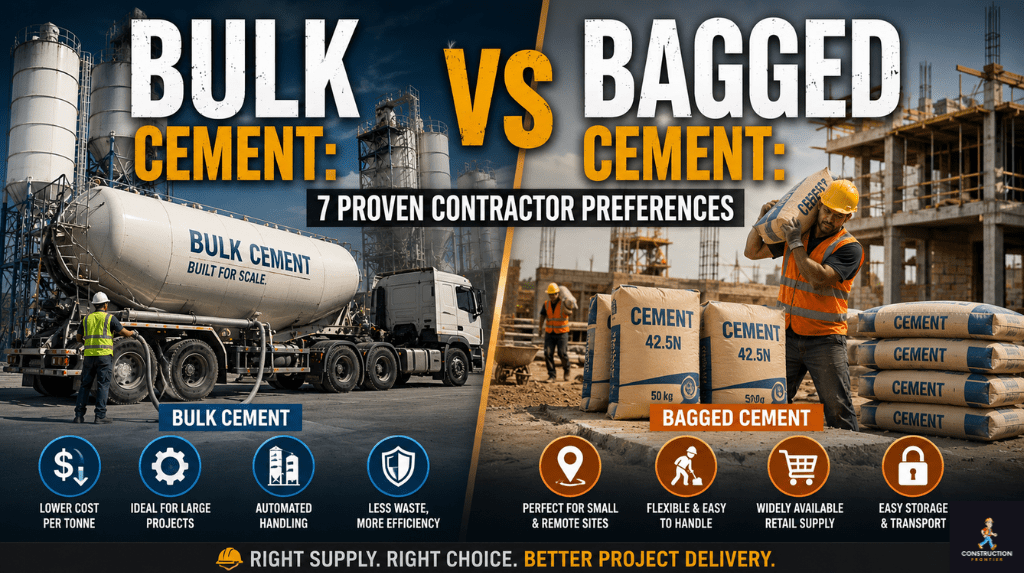
The bulk vs bagged cement debate remains a crucial consideration for contractors managing cost, logistics, and efficiency in modern construction projects. While bulk cement dominates large infrastructure and megaprojects, bagged cement remains essential for small contractors and remote sites across Africa and emerging markets. This guide explores seven proven contractor preferences, analysing cost efficiency, project scale, storage requirements, and supply chain logistics to help industry professionals choose the right cement delivery method.
Technical Snapshot: Bulk vs Bagged Cement Supply Systems
| Parameter | Bulk Cement | Bagged Cement |
| Delivery method | Tanker trucks or rail wagons | Packaged in 25kg or 50kg bags |
| Typical usage | Ready-mix plants, megaprojects | Retail construction |
| Storage | Steel silos | Covered warehouses |
| Handling system | Pneumatic transfer | Manual handling |
| Logistics cost | Lower per tonne | Higher per tonne |
| Material loss risk | Minimal | Moderate |
| Environmental impact | Reduced packaging waste | Packaging disposal required |
Introduction: Bulk vs Bagged Cement in Modern Construction Supply Chains
The bulk vs bagged cement decision plays a decisive role in construction productivity, logistics efficiency, and project cost management. Across Africa and emerging economies, contractors, developers, and infrastructure investors increasingly evaluate cement supply methods in Africa as part of broader procurement and supply chain optimisation strategies. The decision is also influenced by the specific types of cement and their common uses in construction, since different projects require varying handling, storage, and delivery approaches depending on the cement specification.
Large-scale infrastructure projects such as highways, dams, rail corridors, and industrial plants depend heavily on uninterrupted concrete production. In these environments, bulk cement delivery in Africa has become the dominant supply model because it supports automated batching systems, reduces handling losses, and significantly lowers logistics costs per tonne. By contrast, bagged cement remains essential for retail construction markets, small contractors, and remote infrastructure projects where bulk storage systems are not feasible.
The operational trade-offs between bulk cement and bagged cement extend beyond simple transportation differences. Contractors must evaluate project scale, storage infrastructure, labour requirements, material quality control, and environmental considerations when determining the most efficient cement supply model. These factors are particularly critical in emerging economies, where infrastructure development is accelerating, but logistics networks remain uneven.
Global cement demand continues to grow as urbanisation accelerates in emerging economies. According to the International Energy Corporation, global cement production exceeds four billion metric tonnes annually, with most future growth expected in developing regions. These trends are reshaping cement logistics in construction, forcing contractors to adopt more efficient supply strategies that balance cost, productivity, and sustainability.
Understanding Bulk vs Bagged Cement in Modern Construction
The ongoing discussion surrounding bulk vs bagged cement reflects the broader transformation of construction logistics and materials supply chains. As projects become larger and more technologically complex, contractors must evaluate procurement strategies that support continuous concrete production while minimising operational costs.
In advanced construction markets, bulk cement dominates because it integrates seamlessly with automated batching plants and ready-mix concrete operations. However, in emerging economies such as those in Africa and Southeast Asia, construction markets remain highly fragmented. This creates a hybrid supply ecosystem in which both bulk and bagged cement formats coexist.
Understanding how these supply systems operate is essential for analysing the cement supply chain within the context of construction dynamics and contractors’ operational preferences.
What is Bulk Cement?
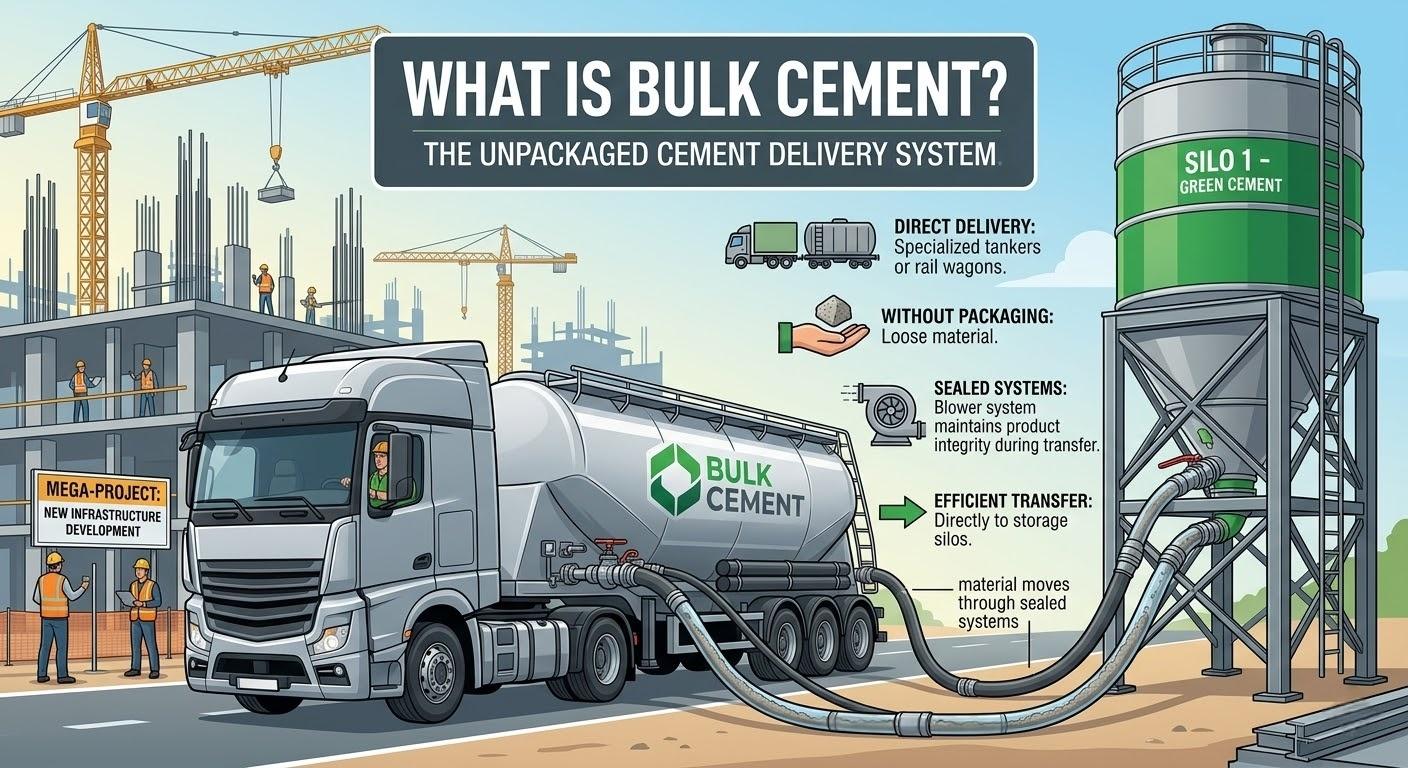
Bulk cement is cement transported without packaging and delivered directly to construction sites via specialised tankers or rail wagons. Instead of bags, the material moves through sealed systems that maintain product integrity while enabling efficient transfer into storage silos.
Upon arrival at a construction site or batching plant, cement is unloaded using pneumatic systems that transfer the material through pressurised pipelines into silos. These silos feed automated batching systems that precisely measure cement quantities during concrete production.
The operational advantages of bulk systems explain why contractors increasingly favour bulk cement delivery for infrastructure projects in Africa. Continuous supply improves batching efficiency and reduces labour costs associated with manual handling.
The advantages of bulk cement in large construction projects include:
- Consistent material flow for batching plants.
- Reduced contamination risks.
- Faster unloading times.
- Lower packaging and transport costs.
These benefits make bulk cement the preferred option for contractors managing large-scale concrete works or mega infrastructural projects.
What is Bagged Cement?
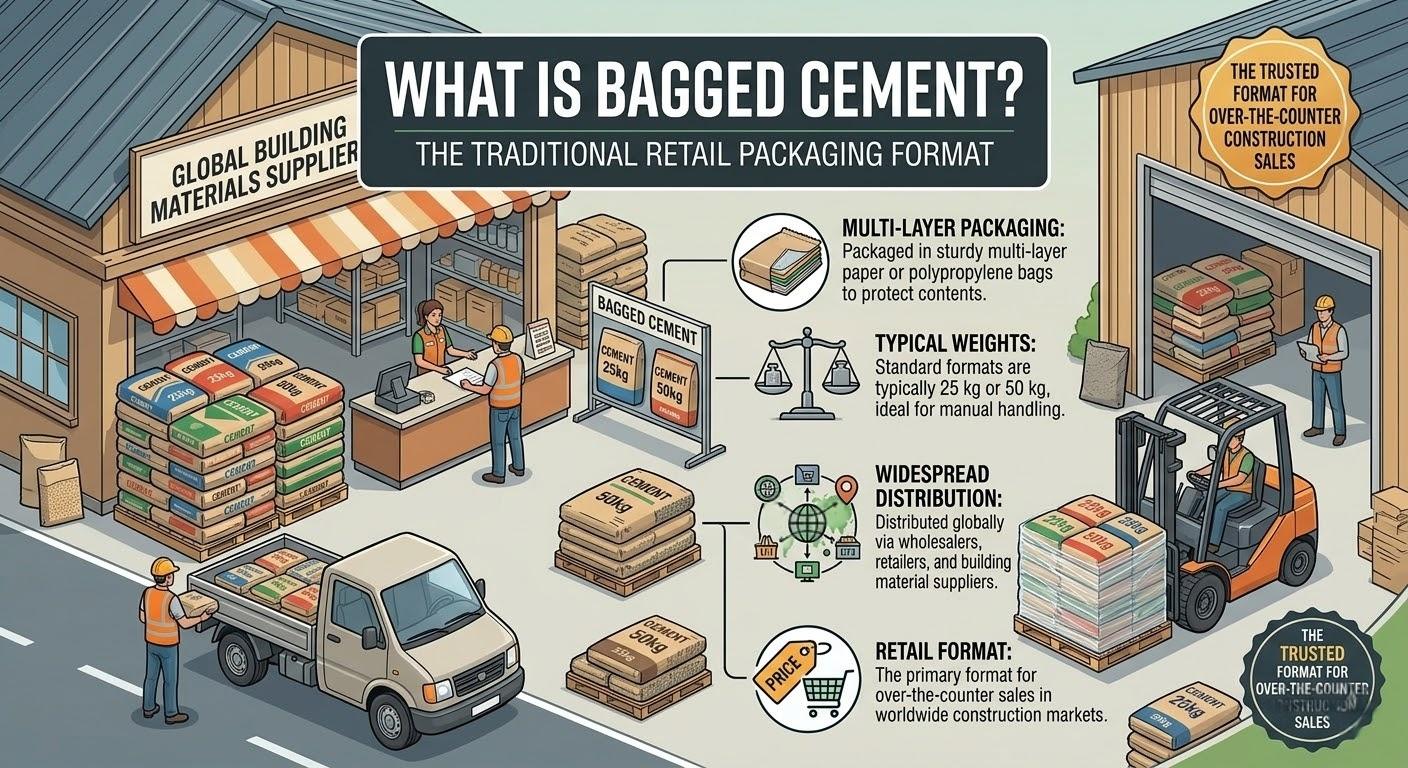
Bagged cement is the traditional retail format used in most construction markets worldwide. Cement is packaged in multi-layer paper or polypropylene bags, typically weighing 25 kg or 50 kg, and distributed through wholesalers, retailers, and building material suppliers.
This format allows contractors to transport and handle cement manually without requiring specialised storage equipment. For small construction projects, this flexibility remains extremely valuable.
The advantages of bagged cement become evident in construction environments where infrastructure limitations prevent the use of bulk supply systems. Small contractors, informal builders, and rural construction sites often depend on bagged cement because it allows flexible purchasing and easier transportation.
However, the handling requirements of bagged cement increase labour dependency and create risks of material loss during transport and storage.
Why the Bulk vs Bagged Cement Debate Matters
The debate over bulk vs bagged cement has major implications for construction economics and supply chain performance.
Cement represents one of the most heavily consumed materials in the construction industry, and inefficient logistics can significantly increase project costs. The choice between supply formats influences several key factors:
- Transportation efficiency.
- Construction productivity.
- Labour requirements.
- Material loss rates.
- Environmental impacts.
Understanding the cost comparison between bulk and bagged cement helps contractors optimise procurement strategies. In emerging markets, this analysis is especially important because infrastructure logistics networks often vary widely between urban and rural regions.
Further Reading: 5 Proven Green Cement Impacts in Africa & Emerging Markets
7 Contractor Preferences Shaping Cement Supply Decisions
Contractors evaluate several operational factors when deciding between bulk cement and bagged cement. These preferences reflect real-world constraints involving logistics infrastructure, project scale, cost management, and material quality.
Understanding these preferences helps explain how cement distribution systems evolve across different construction markets and which project option is best: bulk vs bagged cement.
Preference 1: Project Size Determines Cement Format
Project scale remains the most decisive factor influencing the bulk vs bagged cement decision.
Megaprojects Prefer Bulk Cement
Infrastructure megaprojects require enormous quantities of concrete over extended construction schedules. Continuous supply becomes critical for maintaining productivity during large pours.
Bulk cement supply systems enable batching plants to operate without interruption, making them ideal for projects such as:
- Hydropower dams.
- Highway networks.
- Airport runways.
- Industrial facilities.
These environments highlight the advantages of bulk cement in large construction projects, particularly in terms of productivity and logistics efficiency.
Small Projects Prefer Bagged Cement
Residential buildings, small commercial structures, and renovation work usually rely on manual mixing or small mixers. For these projects, bagged cement offers a practical solution. The advantages of bagged cement include flexible purchase quantities and easier transportation through local supply chains.
Hybrid Use in Medium Projects
Some medium-scale projects adopt hybrid cement supply systems that combine bulk deliveries for structural work with bagged cement for smaller tasks. This approach allows contractors to optimise the efficiency of bagged vs bulk cement based on specific construction requirements.
Preference 2: Cost Efficiency in Bulk Cement Supply
Cost considerations significantly influence contractor preferences when evaluating bulk cement vs bagged cement supply systems.
Lower Packaging and Handling Costs
Bulk cement eliminates packaging costs associated with manufacturing and distributing cement bags. This reduction in packaging materials also lowers logistics complexity.
Additionally, automated unloading systems reduce labour costs because workers no longer need to handle individual cement bags.
Transport Efficiency
Bulk tanker trucks transport larger volumes of cement than trucks carrying bagged cement pallets. This transport efficiency significantly reduces the cost per tonne, improving the cost comparison for large infrastructure projects and cement usage.
Cost Comparison for Contractors
In many regions, bulk cement can cost 10-20 percent less per tonne than bagged cement, once logistics and handling costs are included.
However, the bulk vs bagged cement cost comparison in Africa and emerging markets varies depending on transport infrastructure and project location.
Preference 3: Storage and Handling Requirements
Storage infrastructure is a critical factor in the decision-making process of whether a contractor should choose between bulk vs bagged cement.
Bulk Cement Storage Systems
Bulk cement requires steel silos connected to batching plants through pneumatic transfer systems. These systems maintain airtight storage conditions that prevent moisture contamination.
Such systems provide substantial bulk cement storage and transport benefits for high-volume construction operations.
Bagged Cement Storage Needs
Bagged cement requires covered storage areas to prevent exposure to humidity and rainfall. Construction workers typically stack bags by hand in warehouses or temporary site shelters.
Risk Factors
Improper storage conditions can degrade cement quality regardless of supply format. Effective cement supply chain construction management ensures that both bulk and bagged cement remain within quality specifications.
Preference 4: Construction Speed and Productivity
Cement supply logistics directly affect project productivity and construction schedules.
Bulk Cement Enables Continuous Concrete Production
Automated batching plants using bulk cement allow continuous concrete production during major structural works. This operational efficiency explains why contractors increasingly prefer bulk cement delivery for large infrastructure projects in Africa and emerging markets.
Bagged Cement Slows Production
Manual bag handling slows the concrete mixing process and increases labour requirements. Workers must transport, open, and empty each bag individually before mixing concrete.
Productivity Impact on Infrastructure Projects
For megaprojects requiring thousands of cubic metres of concrete daily, using bagged cement can significantly reduce productivity. These operational constraints explain why contractors prefer bulk cement in large-scale construction environments.
Preference 5: Accessibility and Supply Chain Logistics
Transport infrastructure plays a critical role in determining the methods of cement supply in Africa and emerging markets.
Bulk Cement Best for Urban Infrastructure Projects
Urban construction sites typically have better road infrastructure capable of supporting bulk cement tanker deliveries. This makes bulk cement delivery in Africa particularly effective for city-based megaprojects.
Bagged Cement Essential in Remote Areas
Remote construction sites often lack the transport infrastructure needed for heavy cement tankers. In these locations, bagged cement remains essential for project logistics.
Logistics Constraints in Emerging Markets
Many emerging economies face infrastructure bottlenecks that complicate the distribution of cement. Improving cement logistics in construction remains essential for accelerating infrastructure development.
Preference 6: Quality Control and Material Consistency
Quality assurance represents another key factor influencing bulk cement vs bagged cement decisions.
Advantages of Bulk Cement Quality Management
Bulk cement storage systems reduce contamination risks because the material remains sealed throughout transport and storage. Automated and computerised batching plants ensure consistent mix proportions during concrete production.
Bagged Cement Quality Challenges
Bagged cement can deteriorate if exposed to moisture during transport or storage. In some markets, counterfeit or substandard cement bags also pose quality risks.
Role of Cement Manufacturers and Standards
International engineering standards govern cement quality and testing. Organisations such as ASTM International and the European Committee for Standardisation publish specifications that guide cement production and quality control.
Preference 7: Sustainability and Environmental Impact
Environmental considerations increasingly influence cement supply strategies.
Environmental Benefits of Bulk Cement
Bulk cement reduces packaging waste by eliminating paper and plastic cement bags. This reduction significantly improves environmental performance across the cement supply chain.
Waste Management Issues with Bagged Cement
Bagged cement generates packaging waste that must be disposed of after construction operations. Poor waste management can create environmental challenges on construction sites and the surrounding environment.
Green Construction Trends
Sustainable construction practices encourage contractors to optimise logistics and reduce waste. These trends are reshaping cement supply trends in construction 2026 and promoting more efficient supply chain models.
Further Reading: Top 10 Cement Brands in Africa: Elite Industry Leaders
When Contractors Should Choose Bulk Cement
Contractors have to compare both bulk vs bagged cement, typically choosing bulk supply when project scale, productivity requirements, and logistics efficiency demand continuous concrete production. In these environments, the advantages of bulk cement in large construction projects become operationally critical because they reduce labour handling, improve batching accuracy, and significantly lower material transport costs per tonne.
Bulk systems integrate directly with automated batching plants, enabling consistent cement feeding into concrete production cycles. This integration improves concrete quality control, minimises handling losses, and supports high-volume structural pours required in mega infrastructure and industrial construction.
1. Infrastructure Megaprojects
Large infrastructure developments require massive concrete volumes delivered under strict construction schedules. Projects such as highways, bridges, hydropower dams, rail corridors, ports, and airport runways rely on continuous batching operations, making bulk cement delivery in Africa the most efficient supply method.
For example, hydropower dam construction may require tens of thousands of cubic metres of concrete within limited pouring windows. Bulk cement supply allows contractors to maintain uninterrupted production while ensuring consistent mix proportions across large structural elements.
2. Ready-Mix Concrete Plants
Ready-mix plants operate on automated batching systems designed for high-frequency concrete production. These plants rely almost entirely on bulk cement stored in vertical silos, which are connected to pneumatic transport systems.
Bulk supply ensures stable material flow into batching hoppers, allowing plants to deliver large volumes of ready-mix concrete to multiple construction sites throughout the day. In this environment, the benefits of bulk cement delivery for construction include reduced material handling time, improved batching precision, and lower operating costs.
3. Industrial Developments
Industrial construction projects, such as manufacturing plants, energy facilities, refineries, and logistics hubs, often involve heavy structural foundations and reinforced concrete structures, as in the Tatu City Technopolis logistics hub in Kenya.
These projects often require continuous concrete pours for large slabs, equipment foundations, and structural frames. Bulk supply systems allow contractors to maintain efficient production cycles while improving overall cement logistics in construction.
4. Large Commercial Construction
High-rise commercial buildings such as the proposed NSSF 60-storey skyscraper in Nairobi, shopping centres, large office developments, and the Affordable Housing Projects in Kenya require large quantities of structural concrete for foundations, columns, and slabs.
Contractors managing these projects typically operate on tight schedules where delays in concrete supply can disrupt entire construction phases. Bulk cement storage and automated batching plants provide the reliability required to maintain productivity across large commercial developments.
When Bagged Cement Remains the Better Choice
Despite the growth of bulk supply systems, bagged cement continues to play a vital role across construction markets, particularly in regions where infrastructure and logistics systems remain underdeveloped.
The benefits of bagged cement are most relevant in projects where flexibility, accessibility, and small-volume procurement are more important than high-volume production efficiency.
1. Small Contractors
Small-scale contractors typically operate without access to batching plants or silo storage infrastructure. These builders often work on residential homes, small commercial buildings, or renovation projects where cement demand remains relatively modest.
Bagged cement allows contractors to purchase material in manageable quantities, avoiding the need for bulk orders from cement manufacturers and specialised storage systems. This flexibility explains why bagged cement dominates retail construction markets across many emerging economies.
2. Rural Construction Sites
Construction in rural regions often faces logistical constraints, including poor road networks, limited equipment availability, and small project sizes.
Transporting bulk cement tankers into remote locations may be impractical or economically inefficient. In these situations, cement supply methods in Africa rely heavily on bagged cement transported through smaller vehicles or local distributors.
This decentralised distribution network ensures construction activities can continue even in regions where modern batching infrastructure is unavailable.
3. Retail Building Material Supply
Bagged cement forms the backbone of retail building material markets. Hardware stores, local distributors, and construction material outlets supply bagged cement to builders, homeowners, and small contractors.
Retail supply chains enable customers to purchase cement in small quantities for maintenance work, minor construction projects, and self-built housing projects. This market segment remains one of the most important channels within the broader cement supply chain construction ecosystem.
4. Emergency Repairs and Maintenance
Bagged cement also plays an important role in emergency repairs and maintenance works. Infrastructure repairs, road patching, structural maintenance, and small foundation work often require immediate access to cement without waiting for bulk-delivery logistics.
Since bagged cement is easy to store in warehouses and distribute quickly, it provides essential flexibility for maintenance teams and contractors performing urgent repair works.
Cement Logistics Benchmarking Table Used by EPC Contractors
Engineering, Procurement, and Construction (EPC) contractors routinely benchmark cement supply systems during project planning to optimise procurement strategies, minimise logistics costs, and ensure uninterrupted concrete production. These benchmarks evaluate transportation efficiency, storage infrastructure, labour requirements, and material loss risks associated with bulk cement vs bagged cement supply methods.
The following benchmarking framework reflects common evaluation metrics used in infrastructure procurement planning and large construction tenders.
Table 1.0: Benchmark Table Used by EPC Contractors in Bulk vs Bagged Cement
| Benchmark Parameter | Bulk Cement Supply | Bagged Cement Supply | Contractor Evaluation Impact |
| Typical delivery method | Pneumatic tanker trucks or rail wagons | Truck pallets of 25kg or 50kg bags | Determines transport efficiency |
| Average transport capacity per delivery | 25–40 tonnes per tanker | 15–25 tonnes per truck | Bulk improves logistics efficiency |
| Unloading time | 30–60 minutes via pneumatic systems | Several hours of manual unloading | Bulk accelerates site operations |
| Storage infrastructure | Steel silos connected to batching plants | Covered warehouses or site shelters | Bulk requires capital investment |
| Labour requirements | Minimal | High manual labour | Impacts contractor operating costs |
| Material loss during handling | <1% | 2–5% typical losses | Affects procurement efficiency |
| Quality control consistency | High due to sealed handling systems | Moderate; exposure risk exists | Bulk improves mix reliability |
| Packaging waste generation | None | Paper or polypropylene waste | Environmental compliance factor |
| Best project applications | Infrastructure megaprojects, ready-mix plants | Small contractors, remote sites | Determines supply strategy |
EPC contractors apply these logistics benchmarks during feasibility analysis to determine the most efficient cement supply methods in Africa and other emerging markets. For large structural pours, the advantages of bulk cement in construction projects usually outweigh the infrastructure costs of silo installation.
Procurement Cost Modelling Used by Infrastructure Investors
Infrastructure investors and project developers evaluate cement procurement through lifecycle cost modelling rather than simple material price comparisons. Cement logistics represent a significant portion of concrete production costs, especially in large projects where thousands of tonnes of cement must be delivered reliably throughout construction. Cost modelling frameworks typically analyse the bulk vs bagged cement cost comparison across several operational variables.
Table 2.0: Key Procurement Cost Variables in Bulk vs Bagged Cement
| Cost Component | Bulk Cement Supply | Bagged Cement Supply |
| Cement production cost | Base material cost | Base material cost |
| Packaging cost | None | Added bag manufacturing cost |
| Transport cost per tonne | Lower due to tanker capacity | Higher due to palletised transport |
| Handling labour | Minimal | Significant manual labour |
| Storage infrastructure | Requires silo installation | Low storage investment |
| Material loss risk | Low | Moderate handling losses |
| Waste management cost | Minimal | Packaging disposal cost |
Example: A Cement Cost Model for Infrastructure Projects
For large projects consuming more than 10,000 tonnes of cement, contractors typically observe the following operational trends:
- Bulk cement reduces logistics costs by 10–20 percent per tonne compared with bagged supply.
- Material handling losses decrease significantly due to sealed pneumatic systems.
- Continuous batching operations increase productivity on large concrete pours.
These operational advantages explain why contractors prefer bulk cement for infrastructure megaprojects, ready-mix plants, and industrial construction.
However, the bulk vs bagged cement cost comparison in Africa and emerging markets may vary depending on several regional factors:
- Road infrastructure quality.
- Distance from cement manufacturing plants.
- Availability of bulk transport fleets.
- Access to the batching plant infrastructure.
For smaller construction projects or remote infrastructure works, bagged cement may remain the more practical procurement option despite higher logistics costs.
By integrating these cost variables into procurement planning, infrastructure investors can optimise cement supply chain construction strategies while maintaining cost efficiency and material reliability across large construction programmes.
Cement Consumption Trends in Africa and Emerging Markets
Cement demand in Africa and emerging economies has expanded rapidly over the past two decades. Population growth, urbanisation, and industrial development continue to drive large-scale infrastructure investment across these regions.
This growth is transforming construction models in the cement supply chain as contractors and manufacturers adapt to increasing demand for reliable material supply.
1. Rapid Infrastructure Growth Driving Cement Demand
Africa currently faces one of the largest infrastructure development gaps in the world. Governments and development finance institutions are investing heavily in roads, railways, power generation, and housing programmes.
According to the Africa Europe Foundation, the continent requires $130-$170 billion annually in infrastructure investment to meet development needs, which is marginal compared to approximately 40% ($80 billion) contributed by the African governments.
Major infrastructure projects driving cement consumption include:
- Transport corridors and expressways.
- Urban mass transit systems.
- Ports and maritime infrastructure.
- Hydropower and energy facilities.
These projects require large volumes of reinforced concrete, making efficient cement logistics essential for efficient project delivery.
2. Market Characteristics in Africa
Construction markets across Africa feature a dual structure consisting of large infrastructure contractors and a vast informal building sector.
Megaproject contractors typically rely on automated batching plants and bulk cement delivery, while smaller builders depend on retail supply chains to distribute bagged cement.
This dual structure explains why the bulk vs. bagged cement cost comparison in Africa and emerging markets varies significantly by project scale and location.
3. Global Perspective
In developed construction markets such as Europe and North America, bulk cement supply systems dominate industry operations. Automated logistics networks allow cement producers to deliver material directly to ready-mix plants and large construction sites.
In advanced economies, bulk cement is the primary delivery method because a high proportion of construction relies on industrial-scale ready-mix and precast production rather than manual on-site mixing. According to data from GCCA-supported industry studies, advanced markets like Germany directed 78% of cement deliveries toward concrete production in 2021, with 56% specifically to ready-mix. This infrastructure-heavy model contrasts with emerging markets such as India, where bulk cement has historically accounted for only 20-25% of consumption, as the majority of cement in those regions is still delivered in bags for manual mixing.
As infrastructure investment expands across emerging markets, similar supply chain models are expected to influence cement supply trends in construction 2026 and beyond.
Further Reading: Kenya Cement Market: Strong Growth Outlook 2026–2030
Future of Cement Logistics in Africa
The structure of cement distribution across Africa is undergoing a gradual transformation as infrastructure investment accelerates and construction technologies evolve. Governments and private developers are investing in transport corridors, industrial zones, and urban development projects that demand more efficient material supply systems.
These developments are driving major changes in cement logistics in construction, encouraging cement manufacturers and contractors to modernise supply chains.
Rise of Bulk Cement Supply Chains
Large infrastructure programmes across Africa are increasing demand for high-volume cement supply systems. Projects such as transnational highways, urban rail systems, and energy infrastructure require consistent concrete production over extended construction schedules.
To meet this demand, cement producers are expanding bulk cement delivery in Africa through specialised tanker fleets, terminal silos, and integrated distribution networks. These supply chains allow cement manufacturers to deliver material directly to batching plants and large construction sites.
As megaproject development accelerates, bulk supply systems are expected to capture a growing share of cement distribution in emerging markets.
Digital Cement Supply Management
Technological advancements are transforming the way contractors manage cement logistics. Modern batching plants now incorporate digital monitoring systems that track cement inventory levels, batching cycles, and delivery schedules.
Smart logistics platforms enable real-time coordination between cement manufacturers, transport providers, and construction contractors. These digital tools improve efficiency across the cement supply chain construction network by reducing delivery delays and preventing material shortages.
Additionally, automated inventory monitoring systems help batching plants maintain optimal cement storage levels, ensuring continuous concrete production during large construction operations.
Market Outlook for Cement Distribution
Cement consumption across Africa and other emerging markets is expected to grow steadily over the coming decades. Population growth, rapid urbanisation, and industrial development will continue to drive demand for housing, infrastructure, and commercial construction.
While bagged cement will remain essential for retail markets and rural construction, bulk supply systems are likely to expand rapidly as infrastructure projects increase in scale and complexity.
This evolving balance between bulk and bagged distribution will shape cement supply trends in construction 2026 and beyond. Contractors who understand the operational differences between bulk cement and bagged cement will be better positioned to optimise procurement strategies, reduce logistics costs, and improve project delivery performance.
Strategic Outlook: Optimising Cement Supply for Future Infrastructure
The bulk vs bagged cement decision ultimately depends on project scale, logistics infrastructure, and operational efficiency. Large infrastructure developments overwhelmingly favour bulk supply systems because they reduce labour costs, improve batching efficiency, and minimise packaging waste.
However, bagged cement will remain indispensable for smaller construction projects and remote infrastructure markets where bulk supply infrastructure remains limited. As construction demand continues to expand across Africa and other emerging regions, contractors must carefully evaluate the cost comparison between bulk and bagged cement to determine the most efficient supply strategy.
Improving cement logistics in construction will be essential for supporting infrastructure development, reducing costs, and increasing productivity across the global construction industry, while keeping the bulk vs bagged cement debate aside.
CTA – Explore Construction Materials Analysis at Construction Frontier
Stay informed with expert insights on cement technologies, construction materials, infrastructure development, and heavy equipment trends at Construction Frontier. Our platform delivers data-driven analysis tailored for engineers, contractors, developers, and infrastructure decision-makers across Africa, emerging markets, and global megaprojects.