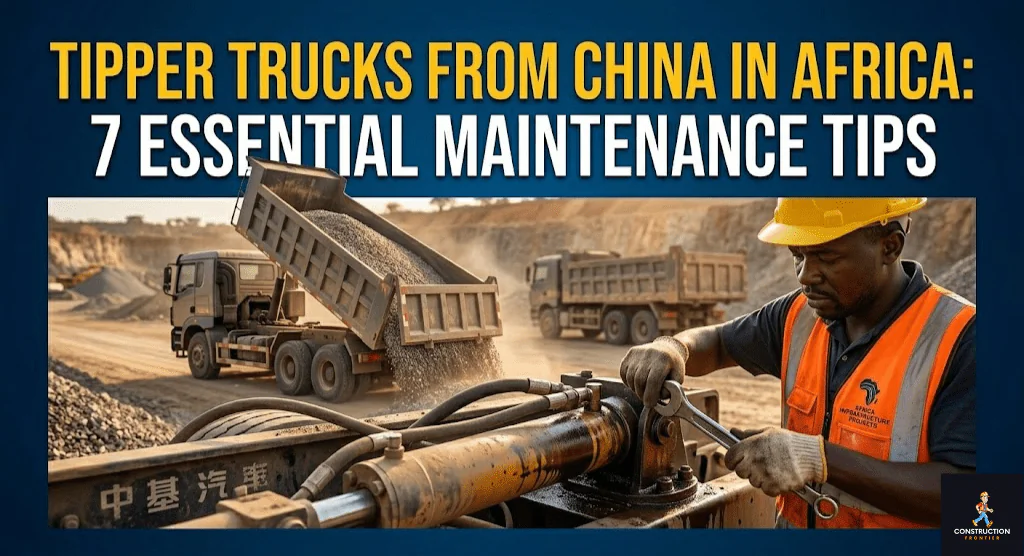
Tipper Trucks from China in Africa: 7 Essential Maintenance Tips
Tipper trucks from China in Africa have become the backbone of construction logistics across roads, mining, and housing projects, but their performance depends heavily on disciplined maintenance strategies. In high-load, high-temperature environments, poorly maintained fleets can lose up to 30% operational efficiency, while structured maintenance programmes can extend asset life by 40–60%.
Technical Snapshot:
- Average utilisation: 70–90% in infrastructure projects.
- Engine service interval: 5,000–10,000 km.
- Hydraulic failure rate (poor maintenance): up to 25% annually.
- Maintenance cost share: 10–15% of asset value/year.
- Downtime cost impact: up to $500–$1,500 per day per truck.
Understanding how to maintain tipper trucks from China in Africa is therefore not a routine task. It is a core operational strategy that directly affects project delivery timelines, contractor profitability, and long-term asset value.
Introduction: Tipper Trucks from China in Africa
Across Africa’s construction landscape, tipper trucks from China in Africa have shifted from being a cost-driven alternative to becoming a strategic asset class. Contractors rely on them for bulk material movement in roadworks, quarry operations, and urban expansion projects.
The rapid expansion of Chinese dump truck fleets reflects affordability, availability, and adaptability. However, these advantages only translate into sustained value when paired with effective tipper truck maintenance in Africa. Without it, even the most robust truck configurations degrade quickly under harsh operating conditions.
Maintenance, therefore, sits at the intersection of engineering discipline and financial performance. For contractors and investors, maintaining Chinese tipper trucks is not optional; it is central to return on investment.
Why Maintenance is Critical for Chinese Tipper Trucks in Africa
Understanding the operational context is essential before implementing any tipper truck maintenance strategy in Africa. The performance and lifecycle of tipper trucks from China in Africa depend on environmental exposure, utilisation intensity, and maintenance discipline. For contractors and fleet managers, maintaining Chinese tipper trucks is not routine servicing; it is an engineering-controlled process that directly determines reliability, cost efficiency, and project delivery timelines.
1. Harsh Operating Conditions
Tipper trucks from China in Africa operate under combined environmental and mechanical stress that accelerates wear far beyond OEM baseline assumptions.
Key stress drivers include:
- Dust and particulate contamination
- Fine dust penetrates intake systems, causing abrasive wear in turbochargers and cylinder liners.
- Increases engine wear rates by 20–35% without high-efficiency filtration.
- High ambient temperatures
- Sustained temperatures above 30°C accelerate oil oxidation.
- Reduces lubricant life by 25–40%, increasing servicing frequency.
- Poor road infrastructure
- Uneven haul roads induce cyclic loading on suspension and chassis.
- It leads to fatigue cracking and misalignment.
- Overloading practices
- Payload exceedance increases stress on axles, brakes, and frames.
- Can reduce structural lifespan by up to 50%.
From a Chinese dump truck maintenance perspective, these factors demand adaptive servicing intervals rather than fixed OEM schedules.
Engineering implication:
- Increase air filter replacement frequency.
- Upgrade to heavy-duty suspension components.
- Conduct chassis inspections at shorter intervals.
2. High Utilisation Rates
Fleet utilisation across construction and mining projects typically reaches 70–85%, with daily operations extending up to 16 hours. This compresses the servicing schedule for tipper trucks in Africa and accelerates cumulative wear.
Key technical impacts:
- Thermal stress accumulation
- Continuous operation limits cooling cycles.
- Increases the degradation of seals, oils, and bearings.
- Hydraulic system fatigue
- High tipping cycles elevate internal pressures.
- Increases seal failure probability by 30–50%.
- Component fatigue
- Bearings and gears undergo repeated stress cycles.
- Leads to micro-cracks and sudden failure.
For maintaining Chinese tipper trucks, high utilisation requires a shift toward condition-based maintenance.
Recommended engineering controls:
- Oil analysis every 250–500 operating hours.
- Thermal monitoring of engines and transmissions.
- Increased hydraulic inspection frequency.
3. Cost of Downtime
Downtime in tipper truck maintenance in Africa directly impacts project economics and operational continuity.
Primary cost drivers:
- Production disruption
- Idle trucks halt material flow in road and concrete operations.
- Revenue loss (mining operations)
- Each idle truck reduces haulage capacity and throughput.
- Labour inefficiency
- Operators and loaders remain idle.
- Contractual penalties
- Delays trigger liquidated damages in infrastructure contracts.
Industry data benchmarks:
- Unplanned downtime contributes 15–20% of total lifecycle cost.
- Preventive maintenance reduces downtime by 30–50%.
- The cost of a major engine failure often exceeds $8,000–$15,000 per truck.
Engineering conclusion:
A structured truck maintenance strategy for construction vehicles is a direct profit protection mechanism, not a cost centre.
3. Preventive vs Reactive Maintenance
The maintenance model adopted, preventative vs reactive maintenance, defines fleet performance outcomes for tipper trucks from China in Africa.
Reactive Maintenance (Failure-Based)
- Repairs occur after breakdown.
- Lower short-term cost.
- High long-term cost due to:
- Major component failures
- Extended downtime
- Emergency repair premiums
Preventive Maintenance (Scheduled)
- Based on mileage, hours, and inspection cycles
- Reduces failure probability by up to 50%
- Extends equipment lifespan by 20–40%
Predictive Maintenance (Advanced Model)
- Uses telematics and diagnostics
- Monitors:
- Engine temperature
- Fuel consumption
- Vibration patterns
- Detects early-stage failures before breakdown
Engineering Comparison: Maintenance Strategies
| Maintenance Type | Failure Risk | Downtime Impact | Cost Efficiency | Suitability |
| Reactive | High | Severe | Low | Small fleets |
| Preventive | Moderate | Controlled | High | Most contractors |
| Predictive | Low | Minimal | Very High | Large fleets |
Key Takeaways for Contractors
- Tipper trucks from China in Africa require customised maintenance strategies aligned to operating conditions.
- High utilisation and harsh environments demand shorter service intervals.
- Preventive and predictive maintenance significantly reduce lifecycle costs
- Effective heavy truck servicing in Africa improves:
- Fleet availability
- Fuel efficiency
- Asset lifespan
From an engineering and investment standpoint, the answer to how to maintain tipper trucks from China in Africa lies in shifting from reactive repairs to structured, data-driven maintenance systems. This transition defines whether fleets operate as cost burdens or high-performing infrastructure assets.
7 Proven Maintenance Strategies for Tipper Trucks from China in Africa
This section outlines practical, engineering-led strategies that define how to maintain tipper trucks from China in Africa. These are not theoretical guidelines; they are field-tested principles used by leading contractors.
Tip 1: Follow a Strict Preventive Maintenance Schedule
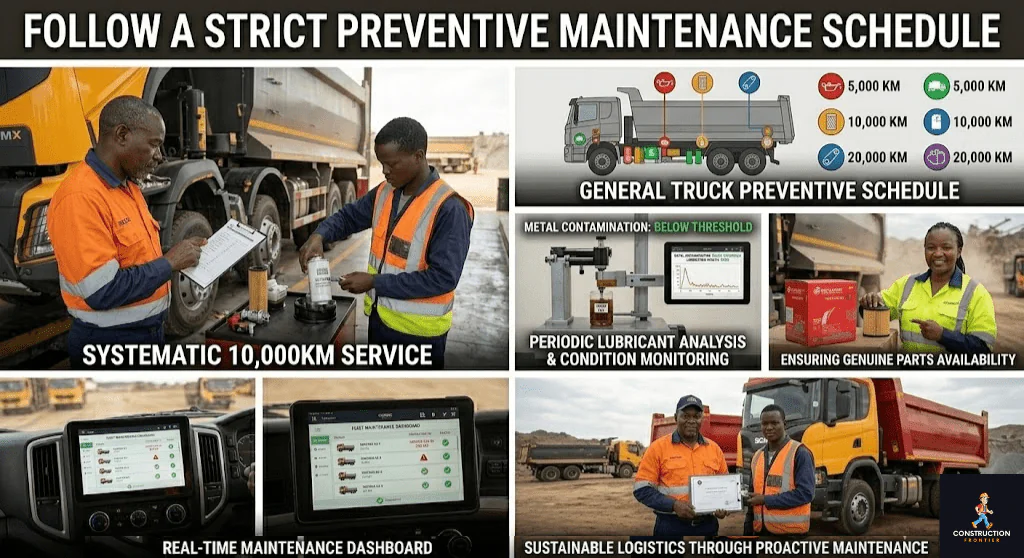
A structured preventive maintenance system is the backbone of effective tipper truck maintenance in Africa, particularly under high utilisation and harsh environmental exposure. Mechanical systems degrade predictably due to lubrication breakdown, contamination, and cyclic loading, making scheduled intervention critical.
From an engineering standpoint, preventive maintenance aligns with reliability-centred maintenance (RCM), where failure modes are identified and mitigated before functional loss occurs. For tipper trucks from China in Africa, this includes oil degradation under thermal stress, filter clogging from dust ingress, and progressive wear in moving components.
A properly designed servicing schedule for tipper trucks in Africa should integrate the following:
- Daily inspections for fluid levels, leaks, and abnormal vibrations.
- Weekly checks on hydraulics, brakes, and tyre condition.
- Monthly structural inspections covering chassis integrity and suspension.
Service intervals must reflect operating conditions. Engine oil changes at 5,000–10,000 km correspond to viscosity breakdown thresholds under high heat, while filter replacement cycles depend on particulate load in dusty environments. Transmission fluids degrade based on torque cycles and must be monitored accordingly.
For contractors, disciplined scheduling reduces unplanned downtime by up to 40% and increases fleet availability beyond 85%. These outcomes position preventive maintenance as the most effective of all maintenance tips for Chinese dump trucks, directly linking operational reliability to financial performance.
Maintenance Performance Benchmarks
A structured preventive maintenance system reduces systemic failure risks across all subsystems in tipper truck maintenance in Africa.
| Parameter | Preventive Maintenance | Reactive Maintenance |
| Failure Rate (annual) | 10–15% | 25–40% |
| MTBF (Engine-related faults) | 1,200–1,800 hrs | 600–900 hrs |
| Downtime per month | 2–4 days | 6–10 days |
| Maintenance Cost Impact | -20% to -30% | +25% to +50% |
| Fleet Availability | 80–90% | 60–70% |
Preventive systems significantly improve reliability by stabilising wear rates and reducing unexpected failures across tipper trucks from China in Africa.
Tip 2: Maintain the Engine and Fuel System
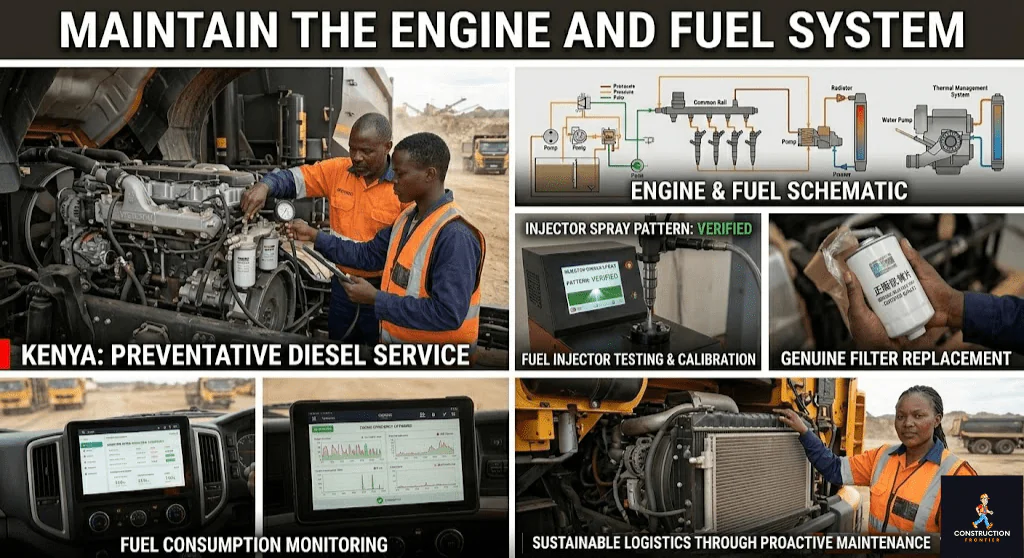
The engine is the primary energy conversion system and the most capital-intensive component in tipper trucks from China in Africa, often representing over one-third of asset value. Its efficiency depends on combustion stability, fuel quality, and thermal management.
Diesel engines operate at high compression ratios, making them sensitive to fuel impurities. In African markets, inconsistent fuel quality introduces contaminants such as sulphur, water, and particulates. These disrupt atomisation, reduce combustion efficiency, and accelerate wear in injectors and pumps – key concerns in Chinese dump truck maintenance.
Common engine platforms such as Weichai, Cummins, and Yuchai each have specific maintenance tolerances. Regardless of brand, degradation mechanisms remain consistent:
- Carbon buildup from incomplete combustion.
- Injector wear due to abrasive particles.
- Lubrication breakdown under high thermal loads.
Advanced maintenance strategies include installing dual-stage fuel filtration systems, integrating water separators, and conducting periodic injector calibration. Oil analysis using spectrometric testing can detect early-stage wear metals, enabling predictive maintenance.
When properly maintained, engines deliver 10–15% better fuel efficiency and extended overhaul intervals. For contractors, engine-focused tipper truck maintenance in Africa significantly reduces lifecycle costs while improving operational consistency in high-demand construction environments.
Engine System Performance Data
Engine and fuel system maintenance directly influences efficiency, emissions, and lifecycle cost in Chinese dump truck maintenance.
| Parameter | Well-Maintained Engine | Poorly Maintained Engine |
| Failure Rate (injectors/fuel system) | 8–12% | 20–35% |
| MTBF (Engine overhaul) | 8,000–12,000 hrs | 4,000–6,000 hrs |
| Fuel Efficiency Loss | <5% | 10–20% |
| Annual Repair Cost | $2,000–$4,000 | $5,000–$10,000 |
| Downtime per failure | 1–3 days | 5–10 days |
Fuel contamination remains a dominant failure driver in tipper truck maintenance in Africa, particularly in remote regions.
Tip 3: Inspect and Maintain the Hydraulic Tipping System
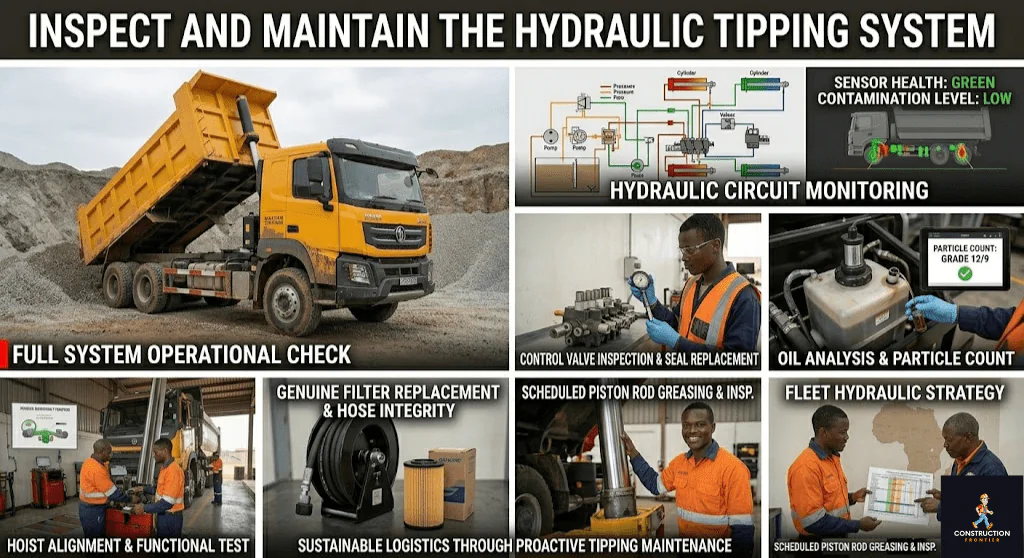
The hydraulic system is the functional core of tipping operations and one of the most failure-prone subsystems in tipper trucks from China in Africa. It operates under high pressures, typically exceeding 200 bar, making it highly sensitive to contamination and seal degradation.
From a fluid mechanics perspective, hydraulic performance depends on pressure stability, fluid viscosity, and system cleanliness. Even minor contamination can cause abrasive wear in pumps and cylinders, leading to efficiency losses and eventual failure, a common pattern in issues with Chinese tipper trucks in Africa.
Typical failure modes include:
- Cavitation caused by air ingress.
- Seal failure due to thermal cycling.
- Hose ruptures under pressure fluctuations.
Engineering controls must focus on maintaining fluid integrity. This involves using ISO-standard clean hydraulic oil, replacing filters regularly, and monitoring viscosity changes. Pressure testing can identify inefficiencies before they escalate into operational failures.
Operationally, hydraulic inefficiencies increase cycle times, reducing loading productivity and increasing fuel consumption due to prolonged idling. For contractors managing high-volume material movement, maintaining hydraulic systems is essential for sustaining throughput and minimising downtime in truck maintenance and construction vehicles.
Hydraulic System Reliability Data
Hydraulic systems are high-risk due to pressure sensitivity and contamination exposure in tipper trucks from China in Africa.
| Parameter | Maintained System | Poorly Maintained System |
| Failure Rate (annual) | 10–15% | 25–30% |
| MTBF (Hydraulic system) | 1,000–1,500 hrs | 500–800 hrs |
| Average Repair Cost | $800–$2,500 | $3,000–$6,000 |
| Downtime per failure | 1–2 days | 4–7 days |
| Productivity Loss | <5% | 15–25% |
Hydraulic inefficiencies significantly affect loading cycles, making this a critical focus area in maintenance tips for Chinese dump trucks.
Tip 4: Protect the Chassis and Suspension System
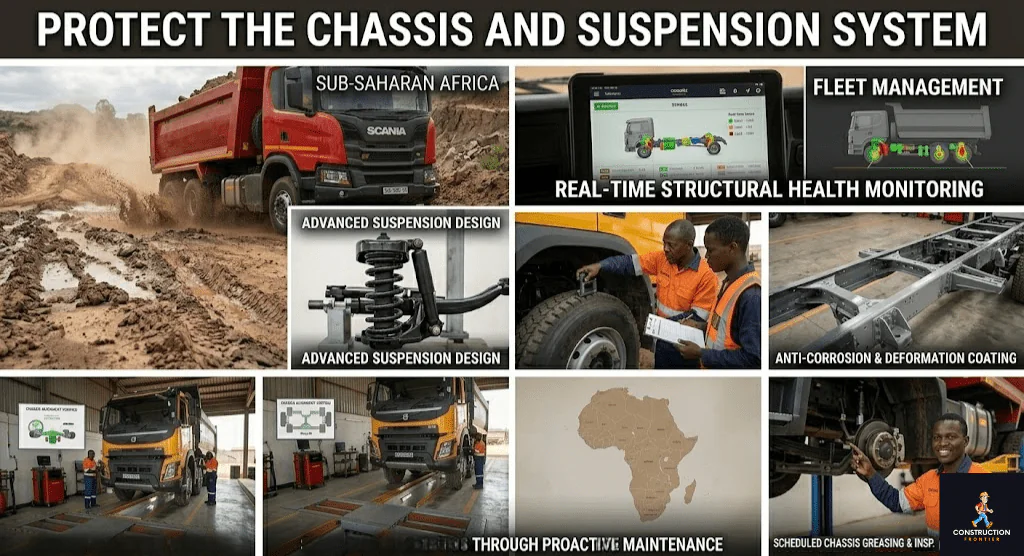
The chassis and suspension system form the structural backbone of tipper trucks from China in Africa, bearing dynamic loads under highly variable terrain conditions. These components are subject to fatigue, deformation, and environmental degradation over time.
From a structural engineering perspective, repeated loading cycles generate stress concentrations, particularly at joints and weld points. Overloading exacerbates this by inducing plastic deformation and accelerating crack propagation, which is one of the most critical risks in heavy truck servicing in Africa.
Suspension systems, including leaf springs and shock absorbers, absorb impact forces from uneven terrain. Continuous exposure to rough roads leads to fatigue failure, misalignment, and reduced load stability.
Preventive measures include:
- Routine non-destructive testing (NDT) for crack detection.
- Reinforcement of high-stress parts such as cross-members.
- Application of anti-corrosion coatings to mitigate environmental damage.
Maintaining structural integrity ensures load stability, reduces the risk of catastrophic failure, and extends service life beyond typical replacement cycles. For contractors, this aspect of tipper truck maintenance in Africa directly influences safety, durability, and long-term asset performance.
Chassis & Suspension Performance Data
Structural durability is essential for long-term performance in tipper truck maintenance in Africa, especially under overloading and rough terrain.
| Parameter | Maintained Structure | Poorly Maintained Structure |
| Failure Rate (structural issues) | 5–10% | 15–25% |
| MTBF (major structural repair) | 3–5 years | 1–2 years |
| Repair Cost (chassis cracks) | $1,000–$3,000 | $4,000–$10,000 |
| Downtime per failure | 2–5 days | 7–14 days |
| Safety Risk Level | Low | High |
Structural failures are among the most expensive issues in heavy truck servicing in Africa, often requiring extended downtime.
Tip 5: Monitor Tyres and Braking System
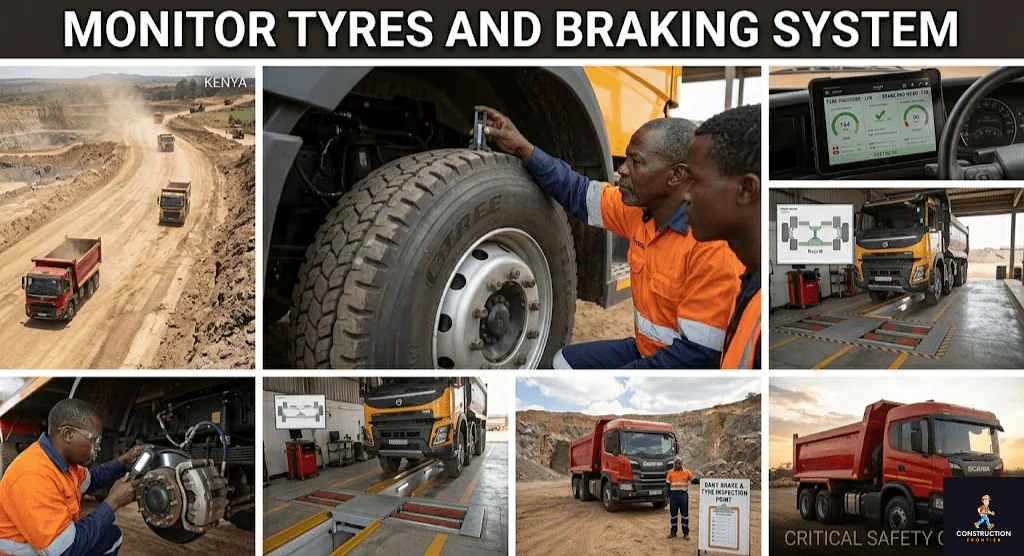
Tyres and braking systems are critical safety and efficiency components in tipper trucks from China in Africa, directly affecting operational cost and risk exposure.
Tyre performance depends on load distribution, alignment, and inflation pressure. Uneven wear patterns indicate underlying issues such as suspension misalignment or overloading. Increased rolling resistance from poorly maintained tyres can raise fuel consumption by up to 10%, making tyre management a key element of truck maintenance for construction vehicles.
Brake systems, typically air-based, rely on pressure stability and friction efficiency. High-load operations generate significant heat, leading to brake fade if not properly managed. This reduces stopping power and increases accident risk.
Maintenance strategies include the following:
- Maintaining optimal tyre pressure based on load conditions.
- Conducting regular wheel alignment checks.
- Inspecting brake pads, discs, and air systems for wear and leaks.
From an engineering standpoint, tyre and brake systems must be treated as integrated safety systems. Proper maintenance reduces accident probability, improves fuel efficiency, and ensures compliance with operational safety standards in tipper truck maintenance in Africa.
Tyre & Brake System Data
Tyres and brakes directly influence safety, fuel efficiency, and operating cost in truck maintenance and construction vehicles.
| Parameter | Properly Maintained | Poorly Maintained |
| Tyre Failure Rate | 10–15% | 25–40% |
| MTBF (Tyre replacement cycle) | 60,000–80,000 km | 30,000–50,000 km |
| Brake Failure Rate | 5–10% | 15–25% |
| Fuel Efficiency Impact | Baseline | +5–10% fuel consumption |
| Accident Risk | Low | High |
Tyre mismanagement alone can increase total operating costs significantly in tipper trucks from China in Africa.
Tip 6: Ensure Availability of Genuine Spare Parts
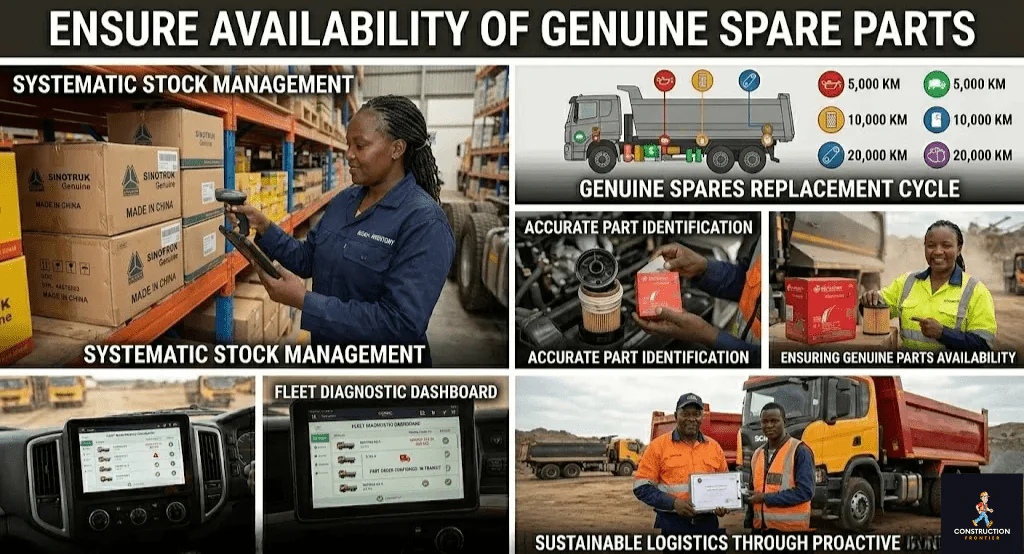
Spare parts management is a critical operational factor in maintaining Chinese tipper trucks, particularly in regions where supply chains are inconsistent or fragmented.
From a materials engineering perspective, counterfeit parts often fail due to inferior metallurgy, poor manufacturing tolerances, and a lack of quality control. These deficiencies increase wear rates and introduce systemic risk across interconnected components, key contributors to common issues with Chinese tipper trucks in Africa.
A structured supply chain strategy for heavy truck servicing in Africa should include:
- Procurement from OEM-authorised dealers in Africa.
- Standardisation of parts across fleet models.
- Strategic stocking of high-failure components.
Inventory optimisation can be achieved through ABC classification, where critical components such as filters, seals, and brake parts are prioritised. Lead-time reduction for essential parts directly minimises downtime.
Operationally, access to genuine spare parts improves maintenance efficiency, reduces failure frequency, and ensures compatibility with existing systems. For contractors managing multiple units, this approach enhances reliability and supports scalable fleet operations.
Spare Parts Reliability Data
Spare parts quality directly affects system reliability in maintaining Chinese tipper trucks.
| Parameter | Genuine Parts | Counterfeit Parts |
| Failure Rate | 5–10% | 20–35% |
| MTBF (component lifespan) | 1.5x–2x longer | Reduced by 40–60% |
| Maintenance Cost Impact | Baseline | +30–70% |
| Downtime Frequency | Low | High |
| System Compatibility | High | Inconsistent |
Poor-quality components significantly increase failure probability in common issues with Chinese tipper trucks in Africa.
Tip 7: Train Operators and Drivers Properly
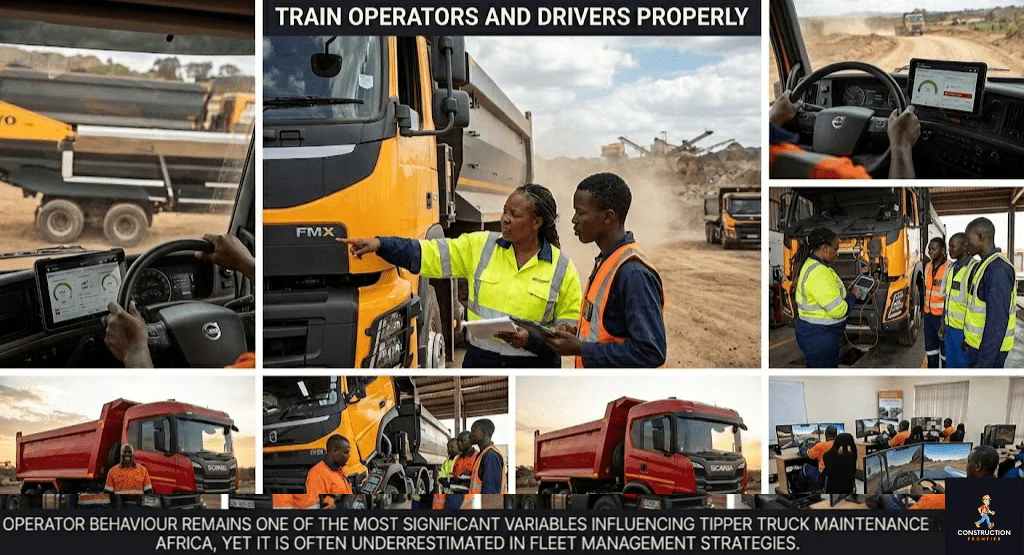
Operator behaviour remains one of the most significant variables influencing tipper truck maintenance in Africa, yet it is often underestimated in fleet management strategies.
From a mechanical standpoint, improper operation accelerates wear in key components:
- Incorrect gear selection increases gearbox stress.
- Over-revving causes engine overheating.
- Poor loading practices lead to uneven chassis stress.
These factors contribute significantly to maintenance costs, often increasing them by 15–25% in poorly managed fleets.
Structured training programmes should focus on:
- Optimal gear usage based on load and terrain.
- Controlled acceleration and braking techniques.
- Proper load distribution to minimise structural stress.
Drivers should also follow daily tipper truck inspection routines, identifying issues such as leaks, tyre wear, and abnormal sounds before they escalate. This aligns with best practices in how to maintain tipper trucks from China in Africa, where early detection plays a critical role in failure prevention.
Well-trained operators improve fuel efficiency, extend component lifespan, and reduce breakdown frequency. For contractors, investing in operator training delivers measurable returns in both performance and cost control, making it a core pillar of effective Chinese dump truck maintenance.
Operator Impact Performance Data
Operator behaviour is a key variable influencing wear rates and system longevity in tipper truck maintenance in Africa.
| Parameter | Trained Operators | Untrained Operators |
| Failure Rate (driver-induced) | 5–10% | 20–30% |
| MTBF (gearbox/clutch systems) | 3,000–5,000 hrs | 1,500–2,500 hrs |
| Fuel Efficiency | Optimised | +10–15% fuel waste |
| Maintenance Cost Impact | -10–20% | +20–30% |
| Accident Rate | Low | Moderate–High |
Driver behaviour significantly affects long-term performance in maintaining tipper trucks from China in Africa.
Further Reading: 22 Best Chinese Tipper Truck Dealers in Africa: Verified List of Trusted Suppliers
Common Problems with Tipper Trucks from China in Africa
Operational data across fleets shows that tipper trucks from China in Africa exhibit predictable failure modes tied to environment, loading patterns, and maintenance discipline. Understanding these common issues with Chinese tipper trucks in Africa allows engineers to design targeted interventions with measurable reliability gains.
1. Engine Overheating and Thermal Stress
Engine overheating remains one of the highest-frequency failure modes in Chinese dump truck maintenance, particularly in high-ambient regions where temperatures exceed 35°C and cooling systems operate near design limits. Field studies across Sub-Saharan haulage fleets indicate that overheating contributes to 18–25% of unplanned downtime events.
The root causes are rarely singular. Dust ingress reduces radiator efficiency by up to 30%, while degraded coolant loses thermal transfer capacity. In tipper truck maintenance in Africa, improper coolant ratios and delayed replacement cycles accelerate scale formation inside cooling channels, reducing heat dissipation.
From an engineering standpoint, sustained overheating leads to:
- Cylinder head warping above 120°C operating thresholds.
- Lubrication breakdown, increasing wear rates by 2–3 times.
- Turbocharger inefficiency due to elevated exhaust temperatures.
A structured approach to how to maintain tipper trucks from China in Africa must prioritise cooling system performance as a core reliability variable rather than a routine check item.
2. Hydraulic System Failures
Hydraulic system failures represent the most critical operational risk in tipper trucks from China in Africa, directly affecting load discharge capability. Hydraulic-related faults account for 20–30% of functional failures in dump operations.
The failure mechanism is typically contamination-driven. Fine particulates entering the hydraulic fluid increase internal wear rates in pumps and cylinders. Once contamination exceeds ISO 4406:1999 cleanliness thresholds, seal degradation accelerates, leading to leakage and pressure loss.
Engineering implications include the following:
- Reduced lifting force due to pressure drops below 180–220 bar operating range.
- Cylinder scoring and seal failure.
- Increased cycle time, reducing productivity by up to 15%.
Effective maintenance tips for Chinese dump trucks must incorporate fluid analysis and contamination control as core system management practices, not optional diagnostics.
3. Electrical System Degradation
Electrical faults in construction tipper trucks often emerge gradually but result in high downtime when failures occur. Wiring harness degradation, connector corrosion, and battery inefficiencies are amplified by humidity, dust, and vibration.
Electrical issues contribute to 10–18% of service incidents in heavy truck servicing in Africa. The most common failure points include:
- Starter motor circuits.
- Sensor wiring for engine control units.
- Lighting and safety systems.
From a systems perspective, voltage instability can disrupt ECU-controlled fuel injection, reducing engine efficiency and increasing fuel consumption by 5–10%. In poorly maintained systems, intermittent faults are difficult to diagnose, increasing repair time.
4. Chassis Fatigue and Structural Cracking
Chassis failure represents a high-severity, low-frequency risk with significant cost implications in tipper truck maintenance in Africa. Overloading beyond the rated payload capacity introduces cyclic stress beyond design fatigue limits.
Engineering analysis shows:
- Repeated overloading increases stress cycles, reducing fatigue life by up to 40%.
- Micro-cracks propagate under vibration, eventually leading to structural failure.
- Weld repairs, if poorly executed, introduce new stress concentration points.
In common structural issues with Chinese tipper trucks in Africa, chassis cracks are often detected late due to a lack of routine non-destructive inspection methods, as we had explained in Tip 4. This highlights the need for structured inspection protocols aligned with the servicing schedules for tipper trucks in Africa.
Tipper Truck Maintenance Checklist for Africa
A structured maintenance framework is essential for optimising tipper trucks from China in Africa. The checklist below reflects a field-tested servicing schedule for tipper trucks in Africa, aligned with engineering reliability standards.
| Component | Check Frequency | Key Action | Failure Risk if Ignored | MTBF Impact |
| Engine | Daily | Check oil, coolant, and leaks | Overheating, seizure | ↓ MTBF by 20–30% |
| Hydraulics | Weekly | Inspect hoses, pressure, and fluid | Lifting failure | ↓ MTBF by 25% |
| Tyres | Daily | Pressure, tread wear | Blowouts, instability | ↓ MTBF by 15% |
| Brakes | Weekly | Air pressure, pad wear | Safety risk, accidents | ↓ MTBF by 20% |
| Chassis | Monthly | Crack inspection, weld checks | Structural failure | ↓ MTBF by 35% |
This checklist supports maintaining Chinese tipper trucks under high-utilisation conditions, ensuring that failure risks are systematically reduced.
Cost of Maintaining Chinese Tipper Trucks in Africa
Maintenance cost structures directly influence the lifecycle economics of tipper trucks from China in Africa. For contractors and investors, understanding cost drivers is central to fleet optimisation.
Average Maintenance Costs
Empirical data across African construction fleets shows that the cost of maintaining tipper trucks in Africa typically ranges between the following:
- $3,000–$8,000 annually per truck under standard utilisation (70–85%).
- Up to $10,000+ for high-intensity mining operations.
These costs include:
- Routine servicing.
- Spare parts replacement.
- Labour and diagnostics.
From a cost modelling perspective, maintenance represents 10–15% of total operating costs, aligning with global heavy vehicle benchmarks.
Cost Comparison: Chinese vs European Trucks
In heavy truck servicing in Africa, Chinese trucks maintain a cost advantage due to simpler mechanical systems and wider parts availability.
| Cost Category | Chinese Trucks | European Trucks |
| Annual Maintenance | $3,000–$8,000 | $6,000–$12,000 |
| Parts Cost | Low–Moderate | High |
| Labour Complexity | Low | High |
| Diagnostic Cost | Minimal | Advanced tools required |
This 20–40% cost advantage explains the dominance of tipper trucks from China in Africa in cost-sensitive markets.
Cost Reduction Strategies
Engineering-led cost optimisation in truck maintenance and construction vehicles focuses on reducing variability rather than simply cutting expenses.
Key strategies include:
- Preventive maintenance aligned with OEM intervals.
- Bulk procurement of critical spare parts to reduce unit cost.
- Fleet standardisation to simplify inventory and training.
These approaches improve predictability in the cost of maintaining tipper trucks in Africa, enabling better financial planning.
Further Reading: 10 Powerful Insights: OEM vs Third-Party Maintenance Explained for Smarter Equipment Management
Tipper Trucks Maintenance: Africa and Emerging Markets Focus
Maintenance strategies for tipper trucks from China in Africa must align with operational realities across emerging markets.
Maintenance Challenges in Remote Areas
Remote project sites introduce constraints that directly impact Chinese dump truck maintenance:
- Limited access to service centres.
- Delayed spare parts delivery (up to 2–4 weeks).
- Reliance on on-site mechanical teams.
This increases the importance of self-sufficient maintenance systems and mobile workshops.
Growing Dealer Support Networks
The expansion of authorised service networks is transforming heavy truck servicing in Africa. OEM-backed Chinese tipper truck dealers now provide the following:
- Regional parts distribution hubs.
- Field service teams.
- Technical training programmes.
This development reduces downtime and improves reliability for tipper trucks from China in Africa.
Fleet Optimisation Opportunities
Digital transformation is reshaping the maintenance of Chinese tipper trucks through the following:
- Telematics systems track engine performance and fuel usage.
- Predictive maintenance models identify failure patterns.
- Fleet management software optimises utilisation rates.
These tools enhance decision-making and reduce lifecycle costs, particularly for large contractor fleets.
Future Trends in Construction Truck Maintenance
The future of tipper truck maintenance in Africa, whether OEM or third-party maintenance, is shifting toward data-driven, predictive systems that reduce uncertainty in fleet operations.
Telematics and Predictive Maintenance
Telematics systems enable real-time monitoring of:
- Engine temperature
- Fuel consumption
- Hydraulic pressure
By analysing this data, predictive models can forecast failures before they occur, reducing downtime by up to 30–50%.
AI Diagnostics and Automation
AI-driven diagnostics are emerging as a key component of truck maintenance and construction vehicles, allowing the following:
- Automated fault detection.
- Root cause analysis.
- Maintenance scheduling optimisation.
These systems reduce reliance on manual inspection and improve accuracy in how to maintain tipper trucks from China in Africa.
Electrification and System Simplification
While still emerging in Africa, electrification trends will eventually impact heavy truck servicing in Africa by:
- Reducing mechanical complexity.
- Lowering maintenance frequency.
- Eliminating traditional engine-related failures.
However, hybrid adoption will likely dominate in the near term due to infrastructure constraints.
Engineering Perspective on Essential Tipper Truck Maintenance Tips
Across all sections, the operational reality is clear. Brand new and used tipper trucks from China in Africa deliver strong economic value, but only when supported by structured maintenance systems grounded in engineering principles.
Failure patterns are predictable. Costs are manageable. Performance outcomes are controllable.
Contractors who integrate maintaining Chinese tipper trucks into a data-driven maintenance framework consistently achieve:
- Higher utilisation rates (above 80%).
- Lower lifecycle costs.
- Reduced downtime risk.
In contrast, reactive approaches lead to exponential cost escalation and asset underperformance.
For decision-makers, the focus should shift from maintenance as an expense to maintenance as a strategic asset management function within modern construction logistics.
Further Reading: Used Tipper Trucks from China: 6 Essential and Profitable Buying Tips
Conclusion: Maximising Performance and Lifecycle Value
Tipper trucks from China in Africa have moved beyond their original positioning as low-cost alternatives. Today, they sit at the centre of infrastructure delivery across emerging markets. However, their true value only emerges when supported by disciplined maintenance systems. Contractors who implement structured preventive strategies consistently achieve higher utilisation rates, lower downtime, and stronger financial returns.
Looking ahead, maintenance will increasingly become a data-driven discipline. The integration of telematics, predictive analytics, and digital fleet management will transform how operators approach Chinese dump truck maintenance. For investors and contractors, the strategic focus must shift from short-term cost savings to lifecycle optimisation. Those who align maintenance practices with long-term asset performance will define the next phase of competitive advantage in Africa’s construction sector.
Frequently Asked Questions (FAQs)
1. How often should Chinese tipper trucks be serviced?
Every 5,000–10,000 km. For heavy mining or dusty off-road conditions, stick to the 5,000 km interval to prevent engine clogging; for urban construction, 10,000 km is standard.
2. What is the biggest maintenance issue with Chinese tipper trucks?
Hydraulic system failures (seals and pumps) and accelerated engine wear. These usually stem from using contaminated hydraulic oil or poor-quality air filters in dusty environments.
3. Are Chinese tipper trucks easy to maintain in Africa?
Yes. Their mechanical simplicity (less complex electronics) makes them easier for local technicians to repair. Additionally, authorised dealers like CFAO Group and TransAfrica Motors now maintain massive local spare parts inventories.
4. How can I reduce maintenance costs?
Stick strictly to preventive maintenance schedules, use genuine parts from authorised dealers to avoid engine damage, and train operators on proper gear shifting and PTO (tipping) engagement.
Explore Construction Equipment Maintenance Insights
Stay ahead with expert insights on maintaining tipper trucks from China in Africa, fleet optimisation strategies, and equipment lifecycle management at Construction Frontier.