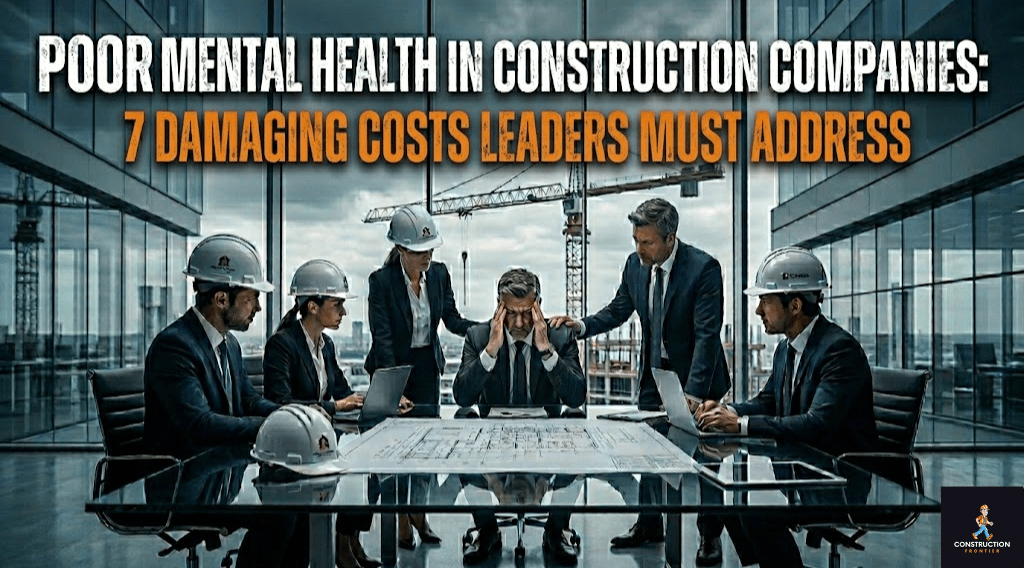
Poor Mental Health in Construction Companies: 7 Damaging Costs Leaders Must Address
Poor mental health in construction companies is no longer a peripheral welfare concern; it is a measurable business liability. Construction firms across the globe are absorbing hundreds of millions in avoidable costs tied directly to psychological distress in their workforces, from escalating absenteeism and safety failures to project delays and talent haemorrhage. With 83% of construction workers reporting a mental health issue at some point in their career, and 64% experiencing anxiety or depression in the past 12 months alone, the financial case for intervention has become impossible to dismiss.
Technical Snapshot: The Business Cost of Poor Mental Health in Construction
| Indicator | Data Point |
| Construction workers reporting anxiety or depression (2025) | 64% (up from 54% in 2024) |
| Annual US economic cost of poor mental health | USD 193.2 billion |
| Global annual productivity loss from depression & anxiety | USD 1 trillion |
| Annual cost per worker with untreated substance use disorder | USD 8,591 |
| Construction suicide rate vs. general male population | 75% higher (CDC) |
| The cost of presenteeism to UK employers from mental ill-health | GBP 28 billion/year |
| Workers without accessible mental health support (construction) | 75% (Gallup) |
| Productivity gain from prioritising mental health | +23% (Deloitte) |
Poor mental health in construction companies generates measurable losses across every performance metric a firm tracks. The seven costs below translate that exposure into financial terms that leaders can act on.
Introduction: The Business Cost Construction Leaders Are Still Underestimating
Construction remains the global economy’s most physically visible industry. Steel rises, tunnels bore through rock, and bridges stretch across rivers that once separated nations. Behind every milestone, workers absorb psychological pressures that accumulate quietly until they do not. The full costs of poor mental health in construction companies extend far beyond individual suffering; they sit inside project financials, safety incident reports, insurance premiums, and retention statistics. The question of how mental health affects construction productivity, safety, and workforce stability now carries the same commercial weight as any other project input cost.
The wider implications of this crisis are documented in “Unearthing Construction’s Biggest Killer: Mental Health“, a pillar resource mapping the full scope of psychological risk across the industry. This article translates that scope into seven specific financial and operational damages that compound every quarter a firm delays action.
1. Productivity Collapse: How Mental Health Affects Construction Output
Productivity in construction is already under pressure from labour shortages, project complexity, and rising material costs. Poor mental health in construction companies adds a parallel drain that operates beneath the surface, reducing output without appearing clearly in any single line item. Workers managing anxiety, depression, or chronic stress complete tasks more slowly, make more calculation errors, and struggle to sustain the decision quality that complex construction demands.
The mechanism is physiological as much as behavioural. Cortisol elevation from sustained stress impairs working memory and executive function, directly degrading the cognitive performance that engineers, site supervisors, and project managers rely on. Presenteeism, where workers show up but function at reduced capacity, consistently costs more than absence. Studies show workers with positive mental health outperform distressed colleagues by 12%, and organisations that invest in mental health programmes see a 23% gain in construction company productivity.
For a mid-size firm running a project team of 50 people, a 12% productivity gap across a percentage of that workforce adds weeks to programme schedules. Delays carry compounding costs: penalty clauses, extended equipment hire, prolonged site overheads, and loss of reputation with clients. How mental health affects construction productivity is not a soft question; it converts directly into hard schedule and margin outcomes. Construction company productivity, once eroded by psychological distress, does not recover without deliberate intervention.
Construction burnout is a primary driver of this output erosion, compressing the cognitive resources workers bring to each shift. The relationship between overextension and declining performance is examined in our detailed analysis of construction burnout cases and prevention strategies for workers.
2. Absenteeism and the Hidden Payroll Drain
Unplanned absence is one of the most quantifiable costs of poor mental health in construction companies, yet most firms track it only as a time-keeping issue rather than a mental health signal. Mental health conditions are among the leading drivers of unplanned sick leave across all industries, and construction workers experience them at rates that consistently exceed those of other sectors.
Gallup estimates each missed workday costs an employer approximately USD 340 for a full-time employee. In the UK, mental health conditions account for roughly 70 million sick days annually across industries, generating losses between GBP 70 billion and GBP 100 billion per year. In construction specifically, close to 45% of workers in construction and engineering take time off owing to poor mental wellbeing. Approximately 30% of those workers choose to use annual leave rather than report the true reason, masking the scale of the problem from management data.
The absenteeism cost compounds when it is not addressed at the source. A crew member absent due to unmanaged anxiety requires cover, redistributes workload onto colleagues, disrupts the sequencing of interdependent tasks, and often returns before they are ready, cycling back into absence within weeks. Construction employee stress, when chronic and untreated, produces this cycle repeatedly. According to World Economic Forum research, firms that implement mental health initiatives reduce absenteeism rates by 25% and decrease presenteeism by 40%.
Long working hours, a sector norm, directly fuel the mental health challenges that produce absenteeism. The evidence for this relationship is detailed in long working hours in construction, which quantifies the exposure thresholds at which absence risk accelerates.
3. Safety Incidents and the Cost of Impaired Judgement on Site
Construction is already the most dangerous major industry by fatality rate. Mental health challenges in construction magnify that risk in ways that conventional safety management systems rarely capture. A worker managing untreated depression loses the attentional bandwidth to consistently identify hazards. A worker under acute anxiety makes faster, less considered decisions under time pressure. A worker in psychological distress is statistically more than twice as likely to suffer a workplace injury as a counterpart in good mental health. These mental health challenges in construction represent a systemic safety governance gap that most site management frameworks do not yet address.
The causal pathway is direct. Following a workplace fatality, 26.8% of directly exposed colleagues show PTSD symptoms within one month, including depressed mood and withdrawal from work engagement. Distressed workers demonstrate measurably worse attitudes toward safety, increasing the probability of further incidents. In this way, a single serious event generates a psychological chain reaction that elevates site risk across the entire team.
The financial consequence is severe. According to the Workplace Safety and Insurance Board, the average cost of one lost-time construction injury is USD 35,000, with many exceeding that figure substantially once litigation, medical expenses, and compensation are factored in. Workers’ compensation claims represent over 70% of all construction insurance claims, and a single injury claim can drive insurance rate increases that persist for years. Industry data places workplace injury-related costs at 6 to 9% of total construction project expenditure, a figure that rises when the workforce is managing high levels of mental health issues in construction workplaces.
Mental Health in Construction: Risks and Safety Consequences
| Mental Health Condition | Safety-Relevant Impact | Measurable Consequence |
| Depression | Reduced attention & slower hazard recognition | Increased near-misses and struck-by incidents |
| Anxiety | Impulsive decisions under time pressure | Higher fall and equipment-contact risks |
| Chronic stress | Cognitive overload, reduced working memory | Errors in calculations and sequencing |
| Substance use disorder | Coordination and judgement impairment | 19% prevalence; USD 8,591/worker/year cost |
| PTSD (post-incident) | Disengagement and avoidance behaviours | Secondary accidents and absenteeism surge |
4. Workforce Turnover: Losing Skilled Labour to Avoidable Exits
According to the Associated Builders and Contractors, the construction industry enters 2026 still trying to find nearly 454,000 additional workers beyond normal hiring requirements. Against that backdrop, any turnover driven by avoidable mental health failure is doubly costly: it removes trained, experienced people from a market that cannot replace them quickly enough, while simultaneously demanding significant recruitment and onboarding spend. The costs of poor mental health in construction companies are sharpest precisely where workforce scarcity is greatest.
The link between poor mental health and workforce departure is direct and well-documented. Construction workforce wellbeing shapes retention decisions more than many leaders assume. A Randstad study found 77% of workers weigh a company’s mental health support when evaluating job offers. Close to half of construction workers report finding mental health difficult to discuss within the industry culture, and many resolve that discomfort by leaving. Construction employee stress, stigmatised rather than managed, is therefore not just a welfare problem; it is a structural driver of the sector’s most persistent operational challenge.
Replacement costs for construction roles are substantial. Onboarding a new employee costs between 10% and 30% of their annual salary, depending on the role and specialist skill requirements. For a senior site engineer or project manager earning GBP 70,000, that translates to GBP 7,000 to GBP 21,000 per departure before accounting for the productivity gap during the transition period. UK data shows the cost of staff turnover driven by mental health increased over 150% in three years, rising from GBP 8.6 billion in 2019 to GBP 22.4 billion in 2021 across all sectors.
The financial stress that workers absorb on projects under budget and schedule pressure is a documented trigger for exits. Our article on financial stress in construction projects examines how project-level financial dynamics translate into individual psychological strain and workforce instability.
Further Reading: Financial Stress in Construction Projects: 7 Alarming Effects on Worker Wellbeing
5. Recruitment Damage: When Poor Culture Becomes a Barrier to Entry
Construction workforce wellbeing not only affects those already on a firm’s books, but it also shapes the company’s ability to attract talent from outside. In a sector already struggling to recruit younger professionals and women into the trades, a reputation for dismissing mental health issues in construction workplaces becomes a structural competitive disadvantage. We found that 92% of construction firms report difficulty finding qualified workers. Firms that do not address construction employee stress visibly and credibly operate with a narrowed talent pool from the outset.
The demographic challenge intensifies this dynamic. Women represent around 11.2% of the US construction workforce, and research consistently links minority status on construction sites to elevated burnout rates and adverse mental health outcomes, which suppress recruitment from this talent pool. Younger professionals, whose career choices place strong weight on employer values around wellbeing, are disproportionately discouraged by cultures that stigmatise mental health disclosure. The industry cannot close its skills gap while simultaneously maintaining the conditions that drive prospective workers elsewhere.
Firms that invest in transparent mental health policies, employee assistance programmes, and management training for mental health awareness acquire a measurable recruitment advantage. They appear on industry shortlists of preferred employers, generate stronger referral pipelines from existing employees, and convert offers at higher rates.
Reducing mental health stigma in construction companies is not simply an ethical position; it is a talent acquisition strategy in a market where qualified workers are choosing between employers on exactly these criteria. The cost of poor mental health in construction companies in this dimension is an opportunity cost: the value of talent that firms with better cultures capture instead. Reducing mental health risks in construction firms produces a compounding advantage that no recruitment campaign can replicate.
6. Project Delays and the Compounding Cost of Reduced Decision Quality
Construction project delivery depends on decision-making quality at every level, from a labourer judging safe load placement to a project director committing to programme milestones under client pressure. Mental health challenges in construction degrade decision quality at scale when they are widespread and unmanaged. How mental health affects construction productivity in this domain is visible in rework rates, instruction errors, and the number of design queries that surface on site rather than in preconstruction review. The resulting project delays generate costs that sit in penalty clauses, client relationship damage, and extended overhead recovery periods.
According to the American Psychiatric Association, employees experiencing unresolved depression suffer a 35% drop in productivity, costing US organisations USD 210.5 billion annually across absenteeism, reduced output, and medical expenses. In construction, where schedule slippage on one trade package cascades into delays for every subsequent trade, that individual productivity deficit becomes a programme management crisis. A project manager unable to sustain full cognitive capacity miscommunicates specifications, misses programme conflicts, and produces risk assessments that underestimate exposure.
The 2024 data is instructive: 53% of US construction firms reported project delays or abandonments attributable to rising costs and operational pressures, and mental health issues in construction workplaces sit within that broader picture of reduced organisational resilience. Reducing mental health risks in construction firms directly improves the decision-making environment on which schedule adherence depends.
The downstream consequences of these delays and impairments on project economics and broader industry performance are mapped in the article on how mental health in construction impacts performance, which connects workforce psychological conditions to project-level financial outcomes.
7. Insurance, Legal Liability, and the Regulatory Cost Trajectory
Beyond operational costs, poor mental health in construction companies generates a growing liability exposure that insurance markets are beginning to price more aggressively. Workers’ compensation claims account for more than 70% of all claims in the construction industry. When mental health failures contribute to incidents, the claims trail is long: medical treatment, lost time, litigation, regulatory investigation, and reputational damage compound into totals that dwarf the cost of the wellbeing programmes that would have prevented them.
OSHA’s penalties for construction violations reached USD 127.4 million in 2024, with an average penalty per citation of USD 8,012 and a maximum wilful violation penalty of USD 165,514 per incident. Firms that cannot demonstrate proactive duty of care toward construction employee stress and mental health now face regulatory scrutiny extending beyond physical safety compliance. Duty of care frameworks in the UK, Australia, and several African jurisdictions are expanding explicitly to cover psychosocial hazards, making inaction a legal as well as operational risk. Mental health issues in construction workplaces are, in this regulatory environment, a documented liability rather than a private matter between a worker and their employer.
Insurance costs follow the same trajectory. A single serious injury claim drives rate increases that compound across policy renewal cycles. Firms with demonstrably higher incident rates pay more for coverage, and mental health-related impairment is now a recognised contributing factor in incident causation analyses. Reducing mental health risks in construction firms is a direct lever on insurance cost management, not a separate welfare initiative. Poor mental health in construction companies increases exposure on every policy line that touches worker performance and safety.
The sustained construction industry suicide crisis sits at the extreme end of unmanaged mental health risk and its specific regulatory and reputational consequences. That crisis represents the worst-case endpoint of the cost trajectory described in each of these seven areas.
Further Reading: Mental Health in Construction: 11 Powerful Ways It Impacts Productivity and Safety
Technical Block: Quantifying the Costs of Poor Mental Health in Construction Companies
Leaders seeking to build a business case for mental health in construction investment need a structured cost framework. The following sections consolidate the key financial mechanisms through which mental health challenges translate into measurable losses.
1. Direct Financial Losses
Direct costs are those appearing in identifiable budget lines. Untreated substance use disorders cost employers USD 8,591 per affected worker per year through turnover, absenteeism, and healthcare expenses. Each lost-time construction injury carries an average direct cost of USD 35,000. Workers’ compensation for construction injuries is the most expensive in any US industry, running at almost double the all-industries average. A workforce where 64% have experienced anxiety or depression in the past 12 months generates these costs continuously.
2. Indirect Productivity Losses
Indirect losses are harder to isolate but substantially larger. Presenteeism, the productivity gap caused by working while psychologically unwell, costs UK employers GBP 28 billion per year across all sectors. A 35% productivity decline in workers with unresolved depression, applied across the construction workforce in any major market, produces programme schedule impacts that convert directly into contract performance risks. According to Gallup, workplaces that prioritise mental health see 13% higher productivity and 2.6 times lower absenteeism.
3. Systemic Workforce Costs
Systemic costs operate at the organisational and sector level. Staff turnover driven by poor mental health in construction companies grew 150% in three years in the UK. Recruitment costs per construction professional replacement range from 10% to 30% of the salary. With 75% of construction workers reporting no accessible mental health support in their workplace, the systemic cost is not a future risk; it is a current drain appearing as a recruitment budget, productivity gaps, and programme overruns. Mental health challenges in construction at the systemic level also reduce construction company productivity sector-wide, compressing the output available on every major project pipeline.
Cost Summary: 7 Damaging Costs of Poor Mental Health in Construction Companies
| Cost Category | Primary Mechanism | Benchmark Figure |
| Productivity collapse | Presenteeism, cognitive impairment | 35% output drop (unresolved depression) |
| Absenteeism | Sick leave, masked absence | USD 340/missed day; 25% reducible with intervention |
| Safety incidents | Impaired judgement, hazard recognition failure | USD 35,000 avg. per lost-time injury |
| Workforce turnover | Mental health exits, stigma-driven departures | 10-30% salary replacement cost per exit |
| Recruitment damage | Talent pool shrinkage, poor employer brand | 77% of workers weigh mental health support in job choices |
| Project delays | Decision quality degradation, programme slippage | USD 210.5bn annual US cost across absenteeism and presenteeism |
| Insurance & legal liability | Claims escalation, regulatory penalties | USD 127.4m annual OSHA penalties (2024) |
4. What Interventions Deliver
The return on mental health in construction companies’ investment is not theoretical, as the Deloitte research shows a 23% increase in construction company productivity in organisations that prioritise mental health. World Economic Forum data shows intervention reduces absenteeism by 25% and presenteeism by 40%. For every GBP 1 invested in mental health support, the average UK employer generates GBP 5 in return.
In construction, where the baseline mental health burden is heavier than in most industries, the return is almost certainly higher. Poor mental health in construction companies is, in this framing, a recoverable cost. Reducing mental health risks in construction firms produces returns that compound across every project in a firm’s portfolio simultaneously.
The specific patterns through which construction employee stress escalates into crisis-level outcomes are examined in construction worker suicide rates, which grounds the business case for intervention in the human cost of delay.
Conclusion: The Cost of Inaction Exceeds the Cost of Care
Every one of the seven costs documented in this article responds to investment. Productivity gaps close when workers receive psychological support. Absenteeism falls when firms create conditions where mental health disclosure is safe. Safety incident rates drop when distressed workers are identified and supported before impaired judgement reaches a site hazard. Turnover reverses when construction workforce well-being becomes a management priority rather than an HR afterthought. How mental health affects construction productivity, safety, and retention is no longer a subject of debate; the data is conclusive.
The costs of poor mental health in construction companies are not inevitable. They are the result of a management posture that treats psychological health as someone else’s problem. Leaders who quantify these costs within their own operations, assign ownership of mental health outcomes, and invest in evidence-based interventions will outperform competitors on margin, schedule, safety, and talent retention simultaneously.
The mental health crisis in construction companies already affects more than half the workforce on any given project. Poor mental health in construction companies will keep draining margins until firms treat it as a core performance variable. Those who act now convert that crisis into a competitive advantage; those who wait continue funding it through every damaged cost line on their accounts. The full human and financial consequences of unaddressed mental health issues in construction workplaces are mapped in the article on impacts on mental health in construction: impacts you cannot afford to ignore.
Stay Ahead of Construction Workforce and Business Risks
Explore Construction Frontier: Construction Workforce Safety, Mental Health & Human Performance for expert insights, industry analysis, and practical strategies addressing poor mental health in construction companies, workforce well-being, productivity, safety, and long-term project performance.