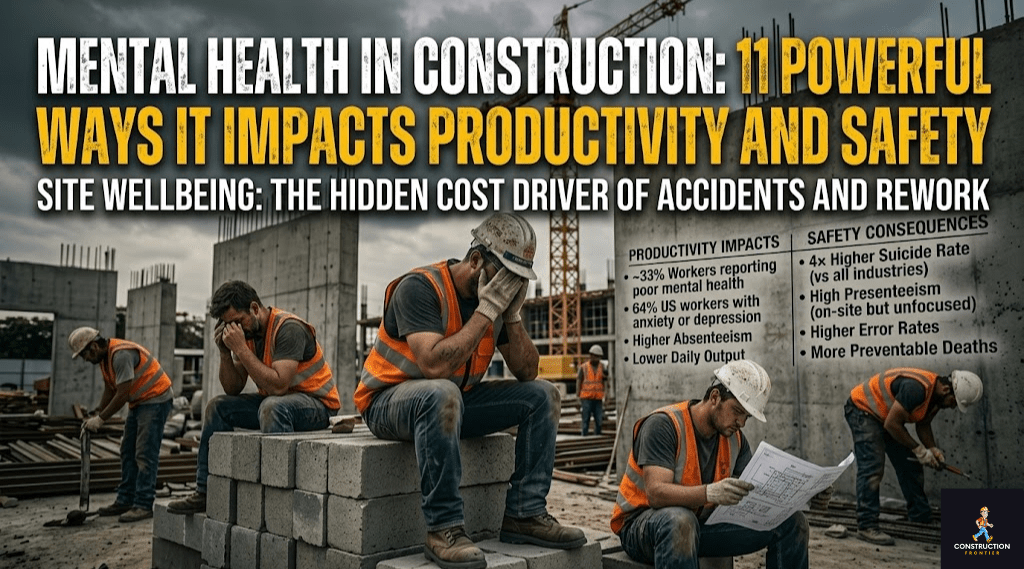
Mental Health in Construction: 11 Powerful Ways It Impacts Productivity and Safety
Mental health in construction shapes every measurable dimension of site performance, from daily output and error rates to fatal accident statistics. The industry employs hundreds of millions of workers globally, yet one in three reports poor psychological wellbeing. When untreated, that figure feeds directly into delayed schedules, inflated rework budgets, and preventable deaths. Understanding how mental health affects construction productivity and safety is no longer optional for project leaders; it is the most consequential workforce management decision they face.
Technical Snapshot: Mental Health in Construction at a Glance
| Metric | Statistics | Source |
| Workers reporting poor mental health | ~33% | Statistics Canada |
| US workers with anxiety or depression (2025) | 64% | Clayco / Construction Dive |
| Construction suicide rate vs all industries (US) | 4× higher | CDC / NIOSH |
| Absenteeism reduction via mental health programmes | Up to 25% | World Economic Forum |
| Presenteeism reduction via mental health programmes | Up to 40% | World Economic Forum |
| EAP return on investment | $3–$10 per $1 spent | ABC Carolinas / Peer review |
Mental health in construction sits at the centre of two crises converging simultaneously: a global skilled-labour shortage and a safety culture that has historically prioritised hard hats over psychological support. Firms that close this gap gain a decisive edge in productivity, workforce retention, and site safety compliance.
Why Mental Health in Construction Demands Immediate Attention
Construction employs more than 100 million workers worldwide, and in nearly every market, the workforce skews heavily male, operates under severe deadline pressure, and endures physical conditions that accumulate psychological wear over the years. Mental health in the construction industry receives a fraction of the attention given to physical hazards, yet its operational consequences are far greater. The question facing every project director, safety manager, and HR lead is not whether mental health affects construction productivity and safety; the evidence on that is conclusive. The question is what measurable losses the industry accepts each year by treating psychological wellbeing as a peripheral concern.
The full picture of this crisis is documented in our core analysis of “Unearthing Construction’s Biggest Killer”. This article maps 11 specific mechanisms through which poor mental health degrades construction productivity and safety, equipping leaders with the causal framework needed to justify and design interventions at scale. Each mechanism below is grounded in data. Taken together, they explain why the industry’s most significant productivity and safety losses do not stem from material costs or equipment downtime; they stem from the workforce’s psychological state.
1. Impaired Concentration and the Accident Chain
Construction demands sustained, split-second attention. A worker operating a crane, mixing concrete adjacent to live excavations, or fixing structural connections at height cannot afford a momentary lapse in situational awareness. Mental health disorders, particularly anxiety and depression, reduce cognitive bandwidth precisely in the areas that construction requires most: working memory, attention switching, and hazard recognition.
Research published in the Journal of Occupational Health confirms that any reduction in concentration among construction workers leads directly to errors, accidents, and rework, with compounding effects on overall productivity in construction projects. A distracted worker does not simply slow down; their presence creates secondary risk for every colleague within the blast radius of a potential incident.
The impact of mental health on construction safety is therefore not linear. One impaired worker on a high-risk task elevates risk across the entire crew. This systemic multiplier explains why mental health in the construction industry functions as a site-wide safety variable rather than an individual performance issue. Understanding why mental health matters in construction projects begins here: the cognitive demands of site work are incompatible with unmanaged psychological distress.
2. Absenteeism: The Visible Productivity Drain
Absenteeism is the most straightforwardly quantified cost of poor mental health. A worker absent from the site produces nothing; their absence forces supervisors to redistribute tasks, often onto already-stretched colleagues, compressing schedules and accelerating the conditions that generate further psychological strain. Why mental health matters in construction projects is clear here: a single absent tradesperson on a critical-path activity shifts a milestone, and that shift costs money.
The World Economic Forum estimates that well-structured mental health initiatives reduce workplace absenteeism by 25%. In construction, where labour is the largest single cost variable on most projects, a 25% reduction in unplanned absence translates to measurable schedule performance improvement and a direct reduction in preliminary overruns. Unplanned absences tied to untreated mental health conditions translate directly to schedule risk, rework costs, and, on fixed-price contracts, liquidated damages exposure. The impact of mental health on construction safety compounds this: absenteeism removes the experienced eyes that spot precursor hazards before they escalate.
The construction industry’s suicide crisis among workers represents the terminal end of this spectrum: permanent, irreversible absence with associated productivity and institutional knowledge loss that no replacement hire can fully offset.
3. Presenteeism: The Hidden Productivity Loss
Presenteeism is the condition in which a worker physically occupies the site but operates at a fraction of effective capacity due to psychological distress. It is more dangerous than absenteeism in two respects: it is harder to detect, and it creates an active safety risk rather than simply a production gap.
The WHO and ILO joint report on mental health at work attributes 12 billion lost working days per year globally to depression and anxiety alone, at a cost of nearly $1 trillion in lost productivity. Research in the Journal of Occupational Health documents that mental health problems such as anxiety and depression impair cognitive functions, including memory, decision-making, concentration, and problem-solving. A worker experiencing these impairments who remains on site contributes substandard output and simultaneously raises incident probability.
Improving mental health in construction workplaces, therefore, requires closing the gap between physical presence and effective contribution, a goal that cannot be achieved through attendance policies alone.
4. Decision-Making Failures and Rework
Construction rework accounts for between 5% and 12% of total project costs across multiple industry studies. The Construction Industry Institute’s analysis of rework costs finds that direct rework costs average 5% of contract value across standard industrial projects, rising to 12.4% for civil and heavy infrastructure projects. A significant share of that rework stems from poor decisions: wrong sequencing, incorrect material specifications, inadequate quality control, and missed inspections.
Depression and anxiety degrade executive function. Workers and supervisors managing untreated mental health conditions exhibit slower reaction times, reduced caution where it is warranted, and elevated risk tolerance where it is not. The consequences include specification errors, omissions in safety protocols, and quality failures that go undetected until costly downstream stages of the project.
The impact of mental health on construction productivity is most clearly seen in rework volumes. A project with high presenteeism rates does not simply run slowly; it accumulates defects that compress the programme at the back end, precisely when schedule pressure is most acute. The connection between mental health in the construction industry and rework costs is a core driver of the underperformance of construction project productivity relative to schedule and budget assumptions.
5. Substance Use and Its Cascading Site Risk
Construction carries the highest heavy alcohol consumption rate of any major industry. The SAMHSA industry survey on substance use by occupation found that 16.5% of construction workers reported heavy alcohol use in the past month, nearly twice the all-industry average of 8.7%. Separately, 12% of construction workers have an alcohol use disorder, compared to 7.5% of the general adult working population.
Substance use is predominantly a response to unaddressed mental health conditions, including chronic pain, anxiety, depression, and work-related trauma. It does not exist in isolation from how mental health affects construction productivity; it is one of the primary pathways through which untreated psychological distress converts into site fatalities, absenteeism, and reduced output.
The causes driving elevated suicide rates in construction overlap substantially with the conditions that produce substance dependency: isolation, financial pressure, hypermasculine site culture, and inadequate access to professional psychological support. Addressing one requires confronting the other.
6. Burnout and the Erosion of Senior Expertise
Burnout occupies a specific position in the construction mental health spectrum because it disproportionately affects experienced workers and supervisors, the individuals whose institutional knowledge is most difficult to replace. A site foreman or project engineer operating under chronic burnout makes decisions that degrade site quality, safety culture, and programme performance, while their departure leaves a replacement to develop capabilities that take years to build.
Construction burnout is not a personal failure. It is a structural outcome of the industry’s long working hours and their compounding effect on mental health. Extended shift patterns, compressed deadlines, and inadequate recovery time erode cognitive resilience, making impaired performance the norm rather than the exception.
The Associated General Contractors of America reported in 2025 that the industry requires approximately 454,000 additional workers beyond normal hiring to meet demand. Every burnout-driven resignation from a skilled tradesperson or supervisor, therefore, incurs a double cost: the productivity loss during the worker’s degraded final period and the recruitment, onboarding, and learning-curve expense of the replacement. Why mental health matters in construction projects is inseparable from why workforce continuity matters: experienced workers who leave under burnout take with them the tacit site knowledge that no onboarding programme can replicate.
Further Reading: Construction Burnout: 7 Critical Causes, Warning Signs, and Proven Prevention Strategies
7. Communication Breakdown and Team-Level Safety Failures
Construction is fundamentally a team-based activity. Safe, productive sites depend on accurate information flowing vertically and horizontally: between workers and supervisors, between subcontractors and main contractors, and between site and design teams. Workers managing anxiety, depression, or burnout withdraw from communication. They under-report hazards, suppress concerns about unsafe instructions, and miss the interpersonal cues that signal emerging risk.
The Frontiers in Public Health systematic review on stress among construction workers identifies poor communication as a primary source of stress, with the fragmented nature of project delivery amplifying the consequences of each communication failure. A miscommunication on a steel erection sequence or a concrete pour specification is not simply a planning error; it is a safety event waiting to manifest.
Teams with strong psychological safety, the organisational condition in which workers feel safe to raise concerns without fear of reprisal, record lower incident rates and higher productivity in construction projects. This connection between mental health in the construction industry and team communication performance is one of the clearest arguments for treating construction worker wellbeing as a workplace safety investment in construction rather than a welfare cost. The impact of mental health on construction safety runs directly through communication: teams that cannot speak openly about risk face preventable incidents.
8. Financial Stress and Its Direct Effect on Project Performance
Financial pressure is among the most powerful drivers of psychological distress in construction. Workers facing wage insecurity, delayed payments, or personal debt carry a cognitive load that competes directly with the attentional demands of site work. Supervisors managing project budgets under cash flow pressure experience the same degradation of executive function that characterises clinical anxiety.
The financial stress embedded in construction project structures creates a reciprocal loop: project financial distress generates psychological distress among the workforce, which in turn leads to productivity and safety failures that deepen the project’s financial distress. Breaking that loop requires addressing mental health as a project risk management variable, not solely as an HR obligation.
Workers managing financial anxiety are more likely to take unsafe shortcuts to maintain pace, less likely to raise quality concerns that might delay payment milestones, and more likely to remain on site while impaired. All of those behaviours translate into safety incidents and quality failures, with direct cost consequences, making financial stress management a specific dimension of construction worker wellbeing that affects productivity in construction projects.
9. Workforce Turnover and the Retention Cost
The correlation between mental health and voluntary staff turnover in construction is direct and well-documented. Workers who experience poor psychological wellbeing, feel unsupported by their employer, and work in high-stigma environments leave. Their departure incurs recruitment costs, knowledge transfer losses, and reduced output during the replacement’s orientation period.
The Australian construction industry data on mental health and skilled worker attrition found that 52% of construction industry leaders agreed that skilled workers are leaving the industry due to stress and burnout. A survey by Workplace Options found that 81% of workers now rank an employer’s commitment to mental health as the most important consideration when evaluating a new job. In an industry facing a structural skilled-labour shortage, with 92% of US construction firms reporting difficulty finding qualified workers, construction worker well-being is a direct lever on workforce availability.
Improving mental health in construction workplaces is therefore a safety, productivity, and talent strategy. Firms that treat these as separate functions, assigning mental health to HR while workplace safety in construction sits with operations and workforce planning belongs to commercial management, fail to capture the full return on investment from intervention. Why mental health matters in construction projects extends beyond site performance: it determines whether firms can retain the workforce capable of delivering their pipeline.
10. Safety Culture Degradation and Regulatory Exposure
Workplace safety in construction depends on a culture in which hazard identification is routine, safety protocols are followed without resentment, and near-misses are reported rather than concealed. That culture cannot survive in an environment where workers are psychologically distressed, feel unable to speak openly, and regard safety procedures as bureaucratic obstacles to the production targets on which their job security depends.
Mental health in the construction industry operates as a prerequisite for a genuine safety culture. Workers carrying unaddressed psychological distress do not engage meaningfully with safety toolbox talks, do not report precursor incidents, and do not enforce safe behaviours in colleagues. The result is a workplace safety in construction programme that appears functional on paper, while actual site risk rises.
The UK Health and Safety Executive’s 2024/25 annual report records 22.1 million working days lost to work-related stress, anxiety, and depression in a single year, representing 52% of all work-related ill health and constituting the single largest category of workplace absence across the entire British economy. This figure has risen 35% in two years. Firms that allow construction workers’ well-being to deteriorate face not only productivity penalties but also growing compliance and reputational exposure as regulators sharpen their enforcement focus on psychosocial hazards.
11. The Commercial Return on Mental Health Investment
The eleven mental health in construction mechanisms above convert psychological distress into measurable financial loss: schedule overruns, rework costs, incident compensation, staff turnover, and regulatory penalties. The reverse is equally quantifiable. Peer-reviewed research on Employee Assistance Programmes shows returns of $3 to $10 per dollar spent, driven by reduced absenteeism, presenteeism, healthcare costs, and turnover. A mid-sized contractor that achieves a 10% reduction in incident rate through structured mental health support realises over $100,000 in workers’ compensation savings per year. How mental health affects construction productivity is the same question as how it affects profitability: the answers are inseparable.
The construction burnout crisis, documented in our analysis of burnout causes and prevention in construction, demonstrates that the conditions driving the highest-cost outcomes for firms are preventable through structured intervention. The question is not whether the return justifies the investment; it consistently does. The question is whether leadership treats the evidence as sufficient to act.
Improving mental health in construction workplaces requires three coordinated commitments: cultural normalisation of psychological support (eliminating the stigma that prevents workers from accessing available resources), structural intervention (EAPs, supervisor mental health training, and workload management systems), and measurement (tracking absenteeism, presenteeism, incident rates, and turnover as leading indicators of programme effectiveness). The impact of mental health on construction safety and productivity is inseparable at the strategic level: both improve or deteriorate together, driven by the same underlying conditions of construction worker wellbeing.
Further Reading: Workplace Bullying in Construction: 10 Disturbing Signs of Toxic Site Culture
Technical Reference: How Mental Health Affects Construction Productivity and Safety
The table below maps each of the 11 impact mechanisms to its primary outcome category and the recommended intervention tier for construction firms.
| Impact Mechanism | Primary Outcome | Intervention Tier |
| Impaired concentration | Workplace accidents | Site-level (toolbox, buddy systems) |
| Absenteeism | Schedule overrun | Firm-level (EAP, flexible leave) |
| Presenteeism | Rework and quality failure | Firm-level (workload monitoring) |
| Decision-making failures | Rework and specification errors | Supervisory training |
| Substance use disorders | Fatal and serious incidents | Clinical referral pathways |
| Burnout of senior staff | Knowledge loss and turnover | Workload and scheduling reform |
| Communication breakdown | Team-level safety failures | Psychological safety programmes |
| Financial stress | Shortcuts and risk tolerance | Financial wellbeing support |
| Workforce turnover | Cost and capability gap | Retention and wellbeing culture |
| Safety culture degradation | Regulatory and liability exposure | Leadership-driven culture change |
| Failure to invest in wellbeing | Compounding cost across all the above | Board-level strategy commitment |
1. Measuring the Productivity Cost of Poor Mental Health
Construction firms that want to understand their actual exposure should quantify unplanned absence rates, rework percentages, near-miss reporting frequency, and voluntary turnover, and track these against any mental health programme investment. These are not soft metrics; they are the same financial indicators that procurement teams and clients scrutinise in contractor performance evaluation. Improving mental health in construction workplaces starts with measuring it: firms that lack baseline data cannot demonstrate improvement, cannot justify programme expenditure to boards, and cannot identify which interventions deliver the strongest return on productivity in construction projects.
2. Applying Mental Health Data to Project Risk Registers
Workforce psychological wellbeing belongs on project risk registers alongside supply chain disruption, weather delays, and design change risk. The OSHA guidance on preventing suicides in construction specifically identifies work-related stressors as drivers of the construction suicide rate, which stands three times higher than that of the general population. Projects operating under high workforce stress, tight schedules, and inadequate support structures are more likely to experience schedule overruns and safety incidents. Quantifying this probability improves project cost modelling and the design of early warning systems. Why mental health matters in construction projects is the same reason any other systemic risk matters: because its probability and impact can be modelled and, therefore, managed.
Conclusion: Mental Health Is a Productivity and Safety System Variable
Mental health in construction is not a welfare initiative sitting alongside the commercial programme. Every one of the eleven mechanisms documented here results in financial loss, schedule delay, safety liability, or workforce capability degradation. The industry’s own data, from the CDC’s National Vital Statistics System analysis of suicide by industry to the WHO’s trillion-dollar productivity loss estimate, from peer-reviewed occupational health research to contractor self-assessments, reaches the same conclusion: improving mental health in construction workplaces is the highest-return investment available to firms that have exhausted conventional cost and schedule improvement levers. The impact of mental health on construction safety and productivity is not theoretical; it is documented across thousands of projects and millions of worker-years.
Why mental health matters in construction projects is captured in a single principle: the workforce that builds the structure is the most critical variable in project success. Construction worker wellbeing determines whether that workforce is attentive, communicative, and effective, or distracted, isolated, and operating at degraded capacity. How mental health affects construction productivity is the question that answers all the others: it affects it comprehensively, in every phase of the project, across every tier of the workforce.
Construction firms that treat construction worker wellbeing as a strategic priority, integrate it into workplace safety in construction systems, and measure its outcomes with the same rigour applied to materials procurement will outperform peers in both safety performance and project delivery. Those who continue to treat mental health in the construction industry as peripheral spend their productivity budget repeatedly correcting failures that a well-being investment would have prevented. Improving mental health in construction workplaces is the most direct path to improving construction productivity and safety at scale. The impact of mental health on construction safety, retention, rework, and schedule performance is not a marginal concern; it is the central workforce management variable for any firm serious about project performance.
Stay Ahead of Construction Workforce and Safety Challenges
Explore Construction Frontier: Construction Workforce Safety, Mental Health & Human Performance for expert insights, industry analysis, and practical strategies on mental health in construction, workforce productivity, psychological safety, and sustainable project performance.