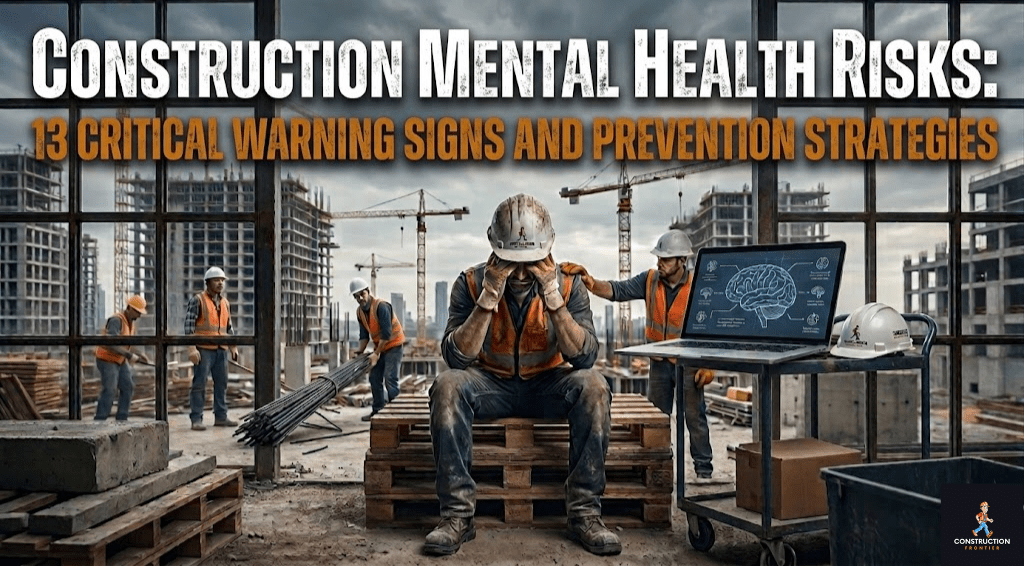
Construction Mental Health Risks: 13 Critical Warning Signs and Prevention Strategies
Construction mental health risks have crossed from a background concern to a front-line operational hazard. Sixty-four per cent of US construction workers reported anxiety or depression in 2025, up from 54% the year before and almost three times the rate recorded in the general population. The psychological burden carried by the global construction workforce now rivals the physical danger of working at height. Spotting the warning signs early and deploying a structured prevention framework saves lives, protects project performance, and determines whether a company keeps its most experienced crews on site.
Technical Snapshot: Mental Health Risk Profile in Construction
| Metric | Data Point |
| Depression / Anxiety Rate (2025) | 64% of US construction workers (Clayco, 2025) |
| Male Suicide Rate (per 100,000) | 56 per 100,000 vs 32 for all male workers (CDC MMWR, 2023) |
| Overdose Risk | Construction accounts for 16% of opioid overdose deaths; 7% of the workforce (CPWR) |
| Mental Health Professional Access | Fewer than 5% of construction workers vs 22% national average |
| Stigma Barrier | 45% would feel ashamed to discuss mental health at work (Clayco, 2025) |
| Untreated SUD Costs to Employers | USD 8,591 per affected worker per year (CPWR) |
| Global Productivity Loss | USD 1 trillion per year is lost from depression and anxiety (WHO, 2022) |
| EAP Return on Investment | USD 3–5 returned per USD 1 invested (EASNA) |
Construction mental health risks constitute a systemic operational hazard. Unmanaged psychological distress erodes safety compliance, crew retention, and project delivery capacity across every segment of the built environment sector globally.
Introduction: The Risk You Cannot See on a Drawing
Every construction project accounts for structural load, ground conditions, material tolerances, and fall arrest systems. Few project risk registers carry a dedicated line for psychological hazards. That omission is no longer defensible. As explored in Construction Frontier’s analysis of the mental health crisis shaping the construction sector, psychological distress now kills more construction workers than physical falls in several national markets, and every data set published since 2023 shows the gap is widening.
Construction is, structurally, a hostile environment for mental wellbeing. Project-based employment creates perpetual income uncertainty. Physical injury accumulates chronically, suppresses mood, and disrupts sleep. Long shifts on remote infrastructure sites sever workers from family and community for weeks at a time. A male-dominated culture that reads emotional expression as professional weakness prevents distress from surfacing until a crisis forces it into view. None of that is accidental; it is the product of how the industry is organised and what it historically rewarded.
Managing construction’s biggest killer, mental health, therefore, demands the same rigour that site managers apply to physical safety: systematic hazard identification, early intervention at individual and organisational levels, and continuous monitoring against measurable outcomes. Construction workforce wellbeing is not a soft metric; it is a project delivery variable with hard consequences when ignored.
Therefore, this article identifies 13 critical warning signs of construction mental health risks and provides a tested prevention framework that project leaders and company directors can put to work in any construction setting, from a ten-person civil subcontractor to a tier-one infrastructure programme.
Why Construction Mental Health Risks Demand Operational Priority
Mental health risk management in construction is not an HR courtesy. Construction mental health risks carry quantifiable consequences at every level of project delivery, and the numbers are now too large to reclassify as a people-management side issue. Psychological risks in construction cost money, time, and personnel in ways that show up in financial reporting; they just rarely appear on the line where they belong.
A 2025 survey of 2,000 construction workers and executives commissioned by design-build firm Clayco found that 64% reported anxiety or depression in the preceding twelve months, up from 54% in 2024 and approaching three times the general population rate. Female workers reported the highest rates at 73%. Generation Z workers followed at 69%, and substance misuse as a coping mechanism climbed to 58% of respondents, an eleven-point rise year-on-year. Those trends sit on top of a baseline that was already alarming. According to the CDC Morbidity and Mortality Weekly Report, male construction workers died by suicide at a rate of 56 per 100,000 in 2021, compared with 32 per 100,000 for all male workers. Construction and extraction occupations recorded the highest suicide rate of any occupation group at 65.6 per 100,000.
The Centre for Construction Research and Training (CPWR) reports that construction workers account for 16% of all opioid overdose deaths in the United States despite representing only 7% of the workforce. In 2023 alone, 15,910 fatal overdoses and 5,095 suicides were recorded across the sector. These are not statistical abstractions; they are measurable losses of experienced personnel, compounded by the project delays, insurance costs, and crew destabilisation that follow each incident.
The economic burden runs parallel. The World Health Organization estimates that depression and anxiety cost the global economy USD 1 trillion per year, driven predominantly by lost productivity. Untreated substance use disorders cost US construction employers USD 8,591 per affected worker annually through turnover, absenteeism, and healthcare expenditure. Construction workforce wellbeing, when neglected, translates directly into those figures. The long-term impacts on workforce performance are now documented thoroughly enough to make inaction a balance-sheet risk, not merely a welfare shortcoming.
Root Causes of Psychological Risk in Construction Workplaces
Effective mental health risk management in construction starts with the structural conditions that generate harm. Five primary drivers operate across every tier of the workforce, from apprentice to project director. Understanding them is not academic; it determines where prevention resources produce the greatest return.
1. Physical Injury and Chronic Pain
Workplace injuries rank among the top health-related risk factors for psychological distress in construction. Trauma from serious accidents triggers PTSD. Chronic musculoskeletal pain disrupts sleep, limits social participation, and compounds depression over months and years. Recovery adds a second layer: income stops, fear of permanent incapacity grows, and the social isolation that comes with time away from the site removes the informal peer contact that buffers stress. A 2013 peer-reviewed study published in PubMed confirmed a strong association between substantial mental distress and higher injury frequency in construction workers, with the relationship running in both directions: distress increases injury risk, and injury deepens distress. The connection between construction burnout and psychological deterioration deserves far greater weight in site safety planning than it currently receives.
2. Excessive Working Hours and Schedule Volatility
Long shifts, consecutive working days without adequate rest, and irregular scheduling driven by project deadlines combine to produce fatigue-related psychological deterioration. The CPWR fatigue management research is explicit: workers with excessive consecutive working days are both less productive and at greater risk of physical injury and mental health problems, including suicidal ideation. The mechanism is not complicated. Sleep deprivation impairs emotional regulation and erodes the psychological resilience that allows people to absorb daily occupational stress without accumulating damage. The documented relationship between long working hours and mental health decline in construction is one of the most consistent findings in the occupational health literature.
3. Financial Stress and Employment Insecurity
Project-based contracting means income stops when projects end or stall. Economic downturns trigger rapid redundancies across subcontractor tiers well before major contractors feel the shock. Workers carrying personal debt against intermittent income streams face chronic financial anxiety that operates as a persistent, low-intensity psychological stressor with compounding consequences. A systematic review published in PMC identified job insecurity as a consistent predictor of chronic job stress and adverse mental health outcomes in construction populations. The structural financial vulnerabilities embedded in construction employment represent one of the most preventable drivers of psychological distress in the sector.
4. Workplace Culture and Stigma
Forty-five per cent of construction workers say they would feel ashamed to discuss mental health at work. Thirty-seven per cent report experiencing discrimination after doing so. A culture that equates emotional expression with professional weakness creates an environment where distress escalates unchecked until it becomes a crisis no one can ignore. The WHO mental health at work guidelines identify stigma reduction as one of the most important organisational interventions available to employers, noting that without it, help-seeking behaviour simply does not occur at meaningful rates. Addressing toxic culture and workplace bullying is not separable from any credible effort to reduce psychological risk in construction.
5. Isolation and Workforce Mobility
Remote and fly-in-fly-out project formats disconnect workers from family networks, community ties, and the informal social support that absorbs daily stress. The transient nature of construction careers, moving between sites and companies across years, prevents stable peer relationships from forming. Workers on large infrastructure projects in emerging markets, isolated from urban centres and family for months at a time, carry elevated psychological risk that employers consistently underestimate. A peer-reviewed global review published in the International Journal of Environmental Research and Public Health in 2025 identified long hours, irregular schedules, and extended separation from family as direct contributors to anxiety, sadness, and burnout in construction populations worldwide.
13 Critical Warning Signs of Construction Mental Health Risks
The following warning signs apply at the individual worker level. Line managers, site supervisors, and peer support volunteers trained to recognise these indicators can initiate early intervention before a crisis develops. Construction worker mental health deteriorates in patterns, not in single events. Warning signs of mental health risks in construction rarely appear in isolation; two or more indicators appearing simultaneously warrant immediate and direct attention.
Warning Sign 1: Marked Withdrawal from Colleagues
A worker who consistently avoids shared spaces, declines conversations that would once have been normal, or stops engaging with the crew dynamic is displaying a primary indicator of depression or acute anxiety. In a site environment where collective communication underpins safety, withdrawal creates operational risk beyond the psychological one: isolated workers miss safety briefings, fail to report near-misses, and lack the peer contact that stabilises judgement under pressure. It is also, in practical terms, the easiest signal to observe; it requires no clinical training to notice that someone has stopped showing up to the tea shack.
Warning Sign 2: Deteriorating Work Quality and Increased Errors
Untreated depression and anxiety impair concentration, working memory, and decision-making. A previously competent tradesperson whose output becomes erratic, who makes sequencing errors they would not have made six months ago, or who cannot retain briefing instructions is demonstrating cognitive symptoms with direct safety implications. NIOSH confirms that mental health challenges compromise the judgement that construction demands most acutely: working at heights, operating a plant, or working with hazardous materials.
Warning Sign 3: Uncharacteristic Irritability and Conflict
Short-temperedness, aggressive responses to minor frustrations, or sudden interpersonal conflict with colleagues or supervisors signal emotional dysregulation. This behavioural shift typically indicates chronic stress, persistent sleep disruption, or the early stages of a depressive episode. On sites where coordinated work under pressure is constant, workers in this state generate friction that erodes team cohesion and elevates confrontational risk. The shift itself is diagnostic: this is not a difficult personality; it is a changed one.
Warning Sign 4: Persistent Fatigue Unrelated to Task Demand
Workers who appear consistently exhausted regardless of shift length, who report difficulty sleeping, or who cannot stay alert during rest breaks are exhibiting a physiological sign common to both depression and anxiety disorders. Fatigue operates simultaneously as a symptom of psychological distress and as an amplifier of it: sleep-deprived workers lose emotional resilience and physical reaction speed at the same time. Separating fatigue-as-symptom from fatigue-as-workload-consequence requires direct, unhurried conversation and sustained supervisory observation, not a single welfare check.
Warning Sign 5: Increased Absenteeism or Unexplained Sick Days
A pattern of short, frequent absences, particularly on Mondays and Fridays, or absences clustering around the most demanding project phases, often signals avoidance behaviour linked to anxiety or severe work-related stress. Absenteeism is among the most directly measurable indicators available to site management, and it is typically one of the earliest signals to appear before more visible psychological deterioration becomes apparent. It is also, critically, reversible at this stage if it is recognised and responded to rather than disciplined.
Warning Sign 6: Changes in Substance Use Behaviour
Workers who begin drinking more heavily after shifts, who arrive on site smelling of alcohol, or whose colleagues observe behaviour consistent with drug use are displaying a pattern that the research literature consistently identifies as a primary coping mechanism for untreated psychological distress. The Center for Construction Research and Training (CPWR) mental health data show that construction workers account for 16% of all opioid overdose deaths in the US, despite being only 7% of the workforce. Any observable escalation in substance-related behaviour constitutes a critical alert requiring immediate intervention. The trajectory from workplace stress through substance dependency toward suicidal crisis in construction is a documented and preventable progression.
Further Reading: Poor Mental Health in Construction Companies: 7 Damaging Costs Leaders Must Address
Warning Sign 7: Declining Engagement with Safety Protocols
A worker who begins bypassing PPE requirements, dismissing pre-start briefings, or ignoring standard operating procedures may have entered a psychological state of disengagement or fatalism. Research on distress and injury patterns in construction identifies a mechanism in which workers experiencing severe psychological distress unconsciously deprioritise their own safety. This is not complacency. It is a clinical behavioural indicator, and it demands psychological support alongside, not instead of, any operational or disciplinary response.
Warning Sign 8: Expressed Hopelessness or Worthlessness
Statements such as “Nothing is going to improve”, “I don’t care what happens to me”, or “I’m useless on this job” should never be treated as passing frustration. The NIOSH Science Bulletin on suicide prevention in construction is explicit: these expressions constitute verbal warning signs for depressive episodes or suicidal ideation and require immediate, non-judgemental follow-up by a trained responder. Dismissing such statements as dramatic is one of the most consequential errors a site manager can make.
Warning Sign 9: Financial Desperation Signals
Workers who borrow money from colleagues, discuss an inability to cover basic living costs, or show secondary signs of financial crisis (skipping meals, visible deterioration in clothing, distracted behaviour around pay cycles) are carrying financial stress at a level that research consistently links to acute psychological risk. Financial distress is a particularly powerful trigger in construction because income insecurity is structurally embedded in project-based employment, making it both highly prevalent and systematically overlooked by management. The financial pressures specific to construction workforces deserve explicit inclusion in any mental health risk assessment.
Warning Sign 10: Relationship Breakdown and Family Conflict
Workers who report marriage or partnership breakdown, estrangement from children, or custody disputes are navigating stressors that occupational health research identifies as among the strongest predictors of suicidal crisis in working-age males. Site-based work amplifies the weight of relationship breakdown by removing the immediate social support that would otherwise buffer the distress. A worker managing a family crisis alongside a demanding project schedule is carrying a compounded load that most employers neither recognise nor have any framework for addressing. That gap is both a welfare failure and an operational risk.
Warning Sign 11: Dramatic Personality or Mood Shifts
Sudden shifts from a worker’s established character, a reliable person becoming unreliable, a sociable colleague becoming hostile, and a high performer becoming apathetic are clinical indicators of significant psychological change. The peer-reviewed systematic review published in PMC on mental ill-health risk factors in construction notes that mood and personality changes typically precede more visible crisis symptoms by weeks. Supervisory attentiveness to baseline behaviour is therefore a critical early-detection capability that costs nothing but requires consistent and deliberate cultivation.
Warning Sign 12: Preoccupation with Death or Farewell Behaviour
A worker who makes repeated references to death, asks colleagues what would happen to their tools or belongings after they’re gone, gives away personal possessions, or makes statements consistent with settling affairs is displaying acute warning signs of a suicidal crisis. These signals demand immediate action: moving the individual away from hazardous environments, connecting them with crisis support, and contacting emergency services if direct intent is expressed. The CDC records male construction workers as having the highest suicide rate of any occupation group in the US. This category of warning sign is accordingly the most critical on any site.
Warning Sign 13: Physical Complaints Without Medical Diagnosis
Persistent headaches, gastrointestinal problems, chest tightness, and musculoskeletal pain that do not resolve with treatment and carry no clear physical origin are recognised somatic expressions of psychological distress. Workers in cultures where emotional difficulty is stigmatised frequently present psychological pain through physical symptoms because the physical route carries less social penalty. A pattern of recurrent, unexplained physical complaints should prompt mental health screening before further physical investigation. The body is communicating what the culture prevents the worker from saying directly.
Further Reading: Mental Health in Construction: 11 Powerful Ways It Impacts Productivity and Safety
Summary: Construction Mental Health Risk Matrix
The table below classifies all 13 warning signs by severity and recommended response tier. Site safety teams and project management can use this as a first-response reference framework.
| Warning Sign | Severity | Recommended Response |
| Preoccupation with death/farewell behaviour | Critical | Immediate crisis referral; remove from hazardous environment |
| Expressed hopelessness or worthlessness | Critical | Immediate supervisor intervention; trained first responder follow-up |
| Substance use escalation | High | EAP referral; confidential counselling; SUD programme access |
| Safety protocol disengagement | High | Direct welfare conversation; temporary duty reassignment |
| Relationship breakdown/family crisis | High | Peer support referral; flexible scheduling review |
| Dramatic personality or mood shift | Moderate-High | Manager welfare check; occupational health referral |
| Persistent unexplained fatigue | Moderate-High | Workload review; sleep health assessment; GP referral |
| Withdrawal from colleagues | Moderate | Informal peer check-in; include in toolbox talk |
| Increased absenteeism | Moderate | Return-to-work welfare conversation; workload review |
| Physical complaints without diagnosis | Moderate | Mental health screening; occupational health assessment |
| Uncharacteristic irritability and conflict | Moderate | Supervisor conversation; conflict mediation support |
| Financial desperation signals | Moderate | Financial assistance signposting; EAP financial counselling |
| Declining work quality and errors | Early Indicator | Supportive supervision; workload and task reassessment |
Mental Health Prevention Strategies: A Six-Pillar Construction Framework
Prevention must operate at three levels simultaneously: the individual worker, the supervisor and team layer, and the organisational policy architecture. Understanding how to prevent mental health issues in construction requires accepting that no single lever works alone. The framework below is built from interventions with documented effectiveness in construction environments specifically, not generic workplace wellness guidance that assumes an office context and a workforce willing to self-refer.
Pillar 1: Embed Mental Health Risk in the Site Safety Management System
Psychological hazards belong in the site risk register. Mental health risk management in construction gains traction only when it operates within the same governance structure as fall prevention and plant safety. That means a named mental health lead at the project level; psychological risk included in pre-start briefings; and mental health performance indicators alongside Reporting of Injuries, Diseases and Dangerous Occurrences Regulations (RIDDOR) statistics in monthly reports. The WHO/ILO joint policy brief on mental health at work recommends exactly this organisational intervention, defining psychosocial risk assessment as a core employer responsibility equivalent to physical hazard management. Companies that have implemented the shift from a welfare footnote to a safety line item report measurable reductions in stress-related absences within twelve months. The broader commercial case for treating mental health investment as a business strategy is now substantiated beyond reasonable dispute.
Pillar 2: Train Supervisors as First Responders
The most under-utilised asset in construction mental health prevention is the first-line supervisor. Foremen and site managers observe worker behaviour daily, in real conditions, and at close range. No occupational psychologist or HR manager matches that proximity. Mental Health First Aid training equips these individuals to recognise warning signs, initiate non-judgemental conversations, and connect distressed workers with professional support. The return on modest training costs, measured in early intervention before crisis, is substantial. Programmes should cover substance misuse recognition, suicide awareness, and trauma-informed response, all directly relevant to construction site conditions.
Pillar 3: Deploy Peer Support Networks
Workers disclose psychological distress to trusted colleagues far more readily than to managers or HR representatives. Formalised peer support programmes, in which trained volunteers drawn from the workforce provide confidential first-line support, function as an accessible and culturally credible bridge between initial distress and professional intervention. Australia’s MATES in Construction programme demonstrated this model at scale from 2008 onwards, reducing suicide rates in the construction industry through site-based community support combined with training for the broader workforce. Peer support is particularly effective in addressing stigma in male-dominated site cultures because the volunteer is visibly a tradesperson working in identical conditions, not an external professional from a different social world. The stigma that prevents construction workers from seeking help yields to peer credibility more reliably than it yields to clinical authority.
Pillar 4: Structure Work to Reduce Preventable Stressors
No individual-level intervention can solve a problem generated by structural working conditions. Schedule management is a direct mental health lever: capping consecutive working days, enforcing statutory rest periods, and building schedule buffers that prevent the chronic deadline panic that accumulates into clinical stress. Financial transparency and prompt payment processing reduce anxiety for subcontractor workers whose cash flow is sensitive to payment chain delays. Clear, honest communication about project status, employment continuity, and role expectations removes the uncertainty that converts ordinary occupational stress into clinical distress. The ISO 45003 standard on psychological health and safety provides a practical governance framework for embedding these structural changes across an organisation.
Pillar 5: Provide Accessible, Confidential Support Resources
Employee assistance programmes deliver a measurable return on investment. The Employee Assistance Society of North America documents USD 3 to 5 returned per dollar invested through reduced absenteeism and recovered productivity. EAP deployment in construction requires deliberate design: 24/7 telephone access for shift workers who cannot use services during business hours; mobile-accessible platforms for workers on remote sites without stable internet; and multilingual provisions for the diverse migrant workforce that constitutes a large and typically underserved segment of construction labour globally. The 45% of workers who fear disclosure will not use a service they do not trust. Confidentiality guarantees must be explicit, repeated, and demonstrably maintained.
Pillar 6: Build a Measurable Culture of Psychological Safety
Culture change in construction requires sustained commitment from the most senior figures on site and in the boardroom. Leaders who acknowledge their own experience of occupational stress, who use wellbeing resources visibly, and who create direct permission for disclosure normalise help-seeking more effectively than any poster campaign or awareness week. Regular toolbox talks on poor mental health management in construction companies that address psychological wellbeing alongside physical safety demonstrate institutional commitment in a format that construction workforces already recognise and respect. Measuring culture through anonymous workforce surveys, tracking EAP utilisation rates, monitoring absenteeism and presenteeism separately, and reporting these metrics at the board level creates the accountability structure that prevents mental health initiatives from becoming cyclical. Companies that embed a prevention-focused approach to psychological risk management report improvements in retention, crew cohesion, and project-level productivity alongside the reduction in psychological harm.
Further Reading: Construction Workers’ Suicide Rates: 8 Critical Causes and Proven Prevention Strategies
Technical Block: Mental Health Risk Management Implementation Framework
The following technical reference consolidates the key operational components of a site-level construction mental health management system. Construction mental health management strategies fail most commonly not from a lack of intent but from a lack of structure: good intentions without governance, training without escalation protocols, and EAP contracts that nobody on site knows how to access. Implementation should be phased and sequenced to match organisational capacity and the specific workforce profile of each project.
1. Governance Structure
To establish a robust governance structure, projects must assign clear roles and create open communication channels.
- Appoint a lead: Name a project-level mental health lead.
- Direct reporting: Link the lead directly to the Safety Director.
- Form a group: Create a steering group with HR, occupational health, site management, and workforce representatives.
- Define protocols: Establish escalation pathways from peer support to clinical and crisis response.
- Publish pathways: Share these communication channels clearly with all on-site workers.
2. Risk Assessment Integration
Integrating psychological safety into standard risk management ensures that mental health hazards are treated with the same urgency as physical risks.
- Update the register: Add psychosocial hazard categories to the project risk register.
- Track key pressures: Include work pressure, deadline stress, shift scheduling, and fatigue exposure.
- Identify site risks: Monitor isolation risks, especially for remote and fly-in-fly-out operations.
- Address social factors: Watch for financial uncertainty triggers and cultural stigma barriers.
- Review regularly: Reassess hazards quarterly and after major accidents, disruptions, or restructures.
3. Training Schedule
| Training Module | Target Audience | Frequency |
| Mental Health First Aid (2-day) | Supervisors, foremen, team leads | Biennial recertification |
| Suicide Awareness and Response | All managers | Annual |
| Substance Misuse Recognition | Supervisors and HR | Annual |
| Peer Support Volunteer Programme | Selected workforce volunteers | Induction and quarterly refresher |
| Wellbeing Toolbox Talks | Entire site workforce | Monthly minimum |
4. Monitoring and Reporting Metrics
Continuous data collection and reporting hold management accountable and help track the effectiveness of mental health initiatives.
- Track data: Monitor Employee Assistance Program (EAP) referral and utilisation rates by site and trade.
- Isolate absenteeism: Separate mental health-related absences from physical injury data.
- Gauge safety culture: Use near-miss reporting rates to measure psychological safety.
- Survey workers: Collect anonymous data on perceived support, stigma, and schedule balance.
- Log check-ins: Record how often supervisors complete welfare conversations.
- Share findings: Report metrics monthly to project management and quarterly to the board.
Conclusion: Mental Health Risk Is a Project Risk
Construction mental health risks are not peripheral welfare concerns. They carry direct consequences for safety compliance, workforce retention, project schedules, and commercial outcomes. The 13 warning signs in this framework give line managers and safety officers the observational tools to detect distress before it becomes a crisis. The six prevention pillars provide a scalable architecture for reducing the structural conditions that generate that distress in the first place.
Construction worker mental health responds to structured management the same way any other site risk does: treat it systematically, and it improves. The mental health costs in construction are now documented in enough detail and across enough markets to make inaction a risk management failure rather than an oversight. Companies that treat psychological safety as a site-wide operating standard will deliver safer projects, retain more skilled workers, and outperform those that continue to treat mental health as a personal problem requiring individual solutions.
Protect Your Workforce Before Mental Health Risks Escalate
Explore Construction Frontier: Construction Workforce Safety, Mental Health & Human Performance for expert insights, prevention strategies, and industry analysis on construction mental health risks, workforce well-being, psychological safety, and sustainable project performance across the built environment sector.