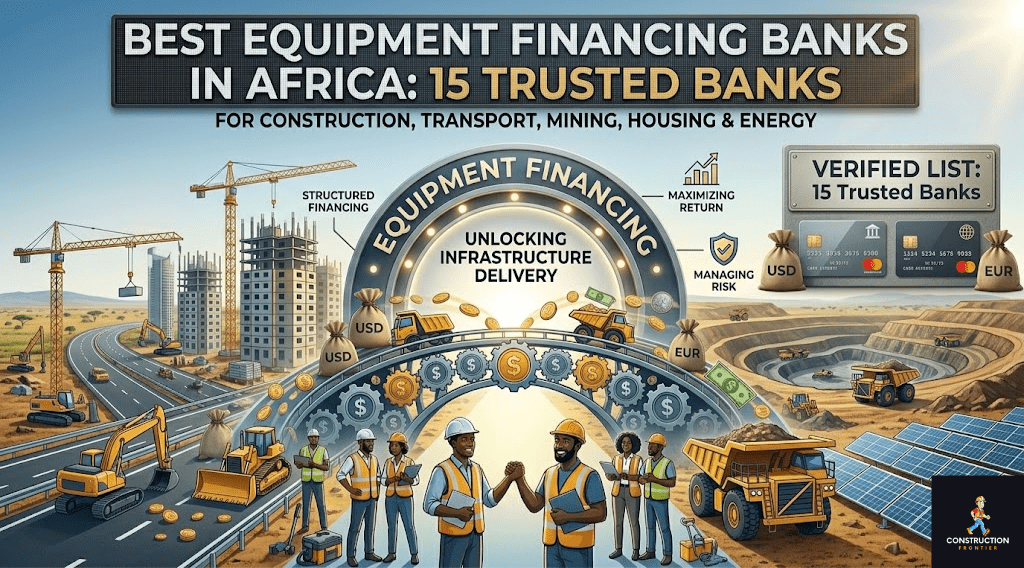
Best Equipment Financing Banks in Africa: 15 Trusted Banks
The best equipment financing banks in Africa play a decisive role in unlocking infrastructure delivery across the continent. As capital-intensive projects expand in transport, mining, housing, and energy, contractors increasingly rely on structured financing to deploy machinery without constraining working capital. Equipment typically accounts for 25–40% of total project costs, making access to financing a critical determinant of project feasibility and scale.
Technical Snapshot:
- Loan tenure: 3–7 years, depending on equipment class.
- Interest rates: 8%–18% across African markets.
- Loan-to-value ratio: 60–90%.
- Equipment utilisation benchmark: 70–85%.
- Payback period: 24–60 months.
For contractors and investors, selecting from the best equipment financing banks in Africa is not just about funding acquisition. It is about structuring capital efficiently, managing risk exposure, and maximising return on equipment investment.
Introduction: Why Equipment Financing is Critical in Africa
Africa’s construction and infrastructure sectors are undergoing rapid expansion, with the market valued at USD 220 billion in 2024 and projected to grow at a 4.83% CAGR through 2030. This surge is driven by the world’s fastest urbanization rate of 3.5% annually, requiring an estimated USD 130–170 billion in annual infrastructure investment to support a city population expected to reach 1.4 billion by 2050.
Government-led initiatives, such as Kenya’s USD 31 billion planned infrastructure pipeline and Egypt’s USD 348 billion in active projects, have solidified the continent as a primary global hub for heavy machinery and transport demand. However, access to capital remains uneven, particularly for contractors and SMEs. The high upfront cost of machinery continues to limit project execution capacity, underscoring the need for financing.
The emergence of the best equipment financing banks in Africa has reshaped how contractors approach equipment acquisition. Instead of relying on outright purchases, firms now use leasing, hire purchase, and asset-backed lending to scale operations. This shift allows contractors to maintain liquidity while expanding their fleets. The reliance on equipment financing banks in Africa continues to grow as project timelines shorten and competition intensifies. Contractors that secure structured financing gain a clear advantage in mobilisation speed, asset utilisation, and project delivery efficiency.
This article provides a comprehensive analysis of the best banks for equipment financing in Africa, offering actionable insights for contractors, investors, and project developers.
Key Factors to Consider When Choosing Equipment Financing Banks in Africa
Selecting from the best equipment financing banks in Africa requires a structured evaluation of financing terms, risk exposure, and operational alignment. Contractors and investors, planning to invest in construction equipment and machinery, must treat financing as a technical decision linked directly to project cash flow and asset productivity.
1. Interest Rates and Hidden Costs
Interest rates across equipment financing banks in Africa typically range between 8% and 18%, depending on country risk, borrower profile, and currency denomination. However, the effective cost of financing often exceeds the nominal rate due to additional charges.
Key cost components include:
- Arrangement fees are typically 1% to 3% of the loan amount.
- Insurance costs cover asset damage and loss.
- Currency hedging costs for foreign-denominated loans.
For contractors using construction equipment loans in Africa, these additional costs can increase total financing costs by 3–7%. Decision-makers must therefore calculate the effective annual cost rather than relying solely on headline rates.
2. Loan Tenure and Repayment Flexibility
Loan tenure directly affects cash flow stability. Most heavy equipment financing structures in Africa fall within 3–7 years, aligned with equipment lifecycle and depreciation curves.
Shorter tenures increase monthly repayment pressure but reduce total interest paid. Longer tenures improve liquidity but increase financing cost. Optimal structuring depends on utilisation rates and project duration.
Flexible repayment structures offered by the best banks for equipment financing in Africa may include:
- Seasonal repayment schedules aligned with project cycles.
- Grace periods during mobilisation phases.
- Balloon payments at the end of the loan term.
These features are critical in infrastructure projects where revenue generation is not immediate.
3. Sector Specialisation
Not all asset financing banks in Africa provide equal expertise across sectors. Banks specialising in construction or mining understand operational risks such as equipment wear, utilisation variability, and project delays.
Specialised equipment loan providers in Africa typically offer:
- Asset-specific financing structures.
- Better valuation models for machinery.
- More accurate risk pricing.
For contractors, this translates into better loan terms and faster approvals.
4. Approval Timelines
Project timelines in Africa are often constrained by procurement and mobilisation deadlines. Delays in financing approval can result in missed project opportunities.
Tier 1 equipment financing banks in Africa can approve loans for established contractors within 2–6 weeks, while smaller institutions may take longer due to limited underwriting capacity.
Fast approval depends on:
- Availability of audited financial statements.
- Proven project pipeline.
- Strong credit history.
5. Geographic Coverage Across Africa
Pan-African contractors require financing partners with cross-border capabilities. The best equipment financing banks in Africa provide regional coverage, enabling seamless operations across multiple jurisdictions.
This is particularly important for:
- Contractors executing multi-country projects.
- Logistics firms operating regional fleets.
- Investors managing diversified infrastructure portfolios.
6. After-Sales and Advisory Support
Leading machinery financing providers in Africa offer more than capital. They provide technical advisory services that enhance asset performance.
These include:
- Equipment valuation and residual value analysis.
- Lifecycle cost modelling.
- Maintenance planning support.
Such services improve asset utilisation and reduce long-term operational risk.
Where to Finance Construction Equipment in Africa
Understanding where to finance construction equipment in Africa requires a clear assessment of available financing channels and their suitability for different project scales.
1. Commercial Banks
Commercial banks dominate the best equipment financing landscape in Africa. They provide structured loans, leasing options, and working capital solutions.
Key advantages:
- Established lending frameworks.
- Faster approval processes for existing clients.
- Broad availability of construction equipment loans in Africa.
However, commercial banks often require strong collateral and financial records, limiting access for smaller contractors.
2. Development Finance Institutions (DFIs)
Development Finance Institutions (DFIs) play a critical role in large-scale infrastructure financing, especially in developing economies, to drive positive economic change. Institutions such as the African Development Bank (AfDB) provide long-term funding at relatively lower interest rates.
Key features:
- Longer tenures of up to 10–15 years.
- Lower interest rates than those of commercial banks.
- Focus on infrastructure and development impact.
DFIs are particularly relevant for large contractors and government-backed projects requiring heavy equipment financing in Africa.
3. Vendor Financing Partnerships
OEM-backed financing has become a major component of equipment loan providers in Africa, exemplified by SANY’s collaboration with Stanbic Bank and CFAO Mobility’s partnership with NCBA Bank to offer 95% asset financing on Sinotruk truck units.
These captive finance models reduce the barrier to entry for contractors by offering lower interest rates and flexible repayment terms than traditional commercial loans. Equipment manufacturers partner with financial institutions to offer bundled financing solutions.
Advantages include:
- Faster approval linked to equipment purchase.
- Lower risk due to asset-backed structure.
- Integrated maintenance and service packages.
This model is increasingly used in the construction tipper trucks in the African market, especially for fleets sourced from major suppliers.
Emerging Trends in Equipment Financing
The financing ecosystem is evolving rapidly, driven by technology and market demand for more accessible capital.
4. OEM-Backed Financing
Manufacturers are increasingly partnering with pan-African banks to lower acquisition barriers. For example, Stanbic Bank Kenya has partnered with TransAfrica Motors to offer up to 90% financing on FAW trucks. Sinotruk collaborated with Dangote Group in Nigeria to facilitate internal credit for fleet buyers, while SANY Group partnered with Standard Bank Group to provide 95% asset financing across South Africa, Ghana, and Zimbabwe. These models often feature extended repayment terms and lower interest rates than standard commercial loans.
5. Digital Lending Platforms
AI-driven platforms are streamlining credit for SMEs. In Nigeria and South Africa, Moove uses IoT-enabled “drive-to-own” models to provide vehicle financing based on real-time revenue data rather than traditional collateral. Similarly, Solarise Africa provides decentralised equipment leasing for commercial solar and industrial machinery across Rwanda and Uganda, using smart metering data to assess creditworthiness.
6. Blended Finance Models
Public and private capital are combined to de-risk massive infrastructure projects. A prime example is the N4 Toll Route (630 Km) connecting South Africa and Mozambique, which utilised a mix of government guarantees and private commercial debt. Additionally, the Emerging Africa Infrastructure Fund (EAIF) recently secured nearly USD 300 million in blended debt packages to support renewable energy and transport infrastructure throughout Sub-Saharan Africa.
These trends are reshaping how contractors interact with the best equipment financing banks in Africa, shifting the focus from simple asset acquisition to intelligent, data-driven financial partnerships.
Further Reading: 22 Best Chinese Tipper Truck Dealers in Africa: Verified List of Trusted Suppliers
The 15 Best Equipment Financing Banks in Africa
The landscape of the best equipment financing banks in Africa reflects a layered ecosystem of commercial lenders, development finance institutions, and hybrid financiers. Each category serves distinct borrower profiles, from SME contractors to multinational EPC firms. Understanding these banks in depth enables contractors and investors to align financing structures with project risk, cash flow cycles, and asset utilisation.
Tier 1: Pan-African and Regional Leaders (Detailed Analysis)
These institutions dominate the equipment financing market in Africa due to their scale, liquidity, and cross-border capabilities.
1. Standard Bank Group
Standard Bank ranks among the best equipment financing banks in Africa due to its integrated infrastructure financing capability across multiple sectors.
- Technical Strength: Integrates asset financing with project finance, enabling bundling of construction equipment loans in Africa within EPC and PPP frameworks.
- Financing Structures:
- Lease-to-own (3–7 years).
- Balloon repayment aligned to project cash flow milestones.
- Revolving credit facilities for fleet expansion.
- Operational Advantage: Strong cross-border execution across Southern, East, and West Africa, supporting multinational contractors.
- Data Insight: Up to 60–70% of heavy equipment fleets in large projects are financed through structured lending.
This positions it among the top banks for equipment financing in Africa for large-scale contractors.
2. Absa Group
Absa operates as a flexible lender in equipment finance across Africa, targeting SMEs and mid-tier contractors.
- Technical Strength: Credit models based on asset productivity and utilisation rather than fixed collateral.
- Financing Structures:
- Operating leases for construction fleets.
- Hire purchase with fixed interest rates.
- Short-term working capital loans tied to equipment use.
- Operational Advantage: Fast approval timelines (typically 2–4 weeks), suitable for time-sensitive projects.
- Data Insight: SME contractors account for over 65% of the demand for financed equipment in African construction markets.
Absa remains a key player among banks offering asset financing for contractors in Africa.
3. Ecobank

Ecobank provides unmatched geographic coverage among equipment loan providers in Africa.
- Technical Strength: Pan-African banking integration across 30+ countries reduces FX and cross-border transaction friction.
- Financing Structures:
- Multi-country syndicated loans.
- Trade-backed equipment financing.
- Cross-border leasing arrangements.
- Operational Advantage: Ideal for corridor projects such as highways, rail, and logistics networks.
- Data Insight: Cross-border infrastructure projects can reduce logistics costs by 15–25% when financing is integrated at the regional level.
Ecobank is a strategic option for contractors evaluating where to finance construction equipment in Africa.
4. Nedbank

Nedbank focuses on sustainability-linked financing for heavy equipment in Africa.
- Technical Strength: Financing tied to equipment emissions performance and energy efficiency.
- Financing Structures:
- Green asset financing.
- Sustainability-linked loans with interest rate incentives.
- Long-term leasing for low-emission fleets.
- Operational Advantage: Access to climate finance funds lowers borrowing costs.
- Data Insight: Green financing can reduce lifecycle costs by 5–10% through fuel savings and incentives.
Nedbank is a leading choice among African banks for asset financing of sustainable projects.
5. First Bank of Nigeria (FirstBank)

FirstBank anchors the West African construction equipment loans segment in Africa.
- Technical Strength: Strong SME-focused lending aligned with contractor cash flow cycles.
- Financing Structures:
- Asset-backed loans.
- Hire purchase agreements.
- Invoice discounting for project-based financing.
- Operational Advantage: Deep penetration in Nigeria’s construction and logistics sectors.
- Data Insight: SMEs represent over 80% of contractors in West Africa, driving demand for flexible financing.
Tier 2: Development & Infrastructure-Focused Banks
These institutions play a catalytic role in machinery financing in Africa, particularly for large-scale infrastructure.
6. African Development Bank (AfDB)
The African Development Bank (AfDB) operates as a macro-level financier in the machinery financing sector in Africa.
- Technical Strength: Provides sovereign and project-level funding for infrastructure.
- Financing Structures:
- Long-term infrastructure loans.
- Blended finance (grants + loans).
- Public-private partnership (PPP) funding.
- Operational Advantage: Enables large-scale fleet procurement for national projects.
- Data Insight: Africa’s infrastructure financing gap exceeds $100 billion annually, driving reliance on AfDB-backed funding.
7. Development Bank of Southern Africa (DBSA)
The Development Bank of Southern Africa (DBSA) specialises in long-term infrastructure financing.
- Technical Strength: Aligns loan structures with asset lifecycle (10–20 years).
- Financing Structures:
- Project finance loans.
- Infrastructure-linked asset financing.
- Municipal and government-backed funding.
- Operational Advantage: Suitable for mega infrastructure contractors.
- Data Insight: Long-tenure financing reduces annual repayment pressure by 20–30% compared to short-term loans.
8. Trade and Development Bank (TDB)
The Trade and Development Bank (TDB) supports regional trade-linked equipment financing banks in Africa.
- Technical Strength: Financing tied to cross-border trade and logistics infrastructure.
- Financing Structures:
- Trade finance-backed equipment loans.
- Structured regional financing.
- Export-import linked credit facilities.
- Operational Advantage: Supports multi-country operations and supply chain integration.
- Data Insight: Trade-linked financing reduces procurement costs by 10–15% through bulk sourcing.
9. African Export-Import Bank (Afreximbank)

The African Export-Import Bank plays a central role among import-driven equipment loan providers in Africa.
- Technical Strength: Facilitates equipment imports through structured trade finance.
- Financing Structures:
- Letters of credit.
- Supplier credit financing.
- Export-import financing packages.
- Operational Advantage: Reduces upfront capital requirements for imported machinery.
- Data Insight: Import financing can reduce immediate capital outlay by 40–60%.
10. Industrial and Commercial Bank of China (ICBC) Africa

ICBC Africa supports large-scale heavy equipment financing in Africa, particularly in Chinese-backed projects.
- Technical Strength: Integration with Chinese Engineering, Procurement, and Construction (EPC) contractors and OEM supply chains.
- Financing Structures:
- Project-tied equipment financing.
- Sovereign-backed loans.
- Large-scale syndicated lending.
- Operational Advantage: Strong alignment with infrastructure megaprojects.
- Data Insight: Chinese-backed projects account for a significant share of Africa’s infrastructure financing.
Tier 3: National and Specialised Banks
These banks drive access to equipment financing for SMEs and mid-sized contractors in Africa.
11. KCB Bank Group

The Kenya Commercial Bank (KCB) is a leading East African player in equipment financing.
- Technical Strength: SME-focused lending with strong regional integration.
- Financing Structures:
- Asset financing loans.
- Hire purchase agreements.
- Fleet expansion credit facilities.
- Operational Advantage: Fast disbursement and strong local market knowledge.
- Data Insight: SME contractors drive over 60% of equipment demand in East Africa.
12. Equity Bank

Equity Bank focuses on accessibility within machinery financing in Africa.
- Technical Strength: Low-barrier entry financing for small contractors.
- Financing Structures:
- Micro-equipment loans.
- Lease financing.
- Asset-backed SME loans.
- Operational Advantage: High accessibility for first-time borrowers.
- Data Insight: Entry-level contractors typically finance 50–70% of initial equipment purchases.
13. Stanbic Bank

Stanbic Bank combines global expertise with local execution.
- Technical Strength: Advisory-led financing for equipment selection and lifecycle optimisation.
- Financing Structures:
- Structured asset financing.
- Leasing solutions.
- Project-linked credit facilities.
- Operational Advantage: Strong integration with Standard Bank Group.
- Data Insight: Advisory-led financing improves asset utilisation rates by 10–15%.
14. Bank of Industry (Nigeria)

The Bank of Industry (BoL) provides financing for industrial and construction projects.
- Technical Strength: Focus on local manufacturing and infrastructure.
- Financing Structures:
- Long-term equipment loans.
- Industrial asset financing.
- Government-backed funding schemes.
- Operational Advantage: Supports local supply chain development.
- Data Insight: Industrial financing contributes significantly to GDP growth in emerging markets.
15. Attijariwafa Bank

Attijariwafa Bank is a key North and West African player among the top equipment financing banks in Africa.
- Technical Strength: Cross-border financing across Francophone Africa.
- Financing Structures:
- Regional asset financing.
- Trade-linked equipment loans.
- Leasing solutions.
- Operational Advantage: Strong expansion across multiple African markets.
- Data Insight: Regional banks improve access to financing by 20–30% in underserved markets.
Comparison Table: Best Equipment Financing Banks in Africa
| Bank | Region | Strength | Ideal For |
| Standard Bank | Pan-African | Industry expertise | Large contractors |
| Absa | Pan-African | Flexible financing | SMEs |
| Ecobank | Pan-African | Cross-border | Regional firms |
| Nedbank | Southern Africa | Green finance | Sustainable projects |
| FirstBank | West Africa | SME focus | Local contractors |
| AfDB | Continental | Large funding | Governments |
| DBSA | Southern Africa | Infrastructure | Mega projects |
| TDB | Regional | Trade finance | Cross-border firms |
| Afreximbank | Continental | Import financing | Equipment buyers |
| ICBC Africa | Global | Large-scale funding | Mega contractors |
| KCB | East Africa | SME lending | Mid-tier firms |
| Equity Bank | East Africa | Accessibility | Small contractors |
| Stanbic | Regional | Expertise | Growing firms |
| Bank of Industry | Nigeria | Industrial focus | Manufacturers |
| Attijariwafa | North/West | Expansion | Regional firms |
Opportunities in Africa’s Equipment Financing Market
The top equipment financing banks in Africa operate within a high-growth environment driven by structural economic trends.
1. Rapid Urbanisation
According to the OECD, Africa’s urban population is expected to double by 2050, from 700 million to 1.4 billion, hence increasing demand for housing, roads, and infrastructure. This directly drives demand for construction equipment loans in Africa.
2. Infrastructure Expansion
Governments across Africa continue to invest heavily in infrastructure. According to development finance estimates, Africa requires over $100 billion annually to meet infrastructure needs. This creates sustained demand for heavy equipment financing in Africa.
3. Growth in Construction Trucks African Market
The demand for fleets, including tipper trucks and logistics vehicles, continues to rise. This expansion is driving demand for machinery financing across Africa’s logistics and construction sectors.
4. Increasing Investor Interest
Private equity firms and institutional investors are entering the equipment financing space, attracted by high returns and strong demand. This trend is strengthening the role of asset financing banks in Africa as strategic partners in infrastructure development.
Expert Tips: How to Secure Equipment Financing Successfully
Securing financing from the best equipment financing banks in Africa requires a disciplined approach that aligns financial, operational, and strategic factors.
1. Build Strong Financial Records
Banks rely heavily on financial data to assess creditworthiness. Contractors must maintain:
- Audited financial statements.
- Cash flow projections.
- Project performance records.
Strong financial documentation increases approval chances and improves loan terms.
2. Choose the Right Lender
Not all banks offering equipment financing in Africa are suitable for every contractor. Selection should be based on:
- Sector expertise.
- Geographic presence.
- Financing structure flexibility.
Choosing the right lender from the best banks for equipment financing in Africa improves long-term financial outcomes.
3. Compare Financing Structures
Contractors must evaluate leasing, hire purchase, and asset-backed lending options. Each structure has different implications for cash flow and ownership.
4. Negotiate Repayment Terms
Negotiation is critical in securing favourable financing. Contractors should focus on:
- Interest rates.
- Grace periods.
- Repayment schedules.
Well-structured repayment terms reduce financial stress and improve project viability.
5. Understand Lifecycle Costs
Equipment financing decisions must consider total lifecycle costs, including:
- Maintenance expenses (10–15% annually).
- Fuel costs (30–45% of operating cost).
- Depreciation.
Understanding these factors ensures that construction equipment loans in Africa remain sustainable over time.
Further Reading: Top 5 Chinese Tipper Trucks Dominating Africa and Emerging Markets
Challenges Facing Equipment Financing in Africa
Despite growth, several structural challenges affect the efficiency of equipment financing banks in Africa.
1. High Borrowing Costs
Interest rates in Africa remain significantly higher than in developed markets due to macroeconomic risk and inflation. In some markets, borrowing costs exceed 15%, making heavy equipment financing in Africa expensive for contractors. In Africa, high borrowing costs reduce project profitability and lengthen payback periods.
2. Currency Risks
Most heavy equipment is imported and priced in foreign currencies such as USD or EUR. Currency depreciation increases repayment costs for loans denominated in foreign currency.
This risk is particularly significant in:
- West African markets with currency volatility.
- Countries with limited foreign exchange reserves.
Contractors using heavy equipment financing in Africa must account for exchange rate fluctuations in financial planning.
3. Limited SME Access
SMEs face significant barriers when accessing the best banks for equipment financing in Africa due to:
- Lack of formal financial records.
- Limited collateral.
- Higher perceived risk by lenders.
This restricts growth for smaller contractors despite the strong demand for equipment.
4. Collateral Constraints
Banks often require collateral covering 100–150% of the loan value. For many contractors, this requirement limits access to financing. Asset-backed lending partially addresses this issue, but not all equipment loan providers in Africa accept equipment as sole collateral.
Africa and Emerging Markets Equipment Financing Focus
Africa has moved from a capital-constrained construction market to a financing-driven growth environment. The expansion of heavy equipment financing in Africa now directly influences project delivery timelines, contractor competitiveness, and infrastructure scalability. Financing is no longer a support function. It is a core operational lever.
Why Africa is a High-Growth Financing Market
The demand for equipment financing banks in Africa is anchored in structural infrastructure deficits and rapid urbanisation.
Africa requires over $130–170 billion annually in infrastructure investment, with a financing gap of approximately $70–100 billion per year, according to the African Development Bank. This gap directly translates into increased reliance on construction equipment loans in Africa and machinery financing in Africa.
Several engineering and financial drivers explain this growth:
- Infrastructure backlog: Road networks, energy systems, and urban housing require accelerated delivery, increasing demand for financed equipment fleets.
- Capital constraints among contractors: Most contractors cannot deploy large fleets without accessing equipment loan providers in Africa, particularly for high-value assets such as excavators, tipper trucks, and batching plants.
- Asset-heavy project models: Infrastructure projects require high upfront capital, making leasing and asset financing critical.
- Fleet scaling requirements: Contractors must scale fleets rapidly to meet tight project timelines. Financing enables this without locking working capital.
From a technical standpoint, heavy equipment financing improves asset turnover ratios and reduces idle capital. Contractors leveraging the best banks for equipment financing in Africa often achieve the following:
- 20–40% faster fleet expansion.
- 15–25% improvement in project execution speed.
- Higher return on invested capital due to reduced upfront expenditure.
Africa vs Emerging Markets Comparison
Africa’s financing environment differs significantly from that of other emerging regions, shaping how top equipment financing banks structure their products.
Africa vs Asia
- Asia: Mature financing ecosystems, lower interest rates (5–10%), strong OEM financing integration.
- Africa: Higher interest rates (12–25%), limited collateral frameworks, but higher project margins.
- Implication: Contractors in Africa must prioritise lifecycle cost modelling when selecting banks for asset financing, as financing costs materially affect profitability.
Africa vs Latin America
- Latin America: More stable currency environments and established credit markets.
- Africa: Higher FX volatility and fragmented financial systems.
- Implication: Currency risk management becomes critical when engaging equipment financing banks in Africa, especially for imported machinery priced in USD.
Risk-Return Profile
Africa presents a high-risk, high-return financing environment:
- Risk factors: Currency fluctuations, political instability, and regulatory variability.
- Return drivers: High infrastructure demand, limited competition, and strong asset utilisation rates.
For investors and contractors, this means that selecting the best equipment financing banks in Africa is not just about access to capital. It is about structuring financing that absorbs risk while maximising operational efficiency.
Future Trends in Equipment Financing in Africa
The evolution of equipment financing banks in Africa is being driven by technology, policy shifts, and changing contractor requirements. These trends are reshaping how capital flows into construction and infrastructure.
1. Growth of Leasing Models
Leasing is rapidly becoming the dominant financing structure for heavy equipment in Africa.
- Technical Rationale: Leasing shifts ownership risk to the lender while allowing contractors to focus on utilisation.
- Market Data: Leasing penetration in African equipment markets is increasing, with some regions reporting lease penetration exceeding 40%.
- Engineering Impact: Contractors can upgrade fleets more frequently, improving efficiency and reducing downtime.
- Operational Benefit: Lower upfront capital requirements improve liquidity and enable multi-project participation.
Leasing is particularly effective for high-utilisation assets such as haulage trucks and earthmoving equipment.
2. Digital Transformation in Lending
Digitalisation is redefining how equipment loan providers in Africa assess and disburse credit.
- Key Technologies:
- AI-driven credit scoring.
- Telematics-based asset monitoring.
- Digital loan processing platforms.
- Performance Impact: Loan approval timelines are reducing from 4–8 weeks to 7–10 days or less in digitally enabled systems.
- Engineering Integration: Telematics data allows lenders to monitor equipment utilisation, enabling performance-based financing.
- Strategic Outcome: Contractors with strong operational data gain preferential access to financing.
This trend is critical for improving access to construction equipment loans in Africa, especially for SMEs.
3. Increased Role of Development Banks
Development finance institutions continue to anchor large-scale machinery financing in Africa.
- Function: Provide long-term, low-cost capital for infrastructure projects.
- Impact: Enable financing of large fleets for highways, railways, and energy projects.
- Blended Finance Models: Combining public and private capital reduces overall financing costs by 10–20%.
- Strategic Relevance: Contractors working on government-backed projects benefit from DFI-linked financing structures.
Development banks will remain critical in bridging Africa’s infrastructure financing gap.
4. Expansion of Asset Financing Banks in Africa
The number of asset financing banks in Africa is increasing, driven by market demand.
- Drivers of Expansion:
- Rising infrastructure investment.
- Growth in the construction and logistics sectors.
- Increasing investor interest.
- Market Impact:
- Greater competition among lenders.
- Improved financing terms for contractors.
- More specialised financing products.
- Technical Outcome: Contractors gain access to tailored financing aligned with specific equipment types and project requirements.
This expansion strengthens the overall ecosystem of top equipment financing banks in Africa.
Technical Construction Equipment Financing Benchmark
To support decision-making, contractors and investors should benchmark financing against key technical indicators used across the best equipment financing banks in Africa.
Core Financing Metrics: Your Fleet Performance Dashboard
When securing equipment loans in Africa, lenders use specific health markers to determine your creditworthiness and the viability of your fleet.
- Loan-to-Value Ratio (LTV) | Target: 60% – 90%
- What it means: The percentage of the equipment’s price that the bank will cover.
- Pro-Tip: While a 90% LTV reduces your upfront cash deposit, it increases your monthly repayment risk. Aim for 70% if your project cash flow is seasonal.
- Debt Service Coverage Ratio (DSCR) | Target: ≥ 1.2
- What it means: Your project’s ability to pay its debt. A ratio of 1.2 means you have $1.20 in cash for every $1.00 of loan payment.
- Why it matters: Lenders for infrastructure projects in Nigeria or Kenya rarely approve loans if the DSCR drops below this threshold.
- Equipment Utilisation Rate | Target: 75% – 85%
- What it means: The percentage of time your equipment is actually working on-site.
- The Bottom Line: To maintain positive cash flow on a financed unit, the truck must be active at least 22 days per month. Anything lower puts you at risk of default.
- Maintenance Cost Ratio | Target: 10% – 15% Annually
- What it means: The total cost of repairs and parts relative to the truck’s value.
- The Chinese Truck Advantage: Authorised dealers like CFAO (Sinotruk) or Transafrica (FAW) help keep this ratio low by providing affordable, genuine spare parts.
- Payback Period | Target: 2 – 5 Years
- What it means: How quickly the equipment “pays for itself” through project earnings.
- Strategy: Aim for a 3-year payback to maximise ROI before major mid-life overhauls (like engine or hydraulic rebuilds) are required.
Strategic Insight: Projects that maintain optimal utilisation and Debt Service Coverage Ratio (DSCR) thresholds consistently achieve better financing terms from equipment financing banks in Africa.
Further Reading: Invest in Construction Machinery and Equipment: 5 Proven Reasons
Conclusion: Choosing the Best Equipment Financing Banks in Africa
Selecting from the best equipment financing banks in Africa requires a disciplined, engineering-driven approach. Contractors must align financing structures with asset utilisation, project cash flow cycles, and lifecycle cost considerations. Decisions based purely on interest rates often overlook critical variables such as downtime risk, maintenance costs, and utilisation efficiency. The most effective financing strategies integrate technical performance data with financial modelling, ensuring that each financed asset contributes directly to productivity and profitability.
Looking ahead, equipment financing banks in Africa will increasingly shape the competitive landscape of the construction industry. As financing models evolve toward leasing, digital lending, and blended finance, access to capital will determine which contractors scale, modernise fleets, and deliver complex infrastructure projects efficiently. In this environment, financing is no longer a transactional decision. It is a strategic lever for growth, enabling contractors and investors to position themselves at the centre of Africa’s infrastructure expansion.
Stay Updated on Construction Equipment Financing Insights
Stay ahead in Africa’s construction economy with expert-led insights on equipment financing banks, contractor funding strategies, and infrastructure investment trends. Explore in-depth guides on Construction Frontier and make data-driven decisions that maximise returns, reduce risk, and scale your operations with confidence.