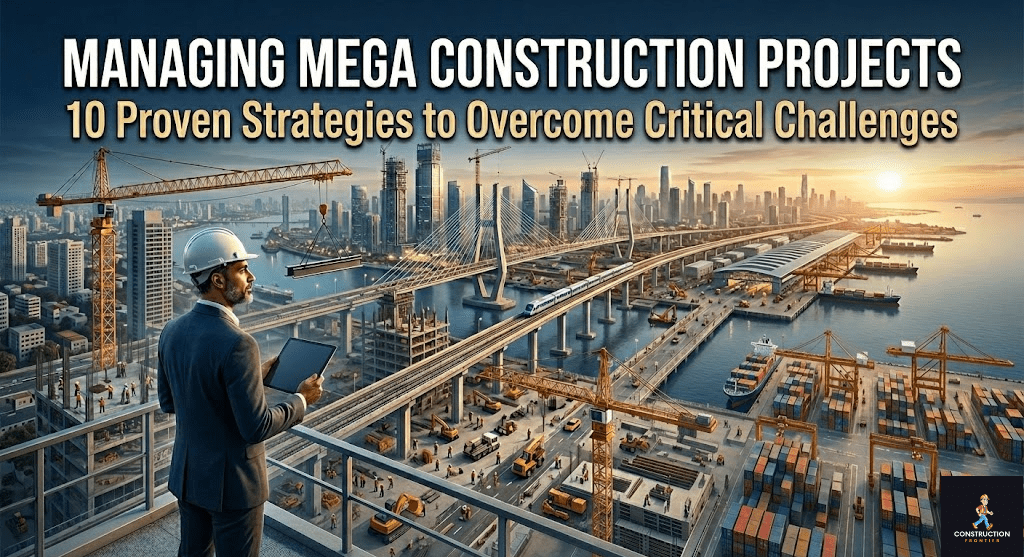
Managing Mega Construction Projects: 10 Proven Strategies to Overcome Critical Challenges
Managing mega construction projects is one of the most demanding disciplines in modern infrastructure delivery. These are capital programmes valued at $1 billion or more, built across compressed timelines, complex geographies, and shifting political landscapes; yet the organisations that master their execution consistently turn transformative ambition into functioning assets. This guide distils the 10 proven strategies that separate successful mega construction project management from the 98% of megaprojects that end in cost overruns or schedule slippage.
Technical Snapshot: Mega Construction Project Profile
| Project Scale | Capital expenditure exceeding $1 billion |
| Timeline | 5 to 25 years from FEED to commissioning |
| Typical Budget Overrun | Average 28–80% above original estimate (Flyvbjerg/McKinsey) |
| Schedule Slippage | Average 20 months beyond the original programme |
| Primary Risk Drivers | Design changes, scope creep, stakeholder misalignment, procurement failures |
| Key Delivery Frameworks | EPC, EPCM, PPP, Alliance Contracting |
| Critical Success Factor | Integrated risk management and digital project controls |
The gap between vision and delivery in large-scale infrastructure project management is almost always a function of execution discipline. Managing mega construction projects successfully requires far more than engineering competence: it demands governance architecture, real-time data systems, and a proactive risk culture embedded from day one.
Introduction: Why Managing Mega Construction Projects Demands a Different Discipline
Managing mega construction projects is fundamentally different from managing standard construction projects. The sheer scale, the concentration of risk, the number of interdependent stakeholders, and the duration of execution introduce systemic complexity that conventional project management frameworks struggle to contain. These are programmes that reshape economies, redefine supply chains, and carry reputational and financial consequences that extend far beyond any individual organisation.
Across the global infrastructure sector, the data on mega construction project performance is sobering. Research by Oxford University professor Bent Flyvbjerg found that nine in ten large infrastructure projects go over budget. McKinsey estimates that global construction inefficiencies cost the sector $1.6 trillion annually, with cost overruns typically ranging from 20% to 45% of original estimates. The McKinsey analysis of megaproject performance also found that a 2022 study of more than 500 capital projects showed cost overruns averaging 79% above initial budget estimates and schedule slippage averaging 52% beyond original timeframes.
Challenges in mega construction projects do not emerge by accident. They are the predictable consequence of insufficient pre-project preparation, inadequate governance, and reactive risk management. A McKinsey review of 48 troubled megaprojects found that poor execution was directly responsible for cost and time overruns in 73% of cases. The remaining 27% were driven by political factors such as regulatory shifts and changes in government, variables that a well-structured governance framework can at least anticipate, if not eliminate entirely.
The strategies examined in this article address both categories. They cover the technical, contractual, and behavioural dimensions of managing complex construction projects: from how projects are structured before a single tender is issued to how digital tools are used to compress the feedback loop between site performance and strategic decision-making during execution. Each strategy is drawn from applied industry evidence, not theoretical frameworks.
Understanding the full lifecycle cost implications is foundational before any of these strategies can be deployed effectively. The infrastructure lifecycle costs and failure modes that derail projects during operation are often seeded during the early engineering and procurement phases, a reality that makes front-end discipline non-negotiable.
Understanding the Mega Project Landscape: Scale, Complexity, and Systemic Risk
Before any management strategy can be applied, project teams need a clear-eyed understanding of what distinguishes mega projects from large-scale construction in general. Size is one dimension, but it is not the defining one. What characterises mega construction project management is the density of interdependencies between design and procurement, between regulatory approvals and site mobilisation, and between primary contractor performance and hundreds of specialist subcontractors operating simultaneously across multiple work packages.
Large-scale infrastructure project management involves coordinating stakeholders who frequently have competing objectives: financiers seeking risk-adjusted returns, governments pursuing political milestones, host communities requiring environmental protections, and contractors managing thin margins under fixed-price commitments. Each of these tensions, if left unmanaged, becomes a source of delay, dispute, or cost escalation.
1.1 Defining Characteristics of Mega Construction Projects
Mega construction projects share a set of defining characteristics that drive their management requirements. Their duration typically spans five to twenty-five years from Front-End Engineering Design (FEED) to commercial operation, meaning that the teams mobilised at project inception rarely see commissioning. Personnel turnover, organisational memory loss, and shifting institutional priorities are structural realities that mega-construction project management must account for explicitly, not as exceptions, but as baseline operating conditions.
Capital concentration is equally defining. Projects where procurement of materials and equipment accounts for 40% to 60% of total project cost require supply chain management that operates more like a global logistics operation than a construction procurement exercise. A single delayed fabrication shipment (structural steel, for example) can stall an entire critical path and cascade delays through multiple dependent packages.
Finally, mega projects almost always operate under public and political scrutiny that no standard construction programme faces. Community relations, environmental compliance, local content requirements, and government oversight introduce a layer of governance complexity that must be designed into the management structure from the outset.
1.2 The True Cost of Mismanagement
The financial consequences of inadequate management of mega construction projects are well documented. McKinsey found that, on average, capital projects overrun budgets and schedules by 30-45%. For rail projects specifically, the average cost overrun reaches 44.7%, while roads average 20% and bridges and tunnels 35%. These are not marginal variances: they represent the destruction of billions in capital and, in the case of publicly funded projects, a direct transfer of cost to national budgets and taxpayers.
Indirect consequences are harder to quantify but often more damaging. Reputational damage to project owners and contractors, the chilling effect on future infrastructure investment, and the social costs of delayed service delivery in sectors such as energy, transport, and water are real and substantial. For African infrastructure markets in particular, where capital is scarcer and investor confidence more fragile, project failures carry outsized systemic consequences.
10 Proven Strategies for Managing Mega Construction Projects
The following strategies represent best-practice synthesis from applied project delivery experience, academic research, and industry analysis. They are sequenced to reflect the project lifecycle: front-end preparation, contracting and governance, execution discipline, and closeout. Implementing all ten cohesively, rather than selectively, defines the difference between projects that deliver and those that become cautionary studies in what managing complex construction projects requires.
| Strategy | Focus Area | Primary Risk Mitigated |
| 1. Invest in FEED | Pre-project engineering | Scope uncertainty, cost baseline instability |
| 2. Select the right delivery model | Contracting structure | Risk misallocation, accountability gaps |
| 3. Build integrated risk registers | Risk governance | Undetected threats, reactive management |
| 4. Deploy digital project controls | Execution visibility | Progress opacity, delayed decision-making |
| 5. Anchor stakeholder management | Governance & relations | Disputes, community opposition, political risk |
| 6. Master supply chain and procurement | Materials & logistics | Procurement delays, cost escalation |
| 7. Enforce change control discipline | Scope management | Scope creep, uncosted variations |
| 8. Build for workforce capability | People & skills | Productivity loss, quality failures |
| 9. Integrate health, safety and environment | HSE performance | Incidents, regulatory shutdowns, and liability |
| 10. Plan the commissioning pathway early | Handover & operations | Delayed start-up, operational underperformance |
Strategy 1: Invest Heavily in Front-End Engineering Design
No strategy in managing mega-construction projects delivers a higher return on investment than the quality of work completed before the first concrete is poured. Front-End Engineering Design, or FEED, is the engineering phase that transforms conceptual project parameters into a sufficiently detailed design basis to support accurate cost estimation, schedule development, and risk identification before the Final Investment Decision (FID) is made.
Projects that underinvest in FEED routinely pay a disproportionate price during execution. Incomplete design at the point of contract award forces engineering rework, generates change orders, and disrupts procurement schedules, triggering the cascade of delays and overruns that defines distressed megaprojects. The 2025 study of large-scale construction projects confirmed this directly: planning errors account for 34.5% of cost overruns and 23.1% of all delays. Most of those planning errors are rooted in insufficient pre-project engineering definition.
The mechanics and strategic value of this phase are detailed in a dedicated analysis of what FEED means in construction and why it matters. The core takeaway is straightforward: the cost of additional engineering rigour at the FEED stage is invariably lower, often by orders of magnitude, than the cost of resolving those same uncertainties during live construction.
1.1 Scope Definition and Cost Basis
A completed FEED package provides the project’s cost and schedule baseline: the foundation against which all future performance will be measured. McKinsey’s research on maximising value through pre-construction excellence found that a major international mining company, by failing to optimise the project before construction, left around $500 million in net present value unrealised, a direct consequence of inadequate front-end preparation. Where the FEED baseline is grounded in detailed material take-offs, confirmed geotechnical data, validated process designs, and completed regulatory pre-assessments, project teams enter execution with confidence.
Best-practice mega construction project management targets a FEED completion that reduces design uncertainty to a level consistent with a Class 3 cost estimate, typically within a +/- 10% to +/- 15% accuracy range. Projects that proceed to FID on a Class 5 or Class 4 estimate, relying on an inadequately completed FEED, are statistically far more likely to experience the overruns that characterise underperforming megaprojects.
1.2 Early Contractor Involvement
How to manage mega construction projects successfully during FEED increasingly involves bringing experienced construction contractors into the engineering phase before contract award. Early Contractor Involvement (ECI) allows constructability reviews to be integrated into design decisions in real time, rather than being identified as problems after lump-sum contracts are signed. ECI arrangements also enable more accurate schedule validation, procurement lead-time assessment, and early supply chain engagement, reducing later procurement risk.
Further Reading: What Is FEED in Construction? 5 Critical Insights Driving Mega Project Success
Mega Construction Project Lifecycle Diagram
The diagram below maps the six phases of a mega-construction project lifecycle from pre-FEED feasibility through to long-term operations and maintenance. Row 1 shows phase headings and typical durations. Row 2 lists representative activities within each phase. Row 3 identifies the key gate review that governs the transition between phases. The arrows represent formal go/no-go decision points, not automatic progressions.
| PHASE 1 Pre-FEED & Feasibility 6 to 18 months | >>> | PHASE 2 FEED 12 to 24 months | >>> | PHASE 3 FID & Procurement 3 to 9 months | >>> | PHASE 4 Construction & Fabrication 24 to 72 months | >>> | PHASE 5 Commissioning & Handover 6 to 18 months | >>> | PHASE 6 Operations & Maintenance 20 to 50 years |
| • Concept selection • Feasibility study • Business case • Stakeholder mapping • Environmental screening | • Design basis • Class 3 cost estimate • Schedule baseline • QRA risk register • Regulatory roadmap • Procurement strategy | • Final Investment Decision • EPC or EPCM award • Long-lead equipment orders • Early Contractor Involvement | • Civil and structural works • Mechanical installation • Procurement execution • BIM coordination • EVM monitoring • HSE management | • Pre-commissioning • System completion • Performance testing • Punch-list clearance • Operations handover | • Asset management • Preventive maintenance • Performance optimisation • Lifecycle cost tracking • Major periodic overhaul | |||||
| Gate 0 Concept Approval | Gate 1 FEED Approval and Budget Sanction | Gate 2 FID — Final Investment Decision | Gate 3 Construction Readiness Review | Gate 4 Mechanical Completion and PAC | Gate 5 Final Acceptance Certificate |
| Coloured box = project phase | >>> = phase transition and gate review | Gate label = formal go or no-go decision point |
Figure: Six-Phase Mega Construction Project Lifecycle — Pre-FEED to Operations and Maintenance. Gate reviews denote formal decision points. Timeframes indicate typical duration ranges; specific projects vary by complexity, geography, and regulatory environment.
Strategy 2: Select the Right Delivery Model and Contracting Structure
The contracting model chosen for a mega construction project is not an administrative decision; it is a risk-allocation decision that shapes every downstream dynamic of project execution. Best strategies for large construction project delivery require that the delivery model align with the project’s complexity, the owner’s technical capacity, and the work’s risk profile. Getting this wrong creates misaligned incentives, accountability gaps, and contractual disputes that consume years and hundreds of millions in arbitration.
The three dominant delivery frameworks for mega construction project management are as follows, each with a distinct risk profile:
- The Engineering, Procurement and Construction (EPC) contract model.
- The Engineering, Procurement and Construction Management (EPCM) model.
- The Public-Private Partnership (PPP) model.
The functional differences between these models and the specific role that EPC contractors play in large-scale project delivery are examined in detail in our Construction Frontier analysis. The core structural principle is that EPC contracts transfer construction risk to a single contractor under a fixed-price lump-sum arrangement, while EPCM retains that risk with the owner in exchange for greater project control.
2.1 EPC Contracts: Single-Point Accountability
Under an EPC contract, a single contractor assumes comprehensive responsibility for engineering, procurement, and construction, typically for a guaranteed price by a fixed completion date. This model is particularly suited to managing mega construction projects where the owner has limited in-house construction management capacity or where lenders require a defined risk-transfer structure as a condition of project financing. The EPC contractor coordinates all design, procurement, and construction work and is contractually liable for cost overruns and delays within its scope.
The discipline that EPC contracts impose on project execution (fixed scope, defined performance benchmarks, and single-point accountability) is one of the most effective tools available for overcoming risks in mega infrastructure projects. However, it requires a sufficiently completed FEED to function effectively. Awarding an EPC contract against an incomplete design basis forces the contractor to price uncertainty into its lump sum, inflating headline costs and creating fertile ground for contractual disputes as that uncertainty resolves into actual scope.
2.2 Alliance and Collaborative Contracting
For projects with genuine technical uncertainty, where fixed-price contracting would result in excessive contingency pricing or contractor insolvency risk, alliance contracting models offer an alternative. Manchester Business School’s report analysis of lessons from managing large infrastructure projects cites Heathrow Terminal 5 as a defining example: it was delivered on schedule and within budget precisely because the client held comprehensive project insurance and treated contractors as team members jointly focused on delivery, rather than adversarial parties managing contractual exposure. These frameworks align the owner’s and contractor’s incentives around shared risk and reward pools.
Alliance contracting is increasingly used in tunnel projects, complex rehabilitation programmes, and infrastructure delivered in politically sensitive environments where design scope cannot be fully resolved at contract award. They are particularly relevant for mega construction projects in African markets where limited contractor capacity, local content requirements, and evolving regulatory frameworks make rigid fixed-price structures commercially unsustainable.
Strategy 3: Build an Integrated Risk Management Architecture
Challenges in mega construction projects are, in their essence, risk events that were inadequately identified, insufficiently mitigated, or poorly monitored during execution. Overcoming risks in mega infrastructure projects requires a risk management architecture that is proactive, integrated across all project functions, and supported by consistent senior leadership engagement, not a compliance exercise completed once at project inception and filed away.
The statistical reality of construction risk is addressed directly in the Construction Frontier analysis of construction risk management facts that every project professional should know. The implications for megaproject management are significant: risk on large-scale programmes is not simply proportional to scale; it is exponentially amplified by interdependency, schedule compression, and stakeholder complexity.
3.1 Risk Register Development and Ownership
An integrated risk register for a mega construction project is not a spreadsheet. It is a living governance document that captures quantified probabilities, financial exposure ranges, mitigation actions, responsible owners, trigger indicators, and residual risk ratings for every identified threat across all project dimensions. Construction risk, geopolitical risk, procurement risk, regulatory risk, and interface risk between packages must each be represented, with clear ownership assigned and regular review cycles enforced.
Best practice in managing complex construction projects assigns risk ownership to the function closest to the risk, not to a central PMO that lacks the operational intelligence to manage it in real time. A procurement delay risk sits with the procurement lead. A regulatory approval risk sits with the government relations function. The central PMO aggregates, escalates, and reports; it does not absorb all risk ownership by default.
3.2 Quantitative Risk Analysis
For capital-intensive megaprojects, qualitative risk ratings are insufficient. Quantitative Risk Analysis (QRA) using Monte Carlo simulation provides the probabilistic cost and schedule distributions that enable owners to make rational contingency allocation decisions. The PMI research on the integration of earned value management and risk management demonstrates that combining EVM indices with probabilistic risk models provides project managers with a far more reliable forward-looking performance signal than either discipline can provide in isolation. Sizing contingency reserves to reflect actual, quantified risk exposure rather than applying arbitrary percentage allowances is the defining difference between professional and superficial risk management on mega construction projects.
QRA also enables the identification of schedule and cost risk drivers, specifically the risks that dominate the P80 and P90 cost outcomes, allowing mitigation resources to be directed where they have the highest impact on project outturn. This is how professional mega-construction project management converts risk analysis from a reporting obligation into a capital allocation tool.
3.3 Key Risk Categories in Mega Construction Project Management
| Risk Category | Examples | Management Response |
| Technical/Design | Incomplete FEED, design clashes, geotechnical surprises | QRA, peer reviews, BIM clash detection |
| Procurement & Supply Chain | Material price volatility, long-lead equipment delays | Early procurement, multi-source strategies |
| Contractual/Legal | Scope disputes, claims, and contractor insolvency | EPC structure, robust change control |
| Regulatory/Political | Permit delays, policy changes, government transitions | Early engagement, regulatory roadmap |
| Community & Social | Land access disputes, protest actions, and resettlement | ESMP, stakeholder management plans |
| Force Majeure | Extreme weather, seismic events, and pandemics | Schedule float, insurance, contingency |
Further Reading: Construction Risk Management: 10 Crucial Facts You Must Know to Avoid Costly Project Failures
Strategy 4: Deploy Digital Project Controls and Real-Time Performance Monitoring
Managing mega construction projects in the current environment without digital project controls is analogous to navigating a complex multi-year financial programme without a consolidated accounts system (operationally possible, theoretically, but practically unsustainable at scale). The information density of a megaproject (thousands of concurrent activities, hundreds of contractors, multiple work packages, parallel procurement streams) exceeds the processing capacity of any manual reporting system.
MDPI’s analysis of capital project performance identified inadequate controls as a defining characteristic of distressed megaprojects: specifically, the absence of robust risk analysis protocols and the failure to provide timely progress reporting against budgets and timelines. Projects relying on payment-based progress metrics, measuring completion by what has been invoiced rather than what has been built, systematically misrepresent project status, leaving management unable to anticipate problems until they become crises.
4.1 Building Information Modelling
Building Information Modelling (BIM) transforms project information management by integrating design, cost, schedule, and operational data into a single centralised model. Deloitte’s analysis of technology integration in construction project delivery identifies BIM integration with Project Management Information System (PMIS), Enterprise Resource Planning (ERP), and digital twin systems as the foundation for predictive and preventive asset maintenance, streamlined cost tracking, and real-time decision-making across contracts, schedules, and quality. For mega construction project management, BIM’s most immediate value is in clash detection: the automated identification of design conflicts between structural, mechanical, electrical, and civil systems before those conflicts reach the construction phase, where resolution costs are orders of magnitude higher.
Beyond clash detection, 4D BIM links the geometric model to the project schedule, enabling visual simulation of construction sequence and logistics planning. 5D BIM extends this by connecting design quantities to cost data, providing real-time earned value analysis at a granularity that traditional cost reporting cannot match. Studies report 20–30% productivity improvements on projects where BIM is deployed systematically across all project phases rather than used selectively within individual disciplines.
4.2 Digital Control Towers and Integrated Project Dashboards
A digital control tower functions as the central data repository and analysis hub for all project performance information. McKinsey’s research on increasing transparency in megaproject execution documented how one company facing overruns on a large petrochemical facility deployed a digital control tower that identified more than $75 million in cost savings within the remaining execution programme, with initial setup completed in weeks. The control tower consolidated cost, schedule, safety, and procurement data into a single integrated view accessible to project leadership, replacing fragmented time-lagged reporting with real-time performance visibility.
Effective control towers consolidate cost, schedule, safety, procurement, and quality data from multiple systems into a single integrated view accessible to project leadership. They replace the fragmented, time-lagged reporting that characterises distressed megaprojects with real-time visibility that supports proactive management rather than reactive crisis response. For organisations managing mega construction projects across distributed geographies, digital control towers are not optional infrastructure: they are the central nervous system of execution.
Strategy 5: Establish Structured Stakeholder and Community Management
Managing complex construction projects demands that stakeholder management be treated as a technical discipline, not a communications afterthought. The community opposition, regulatory delay, and political risk that undermine mega infrastructure projects globally are rarely caused by genuine intractability; they are almost always the consequence of inadequate early engagement, poor expectation management, and failure to integrate stakeholder concerns into project design before positions harden into disputes.
5.1 Stakeholder Mapping and Engagement Strategy
A structured stakeholder management approach for a megaproject begins with a comprehensive mapping exercise that identifies every party with a material interest in the project, from national government ministers and regulatory agencies to local community leaders, environmental NGOs, and project-affected landholders. Each stakeholder group requires a tailored engagement strategy that addresses their specific concerns, aligns with their decision-making authority, and is managed through defined communication channels.
Engagement strategies for mega construction projects operating in Africa and other emerging markets must account for the particular complexity of community relations in contexts where land rights are contested, where project benefits are unevenly distributed, and where historical patterns of exclusion create deep scepticism towards large-scale development. Environmental and Social Management Plans (ESMPs) provide the governance framework for managing these relationships throughout the project lifecycle.
5.2 Managing Government and Regulatory Relationships
Regulatory approval timelines are among the most common and most damaging sources of delay in large-scale infrastructure project management. Permits that were expected in six months take two years. Environmental approvals that should be procedural become political. Construction programmes built on overly optimistic regulatory timelines fall apart before a single contract is awarded.
Best strategies for large construction project delivery treat regulatory engagement as part of the critical path, not as a parallel administrative process. Dedicated government relations functions, pre-consultation with regulatory bodies during FEED, and proactive regulatory roadmaps that sequence approvals against the procurement and construction programme are standard practice on well-managed megaprojects. These are not bureaucratic courtesies. They are schedule-critical risk mitigations.
Further Reading: How EPC Project Delivery Works: 7 Proven Steps Driving Successful Infrastructure Projects
Strategy 6: Master Supply Chain and Procurement Management
Procurement accounts for 40% to 60% of total capital expenditure on most mega construction projects, making supply chain management one of the highest-leverage disciplines in large-scale infrastructure project management. Yet procurement is consistently treated as a downstream execution function rather than a strategic risk management capability, with consequent exposure to the material cost escalation and long-lead equipment delays that have derailed multiple high-profile megaprojects.
Overcoming risks in mega infrastructure projects through procurement requires embedding supply chain strategy into the project from the FEED phase, not from the point of contract award. Long-lead equipment identification, vendor pre-qualification, early orders for critical items, and multi-source strategies for commodities vulnerable to price volatility all require lead times that most projects underestimate.
6.1 Long-Lead Equipment and Early Procurement
Turbines, transformers, specialised steel fabrications, subsea equipment, and custom-engineered process plant components routinely carry fabrication and delivery schedules of twelve to thirty-six months. On a mega project with a five-year construction programme, that means procurement decisions must be made during or immediately after FEED, sometimes before detailed design is complete. Projects that delay these decisions pending full engineering completion create schedule risks that cannot be recovered within the construction programme.
Managing mega construction projects successfully requires a procurement organisation capable of issuing early letters of intent, managing vendor design interfaces, and tracking fabrication progress through regular factory inspections and hold points. This is not standard construction procurement; it is supply chain management in the industrial sense, requiring dedicated resources and rigorous process discipline.
6.2 Local Content and African Infrastructure
For mega construction projects in Africa, local content requirements add a further dimension to procurement complexity. Government mandates requiring minimum percentages of locally sourced labour, materials, and services are increasingly embedded in project approvals and financing conditions. Managing these requirements, particularly for projects in markets with limited local manufacturing capacity, requires detailed local content management plans that map realistic local sourcing against the project’s actual procurement needs.
The procurement and contracting dynamics specific to African infrastructure programmes are explored in the Construction Frontier analysis of common delays in African construction projects, which identifies procurement failures and supply chain disruption as among the most consistent drivers of schedule overrun across the continent.
Strategy 7: Enforce Rigorous Change Control and Scope Management
Scope creep is the quiet destroyer of mega construction projects. Unlike a sudden geotechnical problem or a regulatory shutdown, scope creep accumulates gradually: individual change orders that each appear manageable, cumulatively building into schedule and cost impacts that dwarf the original contingency. Research into large-scale construction project performance consistently identifies changes in project scope as a primary driver of both cost overruns and delays.
Design changes alone account for 56.5% of cost overruns in large-scale construction, underscoring the critical importance of scope lock and formal change control as pillars of megaconstruction project management. Every uncosted design variation, every undocumented scope addition, and every verbal instruction that bypasses the change control process represent an erosion of the cost and schedule baseline that management is accountable for delivering against.
7.1 Change Control Governance
A formal change control system for a mega-project defines the process by which any proposed deviation from the contracted scope is initiated, evaluated, approved, costed, scheduled, and recorded. No change reaches the construction site without a signed change order that captures its cost and schedule impact and identifies the party responsible for absorbing it. This discipline requires cultural enforcement from project leadership, specifically the willingness to reject even minor undocumented changes from powerful stakeholders, supported by contractual backing through clearly defined change management provisions.
On mega construction projects, change control is inseparable from contract administration. The EPC contractor’s right to claim time and cost for changes is governed by the contract. An owner that permits undocumented changes, or that instructs variations verbally without formal follow-up, loses the contractual basis to contest subsequent claims. Maintaining the integrity of the change control record is both a cost management discipline and a legal obligation in managing complex construction projects.
7.2 Scope Freeze and Design Freeze Milestones
Best practice in large-scale infrastructure project management establishes a formal scope freeze. Milestones: agreed points in the project schedule beyond which scope changes require executive approval, explicit cost and schedule impact quantification, and formal contract amendment. Scope freeze disciplines are rarely absolute on megaprojects, where genuine unforeseen conditions and regulatory changes make some variation inevitable. But they create accountability structures that distinguish necessary change from the incremental scope additions that accumulate through insufficient planning.
Strategy 8: Build Workforce Capability and Organisational Resilience
The most sophisticated project control system in the world is inert without the capable people to operate it. Key challenges in mega construction project management include not only technical complexity but also the human capability challenge of assembling, retaining, and developing the professional workforce required for large-scale infrastructure project management.
On mega construction projects in Africa and other emerging economies, workforce challenges extend beyond skill shortages to encompass the physical logistics of deploying large workforces to remote construction sites, managing cultural diversity across international project teams, and navigating local content requirements that mandate minimum proportions of local labour at various skill levels. These are not peripheral HR challenges: they are core to project execution strategy.
8.1 Project Organisational Design
Managing mega construction projects requires an organisational structure tailored to the scale and complexity of the work. McKinsey’s research on leadership practices in ultralarge projects identifies four core mindsets that distinguish successful ultra-large project leaders: constructive decision-making, trust-based relationships, owner accountability, and the recognition that process alone cannot resolve every execution challenge. These mindsets must be adopted across the entire project organisation, not just at the top, because it is at the interface between discipline managers, subcontractors, and site supervisors where execution quality is actually determined.
Key positions (project director, engineering manager, procurement director, construction manager, and HSE director) must be filled before mobilisation, not backfilled during execution. The cost of a leadership vacancy on a mega-project is measured not in salary savings but in weeks of schedule delay and the management dysfunction that cascades when critical coordination roles are unfilled during early execution.
8.2 Knowledge Transfer and Succession Planning
Given the multi-year duration of most mega construction projects, personnel turnover is inevitable. Key challenges in mega construction project management include preserving institutional knowledge across transitions and ensuring that decisions, assumptions, and technical judgements made during early project phases are documented and accessible to teams executing later phases. Knowledge management systems, project lessons-learned databases, and structured handover protocols for key roles are operational requirements, not administrative luxuries.
Strategy 9: Integrate Health, Safety and Environmental Management Systemically
Health, safety, and environmental (HSE) performance on mega-construction projects is both a moral imperative and a commercial risk management priority. A serious safety incident on a mega-project does not merely impose regulatory consequences and human cost: it can trigger construction shutdowns that cascade through the schedule, attract public and media scrutiny that undermines stakeholder confidence, and expose the project owner to legal and reputational liabilities that persist long after physical remediation.
Overcoming risks in mega infrastructure projects through HSE excellence requires that safety is integrated into project design and execution planning, not bolted on as a compliance layer. Temporary works design, construction methodology sequencing, plant and equipment selection and workforce accommodation standards all carry HSE dimensions that must be assessed and managed as part of mega-construction project management from the earliest project phases.
9.1 HSE Management Systems
A project-specific HSE management system defines the governance, procedures, standards, and performance measurement framework within which all construction activities are executed. For mega construction projects involving multiple prime contractors and hundreds of subcontractors, maintaining consistent HSE standards across the contractor hierarchy requires contractual enforcement through HSE pre-qualification, performance KPIs embedded in contract payment terms, and regular third-party auditing of contractor HSE systems.
9.2 Environmental and Social Management
Environmental management on mega infrastructure projects encompasses far more than compliance with permits and mitigation conditions. Large-scale infrastructure project management carries cumulative environmental impacts: changes to hydrological systems, biodiversity disruption, air and noise emissions, and waste generation, all of which require active management programmes, third-party monitoring, and community reporting throughout the full construction programme. Projects that proactively manage these issues maintain their community and regulatory licence to operate; those that reactively manage them invite interventions and shutdowns that destroy the schedule.
Strategy 10: Plan the Commissioning and Handover Pathway from Day One
How to manage mega construction projects successfully is, at its most fundamental level, a question about what it means to finish. Commissioning and handover on a mega project are not administrative events that follow the completion of construction; they are complex, multi-phase technical processes that must be planned with the same rigour as the construction work itself. Projects that treat commissioning as an afterthought routinely experience start-up delays that can stretch to months or years, resulting in revenue losses, financing cost overruns, and operational performance shortfalls that persist long after the ribbon-cutting ceremony.
Best strategies for large construction project delivery embed commissioning planning into the project schedule from the initial FEED baseline. Commissioning sequences, pre-commissioning punch list management, system completion protocols, and the staffing and training of the operational organisation must be resourced and scheduled with the same discipline as civil and mechanical construction activities.
10.1 Integrated System Completion Management
System Completion Management (SCM) is the discipline of managing the transition from construction to operations as a structured, systems-based process. On a complex mega-project (a power plant, a refinery, or a large dam), thousands of individual components must be individually tested, documented, and accepted before systems can be progressively energised and brought to operational readiness. SCM frameworks define the hierarchy of systems, subsystems, and components; track completion status against a defined database; and provide the project team with a real-time view of handover readiness.
Projects that manage this process using paper-based punch lists and manual tracking consistently experience extended commissioning periods, disputed completion milestones, and contractual uncertainty about when project completion has been achieved and when operational warranties commence. Digital SCM platforms that integrate with the project control system provide the transparency and traceability that large-scale infrastructure project management requires at the handover interface.
10.2 Operations Readiness and Training
A mega project that reaches mechanical completion without a trained, equipped operations team is not complete. Operations Readiness (OR) planning ensures that the organisational structure, recruitment, training, maintenance systems, spare parts inventory, and operational procedures required to manage the completed facility are in place before commissioning commences. On African mega projects where the operational organisation is often being built from scratch alongside the construction programme, OR planning requires a multi-year resourcing strategy that runs in parallel with the construction schedule.
Further Reading Infrastructure Lifecycle Costs: 5 Critical Reasons Traditional Procurement Models Fail to Optimise Value
Summary: Top 10 Mega Construction Project Challenges vs. Solutions
The table below maps the ten most critical challenges in mega construction project management to their root drivers, typical financial and schedule impact, and proven management responses. Severity ratings reflect aggregate frequency and financial exposure documented across McKinsey, PMI, Oxford megaproject research (Flyvbjerg), and ASCE published studies.
| # | Challenge and Root Driver | Typical Impact | Recommended Solution | Severity |
| 01 | Cost Overruns Undercosted FEED, scope creep, design changes | Average 28 to 80% above the initial estimate | Class 3 cost estimate at FEED; fixed-price EPC contract; rigorous change control; QRA-based contingency sizing | CRITICAL |
| 02 | Schedule Slippage Procurement delays, design rework, and regulatory lag | Average 20 or more months beyond the programme | CPM scheduling with baseline integrity; early procurement of long-lead items; regulatory engagement on the critical path | CRITICAL |
| 03 | Scope Creep Incomplete design at contract award; undocumented variations | Design changes cause 56.5% of cost overruns | Scope freeze milestones; formal change control system; signed change orders required before any site instruction | CRITICAL |
| 04 | Stakeholder and Community Opposition Inadequate early engagement; unresolved land and social impacts | Construction stoppages, permit revocation, and litigation | Stakeholder mapping from FEED phase; Environmental and Social Management Plan; dedicated government relations function | HIGH |
| 05 | Procurement and Supply Chain Failure Late equipment orders; single-source dependency; price volatility | Critical path delays; cost escalation on bulk materials | Procurement strategy embedded in FEED; long-lead equipment identification; multi-source strategies; factory inspection hold points | HIGH |
| 06 | Inadequate Risk Management Qualitative-only risk registers; no QRA; dispersed ownership | Undetected threats escalate into crises | Integrated risk register with quantified exposure; Monte Carlo QRA; function-level risk ownership; regular senior leadership review | HIGH |
| 07 | Contractor Performance and Insolvency Underbid contracts; thin margins; inadequate subcontractor management | Work suspension; disputes; replacement procurement delays | Robust contractor pre-qualification; EPC single-point accountability; performance bonds; step-in rights in contract | HIGH |
| 08 | Governance Opacity and Reporting Failure Construction-centric KPIs; progress overstated; no EVM | Overruns are masked until unrecoverable | Earned Value Management; digital project control tower; independent schedule audits; payment-based progress metrics eliminated | MEDIUM |
| 09 | Skills Shortage and Workforce Gaps Remote locations; local content mandates; specialist skill scarcity | Productivity loss; quality failures; safety incidents | Operations Readiness planning; early training programmes; knowledge management systems; structured leadership handovers | MEDIUM |
| 10 | Commissioning Delays and Start-Up Failure Commissioning planned late; system completion unmanaged; operations team not ready | Delayed revenue; warranty disputes; sustained underperformance | Commissioning pathway in baseline schedule; System Completion Management; Operations Readiness programme running parallel to construction | MEDIUM |
Table: Top 10 Challenges in Managing Mega Construction Projects — Root Drivers, Impacts, and Recommended Solutions. Source: Construction Frontier synthesis of McKinsey Capital Projects, PMI Megaproject Research, and Flyvbjerg / Oxford Major Programme Management data.
Technical Reference: Mega Construction Project Management Frameworks
Managing billion-dollar infrastructure assets requires a move beyond traditional oversight toward rigorous, data-driven governance. Megaprojects are uniquely susceptible to optimism bias and structural fragmentation; therefore, success depends on the integration of quantitative performance metrics, disciplined scheduling, and globally recognised legal frameworks. This reference details the essential components of the accountability architecture, covering Earned Value Management (EVM), critical path integrity, FIDIC contract standards, and the specific KPIs required to maintain control over complex, multi-year delivery timelines.
1. Earned Value Management in Mega Project Controls
Earned Value Management (EVM) is the quantitative foundation of performance measurement in managing mega construction projects. It integrates scope, schedule, and cost into a single performance measurement framework, expressing the value of completed work relative to planned value and actual cost to produce the Cost Performance Index (CPI) and the Schedule Performance Index (SPI). The PMI’s analysis of risk analysis to support strategic and project management confirms that EVM-based cost and schedule risk analysis supports strategic decision-making at the megaproject portfolio level, not just at the level of individual work packages, enabling organisations to manage capital project selection and resource optimisation across concurrent programmes.
On a mega project with hundreds of work packages and billions in capital expenditure, EVM provides the only reliable basis for forecasting final cost and schedule outcomes. Projects managing mega construction programmes without EVM-based controls rely on contractor-reported physical progress data that is structurally incentivised to overstate completion, producing the systematic optimism bias that masks developing overruns until they become unrecoverable.
| EVM Metric | Formula | Management Signal |
| Cost Variance (CV) | Earned Value – Actual Cost | Positive = under budget; Negative = over budget |
| Schedule Variance (SV) | Earned Value – Planned Value | Positive = ahead of schedule; Negative = behind |
| Cost Performance Index (CPI) | Earned Value ÷ Actual Cost | < 1.0 signals cost escalation trajectory |
| Schedule Performance Index (SPI) | Earned Value ÷ Planned Value | < 1.0 signals schedule slippage trajectory |
| Estimate at Completion (EAC) | Budget ÷ CPI | Projected final cost based on current performance |
2. Critical Path Method and Programme Management
Critical Path Method (CPM) scheduling is the universal language of large-scale infrastructure project management. McKinsey’s research on schedule optimisation in capital projects found that a basic-materials company that standardised modular architecture across its project portfolio achieved a 15% reduction in project lead time, 50% savings in engineering costs and a 60% decrease in rework costs: outcomes directly attributable to schedule discipline combined with design standardisation. These gains are only achievable when the CPM baseline remains intact as a reference against which actual progress is honestly measured.
Programme management for mega construction projects requires baseline schedule integrity: the discipline of maintaining the original approved programme as a reference against which all actual progress is measured, rather than progressively revising the baseline to match actual performance. Baseline revision destroys the project’s ability to measure true schedule variance and undermines the management accountability that the schedule is supposed to enforce.
3. FIDIC Contract Frameworks
The International Federation of Consulting Engineers (FIDIC) contract suite provides the internationally recognised legal framework most commonly used in managing mega construction projects across Africa, the Middle East, Asia, and Europe.
- The FIDIC Silver Book (EPC/Turnkey): It governs lump-sum turnkey contracts.
- The FIDIC Gold Book: It governs design-build-operate programmes.
- The FIDIC Rainbow Suite: It provides frameworks for reimbursable and management contractor arrangements.
FIDIC contracts embed risk allocation, dispute resolution, variation management, and time extension claim procedures into a standardised legal framework that project finance lenders recognise and accept. For mega projects seeking multilateral development bank funding from the African Development Bank, the World Bank, or development finance institutions, FIDIC compliance is frequently a financing condition, making familiarity with FIDIC contract administration a core competency in managing complex construction projects.
4. Key Performance Indicators for Mega Project Management
| KPI Category | Metric | Target Benchmark |
| Cost Performance | CPI (monthly) | > 0.95 |
| Schedule Performance | SPI (monthly) | > 0.95 |
| Safety | Lost Time Injury Frequency Rate | < 0.1 per 200,000 hours |
| Quality | Non-Conformance Report (NCR) closure rate | > 90% within 30 days |
| Procurement | On-time delivery rate for critical materials | > 95% |
| Commissioning | System completion punch items outstanding | Zero Type A items at handover |
Conclusion: Execution Discipline is the Defining Variable
Managing mega construction projects successfully is not a function of project size, funding availability, or engineering complexity alone. It is, above all, a function of execution discipline: the systematic application of the strategies, tools, and governance structures that translate ambition into operational infrastructure. The data is consistent: projects that invest in FEED, select appropriate delivery models, build integrated risk management frameworks, deploy digital controls, and maintain stakeholder and supply chain discipline consistently outperform those that do not.
Challenges in mega construction projects are real and substantial. Structural cost pressures, geopolitical volatility, supply chain fragility, and the sheer complexity of coordinating thousands of people across multi-year programmes create conditions where failure is always the path of least resistance. What separates successful mega-project delivery from the statistical majority is the organisational will to apply the proven strategies described here, not partially, not selectively, but as a coherent and integrated management system.
For Africa’s infrastructure development pipeline, which spans hundreds of billions of dollars in energy, transport, water, and industrial projects, the stakes of getting this right extend beyond individual projects. Each mega construction project that delivers on time and within budget strengthens the investment case for the next. Each failure erodes the institutional confidence and investor appetite that the continent’s infrastructure transformation requires. Mega construction project management, done well, is infrastructure development at scale. Done poorly, it is a generational setback.
The ten strategies examined in this article are not theoretical constructs. They are the operational foundations of every mega-infrastructure project delivered. Understanding them, applying them, and holding project organisations accountable to them, as well as knowing how to choose a contract strategy, is how the industry closes the gap between what gets approved and what gets built.
Stay Updated on Africa’s Infrastructure Megaprojects
Stay ahead of Africa’s infrastructure transformation with Construction Frontier: Civil Engineering & Construction Practices. Explore deep technical insights, expert analysis, and investment intelligence shaping the future of African construction and large-scale infrastructure delivery.