EPC vs Design-Bid-Build vs PPP: 7 Powerful Differences Every Infrastructure Leader Must Know
The EPC vs Design-Bid-Build vs PPP decision is one of the most consequential choices in infrastructure procurement. Each model distributes risk, cost, and control differently, and selecting the wrong construction contract model for a given project can trigger delays, disputes, and fiscal exposure that take years to unwind. This EPC vs Design-Bid-Build vs PPP comparison breaks down seven structural differences that every infrastructure leader, procurement officer, and project financier must understand before committing to a contract model.
Contract Model Snapshot: Core Procurement Specifications
| Attribute | Details |
| Procurement Models Compared | EPC (Engineering, Procurement, Construction); Design-Bid-Build (DBB); Public-Private Partnership (PPP) |
| Primary Differentiator | Risk allocation, financing source, and contract duration |
| Typical Contract Value | EPC: USD 50M to 10B+; DBB: any scale; PPP: USD 100M to 5B+ |
| Project Lifespan Covered | EPC: Construction only; DBB: Construction only; PPP: Construction plus 15 to 35 years O&M |
| Financing Responsibility | EPC and DBB: Public or owner-financed; PPP: Private-sector financed |
| Risk Profile | EPC: Contractor; DBB: Owner; PPP: Shared with private partner |
| Global Usage Context | DBB most common globally; EPC is dominant in energy and industrial; PPP is growing in Africa and emerging markets |
The EPC vs Design-Bid-Build vs PPP question sits at the intersection of procurement strategy, financial engineering, and risk governance. Across Africa’s infrastructure pipeline, where project values regularly exceed USD 500 million and sovereign fiscal capacity is constrained, choosing the right construction procurement model shapes not only delivery outcomes but also long-term national balance sheets.
Introduction: EPC vs Design-Bid-Build vs PPP Explained
No procurement model is inherently superior. The debate over EPC vs Design-Bid-Build vs PPP is ultimately a question of context: project complexity, risk appetite, government capacity, financing availability, and operational horizon. Yet infrastructure leaders across Africa and emerging markets persistently apply the wrong model to the wrong project, generating cost overruns, contractual disputes, and stranded assets that consume political capital for decades. The EPC vs Design-Bid-Build vs PPP question deserves the same rigour applied to technical design and financial modelling.
A credible construction contract model comparison starts with a clear-eyed view of what each model is designed to achieve. Design-Bid-Build (DBB) separates the design and construction mandates into sequential phases, keeping the owner in control while absorbing the bulk of the risk. EPC transfers engineering, procurement, and construction responsibility to a single contractor under a fixed-price turnkey arrangement. PPP goes further, drawing private capital into the financing stack and extending the contractor’s responsibility across the full operational lifecycle of the asset. Each model represents a distinct set of infrastructure procurement methods, and each carries a different risk profile, governance requirement, and financing logic.
The EPC vs PPP vs Design-Bid-Build comparison is also a conversation about institutional capacity. An owner with limited project management resources will perform differently under each model, and the decision should account for that reality as clearly as it accounts for budget and technical scope. Effective management of mega construction projects demands that procurement officers and project sponsors read the structural logic of each model before signing a contract. The seven EPC vs DBB vs PPP differences outlined here are not academic distinctions. They are the fault lines along which projects succeed or fail.
Difference 1: Contract Structure and Single-Point Accountability
The most visible distinction in any EPC vs Design-Bid-Build vs PPP comparison is how responsibility is formally distributed across the contract chain. Each model creates a fundamentally different organisational logic, and that logic determines every downstream decision on the project. The differences between EPC, PPP, and DBB contracts begin here, at the structural level, before a single line of design is drawn.
1.1 Design-Bid-Build: Fragmented Accountability
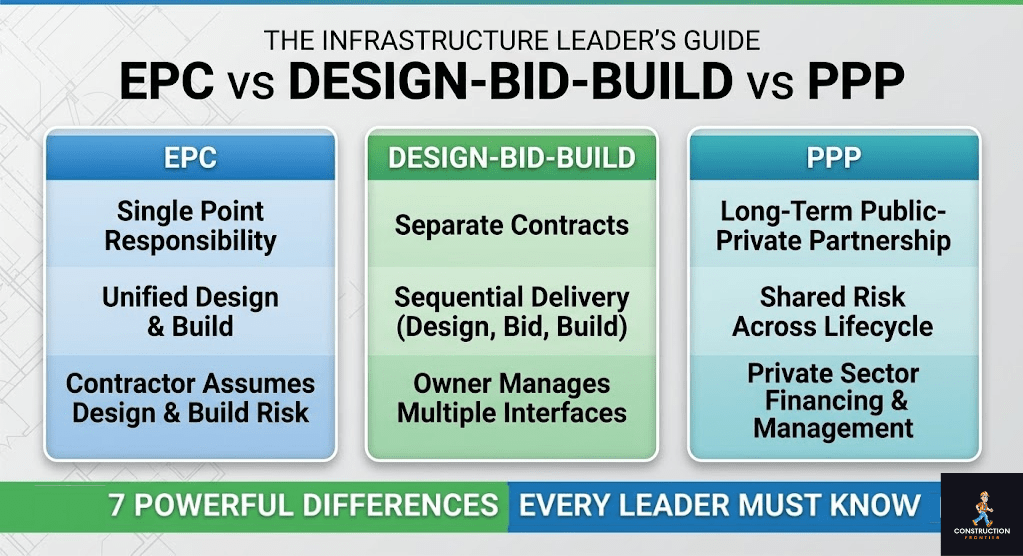
In the DBB model, the owner holds two separate contracts: one with the designer and one with the construction contractor. Design reaches 100 percent completion before the project goes to tender, and the owner acts as the integration layer between the two parties. This separation, while administratively clean, creates conditions for adversarial dynamics. When construction-phase problems emerge, the designer points to execution, and the contractor points to the drawings, leaving the owner to resolve competing claims at their own cost.
Understanding the role of EPC contractors in replacing this fragmented model clarifies precisely why single-point accountability matters. Under DBB, that exposure stays entirely open.
1.2 EPC: Single-Point Responsibility
EPC restructures accountability by consolidating engineering, procurement, and construction under one contractual relationship. The owner specifies outcomes (energy output, throughput capacity, and efficiency standards), and the EPC contractor determines how to deliver them. This is the foundational structural shift in the EPC vs DBB vs PPP differences framework: a single party absorbs design risk, procurement risk, and construction risk simultaneously. As a type of construction contract comparison, this is EPC’s defining advantage over DBB.
1.3 PPP: Lifecycle Accountability
PPP extends the accountability horizon beyond construction into operation and maintenance, often across 20 to 35 years. The private partner is not only responsible for building the asset but also for maintaining its performance to contractual standards across its full operational life. This creates a powerful alignment incentive: a contractor who will operate what they build has an inherent interest in constructability, materials quality, and system reliability that neither DBB nor EPC can replicate. In the EPC vs Design-Bid-Build vs PPP comparison explained, this lifecycle accountability is PPP’s structural signature.
Difference 2: Risk Allocation and Who Bears Cost Overruns
Risk allocation is the central variable in the EPC vs PPP vs Design-Bid-Build comparison. The distribution of cost overrun exposure, schedule risk, and performance liability defines the financial character of each model and determines its appropriateness for any given project context. Any serious construction contract model comparison must resolve this question first. The differences between EPC, PPP, and DBB contracts are sharpest here: no other variable separates the three models as definitively as who absorbs the cost when something goes wrong.
2.1 Owner Carries the Risk in DBB
Under Design-Bid-Build, the owner retains the dominant risk position. Because design and construction are sequenced and contracted separately, scope changes during construction generate change orders that accrue directly to the owner’s account. The owner proceeds through the design phase without a firm construction cost figure, and the winning bid often reflects aggressive pricing rather than accurate estimation. Complications discovered during the build translate into claims, variations, and protracted negotiations. As the common delays in African construction projects‘ records confirm, this dynamic is particularly damaging in markets where institutional capacity to manage claims is limited. This is the sharpest practical lesson in any EPC vs Design-Bid-Build vs PPP evaluation: DBB leaves public owners exposed.
2.2 Contractor Risk Dominates in EPC
The EPC model inverts this logic. The contractor accepts a lump-sum fixed price and absorbs cost overrun risk in full. Hidden site conditions, procurement delays, and design revisions: under a properly structured EPC contract, these risks transfer to the contractor. The owner’s primary financial exposure is the agreed contract sum, not an open-ended construction budget. This cost certainty is the primary driver of EPC’s dominance in energy infrastructure, where project values routinely exceed USD 1 billion, and lender underwriting requires predictable capex.
Robust construction risk management in EPC procurement centres on the quality of scope definition. A poorly specified output requirement shifts risk back to the owner through performance claims and variation disputes. The Front-End Engineering Design (FEED) process is the instrument through which owners lock in scope definition before going to EPC tender, directly controlling their downstream exposure. When choosing the right construction procurement model for energy or industrial assets, FEED completion is non-negotiable.
2.3 Shared Risk in PPP
PPP does not eliminate risk. It structures risk distribution across public and private parties according to who is best positioned to manage each category. Construction risk transfers to the private partner. Demand and revenue risk are negotiated: concession-based PPPs (toll roads, seaports, airports) expose the private partner to traffic or throughput volatility, while availability-payment PPPs guarantee a public-sector payment stream regardless of demand, reducing but not eliminating sovereign fiscal exposure. Political risk, regulatory risk, and force majeure are typically shared through carefully negotiated contract provisions. This nuanced structure is central to any EPC vs Design-Bid-Build vs PPP assessment for revenue-generating infrastructure.
Further Reading: What Is FEED in Construction? 5 Critical Insights Driving Mega Project Success
Difference 3: Financing Structure and Capital Source
The three infrastructure procurement methods differ fundamentally in how they source and structure capital. This distinction is especially consequential in Africa, where public balance sheets are constrained, and the infrastructure financing gap exceeds USD 100 billion annually. Understanding the financing architecture in any EPC vs Design-Bid-Build vs PPP analysis is as important as understanding the construction mechanics. The EPC vs DBB vs PPP differences in capital structure ultimately determine which financing instruments are available, which lenders will participate, and what risk premium the project must absorb.
3.1 Public Capital in DBB and EPC
Both DBB and EPC are owner-financed models. The government or project sponsor provides the capital, whether from the national budget, multilateral development bank lending, or bilateral concessional finance. The contractor receives progress payments as work is completed. This model is straightforward and gives the public sector full financial control, but it places the entire fiscal burden on the owner and crowds out spending in other public priorities. In the spectrum of types of construction contracts, DBB and EPC share this capital structure even as they diverge on risk and accountability.
3.2 Private Capital in PPP
PPP’s defining characteristic, within any EPC vs Design-Bid-Build vs PPP comparison explained, is its use of private capital to finance infrastructure delivery. The private partner (typically a special purpose vehicle combining equity from sponsors and debt from commercial lenders) funds the project upfront and recovers its investment over the concession period through user fees or availability payments. This structure allows governments to deliver infrastructure without immediate fiscal outlay, though the long-term cost of private financing generally exceeds the cost of sovereign borrowing.
The infrastructure lifecycle costs and failures analysis is essential in PPP procurement precisely because the private partner’s return depends on whole-life cost management. Projects that appear competitive at financial close can generate significant long-term fiscal liabilities if availability payment structures are poorly designed. This is a critical point for infrastructure leaders choosing the right construction procurement model in fiscally constrained environments.
EPC vs Design-Bid-Build vs PPP: Full Comparison Table
The table below consolidates the seven structural differences between EPC, PPP, and DBB contracts across the key procurement variables that shape project outcomes. This EPC vs PPP vs Design-Bid-Build reference is designed for decision-makers who need a rapid read on which contract model is best for infrastructure projects before entering procurement. It does not replace contextual analysis, but it anchors the EPC vs Design-Bid-Build vs PPP comparison explained in verifiable structural facts.
| Factor | EPC | Design-Bid-Build (DBB) | PPP |
| Contract Structure | Single lump-sum turnkey | Separate design and construction contracts | Long-term concession or availability payment |
| Risk Ownership | The contractor bears cost and schedule risk | The owner retains most risk | Shared: construction to contractor; demand or revenue risk negotiated |
| Financing Source | Owner or government-funded project | Owner or government-funded project | Private sector finances; recoups via user fees or availability payments |
| Project Duration | Medium-term (2 to 7 years) | Longer due to sequential phases | Long-term (15 to 35 years, including O&M) |
| Owner Control | Low during execution | High throughout | Low during the concession period |
| Cost Certainty | High (fixed price) | Lower (change order exposure) | High once financial close is achieved |
| Best For | Industrial, energy, infrastructure turnkey | Public buildings, standard civil works | Roads, ports, airports, and utilities need private capital |
Difference 4: Project Timeline and Delivery Speed
Delivery speed is a practical differentiator often understated in formal construction contract model comparison frameworks. Sequential phase structures, competitive bidding processes, and financing timelines all affect when infrastructure becomes operational. In African markets, where delays compound economic costs and political cycles constrain implementation windows, timeline differences between EPC vs Design-Bid-Build vs PPP can be decisive.
4.1 DBB’s Sequential Constraint
Design-Bid-Build is structurally sequential: design must reach 100 percent completion before procurement, and procurement must close before construction begins. This prevents fast-track execution and creates multiple delay points. Any extension in the design phase propagates directly into the construction start date. In the differences between EPC, PPP, and DBB contracts, the timeline gap between DBB and EPC is most pronounced precisely because EPC enables concurrent engineering.
4.2 EPC’s Concurrent Engineering Advantage
EPC enables front-loaded schedule compression. Because a single contractor controls engineering, procurement, and construction, design development, and material procurement can proceed in parallel. Long-lead equipment (turbines, transformers, specialised piping) enters the supply chain months before detailed engineering is complete. On large energy or industrial projects, this overlap reduces overall project duration by 15 to 30 percent compared with a sequential DBB approach. For infrastructure leaders evaluating EPC vs DBB vs PPP differences on time-critical assets, this compression is a commercial argument in its own right.
4.3 PPP’s Extended Timeline to Financial Close
PPP procurement introduces a different timeline dynamic. Before construction can begin, the private consortium must achieve financial close: securing equity commitments and executing project finance debt facilities. This process, involving multiple lenders, legal advisors, insurance providers, and government counterparties, routinely takes 18 to 36 months on complex African PPP transactions. Choosing the right construction procurement model in time-critical situations requires weighing PPP’s long pre-construction pipeline against its financing and lifecycle benefits.
Difference 5: Owner Control and Design Influence
The inverse of risk transfer is control. In the EPC vs PPP vs Design-Bid-Build framework, the models that transfer the most risk also surrender the most owner control over design decisions, procurement choices, and operational standards. This trade-off is central to any EPC vs Design-Bid-Build vs PPP evaluation for public-sector clients with accountability obligations. When choosing the right construction procurement model, the owner’s internal technical capacity and governance requirements weigh as heavily as project cost and risk profile.
5.1 Maximum Control in DBB
DBB preserves the highest degree of owner control. The design is developed entirely to the owner’s specifications before procurement opens, and the owner retains full authority over design changes throughout. For public-sector clients with strong technical departments and specific design requirements (civic buildings, heritage infrastructure, and complex urban works), this control has genuine value. The owner approves every drawing, specifies every material, and retains the right to modify the scope at any time, though at the cost of variation orders.
5.2 Reduced Owner Involvement in EPC
How the EPC project delivery works deliberately reduces owner involvement during execution. Once the contract is executed and scope specifications are locked, the EPC contractor manages engineering decisions, procurement sourcing, and construction methodology with significant autonomy. The owner’s primary touchpoint is milestone verification and performance testing at completion. Owners unaccustomed to this model can find the reduced visibility uncomfortable, particularly in markets where political accountability demands demonstrable oversight of public expenditure. Resolving this tension is one of the practical challenges in EPC vs Design-Bid-Build vs PPP selection for African government clients.
5.3 Contractual Governance in PPP
In PPP, the owner’s control is exercised through the contract rather than through day-to-day project management. The concession agreement defines output specifications, service level standards, payment triggers, and default remedies. The owner monitors compliance rather than directing execution. This requires sophisticated contract management capacity on the public side, a capability that research on Sub-Saharan Africa PPP performance consistently identifies as underdeveloped and a leading cause of suboptimal outcomes.
Further Reading: Infrastructure Lifecycle Costs: 5 Critical Reasons Traditional Procurement Models Fail to Optimise Value
Difference 6: Project Suitability and Sector Application
The EPC vs Design-Bid-Build vs PPP decision is ultimately sector-specific. Each model has evolved in response to the characteristics of particular infrastructure categories, and applying a model outside its natural domain consistently produces dysfunction. The types of construction contract questions cannot be answered without a clear read of sector conditions, technical complexity, and the ownership structure of the asset. Across the types of construction contracts available to infrastructure sponsors, the sector application criteria are among the most reliable decision anchors.
6.1 DBB: Public Buildings and Standard Civil Works
Design-Bid-Build remains the dominant model for publicly procured buildings, schools, hospitals, courthouses, and standard road construction. These are projects where design specifications are well understood, technical complexity is moderate, and competitive pricing is the primary procurement objective. DBB’s alignment with public tender regulations makes it the default for government infrastructure procurement methods across most African jurisdictions. The transparency of the open bidding process supports accountability requirements and audit compliance, even if it foregoes the efficiency benefits of integrated delivery.
6.2 EPC: Energy, Industrial, and Complex Infrastructure
EPC dominates in energy generation, oil and gas processing, petrochemicals, large-scale water treatment, and telecommunications infrastructure. These sectors are characterised by high technical complexity, significant procurement risk in equipment sourcing, and binary performance requirements: the plant either produces the specified output or it does not.
In any EPC vs Design-Bid-Build vs PPP comparison explained for energy assets, the answer is almost always EPC. This holds across the continent, from hydroelectric projects in the Congo Basin, such as the Grand Inga Dam, to utility-scale solar in the Sahel, such as the Benban Solar Park. When evaluating which contract model is best for infrastructure projects in the power sector, EPC’s fixed-price turnkey structure is the benchmark. The EPC vs DBB vs PPP differences in procurement risk are most consequential in this category, where equipment sourcing timelines and performance guarantees make integrated delivery essential.
6.3 PPP: Revenue-Generating or Service-Critical Assets
PPP is most effective for infrastructure that generates user revenue or delivers a quantifiable public service over a long operational horizon: toll roads, seaports, airports, bridges, water utilities, and urban transit systems. The model requires a sufficiently large and predictable demand base to support private financing and functions best in regulatory environments that offer contractual certainty across political cycles.
Lesotho’s Queen Mamohato Memorial Hospital PPP (covering design, construction, financing, and operation) is frequently cited as a benchmark for healthcare infrastructure delivery under constrained fiscal conditions. It illustrates precisely why choosing the right construction procurement model requires reading both the asset type and the institutional environment. Across all types of construction contracts, PPP is the most demanding to structure and the most powerful when conditions are right. Understanding which contract model is best for infrastructure projects in any revenue-generating category begins with this model.
Difference 7: Lifecycle Cost Management and Long-Term Value
The final and most strategically significant difference in the EPC vs PPP vs Design-Bid-Build comparison concerns the total cost of ownership. Capital cost is only the first instalment in an infrastructure asset’s fiscal profile. Operating cost, maintenance expenditure, and end-of-life renewal can dwarf the original construction budget over a 30-year horizon. No infrastructure procurement method analysis is complete without addressing this dimension.
The construction contract models comparison shifts decisively in favour of PPP when lifecycle cost is the primary evaluation criterion, and any assessment of which contract model is best for infrastructure projects in the operational infrastructure category must weigh this advantage carefully. Similarly, the types of construction contracts most suited to long-tenure public assets are those that build operational accountability into their core contractual structure.
7.1 DBB’s Lifecycle Blind Spot
Design-Bid-Build has no structural mechanism for managing lifecycle cost. The designer optimises for upfront construction cost and design elegance; the contractor optimises for margin within the bid price. Neither party has a contractual stake in what the asset costs to operate. Owners who deploy DBB without rigorous whole-life cost analysis during the design phase routinely commission infrastructure that is inexpensive to build but expensive to maintain. This pattern is extensively documented across African public infrastructure and represents one of the most persistent failures in the EPC vs Design-Bid-Build vs PPP decision history of the continent.
7.2 EPC’s Construction-Phase Focus
EPC improves on DBB by aligning design and construction decisions within a single entity, enabling value engineering that reduces both construction cost and operational complexity. However, the EPC contractor’s mandate typically ends at practical completion and performance testing. Once the asset is handed over, the owner absorbs the full operational costs. The EPC vs DBB vs PPP differences in lifecycle cost, therefore, require EPC clients to invest heavily in operations planning before handover, a step that is frequently underresourced in African project programmes.
7.3 PPP’s Whole-Life Incentive
PPP’s structural advantage in lifecycle cost management is its most compelling argument for revenue-generating infrastructure. A private partner who designs, builds, finances, and operates the asset for over 25 years has a direct financial incentive to minimise total lifecycle cost. Specifying durable materials, commissioning efficient mechanical systems, and designing for maintainability are not altruistic choices. They are commercial imperatives that reduce the private partner’s operating expenditure over the concession period. This alignment is precisely why PPP has gained traction in infrastructure categories where maintenance failure historically follows public ownership. It is the dimension that most clearly distinguishes EPC vs Design-Bid-Build vs PPP at the strategic level.
Further Reading: How EPC Project Delivery Works: 7 Proven Steps Driving Successful Infrastructure Projects
Technical Block: Procurement Model Selection Framework
Selecting between EPC, Design-Bid-Build, and PPP requires a structured assessment across the seven dimensions examined here. The criteria below reflect best practice in infrastructure procurement method selection for complex projects. Applying them reduces the risk of model mismatch, which remains one of the most common and costly errors in African infrastructure delivery. This selection framework translates the EPC vs Design-Bid-Build vs PPP comparison explained throughout this article into actionable procurement guidance. The construction contract models comparison reduces to a disciplined matching of project conditions against contract logic: the right EPC vs PPP vs Design-Bid-Build answer is always contextual, never default.
Key Selection Criteria
| If your project has… | Consider… | Because… |
| High technical complexity, fixed budget, single-outcome objective | EPC | Risk and cost certainty are transferred to the contractor |
| Standard design, public accountability requirements, competitive market | Design-Bid-Build | Transparent bidding preserves owner control and audit compliance |
| Revenue-generating or service-critical asset, constrained public capital | PPP | Private financing and lifecycle alignment reduce fiscal burden |
| Political urgency but limited fiscal headroom | PPP (availability payment) | Defers capex while guaranteeing service delivery |
| Well-understood scope, low complexity, strong in-house technical team | Design-Bid-Build | Owner control outweighs integration benefits |
Conclusion: Beyond Defaults — Mastering the EPC, PPP, and DBB Framework for Project Success
The EPC vs Design-Bid-Build vs PPP comparison is not a preference exercise. It is a risk architecture decision with direct consequences for project cost, delivery speed, and long-term asset performance. DBB preserves owner control at the cost of risk retention and sequential inefficiency. EPC transfers risk and accelerates delivery at the cost of owner visibility and contractual flexibility. PPP extends the model’s logic into private financing and lifecycle management, at the cost of procurement complexity and extended pre-construction timelines. Understanding these differences between EPC, PPP, and DBB contracts is the foundation of any credible infrastructure procurement strategy.
For Africa’s infrastructure pipeline (characterised by constrained public budgets, large project scale, and decades of deferred maintenance), the construction contract model comparison must be applied with rigour and project specificity. The differences between EPC, PPP, and DBB contracts examined across these seven dimensions give infrastructure leaders a structured basis for that decision. Those who understand which contract model is best for infrastructure projects are not those who default to the familiar. They are those who read risk, capital, and operational context clearly before the contract is signed. That analytical discipline, grounded in a thorough EPC vs Design-Bid-Build vs PPP comparison explained at the outset of every procurement, is what separates projects that deliver from projects that litigate.
For a broader operational framework, the pillar guide on managing mega construction projects covers the full range of delivery strategies, governance structures, and execution disciplines that underpin successful infrastructure programmes at scale.
Stay Updated on Africa’s Infrastructure Megaprojects
Stay ahead of Africa’s infrastructure transformation with Construction Frontier: Civil Engineering and Construction Practice. Explore the infrastructure procurement methods, deep technical insights into infrastructure projects, expert contract model analysis, and investment intelligence shaping the future of African infrastructure procurement and project delivery.