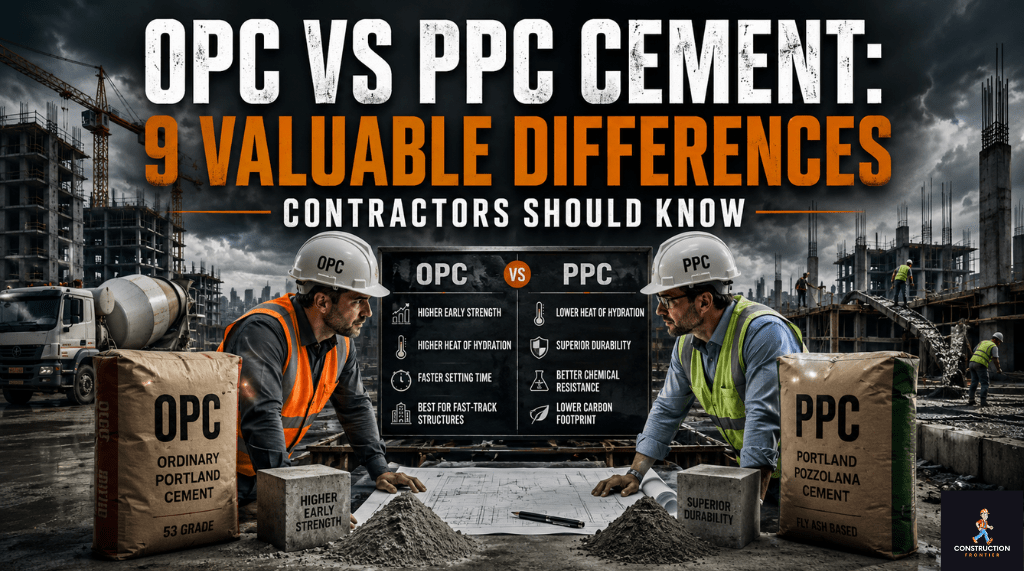
OPC vs PPC Cement: 9 Valuable Differences Contractors Should Know
OPC vs PPC cement are the two dominant binder types in construction, each with distinct chemical profiles, strength development curves, and application ranges. OPC (Ordinary Portland Cement) is a clinker-intensive binder that builds compressive strength rapidly, making it the standard specification for fast-track structural work. PPC (Portland Pozzolana Cement) incorporates 15–35% fly ash by mass, producing a progressively denser matrix with superior chemical resistance at a lower cost and a smaller carbon footprint. Choosing between them is a technical decision: the wrong specification in a chemically aggressive environment does not announce itself at handover; it accumulates into structural maintenance costs from year fifteen onwards.
Technical Snapshot: Core Specification Comparison
| Type | Ordinary Portland Cement (OPC) vs Portland Pozzolana Cement (PPC) |
| OPC Grades | 33, 43, 53 (IS 269:2013) |
| PPC Grade | Single grade, IS 1489 Part 1 & 2 |
| PPC Fly Ash Content | 15–35% by mass |
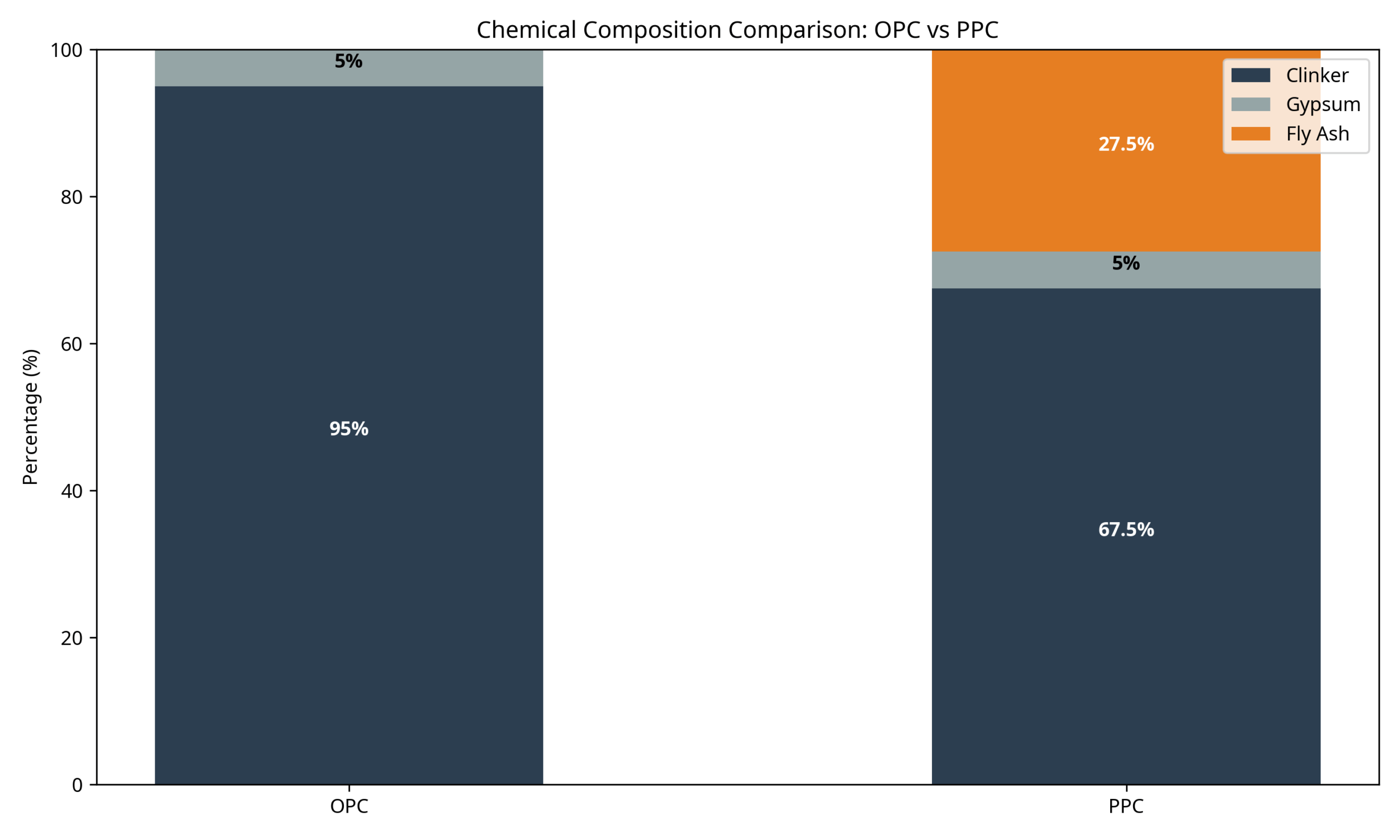
| OPC Composition | ~95% clinker + 5% gypsum |
| PPC Composition | 65–70% clinker + 25–30% pozzolana + gypsum |
| Heat of Hydration | OPC: higher; PPC: significantly lower |
| Final Setting Time | OPC: up to 280 min; PPC: up to 600 min |
| Cost Differential | PPC is typically 5–8% lower per tonne than OPC |
| Carbon Footprint | PPC lower (fly ash displaces clinker production) |
| OPC Best For | Fast-track structures, precast, early-load applications |
| PPC Best For | Marine works, mass concrete, water infrastructure, residential |
Both cement types satisfy structural requirements when correctly applied, but the margin between the right and wrong choice widens sharply in marine environments, mass concrete pours, and time-critical construction programmes, making the OPC vs PPC cement decision a specification imperative, not a procurement default.
Introduction: OPC vs PPC Cement in Construction
Cement selection carries consequences that persist for the life of the structure. Specify the wrong type, and the problem does not surface on handover day; it surfaces years later as cracks, spalling, or reinforcement corrosion that a structural engineer must explain and a client must fund. Two binder types dominate most construction markets: OPC and PPC. Each has a distinct hydration chemistry, a different strength development curve, and a specific tolerance profile for environmental exposure.
The difference between OPC and PPC cement spans composition, early and long-term strength, heat generation, chemical resistance, cost, and carbon footprint. Knowing how to choose cement for construction projects means interrogating each of those dimensions against the exposure class, programme, and design life of every structural element on the project. Readers building a wider framework for cement types will find the full picture in our pillar guide, 15 types of cement and their application in modern construction. The nine differences below provide the technical basis for that decision.
Composition and Available Grades
The two most widely used types of cement in construction share the same foundational raw material, Portland clinker, but diverge sharply in their secondary composition. That divergence drives every performance difference covered in this article, from early strength to long-term durability to carbon footprint.
1. Chemical Composition
OPC consists of approximately 95% Portland clinker ground with 5% gypsum. No supplementary cementitious material features at a meaningful volume. Clinker forms by heating limestone and clay to over 1,400 degrees Celsius in a rotary kiln, producing calcium silicate compounds (primarily C₃S alite and C₂S belite) that react with water to develop binding strength.
PPC introduces pozzolanic material into that clinker base. The standard composition runs 65-70% clinker, 25-30% fly ash sourced from coal-fired power generation, and gypsum. Under IS 1489, as specified by the Bureau of Indian Standards, fly ash content must fall within 15-35% by mass. The fly ash does not hydrate independently; it reacts with the calcium hydroxide released during clinker hydration to form additional calcium silicate hydrate (CSH), thereby densifying the matrix over time.
2. Available Grades and Standards
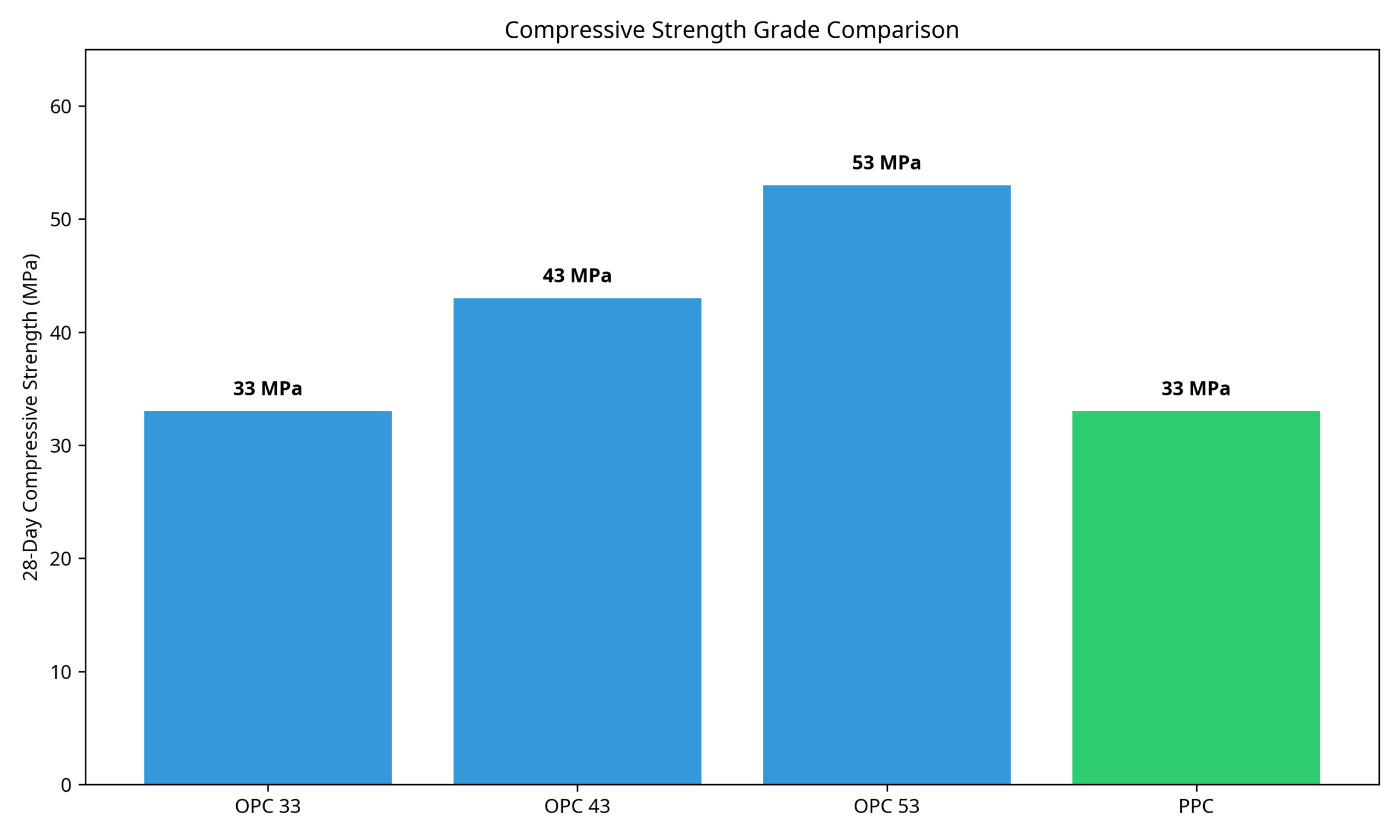
OPC is produced in three strength grades (33, 43, and 53), where the number denotes the minimum 28-day compressive strength in megapascals. The BIS compendium on cement standards confirms that IS 269:2015, reaffirmed in 2020, governs OPC manufacture and testing, covering chemical composition, fineness, setting time, and compressive strength. OPC 53 is the grade most commonly specified for structural concrete, precast elements, and fast-track construction.
PPC carries a single grade under IS 1489. Its 28-day strength broadly matches OPC 33, though the extended pozzolanic reaction allows long-term performance to approach higher OPC grades in applications that tolerate slower curing. Procurement teams should anchor specifications to the 28-day strength figure rather than the grade label, which varies by regional standard. For a full mapping of grade designations to structural applications, the guide on six cement grades and their construction uses covers that directly.
Strength Development: Early Gain vs Long-Term Performance
Strength governs when a structure can be loaded, when formwork strips, and when the programme advances. OPC and PPC follow different strength curves, and matching that curve to the construction schedule is a core specification decision, not a detail deferred to the concrete supplier.
3. Early-Age Compressive Strength
OPC develops strength rapidly in the first 7-14 days, driven by the fast hydration of C3S in its clinker-rich mix. A well-cured OPC 53 mix reaches 70-80% of its 28-day strength within the first seven days. That profile makes OPC the default for time-critical formwork removal, precast elements requiring fast demoulding, and any structure that must carry a load before extended curing is possible.
PPC’s early strength is more modest. The pozzolanic reaction begins only after clinker hydration has produced sufficient calcium hydroxide, typically several days later. A PPC mix at seven days shows noticeably lower compressive strength than an equivalent OPC mix. Contractors who treat that gap as a permanent shortfall make a costly specification error.
4. Long-Term Strength and Durability
At 28 days and beyond, the gap narrows substantially. The secondary pozzolanic reaction in PPC continues past 28 days; peak strength in some formulations arrives between 60 and 90 days. The additional CSH compounds produced fill capillary pores that remain open in an OPC matrix, yielding denser, less permeable concrete with greater resistance to chemical ingress.
For infrastructure with a 50-year design life, the long-term microstructure matters more than the 7-day number. The decision on bulk versus bagged cement supply intersects here: large-volume PPC procurement for infrastructure programmes compounds both the cost and durability advantages at scale.
Further Reading: Bulk vs Bagged Cement: 7 Proven Contractor Preferences
Setting Time and Heat of Hydration
Two properties that rarely feature in contractor briefings (setting time and heat of hydration) directly control crack risk and construction sequencing. Both deserve explicit attention at the specification stage, not as afterthoughts on the mix design sheet.
5. Setting Time
OPC’s initial setting time is a minimum of 30 minutes, with final setting completing within 280 minutes under standard test conditions. PPC’s final setting time extends to 600 minutes, more than double the previous limit. On a hot site, that extended open time reduces the risk of premature stiffening during placement and improves consolidation in difficult-to-reach zones. In cold-weather conditions or where formwork removal is contractually time-bound, the same extended setting time becomes a scheduling constraint.
6. Heat of Hydration
Cement hydration is exothermic. In thin elements, heat dissipates without structural consequence. In mass concrete (raft foundations, dam sections, large pile caps, and retaining walls), the thermal gradient between a hot core and cooler surface generates tensile stresses that can crack concrete before it reaches structural strength.
OPC generates considerably more heat than PPC, owing to its higher clinker content and faster reaction rate. PPC’s fly ash fraction dilutes the clinker and flattens the heat profile. For any pour exceeding one metre in its least dimension, or any element explicitly designated mass concrete in the structural specification, PPC is the technically correct choice on heat-of-hydration grounds alone.
Chemical Resistance and Durability
Infrastructure does not operate in a laboratory. Foundations sit in chemically active soils. Marine structures face continuous chloride exposure. Sewage and water treatment works see a sustained sulphate attack. The cement matrix must resist all of it without relying on protective coatings or scheduled maintenance.
7. Sulphate and Chloride Resistance
OPC hydration leaves substantial quantities of calcium hydroxide in the matrix, a compound that leaches readily in wet conditions and reacts with sulphates to form ettringite, a crystalline expansion product that destroys the matrix from within. Chloride ions penetrate OPC’s open pore structure, reach embedded reinforcement, and initiate the corrosion cycle responsible for delamination and spalling in coastal structures.
PPC addresses both failure modes. The pozzolanic reaction consumes the vulnerable calcium hydroxide, converting it into additional CSH. Peer-reviewed research published in Applied Sciences confirms that fly ash incorporation significantly retards chloride penetration and sulphate ingress by refining the concrete pore structure and improving chloride binding capacity. Separately, research published in Scientific Reports demonstrates that fly ash-cement mixes produce a denser, less permeable matrix that shields embedded reinforcement from corrosive ions, thereby extending the predicted service life. PPC is the standard specification for hydraulic structures, canals, marine retaining walls, and any element in a sulphate-aggressive soil class.
Cost Structure and Environmental Performance
Cost and carbon footprint point in the same direction with PPC. Understanding both dimensions prevents short-sighted procurement decisions that optimise unit cost at the expense of lifecycle performance or sustainability obligations.
8. Unit Cost and Lifecycle Economics
OPC costs more per tonne than PPC in most markets, owing to its higher clinker content and more energy-intensive manufacture. In markets with fly ash availability from coal-fired power generation, PPC trades at 5-8% below OPC per tonne. Across a large programme consuming thousands of tonnes, that differential is material. Knowing how to choose cement for construction projects, therefore, extends beyond technical specifications: it is a lifecycle budget decision.
The unit cost gap tells only half the story. A PPC structure in a chemically aggressive environment requires less remediation over its design life than an equivalent OPC structure in the same exposure class. Specifying OPC on cost grounds for a coastal element is a decision whose full cost is realised in year fifteen, not year one.
9. Carbon Footprint and Sustainability Credentials
According to the International Energy Agency’s cement sector analysis, the cement industry accounts for approximately 7% of global CO₂ emissions, with clinker production during limestone calcination responsible for the majority. OPC’s near-total reliance on clinker gives it a substantially higher emission intensity per tonne than PPC. As the Carbon Brief’s analysis of clinker substitution shows, high-blend cements incorporating fly ash can reduce emissions per kilogram by up to four times compared to standard Portland cement, and the world average clinker ratio has already fallen as blended cements gain market share.
On projects subject to green building certification (LEED, EDGE, or Africa-specific rating schemes), PPC’s lower embodied carbon makes it the preferred specification wherever structural requirements allow. The fly ash component also diverts an industrial waste stream that would otherwise require landfill. For projects with sustainability reporting requirements or carbon budget constraints, PPC is the default binder wherever the structural programme can accommodate the slower strength development curve.
Further Reading: 5 Proven Green Cement Impacts in Africa & Emerging Markets
OPC vs PPC Cement: Side-by-Side Comparison
The nine differences above can be reduced to a single reference matrix. Use it as a specification checklist, mapping each factor to project-specific conditions rather than defaulting to a single cement type across all elements.
| Factor | OPC | PPC |
| Composition | ~95% clinker + 5% gypsum | 65–70% clinker + 25–30% pozzolana + gypsum |
| Available Grades | 33, 43, 53 | Single grade |
| Initial Strength | High at 7–14 days | Moderate; builds steadily |
| Long-Term Strength | Comparable at 28+ days | Equals or exceeds OPC at 28+ days |
| Final Setting Time | Up to 280 minutes | Up to 600 minutes |
| Heat of Hydration | Higher; thermal crack risk | Lower; safer for mass concrete |
| Chemical Resistance | Moderate | Superior (sulphates, chlorides) |
| Cost | Higher (clinker-intensive) | 5–8% lower on average |
| Carbon Footprint | Higher CO₂ | Lower CO₂ (fly ash displaces clinker) |
Application-Specific Guidance
Technical properties only matter in context. The table below translates the nine differences into project-specific guidance for the applications contractors encounter most frequently. When two cement types appear viable, the exposure class designation in the structural specification determines the final selection.
| Application | Preferred Cement | Reason |
| High-rise structures | OPC 53 | Early strength for fast formwork cycles |
| Bridges and flyovers | OPC 43 or 53 | High initial load-bearing demand |
| Dams and retaining walls | PPC | Low heat of hydration prevents cracking |
| Marine and coastal works | PPC | Sulphate and chloride resistance |
| Residential slabs, plaster | PPC | Workability, finish, cost efficiency |
| Mass concrete foundations | PPC | Reduces thermal gradients |
| Precast concrete elements | OPC 53 | Rapid demoulding strength |
| Water tanks and canals | PPC | Low permeability, chemical durability |
Which is Better: OPC or PPC Cement?
The question of “Which is better, OPC or PPC cement?” carries no universal answer: it has a project-specific answer. Several decision factors, however, apply consistently across project types and must be resolved before the first bag is ordered.
When OPC is the Correct Specification
OPC cement is clustered in time-critical and high-early-strength applications. OPC is the right specification when the construction programme cannot absorb the slower curing curve that PPC demands: fast-track high-rise frame construction, precast elements requiring rapid demoulding, bridge deck pours on active traffic corridors, and industrial floor slabs that must carry forklift loads within days of casting. OPC 53 is the standard for reinforced concrete columns, beams, and suspended slabs in multi-storey construction. Where the exposure condition is moderate and the programme is tight, OPC delivers the required performance without programme risk.
When PPC is the Correct Specification
The advantages of PPC cement over OPC are most pronounced in applications where durability is paramount. Coastal and marine infrastructure, water treatment and wastewater works, irrigation canals, retaining structures in aggressive soils, and all mass concrete applications belong in this category. PPC cement advantages extend to residential construction as well: its longer setting time improves workability and surface finish, while its lower unit cost makes it the commercially rational choice for plastering, masonry mortar, and non-structural slabs.
The OPC vs PPC cement strength comparison goes like this: OPC leads on the 7-day curve; PPC matches or exceeds it at 28 days and beyond, and extends that advantage through service life, where microstructure density determines how the structure responds to its environment.
Mixed Specification: Using Both on One Project
Many projects do not have monolithic requirements. A coastal hotel may specify OPC 53 for its structural frame (to hold a fast construction programme) and PPC for its seawall, ground-floor foundations, and external concrete, where sulphate and chloride exposure govern. The specification should assign cement type element by element, not project by project. The structural engineer’s exposure class designations in the concrete schedule provide the technical basis for each assignment.
Conclusion: Cement Type as a Technical Decision
OPC and PPC are not interchangeable defaults. OPC delivers high speed and early strength at a higher cost and a heavier carbon load. PPC delivers long-term durability, chemical resistance, and lower environmental burden at the cost of a slower strength curve and extended curing requirement. The best cement for construction is the one correctly matched to the exposure class, structural programme, and design life of each element, not the one that costs least per bag or arrives fastest on site. The contractor who applies that logic, element by element across the project, builds structures that perform and budgets that hold. Cement type selection sits within the broader discipline of concrete mix design.
Build Smarter with the Right Construction Materials
Explore Construction Frontier: Construction & Building Materials for expert insights, technical comparisons, and practical guidance on cement, concrete, steel, and material selection for high-performance construction projects.