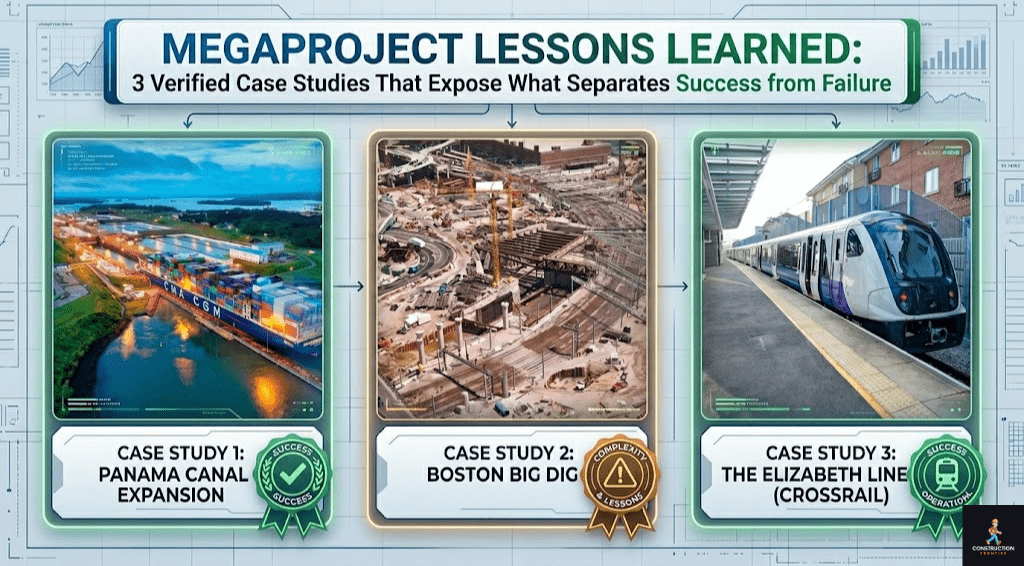
Megaproject Lessons Learned: 3 Verified Case Studies That Expose What Separates Success from Failure
The Panama Canal expansion delivered. Crossrail lost 3.5 years and GBP 4 billion. The Boston Big Dig became the most documented cost collapse in US infrastructure history. Three programmes, three continents, and a combined capital value exceeding USD 38 billion. The megaproject lessons learned across them are not about technical complexity. Panama’s engineering was more demanding than Boston’s, yet Panama succeeded, and Boston failed. What separated them was governance: the authority of the PMO, the integrity of the cost baseline, and the institutional culture around transparent reporting. The lessons learned from this megaproject analysis are drawn exclusively from official inquiry reports, PMI project records, and peer-reviewed institutional sources.
Technical Snapshot: Three-Programme Overview
| Attribute | Details |
| Cases | Panama Canal Expansion (USD 5.25B); Crossrail / Elizabeth Line (GBP 18.9B); Boston Big Dig (USD 14.78B) |
| Outcome range | One verified success; one governance-driven overrun; one politically induced cost collapse |
| Success differentiators | Dedicated PMO authority; Monte Carlo risk quantification; tiered change control (Panama) |
| Crossrail failure mode | Governance opacity, commissioning underestimation, a 3.5-year delay and GBP 4 billion overrun |
| Big Dig failure mode | Political cost baseline; information concealment; 428% overrun; one fatality |
| Cross-case lesson | Engineering rarely causes megaproject failure. Governance always does. |
The cumulative record across these three cases is precise: one benchmark programme, two governance collapses of different character, and a set of megaproject lessons learned that cover the full failure spectrum. Bent Flyvbjerg’s research across hundreds of programmes in 20 nations puts the failure rate of construction megaprojects at 9 in 10. These megaproject lessons learned explain, with primary-source specificity, why that rate is structural rather than incidental. The lessons from failed infrastructure projects in this analysis are not historical footnotes. They are the active governance standard against which today’s programmes should be measured.
Introduction: Why Engineering Is Rarely the Problem
Infrastructure leaders instinctively reach for technical explanations when megaprojects fail. Ground conditions. Interface complexity. Design scope growth. The evidence from this case portfolio does not support that instinct. The Big Dig’s tunnelling through geotechnically unstable Boston fill was executed. Crossrail’s 42 kilometres of bored tunnel under central London were delivered on schedule. Panama’s water-recycling locks, built on a compressed timeline by a four-nation consortium, came within two years of the target despite a contractor dispute and a commissioning seepage event.
The engineering was delivered. What failed, two out of three, was megaproject governance: the structures that set cost baselines, surface accurate information, enforce accountability, and manage what happens when things go wrong. These are the megaproject lessons learned that matter: not what went wrong technically, but what failed structurally. Why do megaprojects fail nine times in ten? Not because of engineering. Because governance is structurally inadequate, the megaproject lessons learned from the three programmes below confirm this with primary-source precision.
This analysis covers the three most comprehensively documented programmes of their generation. The construction project management lessons drawn here connect directly to the broader framework for managing mega construction projects and specifically to the governance and risk disciplines that determine whether a programme is controllable before construction begins. All capital figures, schedule data, and megaproject governance findings are sourced from primary or peer-reviewed documentation. No data is illustrative. The lessons learned from the megaproject here are verified, not illustrative.
Case Study 1: Panama Canal Third Set of Locks
The Panama Canal expansion is the rare megaproject that succeeded across all three primary performance dimensions simultaneously: cost, schedule, and operational outcome. At USD 5.25 billion, approved by national referendum in October 2006, the programme doubled canal capacity, generated USD 3.2 billion in annual revenue by 2018, and produced megaproject PMO best practices that procurement authorities now treat as benchmarks. What made it work was not an exceptional site or a favourable contract market. It was the governance architecture that the Panama Canal Authority put in place before construction began. The absence of megaproject cost overrun here was not luck; it was structured.
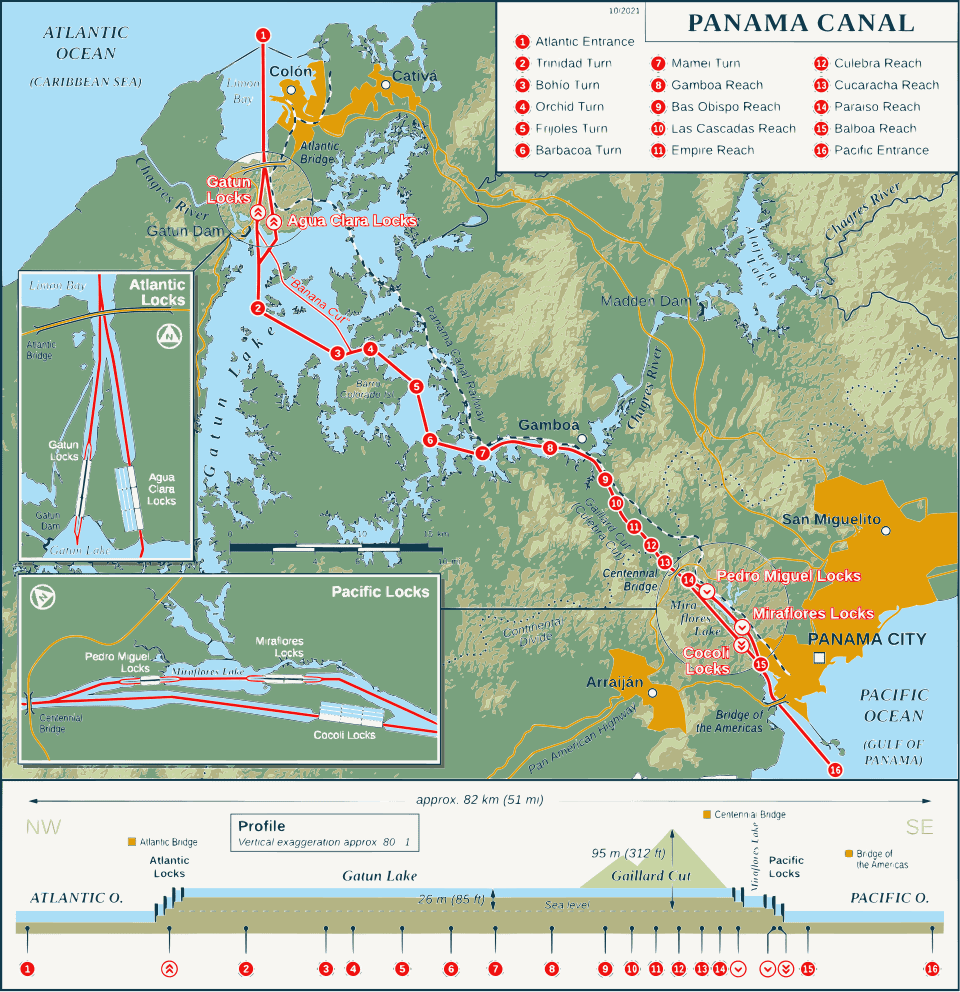
1.1 PMO Authority and Risk Quantification
The ACP established a dedicated Programme Management Office staffed by 350 professionals, positioned as the organisation’s highest institutional priority. Nearly 300 bidding contractors were brought to Panama for intensive pre-bid briefings before the tender was issued, compressing the information gap between owner expectations and contractor pricing. That gap is one of the most consistent drivers of construction cost overruns and of failures in cost overrun prevention on distressed programmes globally: contractors price what they understand, and what they do not understand, they claim later.
From the conceptual design phase onwards, the ACP deployed a Monte Carlo simulation model to quantify cost and schedule contingencies. The result was a risk-based budget range rather than a single-point estimate, giving the board a probability distribution of outcomes rather than a politically convenient figure. This is the founding discipline that separates Panama from Boston: one began with an engineering estimate, the other with a political number, and every governance mechanism built on each baseline performed accordingly.
This project also answers the core question of why megaprojects fail at the cost stage: approval optimism does not reduce construction costs; it removes the reference point against which overruns become visible. The megaproject lessons learned from Panama’s risk quantification approach are transferable to any programme context where the owner can define the scope before going to tender.
1.2 Change Control and Contingency Execution
Change control operated through a tiered approval matrix: project managers approved changes up to USD 5 million, the PMO director above that threshold, and the ACP board for changes exceeding 5 percent of the total budget. This structure foreclosed undocumented scope growth, which characterises most construction megaproject failure cost trajectories, and it is one of the most concrete megaproject lessons learned in the documented portfolio: tiered financial authority prevents megaproject cost overruns from compounding silently.
When a contractor compensation dispute triggered a two-week labour stoppage in 2014 and when lock seepage was discovered during commissioning, the ACP activated a documented Plan B: alternative contractor sourcing options already prepared, dispute-resolution mechanisms per contract, and technical remediation of the seepage before commercial opening. The stoppage resolved without contractor replacement. The seepage was fixed before the first transit. The megaproject lessons learned from Panama on contingency are not about having a document. They are about institutional readiness to execute it under commercial pressure.
The programme also produced a 90 percent Panamanian workforce and a behavioural coaching programme for team leaders deployed by the PMO. Canal pilot expertise became an international benchmark. A simulation training school was established. Within 20 months of opening, 3,000 New Panamax vessels had transited the expansion. The total programme was delivered without a megaproject cost overrun, without a safety fatality, and above demand projections. The governance architecture that delivered the physical asset also delivered a sustained human capital outcome. That combination is the full definition of megaproject PMO best practices applied at scale.
Further Reading: Construction Risk Management: 10 Crucial Facts You Must Know to Avoid Costly Project Failures
Case Study 2: Crossrail (The Elizabeth Line)
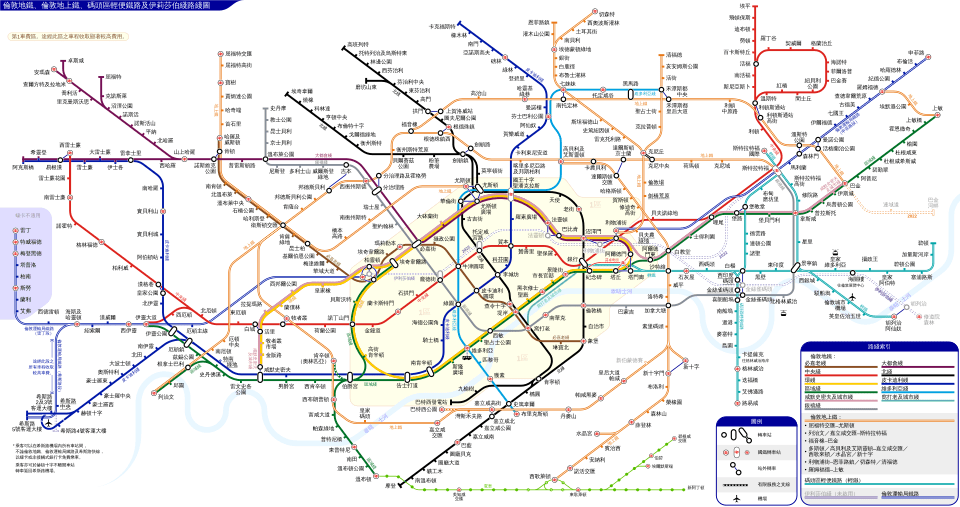
The Crossrail – Elizabeth Line project is the case of a mega construction programme that appeared, for most of its lifecycle, to be broadly on track before revealing in 2018 that it had been systematically misreporting its status for years. The 3.5-year delay and GBP 4 billion overrun were not caused by geotechnical failure or design collapse.
The lifecycle overrun was caused by megaproject governance opacity: a board that had not engaged early enough with the commissioning challenge; management information built around construction Key Performance Indicators (KPIs) that masked systems integration risk; and a sponsor team that lacked the technical authority to challenge what it was being told. The megaproject lessons learned from Crossrail are now defining commissioning governance standards for complex railway programmes globally.
2.1 The Commissioning Trap
Crossrail required 42 kilometres of bored tunnel under central London, 10 new central stations, and integration with 41 existing stations across six rail operators, deploying a bespoke signalling system across a combined new-infrastructure and legacy-network environment never previously attempted at this scale. For nine years, the programme appeared broadly on track. Tunnelling, tracklaying, and electrification were delivered on or near schedule. By early 2018, Crossrail Limited reported the programme as 90 percent complete and on course for a December 2018 opening.
In August 2018, the opening was delayed to autumn 2019. The line did not open until May 2022. The 2024 official inquiry by the Department for Transport and the Infrastructure and Projects Authority identified the core failure: the board had not focused early enough on the scale of systems integration required to bring the railway into service. Construction completion and operational readiness are not the same milestone. Treating them as equivalent is the commissioning trap, and it is one of the most consequential lessons from failed infrastructure projects worldwide.
The GBP 4 billion overrun was not caused by materials inflation or scope change. It was caused by the commissioning complexity that the governance framework had never measured. That is the precise answer to why megaprojects fail at commissioning: they measure construction and assume readiness. The megaproject lessons learned from the Elizabeth Line are now embedded in UK infrastructure policy. Every comparable programme should treat them as an operational standard.
2.2 Governance Opacity and Sponsor Failure
Risks were managed individually rather than as interdependent system risks. Construction-centric KPIs systematically overstated completion during 2016 to 2018, as the commissioning effort revealed its true scale. An unnamed participant quoted in the official report described the dynamic precisely: everyone on the ground knew about the delays, but it was in nobody’s interest to say so. This is the optimism bias pathology that characterises construction megaproject failure at the governance level.
The joint Department for Transport and Transport for London sponsor team raised concerns but lacked the technical authority and contractual mechanisms to enforce a response. The inquiry concluded that the delivery model should be under constant review throughout the full project lifecycle and that independent technical advisors with megaproject commissioning experience are a megaproject governance requirement, not discretionary overhead.
The construction project management lessons here are specific: sponsor-side engineers with commissioning expertise are the last accountability check before the board makes irreversible decisions. The risk management failures documented in African construction follow this same pattern: owner-side technical capacity lags contractor sophistication, and the resulting reporting gap is never recovered without high cost. It is one of the most consistent lessons from failed infrastructure projects across every governance review of the past two decades.
Recovery from 2019 to 2022 involved independent schedule audits, a programme reset, and a commissioning reporting framework, finally separated from construction KPIs. The Elizabeth Line opened in May 2022, operates at 24 trains per hour at peak, and is performing above expectations in terms of ridership. The projected GBP 42 billion boost to the UK economy is real. It was deferred for three and a half years by governance failure rather than engineering impossibility. That deferral is the cost of not applying megaproject lessons learned on commissioning governance from the earliest project phases. It is a construction project management lesson that the field now has no excuse to repeat.
Case Study 3: Boston Big Dig (Central Artery Tunnel Project)
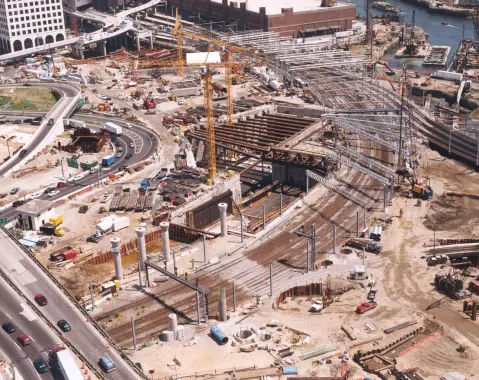
The Big Dig is the most extensively documented megaproject cost collapse in US construction history. Its trajectory from USD 2.8 billion in 1985 to USD 14.78 billion at 2007 completion (approximately USD 22 billion including financing) was not a consequence of geotechnical complexity or legitimate scope growth. It was the predictable result of a political cost estimate that was never intended to represent project reality, combined with information management practices that concealed the true cost trajectory from federal oversight for years.
The megaproject lessons learned from Boston trace the exact mechanism by which a political decision at the budget stage propagates into megaproject cost overruns across the entire programme lifecycle. The 428 percent overrun was not a deviation from the plan. It was the plan’s inevitable consequence.
3.1 The Political Baseline: How Everything Collapsed Before Construction Began
The 1985 figure of USD 2.8 billion was not an engineering cost estimate; it was a political cost set to secure federal funding approval without triggering congressional resistance. Internal project estimates already exceeded USD 7 billion in the early 1990s. The gap was not managed through better controls but was managed through concealment. A USD 1.4 billion overrun was withheld from the Federal Highway Administration, triggering investigations by the FBI, the SEC, and the attorney general.
The construction cost overrun causes and prevention lesson here is foundational: when the approved budget is known internally to be unrealistic, cost reporting becomes an exercise in managing political exposure rather than managing project costs. The accountability framework collapses at every level below it. Virginia Greiman, the project’s former deputy chief legal counsel and risk manager, stated the corrective principle directly: report problems as they occur, accurately and truthfully.
A Class 3 independent estimate at FEED would have produced a larger headline figure and harder political conversations in 1985. It would also have produced a governed programme, and the construction megaproject failure that followed would not have occurred. The megaproject lessons learned from this juncture are upstream of procurement: the moment when a cost estimate becomes a political instrument is when governance becomes impossible. The FEED process is the stage at which cost baseline integrity is either established or forfeited. On the Big Dig, it was forfeited before the project was authorised.
This failure mode is not uniquely American. The lifecycle cost management failures documented across Africa’s construction frequently trace to politically motivated underbidding, where sponsors accept convenient estimates to secure approval and absorb escalation through supplementary budgets rather than transparent revision. Boston is the documented extreme of a structural risk present wherever political approval depends on a figure that engineering analysis cannot support.
3.2 Contractor Accountability, Information Systems, and Design Failure
Project management failed to hold contractors to their bids or apply cost containment on claims. The Massachusetts Inspector General issued reports identifying compliance failures and sustained cost management deficiencies between 1993 and 1999. The cost tracking system functioned correctly. Its data was not reported accurately upward through the management hierarchy, negating its megaproject governance value entirely. Technology cannot substitute for a culture of transparent reporting. The construction cost overrun causes and prevention lesson here is precise: the Big Dig’s information system was inadequate. The reporting culture was not. That distinction defines why megaprojects fail at the information stage: sophisticated systems produce governance outcomes only when the data entering them is honest.
The July 2006 ceiling collapse in the Interstate 90 connector tunnel exposed a further layer of failure. Design responsibility had been transferred between designers and contractors without clear documentation. A ceiling-type substitution was installed without updated anchor calculations. Warning signs that anchors were working loose were not adequately escalated, resulting in one person’s death. On programmes involving multiple designers and design substitutions, the accountability matrix must be version-controlled and formally transferred with every scope change. No substitution should proceed without an explicit written responsibility transfer and updated engineering review.
Common delays and accountability gaps in African construction programmes reflect the same dynamic on a smaller scale. The Big Dig is the fatal version of a contract administration failure that occurs wherever design ownership becomes ambiguous. It is among the most direct lessons from failed infrastructure projects documented: design accountability is a contract-administration standard, and its absence has consequences that no post hoc megaproject lessons-learned exercise can undo.
Further Reading: The 11 Biggest Construction Fails of 2025: Costly Mistakes That Shook the Industry
What Three Programmes Confirm About Megaproject Failure
Placed against each other, these three programmes isolate the variables that determine megaproject fate with unusual precision. The engineering was delivered or deliverable on all three. The megaproject lessons learned across them are not about technical capacity but rather the governance that separated them.
Cross-Programme Comparison: Panama Canal vs Crossrail vs Boston Big Dig
| Factor | Panama Canal | Crossrail | Boston Big Dig |
| Capital cost | USD 5.25B (within budget) | GBP 18.9B (GBP 4B over) | USD 14.78B (428% over) |
| Schedule | 2-year delay vs centenary target | 3.5 years late | 9 years late |
| PMO | 350-person; board authority; tiered change control | The board lacked commissioning focus; no systems integration oversight | Fragmented multi-agency; no single accountable entity |
| Cost baseline | Monte Carlo from feasibility; risk-based range | Construction KPIs; commissioning risk unquantified | Political estimate set to secure approval, not reflect cost |
| Transparency | Problems escalated; contingency activated | Ground-level delays hidden from the board and sponsors | USD 1.4B overrun withheld from the Federal Highway Administration |
| Outcome | USD 3.2B annual revenue by 2018; benchmark programme | Opened May 2022; above ridership target; inquiry published | FBI, SEC, AG investigations; one fatality; debt repaid for decades |
1.1 PMO Authority Is Non-Negotiable
Panama’s Project Management Office (PMO) had 350 professionals, board-level authority, and a tiered change control matrix calibrated to financial exposure. Crossrail Limited had the structure of a delivery body but lacked the commissioning depth to operate it through systems integration. The Big Dig lacked a unified PMO: oversight was fragmented across agencies, with no single accountable entity for programme costs. These are structural governance differences, not differences in individual management competence. The megaproject PMO best-practices literature is consistent on this point: a PMO without authority to approve changes, enforce contractor performance, and report accurate cost status is an administrative function, not a governance instrument.
1.2 Cost Baseline Integrity Determines Everything Downstream
Every governance mechanism on a megaproject operates against the approved cost baseline. When that baseline is honest, change orders have a stable reference point, contingency reflects genuine risk, and deviation is detectable. When it is political, every downstream mechanism is calibrated against fiction. The megaproject cost overrun on the Big Dig was not a management failure in execution but rather a governance failure in conception.
Construction cost overrun causes and prevention frameworks consistently identify political baseline inflation as the highest-leverage intervention point: address it before approval or absorb it at multiples later. Panama’s Monte Carlo risk model produced a credible range. Boston’s political figure produced a 428 percent overrun and a federal criminal investigation. Megaproject PMO best practices on cost baseline governance begin at feasibility, not at financial close.
1.3 Information Culture Cannot Be Manufactured by Technology
Both Crossrail and the Big Dig deployed functional management information systems. Both systems failed to inform governance because the data was distorted, withheld, or reported through indicators that masked rather than revealed programme status. Panama’s ACP escalated problems and activated contingency. The lessons from failed infrastructure projects on information culture are consistent: oversight bodies can mandate reporting. They cannot compel accuracy without an institutional environment that rewards it.
Why do megaprojects fail at the reporting level? Because the incentive to surface bad news is structurally weaker than the incentive to manage expectations. Construction cost overrun causes and prevention frameworks identify information concealment, alongside political baselines, as the two primary upstream failure modes. Construction megaproject failure at this rate is the predictable result of governance frameworks that do not account for either.
Technical Block: Applying These Lessons to Active Programmes
The governance deficits documented across these three cases translate into specific, correctable standards. These are the megaproject lessons learned that active programme sponsors and PMO directors can apply directly. None of what follows is advanced doctrine. All of it is drawn from what the evidence shows: the lessons from failed infrastructure projects that cost 428 per cent overruns, GBP 4 billion over budget, and one fatality, alongside the megaproject PMO best practices that kept Panama within budget and ahead of demand forecasts.
1.1 Project Management Office (PMO) Design
A PMO sized and positioned to coordinate activity rather than govern it will not prevent the failure modes documented here. The PMO must have authority to enforce change control at defined financial thresholds, access to independent cost data that does not pass through the delivery body, and commissioning expertise embedded from the earliest project phases. Panama’s 350-person structure, Monte Carlo risk tools from feasibility, and a tiered change approval matrix are the operational standards.
Megaproject PMO best practices are not exotic: they are the design choices the ACP made, and Crossrail and the Big Dig did not. The megaproject lessons learned from both failures confirm this from the bottom up: governance structures that lacked PMO authority, independent cost data, and commissioning expertise produced the worst-performing programmes in their respective national records. Megaproject PMO best practices must be treated as programme pre-conditions, not post-hoc governance upgrades.
1.2 Commissioning as a Discrete Work Programme
The Crossrail inquiry established a specific standard: commissioning must be scoped, resourced, and scheduled as a discrete work programme from the earliest project phases. The commissioning scope must not be subsumed within construction KPIs or managed by teams whose expertise lies in civil or structural delivery. What is not explicitly measured is not managed. On any programme involving significant systems integration, the construction project management lessons from the Elizabeth Line are operationally binding: define the commissioning work programme at the FEED stage, schedule it independently, and report against it separately from construction progress.
1.3 Cost Baseline and Independent Verification
No risk management system or change control framework can perform correctly on a budget set for political rather than engineering reasons. The corrective discipline is a Class 3 independent cost estimate, completed before budget approval is sought, produced by qualified cost engineers, and treated as a non-negotiable governance precondition. The FEED process provides the scope definition foundation within which credible estimates are possible.
Programmes that proceed to approval without independent cost validation carry a structural risk of megaproject cost overrun that no downstream mechanism can close. The causes and prevention standards for construction cost overruns in the Big Dig record are unambiguous: cost baseline integrity is a governance precondition. The Big Dig’s overrun was built into the contract before it was signed.
1.4 Design Accountability on Multi-Contractor Programmes
Where design responsibility transfers between parties, the accountability matrix must be version-controlled, formally accepted by the receiving entity, and updated with every scope change or design substitution. No substitution proceeds without an explicit written responsibility transfer and updated engineering review. The Big Dig ceiling collapse was the fatal version of a contract administration failure preventable through basic documentation discipline. It is a construction project management lesson baseline: where design ownership is ambiguous, megaproject lessons learned from the most documented case in the record are clear about the consequences.
Conclusion: The Megaproject Playbook — Decoding Success Through 3 High-Stakes Case Studies
The megaproject lessons learned from Panama, London, and Boston converge on a small number of structural variables that repeat across every well-documented case in the field. PMO authority, cost baseline integrity, commissioning visibility, information transparency, and design accountability are not advanced governance concepts. They are the foundations of programme control. What the evidence shows, with the specificity that primary-source documentation provides, is that their absence does not result in modest underperformance. It produces 428 percent overruns, 3.5-year delays, federal investigations, and fatalities. The answer to why megaprojects fail at this rate is structural, not incidental. These megaproject lessons learned make it preventable.
The construction megaproject failure rate of nine in ten is not a law of nature. Panama proved that. It is the aggregate consequence of identifiable, well-documented governance deficits. Infrastructure leaders who apply the standards derived from this analysis are not following theoretical guidance. They are following the operational records of the most expensive megaproject governance cases produced over the past three decades.
For the full governance, risk, and delivery framework that these megaproject lessons learned support, the pillar guide on managing mega construction projects covers programme structure, contractor management, and lifecycle disciplines across the full scope of infrastructure delivery at scale. The megaproject lessons learned in this analysis are its empirical foundation.
Stay Updated on Africa’s Infrastructure Megaprojects
Stay ahead of Africa’s infrastructure transformation with Construction Frontier: Africa Mega Projects. Explore deep technical insights, expert analysis, and investment intelligence shaping the future of African infrastructure programme delivery.