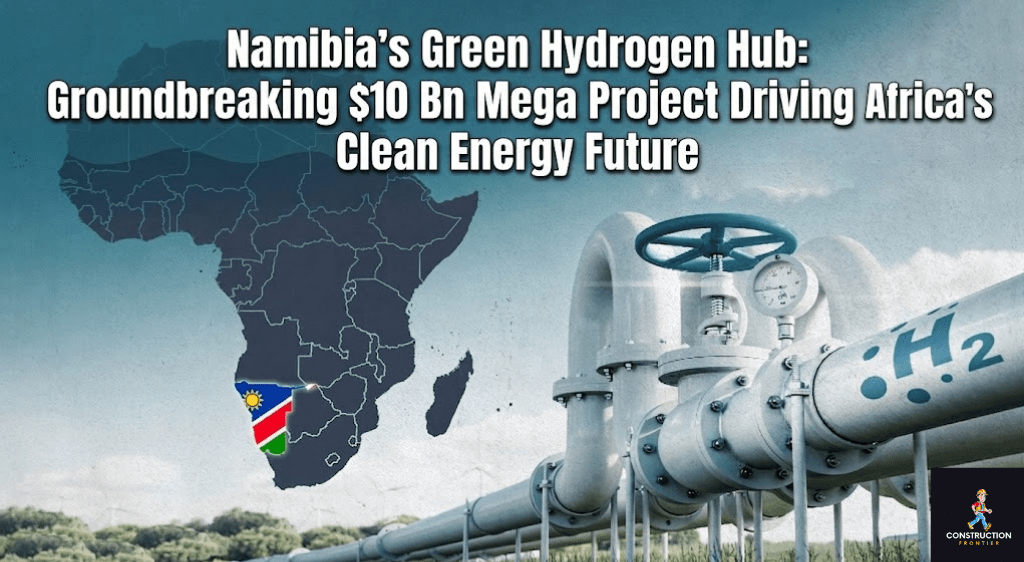
Namibia’s Green Hydrogen Hub: Groundbreaking $10 Bn Mega Project Driving Africa’s Clean Energy Future
Namibia’s Green Hydrogen Hub is not a distant ambition. It is a $10 billion infrastructure undertaking actively reshaping Southern Africa’s economic and energy landscape, with the potential to position one nation at the centre of the global clean fuel revolution.
The Hydrogen Hub, anchored by the Hyphen Hydrogen Energy project in the Tsau//Khaeb National Park near Lüderitz, stands as Africa’s most advanced large-scale green hydrogen and green ammonia project. The hub will deploy 7 GW of combined solar and wind capacity alongside 3 GW of electrolyser capacity to produce 350,000 tonnes of green hydrogen annually at full build-out, converting that output into two million tonnes of green ammonia per year for international export.
Technical Snapshot: Core Project Specifications
- Project Name: Hyphen Hydrogen Energy (Namibia’s Green Hydrogen Hub).
- Location: Tsau//Khaeb National Park, Lüderitz, Karas Region, Namibia.
- Project Type: Vertically integrated green hydrogen and green ammonia production.
- Total Renewable Capacity (Phase 1+2): 7 GW solar and wind.
- Electrolyser Capacity: 3 GW.
- Green Hydrogen Output: ~350,000 t/year (full build-out).
- Green Ammonia Output: 2 million tonnes per year (full build-out).
- Total Capital Investment: Over $10 billion USD.
- Project Developer: Hyphen Hydrogen Energy (joint venture: ENERTRAG and Nicholas Holdings).
- Government Equity Stake: 24% (via SDG Namibia One).
- Development Status: Front-end engineering design (FEED); feasibility phase through the end of 2026.
- Phase 1 Ammonia Target: 1 million tonnes per year (targeting 2028/2029 commissioning).
- CO₂ Reduction Target: 5–6 million tonnes per year.
- Jobs: 15,000 construction jobs; 3,000 permanent positions (90% Namibian nationals).
Namibia’s Green Hydrogen Hub represents far more than a single project. It serves as the flagship of the Southern Corridor Development Initiative (SCDI), Namibia’s strategic framework for building an entire green hydrogen industry from the ground up, targeting European and Asian export markets and establishing the country as a globally significant clean energy exporter.
Introduction: Hyphen Hydrogen Energy is Namibia’s First Large-Scale Green Hydrogen Hub
The global energy transition has accelerated the search for scalable, low-carbon fuel alternatives that can replace fossil fuels across heavy industry, shipping, and power generation. Green hydrogen, produced by splitting water molecules using electrolysis powered by renewable electricity, has emerged as one of the most promising solutions. Renewable energy projects in Namibia have drawn intense international attention because of the country’s extraordinary solar irradiance, consistently strong coastal winds, vast available land, and proximity to deep-water port infrastructure.
Against that backdrop, Namibia’s Green Hydrogen Hub has become one of the most strategically significant energy megaprojects anywhere on the African continent. The hub anchors Namibia’s clean energy investment strategy, connects the country to European decarbonisation targets, and sets a replicable template for Africa’s green hydrogen development. For civil engineers, infrastructure investors, and policymakers tracking the continent’s transformation, Namibia’s Green Hydrogen Hub deserves detailed examination.
Overview of Namibia’s Green Hydrogen Hub
Namibia’s Green Hydrogen Hub draws strength from the convergence of natural endowments, political stability, and a deliberate industrial policy. Understanding the project’s fundamentals requires examining where it sits, who is building it, and how the capital structure supports a phased delivery model that manages risk while maximising eventual output.
Project Location and Strategic Significance
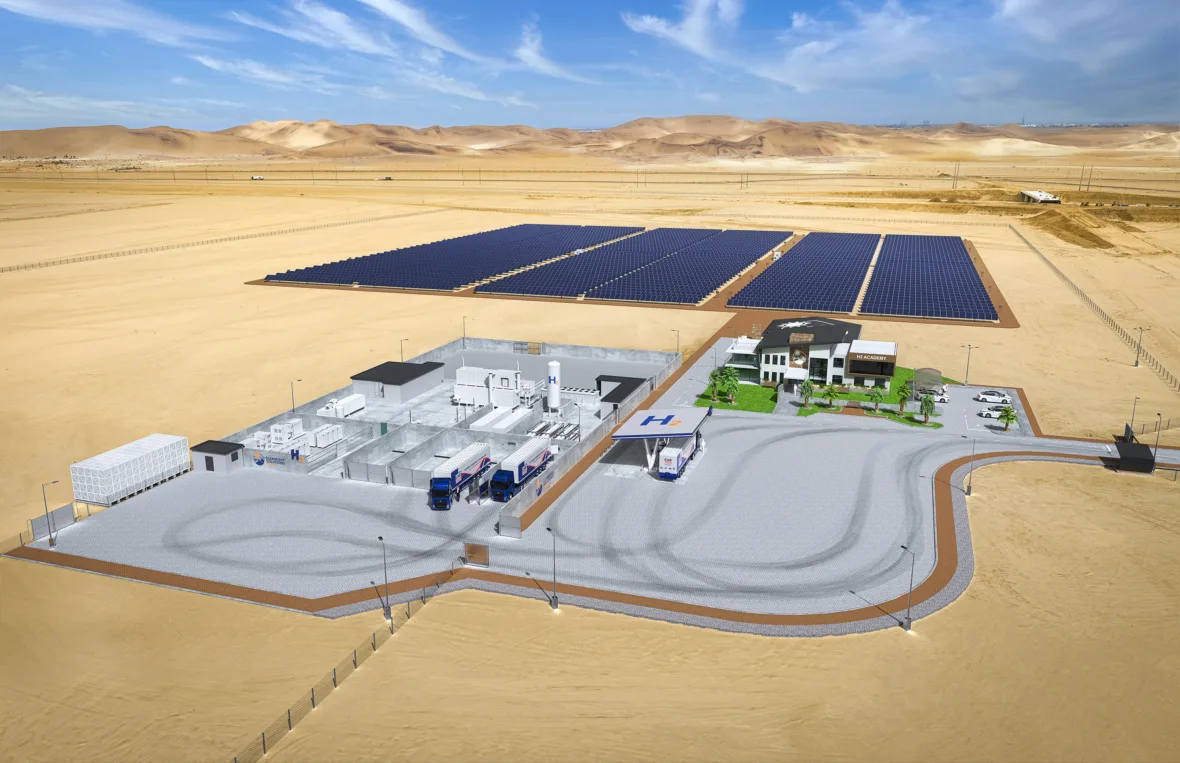
The hub occupies approximately 4,000 km² within the Tsau//Khaeb National Park in southern Namibia, split across two concession areas designated “Springbok” and “Dolphin”. The site sits near Lüderitz, a coastal town that offers access to the Atlantic Ocean shipping lanes connecting Africa to European and Asian markets.
The location carries a rare combination of advantages. Namibia ranks among the highest-resource environments globally for combined wind and solar electricity generation. The Karas Region receives intense solar irradiance year-round, while coastal and inland winds provide complementary generation, smoothing output variations. This hybrid resource profile reduces the need for large-scale energy storage and keeps the levelised cost of hydrogen production competitive with other global production centres.
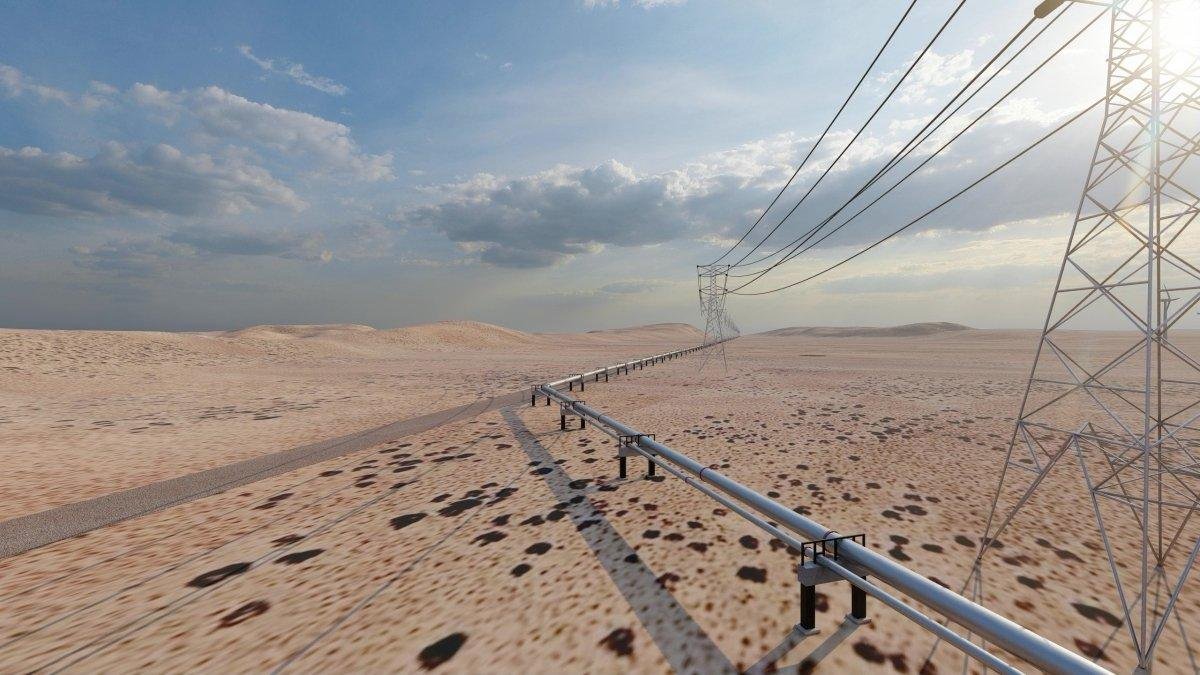
Crucially, the proximity of the renewable generation zone to the deep-water port at Lüderitz (and the planned upgrade at Angra Point) minimises the pipeline distance for hydrogen export logistics. Hydrogen travels from the electrolysis plant to port facilities via a dedicated pipeline, while desalinated water returns in an adjacent pipe, creating an efficient bilateral supply chain within a compact footprint.
Project Vision and Development Partners
Hyphen Hydrogen Energy, the project developer, is a Namibian-registered joint venture between ENERTRAG (Germany) and Nicholas Holdings (South Africa). ENERTRAG brings decades of renewable energy engineering expertise across Europe and international markets, while Nicholas Holdings contributes African market knowledge and regional development capabilities.
The Namibian government selected Hyphen in November 2021 to develop the nation’s first gigawatt-scale green hydrogen project following a competitive process. The government subsequently confirmed a 24% equity stake in the project through SDG Namibia One, ensuring that Namibians benefit directly from project profits. Combined with lease fees, tax receipts, and licence revenues, the government’s total financial participation exceeds 50% of the project’s net profits over its lifespan.
The African Development Bank (AfDB) approved a $10 million loan from its Sustainable Energy Fund for Africa (SEFA) in December 2025 to support front-end engineering design studies covering solar and wind generation, battery energy storage, electrolyser capacity, and desalination infrastructure. Germany designated the project as a “strategic foreign project” in 2024, making it eligible for prioritised support through German export and investment promotion instruments. This international backing illustrates how Namibia’s green hydrogen project has moved beyond regional significance to occupy a place in Europe’s energy security calculus.
Investment Size and Development Phases
The total capital investment across both phases exceeds $10 billion, a figure that approximates Namibia’s entire annual gross domestic product and underscores the transformative scale of Namibia’s Green Hydrogen Hub relative to the host economy.
Phase 1 deploys 3.5 GW of renewable electricity generation capacity to produce 175,000 tonnes of green hydrogen per year, which is converted into 1 million tonnes of green ammonia annually for export, targeting initial commissioning around 2028/2029. Phase 2 expands renewable capacity to 7 GW and the electrolyser base to 3 GW, lifting green hydrogen output to approximately 350,000 tonnes per year and ammonia production to 2 million tonnes per year.
Front-end engineering design studies began in late 2024, with a final investment decision targeted for 2026 following the completion of the Environmental and Social Impact Assessment (ESIA) process and the conclusion of offtake negotiations with international buyers.
Green Hydrogen & Ammonia Project Roadmap
| Feature/Milestone | Phase 1 | Phase 2 |
| Renewable Energy Capacity | 3.5 GW | 7 GW (Total) |
| Electrolyser Capacity | Not specified | 3 GW |
| Green Hydrogen Output | 175,000 tonnes/year | ~350,000 tonnes/year |
| Green Ammonia Output | 1 million tonnes/year | 2 million tonnes/year |
| Target Commissioning | 2028/2029 | Not specified |
Further Reading: Hydrogen Infrastructure: The Backbone of the Global Green Energy Transition
Engineering and Infrastructure Behind the Project
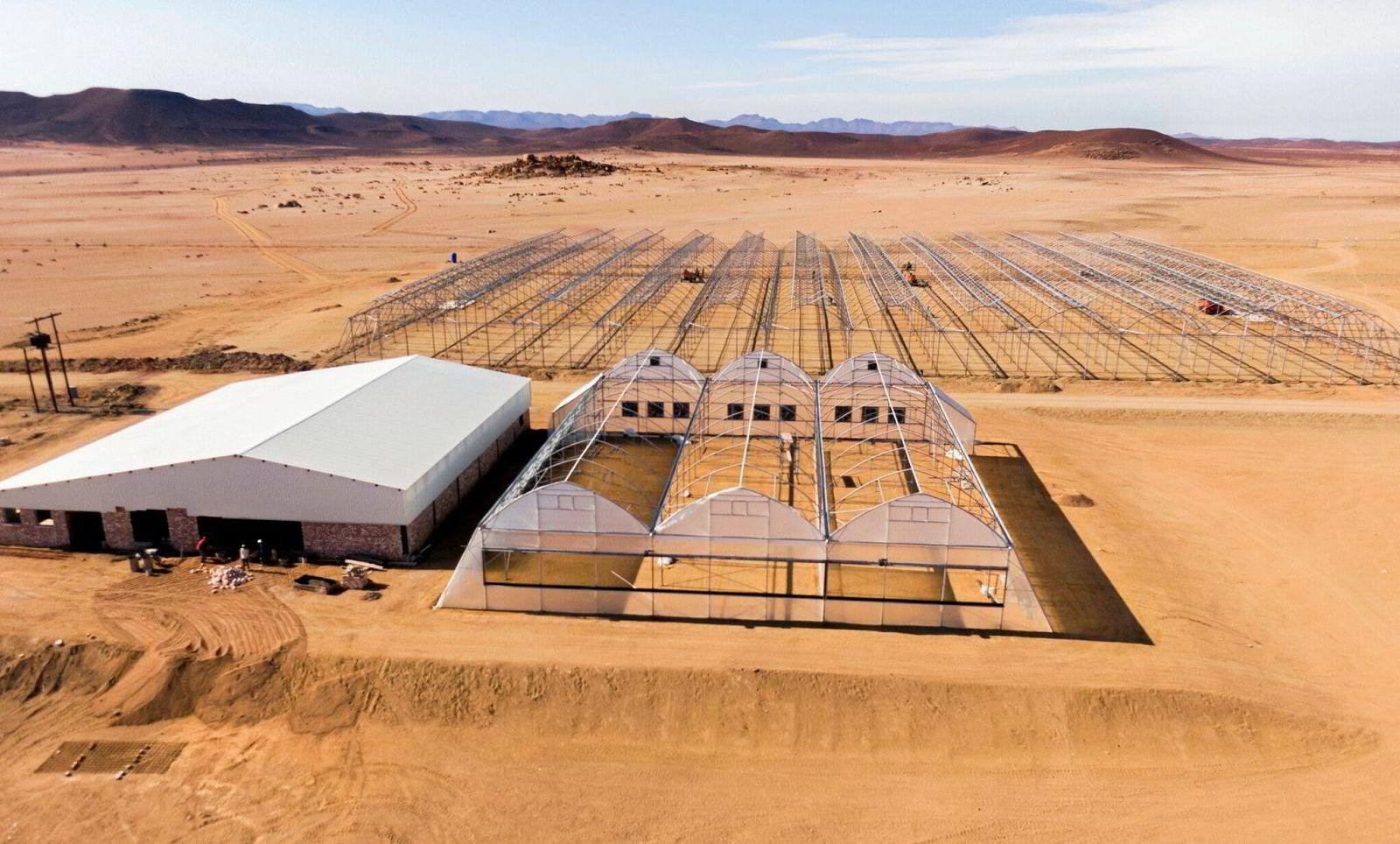
The engineering complexity of Namibia’s Green Hydrogen Hub matches its scale. The project integrates renewable generation, electrolysis, water treatment, hydrogen processing, and port export infrastructure into a single vertically integrated system that spans hundreds of kilometres of semiarid terrain.
Renewable Energy Inputs: Solar and Wind Integration
The Springbok and Dolphin concessions sit within a zone where solar and wind resources operate in partial complementarity. Solar generation peaks during clear daytime hours while onshore winds, driven by pressure gradients between the hot Namib interior and the cool Atlantic, produce stronger output during evenings and overcast periods. This natural pairing improves the overall capacity factor of the combined renewable system, reducing electrolyser idle time and improving hydrogen output per unit of installed capacity.
The physical footprint of the renewable infrastructure within the 4,000 km² concession covers less than 3% of the total land area. Solar PV panels account for nearly half of that physical disturbance, with wind turbines and transmission lines making up most of the remainder. Hyphen’s engineering team has invested heavily in biodiversity baseline surveys and environmental mapping to minimise the project’s impact on the protected national park, with the physical infrastructure footprint constrained to approximately 115 km².
Meteorological masts installed across the concession are collecting wind and solar data to refine the generation model and inform turbine placement decisions. This data gathering continues through the FEED phase to optimise the layout of the hybrid renewable system before construction begins.
Hydrogen Production Technology: Electrolysis Systems
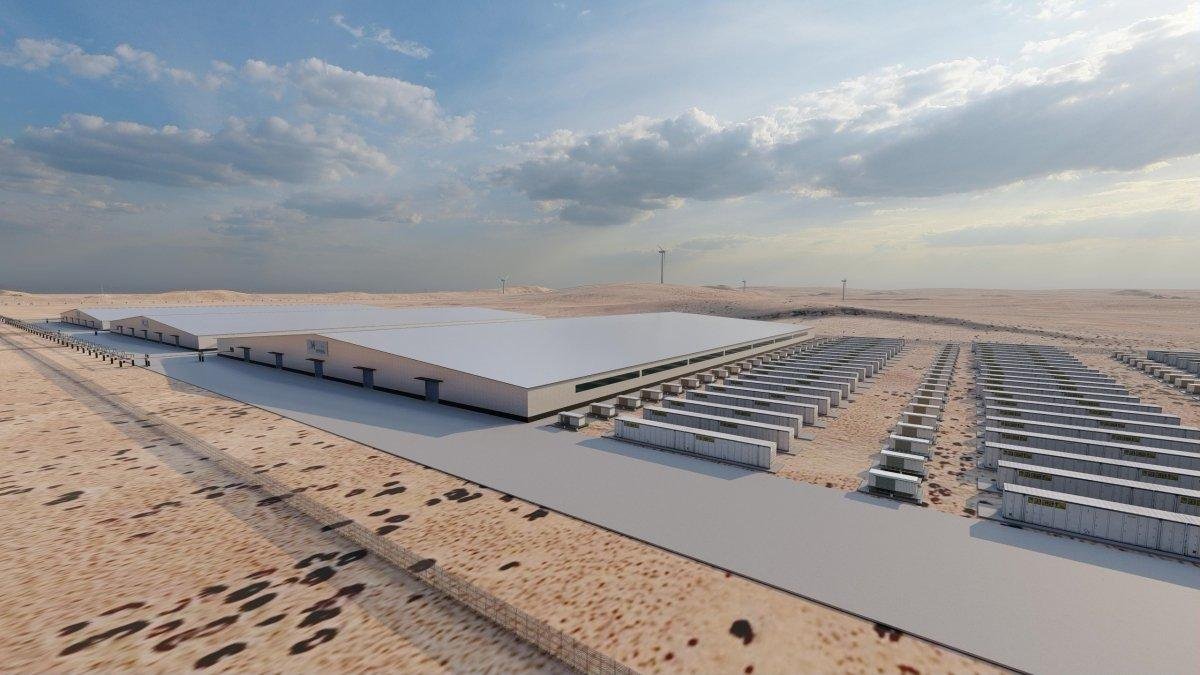
Green hydrogen production at Namibia’s Green Hydrogen Hub relies on large-scale electrolysis, a process that passes an electrical current through water to split it into hydrogen and oxygen. At full build-out, the project will deploy 3 GW of electrolyser capacity, making it one of the largest planned electrolyser installations in the world.
The electrolysis systems consume desalinated seawater rather than freshwater, an important engineering decision given that the Lüderitz area faces chronic freshwater scarcity. A dedicated desalination facility at the port processes Atlantic seawater into a feedstock-quality supply, which travels inland via the return pipeline to the electrolyser plant. This arrangement also allows surplus fresh water to be distributed to the local Lüderitz community, delivering a social infrastructure benefit alongside the primary production function.
The project targets a production cost of between $1.73 and $2.30 per kilogram of green hydrogen, reflecting the combination of low-cost renewable inputs and large-scale economies. As the hydrogen industry matures along its learning curve, these costs are expected to fall further, improving the project’s long-term export competitiveness.
Storage, Transport, and Export Infrastructure
Hydrogen leaves the electrolysis plant via a buried pipeline “spine” running centrally through the two concession areas toward the port zone near Angra Point. At the port, nitrogen extracted from ambient air combines with hydrogen in the Haber-Bosch synthesis process to produce ammonia, which is far easier to store and ship than compressed or liquefied hydrogen. Ammonia production, storage, and handling all occur within the port area, benefiting from marine infrastructure for loading onto specialised export vessels.
Electricity also travels from the renewable generation zone to the port area via transmission infrastructure to power the nitrogen purification and ammonia synthesis processes. This distributed but integrated architecture keeps the most hazardous chemical handling as close as possible to the export terminal while protecting the inland generation and electrolysis systems from the operational constraints of the port zone.
Port infrastructure upgrades at Angra Point form a critical component of Namibia’s clean energy investment in the region. The harbour must accommodate tankers capable of loading liquefied ammonia for the long-haul voyages to European and Asian import terminals.
Namibia’s Renewable Energy and Hydrogen Export Strategy
Namibia’s Green Hydrogen Hub does not operate in isolation from national policy. It represents the commercial cornerstone of a broader national hydrogen strategy that aligns Namibian resource endowments with the import requirements of decarbonising economies in Europe and East Asia.
Positioning Namibia in the Global Hydrogen Market
Europe’s REPowerEU strategy, developed in response to the energy security crisis triggered by Russia’s invasion of Ukraine, set a target of importing 10 million tonnes of green hydrogen annually by 2030. Germany, in particular, has actively pursued bilateral hydrogen partnerships with resource-rich nations, including Namibia, reflecting its need to replace fossil fuel imports with clean alternatives at scale.
Namibia’s Green Hydrogen Hub targets the European market as its primary export destination, with RFNBO (Renewable Fuels of Non-Biological Origin) compliance built into the project’s design to satisfy European Union certification requirements. Germany’s designation of the Hyphen project as a “strategic foreign project” in March 2024 provides access to German export credit agency (ECA) support and investment guarantees, materially de-risking the financing structure for international lenders.
East Asia represents a secondary but growing market. Japan and South Korea have both committed to large-scale green hydrogen and green ammonia imports as part of their national decarbonisation strategies, and the Atlantic shipping routes from Namibia to Asian ports via the Cape of Good Hope are commercially viable for ammonia tanker logistics.
Integration with Namibia’s Energy Policy
Namibia’s National Hydrogen Strategy frames the country’s clean energy investment ambitions through 2030 and beyond. The Southern Corridor Development Initiative provides the institutional architecture under which Namibia’s Green Hydrogen Hub operates as the first and largest project, with seven additional green hydrogen initiatives currently active in the country at smaller scales.
The Renewable Energy Feed-in Tariff (REFIT) programme guarantees a fixed price for renewable energy producers, reducing investor uncertainty. The Infrastructure Development Fund directs capital toward the enabling infrastructure that underpins hydrogen projects across multiple sites. Tax incentives, including potential VAT and customs duty exemptions for eligible renewable energy equipment, reduce project capital expenditure and improve returns for developers and equity partners.
Namibia’s Quality Infrastructure Policy (2020-2025) ensures that projects within the hydrogen programme meet both national and international standards for safety, environmental sustainability, and efficiency, a requirement that is critical for European RFNBO certification compliance.
Trade Corridors and Export Logistics
Lüderitz and the upgraded Angra Point port complex anchor Namibia’s export logistics. The Atlantic corridor to European ports in Germany, the Netherlands, and Belgium represents the most direct shipping route for Namibian green ammonia, with voyage times of approximately two to three weeks. The same trade corridor supports return voyages, allowing shipping operators to build efficient two-way cargo models.
The surplus electricity generated by the hydrogen industry, once production scales, will exceed Namibia’s current national grid capacity by a factor of nine to ten times. This surplus creates an opportunity to supply South Africa’s industrial sector with clean power via a better-integrated regional transmission grid, generating additional revenue streams and supporting Southern Africa’s broader decarbonisation objectives.
Namibia’s Green Hydrogen Hub Project’s Impact on Africa
Namibia’s Green Hydrogen Hub project’s impact on Africa extends well beyond the country’s borders. The project establishes a practical, bankable model for translating Africa’s renewable energy abundance into high-value industrial export products, a model that other African nations are actively studying and adapting to their own circumstances.
Accelerating Africa’s Green Hydrogen Development
The Africa Green Hydrogen Alliance (AGHA), founded by six leading nations including Namibia, Egypt, Kenya, Mauritania, Morocco, and South Africa, aims to produce 30 to 60 million tonnes of clean hydrogen annually by 2050, a volume equivalent to 5 to 10% of projected global hydrogen demand. The Alliance estimates that achieving this scale of production could contribute $60 to $120 billion to the collective GDP of its member nations.
Namibia’s Green Hydrogen Hub project’s impact on Africa manifests through the demonstration effect it creates for this broader coalition. No other African project combines Namibia’s combination of scale, financial backing, government equity participation, and German strategic designation in a single development. When Namibia’s Green Hydrogen Hub successfully reaches a financial investment decision and moves into construction, it validates the technical and commercial feasibility assumptions that underpin dozens of other African hydrogen proposals currently at the pre-feasibility stage.
The AfDB has explicitly described the Hyphen project as expected to have a demonstration effect across Africa, particularly in countries that possess abundant renewable energy resources but lack a bankable precedent to present to international capital markets.
Strengthening Hydrogen Energy Infrastructure in Africa
Hydrogen energy infrastructure in Africa currently lags far behind the continent’s resource potential. A 2025 report by the Africa Green Hydrogen Alliance and its partners found that only three operational electrolysis projects totalling 23.5 MW exist across the entire continent, against a pipeline of 39 projects representing more than 40,000 MW at the feasibility stage. The gap between aspiration and operational reality reflects the infrastructure investment challenge.
Namibia’s Green Hydrogen Hub addresses this gap directly by building the hydrogen energy infrastructure Africa needs at a scale that justifies the supporting port, pipeline, water, and transmission investments. Each infrastructure component developed for Namibia’s Green Hydrogen Hub, from the desalination facility to the ammonia export terminal, serves as a template that other projects can replicate and adapt in their own regional contexts.
Role in Africa’s Energy Transition
Africa’s energy transition requires not only renewable electricity generation but also the industrial feedstocks and export revenue streams that justify the capital intensity of clean energy infrastructure at scale. Green ammonia exports from Namibia can fund the renewable energy capacity that simultaneously supplies the national grid, accelerating the displacement of coal-fired imports from South Africa and diesel generation across the SADC region.
The green hydrogen locomotive pilot project for Namibian Railways, which aims to convert the first hydrogen-powered train in Africa using dual-fuel hydrogen combustion technology, illustrates how Namibia’s Green Hydrogen Hub drives domestic clean energy adoption in parallel with export ambitions. This kind of demonstration technology transfer positions Africa’s energy transition as inclusive of domestic beneficiation rather than purely export-oriented.
Benefits of Green Hydrogen Projects in Namibia
The benefits of green hydrogen projects in Namibia operate across multiple dimensions simultaneously: economic, environmental, and industrial. Few single infrastructure investments in Namibia’s history carry the potential to reshape so many aspects of the national economy at once.
1. Economic Growth and Job Creation
Namibia’s Green Hydrogen Hub will generate approximately 15,000 construction jobs during the four-year build period, followed by 3,000 permanent operational positions once the project reaches full production. More than 90% of these jobs will go to Namibian nationals, with at least 20% specifically targeting youth employment in a country where youth unemployment exceeds 38%.
The Socio-Economic Development (SED) Framework embedded within Hyphen’s project structure commits to 30% local procurement, meaning that a substantial share of the $10 billion investment will circulate within the Namibian economy through contracts, materials supply, and services. As additional projects within the SCDI come online, cumulative job creation and economic stimulus will compound, building a self-reinforcing industrial base around the hydrogen economy.
By 2050, Namibia could scale its green hydrogen production from the initial 1 to 2 million tonnes per year target toward 10 to 15 million tonnes annually, according to the National Hydrogen Strategy. That trajectory implies a decades-long programme of infrastructure investment, skills development, and industrial expansion that places the benefits of green hydrogen projects in Namibia on a fundamentally different scale from conventional resource extraction.
2. Decarbonisation and Climate Benefits
At full production, Namibia’s Green Hydrogen Hub eliminates 5 to 6 million tonnes of CO₂ emissions per year by displacing fossil fuel-derived hydrogen in industrial processes. This figure represents a significant contribution to global decarbonisation, given that conventional hydrogen production through steam methane reforming accounts for approximately 900 million tonnes of CO₂ annually worldwide.
The project’s renewable energy generation capacity, totalling 7 GW at full build-out, also produces surplus electricity that can supply the Namibian national grid and potentially the Southern African regional grid. Since more than 80% of South Africa’s electricity generation relies on coal, substituting even a fraction of that supply with Namibian clean energy would produce a substantial additional emissions reduction benefit at a continental scale.
3. Industrial Development and Value Chains
Green ammonia from Namibia’s Green Hydrogen Hub feeds directly into multiple high-value industrial value chains. Ammonia serves as the feedstock for nitrogen fertiliser production, a critical input for African agriculture that currently depends almost entirely on fossil fuel-derived imports. Namibian green ammonia, therefore, carries the potential to support food security across the continent by substituting cleanly produced fertiliser for grey alternatives.
Beyond fertilisers, ammonia-derived green hydrogen can feed steel production via direct reduced iron (DRI) processes, eliminating the coking coal that drives most African steel manufacturing today. The HyIron Oshivela project in Namibia already aims to produce 15,000 tonnes of direct reduced iron per year using green hydrogen, with the potential to avoid 27,000 tonnes of CO₂ emissions annually, equivalent to 50% of Namibia’s entire power sector emissions.
Further Reading: What Is Green Building Technology? Definition, 5 Benefits, and Applications
Large-Scale Hydrogen Infrastructure Projects in Africa
Namibia’s Green Hydrogen Hub occupies a distinctive position within a rapidly expanding landscape of African hydrogen initiatives, but it does so against a backdrop of ambitious proposals that face shared structural challenges around financing, infrastructure, and offtaker commitment.
Comparison with Other African Hydrogen Initiatives
Egypt, Morocco, and South Africa together account for roughly 80% of Africa’s planned green hydrogen investment pipeline, according to analysis by the Africa Energy Council. Egypt’s National Green Hydrogen Strategy targets 8% of the global hydrogen market and 10 million tonnes of annual production by 2050, anchored by a 4 GW electrolyser facility at the Suez Canal Economic Zone. Morocco advances the AMUN project targeting 900,000 tonnes of green ammonia per year. South Africa develops the Boegoebaai Green Hydrogen Development Programme and several other projects across the Northern and Western Cape.
What distinguishes Namibia’s Green Hydrogen Hub from these competing initiatives is the combination of a single gigawatt-scale development backed by a designated strategic foreign project status, direct government equity participation, multilateral development finance bank support from the AfDB, and a clearly defined RFNBO-compliant export pathway.
The continent’s green hydrogen front runners, as categorised by the H2Global 2025 analysis, include Namibia alongside Egypt, Kenya, Mauritania, Morocco, South Africa, and Tunisia. Namibia’s Green Hydrogen Hub leads within that group on project specificity and institutional backing.
Investment Trends in Hydrogen Energy Infrastructure in Africa
Investment in hydrogen energy infrastructure in Africa reached an inflexion point between 2022 and 2025 as European energy security pressures accelerated bilateral partnership agreements. The EU contributed €50 million to Namibian and South African green hydrogen investment funds covering production, transportation, storage, and downstream industries. The EU-Get transform programme received €2.7 million in EU funding to assist Namibia’s Ministry of Mines and Energy with energy planning and renewable capacity expansion.
Despite this momentum, the broader African green hydrogen investment landscape faces a structural challenge: of the 35 green hydrogen projects tracked across the continent, only four have announced offtake agreements with specific buyers. Without committed buyers, financing structures for capital-intensive projects remain speculative. The withdrawal of RWE from its ammonia offtake discussions with Hyphen in September 2025, following its exit from global hydrogen initiatives, illustrates the market uncertainty that all large-scale hydrogen infrastructure projects in Africa must navigate.
Challenges Facing Namibia’s Green Hydrogen Hub
A balanced evaluation of Namibia’s Green Hydrogen Hub must acknowledge the substantial challenges that confront the project and the broader green hydrogen sector. These challenges are real, but they are not unique to Namibia, and the project’s institutional structure positions it more robustly than most comparable initiatives.
1. High Capital Costs and Financing Risks
The $10 billion capital requirement for Namibia’s Green Hydrogen Hub demands a complex multi-layered financing structure combining equity from project sponsors, development finance institution lending from institutions like the AfDB and German development banks, export credit agency guarantees, and commercial debt. Each financing tranche requires its own due diligence, documentation, and alignment of risk appetites, making financial close a lengthy and technically demanding process.
The project’s total investment roughly equals Namibia’s entire annual GDP, a scale that concentrates significant sovereign economic risk in a single infrastructure development. Political and regulatory continuity over the multi-decade project lifespan remains essential to maintain investor confidence through both phases of construction and into the operational period.
2. Infrastructure Gaps and Logistics Constraints
Namibia’s green hydrogen ambitions require infrastructure that does not yet fully exist. Angra Point port must undergo significant capital upgrades to handle ammonia tanker operations at the volumes Namibia’s Green Hydrogen Hub will eventually require. The road and logistics network serving the Lüderitz region needs reinforcement to support the construction phase workforce and equipment movements. The national electricity grid, currently reliant on imports from South Africa for approximately one-third of its supply, cannot yet absorb the surplus renewable generation that the hub will produce.
The water scarcity challenge in the Lüderitz area adds another engineering constraint. The desalination facility must operate reliably at scale before hydrogen production can reach its design output, making the desalination plant a critical-path item in the construction programme.
3. Technology Maturity and Market Uncertainty
Green hydrogen and green ammonia remain early-stage commercial markets. No commercial-scale green hydrogen project anywhere in the world had reached a final investment decision as of early 2026. The absence of a global precedent at this scale means that Namibia’s Green Hydrogen Hub will pioneer cost structures, operational protocols, and export certification processes for which limited comparable benchmarks exist.
Offtaker market uncertainty poses the most immediate commercial risk. European demand for green hydrogen imports in the near term has grown more slowly than policy targets suggest, partly because high production costs reduce industrial buyers’ willingness to pay premiums. The RWE withdrawal from its non-binding MoU with Hyphen, while not a binding commitment, signals the volatility of demand signals at the current stage of market development. Securing binding long-term offtake agreements before financial close remains Hyphen’s primary commercial priority for 2025 and 2026.
How Namibia is Leading Green Hydrogen in Africa
Namibia’s success in attracting investment, structuring government participation, and securing international strategic designations for Namibia’s Green Hydrogen Hub reflects a deliberate policy architecture that other African nations now study as a model. How Namibia is leading green hydrogen in Africa becomes clear when examining the institutional, regulatory, and competitive factors that set the country apart.
1. Policy Framework and Government Support
The Namibian government’s approach to how Namibia is leading green hydrogen in Africa rests on three of the following interconnected pillars:
- Strategic Framework (SCDI): The Southern Corridor Development Initiative (SCDI) provides an overarching structure for all hydrogen projects in southern Namibia. This ensures shared infrastructure use and prevents redundant capital spending.
- Government Equity Alignment: The state’s 24% equity stake creates a direct financial incentive for the government to maintain a stable regulatory and fiscal environment, aligning public and private interests.
- Financial Instruments: The project is supported by concrete financial mechanisms rather than just policy goals, specifically through the Renewable Energy Feed-in Tariff and the Infrastructure Development Fund.
The Quality Infrastructure Policy ensures that Namibian hydrogen meets international certification standards, a prerequisite for RFNBO-compliant export to the EU. This regulatory specificity demonstrates a sophisticated understanding of the export market requirements that Namibia must satisfy to compete with producing nations closer to European consumption centres.
2. Public-Private Partnerships Driving Innovation
The structure of Namibia’s Green Hydrogen Hub exemplifies how Namibia is leading green hydrogen in Africa through collaborative partnership models. ENERTRAG’s technical leadership, Nicholas Holdings’ regional expertise, and the government’s equity participation create a three-way alignment that distributes risk, combines capabilities, and keeps national interests embedded within the project governance structure.
International partnerships extend beyond the project itself. Germany’s strategic designation opens access to federal export credit instruments. The AfDB’s SEFA loan de-risks the FEED phase for private co-investors. The EU’s €50 million commitment to hydrogen investment funds provides capital for the downstream value chain. These layered partnerships reflect Namibia’s skill in mobilising international cooperation around a nationally owned strategic agenda.
3. Competitive Advantages: Resources, Location, and Stability
Namibia’s competitive advantages in the global green hydrogen landscape rest on factors that no policy intervention can manufacture. The country possesses some of the world’s highest combined solar and wind energy potential, translating directly into low-cost renewable electricity inputs. Its 4,000 km² concession area sits within practical pipeline distance of a deep-water port with Atlantic Ocean access, eliminating the landlocked logistics penalty that affects hydrogen ambitions in Botswana, Zimbabwe, and the Sahel.
Namibia’s status as a stable, multiparty democracy with a track record of protecting property rights and honouring international investment agreements provides the institutional confidence that infrastructure investors with 40-year project horizons require. In a region where political risk premiums can make or break financing cases, Namibia’s governance record is itself a competitive asset.
Future Outlook of Namibia’s Green Hydrogen Hub
The trajectory of Namibia’s Green Hydrogen Hub over the next decade and beyond depends on the resolution of three interlinked uncertainties: financial close, offtake agreements, and technology cost trajectories. The current evidence suggests cautious optimism grounded in the project’s structural strengths.
1. Expansion Potential and Scaling Strategy
Phase 1 production of one million tonnes of green ammonia annually creates the operational foundation and revenue stream that finances Phase 2 expansion to two million tonnes. Beyond Phase 2, Namibia’s National Hydrogen Strategy projects a scaling pathway toward 10 to 15 million tonnes of hydrogen equivalent annually by mid-century, requiring successive rounds of renewable capacity addition, electrolyser deployment, and port infrastructure expansion that together constitute a decades-long industrial development programme.
As additional SCDI projects come online alongside Namibia’s Green Hydrogen Hub, shared infrastructure costs will fall on a per-project basis, improving the economics of new entrants and accelerating the growth of a hydrogen industrial cluster in southern Namibia. The Daures Green Hydrogen Village in the Erongo region, targeting 180,000 tonnes of green hydrogen and one million tonnes of green ammonia annually at full scale represent the next tier of development within this expanding ecosystem.
2. Long-Term Impact on Africa’s Clean Energy Future
Namibia’s Green Hydrogen Hub carries profound long-term implications for Africa’s clean energy future. The continent currently produces only a negligible share of global hydrogen supply. A successful Hyphen project shifts that narrative definitively, demonstrating that African nations can build, operate, and export clean industrial feedstocks at a gigawatt scale in competitive international markets.
The surplus renewable electricity that Namibia’s Green Hydrogen Hub generates beyond hydrogen production needs can supply the national grid and potentially the Southern African regional grid. This energy availability accelerates the decarbonisation of Namibia’s mining sector, supports the electrification of transport, and reduces the country’s dependence on coal-fired imports from South Africa. The cumulative infrastructure investments in ports, pipelines, transmission lines, and desalination capacity also serve broader national development objectives that extend well beyond hydrogen.
3. Namibia’s Role in the Global Energy Transition
The global energy transition requires supply diversification across multiple clean fuel types and multiple geographies. Namibia’s Green Hydrogen Hub offers Europe a strategically positioned, politically stable, and technically credible alternative to existing fossil fuel supply chains. Germany’s designation of the project as a strategic foreign project reflects a considered foreign energy policy calculation, not a development gesture.
As the green hydrogen market matures through the late 2020s and 2030s, production cost reductions driven by electrolyser learning curves and renewable energy scale economies will progressively close the cost gap between green and grey hydrogen. When that convergence occurs, projects with Namibia’s combination of low-cost renewable inputs, established infrastructure, and long-term offtake relationships will occupy the most competitive position in the global supply hierarchy.
Technical Overview: Namibia Green Hydrogen Hub Infrastructure & ESG Framework
The Hyphen Hydrogen Energy project, a joint venture between ENERTRAG and Nicholas Holdings, represents Namibia’s inaugural vertically integrated, gigawatt-scale green hydrogen initiative. Located within the Tsau//Khaeb National Park near Lüderitz, the project utilises the region’s world-class co-located wind and solar resources to target an eventual annual production of 2 million tonnes of green ammonia. This landmark development serves as the anchor for Namibia’s broader Southern Corridor Development Initiative (SCDI), aiming to position the nation as a leading global exporter of zero-carbon energy.
1. Electrolyser Configuration & Grid Integration
The project is evaluating a multi-technology approach involving Alkaline (AEL), Proton Exchange Membrane (PEM), and Solid Oxide (SOEC) systems to achieve the 3 GW electrolyser target.
- Operational Dynamics: Selection is driven by the requirement to balance the high CAPEX efficiency of AEL with the superior ramp rates and load-following capabilities of PEM, which are essential for stabilising the variable outputs of the solar-wind hybrid feed.
- Regional Optimisation: Current FEED studies are benchmarking stack durability and degradation rates against the specific particulate and climatic conditions of the Tsau//Khaeb environment.
2. Haber-Bosch Synthesis & Export Logistics
Hydrogen is transferred via pipeline to the Angra Point port zone for conversion into anhydrous ammonia.
- Synthesis Process: Standard Haber-Bosch thermochemical loop, utilising atmospheric nitrogen via Air Separation Units (ASU).
- Storage & Handling: The product will be maintained in a liquid state either through cryogenic refrigeration (-33°C) or pressurised containment (~10 bar) to meet international maritime standards.
- Offtake Infrastructure: Export flows are optimised for deep-water loading at the Angra Point terminal, targeting newly commissioned ammonia-ready receiving terminals in the EU hydrogen corridor (Germany, Netherlands, and Belgium).
3. Environmental & Social Impact Assessment (ESIA)
Due to the project’s location within a protected national park, the ESIA follows a high-stringency “least-impact” design philosophy.
- Footprint Management: Physical infrastructure is restricted to a 115 km² footprint, representing less than 3% of the total 4,000 km² concession.
- Ecological Monitoring: Multi-year baseline data (covering avifauna, chiroptera, and endemic vegetation) collected through 2024 is being used to define exclusion zones and migratory corridors.
- Compliance Timeline: The ESIA and parallel social licensing (National Green Hydrogen Roadshow) remain the critical path for the 2026 Final Investment Decision (FID).
Conclusion: Namibia’s Green Hydrogen Hub Redefines What Africa Can Build
Namibia’s Green Hydrogen Hub stands as the most consequential clean energy infrastructure project on the African continent today. At $10 billion in total capital investment, with 7 GW of renewable capacity, 3 GW of electrolyser deployment, and two million tonnes of annual green ammonia export at full build-out, the project redefines the industrial possibilities available to African nations within the global energy transition.
The project’s structural strengths are real and measurable. German strategic project designation, AfDB development finance, a 24% government equity stake, RFNBO-compliant export design, and a 40-year operating concession combine to create a risk-managed investment case that has no close equivalent elsewhere in Africa. The SCDI framework ensures that Namibia’s Green Hydrogen Hub drives broader industrial cluster development rather than functioning as an isolated extraction enterprise.
The challenges are equally real: final investment decision, off-take agreement completion, and infrastructure development milestones all remain ahead. But Namibia’s deliberate policy architecture, institutional partnerships, and resource endowments place the country in the strongest position of any African nation to lead the continent’s hydrogen export future. When Namibia’s Green Hydrogen Hub moves from feasibility into construction, it will not merely produce clean fuel. It will produce a proof of concept for Africa’s industrial future.
Stay Updated on Africa’s Clean Energy Mega Projects
Stay ahead of Africa’s infrastructure transformation with Construction Frontier: Africa Mega Projects. Explore deep technical insights, expert analysis, and investment intelligence shaping the future of African clean energy infrastructure.