Nigeria-Morocco Gas Pipeline: Game-Changing Mega Ultimate Project for Africa
The Nigeria-Morocco Gas Pipeline (NMGP), also designated as the African Atlantic Gas Pipeline (AAGP), is a proposed 5,660-kilometre offshore and onshore natural gas transmission system originating from Brass Island in Nigeria’s Niger Delta and running along the Atlantic coast through 13 West African countries to Morocco with onward connections to European markets via the Maghreb-Europe Pipeline and Cádiz, Spain.
Jointly led by Nigeria’s NNPC Limited and Morocco’s Office National des Hydrocarbures et des Mines (ONHYM), the pipeline targets a design throughput of up to 30 billion cubic metres (bcm) per year at an estimated total capital cost of USD 25 billion. In December 2024, the 66th ECOWAS Summit formally approved the project’s Intergovernmental Agreement, marking the transition from engineering studies to active institutional implementation.
Technical Snapshot: Core Project Specifications
- Origin Point: Brass Island, Niger Delta, Nigeria.
- Terminal Point: Dakhla and Tangier, Morocco; onwards to Cádiz, Spain, via the Maghreb-Europe Pipeline.
- Trunk Line Length: 5,660 km.
- Total System Length (including supply branches): approximately 7,000 km.
- Offshore Segment: approximately 5,300 km; 48-inch diameter.
- Onshore Segment (Morocco): approximately 1,672 km; 56-inch diameter.
- Design Throughput Capacity: up to 30 bcm/year.
- Compressor Stations: approximately 13.
- Countries Traversed: Nigeria, Benin, Togo, Ghana, Côte d’Ivoire, Liberia, Sierra Leone, Guinea, Guinea-Bissau, The Gambia, Senegal, Mauritania, and Morocco.
- Landlocked Supply Connections: Niger, Burkina Faso, and Mali.
- Estimated Capital Cost: USD 25 billion.
- Implementation Horizon: 25 years (estimated completion by 2046).
- Status (April 2026): FEED completed; Intergovernmental Agreement signed; project company established; initial tenders launched for Moroccan segment.
The Nigeria-Morocco Gas Pipeline does not merely add transmission capacity to West Africa. It redefines Africa’s position in global energy supply chains by converting the continent’s largest stranded gas endowment into a strategic export asset serving both regional and European markets.
Introduction: Why the Nigeria-Morocco Gas Pipeline Redefines African Energy Infrastructure
Africa’s energy infrastructure gap is not a resource problem. It is a systems problem. Nearly two out of every five people in Africa, around 600 million in total, still live without access to electricity. Yet the continent sits atop one of the world’s most significant natural gas endowments, with Nigeria alone holding reserves that dwarf the West African subregion’s consumption needs.
According to the U.S. Energy Information Administration (EIA), Nigeria held an estimated 211.1 trillion cubic feet (Tcf) of proved natural gas reserves in 2024, the largest on the African continent. Despite this abundance, significant amounts of natural gas in Nigeria are either reinjected or flared, and some oil fields lack the infrastructure to capture associated gas produced alongside oil. Nigeria flared approximately 229 Bcf of natural gas in 2024, an increase of about 12% from the previous year, making it the seventh-highest flaring country by volume.
The Nigeria-Morocco Gas Pipeline directly targets this structural contradiction. By constructing a continuous coastal transmission corridor from the Niger Delta to Morocco, the project converts stranded gas into a monetisable, exportable commodity while simultaneously delivering energy access to hundreds of millions of people across West Africa. Spanning 5,600 kilometres, the proposed pipeline aims to deliver an annual throughput of 15–30 billion cubic meters of natural gas, serve 13 West African coastal states, and reach approximately 400 million people.
This article provides a thorough engineering, financial, and strategic analysis of the Nigeria-Morocco Gas Pipeline, drawing on verified data from the project’s front-end engineering design (FEED) studies, official government statements, and records of international development institutions.
Nigeria-Morocco Gas Pipeline: Project Overview
| Parameter | Details |
| Official Name | Nigeria-Morocco Gas Pipeline (Nigeria-Morocco Gas Pipeline)/African Atlantic Gas Pipeline (AAGP) |
| Project Owners | NNPC Limited (Nigeria), ONHYM (Morocco) |
| Governing Body | ECOWAS |
| Trunk Line Length | 5,660 km |
| Total System Length | approximately 7,000 km (including lateral branches) |
| Offshore Segment | approximately 5,300 km; 48-inch diameter |
| Onshore Segment (Morocco) | approximately 1,672 km; 56-inch diameter |
| Design Capacity | up to 30 bcm/year |
| Compressor Stations | approximately 13 |
| Origin | Brass Island, Niger Delta, Nigeria |
| Terminus | Dakhla/Tangier, Morocco; Cádiz, Spain |
| Countries Traversed | 13 (Nigeria to Morocco) |
| Landlocked Supply Routes | Niger, Burkina Faso, Mali |
| Estimated Cost | USD 25 billion |
| FEED Phase I Contractor | Penspen (United Kingdom) |
| FEED Phase II Contractor | Worley / Intecsea BV (The Hague, Netherlands) |
| FEED PMC Contractor | ILF Consulting Engineers (Munich) / DORIS Engineering (Paris) |
| Survey Contractor | N-Sea (Netherlands) |
| Pipe Supply Contractor | Jingye Steel Group (China) |
| Implementation Horizon | 25 years; estimated completion 2046 |
| Status | FEED completed; IGA signed; project company established; Moroccan segment tenders launched |
Strategic Architecture of the Nigeria-Morocco Gas Pipeline Project
The Nigeria-Morocco Gas Pipeline operates at a continental scale, combining infrastructure engineering with geopolitical alignment. Its design reflects a shift from isolated national energy systems toward integrated regional energy networks capable of supporting long-term industrial growth.
From Bilateral Agreement to Continental Framework
The Nigeria-Morocco Gas Pipeline originated from a December 2016 bilateral agreement between the Nigerian National Petroleum Corporation (NNPC) and Morocco’s Office National des Hydrocarbures et des Mines (ONHYM). What began as a two-country initiative has since evolved into a full continental programme under ECOWAS governance, with all 13 coastal transit states formally integrated into the project framework.
The conceptual ambition and feasibility study of the Nigeria-Morocco Gas Pipeline goes beyond pipeline construction. It represents a strategic repositioning of West African gas from a domestically constrained resource into a competitive export commodity with dual markets: the energy-deficient economies of sub-Saharan West Africa and the import-dependent economies of Southern Europe. These two demand centres sit at opposite ends of the pipeline, separated by more than 6,000 kilometres of Atlantic coastline, and the Nigeria-Morocco Gas Pipeline’s design is intentionally designed to serve them both simultaneously.
The Geopolitical Trigger: Algeria and the Maghreb-Europe Pipeline
Understanding why Morocco pursued the Nigeria-Morocco Gas Pipeline with such determination requires examining the political rupture that preceded it. The Maghreb-Europe Gas Pipeline (GME), a 1,620-kilometre system connecting Algerian gas fields through Morocco to Spain and Portugal, has been in operation since the mid-1990s. The GME earned, Morocco spent over 50 million euros annually on transit fees and delivered 800 million cubic metres of Algerian gas at a stable price for domestic power generation. After Algeria cancelled the supply in October 2021 following a diplomatic breakdown between Rabat and Algiers, Morocco lost both a revenue stream and a primary domestic energy source.
With annual natural gas production of fewer than 100 million cubic metres, Morocco relies heavily on imports to meet domestic demand. The Nigeria-Morocco Gas Pipeline eliminates that dependency on Algerian supply by creating an independent corridor that requires no cooperation from Algiers. It also positions Morocco to resume its role as a transit hub for European gas imports, this time on its own sovereign terms.
Competing Route: The Trans-Saharan Alternative
The Nigeria-Morocco Gas Pipeline competes strategically with the Trans-Saharan Gas Pipeline (TSGP), an Algeria-backed project that would carry Nigerian gas northward through Niger and Algeria to Mediterranean export terminals. The TSGP route spans 4,128 kilometres through Nigeria, Niger, and Algeria, with a planned capacity of up to 30 bcm/year.
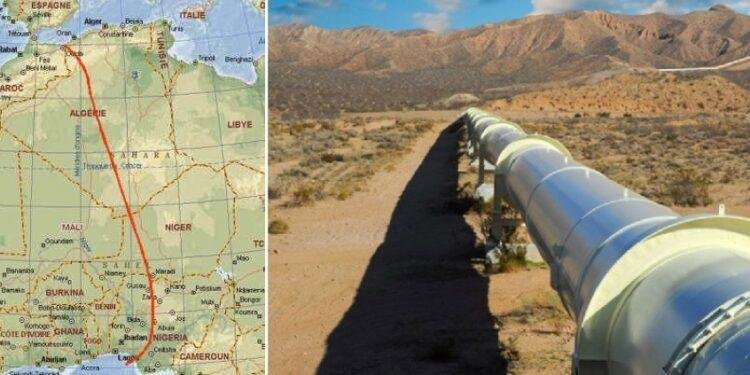
However, Morocco argues that the Trans-Saharan route would traverse regions with significant militant activity, citing security risks in the Sahel as a fundamental structural liability. The Atlantic coastal route of the Nigeria-Morocco Gas Pipeline avoids the Sahel entirely, maintaining an offshore alignment for most of its length, thereby reducing both political risk and land-acquisition complexity.
Nigeria-Morocco Gas Pipeline Route and Countries Involved
The geographic footprint of the Nigeria-Morocco Gas Pipeline is as consequential as its engineering design. The route traverses 13 sovereign jurisdictions that span diverse political, economic, and coastal environments across approximately 5,660 kilometres of the Atlantic coastline, making corridor alignment a discipline that combines offshore pipeline engineering, geopolitical negotiation, and environmental risk management in equal measure. This section examines the confirmed coastal alignment and its engineering rationale, the full list of participating countries and their individual roles within the corridor, and the critical European market connection that Morocco’s geography uniquely enables.
Detailed Pipeline Route and Coastal Alignment
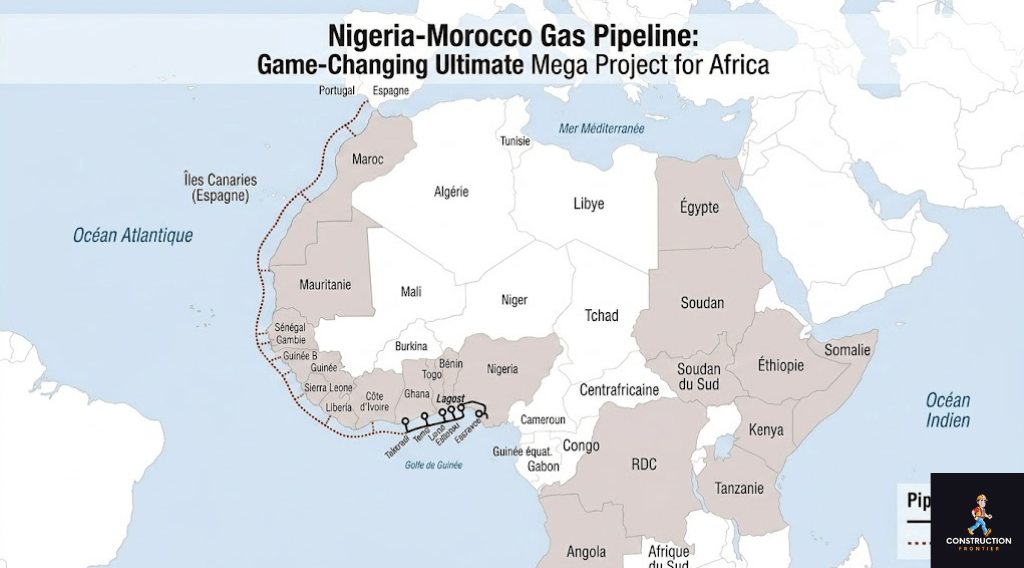
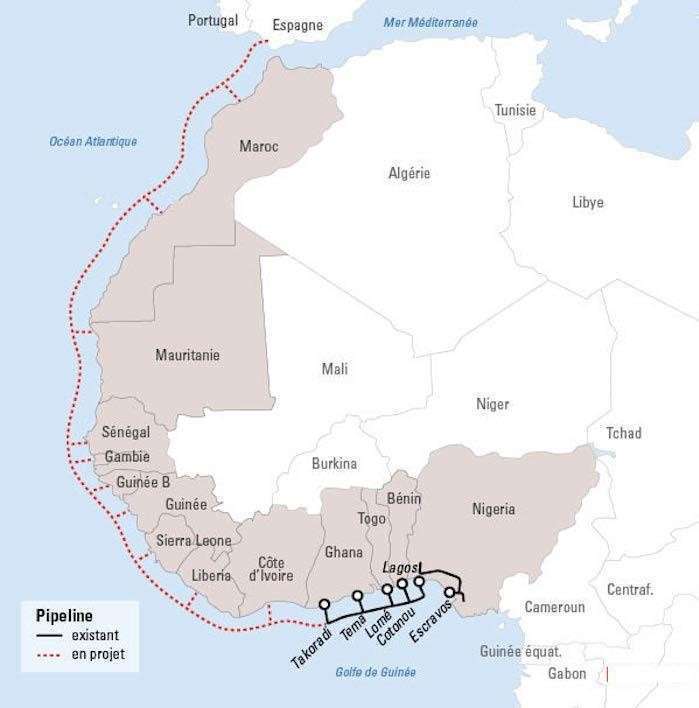
The Nigeria-Morocco Gas Pipeline runs approximately 5,660 kilometres from Brass Island in Nigeria’s Niger Delta northward along the Atlantic coastline, passing through Benin, Togo, Ghana, Côte d’Ivoire, Liberia, Sierra Leone, Guinea-Bissau, The Gambia, Senegal, and Mauritania before terminating at Tangier in northern Morocco, where it connects directly to the existing Maghreb-Europe Gas Pipeline, linking Morocco to Spain and the broader European gas network.
The route’s coastal alignment is deliberate and technically justified. The pipeline includes an offshore section stretching 5,300 kilometres from Brass Island in Nigeria to Dakhla in Morocco’s southern Sahara region and a 1,700-kilometre onshore segment extending from Dakhla northward to the Maghreb-Europe Pipeline connection.
Routing the trunk line offshore for most of its length eliminates the need for land acquisition across thousands of kilometres of coastal territory, reduces exposure to political instability in inland zones, and avoids population-dense agricultural and urban hinterlands, where right-of-way negotiations typically generate delays, community disruptions, and resettlement obligations. The West African Gas Pipeline Project (WAGP) demonstrates that this coastal subsea corridor, which runs 15 to 20 kilometres offshore in water depths of 30 to 75 metres, is both technically proven and operationally manageable at scale.
The pipeline primarily follows an offshore route to Dakhla, then runs along the Atlantic coast onshore to connect to the Maghreb-Europe Gas Pipeline. The project also represents a continuation of the Lagos-to-Takoradi pipeline via Benin and Togo, before heading to Abidjan and Tangier along the Atlantic coast, and from Tangier through the Strait of Gibraltar to Cádiz in Spain, where it joins the original Algeria-Morocco-Spain pipeline infrastructure. This alignment means that the Nigeria-Morocco Gas Pipeline builds upon and integrates with four decades of existing West African gas transmission experience rather than constructing an entirely new route from scratch.
Countries Participating in the Pipeline Corridor
The pipeline connects directly to the major coastal cities of the West African corridor, including Cotonou in Benin, Lomé in Togo, Tema and Takoradi in Ghana, Abidjan in Côte d’Ivoire, Monrovia in Liberia, Freetown in Sierra Leone, Conakry in Guinea, Bissau in Guinea-Bissau, Banjul in The Gambia, Dakar in Senegal, Nouakchott in Mauritania, and Tangier in Morocco, with a possible extension to Europe through Cádiz in Spain. Each city serves as both a delivery node and a potential industrial anchor: the pipeline establishes the energy-supply conditions for gas-fired power generation, manufacturing, and petrochemical development at each connection point.
Beyond the 13 coastal states, the Nigeria-Morocco Gas Pipeline will supply the landlocked states of Niger, Burkina Faso, and Mali via lateral extensions, extending the corridor’s development impact deep into the Sahel. Technical studies completed in 2025 confirmed the pipeline’s route, with internal domestic connections linking Niger, Burkina Faso, and Mali to the main trunk line.
Each participating state within the corridor occupies a dual role. Coastal countries with existing energy infrastructure, such as Ghana and Côte d’Ivoire, primarily serve as consumption nodes, with gas directly feeding power plants and industrial facilities. Countries with smaller domestic demand but strategic coastal positioning, such as Guinea-Bissau and The Gambia, function principally as transit hubs, earning transit fees while benefiting from spur-line connections that serve their domestic gas needs.
The African Atlantic Gas Pipeline comprises two projects: the USD 975 million West African Gas Pipeline Extension Project, spanning 678 km, and the 5,669 km Nigeria-Morocco Gas Pipeline, valued at approximately USD 25 billion. This brings the total integrated programme to an estimated USD 26 billion. This formal merger of the WAGP extension with the Nigeria-Morocco Gas Pipeline under a single ECOWAS-governed framework ensures that all 13 coastal states participate in a unified system rather than a fragmented sequence of bilateral agreements, reinforcing both political alignment and the infrastructure’s long-term operational coherence.
Strategic Access to European Energy Markets
Morocco’s geographic position at Africa’s northwestern apex gives the Nigeria-Morocco Gas Pipeline a transcontinental dimension that no other proposed West African gas infrastructure can match. According to the Pipeline and Gas Journal, ONHYM Director-General Amina Benkhadra confirmed that the project has already secured one of the largest aggregators in Europe to purchase all gas exported through the Maghreb-Europe Pipeline once the Nigeria-Morocco Gas Pipeline connects to it, thereby converting Morocco’s geographic advantage into a bankable commercial commitment.
The route is deliberately coastal, avoiding the security-compromised Sahel corridor that makes the competing Trans-Saharan pipeline through Niger and Algeria a more complex proposition. This security premium embedded in the coastal alignment directly enhances the project’s appeal to European buyers and international financiers, who have become acutely sensitive to supply chain security following the Russian gas supply disruptions of 2021 and 2022.
From Tangier, the pipeline passes through the Strait of Gibraltar to Cádiz in Spain, where it joins the former Algeria-Morocco-Spain pipeline infrastructure, meaning the Nigeria-Morocco Gas Pipeline leverages existing European grid connections rather than requiring new cross-Mediterranean engineering. Nigeria’s gas, once flowing, enters a European distribution system that already knows how to receive it.
Engineering Design and System Specifications of the Nigeria-Morocco Gas Pipeline
The engineering design of the Nigeria-Morocco Gas Pipeline places it in a category of its own among global gas transmission infrastructure. The project does not simply extend existing pipeline technology to a larger scale; it demands purpose-engineered solutions for subsea pressure management, multi-environment material performance, and continental-scale compression logistics that have no direct precedent in African infrastructure history. This section examines the confirmed pipeline geometry and dimensions, the compression architecture required to maintain gas flow across more than 5,000 kilometres, and the detailed scope of the FEED work delivered by the project’s engineering team.
Pipeline Geometry: Dimensions and World Record Status
The confirmed technical specifications of the Nigeria-Morocco Gas Pipeline are provided by the contractors who delivered the FEED Phase II work. The pipeline carries a planned diameter of 48 inches offshore and 56 inches onshore, with a throughput of 30 billion cubic metres per year. When completed, the gas pipeline will be the longest offshore pipeline in the world and the second-longest pipeline overall.
The differential diameter specification reflects hydraulic engineering logic rather than an arbitrary design choice. The offshore 48-inch diameter balances structural integrity with flow efficiency across the subsea environment, where varying bathymetry, seabed topography, and marine dynamic loads govern pipe wall thickness and material selection. The wider 56-inch onshore Moroccan segment aggregates flow from multiple offshore spur lines as the pipeline converges toward its European export terminal, requiring greater volumetric capacity to handle the accumulated throughput. The offshore section stretches 5,300 kilometres from Brass Island in Nigeria to Dakhla in Morocco’s southern Sahara region, and the onshore segment extends 1,700 kilometres from Dakhla northward to the Maghreb-Europe Pipeline connection.
The pipeline’s engineering record status warrants context. To appreciate its scale:
- The Nord Stream 2 pipeline, one of the world’s best-known offshore systems, spans 1,234 kilometres and is 48 inches in diameter.
- The existing West Africa Gas Pipeline, the NMGP’s direct predecessor, runs 678 kilometres offshore and is 20 inches in diameter.
- The NMGP offshore section, at 5,300 kilometres, will be more than four times the length of Nord Stream 2 and over seven times the length of WAGP.
These comparisons reinforce why the engineering strategy for the Nigeria-Morocco Gas Pipeline demands unprecedented coordination across materials procurement, installation vessel scheduling, and multi-jurisdiction regulatory approval.
Compression System Engineering
The pipeline system incorporates approximately 13 compressor stations distributed along the route. In a system spanning this distance, compression engineering is the decisive factor in operational viability. Natural gas loses pressure progressively over distance due to friction with the pipe walls. With a trunk line extending 5,000 kilometres offshore, cumulative pressure drops would, without staged recompression, technically make gas deliveries to Morocco impossible.
Each compressor station uses gas turbine-driven centrifugal compressors capable of handling high volumetric throughput under variable inlet conditions. The stations return the pipeline pressure to the operating design specifications after each transmission segment, with their spacing determined through the detailed hydraulic modelling conducted during the FEED Phase II study.
The pipeline incorporates intermittent onshore returns for compression as a base case, meaning the system brings the pipeline onshore at strategic coastal points to connect to compressor stations before returning it offshore. This hybrid topology solves the practical challenge of maintaining compression infrastructure in deep-water environments, where fully subsea compressor systems carry significantly higher capital and long-term maintenance costs than onshore equivalents.
The engineering logic behind the compression strategy delivers four compounding benefits:
- Pressure stability: Staged recompression maintains design operating pressure across each segment, ensuring consistent throughput to all 13 delivery nodes.
- Flexibility: Onshore compression stations allow maintenance and capacity adjustment without disrupting offshore pipeline operations.
- Cost efficiency: Onshore station construction costs substantially less than deep-water alternatives, thereby preserving capital for pipeline construction.
- Renewable integration potential: The project explores using renewable energy resources to power the pipeline and reduce its carbon footprint, with onshore stations providing the grid connectivity required for renewable power sourcing.
FEED Scope and Engineering Contractor Responsibilities
ILF Consulting Engineers of Munich and DORIS Engineering of Paris were jointly commissioned to provide project management consultancy services for FEED Phase II. Their scope covers onshore and offshore pipeline and compressor station engineering, engineering surveys, environmental and social impact assessment, land acquisition studies, and the project implementation framework.
Worley manages the overall FEED services for the Nigeria-Morocco Gas Pipeline through its offshore engineering consultancy, Intecsea BV, based in The Hague, Netherlands. The OPEC Fund for International Development committed USD 14.3 million to the FEED Phase II study, specifically to co-finance survey works for the northern area covering Senegal, Mauritania, and Morocco.
N-Sea conducted reconnaissance and meteocean surveys along with topographical and geotechnical onshore surveys for the offshore Nigeria-to-Senegal segment, including landfalls and onshore routes to compressor stations. These surveys establish the seabed bathymetry, soil classification data, and metocean statistics that directly determine pipe wall thickness calculations, free-span analysis, and installation vessel selection, forming the technical foundation upon which all future construction procurement rests.
Construction Progress and Implementation Status of the Nigeria-Morocco Gas Pipeline
The Nigeria-Morocco Gas Pipeline has advanced through a carefully sequenced series of engineering, institutional, and commercial milestones since its inception in 2016. Progress has not been linear: the project has had to absorb financing delays and political disruptions, as well as the sheer governance complexity of aligning 13 sovereign governments around a single infrastructure programme. This section tracks the full development timeline from feasibility to current implementation status, examines the governance breakthroughs achieved in 2024 and 2025, and outlines the phased construction sequence that will carry the project through to its estimated completion in 2046.
2016 to 2024: Engineering Development Timeline
NNPC and ONHYM completed the feasibility study in January 2019 and, in the same month, contracted Penspen to conduct FEED Phase I. By March 2020, FEED had entered its second phase. In April 2022, Worley was selected to provide the main FEED services for the NMGP project. In July 2022, ILF and DORIS won the PMC contract for FEED Phase II. Engineers completed detailed design studies in 2024, and teams finished environmental and social impact assessments for the northern section.
This engineering timeline reflects deliberate pacing. Each FEED phase is built on the technical outputs of the previous one, progressively narrowing cost uncertainty and validating the route before the project advances to financial close. The sequence of key engineering milestones confirms the depth of technical preparation now underpinning the construction phase:
Nigeria-Morocco Gas Pipeline (NMGP) Development Timeline
| Date/Period | Project Milestone | Technical & Strategic Actions |
| December 2016 | Project Initiation | A bilateral agreement was signed between NNPC (Nigeria) and ONHYM (Morocco). |
| August 2017 | Feasibility Kick-off | Formal commencement of feasibility studies to determine route viability. |
| January 2019 | FEED Phase I | Feasibility study completed; Penspen contracted for the Front-End Engineering Design (FEED) Phase I. |
| March 2020 | FEED Phase II Initiation | Commencement of the second, more detailed phase of engineering design. |
| April 2022 | Technical Appointment | Worley appointed as FEED Phase II contractor through its subsidiary Intecsea BV. |
| July 2022 | Project Management | ILF and DORIS appointed as Project Management Consultants (PMC) for FEED Phase II. |
| 2023 – 2024 | Field Assessments | Completion of route surveys, Environmental and Social Impact Assessments (ESIA), and land acquisition studies for the northern section. |
| 2024 | Design Finalisation | Detailed design studies have been finalised; FEED Phase II is officially complete, moving the project toward the Final Investment Decision (FID). |
2024-2025: Institutional Acceleration and Governance Milestones
The project’s governance framework advanced decisively in late 2024. In December 2024, West African leaders approved the Intergovernmental Agreement during the 66th ECOWAS Summit, spelling out each country’s rights and responsibilities for the project. This agreement is the legal architecture that makes the pipeline viable as a multi-sovereign infrastructure programme. It establishes the host government framework, transit fee structures, supply obligations, and dispute resolution mechanisms that commercial lenders and equity investors require before committing capital at this scale.
Morocco’s Minister of Energy Transition and Sustainable Development, Leila Benali, confirmed that the latest ministerial meeting approved an agreement between participating countries, along with the Host Country Agreement, which is an important step forward for the project. A special-purpose joint venture is being established between Moroccan and Nigerian stakeholders, with a final investment decision expected before the end of 2025.
On the ground, Morocco has moved from planning to preparatory construction. Morocco has taken the first concrete steps in the project by connecting the northern port of Nador to the southern port of Dakhla, a preparatory phase aimed at facilitating the delivery of equipment and logistical materials now that technical and environmental assessments are complete.
In July 2025, NNPC, ONHYM, and Togo’s gas company, SOTOGAZ, signed a memorandum of understanding, completing a series of partnerships with all countries along the pipeline route. NNPCL Group Chief Executive Mele Kyari confirmed the completion of FEED Phase II and noted that the project had entered the land acquisition and resettlement phase, stating: “These milestones reflect our commitment and shared ability to execute this transformative pipeline project.”
Phased Construction Strategy and Commercial Sequencing
Morocco announced plans to launch initial tenders in 2025, aligned with ONHYM’s 2025 Action Plan and targeting the Moroccan segment of the pipeline covering 1,672 km. A private company will be established to supervise the pipeline’s construction, operation, and maintenance. The first phase connects Morocco to gas fields offshore Senegal and Mauritania, as well as Ghana to Côte d’Ivoire. The second phase connects Nigeria to Ghana, and the third phase links Côte d’Ivoire to Senegal.
This three-phase sequencing is commercially rational. Starting with the northern and southern anchor segments, where demand is most immediately monetisable and financing most readily available, reduces capital exposure on the longer and more complex central section while generating early revenue that demonstrates the project’s commercial viability to the broader investor community.
China’s Jingye Steel Group has been awarded a contract to supply pipes for the project, a concrete procurement milestone that confirms the transition from engineering design to active supply chain mobilisation. The pipe-supply contract, combined with Morocco’s ground-level preparatory works between Nador and Dakhla, marks the most tangible evidence to date that the Nigeria-Morocco Gas Pipeline has evolved from a planning programme into an infrastructure project entering its construction phase.
Further Reading: Grand Ethiopian Renaissance Dam: Africa’s Monumental Hydropower Project Transforming Energy
Economic and Investment Structure of the Nigeria-Morocco Gas Pipeline Project
The Nigeria-Morocco Gas Pipeline requires USD 25 billion in capital, demanding a financing structure as ambitious as the engineering design. This section examines the confirmed cost structure, the multi-institutional funding pool that has formed around the project, and the revenue logic that underpins its long-term economic viability for participating countries.
Capital Cost and Confirmed Financing Institutions
The Nigeria-Morocco Gas Pipeline (NMGP) is anchored by a $25 billion capital requirement, supported by finalised feasibility and Front-End Engineering Design (FEED) studies. Official project updates from the Moroccan Ministry of Energy Transition confirm that all 13 participating countries have reached a consensus on the optimal offshore-onshore pipeline route. This alignment transitions the project from a conceptual framework into a high-priority regional infrastructure asset.
The financial architecture for the $25 billion project is structured as a multi-lateral funding pool involving sovereign equity and international development debt.
Confirmed Financial Contributions and Institutional Support
| Institution/Entity | Contribution Type | Financial Detail |
| NNPC Limited (Nigeria) | Equity Share | $12.5 Billion (50% Project Equity) |
| Islamic Development Bank (IsDB) | Study Funding | $45 Million (FEED Phase Support) |
| OPEC Fund for Int. Development | Study Funding | $14.3 Million (Feasibility Support) |
| European Investment Bank (EIB) | Financing Support | Strategic Debt Alignment |
| United Arab Emirates (UAE) | Financing Support | Capital Investment Partner |
A primary driver of the project’s bankability is the formalisation of a large-scale offtake agreement. ONHYM leadership confirmed at the Invest in Africa Energy conference that a major European gas aggregator has committed to purchasing the total volume of gas exported via the Maghreb-Europe pipeline connection.
This commercial agreement is critical for the project’s financial close. It converts engineering data into guaranteed cash flow projections, providing the revenue certainty required by project finance lenders to commit long-tenor debt. By securing a guaranteed European market, the Nigeria-Morocco Gas Pipeline project minimises market risk and establishes a stable Debt Service Coverage Ratio (DSCR) for its international backers.
Governance Structure and the Project Company
The governance of the Nigeria-Morocco Gas Pipeline (NMGP) utilises a tiered corporate structure approved by ECOWAS to manage the complexities of a 13-nation infrastructure corridor. This model centres on a parent holding company that oversees various regional entities responsible for managing specific pipeline segments.
The institutional framework has matured through the following key developments:
- Formation of the Project Company: The establishment of a dedicated Project Company marks the formal shift from the feasibility and financial study phase to a construction-ready execution framework. This entity serves as the primary vehicle for securing the institutional and financial commitments required for the $25 billion build.
- Regional Integration: In July 2025, the project’s public-sector partnership was expanded to include Togo. A tripartite protocol was signed by NNPC Limited, ONHYM, and SOTOGAZ, bringing Togo into the core governance structure.
- Layered Management Model: This governance architecture ensures specialised focus across different project demands:
- The Parent Company: Oversees consolidated financing, intergovernmental compliance, and transcontinental debt servicing.
- Segment-Level Entities: Manage localised construction procurement, environmental permitting, and host-government relations within each participating country.
This decentralised yet integrated approach mirrors successful multi-sovereign pipeline systems globally, providing the legal and operational stability necessary to derisk a project of this geographic and financial scale.
Revenue Logic for Participating Countries
The Nigeria-Morocco Gas Pipeline (NMGP) delivers economic value through several distinct mechanisms, creating a strategic financial framework for 13 participating African nations.
Revenue Streams and Economic Logic
The pipeline’s economic foundation is built on three core pillars of value creation:
- Transit Fee Revenues: States along the corridor earn a steady income from transit fees. These fees serve as compensation for the right-of-way and safety services provided by each host country, creating a stable revenue stream independent of domestic gas consumption.
- Energy Bill Reduction: Nations with domestic gas requirements can access supply at contracted prices that are typically lower than the cost of LNG import parity or diesel-based power generation. This reduces national energy import bills while providing the baseload stability required for grid expansion.
- Wealth Recovery and Monetisation: As the upstream producer, Nigeria captures export revenue by monetising gas reserves that have historically been lost to flaring. Between 2002 and 2024, Nigeria incurred approximately $56.75 billion in direct revenue losses from flaring, a figure that swells to $120.15 billion when foregone LNG export revenue is factored in.
Strategic Financial Implications
The project is framed not merely as an infrastructure investment but as a mechanism for recovering decades of lost national wealth. By converting flared gas into an exportable asset, the NNPC and ONHYM are positioning the pipeline as a continental energy hub that leverages existing infrastructure, such as the Maghreb-Europe Gas Pipeline, to reach European markets.
Regional and Strategic Impact Analysis on the Nigeria-Morocco Gas Pipeline Project
The impact of the Nigeria-Morocco Gas Pipeline extends well beyond gas transmission. This section examines three interconnected strategic dimensions: the project’s role in addressing West Africa’s electricity access crisis, Morocco’s repositioning as Europe’s African gas gateway, and the pipeline’s contribution to industrial development and regional economic integration.
Closing the West African Electricity Access Gap
Sub-Saharan Africa remains the global epicentre for energy poverty. In 2024, regional progress on electricity connections lagged behind pre-pandemic averages, with 27 countries struggling to regain momentum. Nigeria currently faces the world’s largest national electricity deficit, with over 86 million people lacking access as of late 2023.
- Gas-to-Power Scalability: For the 13 countries along the NMGP corridor, gas represents the fastest route to grid expansion. The pipeline provides the firm with baseload generation that solar and wind, due to intermittency, cannot yet deliver at industrial volumes.
- Operational Efficiency: By utilising combined-cycle power plants with efficiencies exceeding 55%, West African economies can achieve rapid capacity expansion.
- Industrial Feedstock: A stable gas supply unlocks dormant capacity in fertiliser production, cement manufacturing, and steel processing.
- Inland Reach: Lateral connections to landlocked nations such as Niger, Burkina Faso, and Mali extend this energy security to regions where energy poverty is a primary driver of political instability.
Morocco: Europe’s New African Energy Gateway
The Nigeria-Morocco Gas Pipeline is a strategic energy corridor that repositions Africa in the global gas market. Europe has prioritised alternative energy sources in response to supply shocks caused by the Russia-Ukraine conflict, making the NMGP a vital link to continental energy security.
- Infrastructure Synergy: The project leverages the existing 1,620-kilometre Maghreb-Europe Pipeline, which connects Morocco to Spanish and Portuguese gas grids. This restores Morocco’s role as an independent continental energy hub.
- Strategic Investment: Morocco is investing $6 billion to link Nador to Dakhla, part of a broader continental integration effort that extends through Mauritania and Senegal.
- Future-Proofing with Green Hydrogen: The pipeline is designed as a “multi-energy corridor”. Morocco’s established solar and wind capacity enables future green hydrogen infrastructure and transport, positioning the project at the intersection of the fossil fuel transition and the emerging hydrogen economy.
Industrial Development and South-South Integration
The Nigeria-Morocco Gas Pipeline establishes a new model for South-South cooperation. Rather than a hub-and-spoke model that exports raw resources to external markets, Nigeria and Morocco are co-leading a program that keeps economic value in Africa.
- Distributed Wealth: The transit fee framework ensures that revenue is distributed across 13 distinct economies, while gas supply nodes drive domestic industrialisation at every stop.
- Geopolitical Alignment: President Bola Tinubu has designated the NMGP a top national priority. In a significant shift in April 2025, Nigeria’s Ministry of Finance confirmed that the U.S. administration expressed strong interest in investing in the project. This follows high-level bilateral discussions during the 2025 IMF and World Bank Spring Meetings, signalling that the pipeline is now a focal point for U.S. strategic interests in Africa’s energy security.
Challenges and Risk Assessment in the Nigeria-Morocco Gas Pipeline Project
No serious analysis of the Nigeria-Morocco Gas Pipeline can ignore the structural challenges that have delayed its final investment decision multiple times and continue to test the project’s momentum. This section examines three critical risk dimensions: the financial complexity inherent in a USD 25 billion multi-sovereign program, the persistent multi-country coordination challenges, and the security and environmental risks that demand active management throughout construction and operation.
Financing Complexity at USD 25 Billion Scale
A $25 billion price tag across 13 sovereign jurisdictions creates a financing environment that no single lender can absorb. The capital structure relies on a high-stakes coordination of sovereign equity, multilateral debt, and commercial project finance.
- Currency and Risk Mismatch: A primary hurdle is currency risk. Revenues generated in 13 different local currencies must service massive debt obligations denominated in USD and EUR.
- Timeline and FID Shifts: Reflecting this complexity, the Final Investment Decision (FID), originally targeted for December 2024, was moved to early 2025 and later projected for the end of 2025.
- Cost Escalation: Historical data for mega-infrastructure suggests overruns of 20% to 40% are common. Over a 25-year construction horizon, the project remains exposed to commodity price cycles and labour market fluctuations that are difficult to hedge.
Multi-Sovereign Coordination Across 13 Governments
The Nigeria-Morocco Gas Pipeline’s most persistent non-technical challenge is its linear dependency during construction. A delay in the environmental permits or land acquisition of one country can stall the entire $25 billion chain.
- Political Instability: The August 2023 coup in Niger highlighted the region’s volatility. While the NMGP’s Atlantic coastal route offers more security than the Trans-Saharan Gas Pipeline (TSGP), political shifts in any of the 13 host nations can threaten the 25-year program’s long-term continuity.
- Regulatory Friction: Each nation requires a unique Host Government Agreement (HGA). Aligning these 13 legal frameworks into a single project management structure remains a major diplomatic challenge for NNPC and ONHYM.
Security, Environmental Risks, and Community Impacts
The pipeline’s geography introduces a diverse set of risk vectors, from the restive Niger Delta to the deep waters of the Gulf of Guinea.
- The Origin Zone: The Niger Delta remains a high-risk area for pipeline vandalism and crude oil theft. While the offshore route mitigates some onshore conflict, it introduces risks of piracy and subsea interference from commercial shipping.
- Livelihood Disruption: Lessons from the existing West African Gas Pipeline (WAGP) show that 1 km security exclusion zones can severely restrict local fishing access. This has historically led to reduced catches and community displacement.
- Social License: To avoid the socio-economic friction seen in previous projects, the NMGP must implement independent grievance mechanisms and transparent compensation frameworks. Maintaining a social license to operate is as critical as the engineering itself for the pipeline’s long-term survival.
Further Reading: Mambilla Hydroelectric Power Project in Nigeria: Transformative Energy Mega Project Driving Growth
Future Outlook and Expansion Potential of the Nigeria-Morocco Gas Pipeline Project
The Nigeria-Morocco Gas Pipeline’s long-term trajectory extends well beyond first gas. This section examines the immediate path to financial close and construction commencement, the green hydrogen dimension that extends the project’s economic life into the post-fossil-fuel era, and the broader expansion potential that positions Africa as a structural participant in global energy markets through the 2050s.
Path to Financial Close and Construction Start
The Nigeria-Morocco Gas Pipeline (NMGP) has reached its most advanced institutional stage since its inception in 2016. The establishment of a joint special-purpose company (SPC) between Nigeria and Morocco is the primary vehicle for reaching the final investment decision, which is officially expected by the end of 2025.
Strategic Readiness and Infrastructure Preparation
The project is transitioning from study to physical execution through a series of enabling milestones:
- Segment Tendering: The Moroccan segment tenders serve as the first concrete procurement step, establishing market pricing benchmarks and testing contractor appetite for the larger offshore phases.
- Enabling Infrastructure: Morocco is investing $6 billion to expand its national gas network, linking Nador to Dakhla. This 1,600 km corridor serves as the reception and distribution backbone for the NMGP’s northern segment.
- Regional Alignment: The African Atlantic Gas Pipeline (AAGP) intergovernmental agreements have been formally adopted by ECOWAS ministers, ensuring legal and operational synchronisation across 13 nations.
With a finalised FEED, a signed Intergovernmental Agreement (IGA), and a secured European offtake aggregator, the project occupies the closest-to-ready environment in its history.
Green Hydrogen and Long-Term Transition Value
The Nigeria-Morocco Gas Pipeline is engineered to exist beyond the natural gas era. As the global energy system shifts, this infrastructure is designed to serve as a multi-energy corridor that balances fossil fuel recovery with a low-carbon future.
Hydrogen-Ready Infrastructure
Morocco’s massive investments in solar and wind, particularly along the Atlantic coast, create a surplus of renewable electricity suitable for green hydrogen production. The NMGP’s high-pressure transmission design is being future-proofed for the following:
- Hydrogen Blending: Injecting hydrogen into the natural gas stream to lower carbon intensity.
- Dedicated Transport: Eventual conversion to pure hydrogen transport as European and African demand peaks in the mid-21st century.
Continental Demand Trajectory
The African Energy Chamber 2026 Outlook forecasts a 60% rise in continental gas demand by 2050. Nigeria, holding Africa’s largest reserves, is uniquely positioned to meet this demand through the NMGP, ensuring energy security across the African Continental Free Trade Area (AfCFTA). This pipeline sits at the precise intersection of a 25-year demand growth curve and the infrastructure required to serve it.
Conclusion: Africa’s Energy Sovereignty Moves Through This Pipeline
The Nigeria-Morocco Gas Pipeline is the most consequential African infrastructure project of the 21st century, and it is not yet fully under construction. It resolves three structural failures simultaneously: Nigeria’s USD 120 billion gas monetisation deficit, accumulated through decades of flaring and underinvestment; West Africa’s electricity access crisis, affecting hundreds of millions of people across the 13-country corridor; and Europe’s urgent, post-Ukraine imperative to diversify gas supply away from Russian dependence.
The engineering fundamentals are verified and sound. FEED, delivered by Worley, Intecsea, ILF, and DORIS Engineering, has produced a technically validated design with confirmed dimensions of 48 inches offshore and 56 inches onshore, 13 compressor stations, a 30-bcm/year throughput capacity, and a total system length of approximately 7,000 kilometres. The institutional framework is in place: the ECOWAS Intergovernmental Agreement has been signed, the project company has been established, the pipe supply contract has been awarded to Jingye Steel Group, and Moroccan segment tenders are underway. A secured European offtake aggregator converts engineering feasibility into bankable revenue projections.
What now separates the Nigeria-Morocco Gas Pipeline from delivery is disciplined financial closure and sustained political will across 13 governments over a 25-year construction horizon, and rigorous environmental and community management at each stage of implementation. These requirements are demanding. But no alternative infrastructure programme in Africa comes close to matching the economic scale, depth of regional integration, or strategic relevance of the Nigeria-Morocco Gas Pipeline.
Stay Updated on Africa’s Infrastructure Megaprojects
Stay ahead of Africa’s infrastructure transformation with Construction Frontier: Africa Mega Projects. Explore deep technical insights, expert analysis, and investment intelligence shaping the future of African energy infrastructure.