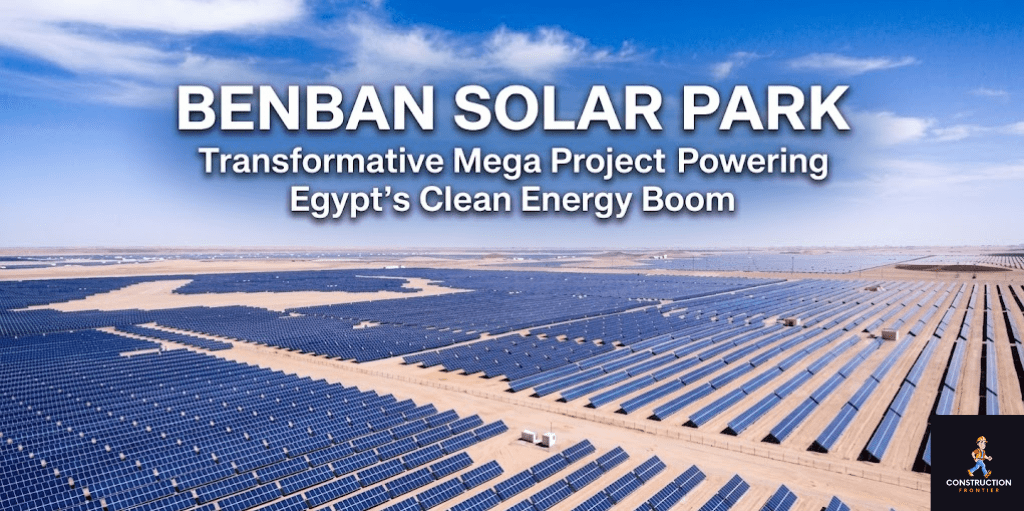
Benban Solar Park: Transformative Mega Project Powering Egypt’s Clean Energy Boom
Benban Solar Park stands as one of the world’s largest solar installations: a 1.8 GW photovoltaic complex that fundamentally altered Egypt’s energy trajectory. Located in the Aswan Governorate of Upper Egypt, it was developed under Egypt’s 2014 Feed-in Tariff (FiT) Framework, achieved full operational status by 2019, and drew over USD 4 billion in international investment.
Technical Snapshot: Core Project Specifications
| Specification | Detail |
| Total Installed Capacity | 1.8 GW (nominal); 1,465 MWac operational |
| Site Area | 37.2 km² (8,843 acres) |
| Number of PV Plants | 41 plots; 32 operational plants |
| Annual Energy Output | ~3.8–4.0 TWh |
| CO₂ Avoided (Annual) | ~1.9–2.0 million tonnes |
| Households Powered | 350,000+ |
| Total Project Cost | ~USD 4 billion |
| Location | Benban, Aswan Governorate, Upper Egypt |
| Grid Connection | 220 kV and 500 kV transmission lines |
| PPA Duration | 25 years (with EETC) |
| Lead Financing | IFC (USD 653M), EBRD (USD 1.13B across 750 MW) |
Benban Solar Park has permanently redefined Africa’s solar power plants landscape, positioning Egypt as the continent’s foremost large-scale solar developer and a benchmark for renewable energy projects in Egypt and across the region.
Introduction: Egypt’s Benban Solar Park Gamble That Changed a Continent
For decades, Egypt powered its rapidly growing economy almost exclusively on natural gas and oil. Then in 2014, facing an acute energy crisis following years of political upheaval, the government made a pivotal decision: open the sun-drenched Western Desert to the world’s private solar developers under a structured feed-in tariff framework. The result was Benban Solar Park, a project that would become one of the most consequential clean energy investments in the developing world.
Benban Solar Park sits at the heart of Egypt’s solar energy projects, representing both the flagship achievement and the catalytic foundation for everything that followed. Built across 37.2 square kilometres of arid desert near Aswan, the park is so large it is visible from space. Its construction triggered a transformation in Upper Egypt’s economic geography, drew financing from institutions spanning five continents, and validated the case for large-scale solar in emerging markets before that thesis became mainstream. Egypt’s power sector was generating around 90% of its electricity from fossil fuels as recently as 2024, making the scale of what Benban has displaced all the more significant.
Within Africa’s solar power plant landscape, no other installation has assembled this scale of capacity, this concentration of international developers, or this depth of multilateral financing in a single complex. Understanding Benban means understanding the full arc of Egypt’s clean energy transition and what it signals for every resource-constrained economy seeking to industrialise on renewable power. The project’s institutional architecture (its Feed-in-Tariffs (FiT) contract structure, its shared infrastructure model, and its multilateral co-financing framework) is now a documented blueprint available to any government with a comparable solar resource and the political will to deploy it.
Overview of Benban Solar Park and Its Strategic Importance
The project’s significance stems from three converging factors: an exceptional solar resource, a well-designed FiT framework, and an infrastructure model that enabled private capital to scale without sovereign balance-sheet risk. The subsections below address each dimension.
Location and Scale of Benban Solar Park, Egypt
Benban Solar Park, Egypt, is located in the desert terrain of the Aswan Governorate at 24.26°N, 32.43°E, approximately 650 km south of Cairo and 40 km northwest of Aswan city. NASA studies confirmed the Benban site receives approximately 2,300 kWh/m²/year of solar irradiation, among the highest recorded anywhere on the planet, translating to a capacity factor of roughly 26%.
The site was selected from a competitive shortlist of potential locations across Egypt’s Western Desert, with the Benban coordinates identified as offering a combination of exceptional irradiation, proximity to an existing 220 kV transmission corridor, and access to Nile River water for operations. The total site spans 37.2 km², subdivided into 41 plots ranging from 0.3 km² to 1.0 km², each allocated to a separate developer under a unified framework coordinated by the New and Renewable Energy Authority (NREA) and the Egyptian Electricity Transmission Company (EETC).
The Egyptian government granted NREA the land in the town of Daraw Markaz, Upper Egypt, under a build-operate-transfer structure with a 25-year usufruct. Four GIS-type high-voltage substations handle power evacuation to the national grid, and a 16-kilometre Nile water pipeline serves operational cleaning needs. The installation is so large that it is readily visible in satellite imagery, a scale that reflects the ambition of Egypt’s solar energy projects at their most developed.
Development Timeline
| Period | Milestone |
| September 2014 | Nubian Suns FiT Programme launched; Benban site designated by NREA |
| 2016–2017 | Financial close achieved for initial tranches; 39 developers selected |
| October 2017 | IFC-led consortium pledges USD 653M for 13 plants |
| March 2018 | First plant inauguration: Infinity Solar / ib vogt 64.1 MWp commissioned |
| 2019 | All 32 plants fully constructed; all projects exporting to EETC grid |
| 2021 | Benban Solar Park declared fully operational at its aggregate capacity |
| 2026–2027 | Nefer Benban (200 MW + 120 MWh BESS) and Nefertiti (500 MW / 1,000 MWh BESS) under construction |
Role in Egypt’s Solar Energy Projects
Before Benban, Egypt’s non-hydro renewable installed capacity stood at just 687 MW. By 2019, that figure had grown to 2,700 MW, a 300% increase in five years, with Benban as the primary engine. The project anchors Egypt’s clean energy transition and Benban Solar Park’s role within the Integrated Sustainable Energy Strategy (ISES), which targets 42% of electricity from renewables by 2030 and 60% by 2040.
Its alignment with Egypt Vision 2030 is direct: every follow-on project at Kom Ombo, Abydos, and across the Nile Valley secured commercial financing more quickly because Benban had demonstrated that the model works. IRENA data confirms Egypt’s total installed renewable energy capacity reached approximately 8.6 GW by fiscal year 2024/25, a trajectory that would be unimaginable without the institutional and market-building legacy of Benban Solar Park.
Further Reading: Aswan High Dam: Remarkable Transformation of Egypt’s Energy, Agriculture & Economy
Engineering Design and Solar Infrastructure
Benban Solar Park’s technical achievement lies not only in its scale, but also in the deliberate system design that enables 32 independently owned plants to function as a unified energy installation across a single, coordinated site.
Installed Capacity and Benban Solar Capacity Breakdown
The Benban solar capacity is expressed in two metrics: nominal DC peak capacity of 1,650 MWp and operational AC grid export capacity of approximately 1,465 MWac. The 41 plots host plants from 20 MW to 64.1 MW. Scatec Solar developed the largest portfolio within the complex: six plants totalling approximately 400 MW. Other key developers include ACWA Power, Acciona Energía, TAQA Arabia, Shapoorji Pallonji Energy, and Delta for Renewable Energy. In total, 39 companies participated, comprising nine international and Arab firms and 30 Egyptian companies selected from over 200 applicants.
Six plants totalling 300 MW deployed bifacial PV modules, generating electricity from both direct sunlight and albedo light reflected from the desert floor. This was a technically progressive choice for 2017–2018. More than 325 MW uses NEXTracker single-axis trackers, which improve annual energy yield by 15–25% compared to fixed-tilt arrays. An additional 64 MW of single-axis trackers was deployed by Mounting Systems GmbH.
Photovoltaic Technology and Grid Integration
The majority of panels are monocrystalline and polycrystalline silicon PV on fixed-tilt frames, with dimensions ranging from 1,200×600 mm to 2,000×1,000 mm. Each plant’s array is connected to a central string or central inverters that convert DC output to AC before step-up transformers feed the four on-site GIS substations, the first completely insulated GIS installations in Egypt.
Power evacuates approximately 12 km to an existing 220 kV line, with a secondary connection available to a 500 kV line for higher-capacity dispatch. The EETC manages grid dispatch through centralised SCADA monitoring across all 32 plants, with each plant required to meet strict interconnection standards, including anti-islanding protection, maximum power point tracking, and automatic synchronisation.
Voltalia’s 32 MW RA plant used Suntech 330 W panels across 93,150 modules, supplying power under a 25-year PPA at USD 0.084/kWh. ACWA Power’s contributions included a 50 MW plant financed with EBRD support. Each of the 12 blocks within a typical 50 MW plant incorporates a cluster of tracker rows feeding into a centralised inverter station, with block-level SCADA data aggregated to the plant control centre and then to the site-wide monitoring facility. Solar irradiation peaks at 272 kWh/m² in June and July and drops to a minimum of 151 kWh/m² in December, reflecting the strong seasonality that plant operators factor into cleaning schedules and maintenance windows.
Benban Solar Capacity and Performance Metrics
Benban Solar Park generates approximately 3.8–4.0 TWh of electricity annually, sufficient to supply over 350,000 Egyptian households and representing roughly 1.5–2% of Egypt’s national electricity demand of approximately 229 billion kWh per year. Independent techno-economic analysis published in the Alexandria Engineering Journal confirmed a levelised cost of energy (LCOE) of approximately 8.1 US¢/kWh and a payback period of 10.1 years at a 12% interest rate, commercially viable metrics that directly justified the multilateral lending consortium’s capital deployment.
The MPPT (maximum power point tracking) efficiency embedded in each plant’s inverter array ensures panels operate at optimal voltage-current conditions throughout the day, continuously adapting to changes in irradiation, ambient temperature, and cloud cover. At Benban, summer heat pushes module operating temperatures above 50°C, causing a measurable decline in voltage-driven output of approximately 0.3–0.5% per degree Celsius above standard test conditions (25°C). For the six bifacial plants totalling 300 MW, EBRD monitoring data confirmed that albedo reflectance from the sandy-gravel desert floor delivers an additional yield improvement of 5–15% relative to monofacial modules in the same conditions, validating the technology selection for high-irradiance desert environments.
All 32 plants have operated continuously since commissioning, exporting clean power to the EETC grid under 25-year PPAs. A Facilities Management Company (FMC), jointly appointed by NREA, EETC, and the Benban Developers Association (BDA), coordinates cross-cutting services, including water supply, waste management, security, and ESHS compliance across the independently owned plants. This shared governance structure has maintained operational consistency that individual O&M contractors alone could not have sustained at this scale, and it has become a reference model for subsequent multi-developer solar complexes in the MENA region.
| Performance Metric | Value |
| Annual Energy Output | ~3.8–4.0 TWh |
| Capacity Factor | ~26% |
| Solar Irradiation (Site) | ~2,300 kWh/m²/year |
| Peak Monthly Irradiation | 272 kWh/m² (June/July) |
| Lowest Monthly Irradiation | 151 kWh/m² (December) |
| Households Powered | 350,000+ |
| CO₂ Avoided (Annual) | 1.9–2.0 million tonnes |
| PPA Tariff Range | USD 0.071–0.084/kWh |
| LCOE (Techno-economic Study) | ~8.1 US¢/kWh |
| Payback Period (at 12% interest) | ~10.1 years |
Economic Impact of Benban Solar Park
The Benban solar park capacity and economic impact in Egypt operate simultaneously at the project, regional, and macro levels. At USD 4 billion in total investment, it ranks among the most capitalised renewable energy projects in the history of emerging markets. Its financing architecture, structurally innovative by design, assembled development banks, bilateral DFIs, commercial lenders, and private equity across 41 separate but coordinated financing packages.
Investment Scale and Financing Structure
| Financing Institution/Mechanism | Amount/Scope | Instrument |
| IFC-led Consortium (10 institutions) | USD 653M for 13 plants | Senior debt + guarantees |
| EBRD (16 projects) | USD 368M direct; USD 1.13B total across 750 MW | Senior project debt |
| Asian Infrastructure Investment Bank (AIIB) | USD 210M for 490 MW | Senior debt |
| MIGA (World Bank Group) | USD 210M political risk insurance (12 projects) | Political risk guarantee |
| Green Climate Fund/FMO/IsDB/ICD | Part of EBRD renewable energy framework | Concessional co-financing |
| ib vogt/Infinity/Phoenix tranche | USD 146M for 166.5 MWp (3 plants) | Project debt |
| Total financial close (30 projects) | Over USD 2.2 billion | Mixed |
All projects operate under 25-year PPAs with the EETC as the sole offtaker, providing contracted revenue certainty that underpinned lender confidence and enabled below-market debt terms. The weighted average cost of capital was substantially below commercial rates for Egyptian infrastructure, owing to the concessional instruments and MIGA’s political risk coverage. The IFC’s Nubian Suns program marshalled nine international banks around a single coordinated commitment, a syndication model directly replicable for future projects in similar markets.
Job Creation and Local Economic Benefits
Upper Egypt has historically suffered from structural unemployment and chronic underinvestment relative to the Cairo-Alexandria corridor. Benban directly addressed this: the construction phase employed more than 10,000 workers on-site daily at peak activity, with total direct employment estimated at 11,720 and a further 23,440 indirect jobs in supply chains, logistics, and support services. The EBRD confirmed its 16 financed projects alone created at least 8,000 construction-phase jobs, with many workers recruited from Benban village and surrounding communities who had previously relied on day labour or seasonal agricultural work.
Post-construction, the park employs approximately 4,000 people in permanent operational roles across plant O&M, facilities management, security, and SCADA monitoring. Engineer Mohamed Emara, who spent three years at the Benban site during construction, described how the project transformed local labour mobility: workers gained structured employment, professional training, and certifiable skills transferable to subsequent projects elsewhere in Egypt and the Middle East and North Africa (MENA) region.
Participating companies were required to allocate 10% of profits to community social responsibility initiatives, providing a sustained economic stimulus that extended beyond direct employment into healthcare, education, and local infrastructure in the Aswan Governorate.
Contribution to GDP and Egypt’s Energy Cost Structure
Benban Solar Park’s 3.8–4.0 TWh of annual output displaces an equivalent volume of gas-fired generation, reducing fuel import volumes and improving Egypt’s current account balance. The 25-year dollar-pegged PPAs lock in long-term cost predictability for the EETC that gas generation cannot match. As global gas prices fluctuated sharply between 2019 and 2024, Benban’s contracted solar output continued at fixed PPA rates of USD 0.071–0.084/kWh, demonstrating the energy cost stability that policymakers prioritise in an economy vulnerable to commodity price cycles.
At the macro level, Benban’s success validated the FiT framework that enabled the 200 MW Kom Ombo competitive tender to achieve a record-low tariff, a pricing outcome that reduced the cost basis for all subsequent renewable energy projects in Egypt. By the end of 2024, Egypt’s total solar PV capacity reached 2.57 GW according to IRENA data, up from 172 MW in early 2018. Benban Solar Park’s investment also contributed to a measurable increase in Upper Egypt’s economic output, with the Aswan Governorate benefiting from infrastructure investment (roads, water, grid connections) that would not otherwise have been allocated to the region under normal development budgeting cycles.
Further Reading: Namibia’s Green Hydrogen Hub: Groundbreaking $10 Bn Mega Project Driving Africa’s Clean Energy Future
Environmental and Sustainability Benefits
Benban Solar Park’s environmental credentials are among its most independently verified attributes. Environmental and Social Impact Assessments mandated by the IFC, EBRD, and the European Investment Bank produced a body of measurement that supports regulatory compliance, carbon market registration, and Paris Agreement tracking.
Carbon Emission Reduction
Benban Solar Park avoids approximately 1.9–2.0 million tonnes of CO₂-equivalent emissions annually, as confirmed independently by the EBRD project database, the Strategic Environmental and Social Assessment prepared for NREA, and peer-reviewed techno-economic studies published in the Alexandria Engineering Journal.
The IFC estimated that the complete complex avoids greenhouse gas emissions equivalent to removing approximately 400,000 cars from Egypt’s roads annually. This displacement is calculated against Egypt’s grid emission factor for fossil gas generation, which emits approximately 0.5 kg CO₂ per kWh produced. The Benban Solar Park Bundled Projects, registered with the Global Carbon Council as Africa’s first GCC-registered solar projects, provide additional formally verified carbon accounting under an internationally recognised standard. The 200 MW tranche alone reduces emissions by approximately 285,050 metric tonnes of CO₂e per year, contributing directly to Egypt’s NDC targets and providing the project’s lenders and equity investors with measurable climate impact data that meets Paris Agreement accounting requirements.
Advancing Renewable Energy Projects in Egypt
Before Benban, fossil fuels accounted for more than 90% of Egypt’s installed electricity generation capacity. Benban Solar Park structurally changed Egypt’s energy balance by proving that private-sector-led renewable energy projects in Egypt could achieve financial close, execute on schedule, and deliver contracted output under a government-backed offtake framework.
Egypt’s non-hydro renewable capacity grew from 687 MW in 2014 to 2,700 MW in 2019, a 300% increase driven primarily by Benban. Total solar PV capacity expanded from 172 MW at the beginning of 2018 to 1,597 MW by the end of 2019, a nine-fold expansion within a single year as Benban plants came online in succession.
The project is directly aligned with Egypt’s NDC commitment to reduce power sector emissions by 37% by 2030 and with the 42% renewable energy share target for the same year, a target the government reaffirmed at COP29 despite acknowledging that it will require significantly accelerated deployment through to 2030.
Benefits of Large-Scale Solar Projects Like the Benban Solar Park
The benefits of large-scale solar projects like Benban Solar Park extend beyond direct output. At the utility scale, shared infrastructure reduces the capital cost per MW. Benban’s USD 4 billion investment across 1.8 GW translates to approximately USD 2.22 per watt installed, materially below the USD 2.50–3.50 per watt typical for independently developed 30–50 MW plants in similar markets during the same period. The modular site model also enables simultaneous multi-developer procurement, reducing component costs through volume. For emerging economies evaluating similar projects, the verified advantages include:
- Shared substation and grid connection infrastructure that reduces per-plant integration costs
- A unified ESHS framework satisfying multiple DFI standards simultaneously across 41 independent plants.
- Workforce skills transfer that builds domestic solar execution capacity for subsequent projects.
- A replicable FiT contract structure requiring no sovereign PPA guarantee, limiting government contingent liability.
- Established O&M protocols and a collective facilities management company model applicable to any multi-developer solar zone.
The scalability argument is reinforced by Benban’s legacy pipeline. Kom Ombo, Abydos, and the upcoming NWFE-backed developments all use contractual, technical, and institutional frameworks derivative of Benban’s design. Each successive project in this lineage has been structured faster, financed at lower cost, and executed with fewer novel risks than its predecessor: the compounding efficiency dividend of a well-designed anchor project.
Benban Solar Park in Africa’s Energy Landscape
Despite more than 85% of Africa’s land area receiving over 2,000 kWh/m² of annual solar irradiation, the continent contributes just 1.48% of global solar electricity generation capacity. The gap between resource endowment and installed capacity is not technical; it is financial, institutional, and regulatory. Benban Solar Park stands as Africa’s largest single PV complex and the continent’s most studied utility-scale solar reference project precisely because it closed that gap in one market through a replicable institutional model.
Comparison with Africa’s Solar Power Plants
| Project | Country | Capacity | Status |
| Benban Solar Park | Egypt | 1.8 GW (1,465 MWac operational) | Operational |
| Noor Ouarzazate Complex | Morocco | 580 MW (CSP + PV hybrid) | Operational |
| Abydos Solar Project | Egypt | 500 MW | Under construction |
| Kenhardt Solar + BESS | South Africa | 540 MW + 1,140 MWh storage | Operational |
| Kom Ombo Solar | Egypt | 200 MW | Operational/expanding |
How Benban Solar Park Powers Africa’s Renewable Energy Growth
How Benban Solar Park powers Africa’s renewable energy growth is evident in the demonstration effect it has produced across the continent. Development finance institutions that co-financed Benban, including the International Finance Corporation (IFC), European Bank for Reconstruction and Development (EBRD), and African Development Bank (AfDB), have cited its risk-return track record in subsequent solar programmes in Senegal, Kenya, and Nigeria.
The MIGA political risk guarantee structure, deployed at scale for the first time at Benban, demonstrated that currency convertibility risk could be covered in emerging markets, expanding the pool of commercial capital available for solar across Africa. This derisking innovation is arguably Benban’s most transferable contribution to continental energy development.
Egypt has leveraged Benban’s institutional knowledge to pursue an ambition to become a regional energy exporter. A planned interconnection with Cyprus and Greece positions the country as a future clean power supplier to European markets. Egypt’s 2024 National Strategy for Low-Carbon Hydrogen targets annual production of 600,000 tonnes in phase one, rising to 2 million tonnes per year, leveraging the renewable energy base established by Benban.
Domestic firms that executed EPC and O&M work at Benban, including Hassan Allam Holdings and Delta for Renewable Energy, now carry verifiable utility-scale solar credentials that position them competitively across MENA project tenders. The broader skills ecosystem created by 11,720 direct construction jobs and 23,440 indirect jobs is a form of human capital investment that compounds over subsequent project cycles.
Challenges and Operational Considerations
Benban Solar Park’s complexity reveals three operational challenges that every stakeholder considering replication must honestly assess: intermittency and storage, desert maintenance, and financial and policy risks.
1. Grid Stability and Energy Storage
Solar PV generation is inherently intermittent, and Egypt’s grid, historically managed around baseload gas turbines and Nile hydropower, was not designed to absorb 1.5 GW of midday PV peaks without storage buffering. The absence of Battery Energy Storage Systems (BESS) at Benban during initial operations was identified as a grid management constraint. Egypt is addressing this directly: the EBRD is financing the Nefertiti 500 MW/1,000 MWh standalone BESS, to be co-located at Benban Solar Park, representing Egypt’s first utility-scale standalone battery storage deployment, with commercial operation targeted for 2027. The Nefer Benban project (200 MW solar + 120 MWh BESS) adds further dispatchability to the site.
2. Maintenance in Desert Conditions
Dust accumulation is the primary mechanism of performance degradation. Saharan dust events can reduce panel output by 20–30% within days if panels are left uncleaned. The 16-kilometre Nile water pipeline was specifically sized to support cleaning operations across 37.2 km² of installed panels.
Summer ambient temperatures exceeding 45°C push panel operating temperatures well above standard test conditions (25°C), reducing silicon PV cell output by approximately 0.3–0.5% per degree above STC. Operators manage this through optimised cleaning schedules, inverter cooling maintenance, and anti-soiling coatings on panel glass.
3. Financial and Policy Risks
All Benban PPAs are denominated in US dollars, but EETC payments are made in Egyptian pounds at the prevailing exchange rate. The Egyptian pound’s significant depreciation since 2016 has created revenue shortfalls for project companies with dollar-denominated debt service obligations. IMGA’s USD 210 million in political risk insurance addresses convertibility risk in principle, but does not fully offset the sustained currency depreciation Egypt experienced between 2022 and 2024. For investors in follow-on projects, structuring adequate currency risk mitigation remains a critical deal condition.
On the policy side, Egypt’s 2024 Biennial Transparency Report showed renewables at just 11% of the electricity mix against a 42% target for 2030, a gap that reflects the structural tension between ambitious policy targets and the grid infrastructure investment, financing access, and institutional capacity required to deploy at the necessary pace. The government’s decision to add 3 GW of solar in 2026 and 600 MW of BESS before the summer peak signals renewed urgency, but for investors evaluating long-term commitments, the consistency of policy execution over successive project cycles remains as important as the headline targets.
Lessons from Benban Solar Park for Future Mega Projects
Benban Solar Park has generated institutional knowledge directly applicable to the next generation of utility-scale solar in Africa and other emerging markets. Three structural lessons stand out, followed by the project’s forward-looking expansion trajectory.
Public-Private Partnership and Regulatory Design
Benban demonstrates that large-scale infrastructure can be delivered without sovereign balance sheet commitments if the government provides three non-negotiable enablers: land allocation, grid connection infrastructure, and a credible offtake mechanism. Egypt’s NREA provided the 37.2 km² land parcel and coordinated the substation and 16-kilometre water supply infrastructure. The EETC provided 25-year PPAs without requiring sovereign guarantees; only its status as a state-owned enterprise with implicit government support was required. This distinction reduced the contingent liability exposure for the Egyptian government while enabling USD 4 billion of private and institutional capital to enter the project.
The Benban Developers Association (BDA) structure enabled 41 independent plant owners to coordinate shared services and cross-cutting ESHS compliance, satisfying differing IFC Performance Standards, EBRD Performance Requirements, and EIB environmental standards simultaneously without conflicting obligations. This governance innovation is directly replicable in any market where a government wants to attract multiple private developers to a single designated zone without requiring a single large project developer that could concentrate execution risk.
For other governments considering similar programmes, Benban demonstrates that policy design quality, not just renewable energy ambition, determines whether multilateral financing flows. An EBRD technical cooperation assignment, co-funded by the Green Climate Fund, simultaneously built EETC’s tender administration capacity, proving that regulatory capability building must be treated as a precondition, not an afterthought.
Future Expansion and Strategic Outlook
Benban Solar Park is an actively evolving infrastructure platform. The Nefer Benban project (258.5 MWp solar with 120 MWh BESS, developed by Hassan Allam Utilities with a USD 65 million EBRD bridging loan) is under construction as of early 2026, with commercial operation targeted for Q3 2027. Hassan Allam Constructions, the EPC contractor, signed supply agreements for trackers and inverters in early 2026, with procurement progressing on schedule.
The larger Nefertiti project (500 MW/1,000 MWh standalone BESS), backed by USD 162.5 million in EBRD financing for AMEA Power, will represent Egypt’s first utility-scale standalone battery storage deployment when commissioned in 2027, directly addressing the intermittency constraints that have limited Benban Solar Park’s contribution to grid stability.
Egypt plans to add 3 GW of solar capacity nationally in 2026 and 600 MW of new BESS before the summer demand peak, with Benban remaining the primary hub for both generation and storage additions. The NWFE program, backed by USD 10 billion in international commitments, includes 1,000 MW of new capacity at the Benban site in its first phase, alongside the 1.1 GW Suez wind farm, the 1 GW Abydos II solar project, and a series of battery storage schemes that will collectively transform Upper Egypt into Africa’s most concentrated clean energy corridor.
At the continental level, Egypt’s 42% renewable energy target by 2030 demands approximately 31 GW of solar capacity, a pipeline that dwarfs Benban in aggregate scope but cannot exist without Benban as its institutional foundation. Benban’s proven FiT contract structure, multilateral co-financing template, and MIGA derisking mechanism are now documented reference instruments available to any government seeking to replicate the model in a comparable solar-resource market. Egypt’s planned Egypt-Cyprus-Greece interconnector and its USD 33 billion green hydrogen investment strategy would not be credible without the generation base established by Benban Solar Park.
Further Reading: Discover 10 Critical Project Management Challenges in African Infrastructure
Technical Block: Benban Solar Park, Engineering, Performance, and Financial Benchmarks
This data-driven technical summary consolidates verified engineering specifications, performance metrics, and financial parameters for engineers, quantity surveyors, developers, and investment decision-makers requiring precise reference data.
Technical Block 1: Core Engineering Specifications
| Parameter | Specification |
| Total Nominal Capacity (DC) | 1,650 MW (1.65 GWp) |
| Total Operational AC Capacity | ~1,465 MWac |
| Design Target Capacity | 1,800 MW (1.8 GW) |
| Number of PV Plots / Plants | 41 plots; 32 operational plants |
| Site Area | 37.2 km² (8,843 acres) |
| Individual Plot Size Range | 0.3 km² to 1.0 km² |
| Panel Technology | Mono/polycrystalline silicon PV; bifacial modules in 300 MW (6 plants) |
| Tracker Systems | Single-axis: 325+ MW (NEXTracker) and 64 MW (Mounting Systems GmbH); balance fixed-tilt |
| Inverter Standards | Anti-islanding, MPPT, automatic synchronisation, high conversion efficiency |
| Substations | 4 × GIS-type HV substations (first GIS substations in Egypt) |
| Grid Connection Voltage | 220 kV (primary); 500 kV (secondary/future) |
| Water Supply Infrastructure | 16 km pipeline from the Nile River |
| Solar Irradiation | ~2,300 kWh/m²/year |
| Capacity Factor | ~26% |
Technical Block 2: Energy Output, Grid Contribution, and Environmental Metrics
| Metric | Value |
| Annual Energy Generation | ~3.8–4.0 TWh |
| Peak Monthly Irradiation | 272 kWh/m² (June/July) |
| Lowest Monthly Irradiation | 151 kWh/m² (December) |
| Grid Share (Egypt) | ~1.5–2% of national demand (~229 billion kWh/year) |
| Households Powered | 350,000+ |
| CO₂ Avoided (Annual) | 1.9–2.0 million tonnes |
| GHG Avoidance Equivalent | ~400,000 cars removed from roads annually |
| PPA Duration / Offtaker | 25 years / EETC (sole offtaker) |
| PPA Tariff Range | USD 0.071–0.084/kWh (dollar-pegged) |
| LCOE (Independent Study) | ~8.1 US¢/kWh |
| Payback Period (12% interest rate) | ~10.1 years |
Technical Block 3: Financial and Infrastructure Metrics
| Financial / Infrastructure Metric | Detail |
| Total Project Investment | ~USD 4 billion |
| Capital Cost per Watt Installed | ~USD 2.22/W |
| IFC-Led Consortium | USD 653M for 13 plants (Nubian Suns Programme) |
| EBRD Total Financing (16 projects) | USD 1.13B (USD 368M direct + USD 400M+ mobilised) |
| AIIB Commitment | USD 210M for 490 MW |
| MIGA Political Risk Insurance | USD 210M (12 projects) |
| Total Financial Close (30 projects) | Over USD 2.2 billion |
| Number of Developers | 39 (9 international/Arab; 30 Egyptian) |
| Direct Construction Jobs | 11,720 (peak 10,000–18,000 daily) |
| Indirect Construction Jobs | 23,440 |
| Permanent Operational Jobs | ~4,000 |
| Substation Infrastructure | 4 GIS-type HV substations (NREA/EETC) |
| Active Expansion (2026–2027) | Nefer Benban: 200 MW + 120 MWh BESS; Nefertiti: 500 MW / 1,000 MWh BESS |
Conclusion: Benban Solar Park Capital, Strategy, and the Long Arc of Africa’s Energy Transformation
Benban Solar Park is best understood not as an endpoint but as an inflexion point. It marks the moment at which the technical feasibility, financial viability, and political will for large-scale renewable energy in Africa ceased to be theoretical propositions and became verifiable facts. The USD 4 billion assembled to build this complex, drawn from development finance institutions across four continents, represents the most concentrated evidence that emerging-market solar can meet institutional investment criteria at utility scale.
For capital allocators still treating African renewable infrastructure as a frontier risk class, Benban Solar Park’s decade of verified performance, its 25-year contracted revenue stream, and its 1.9 million tonnes of annual CO₂ displacement provide a counterargument built on numbers rather than narrative. The trajectory of Egypt’s solar energy projects now points toward a permanent structural shift in how Africa finances and manages its energy future.
When the Nefertiti battery storage system comes online at Benban in 2027, the park will complete its evolution from an intermittent generation asset into a dispatchable clean power platform. Combined with the planned Egypt-Cyprus-Greece interconnector and Egypt’s USD 33 billion green hydrogen investment pipeline, the commercial and geopolitical leverage flowing from Benban’s foundation will continue to compound. For every investor, developer, and policymaker assessing Africa’s energy transition, Benban Solar Park is not a case study in what was built. It is a benchmark for what must be replicated, at scale, across a continent that can no longer afford to leave its solar endowment untapped.
Stay Updated on Africa’s Infrastructure Megaprojects
Stay ahead of Africa’s infrastructure transformation with Construction Frontier: Africa Mega Projects. Explore deep technical insights, expert analysis, and investment intelligence shaping the future of African clean energy infrastructure.