Construction Workers’ Suicide Rates: 8 Critical Causes and Proven Prevention Strategies
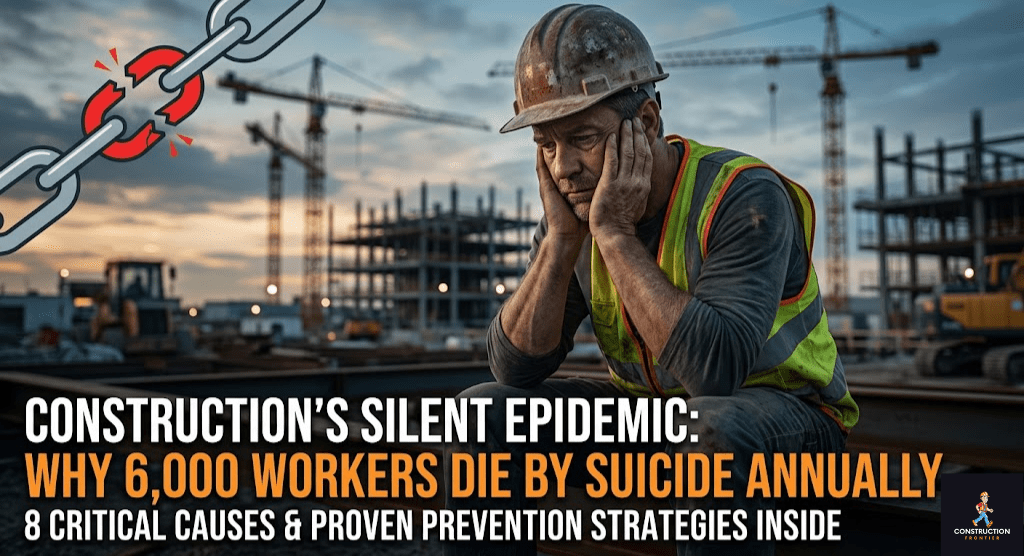
Construction workers’ suicide rates rank among the highest of any profession globally, with male workers in the United States dying by suicide at a rate 75% above the general male population. In 2022, an estimated 6,000 construction workers died by suicide, six times the number who died from on-site physical injuries. The scale of this crisis has transformed mental health in the construction industry from a welfare footnote into one of the sector’s most urgent safety imperatives.
Technical Snapshot: Core Crisis Indicators
• U.S. construction suicide rate (2024): 41.9 per 100,000 workers
• Rate vs. general population: 4+ times higher
• Rate vs. on-site fatalities: 5.5 times higher
• Annual deaths by suicide (2022 est.): 6,000 construction workers
• Share of all industry suicides (2021): 17.9%, despite 7.4% workforce share
• Substance use disorder rate: ~12% vs 7.5% national average
• Primary demographic at risk: White, male, aged 35 to 64
Understanding why construction workers’ suicide rates are high requires confronting the full spectrum of occupational, cultural, and systemic pressures that converge on this workforce. Addressing construction workers’ suicide rates demands intervention at every level, from jobsite culture to corporate policy.
Introduction: The Scale of the Crisis
Construction workers’ suicide rates represent one of the most striking public health failures hidden within an industry defined by physical risk. While the sector invests heavily in fall protection, scaffold safety, and machinery guards, the leading cause of preventable death among construction workers is not a falling object or a collapsed trench. It is SUICIDE. The construction industry mental health crisis has moved from anecdote to epidemiological fact, backed by federal data, peer-reviewed research, and the testimony of thousands of workers and supervisors who have watched colleagues disappear from jobsites permanently.
The most recent data from CPWR, the Center for Construction Research and Training, confirms that construction workers’ suicide rates declined marginally in 2024 to 41.9 per 100,000 workers, down from 43.2 in 2023. The directional movement is welcome, but context is sobering: that rate still exceeds on-site accident fatalities by more than four times. For every worker killed by a physical hazard, four more die by their own hand. Understanding this disparity is the first step toward reversing it.
| Estimated U.S. construction workers who died by suicide in 2022, versus approximately 1,000 from on-site injuries. |
The 2021 National Vital Statistics data, analysed by the CDC, found that construction accounted for 17.9% of all workplace suicides despite representing only 7.4% of the U.S. workforce. Suicide rates in construction workers are not a marginal statistical aberration; they reflect a structural problem rooted in the nature of the work, the composition of the workforce, and decades of cultural avoidance. This supporting article to our analysis of “construction’s biggest killer” examines eight critical causes driving construction workers’ suicide rates and identifies the prevention strategies that are demonstrably moving the needle.
8 Critical Causes Behind Construction Workers’ Suicide Rates
The causes of suicide in the construction industry do not operate in isolation. They compound, intersect, and reinforce each other, creating what researchers at the American Society of Safety Professionals have described as a perfect storm of risk factors. The following eight causes account for the dominant drivers behind elevated suicide rates in construction workers, drawing on CDC data, peer-reviewed literature, and industry analysis.
1. Demographic Concentration of High-Risk Individuals
The construction workforce’s demographic profile closely mirrors the demographic profile of those at the highest statistical risk of construction workers’ suicide rates in the general population. Approximately 90% of construction workers are male, and national data consistently shows men die by suicide at 3.5 times the rate of women. Around 65% of construction workers are white, a group with disproportionately high suicide rates, particularly in the 35 to 64 age bracket, which describes the bulk of experienced site workers.
Veterans, who are 50% more likely to die by suicide than non-veterans, account for more than 15% of the construction workforce. This demographic concentration does not cause suicide, but it creates a baseline vulnerability that amplifies every additional stressor the industry introduces.
2. Chronic Physical Pain and Musculoskeletal Injury
Construction is one of the most physically demanding occupations in any economy. Workers routinely contend with repetitive strain, heavy lifting, vibration exposure, and awkward postures across long shifts on hard terrain. The industry records of musculoskeletal disorder rates in construction are significantly above the cross-industry average. Research from PubMed Central has established a direct relationship between chronic physical pain and elevated suicide risk: pain reduces quality of life, disrupts sleep, limits social participation, and generates persistent psychological distress.
The injury-to-suicide pathway is well documented. A worker sustaining a serious injury faces not only pain but the threat of income loss, reduced professional identity, and fear that they will never return to full capacity. These compounding losses are among the most powerful precipitants of suicidal ideation, making injury prevention a direct suicide prevention strategy.
3. Opioid Dependence and Substance Use
Workplace stress in the construction sector and the chronic pain that follows injury have driven the construction industry’s opioid dependency rate to levels well above the national average. Approximately 12% of construction workers are estimated to have a substance use disorder, compared to 7.5% across all industries. Opioids are frequently prescribed for legitimate injury management but carry a high potential for long-term dependence, particularly where workers return to physically demanding roles before full recovery. Construction workers are also at disproportionate risk for binge drinking and non-prescription drug use as self-medication strategies.
The connection between substance use and construction workers’ suicide rates is direct. Substance dependence degrades judgement, exacerbates depression, destabilises relationships, and strips away the coping mechanisms that would otherwise buffer workers against suicidal crises. In 2020, over 14,000 overdose deaths in construction were recorded with no specific indicator of intent, a figure that likely conceals a significant share of intentional fatalities.
| Risk Factor | Construction Industry | National Average |
| Substance use disorder | ~12% | ~7.5% |
| Male workforce proportion | ~90% | ~53% |
| Annual suicide rate per 100K | 41.9 | ~14.0 |
| Musculoskeletal disorder rate | Above average | Baseline |
| Veterans in the workforce | >15% | ~7% |
4. Workplace Stress, Job Insecurity, and Seasonal Employment
Workplace stress in the construction sector takes forms that are distinct from those in other industries. Construction projects are finite, and the employment model is inherently episodic: workers cycle between contracts, projects, and employers, often without the security of steady income or continuity of professional community. Seasonal layoffs, project cancellations, and budget overruns translate directly into worker anxiety. Financial pressure is one of the most consistent precipitants of suicidal crisis across all demographics, and construction workers face it structurally rather than situationally.
Deadline pressure intensifies these dynamics. Major infrastructure and commercial projects carry penalty clauses, investor expectations, and public scrutiny. Foremen and superintendents absorb that pressure and transmit it down the chain of command, creating chronic stress at every level of the site hierarchy. Workers who manage mental health challenges in these conditions frequently find that the environment compounds their distress rather than providing relief.
Further Reading: Construction Workers’ Suicide Rates: 8 Critical Causes and Proven Prevention Strategies
5. Stigma and the Masculine Culture of Silence
The cultural architecture of the construction industry has historically treated emotional expression as a professional weakness. Workers describe a workplace culture in which strength is equated with stoicism and vulnerability carries a perceived career cost. This stigma is not imaginary: workers who have disclosed mental health difficulties have reported consequences ranging from informal marginalisation to termination. The fear of being seen as unfit, unreliable, or a liability deters help-seeking at precisely the moments when intervention is most critical.
This masculine culture of silence is among the most structurally entrenched causes of suicide in the construction industry. It suppresses disclosure, delays diagnosis, and prevents workers from accessing EAPs, counselling, and peer support networks that could interrupt a developing crisis. Changing this culture requires leadership modelling, normalisation through open discussion, and sustained organisational commitment, not a single toolbox talk.
6. Isolation, Remote Work Sites, and Family Separation
Large infrastructure projects, particularly in road, rail, energy, and resources, routinely deploy workers to remote locations for extended rotations. The fly-in/fly-out and drive-in/drive-out models of employment common in mining and major civil construction separate workers from their primary support systems for weeks or months at a time. Social isolation in the construction sector is one of the most significant independent risk factors for suicidal ideation and completion, and construction normalises it as a standard feature of project delivery.
The intersection of isolation and family strain is particularly acute. Workers managing relationship difficulties, custody disputes, or family health emergencies from hundreds of kilometres away have limited capacity to provide support or receive it. Several studies of male construction worker suicides have identified relationship breakdown and family separation as a primary precipitant, often compounded by financial stress and substance use.
7. Project Transitions, Job Instability, and Loss of Professional Identity
Mental health challenges in construction jobs are amplified by the project-based nature of the industry. Workers frequently transition between teams, sites, roles, and employers, preventing the formation of stable professional communities and mentoring relationships. For experienced tradespersons in their forties and fifties, the additional threat of automation and deskilling generates a specific form of occupational anxiety: the sense that decades of craft expertise are being made obsolete and that no comparable pathway exists.
Professional identity matters deeply to construction workers. The work is physically visible, socially legible, and tied to tangible outcomes. When that identity is threatened by injury, age, or technological disruption, the psychological consequences can be severe. Loss of professional role is among the most frequently cited precipitating factors in construction suicide case analyses.
8. Limited Access to Mental Health Services
Even where construction workers are willing to seek help, access barriers frequently prevent them from doing so. Many construction employers, particularly small and medium-sized subcontractors, do not offer employee assistance programmes. Workers on short-term contracts may have limited or no health insurance coverage. Rural and remote job sites place workers far from specialist mental health services. Shift patterns and site schedules make conventional appointment-based therapy impractical. For migrant workers and non-English speakers, additional barriers of language and cultural unfamiliarity with the mental health system compound access difficulties.
The consequence is that construction worker wellbeing is most at risk in the settings least equipped to support it. Addressing this requires both structural reforms to how care is delivered and funded and industry-wide commitment to integrating mental health resources into the physical infrastructure of the jobsite.
Further Reading: 20 Best Construction Podcasts to Inspire and Educate Industry Professionals
Proven Prevention Strategies: How to Prevent Suicide Among Construction Workers
Understanding how to prevent and reduce construction workers’ suicide rates requires moving beyond awareness campaigns to structural and cultural interventions that address root causes. The following strategies are grounded in evidence and already demonstrating measurable impact across the industry.
Leadership-Modelled Culture Change
The most consistent finding across prevention research is that cultural change requires senior leadership to model the behaviours they want to normalise. When site managers, project directors, and company executives openly discuss mental health, disclose their own struggles, and visibly use support resources, the stigma barrier weakens. Programmes such as MATES in Construction (Australia) and the Construction Industry Alliance for Suicide Prevention STAND Up framework in the United States have built culture-change curricula around this principle, training leaders to initiate conversations rather than waiting for workers to raise them.
Peer Support Networks and Gatekeeper Training
Peer support programmes train selected workers in mental health first aid and gatekeeper skills, equipping them to identify distress signals in colleagues and facilitate access to professional help. The evidence base for peer support in male-dominated, high-stigma industries is strong. Workers are significantly more likely to disclose distress to a trusted colleague than to a supervisor or external counsellor. Several major contractors, including Skanska, have deployed embedded peer supporters on jobsites as a standard safety resource, modelling an approach with demonstrable uptake rates.
Integrated EAP Provision and 24/7 Access
Employee Assistance Programmes (EAPs) are among the most cost-effective mental health interventions available to employers, but their coverage in construction is inconsistent, and their utilisation rates are often low. Effective EAP deployment requires more than distributing a phone number: it demands active promotion by supervisors, confidentiality assurances that workers believe, and service formats (telephone, digital, and off-site) suited to site schedules. Several industry bodies recommend that EAP access be extended to workers’ families, as relationship and family stress is a primary suicide precipitant.
Toolbox Talks and Jobsite Mental Health Normalisation
Toolbox talks, the brief pre-shift safety briefings standard across the sector, have been adapted by organisations including the Associated Builders and Contractors, CPWR, and CIASP to cover mental health topics, warning signs of suicidal crises, and signposting to support resources. When delivered consistently and by credible site leaders rather than as an occasional HR exercise, they serve a dual function: conveying information and signalling that the organisation considers mental health a legitimate job-site safety issue.
Injury Management and Pain Pathways
Reducing the injury-to-addiction-to-suicide pipeline requires treating physical and mental health as interconnected from the point of injury. This means early access to physiotherapy and pain management to reduce opioid reliance, occupational rehabilitation programmes that support workers back to modified duties rather than forcing premature return to full physical demands, and active monitoring of workers recovering from serious injuries for emerging mental health symptoms. Prevention of construction workers’ suicide rates must begin at the first aid box.
Financial Stability and Employment Continuity Measures
Policies that reduce the financial precarity structurally embedded in construction employment address one of the industry’s most consistent suicide risk factors. Paid sick leave, income continuity during project transitions, and accessible workers’ compensation processes reduce the financial anxiety that precedes many crisis episodes. The CPWR has specifically identified increasing paid leave as a targeted intervention for reducing construction workers’ suicide rates, alongside anti-bullying training and the promotion of safety culture as complementary measures.
Digital and Remote Support Tools
For workers in remote or fly-in, fly-out environments, digital platforms extend the reach of mental health support into locations where face-to-face services are not viable. The MATESmobile app, developed as a companion to the MATES in Construction programme, provides reinforcement of training messages, links to crisis resources, and peer connection for workers in isolated settings. The 988 Suicide and Crisis Lifeline in the United States is available by call or text in English and Spanish and represents the most immediate resource available to workers in acute crisis.
Industry Coordination and Contractor Accountability
Individual employer interventions, however well designed, cannot address a systemic problem alone. The construction industry’s mental health crisis requires coordinated action across contractors, unions, industry bodies, and government. Bechtel’s USD 7 million commitment to the American Foundation for Suicide Prevention and the Hard Hat Courage initiative represents the kind of industry-scale investment capable of building sustained infrastructure. The Construction Industry Alliance for Suicide Prevention’s stakeholder pledge model, which commits contractors to specific mental health and safety priorities, offers a framework for collective accountability that individual EAPs cannot replicate.
The Path Forward: Building a Culture That Saves Lives
Construction workers’ suicide rates have declined modestly in 2024, the first directional improvement in several reporting cycles. That movement reflects genuine industry effort: standdowns, peer support deployments, leadership engagement, and toolbox talk programmes are accumulating cultural impact. But at 41.9 per 100,000 workers, suicide rates in construction workers remain a public health emergency that demands sustained, systematic attention.
The industry has developed the tools. What remains is the will to deploy them at scale: to integrate mental health into every contractor’s safety management system, to make EAP access universal regardless of company size or contract type, and to replace the culture of silence with one in which asking for help is recognised as the professional choice rather than a career risk. Every cause identified in this analysis has a corresponding prevention lever. The construction industry mental health crisis is not inevitable, and construction worker wellbeing is a measurable, improvable metric when treated with the same rigour applied to falls and fatalities.
For a comprehensive examination of the broader mental health landscape in construction, including its historical roots and the full policy response, read the pillar article: Unearthing Construction’s Biggest Killer: Mental Health. Related analysis on workforce wellbeing is also available in Construction Frontier’s coverage of major project labour dynamics, including the Dangote Refinery project and the Mambilla Hydroelectric Project, where workforce scale and deployment conditions intersect directly with occupational health imperatives.
Stay Updated on Construction Workforce Mental Health
Explore Construction Frontier: Construction Workforce Safety, Mental Health & Human Performance for expert insights, prevention strategies, and industry analysis on construction workers’ suicide rates, mental health, and workplace safety across the global construction industry.