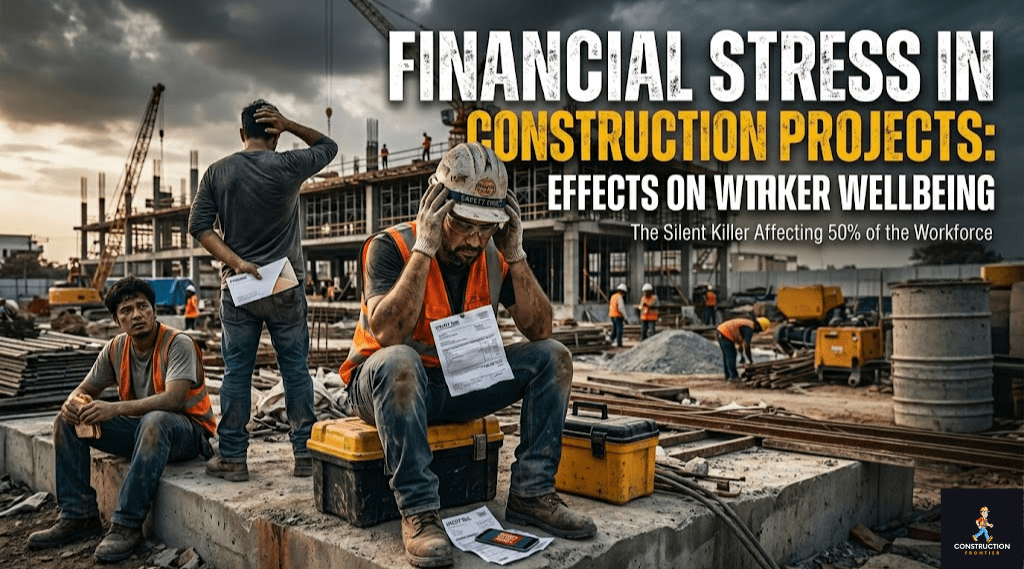
Financial Stress in Construction Projects: 7 Alarming Effects on Worker Wellbeing
Nobody talks about the month a worker ran out of money waiting for a delayed payment. Nobody counts the shifts worked through anxiety, or the near-misses that happen when someone’s mind is somewhere else entirely. Financial stress in construction projects kills quietly: through poor decisions on live sites, through bodies that never fully recover from injuries, and through workers who simply stop showing up. Up to 50% of the construction workforce carries significant mental distress, and financial pressure sits at the root of more of it than the industry admits. The bill, measured in accidents, turnover, and lost productivity, runs into billions.
Technical Snapshot: Core Data on Financial Stress and Worker Wellbeing
| Indicator | Key Statistic |
| Mental distress prevalence in construction | Up to 50% of workers affected (Meta-analysis, multiple studies) |
| Financial stress as top stressor | 62% of construction workers cite financial stress as a primary stressor |
| Stressed workers and accident risk | 3.47× more likely to have a workplace accident vs. unstressed workers |
| Substance misuse to cope | 58% of workers admit to misusing substances to manage mental health (2025) |
| Workers missing work (mental health) | 36% missed at least one day of work due to mental health in the past 12 months |
| Annual cost of mental ill-health (US economy) | USD 193.2 billion in lost productivity annually |
| Substance abuse rate in construction | Nearly double the national average (SAMHSA) |
The seven effects below are not theoretical. Every one of them is costing construction projects money right now, on sites where financial stress remains invisible in every risk register on the shelf.
Introduction: The Financial Burden Behind Every Hard Hat
Construction runs on tight margins and compressed schedules, and workers at the sharp end know it. What the project programme rarely shows is the financial insecurity those conditions create: wage arrears, seasonal layoffs, income gaps between contracts, and the slow grind of knowing that a single injury can wipe out months of earnings. Financial stress in construction projects builds quietly, well before it becomes visible in accident rates or site performance. Causes of stress in construction projects are many, but financial pressure in construction does cumulative damage that most project directors are unwilling to account for.
The construction industry already carries a disproportionate mental health burden. Research by Construction Frontier consistently links workforce wellbeing to elevated rates of depression and anxiety, as explored in our pillar article “Unearthing Construction’s Biggest Killer: Mental Health“. Financial pressure operates as a foundational driver of that burden, yet project governance rarely treats it as a controllable risk. Seven specific effects follow. Each is evidence-based, each carries a measurable cost, and each is more preventable than the industry currently accepts.
Effect 1: Chronic Anxiety and Depression Triggered by Income Insecurity
Pay insecurity travels. It follows the worker onto the site, into the excavator cab, and home at the end of the shift. For construction workers, income insecurity is structural rather than occasional: subcontracting arrangements change, projects end without warning, and delayed payments from principals can drag on for weeks or months before resolution. The anxiety that results does not switch off between shifts. It runs continuously, and it compounds.
How Income Uncertainty Becomes Clinical Distress
A systematic review of mental ill-health risk factors in construction found that between 10 and 38% of construction workers experience clinical depression, with anxiety affecting 19 to 42%, rates well above general workforce averages. The AGC reported construction anxiety at 14.3%, compared with a national average of 8.1%. Financial stress in construction projects is cited by 62% of workers as a primary stressor. Those numbers do not describe a sector under mild strain. They describe a workforce where a significant proportion shows up every day already clinically unwell, and the financial conditions of the job keep them there.
Cortisol and adrenaline are not designed for continuous deployment. The body’s stress response, activated by financial threats as well as physical danger, is designed for short bursts. When the source of stress is structural and unresolved, that response runs on an open loop: disrupted sleep, persistent anxiety, and diminishing capacity to concentrate or make good decisions. Weeks of this produce clinical symptoms. Months produce diagnosable conditions. The wider construction burnout crisis draws from this foundation: the exhaustion is not only physical. It is the relentless mental overhead of financial survival carried alongside a physically demanding job.
Effect 2: Elevated Accident Risk from Financial Stress and Construction Industry Stress
Financial stress in construction projects reaches the job jobsite. Cognitive capacity narrows under sustained financial pressure: attention contracts, decision-making slows, and the split-second processing that safe site work demands starts to degrade. These are not abstract psychological effects. They show up in near-misses, in skipped safety checks, and in accident investigations where the proximate cause is logged as human error but the underlying driver is a workforce running on stress. Construction industry stress of this kind rarely appears in official statistics, but it shapes the accident profile of every major project.
The Safety Arithmetic of Financial Stress
Peer-reviewed research in Frontiers in Public Health found that workers operating under high stress levels face an accident risk up to 3.47 times greater than their unstressed counterparts. In an industry where the Fatal Four (falls, struck-by incidents, electrocutions, and caught-in/between hazards) already claim over a thousand lives annually in the United States alone, this multiplier represents an enormous and preventable burden.
Think about what scaffolding or live electrical work actually requires: constant environmental scanning, rapid judgement calls, and awareness of where everyone else on site is positioned. A worker running a mental background process on missed rent payments or an unresolved wage dispute is not giving that environment full attention. The hazard recognition that prevents fatal incidents at height or near moving plant requires cognitive headroom that financial stress steadily erodes. Site managers who file safety and workforce welfare under separate columns of the risk register are not accurately assessing the situation.
Effect 3: Substance Misuse as a Coping Response
Construction workers under severe financial pressure face a choice most professionals in other industries never encounter: absorb the stress with no access to formal support, or find relief where it is available and affordable. For too many, that means alcohol after the shift, opioids for chronic pain that no longer get treated, or other substances that take the edge off a problem no manager has acknowledged. Financial pressure and mental health in construction are bound together in this way: one fuels the other, and without intervention, both worsen.
Substance Misuse Rates in the Construction Workforce
The Substance Abuse and Mental Health Administration (SAMHSA) data show that construction workers carry a substance abuse disorder rate nearly double the national average. A cross-national study of psychoactive substance use among construction workers confirms that financial difficulty and poor employment prospects are among the primary drivers, with construction workers in low-income roles particularly exposed.
A 2025 industry survey found that 58% of construction workers admitted to misusing or overusing at least one substance within the prior 12 months to manage mental health challenges, an 11-point increase from the previous survey cycle. Opioid use, heavy alcohol consumption, and non-prescription drug use all feature prominently in construction workforce health data, with some studies identifying construction as the sector with the highest rates of marijuana, cocaine, and non-prescription opioid use in the prior month.
Financial stress accelerates substance misuse through two mechanisms that rarely appear in site welfare reports. The first is the psychological trigger: a worker managing mortgage arrears or unpaid wages carries a chronic need for relief, and substances deliver that relief faster and more cheaply than any formal service. The second is access. Counselling costs money. Gym memberships cost money. When financially stretched workers cannot afford healthier outlets, the default is whatever gets them through the night. That is not a character failing. It is a predictable outcome of financial insecurity meeting a welfare gap.
Effect 4: Absenteeism and Presenteeism That Erode Project Performance
The damage from financial stress in construction projects does not stop with the worker. It moves into the programme. Two mechanisms carry it there: absenteeism, where the worker stops coming in, and presenteeism, where the worker comes in but performs well below their capability. Project budgets absorb both as an unexplained variance. Most project managers have never seen a line item labelling the true cause. Worker wellbeing in construction is not a welfare abstraction: it is a schedule and cost variable that the industry consistently fails to price.
Productivity Losses Linked to Worker Financial and Mental Distress
US data puts unplanned absenteeism at roughly USD 600 billion in annual business cost, or about USD 4,080 per employee. In construction, 36% of workers reported missing at least one day in the past 12 months due to mental health, with financial pressure a primary driver. The ILO links psychosocial stress directly to increased absenteeism, falling motivation, and accelerated staff turnover. Those effects hit construction harder than most sectors: there is no buffer capacity. One absent skilled operative on a critical-path activity can stall a programme for a day or more.
Presenteeism is the bigger and quieter problem. A worker physically on site while managing serious financial anxiety will complete tasks, but the quality of judgement drops, the willingness to flag safety concerns drops, and the attention available for technically demanding work drops with it. Research on the impact of mental health disorders on construction worker job performance establishes that psychological distress under job demands measurably reduces individual output and raises error rates. Long working hours in construction already suppress mental health outcomes; add active financial anxiety to those hours, and the productivity gap widens further.
Further Reading: Long Working Hours in Construction: 9 Damaging Mental Health Effects Workers Face
Effect 5: High Turnover That Strips Projects of Experienced Labour
Construction already loses workers faster than most industries. Project cycles terminate employment by design, subcontracting structures insulate principals from workforce continuity, and skilled tradespeople routinely move between employers because stability is not on offer. Financial stress in construction projects accelerates the exit. Workers who cannot afford to stay in an industry that underpays, delays wages, or leaves them exposed during seasonal gaps do not wait around. They find steadier work elsewhere, or they leave construction entirely.
The Cost of Losing Financially Stressed Workers
Approximately 40% of workforce turnover across industries is attributable to workplace stress, and construction significantly exceeds the broader average due to the intensity and structural nature of its financial stressors. Research shows that high turnover and absenteeism can cause up to four days of lost work per affected worker, and that loss extends further when the departing worker carries institutional knowledge, site-specific expertise, or supervisory responsibility.
McKinsey’s analysis of the construction labour shortage identifies competitive wages as merely the baseline expectation, with workers increasingly emphasizing autonomy, support, and stability when deciding where to deploy their skills. When financially stressed workers leave the sector, they take with them the tacit knowledge that differentiates experienced tradespeople from novices. Replacement and retraining costs, combined with the productivity ramp-up period for new hires, impose real financial penalties on project margins, creating a cycle in which financial pressure on workers ultimately generates pressure on the organisation that failed to manage it.
Effect 6: Deteriorating Physical Health and Injury Recovery
Financial stress and physical health are not separate systems. Sustained cortisol elevation disrupts sleep, weakens immune function, and heightens pain sensitivity. On a construction site, those physiological changes have direct consequences: slower reaction times, reduced physical resilience, and a body that takes longer to recover from the injuries this work routinely inflicts. Construction workers already carry the highest physical hazard exposure of any major industry. Financial stress makes that exposure more dangerous.
How Financial Anxiety Worsens Physical Outcomes
US Bureau of Labor Statistics data records approximately 195,600 non-fatal occupational injuries in construction in a recent annual period, at a rate of 2.2 per 100 full-time workers. The CDC puts the average economic cost of a fatal construction injury at USD 991,027. Non-fatal injuries carry their own financial toll: lost wages, medical costs, and workers’ compensation processes that can grind on for months. For a worker already stretched financially, a moderate injury is not just an inconvenience. It is a crisis that compounds the ongoing one.
Financial stress impairs safety behaviours, thereby increasing injury risk. The injury results in income loss and medical costs, further deepening financial stress. Deeper financial stress drives workers back onto the site before they have recovered because they cannot afford the time off, and because the psychological distress of the situation slows healing from the inside.
A Harvard School of Public Health study at New England construction sites found a high co-occurrence of mental distress, musculoskeletal pain, and workplace injuries, confirming that physical and psychological harm run together in this workforce. The causes behind the construction workforce’s alarming suicide statistics frequently trace through exactly this sequence: financial loss following injury strips a worker of both income and vocational identity at the same time.
Effect 7: Social Isolation and Relationship Breakdown
What happens on-site comes home with the worker. Financial anxiety travels with him: to a partner already worried about the mortgage, to children who sense the tension without understanding its source, and to friendships that drift when there is no money to sustain them. Financial pressure in construction fractures domestic life in ways that rarely make it into a site welfare assessment. When employers leave this unacknowledged, workers carry it alone.
The Social Consequences of Construction Financial Pressure
Stress research on construction workers consistently puts relationship problems with partners as the second most common stressor, behind only the lack of positive social events outside work, affecting 68% of respondents. Financial pressure drives much of that relationship conflict. When money is short and uncertain, the domestic space that should offer psychological recovery between shifts becomes another source of tension. Workers who cannot decompress at home return to the site carrying the weight of both environments.
Social isolation further deepens as financially stressed workers withdraw from activities they can no longer afford, avoid peer networks out of shame, and reduce social contact outside of work. In construction cultures where mental health stigma remains high, financial shame compounds the reluctance to seek professional support. Nearly half of construction workers report feeling ashamed to discuss their mental health with colleagues, a figure that has increased year on year as industry surveys document the deepening crisis. Qualitative research into male construction worker suicides in Australia identified financial and legal problems, relationship breakdown, and transient employment as interrelated pressures in the majority of cases, confirming that financial hardship and social isolation together constitute the highest-risk combination in this workforce.
Further Reading: Construction Burnout: 7 Critical Causes, Warning Signs, and Proven Prevention Strategies
Summary Data Table: 7 Effects of Financial Stress on Construction Worker Wellbeing
| # | Effect on Worker Wellbeing | Key Evidence | Industry Impact |
| 1 | Anxiety and depression | 62% cite financial stress as the top stressor; 10-38% clinical depression prevalence | Mental health burden; increased healthcare costs |
| 2 | Elevated accident risk | Stressed workers are 3.47× more likely to suffer an accident | Fatalities, injuries, OSHA penalties |
| 3 | Substance misuse | Construction substance abuse nearly doubles the national average; 58% misuse to cope | Safety risk, absenteeism, and legal liability |
| 4 | Absenteeism and presenteeism | 36% missed work due to mental health; absence reduces team output by 36% | Schedule delays, cost overruns |
| 5 | High staff turnover | ~40% of turnover linked to workplace stress; up to 4 days lost per affected worker | Skill loss, retraining costs, and schedule risk |
| 6 | Physical health deterioration | Chronic stress amplifies injury risk and slows recovery; 195,600 non-fatal injuries/year (US) | Workers’ compensation costs, productivity loss |
| 7 | Social isolation and relationship breakdown | 68% of workers cite relationship problems as a key stressor; rising stigma barriers | Suicide risk, workforce exit, retention failure |
Technical Block: Addressing Financial Stress in Construction Projects
The evidence is not in question. Financial stress in construction projects causes measurable harm to worker wellbeing across seven distinct dimensions, and each dimension has a project cost associated with it. What project leadership and contract structures can do about them is a practical question, not a theoretical one. Each intervention below has a research base and targets a specific mechanism.
1. Payment Certainty and Wage Transparency
Pay workers on time, in full, with clear written accounting for overtime, bonuses, and deductions. This is not a complex intervention. Payment delays in subcontracting chains are common precisely because principals control cash flow and absorb the working capital benefit of holding it longer. That benefit comes at a direct cost to the worker at the end of the chain. Contractors who enforce prompt payment clauses, run transparent payroll systems, and treat wage certainty as a contractual obligation rather than a courtesy address the primary cause of stress in construction projects before it ever enters the wellbeing system.
2. Income Protection During Seasonal and Project Transitions
When a project ends, workers lose income. In many markets, there is no bridge. Seasonal gaps and project-end layoffs are structural features of construction employment, not exceptions, and they generate acute financial stress at precisely the moment workers have the least support available. Income protection schemes, formal job transition assistance, and emergency financial counselling during these periods directly address the gap. Larger contractors and programme managers with multi-project pipelines can go further by offering rolling employment arrangements that give workers continuity between phases, rather than terminating and rehiring the same people repeatedly at increased cost to everyone.
3. Mental Health and Financial Counselling Integration
Employee Assistance Programmes that combine mental health counselling with financial guidance address two problems simultaneously: the clinical distress and the financial pressure, and mental health in construction that feeds it. The 2025 industry survey found professional mental health service uptake at 44%, up from 34% the previous year. Demand exists when access is genuine.
A systematic review of organisational-level mental health interventions in construction found that structured programmes improve outcomes when workers can use them without stigma or risk of job loss. Financial literacy programmes covering debt management, navigating injury compensation, and retirement planning give workers the tools to reduce vulnerability before a crisis materialises. That improves construction workforce wellbeing in ways that no counselling session after the fact can replicate.
4. Leadership Training and Supervisory Culture
National Institute for Occupational Safety and Health (NIOSH)-funded research found that supervisory training meaningfully increases managers’ support for mental health, encourages workers to use available resources, and improves overall on-site overall wellbeing outcomes. A supervisor who understands how financial stress in construction projects manifests in behaviour, distraction, risk-taking, and reluctance to raise concerns can intervene before the situation reaches a critical point.
That is not a pastoral skill; it is a safety competency, and developing it costs less than a single serious incident. Identifying causes of financial stress in construction projects and responding at the supervisory level before they escalate to absence or accident requires no capital budget, only trained attention and a site culture that allows difficult conversations to happen.
5. Industry-Level Policy and Contract Reform
Firm-level initiatives help, but they cannot carry the full load. Procurement frameworks that protect subcontractor payment security, standard mental health provisions in construction contracts, and regulatory welfare plan requirements on major projects change the baseline conditions across the whole sector, not just for contractors willing to lead voluntarily. Mental health in the construction industry needs structural responses calibrated to how project finance actually works. The broader challenge of construction industry stress demands a policy that classifies financial stress in construction projects as an occupational hazard with quantifiable consequences for safety, programme delivery, and workforce retention.
Conclusion: Financial Wellbeing Is a Project Delivery Issue
Financial stress in construction projects is not a peripheral welfare concern. It drives the mental health crisis in the construction industry, contributes directly to fatal and non-fatal accidents, accelerates workforce exit, and undermines project productivity in ways that never get attributed to their real cause.
The seven effects of financial pressure in construction in this article are not independent; anxiety impairs safety behaviour, substance misuse compounds absenteeism, social isolation accelerates the decision to leave, and physical injury deepens financial insecurity. Each one feeds the others, and the industry funds all of them through accident claims, delays, and the endless cost of replacing workers it failed to retain. How financial stress affects construction workers is a question that project directors, contract managers, and site supervisors need to answer with data and policy, not tolerance.
Firms that treat financial security as part of construction workforce wellbeing, embed payment certainty into project governance, and make mental health support genuinely reachable will absorb fewer of those costs. Those who treat financial pressure in construction as an unavoidable feature of the industry will keep paying for it through accident claims, programme overruns, and a workforce that leaves faster than it arrives. Reducing construction worker suicide and the broader mental health burden does not begin with awareness campaigns. It begins with the financial conditions workers return to after every shift. Improving worker wellbeing in construction projects starts with the pay packet.
Stay Ahead of Construction Workforce and Project Risks
Explore Construction Frontier: Construction Workforce Safety, Mental Health & Human Performance for expert analysis, industry insights, and practical strategies addressing financial stress in construction projects, worker wellbeing, mental health, and sustainable project performance.