Workplace Bullying in Construction: 10 Disturbing Signs of Toxic Site Culture
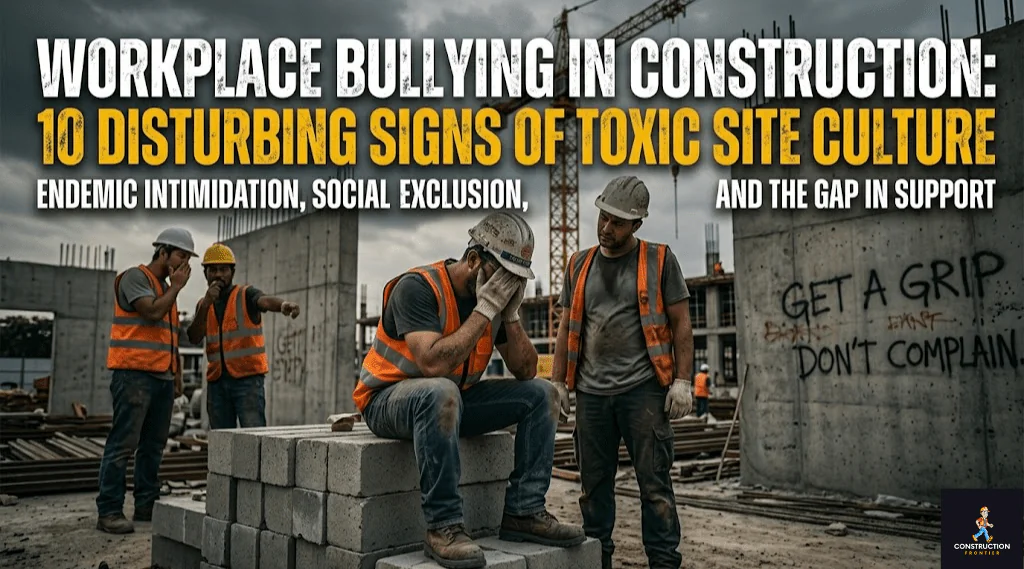
Workplace bullying in construction is endemic, entrenched, and measurable in its damage. The industry’s site culture normalises intimidation, public humiliation, and social exclusion as standard parts of working life, pushing workers towards anxiety, depression, and, in the most severe cases, suicide. Understanding the 10 most disturbing signs of toxic site culture in construction is the first step towards dismantling a system that kills workers long before a scaffold collapses.
Key Facts: Workplace Bullying in Construction
| Indicator | Data Point |
| Construction suicide rate (Australia) | 24.2 per 100,000 vs 13.9 for all other occupations |
| Workers experiencing anxiety symptoms (US, 2021) | 15.4% of construction workers |
| Workers experiencing bullying (general workforce) | Up to 30% report direct exposure |
| EEOC harassment claim recovery (2023) | USD 664 million, up 30% from 2022 |
| Workers never see a mental health professional | Over 95% of construction workers |
| TUC survey top site risks (UK, 2021) | Verbal abuse and bullying rank in the top five |
The construction sector cannot separate its physical safety record from its psychological safety failures. Both originate in the same site culture.
Introduction: The Site Culture Problem Nobody Wants to Name
Workplace bullying in construction operates through a specific cultural logic: the site is a proving ground, suffering signals strength, and complaints signal weakness. This logic has survived for decades precisely because it transfers from generation to generation through informal initiation, peer pressure, and supervisory silence. The consequences are now quantified, and they are severe.
Research published in Frontiers in Psychiatry identifies workplace bullying as a direct contributor to poor mental health, increased substance use, job dissatisfaction, and early departure from the industry among construction apprentices. A 2024 study by the Centre for Construction Research and Training found that almost half of construction workers in the US experience symptoms of anxiety and depression, a rate exceeding that of the general population. Yet fewer than 5% report seeing a mental health professional.
The gap between the scale of distress and the uptake of support is not a personal failure. It is a structural one. Toxic site culture suppresses help-seeking through stigma, ridicule, and the ever-present threat of professional marginalisation. The 10 signs below are not anecdotes. Each one is a systemic pattern that organisations, project managers, and site supervisors must actively confront.
The wider crisis of mental health in the construction industry does not begin with individual vulnerability. It begins with the environment that individuals enter every morning.
10 Disturbing Signs of Workplace Bullying in Construction and Toxic Site Culture
Toxic site culture and workplace bullying in construction do not always announce themselves through a single dramatic incident. It accumulates through repeated behaviours, tolerated defaults, and structural omissions. Construction workplace harassment and bullying do not require a single aggressor or a single incident; they require a culture that permits, rewards, or simply ignores abusive conduct over time. The following 10 signs represent the most common and damaging patterns documented across the industry.
1. Hazing and ‘Initiation’ Practices Disguised as Tradition
New apprentices and young workers entering construction sites face a well-documented initiation culture. Tasks are assigned to humiliate, pranks are designed to isolate, and verbal abuse is framed as banter. Research across Australian construction sites identifies hazing as a primary driver of psychological stress among apprentices, linked directly to suicidal ideation and substance use. The framing as ‘tradition’ or ‘how it’s always been done’ is precisely what gives it institutional cover.
When initiation rites are embedded in a site’s informal culture, they operate without formal sanction and without formal remedy. Victims hesitate to report because the perpetrators are peers and supervisors simultaneously. This reluctance to report is not coincidental: it is the mechanism through which toxic site culture in construction sustains itself. Studies by Construction Frontier on construction worker suicide rates consistently identify social isolation and bullying as upstream contributing factors.
2. Public Humiliation as a Management Tool
Supervisors who reprimand workers in front of colleagues, use mocking language to correct errors, or make examples of individuals in group settings are not being direct. They are deploying humiliation as a control mechanism. Construction sites amplify this dynamic because of their hierarchical structure: labourers have limited formal recourse, and the physical proximity of work makes public criticism inescapable.
Public humiliation produces measurable psychological harm. Chronic exposure to public criticism generates anxiety responses, diminishes self-efficacy, and erodes the worker’s capacity to concentrate on safety-critical tasks. A worker in a state of fear-induced hypervigilance does not operate heavy machinery more carefully. The cognitive load of managing social threat directly displaces the cognitive resources required for hazard identification.
3. Systemic Silencing of Complaints
Across construction workplaces, the formal complaint process exists on paper and fails in practice. Workers who raise concerns about bullying or harassment face one of three outcomes:
- Dismissal of their complaint as oversensitivity.
- Transfer to a less desirable assignment.
- Social ostracism from the crew.
All three outcomes communicate the same message: reporting is more dangerous than enduring. Construction burnout accelerates when workers perceive that the organisation will not act on their distress.
Industry-wide data reinforces this pattern. Only 5% of reported workplace bullying cases result in a successful resolution for the victim. In construction, where informal power structures operate alongside formal ones, that figure likely understates the problem because most incidents never reach the formal stage. A site where complaints are silenced is a site where toxic behaviours are institutionally endorsed.
4. Chronic Exclusion Along Gender, Race, or Nationality Lines
Construction has one of the lowest rates of workforce diversity across all sectors, and the culture that drives that gap is not merely statistical. Women, workers of colour, and migrant workers on construction sites report disproportionate rates of social exclusion, assignment to the most physically punishing tasks, and verbal harassment. The British Safety Council’s 2021 TUC survey identified verbal abuse as one of the top five risks named by site safety representatives, a category disproportionately experienced along demographic lines.
Exclusion from informal social networks, from mentoring relationships, and from skill development opportunities creates a two-tier workforce within the same project. The long-term consequence is not merely high turnover among affected groups. It is the ongoing under-utilisation of talent and the perpetuation of a monoculture that equates professional credibility with demographic conformity.
5. Normalised Verbal Abuse Reframed as ‘Site Language’
Few markers of toxic site culture in construction are as pervasive or as consistently minimised as the normalisation of verbal abuse. Slurs, threats, and degrading commentary are categorised as ‘site language’ or ‘the way things are done’, a framing that denies the cumulative psychological damage they inflict. Research on workplace bullying consistently identifies aggressive verbal communication as the most frequent form of bullying, including email tone, yelling, and targeted mockery.
On construction sites, this pattern carries added weight because the physical environment offers no retreat. Workers cannot close an office door. They cannot leave the site without losing a shift. Verbal aggression in confined, noisy, and high-pressure environments escalates the stress response and, over sustained periods, contributes directly to anxiety and depression. The normative label does not neutralise the harm. It simply removes accountability from the perpetrator.
Further Reading: Long Working Hours in Construction: 9 Damaging Mental Health Effects Workers Face
6. Leadership that Rewards Aggression over Competence
In organisations where aggressive supervisors are promoted, aggressive site foremen are praised for ‘getting results’, and confrontational project managers are positioned as effective leaders, the structural message is clear: the site rewards intimidation. Workers observe this logic and adapt to it, either by emulating the behaviour or by withdrawing from any active engagement that might attract attention.
The effect on mental health in the construction industry is not limited to the targets of aggression. Bystanders who witness workplace bullying report emotional injuries comparable in severity to those of direct victims. When leadership models aggression, it deploys bullying as a performance standard. The result is a site culture that treats psychological harm as an operational feature rather than an organisational failure. Long working hours in construction compound this dynamic: exhausted workers have fewer psychological resources to resist or report aggressive management.
7. Absence of Psychological Safety in Safety Briefings
Safety briefings are a mandatory fixture on every regulated construction site. They address fall prevention, PPE compliance, and equipment protocols. What they rarely address is the psychosocial environment in which those physical hazards are navigated. A worker who cannot raise a concern about a physical hazard without fear of ridicule is not operating in a safety-conscious environment. Psychological safety, the confidence that speaking up will not result in punishment, is a precondition for a physical-safety culture.
Research on psychosocial hazards in construction, published by the National Institute for Occupational Safety and Health (NIOSH) in 2023, confirms that job stress and workplace bullying are directly linked to impaired concentration and elevated accident risk. A 2024 study found that 22% of construction workers attributed a physical injury to poor mental health. The absence of psychological safety in briefings is not a procedural gap. It is a safety-critical failure.
8. High Voluntary Turnover Treated as Normal Attrition
Construction’s labour turnover problem is well-documented and persistently misdiagnosed. When experienced workers leave projects early, when apprentices abandon their training, and when skilled tradespeople migrate to less hostile employers, the default industry explanation is market competition or better pay elsewhere. The data contradicts this. MIT Sloan research found that toxic workplace culture is 10.4 times more predictive of voluntary turnover than compensation.
On construction sites, turnover driven by workplace bullying carries a compounding cost. The departing worker takes institutional knowledge and project-specific experience. The replacement worker arrives on a site whose culture has not changed. Society for Human Resource Management (SHRM) data attributes USD 223 billion in turnover costs to toxic workplace cultures over five years across US businesses. Construction, with its project-based workforce and tight margins, absorbs these costs invisibly by distributing them across procurement, rework, and schedule overruns.
Effects of Workplace Bullying in Construction: Operational Impact
| Impact Area | Mechanism | Documented Consequence |
| Safety | Impaired concentration under chronic stress | 22% of workers cite mental health as a physical injury |
| Turnover | Toxic culture drives voluntary exits | 10.4x more predictive than pay in MIT Sloan research |
| Productivity | Disengagement, absenteeism, presenteeism | Direct reduction in output and quality of work |
| Recruitment | Reputational damage among younger workers | 86% of job seekers avoid firms with a poor reputation |
| Legal exposure | Unreported harassment escalates to legal claims | USD 664 million recovered in US harassment claims in 2023 |
9. Substance Use Treated as a Cultural Norm Rather than a Warning Sign
Alcohol use after shifts, drug use to manage physical pain, and stimulant use to manage fatigue are documented patterns in construction workforces across Australia, the UK, and North America. Approximately 15% of construction workers struggle with substance use disorders, a rate nearly double the national average in the United States. Research from NIOSH identifies a direct link between workplace bullying and illicit drug use among young construction workers, mediated by psychological stress and the perceived absence of social support.
When substance use is normalised on-site, the underlying drivers, including chronic bullying, unaddressed anxiety, and the absence of formal support mechanisms, remain unaddressed. The substance use becomes a cultural identity marker rather than a health signal. Toxic work environments in construction that treat drinking culture as a bonding mechanism are simultaneously suppressing the visibility of workers in genuine crisis.
10. Resistance to Mental Health Initiatives as a Cultural Statement
The most structurally revealing sign of toxic site culture in construction is the active resistance that mental health initiatives encounter. When a site supervisor dismisses a wellbeing programme as unnecessary, when workers mock colleagues for using an employee assistance line, or when project managers characterise mental health conversations as time-wasting, that resistance is not incidental. It is the culture defending itself.
Construction worker wellbeing programmes that fail do not typically fail because of poor design. They fail because the site culture actively undermines their adoption. Research on intervention programmes in Queensland and the Northern Territory found that training required addressing supervisors, apprentices, and the general workforce simultaneously because resistance operated at every level. A site that cannot discuss mental health cannot identify a worker in crisis. And as the data on the construction industry suicide crisis consistently demonstrates, the cost of that silence is measured in lives.
Further Reading: Long Working Hours in Construction: 9 Damaging Mental Health Effects Workers Face
How Toxic Site Culture Affects Construction Worker Wellbeing
Understanding how toxic site culture affects construction workers requires looking beyond the most visible victims. The effects of workplace bullying in construction extend beyond the individual targeted. A site where bullying is normalised operates as a systemic stressor affecting every worker who observes it, regardless of whether they are directly targeted. Research on bystander effects in workplace bullying documents that psychological injury in witnesses is comparable in severity to that experienced by direct targets.
Preventing workplace bullying in construction requires organisations to understand this systemic spread. A 2023 systematic review covering 68 studies from 1992 to 2022 identified workplace bullying as one of the five primary psychological harm factors in construction, alongside job insecurity, long working hours, high demands, and poor work-life balance. None of these factors operate in isolation; on a site with a toxic culture, they compound.
The physical safety consequences are equally direct. Mental health conditions, including anxiety and depression, impair concentration, reduce hazard identification accuracy, and increase risk tolerance. Workers managing chronic stress from bullying are not safer on scaffolding, in excavations, or operating a plant. The construction industry’s physical safety record cannot be separated from its psychological safety failures because the same environment produces both.
Conclusion: Preventing Workplace Bullying in Construction
Addressing workplace bullying in construction requires intervention at three levels: leadership behaviour, organisational policy, and site-level norm change. None of these in isolation produces durable results. Leadership that models respect without policy enforcement creates permission-based cultures where respectful behaviour depends on which supervisor is watching. Policy without norm change produces compliance theatre. The mental health impact of toxic construction culture is not a soft issue; it is a safety-critical, productivity-critical, and reputational liability that compounding silence only deepens.
Effective programmes, such as those trialled by the MATES in Construction initiative in Australia, address apprentices, supervisors, and the general workforce separately and simultaneously. The rationale is structural: bullying in construction operates through the hierarchy, through peer groups, and through bystander silence. An intervention that reaches only one layer leaves the other two intact.
Practically, preventing workplace bullying in construction means: making reporting pathways genuinely confidential and genuinely consequential; including psychosocial risk in safety briefings with the same rigour applied to fall prevention; training supervisors to identify distress rather than dismiss it; and measuring culture change through turnover data, absenteeism rates, and anonymous site surveys, not just incident reports. The construction industry has spent decades treating the physical and psychological dimensions of site safety as separate domains. The evidence demands a different approach. A site that kills through falling objects and a site that kills through chronic psychological harm are at the same site. Fixing one without fixing the other is not fixing either.
Stay Informed on Construction Workplace Culture and Mental Health
Explore Construction Frontier: Construction Workforce Safety, Mental Health & Human Performance for expert insights, industry research, and practical strategies addressing workplace bullying in construction, toxic site culture, worker well-being, and psychological safety across the built environment.