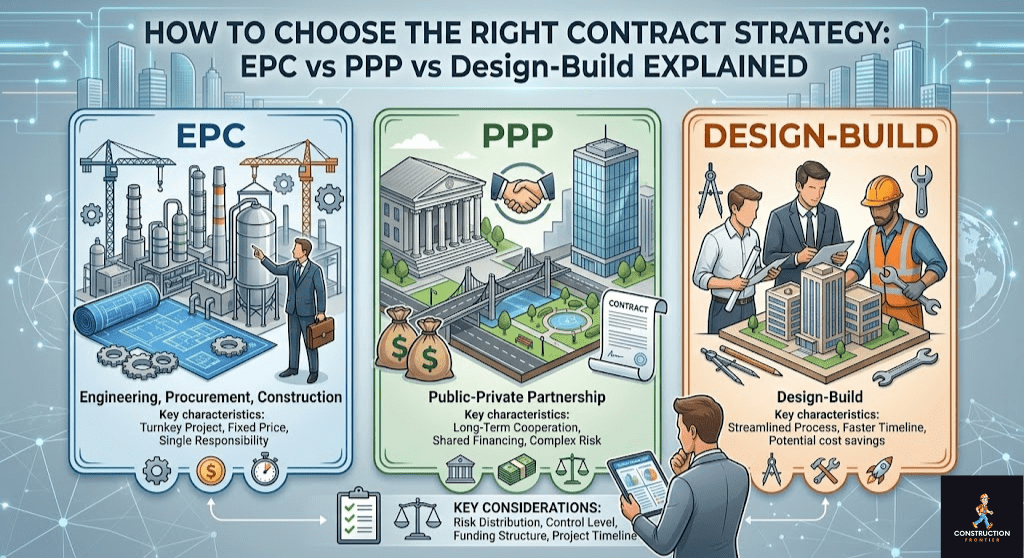
How to Choose the Right Contract Strategy: EPC vs PPP vs Design-Build Explained
Choosing the right contract strategy is one of the most consequential decisions an infrastructure owner makes before construction begins. The selected model (EPC, Design-Bid-Build, Design-Build, or PPP) determines how risk is shared, how financing is structured, and how long-term asset performance is governed. A mismatched contract strategy does not simply inconvenience a project: it locks in misaligned incentives that drive cost overruns, schedule failures, and lifecycle underperformance before a single procurement document is issued.
Technical Snapshot: Core Contract Strategy Specifications
| Primary Delivery Models | EPC, Design-Bid-Build, Design-Build, PPP (DBFOM) |
| Governing Contract Frameworks | FIDIC Red Book (DBB) | Yellow Book (DB/EPC) | Silver Book (EPC Turnkey) | Gold Book (DBFOM) |
| Risk Transfer Spectrum | Owner-retained (DBB) → Partially transferred (DB) → Fully transferred (EPC) → Shared lifecycle (PPP) |
| Key Selection Drivers | Project size, risk allocation, financing model, schedule constraint, and regulatory environment |
| Typical Cost Premium vs DBB | Design-Build: +5–10% | EPC: +10–15% | PPP: higher upfront, lower lifecycle cost |
| PPP Procurement Lead Time | 2–4 years pre-construction; not suited to urgent delivery programmes |
| African Regulatory Context | World Bank/AfDB lending defaults to DBB; PPP requires dedicated national legislation |
| Lifecycle Accountability | Lowest (DBB) → Intermediate (EPC) → Highest (PPP/DBFOM concession) |
Knowing how to choose the right contract strategy requires a structured decision framework applied before procurement begins, not a post-mortem analysis of why the wrong model was selected. This guide provides that framework: a comparative analysis of EPC, PPP, and Design-Build, the decision variables that differentiate them, and real-world African infrastructure examples that demonstrate how each model performs under pressure.
Introduction: Choosing Your Strategy — EPC, PPP, and Design-Build Frameworks Decoded for Project Success
The infrastructure industry produces more procurement doctrine than almost any other sector, yet projects continue to fail at the contract strategy stage. Knowing how to choose the right contract strategy is not a theoretical exercise. It is the discipline that separates projects that close on time and within financing parameters from those that drift into disputes, cost escalation, and ultimately into the failure case studies that define how not to procure infrastructure.
This article is a decision framework, not a descriptive survey. It addresses the five variables that determine which delivery model is appropriate for a given project, compares the four dominant models across those variables, and applies the framework to real African infrastructure projects where contract strategy choices produced measurable consequences. Related Construction Frontier analyses of the EPC project delivery approach, the responsibilities of EPC contractors, and the comparison of EPC vs. PPP vs. Design-Bid-Build are embedded throughout for readers who require greater contractual depth.
Five sections form the analytical core: the key decision factors, the contract framework context, lifecycle cost implications, risk allocation strategy, and real-world project application. The Technical Block near the conclusion consolidates the delivery model comparison and the project-type decision matrix into two structured reference tables.
Why the Wrong Contract Strategy Kills Projects
Infrastructure failures are rarely caused by a shortage of engineering talent or construction capacity. They occur when the contract model creates incentives that push contractors and owners toward opposing objectives. A poorly structured procurement locks in misaligned risk before the first bid is received, and no amount of programme management can recover the structural deficit that creates.
The consequences appear in predictable patterns. Scope disputes arise in lump-sum contracts when the design was incomplete at award. Cost escalation follows on reimbursable contracts where there is no commercial pressure to control expenditure. Financing collapses on Public-Private Partnership (PPP) projects where the revenue model was never tested against realistic demand. Each failure mode corresponds to a contract type that either prevents or magnifies the damage.
These structural failures translate directly into lifecycle cost outcomes that compound over decades. The Construction Frontier analysis of lifecycle cost optimisation challenges documents how procurement decisions made at the contract strategy stage determine asset performance long after practical completion. The patterns behind common delays in African infrastructure projects similarly trace back to contract models mismatched to local procurement law, contractor capacity, or financing timelines, not to execution failures in isolation.
Key Decision Factors Before Selecting a Delivery Model
Five variables determine which delivery model is appropriate for a given project. They interact with each other, which is why sequential analysis matters: beginning with the wrong factor produces the wrong answer. Each factor below is addressed with the specificity required to make a real procurement decision.
1. Project Size and Complexity
Larger, more technically complex projects (refineries, hydroelectric schemes, LNG terminals) reward delivery models that concentrate design and construction accountability under a single entity. The engineering integration risk is too great to distribute across multiple contracts managed directly by the owner. Simpler civil works lend themselves to traditional design-bid-build structures where competitive pricing is the primary procurement objective. The importance of FEED in early-stage planning is directly relevant: projects that complete a robust front-end engineering design phase before selecting a delivery model produce bankable scopes, attract credible contractors, and execute without the scope ambiguity that drives variation orders under any model.
2. Risk Allocation
Every contract model allocates risk differently between the owner and the contractor. The central question is not who can absorb risk but who can best manage and price it. Contractors price the risks they carry: transfer too much, and the contingency embedded in a lump-sum contract exceeds what the owner would have paid to retain those risks directly. The Construction Frontier analysis of risk allocation in construction projects identifies where risk transfer creates genuine value and where it simply shifts cost without reducing exposure. In African infrastructure, sovereign and regulatory risk often sits with the owner in practice, regardless of the chosen contract model.
3. Financing Structure
The financing and contract models are interdependent. Project finance, in which lenders rely on project cash flows rather than balance sheet strength, requires bankable contracts with clearly defined completion obligations, performance guarantees, and revenue mechanisms. PPP structures align the contract model with the financing model: a concessionaire that finances, builds, and operates the asset has every incentive to deliver on time and optimise lifecycle cost. DBB contracts financed through government budgets impose no such lifecycle discipline. The contractor delivers to specification and walks away; the owner inherits whatever maintenance liability was embedded in the design.
4. Timeline Constraints
When the schedule is the primary constraint (a power plant needs to close an electricity deficit, or a port expansion required to clear a logistics bottleneck), the ability to overlap design and construction phases becomes decisive. EPC and Design-Build enable this overlap through fast-track procurement. DBB does not: the design must be complete before construction bids are issued, adding 6 to 18 months to the programme on major projects. PPP carries the longest procurement timeline of any model. Transaction structuring, lender due diligence, and government approvals routinely add two to four years to pre-construction activity.
5. Regulatory and Institutional Environment
African infrastructure procurement operates under sovereign procurement law, donor financing rules, and sector-specific regulatory frameworks simultaneously, and these frequently conflict with one another. World Bank- and AfDB-financed projects follow standard bidding documents that are predominantly design-bid-build. Government-financed projects must comply with national procurement legislation that in many jurisdictions defaults to lowest-bid selection regardless of delivery model. PPP frameworks require dedicated PPP legislation and institutions that remain underdeveloped in several African markets. A design-build or PPP procurement that violates national procurement law creates a significant risk that can halt a project years into development.
Contract Frameworks: FIDIC and the Models They Govern
Contract strategy selection is inseparable from the choice of contract framework. The FIDIC suite, the dominant international standard for infrastructure contracts, is structured around the delivery models under examination. The Construction Frontier guide to standard contract types, such as FIDIC, provides a full contractual breakdown. In summary:
- The Red Book governs Design-Bid-Build.
- The Yellow Book governs Design-Build and standard EPC structures.
- The Silver Book governs full EPC turnkey delivery, including process plants and energy projects.
- The Gold Book introduces DBFOM provisions for PPP-adjacent structures.
Many disputes over African infrastructure projects originate not in contractor failure but in the use of inappropriate FIDIC forms or in special conditions that fundamentally alter the risk allocation of the base form, rendering the resulting document internally inconsistent. An EPC contract drafted on a Red Book base, with special conditions attempting to transfer design responsibility to the contractor, is one of the most common contract drafting errors in African project finance. It produces a document that neither party considers satisfactory, leading to arbitration.
Engaging experienced contract counsel at the strategy stage, before model selection and not after tender issue, eliminates this failure mode. The framework decisions made during procurement strategy development determine which standard form applies, which special conditions are necessary, and which risk allocations are commercially sustainable in the relevant contractor market.
Further Reading: Contract Types Explained: 5 Essential Models from FIDIC to Design-Build for Successful Project Delivery
Lifecycle Cost Implications of Each Delivery Model
Capital expenditure is a poor basis for selecting a contract model. The asset owner’s real exposure is the total lifecycle cost: construction, operations, maintenance, and end-of-life obligations, spread across thirty to fifty years. Delivery models that minimise upfront costs often maximise lifecycle costs. The Construction Frontier analysis of lifecycle cost optimisation challenges documents the failure patterns in detail.
PPP structures create the strongest lifecycle cost incentives because the concessionaire operates what it builds. A toll road PPP that delivers poor pavement quality pays for that decision through higher maintenance costs over a 25-year concession. The same road delivered under DBB imposes those costs on the government authority, which is entirely disconnected from the original contractor’s obligations.
EPC contracts sit in an intermediate position. The contractor accepts responsibility for plant performance through the defects liability period and, in many structures, through a performance warranty extending two to three years post-completion. Beyond that, EPC contractor obligations terminate. Owners relying on EPC delivery for long-lived assets need explicit O&M provisions embedded within the EPC framework or structured as a separate contract. DBB delivers the least lifecycle accountability of any model: the designer and constructor carry separate obligations with no overlap, creating a liability gap that leads to asset underperformance documented in infrastructure failure analyses worldwide.
Risk Allocation Strategy: Matching Risk to the Party That Can Manage It
Risk allocation is the technical core of contract model selection. The principle is not complex: allocate each risk to the party best positioned to manage it. The practice is considerably more difficult under African infrastructure conditions. The risk allocation in construction projects analysis identifies the risk categories that most frequently determine project outcomes.
Ground conditions risk is one of the most consequential allocation decisions. Subsurface investigation quality across many African markets is inadequate, which means contractors cannot accurately price ground risk. Forcing ground risk onto an EPC contractor on a geotechnically complex project results in either extreme contingency pricing or contractor insolvency mid-project. In these conditions, owner-retained ground risk with a target price mechanism often produces better outcomes than a full lump-sum transfer.
Currency and inflation risks demand equal attention for long-duration projects in frontier markets. Most materials and equipment are priced in hard currency, while contract payments are made in local currency. Contracts without appropriate escalation provisions and currency risk-sharing mechanisms generate disputes and claims that consume more management bandwidth than the risk-sharing provisions they sought to avoid.
Force majeure and sovereign risk sit with the owner in practice regardless of contract language. No contractor absorbs the cost of government-mandated scope changes, regulatory delays caused by permitting failures, or security disruptions beyond their operational control. Contracts that attempt this transfer create the adversarial dynamic that ends in major arbitration claims.
Further Reading: Construction Risk Management: 10 Crucial Facts You Must Know to Avoid Costly Project Failures
Real-World Application: African Infrastructure Contract Strategy in Practice
The theoretical framework becomes concrete when applied to actual African megaprojects. The Construction Frontier series on real-world megaproject case studies provides the project-level detail. The contract strategy observations below should be read alongside the guidance on managing mega construction projects effectively.
Dangote Refinery: EPC at Scale
The 650,000-barrel-per-day Dangote Refinery adopted an EPC structure across multiple packages, with Dangote Industries acting as its own project owner and interface manager. The model was appropriate: single-point accountability for technologically complex process units, with performance guarantees tied to refinery output specifications. It worked because the owner had the technical capacity to manage EPC contractor interfaces and the financial resources to carry out a project of this complexity without external project finance constraints dictating contract structure.
LAPSSET Corridor: PPP Framework Challenges
The Lamu Port-South Sudan-Ethiopia Transport Corridor illustrates both the potential and the constraints of PPP delivery in frontier markets. The corridor’s scale requires private capital mobilisation that only PPP structures can attract. The delays experienced in progressing from development agreements to bankable concessions reflect the gap between PPP ambition and the institutional readiness required to close PPP transactions where legislative frameworks, tariff regulation, and off-take certainty remain underdeveloped. LAPSSET is not a PPP failure; it is an accurate demonstration of how long PPP procurement takes in markets without mature concession law.
Nigeria-Morocco Gas Pipeline: Blended Contract and Finance Structures
The Nigeria-Morocco Gas Pipeline represents the emerging norm for African energy megaprojects: blended financing combining sovereign equity, DFI debt, and commercial project finance, under a contract structure that draws on both EPC and PPP principles. Neither model alone is adequate for a pipeline spanning fifteen countries. The contract strategy must follow the financing structure, not precede it, a sequencing discipline that many project sponsors reverse to their detriment.
Grand Ethiopian Renaissance Dam: Government-Led DBB
The GERD was developed under direct government financing, with Ethiopian Electric Power serving as the owner for the civil, electromechanical, and transmission procurement packages. The DBB model reflected a deliberate policy choice: retaining ownership, control, and local employment benefits at the cost of the schedule certainty and lifecycle accountability that EPC or PPP would have provided. The result is consistent with the DBB risk profile: extensive government involvement and schedule extensions, but ultimately cost outcomes that retained significant economic value within Ethiopia.
Technical Block: Contract Strategy Reference Data
The two tables below consolidate the comparative and decision data from the preceding analysis for direct use in developing procurement strategies and evaluating projects. The delivery models comparison covers EPC, Design-Bid-Build, Design-Build, and PPP across five performance dimensions. The decision matrix maps project type to recommended model with an African context note for each category.
1. Delivery Models Compared: EPC vs Design-Bid-Build vs Design-Build vs PPP
Cost premium figures reflect typical tender pricing dynamics rather than outturn costs. A DBB project with significant scope variation may cost 30% more at completion than the original tender sum, while the EPC premium may be more than offset by the delivery certainty it provides on debt-financed assets. The full contractual analysis for each model is available in the Construction Frontier comparison of EPC, PPP, and Design-Bid-Build.
| Model | Risk Allocation | Best For | Cost Premium vs DBB | Owner Control |
| EPC (Turnkey) | Transferred to the contractor | Energy, oil & gas, industrial plants | 10–15% | Low |
| Design-Bid-Build | Retained by owner | Public works, simple civil works | Baseline | High |
| Design-Build | Partially transferred | Transport, social infrastructure | 5–10% | Medium |
| PPP / DBFOM | Shared; private finance leads | Highways, hospitals, utilities | Higher upfront; lifecycle savings | Very Low |
2. Decision Matrix: Matching Project Type to Delivery Model
Two caveats apply. First, hybrid structures are increasingly common (EPC contracts with PPP financing overlays or Design-Build contracts within a PPP concession), and the matrix presents the dominant model for each project type rather than an exhaustive typology. Second, contractor market depth determines what is achievable in practice: a theoretically optimal EPC procurement that attracts only one credible bidder has failed before the contract is awarded.
| Project Type | Recommended Model | Primary Rationale | African Context Note |
| Power plant/LNG terminal | EPC | Single-point accountability; technology risk transfer | Dominant on NNPC and Dangote-scale projects |
| Urban road or bridge | Design-Bid-Build | Government cost control; established procurement law | Standard under AfDB and World Bank lending |
| Toll highway or airport | PPP (DBFOM) | Fiscal relief; private sector efficiency over concession term | Growing uptake: LAPSSET, Maputo Port, JKIA expansion |
| Hospital/school | Design-Build or PPP | Speed to delivery; lifecycle maintenance accountability | PFI-style models active in South Africa and Nigeria |
| Hydroelectric dam | EPC or split EPC packages | High technical complexity; integrated performance guarantee | Grand Inga, Mambilla, Cahora Bassa rehabilitation |
| Greenfield pipeline | EPC with PPP financing overlay | Scale requires blended capital; EPC suits technology risk | Nigeria-Morocco Gas Pipeline blended model |
Conclusion: Framework Before Procurement
Contract strategy selection is a pre-procurement discipline, not a procurement exercise. The decisions made before a tender document is drafted (covering risk allocation, financing structure, lifecycle accountability, and regulatory constraints) determine the range of delivery models that are viable for a given project. Narrowing to a specific model from that range requires project-specific judgement that no framework fully replaces, but the underlying principles are consistent.
Match risk to the party that can manage it. Align the contract model with the financing structure. Account for the regulatory environment before selecting a procurement approach. Evaluate the cost over the asset’s full lifetime. Projects that apply these principles at feasibility, not at tender, are the ones that close on time, within their financing structures, and within the risk profile their owners and lenders accepted at financial close.
For implementation-level guidance, the Construction Frontier analyses of the EPC project delivery approach, EPC contractors’ responsibilities, and effective management of mega construction projects provide the technical depth that strategic frameworks require.
Stay Updated on Africa’s Infrastructure Developments
Stay ahead of Africa’s infrastructure transformation with Construction Frontier: Civil Engineering and Construction Practice. Explore deep technical insights, expert analysis, and investment intelligence shaping the future of African infrastructure procurement and project delivery.