12 Largest Construction Companies in Egypt: Leading Firms Driving Success
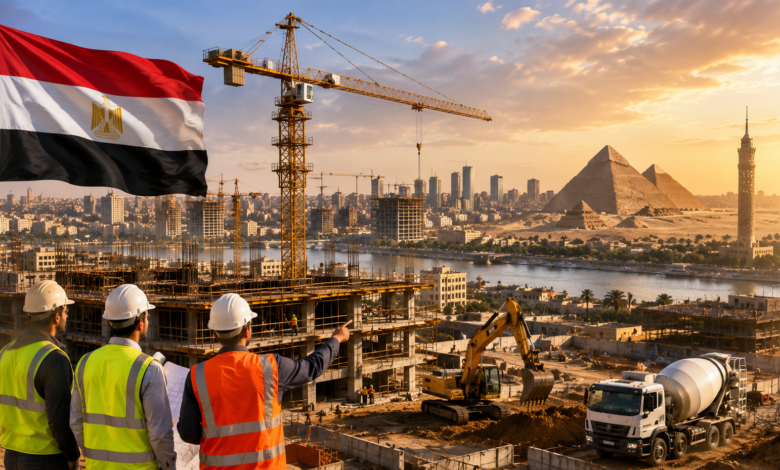
Egypt’s construction industry is anchored by a small group of contractors capable of executing multi-billion-dollar megaprojects, from state-owned pioneers dating back to the Nasser era to Chinese and Belgian joint-venture partners building the New Administrative Capital. The largest construction companies in Egypt now manage a combined project pipeline worth tens of billions of dollars across the capital, the Suez Canal Economic Zone, and a nationwide rail expansion. Egypt’s construction market is projected to reach approximately USD 70.27 billion by 2031, making it Africa’s largest single project market.
Technical Snapshot: Egypt’s Construction Industry at a Glance
| Metric | Detail |
| Number of Companies Ranked | 12 |
| Top-Ranked Company | The Arab Contractors (state-owned, founded 1955) |
| Flagship Megaproject | New Administrative Capital Central Business District |
| Dominant Ownership Structure | Mixed: state-owned, foreign joint venture, and private family-controlled |
| Projected Market Size (2031) | USD 70.27 billion |
Together, these twelve firms show how a state-directed development model, foreign engineering expertise, and private Egyptian capital combine to make Egypt one of the busiest construction markets on the continent.
Introduction: Egypt’s Construction Industry Leaders
The largest construction companies in Egypt sit at the centre of one of the most ambitious infrastructure programmes in Africa or the Middle East, and this ranking of the largest construction companies in Egypt by revenue shows exactly how that scale breaks down. Egypt’s construction sector is projected to expand from roughly USD 48.67 billion in 2025 to USD 70.27 billion by 2031, driven almost entirely by government-directed megaprojects. The list sits alongside Construction Frontier’s ranking of the 20 largest construction companies in the world, which maps how Egyptian firms compare globally.
Egypt’s roster also anchors Construction Frontier’s wider ranking of the largest construction companies in Africa, where several of the names below reappear on a continental scale. What sets Egyptian infrastructure companies apart from peers elsewhere in North Africa is the depth of state involvement. The armed forces, the Ministry of Housing, and long-established family firms control most of the country’s largest contracts, while Chinese and Belgian partners deliver the technical scale needed for signature towers and rail systems. Identifying which construction companies in Cairo actually build the New Administrative Capital, the Suez Canal Economic Zone, and the rail network means separating contracting capacity from developers and financiers.
How These Egyptian Construction Companies Were Ranked
Ranking the largest construction companies in Egypt by revenue is harder than it sounds, since the biggest state-owned contractors rarely publish consolidated financials, and military-affiliated bodies disclose almost nothing. This ranking combines reported revenue and backlog figures, workforce size, historic project value, and confirmed involvement in the current megaproject pipeline, cross-checked against classification data from the Egyptian Federation for Construction and Building Contractors.
Companies were included only where they have demonstrable general contracting capacity, rather than serving purely as developers or financiers. Where a firm sits inside a joint venture, such as the Belgian-Egyptian partnership building the Grand Egyptian Museum, its inclusion reflects its standalone Egyptian contracting footprint rather than the venture’s combined value. This favours transparency over headline size, and explains why some names on generic “biggest company” lists, which confuse trading conglomerates with contractors, do not appear here.
The 12 Largest Construction Companies in Egypt
The table below summarises Egypt’s leading contractors before the profiles rank them into three tiers: state-linked giants, foreign joint-venture partners, and private Egyptian contractors, each reflecting a different route to scale in Egypt’s construction market.
Table: Summary of Egypt’s 12 Largest Construction Companies
| # | Company | Founded | Ownership | Headquarters |
| 1 | The Arab Contractors | 1955 | State-owned | Cairo |
| 2 | Petrojet | 1975 | State-owned | New Cairo |
| 3 | Armed Forces Engineering Authority / NSPO | 1979 | Military | Cairo |
| 4 | China State Construction Engineering Corporation, Egypt | 1979 (Egypt entry 2016) | Chinese state-owned | Cairo |
| 5 | BESIX Group (Orascom joint venture) | 1909 | Belgian, JV with Orascom | Brussels/Cairo |
| 6 | Kharafi National Egypt | 1976 | Kuwaiti, JV operations | Cairo |
| 7 | Orascom Construction PLC | 1976 | Private, family-controlled | Cairo |
| 8 | Hassan Allam Holding | 1936 | Private, family-owned | Cairo |
| 9 | Elsewedy Electric (Engineering & Construction) | 1938 | Private/publicly listed | Cairo |
| 10 | Rowad Modern Engineering | 1998 | Private (Hassan Allam group) | Cairo |
| 11 | Concord for Engineering & Contracting | 1989 | Private | Cairo |
| 12 | Samcrete Holding | 1963 | Private, family-owned | Cairo |
State-Linked Construction Giants
Among Egypt’s state construction companies, the largest state-linked contractors derive their scale directly from national development programmes rather than from open competition. Two of the three names below have operated since the 1950s and 1970s, while the third is a military body whose contracting role has expanded sharply as the armed forces took charge of the country’s flagship megaprojects.
1. The Arab Contractors
- Founded: 1955
- Founders: Osman Ahmed Osman
- Ownership today: State-owned corporation under the Ministry of Housing
- Workforce: Over 70,000 at peak strength
- Major projects: Aswan High Dam, New Administrative Capital road networks, Egypt’s high-speed rail line
Known locally as Al Mokawloon Al Arab, the Arab Contractors remains Egypt’s largest indigenous contractor by workforce and historical project value. Osman Ahmed Osman grew the firm from a single 1955 contract into the region’s dominant contracting name, employing 77,000 people at its peak. Nationalised in 1961, it has built everything from the Aswan High Dam to a joint-venture stake in the 660-kilometre high-speed rail line with Siemens Mobility and Orascom Construction, giving it unmatched reach among Egyptian infrastructure companies and, more broadly, among Egyptian construction industry leaders.
2. Petrojet

- Founded: 1975
- Ownership today: State-owned, part of Egypt’s Petroleum Sector Companies
- Headquarters: New Cairo
- Workforce: Over 9,000 direct employees
- Major projects: Refineries, petrochemical plants, oil and gas infrastructure across Egypt, the Middle East, and Africa
The Petroleum Projects and Technical Consultations Company, known as Petrojet, is Egypt’s largest state-owned joint-stock contractor and its dominant force in oil, gas, and petrochemical infrastructure. Established in 1975 within the petroleum sector, Petrojet delivers engineering, procurement, and construction services well beyond its original hydrocarbon remit. Its scale places it among the biggest engineering firms in Egypt, and state ownership gives it privileged access to energy-sector contracts that private construction companies in Cairo cannot easily match.
3. Armed Forces Engineering Authority and National Service Projects Organization

- Founded: 1979 (National Service Projects Organization)
- Ownership today: Egyptian Ministry of Defence
- Role: Lead developer and contractor for national megaprojects
- Major projects: New Administrative Capital, National Roads Network, Suez Canal expansion works
The Armed Forces Engineering Authority has grown into the state’s largest contracting body, with expanded powers to plan and execute the country’s biggest national projects. Operating through subsidiaries, including the National Service Projects Organisation, established in 1979, the authority oversees the New Administrative Capital, the second Suez Canal, and a growing share of the national roads network. Its projects rarely go to open commercial tender, making it a body that private and foreign contractors must partner with to access Egypt’s largest sites.
Foreign Joint-Venture Partners
International contractors are indispensable to the lists of Egypt’s largest construction companies and to the roster of New Administrative Capital contractors, specifically because few domestic firms can independently deliver supertall towers, high-speed rail signalling, or the financing scale that Chinese and Gulf lenders provide. That reliance sets Egypt apart from markets such as South Africa, where JSE-listed majors covered in our ranking of South Africa’s largest construction companies still dominate megaproject delivery without comparable foreign joint ventures. Each of these three partners entered Egypt through a specific megaproject and has since built a lasting local presence.
4. China State Construction Engineering Corporation, Egypt

- Founded: 1979 globally; Egypt entry from 2016
- Ownership today: Chinese state-owned enterprise
- Flagship contract: USD 3.5 billion Central Business District package, New Administrative Capital
- Major projects: Iconic Tower (Africa’s tallest building), New Alamein residential towers
As one of the most active New Administrative Capital contractors, CSCEC holds one of the most visible single contracts in the capital’s build-out: a USD 3.5 billion agreement, revised upward from an initial USD 3 billion, to build eighteen high-rise towers in the Central Business District, including the 385.8-metre Iconic Tower. A separate USD 1.92 billion deal covers five residential towers in New Alamein. Chinese financing through the Industrial and Commercial Bank of China underpinned much of the CBD package, showing how heavily Egypt’s largest projects depend on foreign capital.
5. BESIX Group (Orascom Construction Joint Venture)
- Founded: 1909
- Ownership today: Belgian, 50 percent owned by Orascom Construction
- Flagship contract: Grand Egyptian Museum, roughly USD 810 million
- Major projects: Grand Egyptian Museum complex, regional infrastructure, and concessions work
BESIX built its Egyptian track record almost entirely through its joint venture with Orascom Construction, most visibly on the Grand Egyptian Museum, where the two firms coordinated over 150 subcontractors using building information modelling across three construction phases. Because Orascom owns half of BESIX outright, the relationship works less like a conventional joint venture and more like an integrated delivery arm, giving Orascom access to European engineering standards on Egypt’s most architecturally demanding sites.
6. Kharafi National Egypt
- Founded: 1976 (Kuwait); Egypt operations established later
- Ownership today: Kuwaiti, part of the Kharafi Group
- Current Egypt operations: Valued at approximately LE30 billion
- Major projects: Power substations across the Nile Delta and Upper Egypt, Toshka and New Delta infrastructure
Kharafi National entered Egypt as a mechanical, electrical, and plumbing specialist before expanding into full infrastructure contracting, and its Egyptian operations are now valued at roughly LE30 billion. The firm has partnered with the Ministry of Electricity to deliver over 2,000 megawatts of power generation capacity and built fourteen substations nationwide. Its involvement in the Toshka and Sinai programmes places it among the top construction firms in Egypt, working on the country’s most strategically significant land-reclamation schemes, reinforcing its standing as a leader in North African construction.
Further Reading: 10 Largest Construction Companies in Morocco: Rising Leaders Powering Growth
Private Egyptian Contractors
Egypt’s private contractors, often the most visible top construction firms in Egypt to international clients, range from century-old family businesses to firms founded within the last three decades, much like the family-run groups covered in Construction Frontier’s ranking of Morocco’s largest construction companies, and all six compete for the same pool of megaproject subcontracts that state and foreign players cannot fully absorb alone. This tier includes the country’s two publicly listed general contractors, as well as four privately held specialists.
7. Orascom Construction PLC
- Founded: 1976, tracing origins to 1950
- Founders: Onsi Sawiris
- Ownership today: Family-controlled, dual-listed in Abu Dhabi and Cairo
- 2025 revenue: Approximately USD 5 billion, with a backlog exceeding USD 9 billion
- Major projects: Grand Egyptian Museum, Egypt’s high-speed rail, New Administrative Capital stadium
Orascom Construction is Egypt’s largest publicly traded builder and one of the largest construction companies in Egypt, and its most internationally recognised contractor, ranked among the world’s top 30. The group closed 2025 with a record backlog of nearly USD 9 billion and net profit up 65 percent year on year, driven by expansion into the United States infrastructure alongside continued dominance of Egyptian megaprojects. Led today by Nassef Sawiris, the company’s joint ventures with Siemens, Arab Contractors, and BESIX give it a footprint across nearly every major Egyptian infrastructure programme of the past decade.
8. Hassan Allam Holding
- Founded: 1936
- Founders: Hassan Mohamed Allam
- Ownership today: Privately held, family-led by Hassan and Amr Allam
- 2025 revenue: Approximately USD 2.1 billion
- Major projects: New Administrative Capital road networks, Cairo Metro Line 4, Afreximbank African Trade Centre
Hassan Allam Holding is the oldest continuously operating construction franchise in the MENA region. Its 2025 results show revenue of USD 2.1 billion, over 100 major projects secured across Egypt, Saudi Arabia, the UAE, and Oman, and a backlog above USD 7.2 billion. Its most prominent current contract is the USD 250 million Afreximbank African Trade Centre in the New Administrative Capital. With roughly 50,000 employees across eighteen subsidiaries, it sits comfortably among Egypt’s largest privately owned construction companies and is the closest private rival to Egypt’s state construction companies by backlog.
9. Elsewedy Electric (Engineering & Construction)
- Founded: 1938
- Founders: The Elsewedy family
- Ownership today: Publicly listed on the Egyptian Exchange, family-controlled
- Workforce: Approximately 15,000 to 18,000
- Major projects: Power transmission infrastructure, industrial complexes, renewable energy plants
Elsewedy Electric began as an electrical equipment trader before establishing Egypt’s first private-sector cable factory in 1984, and its construction and engineering, procurement, and contracting division has since grown into a major infrastructure builder. The company is central to Egypt’s Vision 2030 energy strategy, delivering transmission networks and renewable energy installations that support grid expansion. Its dual identity as manufacturer and contractor gives it a supply-chain edge that pure construction companies in Cairo generally lack, an advantage that keeps it ranked among Egyptian construction industry leaders.
10. Rowad Modern Engineering
- Founded: 1998
- Ownership today: Private, now part of the Hassan Allam group
- Workforce: Over 3,000 skilled professionals
- Major projects: Beni Suef 4,800 MW combined-cycle power plant, Benban Photovoltaic Solar Park
Rowad Modern Engineering built its reputation as a turnkey contractor on some of Egypt’s most technically demanding energy projects, including the Benban Solar Park, one of the world’s largest solar installations, and the Beni Suef power plant complex. It has since expanded into Algeria, Mozambique, Nigeria, and Chad through partnerships with international contractors. Its acquisition by Hassan Allam Holding reinforces Hassan Allam’s position as one of the country’s largest engineering firms rather than diluting Rowad’s identity.
11. Concord for Engineering & Contracting
- Founded: 1989
- Founders: Four Cairo University engineering graduates
- Ownership today: Privately held
- Cumulative project value: Over USD 3 billion completed
- Major projects: Ahmed Hamdi Tunnel, Sarabium Siphon beneath the Suez Canal, Cairo Metro Line 4
Concord for Engineering & Contracting grew from its first contract worth 5,000 Egyptian pounds into a leading civil infrastructure specialist, with a particular focus on tunnelling and waterworks. Its USD 680 million Ahmed Hamdi Tunnel project and its role in the Sarabium Syphon crossing beneath the Suez Canal place it firmly among the top contractors on Suez megaprojects. Concord is one of only five Egyptian construction firms in the United Nations Global Compact, and its Suez Canal work keeps it ranked among the top contractors on Suez megaprojects, a distinction that has helped it expand into Saudi Arabia and Oman.
12. Samcrete Holding

- Founded: 1963
- Founders: Sami Saad
- Ownership today: Privately held, family-owned
- Workforce: Over 5,000 across thirteen subsidiaries
- Major projects: American University in Cairo’s new campus, Ain Sokhna Highway, and industrial park developments
Samcrete Holding is a fully integrated engineering, contracting, and development group with roots dating back to Egypt’s largest building materials plant in the late 1980s. Beyond core contracting, Samcrete is a founding partner of the National Egyptian Railway Industries Company, giving it a direct stake in rolling stock manufacturing alongside construction. Its diversification across real estate, materials, and public-private partnership infrastructure makes it one of the more resilient Egyptian infrastructure companies in Cairo.
The Megaproject Pipeline: Construction Companies Driving Egypt’s Infrastructure Boom
Three interconnected programmes account for almost all of the demand for the largest construction companies in Egypt today, each drawing on a different mix of the state, foreign, and private contractors profiled above. That pattern of concentrated demand echoes what Construction Frontier found in its ranking of Nigeria’s largest construction companies, where a handful of firms, likewise, capture most of the value of megaprojects, and together they are the clearest evidence that construction companies are driving Egypt’s infrastructure boom.
The New Administrative Capital remains the single largest driver, with the Armed Forces Engineering Authority, CSCEC, Hassan Allam, and Arab Contractors holding major packages across its Central Business District, government quarter, and residential zones. The Suez Canal Economic Zone continues to attract Kharafi National, Concord, and Petrojet on power, water, and tunnelling contracts linked to the canal’s second channel. Egypt’s national rail expansion, anchored by the high-speed rail consortium of Siemens Mobility, Orascom Construction, and Arab Contractors, will eventually link 60 cities across a 2,000-kilometre network, making it one of the largest rail programmes in Africa or the Middle East.
Further Reading: 15 Largest Construction Companies in Nigeria: Powerful Firms Fuelling Growth
Challenges Facing Egypt’s Largest Contractors
Even Egypt’s largest construction companies operate against a difficult macroeconomic backdrop that shapes how they price, finance, and staff every contract. Three pressures stand out as the most persistent constraints on Egyptian construction industry leaders.
1. Currency Risk
The Egyptian pound’s repeated devaluations since 2016 have made dollar-denominated contracts far more attractive to lenders than pound-denominated domestic work, pushing state contractors toward hard-currency financing wherever possible. Orascom Construction’s move to relocate its primary listing to the Abu Dhabi Securities Exchange in 2025 reflects this pressure directly, providing it with a more stable reporting currency for its growing US and Gulf operations.
2. Financing
Megaprojects of this scale depend heavily on external financing, from Chinese development banks funding the New Administrative Capital’s Central Business District to Japanese overseas development assistance covering roughly 70 percent of the Grand Egyptian Museum’s cost. This reliance on foreign lenders means project timelines can shift with geopolitical and monetary conditions outside any individual contractor’s control.
3. Materials Cost Inflation
Construction material prices in Egypt climbed sharply in recent years, squeezing margins on fixed-price contracts signed before inflation accelerated. Contractors without vertically integrated supply chains, such as Elsewedy Electric’s in-house cable manufacturing, are more exposed and increasingly build inflation-adjustment clauses into new tenders.
Where Egypt’s Top Contractors Are Building
Egypt’s largest construction companies are not spread evenly across the country; their work clusters around three geographies, each shaped by a different mix of government priority and commercial opportunity, a pattern also visible in Construction Frontier’s ranking of Kenya’s leading construction companies, where public transport and urban housing programmes drive a similar geographic concentration.
1. Urban Megaprojects
Cairo and its satellite developments, above all the New Administrative Capital and New Alamein, account for the largest share of contract value, driven by CSCEC’s tower packages, Hassan Allam’s road and utility networks, and Orascom’s stadium and residential work.
2. Transport Corridors
The high-speed rail network, Cairo Metro Line 4, and the Suez Canal’s tunnel crossings dominate the transport segment, with Arab Contractors, Orascom, Concord, and Siemens Mobility sharing the largest packages across track, signalling, and civil works.
3. Industrial and Energy Zones
Petrojet, Kharafi National, and Rowad Modern Engineering concentrate their heaviest activity in the Suez Canal Economic Zone, the Nile Delta’s power substations, and renewable energy sites such as Benban, reflecting Egypt’s parallel push to expand petrochemical capacity and clean power generation.
Conclusion: Egypt’s Contractors Anchor a Region-Defining Boom
The largest construction companies in Egypt, and the broader roster of Egyptian state construction companies, collectively show that no single ownership model explains the country’s construction boom. State-owned pioneers built the foundations of modern Egyptian infrastructure decades before foreign joint ventures and private family firms arrived to add the technical depth and balance-sheet capacity that megaprojects like the New Administrative Capital demand. That blend has made Egypt Africa’s largest project market and the third-largest in the Middle East and North Africa.
The contractors that combine hard-currency revenue streams, integrated supply chains, and proven megaproject delivery, the traits separating Orascom Construction and Hassan Allam Holding from smaller rivals, are best placed to keep winning Egypt’s biggest tenders. Their performance over the next five years will also shape how Egypt competes with neighbouring markets for the same pool of regional infrastructure financing, making the country a bellwether for North Africa construction leaders more broadly.
Explore Africa’s Construction Powerhouses
Discover more rankings of Africa’s largest construction companies, contractor profiles, and infrastructure leaders on Construction Frontier: Construction Markets & Industry, covering the firms delivering major roads, bridges, buildings, railways, energy projects, and megaprojects across the continent.