Bishoftu International Airport: Inside Ethiopia’s New Promising $12.5bn Mega Aviation Hub
Bishoftu International Airport is a $12.5 billion greenfield hub under construction 40 kilometres southeast of Addis Ababa, built to give Ethiopian Airlines the runway capacity that Bole International Airport can no longer provide. Groundbreaking took place on 10 January 2026, with phase one targeting 60 million passengers per year by 2030 and an eventual capacity of 110 million passengers. The project, designed by a Zaha Hadid Architects-led consortium under lead consultant Dar Al-Handasah, positions Ethiopia to overtake Atlanta’s Hartsfield-Jackson as the world’s busiest airport within a decade.
Technical Snapshot: Bishoftu International Airport Core Project Specifications
| Specification | Detail |
| Project name | Bishoftu International Airport (BIA) |
| Location | Abusera, near Bishoftu, Oromia Region, Ethiopia, 40km southeast of Addis Ababa |
| Developer | Ethiopian Airlines Group, via a wholly owned Special Purpose Company |
| Lead consultant | Dar Al-Handasah, with Zaha Hadid Architects, Pascall+Watson, Landrum & Brown, TYLin, Penspen and Introba |
| Total investment | USD12.5 billion (phase one estimated at USD10 billion) |
| Financing structure | 70:30 debt-to-equity split |
| Groundbreaking | 10th January 2026 |
| Phase one completion | Targeted for 2029 to 2030 |
| Phase one capacity | 60 million passengers annually |
| Ultimate capacity | 110 million passengers annually, across four parallel runways |
| Cargo capacity | 3.73 million tonnes annually |
| Terminal footprint | Over 600,000 square metres of passenger facilities |
Few airport developments anywhere carry the strategic weight of Bishoftu International Airport. For an airline already running Africa’s largest network, the project is less an expansion than a rebuild of the ground it stands on.
Introduction: Bishoftu International Airport
Bishoftu International Airport is the centrepiece of Ethiopia’s aviation strategy for the next generation. Ethiopian Airlines broke ground on the site in January 2026, describing it as the largest aviation infrastructure undertaking in African history. The airport sits near the town of Bishoftu in the Abusera area of the Oromia Region, roughly 40 kilometres from the congestion that has come to define Bole International Airport. The project sits within a continent-wide build-out, fully mapped in our article on Africa’s airport mega-projects.
What makes Bishoftu Airport construction different from the dozens of terminal expansions underway elsewhere on the continent is the marriage of scale and intent. This is not an add-on runway or a new pier bolted onto existing infrastructure. It is a purpose-built replacement hub designed from first principles around a 60-million-passenger opening capacity, engineered to scale to 110 million. This is Ethiopian aviation expansion on a continental scale, built specifically to give Ethiopian Airlines’ new hub room to grow for decades, not years. Understanding why Ethiopia is building Bishoftu Airport requires looking first at the airport it is meant to relieve.
Why Ethiopia Is Building Bishoftu International Airport
Ethiopian Airlines has spent two decades compounding double-digit annual passenger growth on top of a hub airport never designed for the volumes it now carries. That mismatch, more than any single event, explains why Ethiopia is building Bishoftu Airport at a cost that rivals the GDP of some neighbouring economies. Bole’s ceiling and Bishoftu’s site characteristics both point toward the same conclusion: incremental upgrades had reached their limit.
Bole International Airport’s Capacity Ceiling
Bole International Airport currently handles close to 25 million passengers a year, a figure Ethiopian Airlines expects to breach within the next two to three years. Decades of phased expansion have already pushed the terminal past what its runway geometry and apron space can sustainably support. Rather than attempt another costly retrofit, Ethiopian Airlines chose to build Ethiopia’s new airport project from a clean slate. Once Bishoftu International Airport opens, Bole is set to handle only domestic operations, freeing its constrained infrastructure from the pressure of long-haul international traffic. Ethiopian Airlines has been explicit that it is building an Addis Ababa replacement airport for every international route, not merely an overflow facility bolted onto an ageing site.
Further Reading: Bole International Airport: 7 Remarkable Engineering Facts Behind Africa’s Thriving Aviation Hub
The Altitude and Site Advantage at Abusera
Addis Ababa sits at 2,300 metres above sea level, an altitude that forces aircraft departing Bole to carry lighter loads of fuel or cargo. Bishoftu, roughly 400 metres lower, removes that penalty. From the new site, Ethiopian Airlines’ aircraft can carry heavier payloads, opening genuinely non-stop routes to North America that altitude constraints currently complicate. Combined with an arid climate and strong year-round sunshine, the Abusera location also supports the solar-heavy energy strategy built into the airport’s master plan from day one. Bishoftu Airport construction planners locked the runway orientation and terminal siting around this altitude advantage from the earliest engineering studies, rather than treating it as an afterthought.
Bishoftu Airport Construction and Design
Construction of Ethiopia’s new airport project moved from paper to earthworks faster than most greenfield mega-projects manage. Prime Minister Dr. Abiy Ahmed presided over the groundbreaking in January 2026 alongside Ethiopian Airlines Group CEO Mesfin Tasew, an event that also marked the first public release of the terminal’s full architectural concept. The pace since then has been driven by a master plan that Dar Al-Handasah had already locked down well before the ceremonial plaque was laid. Every early work package let so far reinforces how central Bishoftu International Airport has become to Ethiopian Airlines’ new hub strategy.
Groundbreaking and Early Works
Bishoftu Airport construction formally began on 10 January 2026, following the completion of a resettlement and livelihood restoration programme for communities on the project footprint. Three contractors have been awarded a combined USD 620 million in early works, covering site preparation, geotechnical remediation, and initial earthworks, with completion targeted for December 2026. The lump-sum turnkey construction package, the core of Bishoftu Airport construction, is valued at around USD 8 billion, separate from the total USD 12.5 billion budget. Crews mobilised within weeks of the ceremony, a pace rarely seen on greenfield airport sites of comparable size anywhere in Africa.
Bishoftu Airport Construction: Cost Allocation by Component
| Cost Component | Value | Status |
| Early works (site prep, geotechnical remediation, earthworks) | USD620 million | 3 contractors; targeted completion December 2026 |
| Turnkey construction package | USD8 billion | Core lump-sum contract |
| Rail and expressway link to Addis Ababa and Bole | USD954 million | Budgeted separately |
| Resettlement and livelihood restoration | USD741 million | To date |
Terminal Design and Passenger Capacity
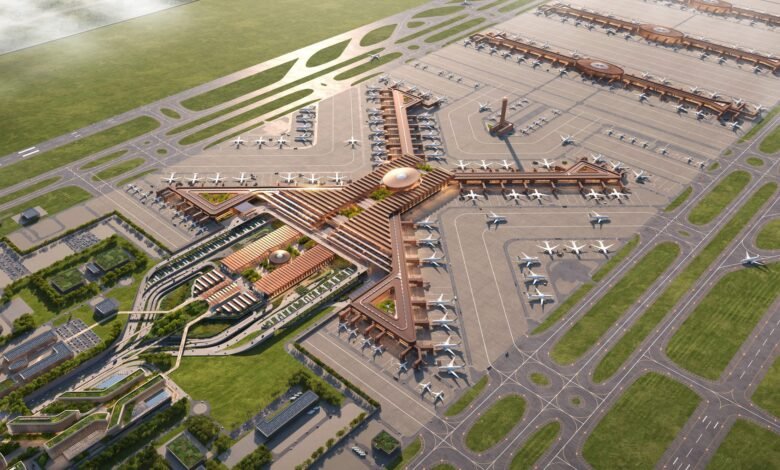
Zaha Hadid Architects has designed an X-shaped terminal organised around a central spine modelled on the Great Rift Valley, with each pier carrying a distinct colour palette drawn from a different Ethiopian region. Semi-enclosed courtyards leverage Bishoftu’s temperate climate, allowing passengers to move through genuinely outdoor spaces rather than sealed corridors, a feature the design team calls unusual among comparable global hubs.
Phase one delivers two runways and parking for a share of the eventual 270 aircraft stands; the ultimate build-out adds two further runways to reach four in parallel, alongside a terminal exceeding 600,000 square metres. Few airports under construction anywhere match the ambition packed into Bishoftu International Airport’s terminal envelope.
Financing Ethiopia’s New Airport Project
No element of Bishoftu International Airport draws more scrutiny than the question of how Ethiopia intends to pay for it. Financing a USD12.5 billion airport from a country with Ethiopia’s balance sheet demands a structure capable of reassuring dozens of international lenders simultaneously, and Ethiopian Airlines has built exactly that around a ring-fenced project finance vehicle. Few lenders underwrite an Addis Ababa replacement airport of this scale without exhaustive due diligence, and the deal structure reflects that caution at every level.
The Debt-Equity Structure Behind the $12.5 Billion Cost
The project is carried out through a special-purpose company wholly owned by Ethiopian Airlines Group, mandated under Council of Ministers Regulation 452/2019 to develop and operate airports. Financing follows a 70:30 debt-to-equity split, with debt broken into three tranches: roughly USD 1.8 billion from multilateral development banks, USD 4.4 billion from export credit agencies, and USD 800 million from commercial banks and private lenders. Ethiopian Airlines itself is committing close to USD 3.2 billion in direct equity, drawn from an airline that has posted profits every year for nearly two decades.
Phase-One Debt and Equity Breakdown
| Funding Source | Amount | Category |
| Multilateral development banks | USD1.8 billion | Debt tranche |
| Export credit agencies | USD4.4 billion | Debt tranche |
| Commercial banks and private lenders | USD800 million | Debt tranche |
| Ethiopian Airlines Group | USD3.2 billion | Direct equity |
| Combined phase-one financing | USD10.2 billion | 70:30 debt-to-equity split |
All project revenue flows into a lender-controlled waterfall account, prioritising operations, debt service, and only then equity distributions. That ring-fencing is what allows this Addis Ababa replacement airport to be financed as a self-contained asset rather than as a direct call on Ethiopia’s sovereign balance sheet.
Courting Global Lenders
The African Development Bank signed on in August 2025 as mandated lead arranger, tasked with mobilising up to USD 8 billion in debt and anchoring the deal with a USD 500 million commitment of its own. By late 2025, Ethiopia’s Finance Minister had confirmed USD 4.8 billion in pledges, including USD 500 million from an undisclosed Chinese bank, with KPMG subsequently appointed as financial adviser to coordinate 59 engaged institutions.
Italian officials entered into financing talks in early 2026, and American interest has surfaced as well, reflecting a genuinely global contest for a stake in Ethiopia’s new airport project, a dynamic echoed further north by the lenders backing Egypt’s own gateway expansion in Cairo. The lender roster now reads like a roll call of every institution with a stake in Ethiopian aviation expansion, from Addis Ababa to Washington, Rome, and Beijing.
Lender Commitment Timeline
| Date | Milestone | Amount / Detail |
| August 2025 | African Development Bank mandated lead arranger | USD 500 million anchor commitment; mandate to mobilise up to USD 8 billion |
| Late 2025 | Ethiopia’s Finance Ministry confirms pledges | USD 4.8 billion |
| Late 2025 | Undisclosed Chinese bank commitment | USD 500 million |
| Late 2025 | KPMG appointed financial adviser | 59 institutions engaged |
| Early 2026 | Italian and American financing talks open | Ongoing |
Further Reading: Cairo International Airport Expansion: 5 Remarkable Engineering Insights Driving Egypt’s $3.5bn Aviation Transformation
Ethiopian Airlines’ New Hub and Ethiopia’s Aviation Expansion
Bishoftu International Airport is not being built in isolation. It lands in the middle of a continent-wide race to fix aviation bottlenecks, and Ethiopian Airlines intends to use its new hub to pull decisively ahead of the competition rather than merely keep pace. It also joins a wave of Ethiopian infrastructure ambition that includes the Grand Ethiopian Renaissance Dam (GERD), reflecting a national pattern of financing and delivering projects at a scale most peer economies would consider unattainable.
Bishoftu Airport Among Africa’s Aviation Gateways
Ethiopian aviation expansion on this scale puts Bishoftu in direct comparison with other projects reshaping African air travel. Kenya, for instance, is working through its own contentious rebuild of Nairobi’s main gateway after its JKIA-Adani deal collapsed, a far messier process than Ethiopia’s single-sponsor model. None of these rivals approaches Bishoftu’s targeted 110 million-passenger ceiling, and none represents the same scale of Ethiopian aviation expansion. The airport that must ultimately be eclipsed is Bole International Airport itself, whose congestion is the sole reason Ethiopia’s new airport project exists, confirming Bishoftu’s role as Addis Ababa’s replacement airport for every route beyond domestic Ethiopia.
Cargo, Trade, and the AfCFTA Dividend
Beyond passengers, Bishoftu International Airport is designed to handle 3.73 million tonnes of cargo annually, tapping into freight demand that industry analysts peg at 15 to 16 percent year-on-year growth across African carriers, roughly triple the global average. Rwanda has pursued the same logic at a fraction of the scale with its purpose-built Bugesera Airport hub outside Kigali, proving the greenfield model works even without Ethiopian Airlines’ balance sheet behind it.
That capacity is built explicitly to support the African Continental Free Trade Area (AfCFTA), giving Ethiopian Airlines’ new hub a logistics role that extends well past passenger connections into the physical movement of goods across the continent. Few competing projects can match the combination of passenger scale and freight capacity built into Ethiopian Airlines’ new hub from day one.
Technical Block: Engineering and Delivery of Bishoftu International Airport
Delivering a USD12.5 billion greenfield airport involves engineering decisions and delivery risks that rarely make headlines but determine whether Bishoftu International Airport meets its 2030 target. The sections below cover the hard infrastructure, the social cost of the site, and the financing risk that still shadows the programme. Bishoftu Airport construction now runs on parallel tracks: physical works on the ground and a financing process that must keep pace if Bishoftu International Airport is to open on schedule.
1. Runway and Airfield Configuration
Phase one delivers two parallel runways engineered for wide-body long-haul aircraft on the Addis Ababa replacement airport site, with apron space and airfield systems built to expand toward the ultimate four-runway configuration without major reconstruction. Parking stands scale toward 270 aircraft at full build-out, a figure that would place Bishoftu International Airport among the largest aircraft parking capacities of any airport in the world.
Runway and Airfield Build-Out by Phase
| Metric | Phase One | Ultimate Build-Out |
| Runways | 2 parallel runways | 4 parallel runways |
| Aircraft capability | Wide-body long-haul | Wide-body long-haul |
| Aircraft parking stands | Partial allocation | Up to 270 stands |
| Airfield systems | Built for future expansion | Full configuration, no major reconstruction required |
2. Rail and Road Connectivity
Bishoftu Airport construction extends beyond the airfield boundary into a dedicated rail and expressway link connecting the new site to Addis Ababa and Bole International Airport, budgeted separately at roughly USD 954 million. High-speed rail is intended to move and transfer passengers and staff between the two airports quickly enough that Bishoftu functions as a genuine extension of the capital rather than an isolated satellite site.
3. Resettlement and Land Acquisition
Construction has displaced more than 15,000 people from over 9,000 acres of agricultural land, a scale of displacement that has drawn sustained scrutiny. Ethiopian Airlines has committed USD 350 million to a resettlement and livelihood restoration programme, building 1,400 homes with electricity, running water, schools, and healthcare facilities, and organising affected households into cooperatives for new business participation. Land acquisition and resettlement costs to date total approximately USD 741 million, a social cost that Ethiopian Airlines treats as inseparable from Bishoftu International Airport’s engineering budget rather than as a side obligation.
Resettlement Programme at a Glance
| Metric | Figure |
| People displaced | More than 15,000 |
| Agricultural land acquired | Over 9,000 acres |
| Resettlement and livelihood investment | USD 350 million |
| Homes built | 1,400, with electricity, water, schools, and healthcare |
| Total land acquisition and resettlement cost to date | USD 741 million |
4. Financing and Delivery Risk
Closing a USD 8 billion debt package within a single year, as aviation analysts have noted, remains an ambitious timeline, even with the African Development Bank’s backing and a blue-chip sponsor in Ethiopian Airlines. Currency risk, Ethiopia’s broader debt position, and the logistics of coordinating dozens of lenders, export credit agencies, and contractors all sit alongside the engineering challenge. Roads, power reliability, and customs efficiency around the new site will ultimately decide whether the cargo capacity built into Bishoftu International Airport converts into the trade volumes its backers expect. Every quarter of delay compounds financing costs and pushes back the timeline Ethiopian aviation expansion has been built around.
Conclusion: Ethiopia’s Bet on Aviation-Led Growth
Bishoftu International Airport represents a wager that Ethiopian Airlines’ operating record can carry a debt and construction programme that few African institutions have attempted at this scale. The airline is not diversifying into aviation infrastructure as a side venture; it is rebuilding the ground beneath its own growth strategy, betting that a lower-altitude, higher-capacity hub converts directly into route economics that Bole could never support.
Ethiopian Airlines’ new hub is the clearest signal yet that Ethiopian aviation expansion has moved from steady growth into a deliberate bid for global relevance. The financing structure, ring-fenced through a dedicated special purpose company and backed by a 70:30 debt-to-equity split, gives lenders a degree of insulation from Ethiopia’s sovereign risk profile that few projects on the continent can offer.
The next four years will test every part of that thesis. Early works must finish on schedule through 2026, the remaining debt package must close without derailing the 2030 target, and the resettlement programme must hold up under continued scrutiny as construction accelerates.
If Ethiopian Airlines delivers Bishoftu International Airport close to its stated timeline, Ethiopia’s new airport project will not just relieve Bole; it will hand Ethiopian Airlines the physical capacity to compete directly with the Gulf carriers that have long captured Africa’s long-haul transit traffic and give the continent its first true rival to Dubai, Doha, and Istanbul as a global connecting point. Ethiopia’s Addis Ababa replacement airport, in other words, is being built to change who controls Africa’s air traffic, not just where passengers land.
Explore More of Africa’s Airport Megaprojects
Bishoftu International Airport is part of a new generation of aviation infrastructure transforming Africa. Discover more technical deep dives, engineering analyses, and project insights across Construction Frontier: Africa Mega Projects.