Chinese vs Western Construction Equipment: 7 Hidden Costs, Smart Wins
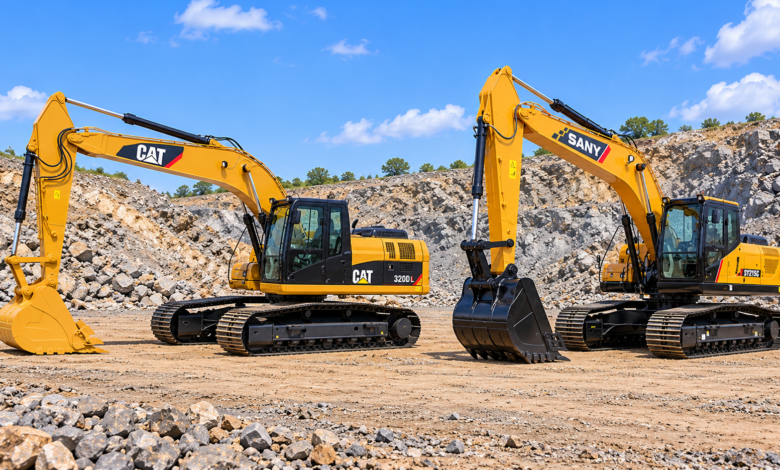
Chinese vs Western construction equipment looks like a price contest, yet a modelled 20-tonne excavator shows a 39% upfront gap shrinking to under 1% over five years at 1,500 operating hours a year. Financing, fuel burn, parts lead time, and resale value absorb the savings, so Chinese machines win below approximately 1,800 hours a year, and Western machines win above that threshold. Buyers who price downtime and residual value, not just the invoice, capture the real savings.
Technical Snapshot: Core Cost Specifications
| Parameter | Value |
| Machine class modelled | 20-tonne crawler excavator, new |
| Landed price, Chinese vs Western | USD 85,000 vs USD 140,000 (39% gap) |
| Five-year total cost at 1,500 hours a year | USD 330,150 vs USD 333,275 |
| Cost per operating hour | USD 44.02 vs USD 44.44 |
| Break-even utilisation | Approximately 1,800 hours a year |
| Binding constraint | Parts lead time and unplanned downtime |
| Fastest lever | A critical-spare kit and a service contract agreed before purchase |
| Benchmark metric | Downtime days a year: 12 Chinese vs 5 Western (planning inputs) |
| Ownership structure shift | SANY and XCMG moving from exports to local subsidiaries and overhaul centres |
| Momentum signal | SANY Africa revenue up 47.66% to USD 790.2 million in the first half of 2026 |
The Chinese vs Western construction equipment decision now turns on utilisation, parts logistics and resale value, not brand reputation. Seven hidden costs determine the winner, each numbered below.
Introduction: Chinese vs Western Construction Equipment
The comparison between Chinese and Western construction equipment has shifted from a quality argument to a cost-per-hour argument. Chinese manufacturers now compete with leading construction equipment manufacturers on volume at home and gain share across Africa, the Middle East and India. Contractors still buy on the invoice, however. In the model below, the invoice covers between a quarter and a third of a five-year outlay, and fuel, parts, downtime, financing, and resale value carry the rest.
The information problem sits in that remainder. Dealer and marketplace estimates put the new-machine price gap at 20% to 50%, but those figures end at the invoice price. They say nothing about the seven extra days a year a Chinese machine may wait for parts under the planning inputs used here, or the 20 percentage points of residual value a buyer may lose at resale. Risk concentrates on remote sites, where a parts delay costs more than the hire rate, and in high-utilisation fleets, where fuel and downtime outweigh the purchase discount.
This article prices seven hidden costs for a 20-tonne excavator, then shows where each side wins and how to run the model on your own fleet. Fleet owners, contractors, investors and procurement teams in Africa form the intended readership. Every cost input is a Construction Frontier planning assumption, not a supplier quote, so replace them with live quotes before committing capital. The structure of arithmetic holds whatever the inputs are.
How the Market Reached Parity on Paper
In the Chinese vs Western construction equipment market, Chinese OEMs closed most of the visible quality gap in under a decade, and African revenue figures now confirm the shift. This section covers the momentum behind Chinese brands in Africa, the localisation of their service networks, and the machine classes where Western brands still lead.
Chinese OEM Momentum in Africa
Half-year results show the scale. SANY Heavy Industry reported first-half 2026 revenue of approximately USD 7.9 billion, up 19.49%, and Africa was its fastest-growing region at USD 790.2 million, up 47.66%. XCMG pushed overseas revenue above 50% of its total for the first time, at approximately USD 4.56 billion. The latest figures on XCMG and SANY growth confirm that both firms now build their expansion on overseas buyers, which sharpens the Chinese vs Western construction equipment contest in African fleets.
SANY describes its strategy as a move from product exports to localised operations, with sales, service and product development closer to customers. For buyers, that localisation matters more than the revenue line. Anyone evaluating SANY equipment in Africa should test service depth country by country, because a dealer in Nairobi does not guarantee a technician in Lubumbashi.
XCMG reports more than 300 overseas dealers, over 2,000 service and spare parts outlets and more than 60 overseas subsidiaries. It opened a Nigerian trading subsidiary in the first half of 2026 and is building overhaul centres in Indonesia and at Simandou in Guinea. Buyers shortlisting XCMG heavy equipment models in Africa should map those outlets against their own haul distances, since an outlet count says nothing about stock on the shelf.
Further Reading: XCMG Equipment in Africa: 7 Proven Models and Smart Buying Tips
Chinese Construction Equipment Quality and Its Limits
Market data on Chinese construction OEMs’ progress shows non-Chinese brands losing share in China over six to eight years, while Chinese brands have reached approximately 5% in Europe and continue to gain in India. The 2020 to 2023 supply shortage that hit Western manufacturers opened a vacuum, and export-minded Chinese OEMs filled it. Rental sales gave them a route around the dealer problem, because large rental firms buy direct.
Parity remains uneven, and Chinese construction equipment quality still varies by machine class and by model generation. Mature, standardised machines show the smallest gap, while machines with complex hydraulics, electronics and punishing duty cycles show the largest.
Table: Where the Gap Sits by Machine Class (Construction Frontier Assessment)
| Machine class | Chinese position | Western position | Cost implication |
| Mid-size excavators (14 to 30 tonnes) | Competitive build and price; fuel burn slightly behind | Lead on hydraulic efficiency and resale | The price gap outweighs the efficiency gap below approximately 1,800 hours a year |
| Wheel loaders | Strong value, including Western-owned Chinese-built ranges | Premium drivetrains and used-market demand | Check where the parts are stocked, not where the loader was built |
| Concrete pumps and mobile cranes | Deep volume experience and low capital cost | Established safety certification and service reach | Verify load charts and certification before price |
| Large mining excavators and haul trucks (above 100 tonnes) | Emerging, with a short track record | Established fleet support from Caterpillar and Komatsu | Daily downtime cost is high, so the Western premium usually pays back |
Seven Hidden Costs in Chinese vs Western Construction Equipment Pricing
Seven costs lie between the invoice and the true price of a machine, and together they form the total cost of ownership that determines Chinese vs. Western construction equipment choices. This section prices them in the order buyers typically encounter them: financing terms, fuel burn, parts lead time, dealer coverage, resale value, import compliance, and, finally, fuel quality, warranty, and operator skills. Each uses the same 20-tonne excavator and the same planning inputs, which the Technical Block later totals.
1. Financing Terms That Move the Break-Even
A 39% invoice gap looks decisive until the loan arrives. At 80% financing over five years at 14% interest, interest is approximately 39.6% of the amount borrowed. The Western buyer therefore pays USD 44,400 in interest, compared with USD 26,900 for the Chinese buyer, widening the Chinese head start by USD 17,500.
Small deposits and OEM-subsidised finance can swing the result either way. Compare the full repayment schedule, not the headline rate, and check whether the lender quotes in USD or local currency, because exchange rate movement can cost more than a point of interest.
2. Fuel Burn Over 7,500 Hours
Fuel is the highest running cost in the model. The planning inputs assume 16 litres an hour for the Chinese machine and 14.5 for the Western machine, with diesel at USD 1.30 a litre. That 1.5-litre difference costs USD 14,625 over five years, which is 27% of the invoice gap.
Real consumption varies more with operator habits and application than with brand. Run a 30-day telematics trial on your own duty cycle before you accept either manufacturer’s burn figure, because a 1-litre error over 7,500 hours moves the total by USD 9,750.
3. Parts Lead Time and Downtime
Chinese parts often cost less per item, yet a machine that waits for a part earns nothing. Downtime cost equals the days lost multiplied by the daily hire-equivalent rate. At USD 400 per day, the extra seven downtime days per year for the Chinese machine cost USD 14,000 over five years.
This line decides most purchases on remote sites. A hydraulic pump that takes 20 days to arrive costs USD 8,000 in lost hire value, which exceeds the savings on many parts orders. Stock a critical-spares kit on site instead of relying on the dealer’s next shipment.
4. Dealer Coverage and Service Reach
Dealer coverage decides how many downtime days a machine loses. Western brands built their African networks over decades, and JCB equipment in Africa is a case where a long-established footprint supports uptime in secondary cities as well as capitals.
Chinese OEMs are closing the gap through new subsidiaries and overhaul centres. A new outlet still needs time to build technician skills and stock parts, so test each branch before you sign. Ask for the fill rate for your 10 most-used parts and the lead time for the main hydraulic pump.
5. Resale Value and Liquidity
Resale value is the second-largest swing in the model after the purchase price. The planning inputs assume a 50% residual value for the Western machine and 30% for the Chinese machine after five years, resulting in USD 70,000 and USD 25,500, respectively. That USD 44,500 difference absorbs 81% of the invoice gap alone.
Dealer estimates for Western construction equipment brands vary widely, from approximately 40% to 70% after five years, depending on the market and hours. Treat any single figure with caution, and test it against Chinese vs Western construction equipment listings in your own market. The Caterpillar vs Komatsu differences matter here because both brands command deep used-machine demand, and that demand supports construction equipment resale value. Chinese brands have yet to build the same track record in African used markets.
Further Reading: Caterpillar vs Komatsu: 7 Critical Differences for Smarter Choices
6. Import Compliance and Inspection
Kenya’s pre-export conformity rules require regulated imports to carry a Certificate of Conformity issued at the point of origin by appointed agents. The programme listed excavators, bulldozers, graders, and movable cranes as mobile equipment. Contractors engaged on government projects can apply for a waiver through the ministry responsible for the project.
Duties, inspection fees, and clearance time sit outside the invoice for either origin. Budget them as a separate line item, and confirm the current rules with the regulator before shipment, as requirements change by country and year.
7. Fuel Quality, Warranty and Operator Skills
Fuel quality drives injector and aftertreatment life. East Africa moved to a 50 ppm sulphur ceiling for diesel in January 2015, and 2018 import data showed an average of approximately 10 ppm, as the debate on ultra-low sulphur fuels in East Africa recorded. Fuel grades elsewhere on the continent vary more, so verify your supply chain before buying a high-tier engine.
Warranty terms differ between brands. Compare covered hours, whether labour and technician travel are included, and who pays when the machine sits 400 kilometres from the nearest branch. Budget for heavy equipment operator training as well, since unfamiliar controls and service routines cost productive hours in the first season.
Smart Wins: Where Each Side Beats the Other
The cost model for Chinese vs Western construction equipment produces a clear split by utilisation and site. This section sets out where Chinese machines win, where Western machines win, and how a mixed fleet captures both advantages.
Chinese Wins: Low Hours and Short Horizons
At 800 hours per year, the Chinese excavator saves USD 14,700 over five years, which is 6.4% of the Western total. Lower utilisation reduces fuel and downtime penalties, while the invoice and interest advantage remains fixed. Wheel loaders show the same pattern, and SDLG wheel loaders in Africa illustrate how a Chinese-built range with Western ownership can further narrow the service gap.
Short project lives favour Chinese construction machinery brands too. A contractor that keeps a machine for two to three years never reaches the point where residual value and downtime dominate.
Western Wins: High Utilisation and Remote Sites
At 2,500 hours a year, the Western excavator saves USD 7,925 over five years. High hours magnify every litre of fuel and every stoppage, and they depress residual values on both machines. Remote sites amplify the effect, since each day of downtime costs more when the nearest technician is a day’s drive away.
Mining and quarry fleets running continuous shifts sit at the far end of this range. For them, a premium for proven fleet support is a cost-of-uptime decision, not a brand preference.
Hybrid Fleet Strategy
The smartest fleets split by duty. Assign machines expected to run fewer than 1,200 hours per year to Chinese brands, and assign front-line machines with more than 2,000 hours to Western brands. Between those thresholds, choose the dealer that commits in writing to respond to a parts request within 5 days.
Standardise within each brand to keep one parts store per brand and to simplify technician training. That discipline matters more in Chinese vs Western construction equipment mixes than in single-brand fleets.
Table: Decision Matrix by Buyer Profile
| Buyer profile | Annual hours | Site access | Likely fit |
| Hire fleet with intermittent work | Below 1,200 | Urban or near a dealer | Chinese |
| Road contractor on a two- to four-year project | 1,000 to 1,500 | Variable | Chinese with finance terms agreed |
| Quarry or haulage operator on continuous shifts | Above 2,000 | Near a dealer | Western |
| Remote mining or infrastructure site | Above 1,800 | A day or more from a dealer | Western, or Chinese, with an on-site spares kit and service contract |
Technical Block: Cost-Per-Hour Arithmetic and Break-Even Rules
The total cost-of-ownership arithmetic behind the verdict fits on one page. This block sets out the five-year cost model, the utilisation sensitivity that identifies the break-even point, the downtime formula, and the pre-purchase checks that turn the model into a negotiation. It closes with a decision rule.
1. Five-Year Cost Model at 1,500 Hours a Year
The model compares one new 20-tonne crawler excavator from each side over 7,500 operating hours. Inputs are planning assumptions: 80% financed at 14% over 60 months, diesel at USD 1.30 a litre, a daily hire-equivalent rate of USD 400, and residual values of 30% and 50% of the purchase price.
Table: Five-Year Cost Model for a 20-Tonne Excavator at 1,500 Hours a Year (USD)
| Cost line | Chinese | Western | Chinese minus Western |
| Landed purchase price, before duty | 85,000 | 140,000 | -55,000 |
| Financing interest | 26,900 | 44,400 | -17,500 |
| Fuel (16 vs 14.5 litres an hour) | 156,000 | 141,375 | +14,625 |
| Maintenance and parts (USD 8.50 vs 9.00 an hour) | 63,750 | 67,500 | -3,750 |
| Downtime (12 vs 5 days a year) | 24,000 | 10,000 | +14,000 |
| Residual value (credit) | -25,500 | -70,000 | +44,500 |
| Total five-year cost | 330,150 | 333,275 | -3,125 |
| Cost per operating hour | 44.02 | 44.44 | -0.42 |
The purchase and interest lines give the Chinese machine a USD 72,500 head start. Fuel, downtime, and resale value return USD 73,125 to the Western machine, and cheaper Chinese parts claw back USD 3,750. The net advantage of USD 3,125 equals 0.9% of the Western total, so a single extra downtime day a year erases approximately 64% of it.
2. Utilisation Sensitivity and Break-Even
Utilisation moves the answer more than any other input because fuel, parts, and downtime scale with hours, while the purchase price does not. The 2,500-hour case also lowers residual values to 20% and 40%, since heavy use depresses resale value.
Table: Five-Year Total Cost by Annual Utilisation (USD)
| Annual hours | Chinese | Western | Chinese minus Western |
| 800 | 216,400 | 231,100 | -14,700 |
| 1,500 | 330,150 | 333,275 | -3,125 |
| 2,500 | 501,150 | 493,225 | +7,925 |
Linear interpolation between the 1,500- and 2,500-hour cases puts the break-even at approximately 1,800 hours per year. Below that, the Chinese machine costs less over five years; above it, the Western machine does.
3. The Downtime Formula
Downtime cost equals stoppages per year multiplied by days lost per stoppage, then multiplied by the daily hire-equivalent rate and the years of ownership. The Chinese input of three stoppages of four days gives 12 days per year, while the Western input of one stoppage of five days gives 5 days per year.
A USD 6,000 critical-spares kit that cuts each Chinese stoppage from four days to one saves nine days a year, or USD 3,600 a year at USD 400 a day. The kit pays back in approximately 1.7 years. Over five years, it returns USD 12,000 net, which turns the model’s USD 3,125 Chinese advantage into approximately USD 15,100.
4. Pre-Purchase Checks Before Signing
Table: Pre-Purchase Checks and Target Thresholds (Construction Frontier Benchmarks)
| Check | Target | Reason |
| Parts fill rate on your ten most-used parts at the nearest branch | At least 90% | Fill rate drives real lead time |
| Lead time for the main hydraulic pump and control valve | Five days or fewer | These parts cause the longest stoppages |
| Written residual or buyback offer | A stated minimum at 5,000 hours | Converts the resale assumption into a contract |
| Warranty scope | Labour and technician travel included | Remote sites make travel the dominant repair cost |
| Telematics trial on your own duty cycle | 30 days before purchase | Confirms real fuel burn against the planning input |
Conclusion: Price Downtime, Not the Invoice
Chinese vs Western construction equipment is a utilisation decision, and the model provides a rule for it. Below 1,200 hours a year, buy Chinese. Above 2,000 hours, buy Western. Between those thresholds, buy from whichever dealer commits in writing to a five-day parts lead time, and negotiate a critical-spares kit into the contract regardless of brand. Fuel, downtime, and resale value together return USD 73,125 to the Western machine, more than the USD 72,500 invoice and the Chinese machine’s interest head start, so the invoice alone never settles the question.
The follow-through is mechanical. Collect three live quotes per side, replace the planning inputs with them, run a 30-day telematics trial, and price the downtime for your own site. Reprice annually, because SANY and XCMG are building local subsidiaries and overhaul centres at pace, and each new service point lowers the Chinese parts lead time and moves the break-even upwards.
Price Your Next Heavy Equipment on Cost per Hour, Not Invoice
Construction Frontier: Equipment Brands & Manufacturers tracks OEM rankings, brand profiles, ownership costs, and maintenance strategies for African contractors, investors, and procurement teams. Follow the vertical for new cost models, dealer coverage analysis, and buyer guides that price every machine on the full cost picture.