InterContinental Shanghai Wonderland: Astonishing Hotel Engineering Inside a Cliff Face
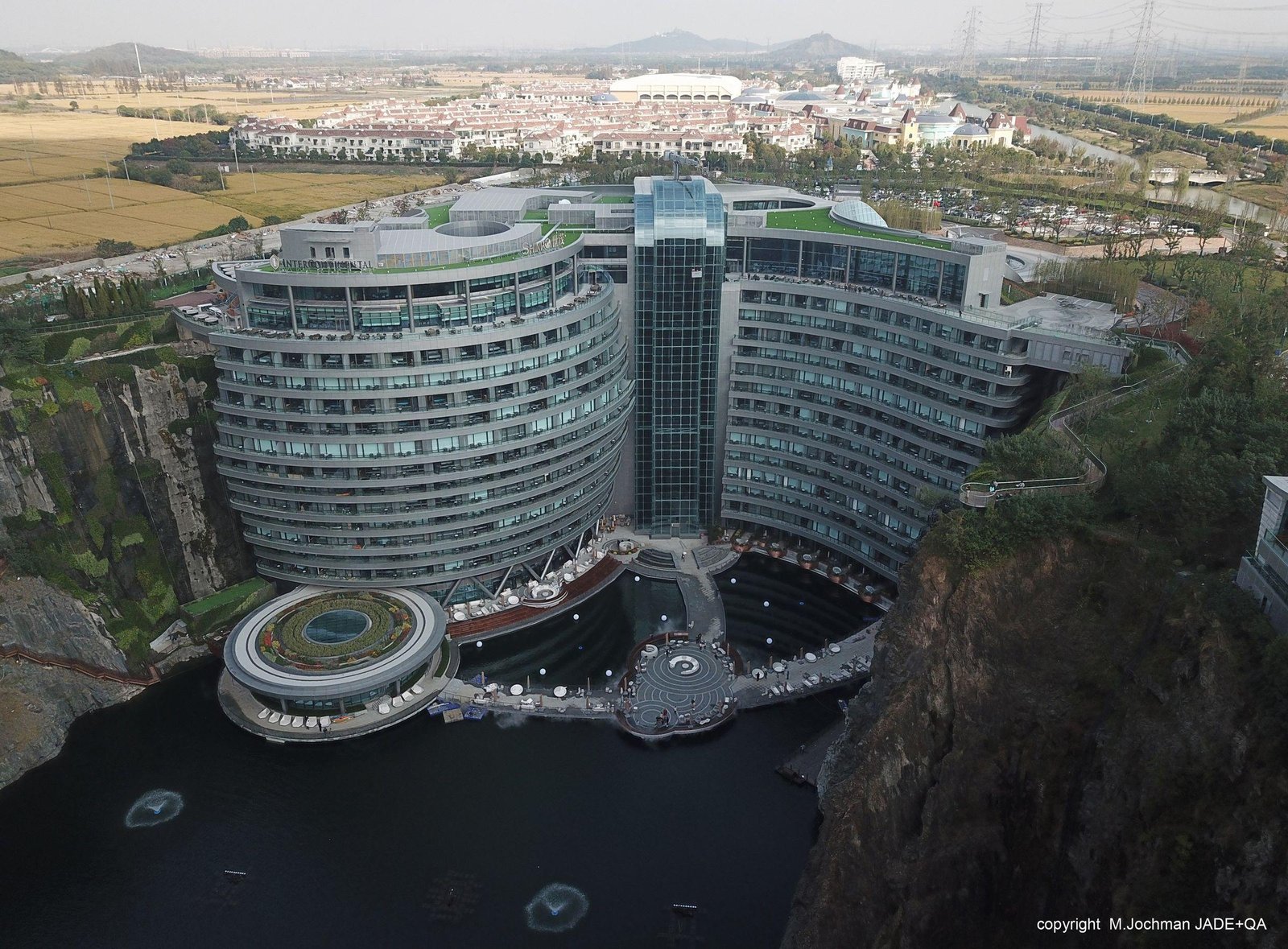
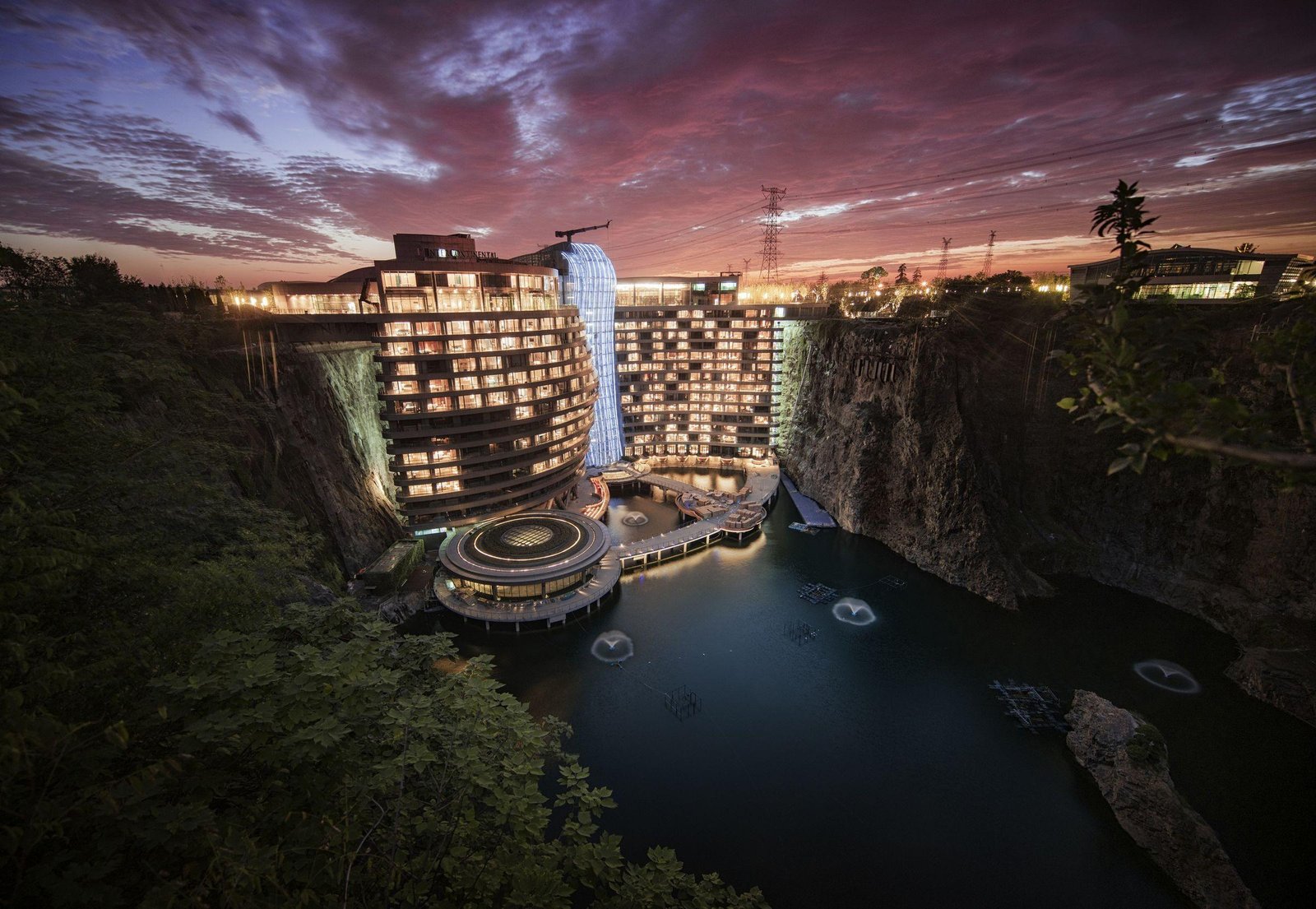
The InterContinental Shanghai Wonderland, also known as Shimao Quarry Hotel, descends 88 metres into an abandoned quarry in Songjiang District, China, redefining what vertical construction can mean. Built over more than a decade at a cost exceeding US$500 million, this 18-storey Shanghai quarry hotel operates 16 floors below ground level, including two floors submerged beneath a natural pit lake. No comparable underground luxury hotel construction project existed before it, and nothing built since matches its geological depth or engineering ambition.
Technical Snapshot: Core Project Specifications
| Specification | Detail |
| Location | Sheshan Town, Songjiang District, Shanghai, China |
| Developer | Shimao Property Group |
| Architect | JADE+QA / Atkins (UK) |
| Interior Design | CCD / Cheng Chung Design (HK) |
| Construction Firm | Shenzhen Asiantime International Construction Co., Ltd. |
| Depth Below Surface | 88 metres |
| Total Floors | 18 (2 above ground, 14 cliff-face, 2 underwater) |
| Total Floor Area | 62,171 m² |
| Guest Rooms | 336 |
| Construction Period | 2006–2018 |
| Project Cost | US$500 million+ |
| Opening Date | 20 November 2018 |
| Patents Registered | 21+ (41+ engineering methods patented) |
The InterContinental Shanghai Wonderland is the world’s deepest five-star hotel and the first purpose-built underground luxury hotel construction project on earth, proving that engineered verticality does not require height.
Introduction: Cliff-Face Hotel Engineering and the Inversion of Vertical Architecture
Most conversations about monumental architecture celebrate daring vertical ascents. From soaring cable-stayed spans to gravity-defying cantilevered observation decks, the structural logic of the world’s most iconic structures, relying on innovative outrigger frames, advanced wind-tunnel aerodynamics, and seismic isolation, is well documented. These landmarks represent the outer edge of traditional outward and upward ambition. The InterContinental Shanghai Wonderland went the other direction entirely.
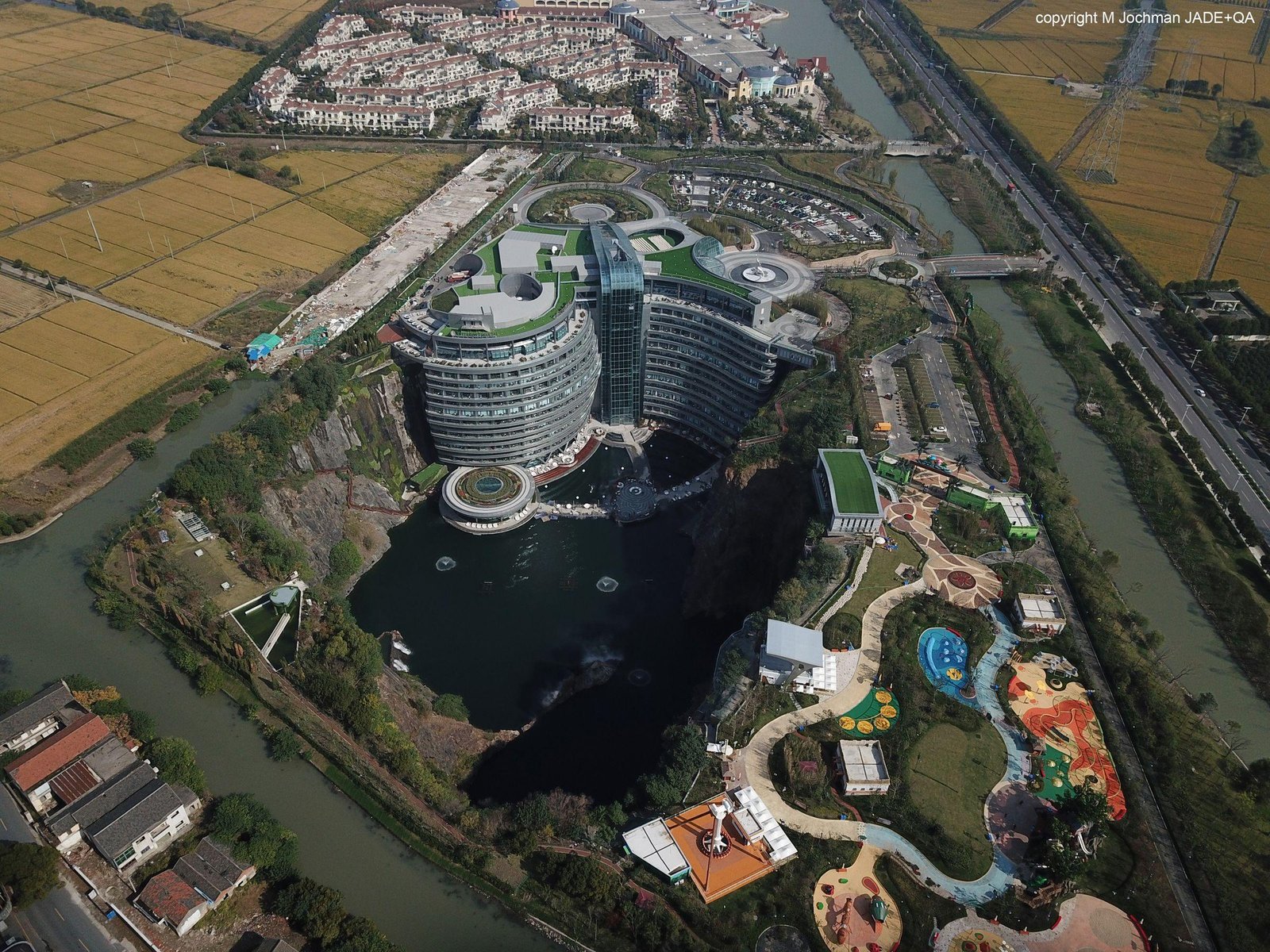
Completed in 2018, the Shanghai Wonderland Hotel transformed the derelict Tianmashan Quarry in Songjiang District into a fully operational five-star resort. The pit, roughly elliptical at 280 metres east-west and 220 metres north-south, had been abandoned after quarrying ceased, leaving sheer rock faces and a lake formed by decades of accumulated rainwater. Shimao Property Group saw not a remediation problem but an engineering opportunity, commissioning an underground hotel construction programme that became the most technically original in global real estate history.
This article draws on the peer-reviewed construction technology research published in Advances in Civil Engineering (Wiley, 2020) to examine how InterContinental Shanghai Wonderland was built, why the engineering required 41-plus patents, and what its sustainable design delivers that no comparable hotel can match. How InterContinental Shanghai Wonderland was built is ultimately a story about what happens when every standard method fails simultaneously.
The Design Concept: Inspired by Antiquity, Executed with Precision
The InterContinental Shanghai Wonderland Hotel brief posed two problems no hospitality architect had solved: anchoring a building to a sheer rock face without destabilising the cliff, and delivering a five-star experience across floors that receive no direct sunlight. Atkins (now AtkinsRéalis) took the initial concept commission, the same practice behind the Burj Al Arab. JADE+QA led detailed development, with interiors by CCD/Cheng Chung Design (HK).
Conceptual Origins and Design Philosophy
Shimao’s chairman first conceived the idea in 2006. The brief was unlike anything Atkins or JADE+QA had taken on before: no comparable underground hotel construction had been attempted anywhere, no cliff-face hotel engineering standard existed, and no building code anticipated a structure in this configuration.
The design team looked to the Hanging Monastery of Hengshan Mountain, a Northern Wei period structure built more than 1,400 years ago that suspends timber architecture against a vertical rock face. That precedent, ancient and formally unrelated to a five-star hotel, gave the architects their structural and spatial logic. The InterContinental Shanghai Wonderland translated the Hanging Monastery’s principle into structural steel, reinforced concrete, and high-specification glazing. JADE+QA’s project documentation records how Taoist ideas of sanctuary and natural harmony shaped spatial decisions from lobby sequence to room orientation, giving the design intent an intellectual coherence that pure engineering problem-solving alone would not have produced.
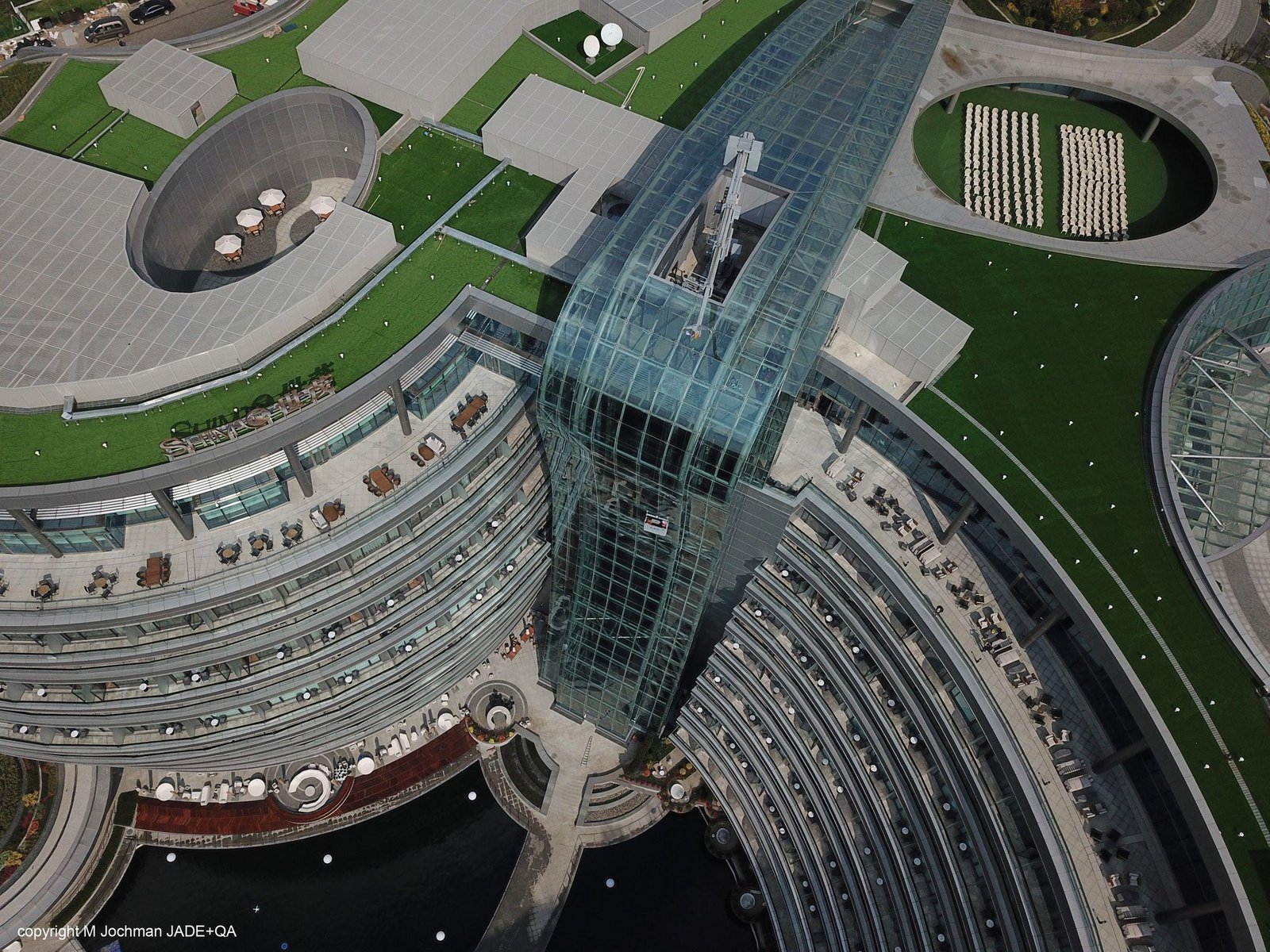
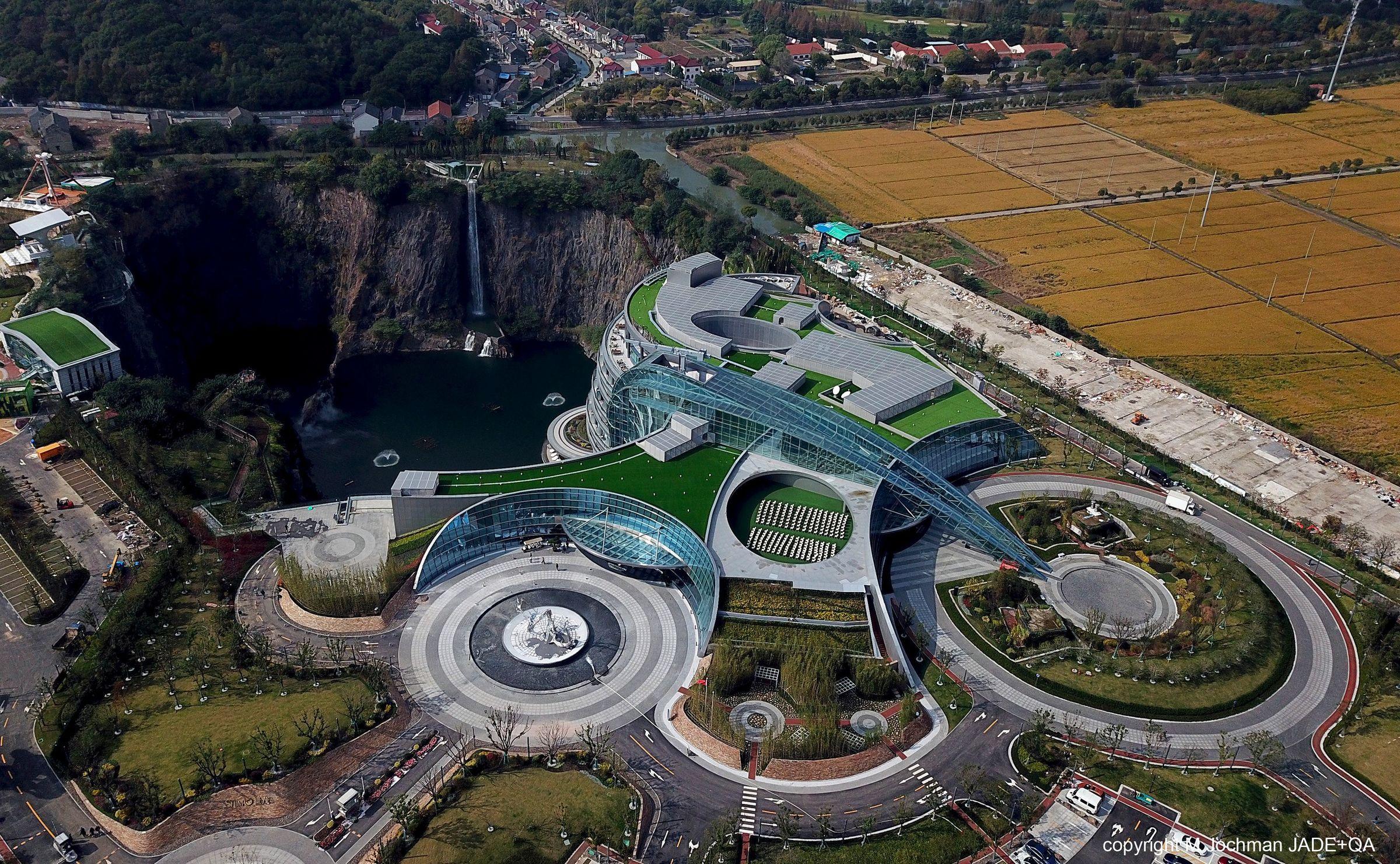
From ground level, the hotel is almost invisible: two low storeys with grass-planted roofs that read as part of the hillside. Step inside, and the quarry opens below. Fourteen floors of guest accommodation cling to the western rock face behind floor-to-ceiling glazing, with direct views across the pit lake. A central glass atrium, evoking a waterfall, carries the observation lifts and provides vertical circulation. CCD anchored the interior narrative to “Adventure to the Centre of the Earth,” building a progressive geological descent from the lobby down to the underwater floors.
Programme and Spatial Organisation
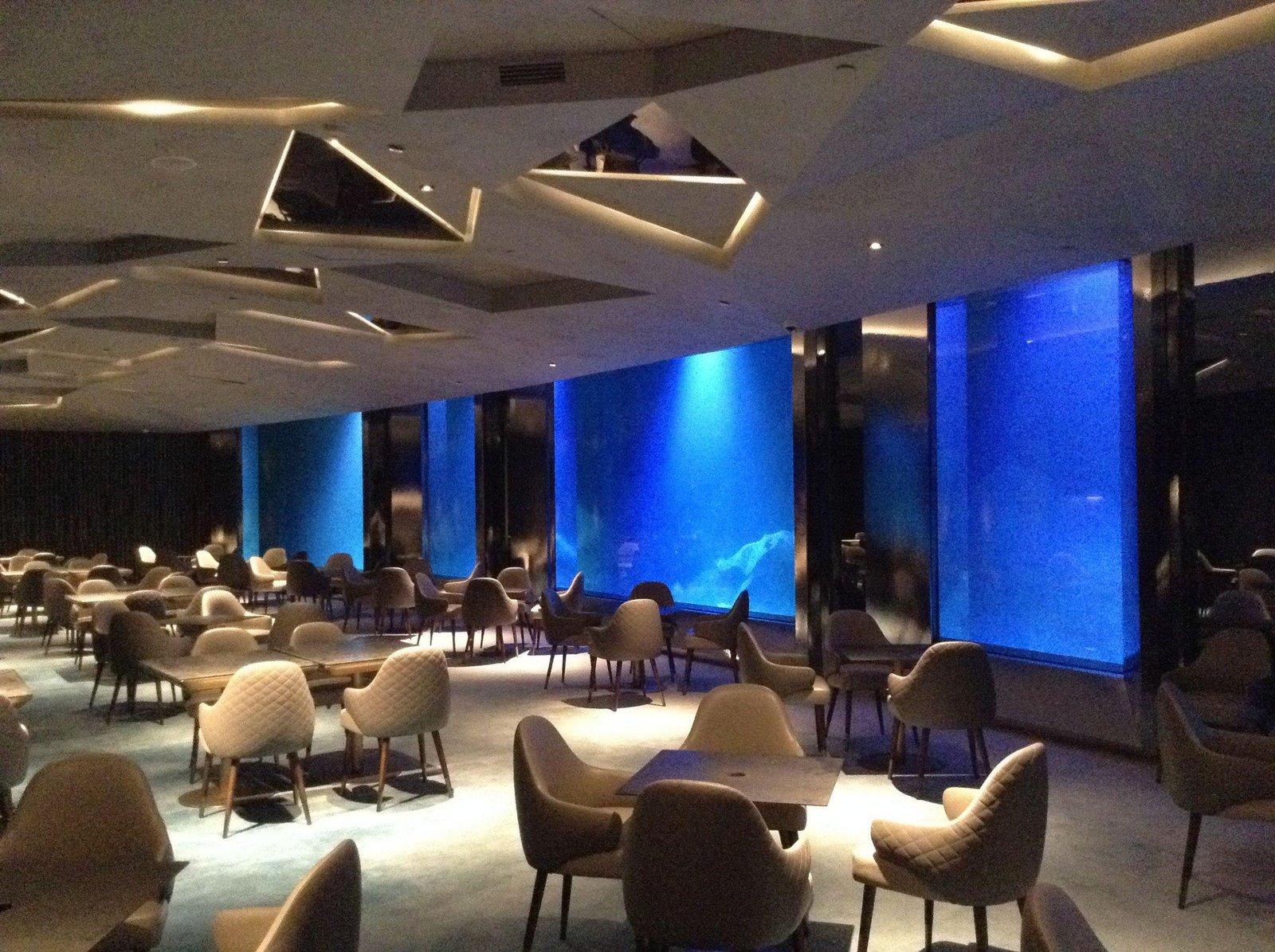
The 62,171 m² programme is distributed across 18 floors. The two above-ground levels hold reception, lobby, and access infrastructure. The fourteen cliff-face floors carry 336 individually designed guest rooms and suites, five restaurants, a spa, rock climbing and zip-lining facilities, and conference and ballroom spaces. The two lowest floors of the Shanghai Wonderland Hotel sit below the pit lake waterline: underwater suites and a seafood restaurant with floor-to-ceiling windows facing the flooded quarry. No quarry hotel in China, or elsewhere, had placed occupied space at this depth before.
Floor Distribution: InterContinental Shanghai Wonderland
| Zone | Floors | Level Relative to Ground | Primary Programme |
| Above-grade | 2 | +1 to +2 | Reception, lobby, access infrastructure, green-planted roofs |
| Cliff-face (upper) | 5 | −1 to −5 | Guest rooms, suites, conference, and ballroom facilities |
| Cliff-face (mid) | 5 | −6 to −10 | Guest rooms, suites, spa, and five restaurants |
| Cliff-face (lower) | 4 | −11 to −14 | Guest rooms, suites, rock climbing, zip-line facilities |
| Underwater | 2 | −15 to −16 (below lake) | Underwater guest suites, seafood restaurant with aquarium glazing |
| Total | 18 | −16 to +2 | 336 keys, 62,171 m² |
Structural Engineering: A Building Fixed at Both Ends
A conventional high-rise is a cantilever: fixed at the base, free at the top, with wind and seismic loads resolved into a single foundation. The InterContinental Shanghai Wonderland reversed that entirely. The building attaches to the cliff at the base of the pit and again at ground level, creating fixed supports at both ends. No building code in the world had addressed this configuration, which the lead architect called an inverted groundscraper. The engineering behind the Shanghai cliff-face hotel’s structural system is what made every other technical decision on this underground hotel construction project both necessary and possible.
The Two-Point Support System
The structural system produces deformation and stress behaviour characteristic of one fixed end and one simply supported end under horizontal load. Engineers verified this through finite element modelling in ETABS and MIDAS, calculating period ratios for the first and third modes of the outer section, Tower 1, and Tower 2 at 0.86, 0.62, and 0.51, respectively. At the pit base, the steel frame embeds into a mass concrete slab to form a rigid joint that dampens vibration during seismic events. Elastic-plastic time history analysis confirmed the system meets seismic requirements under rare earthquake loading. Across the full programme, the team registered 21 patents and filed protection on more than 41 distinct engineering methods.
Structural Modal Analysis: Period Ratios by Structural Segment
| Structural Segment | Mode Pairing | Period Ratio | Compliance Status |
| Outer section | 1st / 3rd mode | 0.86 | Within specification |
| Tower 1 | 1st / 3rd mode | 0.62 | Within specification |
| Tower 2 | 1st / 3rd mode | 0.51 | Within specification |
Period ratios calculated via ETABS and MIDAS finite element modelling. All values confirmed within the Chinese seismic design code GB50011–2010 specification limits.
Cliff Stabilisation and Rock Anchoring
Before a single piece of structural steelwork could proceed, the Tianmashan pit walls needed systematic stabilisation. Engineers drove 2,000 prestressed anchor cables into the rock, each rated 750 to 1,750 kN over lengths of 15 to 35 metres, transferring cliff-face loads back into competent rock behind the excavation face. A further 12,777 anchor bolts, 2,988 at 25 mm diameter and 9,789 at 30 mm, controlled surface stability and constrained potential wedge failures.
Cliff Stabilisation System: Anchor Specifications
| Element | Quantity | Diameter / Capacity | Length / Depth | Function |
| Prestressed anchor cables | 2,000 | 750–1,750 kN capacity | 15–35 m into the rock mass | Transfer cliff-face loads to competent rock behind the excavation face |
| Anchor bolts (small) | 2,988 | 25 mm diameter | Variable | Surface stability; constrain shallow wedge failures |
| Anchor bolts (large) | 9,789 | 30 mm diameter | Variable | Surface stability; constrain deeper wedge failures |
| Total anchor bolts | 12,777 | 25 mm and 30 mm | N/A | Combined surface stabilisation programme |
Three-dimensional dynamic finite element modelling analysed cliff response under earthquake loading. Under static load and small events, the stability coefficient maintained a clear safety margin. Under large earthquakes, the slope retained compliance. Cliff stabilisation was completed in late 2015, clearing the critical path for structural steel erection on the hotel wings.
Further Reading: 20 Tallest Buildings in the World: Record-Breaking Skyscrapers Redefining Global Skylines
Underground Hotel Construction: Methods and Material Logistics
Every standard construction technique failed when applied 88 metres underground inside a confined quarry pit. Concrete chuting separated the mix. Conventional crane geometries did not fit the pit opening. Fire codes were written for buildings that drain by gravity, not against hydrostatic pressure. Dezeen’s coverage quotes the lead architect: the single biggest challenge was satisfying seismic codes for a building type no code had ever contemplated. The team’s answer was to invent, filing over 41 patent applications across the construction period.
The Concrete Delivery Problem
At 88 metres of descent, standard chutes caused aggregates and cement paste to separate, leaving unworkable material at the point of placement. No published guidance covered this failure mode for a building. The InterContinental Shanghai Wonderland construction team designed and patented custom ultra-deep concrete conveying equipment that maintained mix homogeneity throughout the full drop, delivering consistent material to the pit base and to the underwater floor formations. The entire construction sequence was modelled in finite element software before physical work began, giving the team a verified build order and a stage-by-stage safety baseline. Over 5,000 architects, engineers, designers, and workers participated across the twelve-year programme.
Construction Programme: Key Milestones
| Year | Milestone |
| 2006 | Shimao chairman conceives the quarry hotel concept; design brief initiated |
| 2007–2009 | Site investigation, geotechnical survey, and structural feasibility studies |
| 2010–2012 | Design development: JADE+QA appointed; engineering patents process begins |
| 2013–2015 | Cliff stabilisation programme: 2,000 anchor cables and 12,777 anchor bolts installed |
| Late 2015 | Cliff stabilisation complete; critical path cleared for structural steel erection |
| 2016–2017 | Structural steel frame erected; concrete programme using patented deep-conveying equipment |
| 2018 | Interior fit-out completed; MEP commissioning; regulatory inspections |
| 20 November 2018 | InterContinental Shanghai Wonderland opens to guests |
Fire Safety, Drainage, and Flood Protection
Fire egress from a quarry base meant designing multiple escape routes upward through the cliff structure to ground level, then negotiating project-specific life safety benchmarks with Chinese regulatory authorities. Drainage systems that normally discharge by gravity had to operate against the hydrostatic head of the surrounding pit lake, requiring dedicated pump infrastructure and waterproofing membranes with controlled crack-width specifications throughout the below-water-level construction. Active water level monitoring keeps the pit lake at a fixed elevation, preventing overtopping of the lowest habitable floors during intense rainfall events.
Underwater Architecture: The Two Submerged Floors
Two floors of the Shanghai Wonderland Hotel sit below the pit lake waterline. Executing them required reinforced concrete capable of resisting full hydrostatic load at operating depth and structural glazing engineered for sustained underwater pressure. The underwater guest suites use floor-to-ceiling windows facing directly into the flooded quarry. The seafood restaurant, one floor lower, replicates this on a larger scale with oversized glass panels that frame the marine life of the pit lake from the dining space.
Lighting at these depths cannot draw on any natural source. Integrated artificial systems were calibrated to support circadian function while sustaining the visual character of the underwater environment. Temperature and moisture control manage the permanently elevated humidity that proximity to the lake produces. The thermal mass of the surrounding rock assists with passive temperature stabilisation across the entire building section, a benefit the sustainable design team built into the energy model from the outset.
Sustainable Design: The Quarry Microclimate as an Engineering Asset
The sustainable performance of the InterContinental Shanghai Wonderland follows directly from the decision to keep the building inside the quarry. The Urban Land Institute’s analysis identifies the thermal mass of the quarry rock and the microclimate of the pit geometry as the key factors in the hotel’s low-energy operational profile. Neither of those advantages exists if the building is built above grade.
Passive Thermal Performance
Rock carries far higher thermal mass than any conventional building envelope material. The quarry walls absorb heat in summer and release it in winter, moderating indoor temperatures across seasonal extremes without the peak loads a conventionally sited building would impose on its HVAC plant. The sustainable design of InterContinental Shanghai Wonderland exploits that geological property deliberately, reducing both installed capacity and operational energy consumption. Where other hotels engineer their envelope to resist climate, the sustainable design of InterContinental Shanghai Wonderland uses the rock mass as the envelope. The two above-ground levels carry grass-planted roofs, eliminating rooftop heat gain and supporting stormwater retention within the site drainage system.
Active Energy Systems and Brownfield Reuse
Geothermal and solar installations cover a portion of operational energy demand. Combined with the passive thermal buffering from the rock mass, the energy efficiency profile of the InterContinental Shanghai Wonderland is one that no above-grade resort of equivalent scale can replicate.
Sustainability Systems: Passive and Active Energy Measures
| System | Type | Mechanism | Benefit |
| Quarry rock mass thermal buffer | Passive | High thermal mass absorbs summer heat and releases it in winter | Reduces peak HVAC installed capacity and seasonal energy demand |
| Green-planted roofs (above-grade levels) | Passive | The vegetation layer eliminates rooftop solar gain | Reduces cooling load; supports stormwater retention |
| Pit geometry microclimate | Passive | Enclosed quarry moderates wind exposure and solar radiation on lower floors | Reduces envelope heat gain across cliff-face levels |
| Geothermal energy system | Active | Extracts sub-surface heat for heating and domestic hot water | Offsets grid energy consumption |
| Solar photovoltaic installation | Active | On-site generation from solar panels at ground level | Partial renewable offset of operational demand |
| Active drainage and pump system | Active | Maintains controlled pit lake elevation; manages groundwater | Protects envelope integrity; prevents flood risk |
The project is also a brownfield conversion. The abandoned quarry became a destination, demonstrating that innovative hotel construction projects do not require greenfield sites. The Shanghai quarry hotel’s position inside the pit walls rather than above them produced the engineering ambition that distinguishes it from innovative hotel construction projects that use unusual materials or unconventional facades but otherwise sit on conventional ground.
A cantilevered glass-floor overlook walkway at the quarry rim, an outdoor entertainment area, and visitor facilities set within the former pit extend the development publicly, bringing the cliff-face hotel engineering achievement into view from above. The Shanghai quarry hotel has since become a reference for developers asking whether a difficult site can anchor a viable luxury programme, and the answer, for any quarry hotel in China with comparable geology, is now clearly yes. The cliff-face hotel engineering record at Tianmashan is the evidence.
The Michelin Guide awarded the hotel “One Michelin Key” designation. National Geographic’s Megastructures series filmed the construction process. The project received the Best Luxury Hotel Architecture award at the China Luxury Hotel and Resort Congress in 2014, four years before it opened.
Technical Challenges: What Underground Luxury Hotel Construction in China Demanded
There was no design guide for this project; no precedent; no regulatory framework written for a hotel fixed at two points inside a flooded quarry. New Atlas described it as a “groundscraper”: 62,171 square metres across 18 floors in a configuration no building code had addressed. Each challenge below required a new engineering standard derived from first principles before construction could proceed.
1. Seismic Code Compliance for an Unprecedented Structure Type
No Chinese or international structural code covered a tall building fixed at both ends inside a quarry wall. The team built the structural system through first-principles finite element analysis, then negotiated regulatory acceptance for a configuration without precedent. Multiple iterations of elastic-plastic time history analysis preceded sign-off. The process took years and produced a verified structural standard for cliff-face hotel engineering that the industry had not previously needed, and that any future quarry hotel in China or globally attempting comparable innovative hotel construction projects will now inherit.
Seismic Stability Analysis: Cliff Response Under Load Scenarios
| Load Scenario | Analysis Method | Stability Coefficient | Outcome |
| Static load | 3D dynamic FEM | Positive margin | Compliant |
| Small earthquake | 3D dynamic FEM | Positive margin | Compliant |
| Large earthquake | Elastic-plastic time history | Retained compliance | Compliant |
| Rare earthquake (design level) | Elastic-plastic time history | Within code limits | Compliant |
Analysis performed with anchor support measures in place. All scenarios confirmed compliance with the Chinese seismic design code prior to regulatory sign-off.
2. Rock Fall and Geological Hazard Management
Open quarry faces carry ongoing rockfall risk from weathering surfaces and seismically induced wedge failures. The anchor cable and bolt programme addressed this systematically, but monitoring remained a live construction and operational requirement. Seismic monitors installed in the quarry walls provide continuous data on cliff behaviour, enabling intervention before instability reaches the structure.
3. Material and Equipment Access at Depth
Moving materials 88 metres into a narrow pit through a restricted ground-level opening, without conventional crane geometry, required purpose-built logistics at every stage. The concrete conveying patent was one result. The physical choreography of assembling a steel-framed structure inside a confined pit demanded construction management closer to deep mining practice than standard building site coordination.
4. Long-Term Waterproofing Durability
The underwater floors and cliff-face envelope face continuous exposure to groundwater, pit lake water, and humidity that no standard hotel maintenance programme anticipates. Waterproofing was specified for multi-decade service under continuous hydrostatic pressure, with redundant drainage and monitoring providing early warning of any membrane or joint deterioration.
Engineering Legacy: What This Quarry Hotel in China Proved
The InterContinental Shanghai Wonderland proved that underground luxury hotel construction in China, at five-star standards, is technically achievable and commercially viable. The engineering behind the Shanghai cliff-face hotel resolved a two-point structural support system, deep quarry concrete logistics, and sustained underwater building performance with no prior design reference. Documenting the engineering behind the Shanghai cliff-face hotel in peer-reviewed form is what converted twelve years of site-specific invention into transferable construction knowledge.
How InterContinental Shanghai Wonderland was built is now cited in academic literature on seismic design and passive thermal performance for below-grade structures. The Shanghai Quarry Hotel has shifted thinking about what makes an innovative hotel construction project: the most demanding hospitality brief does not have to take the form of a tower. Where conventional underground luxury hotel construction in China stops at basement car parks and service tunnels, the engineering behind the Shanghai cliff-face hotel went to 88 metres and built habitable luxury at the bottom.
The 41-plus patents generated across the programme represent transferable construction technology relevant to any future project combining below-grade construction with seismic exposure, hydrostatic loading, and restricted site access. The structural research published in Advances in Civil Engineering puts that knowledge in front of engineers worldwide. Any quarry hotel in China attempting comparable underground hotel construction in the future has a verified engineering foundation to start from, rather than blank paper.
Innovative projects like the Benban Solar Park in Egypt show how derelict industrial sites anchor transformative investment. The InterContinental Shanghai Wonderland applies the same argument to hospitality, turning an exhausted quarry into one of the most distinctive built environments on earth. That the innovative hotel construction projects that followed in its wake have yet to approach its engineering ambition says everything about how far ahead this Shanghai quarry hotel remains.
The Council on Tall Buildings and Urban Habitat defines supertall structures as those exceeding 300 metres. The InterContinental Shanghai Wonderland demonstrates that the most demanding structural engineering has nothing to do with height. Anchoring a building to a rock face 88 metres below ground required more original design work than most supertall towers, precisely because there was no precedent to adapt. The engineering behind the Shanghai cliff-face hotel proves that difficulty is a function of the problem, not the elevation. And the sustainable design of InterContinental Shanghai Wonderland, which draws energy performance from the rock rather than fighting it, is the kind of passive engineering logic that projects worldwide could replicate wherever below-grade construction meets competent geology.
Technical Block: Engineering Systems of the InterContinental Shanghai Wonderland
The InterContinental Shanghai Wonderland is not a building with one unusual feature. Every primary system, structural, geotechnical, logistical, waterproofing, and thermal, was designed without precedent. The five systems below set out how InterContinental Shanghai Wonderland was built, why the underground hotel construction programme generated its own body of intellectual property, and what each system’s engineering demands reveal about this Shanghai quarry hotel’s true complexity.
1. Structural System Configuration
The primary frame uses reinforced concrete for the core and structural steel for the cliff-face accommodation wings. The two-point support system distributes horizontal seismic and wind loads between the quarry base and ground level, rather than resolving them into a single foundation. ETABS and MIDAS finite element modelling verified modal behaviour and confirmed seismic compliance under rare earthquake loading.
2. Cliff Stabilisation System
2,000 prestressed anchor cables (750–1,750 kN, 15–35 m) and 12,777 anchor bolts (25 mm and 30 mm diameter) stabilise the 88-metre quarry walls. Three-dimensional dynamic finite element analysis confirmed positive stability coefficients under all design load combinations, including large earthquake events. The rock mass is not an obstacle in this system; it is the building’s primary structural partner.
3. Concrete Logistics
Custom ultra-deep conveying equipment, developed and patented during construction, maintains aggregate suspension and concrete mix homogeneity across the full 88-metre descent, delivering workable concrete to depths conventional chutes cannot reach.
4. Waterproofing and Hydrostatic Resistance
Reinforced concrete in the underwater floors uses controlled crack-width specifications. Structural glazing for underwater windows and below-grade facades is rated for sustained hydrostatic pressure. Active drainage and pumping maintain the pit lake at a fixed elevation and manage groundwater ingress at the envelope. Without this system, the sustainable design of InterContinental Shanghai Wonderland and the cliff-face hotel engineering achievement above it would not function: the waterproofing is what makes underground luxury hotel construction in China at this depth operationally viable long-term. The engineering behind the Shanghai cliff-face hotel’s waterproofing envelope demanded the same first-principles rigour as the structural frame, and is the reason this underground luxury hotel construction in China has held since 2018.
Waterproofing System: Specifications by Zone
| Zone | Hydrostatic Exposure | Primary Waterproofing Measure | Secondary / Active Control |
| Underwater floors (−15 to −16) | Full, sustained | Controlled crack-width RC; structural glazing rated for underwater pressure | Active drainage pumps; continuous water-level monitoring |
| Lower cliff-face (−11 to −14) | Groundwater seepage and humidity | Waterproofing membranes; controlled crack-width RC | Drainage channels; humidity management systems |
| Mid cliff-face (−6 to −10) | Groundwater and rainfall ingress | Waterproofing membranes; sealed envelope joints | Passive drainage to active pump systems |
| Upper cliff-face and above grade | Rainfall only | Standard building envelope | Site stormwater retention via green roofs |
5. Passive Thermal and Sustainability Systems
Surrounding rock mass stabilises internal temperatures across seasonal cycles, reducing peak HVAC demand. The sustainable design of InterContinental Shanghai Wonderland converts that geological inertia into operational savings. Solar and geothermal generation supplement the grid supply. Green-planted roofs on the above-ground levels eliminate roof-line heat gain and support site drainage management.
Conclusion: Engineering That Redefined What a Building Can Be
The InterContinental Shanghai Wonderland does not hold a height record. Among all innovative hotel construction projects completed this century, the Shanghai Wonderland Hotel has no equivalent: no other quarry hotel in China or anywhere combines underground luxury hotel construction at this depth with active seismic design, underwater habitation, and a fully operational five-star programme.
The structural system is unprecedented. The construction methods are patented. The waterproofing and seismic solutions came entirely from first principles. The sustainable design of InterContinental Shanghai Wonderland turns the quarry’s geology into a performance asset, and the thermal behaviour of the surrounding rock gives the Shanghai Wonderland Hotel an energy efficiency profile no surface-level resort of equivalent scale can match.
For engineers and developers, how InterContinental Shanghai Wonderland (Shimao Quarry Hotel) was built is a lesson in what the profession produces when there is no prior answer to copy: original thought, applied systematically, at every layer of the design. The underground luxury hotel construction in China programme at Tianmashan generated that knowledge as a by-product of solving real problems under real constraints. How the quarry hotel was built, and what it cost to get there, is a body of work the construction industry will draw on long after this project stops making headlines.
Explore Extraordinary Construction and Engineering Projects
Explore Construction Frontier: Global Megaprojects for deep insights into groundbreaking architecture, underground megastructures, and innovative engineering projects redefining modern construction across Africa and global emerging markets.