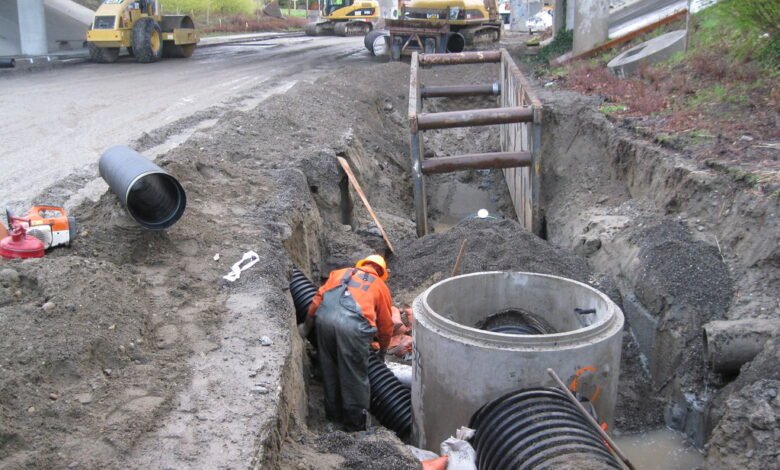
Drainage Design in Road Construction: 5 Proven Fixes for Failure
Drainage design in road construction decides whether a pavement survives its design life or fails within its first rainy season. Across tropical and sub-tropical corridors, saturated subgrades and undersized culverts drive a large share of premature pavement distress, and the pattern repeats on projects where drainage design in road construction is treated as a line item rather than a structural system. Five specific, repeatable fixes, correct hydraulic sizing, integrated surface and subsurface systems, properly placed culverts, return-period-matched design storms, and early recognition of failure patterns, separate roads that last from roads that don’t.
Technical Snapshot: Core Drainage Design Parameters
| Parameter | Typical Value or Range |
| Minimum pavement cross-slope | 1.5% to 2.5% |
| Design storm return period, local/minor drainage | 2 to 10 years |
| Design storm return period, arterial culverts | 25 to 50 years |
| Design storm return period, major/critical crossings | 100 years |
| Minimum self-cleansing velocity in drains | 0.6 to 0.9 m/s |
| Soaked CBR reduction under saturation (weak subgrades) | Up to 50% loss of bearing capacity |
| Minimum culvert cover under pavement | 300 mm to 600 mm, material-dependent |
| Side-drain minimum gradient | 0.5% |
Every one of these figures exists because a road somewhere failed without it. Drainage design in road construction is not a compliance checkbox; it is the hydraulic backbone that keeps the structural pavement dry, stable, and load-bearing for the decades it is meant to serve.
Introduction: The Overlooked Role of Drainage Design
Ask any resident engineer what kills a road, and the honest answer is rarely traffic loading. It is water that gets under the pavement and stays there. Drainage design in road construction sits beneath almost every other layer of the road construction lifecycle, yet it consistently receives less scrutiny than the surfacing, the geometric design, or the pavement structure itself. The importance of drainage design is well documented in every national road manual on the continent, and every experienced site engineer can list a road that failed because water was not managed. Despite that, it remains the system most likely to be value-engineered down or built to a lower standard than the pavement it is meant to protect.
Why is drainage design important in construction terms specifically? Because a road is a linear obstruction placed across a natural catchment, and every metre of it must either pass water safely beneath the surface or divert it around the structure. Get that hydraulic sizing wrong, and the pavement above pays the price. This article explains why drainage design in road construction is deprioritised, what poor drainage design costs structurally, and five proven fixes that turn stormwater drainage civil engineering from an afterthought into a primary design discipline.
Why Drainage Is Deprioritised in Project Planning
Drainage systems rarely fail on day one. A culvert that is one size too small, or a side drain with insufficient gradient, will often perform adequately through several dry seasons before a design storm exposes the shortfall. That delay between decision and consequence is precisely what makes drainage design in road construction vulnerable to being deprioritised during planning, when budgets are tight, and programme pressure is highest.
Budget and Schedule Pressures
Drainage works are earthworks-heavy and are rarely visible in photographs of a finished road. When a project runs over budget, culvert counts, lined-drain lengths, and subsurface drain runs are among the first quantities trimmed, since the pavement surface above still looks complete regardless of what lies beneath it. Contractors under schedule pressure also tend to sequence drainage last, which compresses the time available for proper compaction around structures.
Perception as a Secondary System
Pavement thickness, layer strength, and surfacing type are treated as the road’s defining engineering decisions, while drainage is frequently perceived as ancillary infrastructure that supports those decisions rather than one that determines whether they hold. This perception gap is one of the most persistent common drainage design mistakes in road projects: teams design the pavement first and retrofit drainage around it, when the two systems should be sized together from the outset in any properly run drainage design in the road construction process.
The Engineering Consequences of Poor Drainage
Nothing illustrates the importance of drainage design more starkly than watching one fail. Road drainage failure is not cosmetic. It is a direct mechanical assault on the layers that carry traffic load, and the consequences of poor drainage design compound over a single wet season into defects that no maintenance budget can cheaply reverse. Understanding how drainage failure damages infrastructure at each layer, from subgrade to surfacing to adjacent structures, is what separates a diagnosable defect from a road written off entirely.
Pavement Subgrade Saturation
Water that infiltrates the subgrade increases pore water pressure and reduces the effective stress that holds soil particles together, thereby lowering the soil’s bearing capacity under repeated traffic loading. Even at a level short of full saturation, the resulting reduction in matric suction is enough to weaken a soil’s mechanical properties and structural bearing capacity. A geotechnical investigation into failed pavements on the Enugu-Onitsha expressway in southeastern Nigeria found soaked bearing ratio values as low as 0.9 to 1.6 percent on shale-derived subgrades, well outside the range required for stable pavement construction. This is the mechanism behind most drainage design mistakes: a subgrade that tests adequately dry can lose most of its load-bearing capacity within a single saturated cycle.
Erosion and Scour
Concentrated stormwater that is not properly channelled accelerates velocity at pinch points, culvert outlets, and roadside ditches, stripping fine material from embankments and undermining pavement edges. Uncontrolled scour at culvert outlets is a recurring failure pattern on roads where hydraulic capacity sizing was based on average flow rather than peak design discharge, and it is one of the clearest physical demonstrations of how drainage failure damages infrastructure well beyond the drainage structure itself. This is road drainage failure at its most visible, and it is entirely preventable when drainage design in road construction accounts for peak discharge rather than typical flow.
Flooding of Adjacent Structures
Roads sit within a wider catchment, and a drainage system undersized for the surrounding land use does not just flood the carriageway; it redirects water onto adjacent property, bridge abutments, and utility corridors that were never designed to receive it. This is why stormwater drainage civil engineering treats a road corridor as part of a basin-wide hydrological system rather than an isolated strip of pavement, a principle explored further in the road construction lifecycle, where drainage sits alongside geometric design as a foundational stage rather than a downstream task. The consequences of poor drainage design in this scenario extend well past the road reserve boundary, which is exactly why design responsibility rarely stops at the edge of the carriageway.
Further Reading: Road Construction Lifecycle: 8 Proven Stages from Design to Successful Completion
Core Principles of Effective Drainage Design
Correcting the deprioritisation described above starts with three engineering principles that, applied together, answer why drainage design is important in construction terms that hold under real storm loading rather than average conditions.
Surface and Subsurface Drainage Integration
Surface drainage alone cannot protect a pavement structure once water has already infiltrated the base and subgrade. Effective drainage design in road construction pairs surface systems, cross-falls, side drains, and kerb inlets, with subsurface systems such as edge drains and permeable base layers that intercept infiltrated water before it reaches the subgrade.
Surface Versus Subsurface Drainage Systems
| System | Primary Function | Typical Components |
| Surface drainage | Removes runoff before it reaches the pavement structure | Cross-falls, side drains, kerb and channel, catch pits |
| Subsurface drainage | Intercepts water already infiltrated into the pavement layers | Edge drains, permeable base, geotextile-wrapped pipe, outlet spacing |
Designing these two systems separately, which remains common practice on fast-tracked projects, is one of the most costly drainage design mistakes because it leaves a structural gap between what the surface sheds and what the ground actually receives. Both draw on the same catchment data and should never be sized in isolation.
Hydraulic Capacity Sizing
Every drainage element, from a kerb inlet to a major cross-culvert, must be sized against a specific design storm rather than an assumed average. Catchment area, time of concentration, and rainfall intensity feed into peak discharge calculations that determine pipe diameter, channel cross-section, and culvert barrel count. Undersizing at this stage is invisible until the first storm event exceeds the assumed capacity, at which point the consequences of poor drainage design surface as washouts, ponding, and subgrade intrusion. Correct sizing alone removes the single largest source of road drainage failure before construction even begins.
Culvert and Cross-Drainage Placement
Culverts must sit at the natural low points of a catchment, not at the points most convenient for construction sequencing. Misplaced cross-drainage forces water to pond against embankments before it reaches the structure, accelerating both erosion and subgrade saturation at the very point where the road is structurally weakest. Sound culvert and bridge hydraulic design also accounts for the channel-forming discharge, typically a flow with a return period of 1.5 to 2 years, alongside the larger design storm, to avoid the unexpected erosion that follows when concentrated flow creates a channel where none previously existed.
Recognising Drainage-Related Failure Patterns
Experienced project and site engineers learn to read a failing road before it collapses. Longitudinal cracking that tracks parallel to a blocked side drain, rutting concentrated at low chainage points, and fines pumping at pavement edges are all signatures of road drainage failure rather than pavement design error, even though they are frequently misdiagnosed as the latter.
Common Drainage-Related Failure Signatures
| Visible Symptom | Likely Drainage Cause |
| Longitudinal cracking parallel to the shoulder | Blocked or undersized side drain saturating the pavement edge |
| Rutting concentrated at low chainage points | Ponding from inadequate cross-fall or insufficient inlet capacity |
| Pumping of fines at joints and edges | Repeated hydraulic loading forces saturated fines to the surface |
| Embankment slumping near culvert outlets | Scour from an undersized or poorly protected outlet structure |
Multiple studies across Nigerian road corridors have linked premature pavement failure directly to drainage deficiencies, even when subgrade bearing ratios met specifications, a pattern that confirms that drainage condition, not soil quality alone, ultimately determines pavement longevity. Recognising these patterns early, during routine inspection rather than after a structural failure, is what separates a maintenance intervention from a full-depth reconstruction. It is also where quality control procedures established during construction, covered in road construction quality control testing, pay for themselves years after handover.
Further Reading: Road Construction Quality Control: 6 Key Tests for Reliable Roads
Designing Drainage as a Primary System, Not an Afterthought
Treating drainage design in road construction as structurally equal to the pavement itself is the single mindset shift that resolves most of the failure modes above. In practice, this means five specific fixes applied consistently across design and construction.
- Size hydraulic capacity: Design drainage systems to accommodate the design storm appropriate to the road classification and catchment size, rather than relying on generic assumptions from unrelated projects.
- Integrate surface and subsurface drainage: Coordinate both systems from the earliest design stage so they function together instead of being retrofitted around one another later.
- Position culverts and cross-drainage structures correctly: Locate them at verified hydraulic low points based on survey data, not assumptions derived from the road centreline.
- Incorporate drainage failure recognition into maintenance: Include drainage-related distress indicators in routine inspections so early signs of failure are addressed before they develop into structural problems.
- Prioritise drainage in project planning: Allocate drainage the same level of budget and programme time as pavement works to prevent design shortcomings from remaining uncorrected.
The Five Fixes Mapped to the Failure Mode Each Addresses
| Fix | Failure Mode Addressed |
| 1. Hydraulic capacity sized to design storm | Washouts, overtopping, undersized pipe or culvert failure |
| 2. Surface and subsurface systems integrated | Subgrade saturation from infiltrated but uncollected water |
| 3. Culverts placed at genuine hydraulic low points | Ponding against embankments, misdirected-flow erosion |
| 4. Failure-pattern recognition in routine inspection | Undiagnosed distress escalating to full-depth reconstruction |
| 5. Budget and programme parity with pavement works | Systemic deprioritisation that allows fixes 1 to 4 to lapse |
Applied together, these fixes convert drainage from a hidden liability into a structural asset that protects every other investment made in the road.
Technical Block: Standards, Sizing, and the Case for Structural Priority
Consistent, defensible drainage design in road construction depends on applying recognised hydraulic standards rather than rule-of-thumb sizing, and on closing out the discipline with a design philosophy that treats water management as structural, not cosmetic.
1. Design Standards and Return Periods
International practice, formalised in guidance such as the Federal Highway Administration’s methods for hydrologic and hydraulic design of storm drainage systems, sets the technical baseline that most national road authorities adapt to local rainfall data. Return periods are typically matched to consequence, with the design event scaled to the cost of the facility failing rather than applied as a single blanket figure.
Design Storm Return Period by Facility Type
| Facility | Typical Design Return Period |
| Local/minor drainage (side drains, kerb inlets) | 10 years |
| Culverts under arterial roads | 25 to 50 years |
| Bridges and critical crossings | 100 years |
| Channel-forming discharge (culvert and bridge scour check) | 1.5 to 2 years |
Selecting the correct return period is not a conservative buffer; it is the difference between a culvert that performs for its design life and one that is overtopped within its first decade of service.
Conclusion: Treating Drainage as a Structural Priority
The importance of drainage design is easy to state and hard to budget for, but the conclusion is unavoidable: drainage design in road construction is not a subordinate system waiting on pavement decisions. It is the mechanism that determines whether every other design choice, layer thickness, material selection, and compaction standard actually holds under real climatic loading rather than idealised dry conditions. The evidence from failed corridors across multiple countries points to the same root cause repeatedly: capacity, placement, or integration decisions made without treating drainage as structurally equal to the pavement it protects.
The five fixes set out here on drainage design in road construction, correct hydraulic sizing, integrated surface and subsurface systems, accurately placed culverts, disciplined failure-pattern recognition, and budget parity with pavement works, are not novel engineering concepts. They are standard practices applied consistently rather than selectively. Projects that commit to that consistency from the planning stage, rather than retrofitting drainage once distress appears, are the ones that reach their design life without the reconstruction costs that poor drainage design guarantees elsewhere.
Keep Roads Dry With Smarter Drainage Engineering
Explore more technical road engineering analyses, drainage design reviews, and pavement infrastructure deep dives on Construction Frontier: Construction Methods & Site Execution, where highway drainage systems, hydraulic design, pavement performance, and proven engineering solutions are examined through practical civil engineering insight.