
Road Construction Quality Control: 6 Key Tests for Reliable Roads
Road construction quality control determines whether a pavement survives its design life or fails within its first rainy season. The key tests for road construction quality control are aggregate and sub-base testing, asphalt or concrete mix testing, field density and compaction testing, pavement thickness testing, and roughness and rutting measurement. Contractors who run these road construction quality tests consistently, against clear pavement testing standards, cut early-life failure rates and protect the capital sunk into every kilometre laid.
Technical Snapshot: Core Quality Control Parameters
| Parameter | Value/Standard |
| Standard Proctor compaction reference | AASHTO T99 / ASTM D698 |
| Modified Proctor compaction reference | AASHTO T180 / ASTM D1557 |
| Typical field compaction requirement | 95–100% of maximum dry density |
| Sand cone field density standard | ASTM D1556 |
| Nuclear density gauge standard | ASTM D6938 / ASTM D2950 |
| Los Angeles abrasion limit, base aggregate | Typically, 35–45% maximum loss |
| Core sampling practice | ASTM D5361 |
| Acceptable IRI, new asphalt highway | Approximately 1.5 m/km or lower |
| Marshall stability range, standard mixes | 8–18 kN |
A road that fails one line in this table rarely fails alone; poor compaction, undersized aggregate, and thin layers compound each other, which is why road construction quality control has to run as one continuous system, not a checklist ticked once at handover.
Introduction: Quality Control in Road Construction
Every road that ages gracefully was tested obsessively before it carried its first vehicle. Road construction quality control is the discipline of verifying, at defined points throughout the road construction lifecycle, that materials, compaction, thickness, and surface finish meet design requirements. It is not one inspection at handover, but a sequence of road construction quality tests applied to every layer, since a defect buried under later layers becomes far costlier to fix once traffic loads the pavement.
Under-compacted subgrades and thin, under-tested layers are recurring root causes behind premature rutting and potholing on corridors that skipped proper road construction inspection at the material stage. This article sets out the key tests for road construction quality control that a credible site programme cannot do without, the pavement testing standards that govern them, and the documentation that turns a result into a defensible acceptance decision. Anyone asking how to test road construction quality on an active site needs a working answer to all six, and that answer is inseparable from disciplined site quality control procedures at every layer.
Quality Control vs Quality Assurance On-Site
Quality control and quality assurance are used interchangeably on-site, but they describe two different functions, and confusing them creates gaps in an inspection and test plan. Quality control is the testing itself: sampling aggregate, running a Proctor test, and pulling a core. Quality assurance is the management system that confirms that tests were performed correctly by qualified people on calibrated equipment. Both together are what road construction quality control actually means in practice.
Defining Roles and Responsibilities
In a well-run project, the contractor’s site laboratory conducts day-to-day testing, while the client’s supervising engineer or an independent agency conducts assurance checks at agreed frequencies. The distinction between a site engineer and a project engineer matters here: the site engineer typically owns test scheduling and corrective action, while the project engineer holds responsibility for the specification and sign-off. Where these roles blur, site quality control procedures tend to weaken, and non-conformances get missed.
Further Reading: Site Engineer vs Project Engineer: 5 Essential Differences Explained
Material Testing Requirements
Materials testing is where road construction quality control begins, because no amount of compaction effort can correct a sub-base built with the wrong aggregate or an asphalt mix with the wrong binder content. Each layer has its own specification and quality control procedures in road construction, and the sections below cover three key tests for road construction quality control across granular, bituminous, and rigid pavement materials.
Aggregate and Sub-base Testing
Aggregate for sub-base and base layers is tested for gradation, plasticity, and abrasion resistance before it reaches the paver. Grading analysis confirms the particle size distribution falls within the specified envelope: too fine loses bearing capacity, and too coarse loses workability. The Los Angeles abrasion test measures how much a sample degrades under impact and grinding in a rotating steel drum, with most specifications capping acceptable loss at 35-45 percent for base course material. Atterberg limits and California Bearing Ratio testing complete the suite, providing a direct read on plasticity and load-bearing capacity under saturated conditions.
Asphalt Mix Testing
Asphalt mix testing verifies that the hot mix arriving on site matches the approved job mix formula in binder content, gradation, and air voids. The Marshall stability and flow test remains the most widely used of the road construction quality tests for conventional mixes, loading a compacted specimen until it fails and recording the peak load and deformation together; stability values commonly range from 8 to 18 kN, depending on traffic category. Higher-traffic corridors increasingly specify Superpave gyratory compaction instead, since Marshall testing does not directly characterise rutting resistance. Extraction testing on the plant-produced mix then confirms that the binder content has not drifted from design.
Concrete Testing for Rigid Pavements
Rigid pavements, common on ports, airside aprons, and heavy-duty urban corridors, follow a different regime centred on compressive and flexural strength. Cube or cylinder compressive-strength testing at 7 and 28 days confirms that the mix has reached design strength, while flexural beam testing is often specified for slabs, as it correlates more closely with resistance to traffic-induced bending. Slump testing at placement catches workability problems early, and cement sourced from established African producers, covered in Construction Frontier’s review of leading cement brands, still needs project-specific mix validation rather than a blanket assumption of compliance with road construction quality tests.
Field Density and Compaction Testing
Compaction is the variable most responsible for long-term pavement performance, because under-compacted material consolidates further under traffic and shows up as rutting and settlement years after handover. Field density testing exists to catch under-compaction before the next layer buries the problem, and it sits at the centre of any serious road construction quality control effort. It is also where site quality control procedures are tested hardest, since a rushed density check is the fastest way to let a defective layer pass unnoticed.
Sand Cone and Nuclear Density Methods
The sand cone method, standardised under ASTM’s field density procedure, determines in-place soil density by excavating a small test hole, weighing the excavated material, and measuring the hole’s volume with calibrated sand of known density. It remains the reference method because it is a direct physical measurement, though it is slower than modern alternatives.
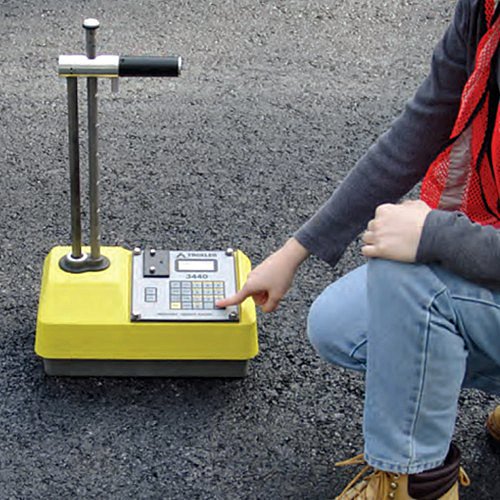
Nuclear density gauges, using a gamma source and detector to estimate density via radiation attenuation, deliver results in seconds, and FHWA guidance on nuclear density testing outlines daily standardisation checks to maintain accurate readings. Most large contractors now run nuclear gauges routinely and reserve sand cone testing for calibration, the practical answer whenever a site asks how to test road construction quality without stopping the compaction train.
Proctor Compaction Standards
Field density results mean nothing without a laboratory reference point, which is where the Proctor test comes in. The standard Proctor test (AASHTO T99/ASTM D698) applies a lighter compactive effort than the modified Proctor test (AASHTO T180/ASTM D1557), which uses roughly 4.5 times the energy and typically yields a higher maximum dry density at a lower optimum moisture content, the reference increasingly specified for heavy-duty pavements.
Field compaction is then expressed as a percentage of whichever laboratory maximum governs, with 95 to 100 percent the typical acceptance band, one of the clearest numerical standards for road construction quality assurance on any site and a benchmark every road construction quality control programme should apply without exception.

Pavement Thickness and Surface Testing
Layer thickness and surface finish are the tests most visible to a client, because they are what a defects liability inspection is most likely to interrogate first. A pavement can be properly compacted and still fail structurally if a layer is undersized relative to design, or fail functionally if the finished surface rides rough enough to accelerate pavement and vehicle wear. Both failure modes are why road construction quality control does not stop once compaction results come back clean.
Core Sampling
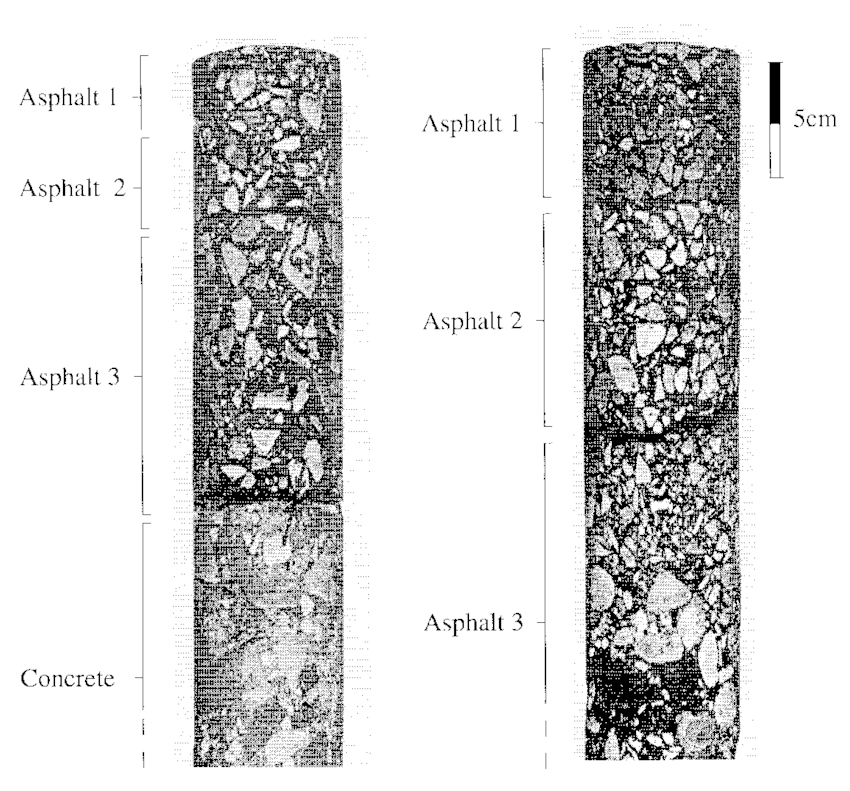
Core sampling is the definitive method for confirming as-built layer thickness on completed asphalt. Following ASTM’s D5361/D5361M core sampling practice, technicians drill cylindrical cores at least 100 mm in diameter at locations determined by a random sampling plan rather than by visual selection, since selecting locations that appear sound biases the results. Recovered cores are measured for thickness and can also be tested for density, air voids, and binder content, making core sampling one of the few road construction inspection procedures that verifies several parameters from a single sample, and one of the more direct ways an engineer learns how to test road construction quality without disputing the result later.
Roughness and Rutting Measurement
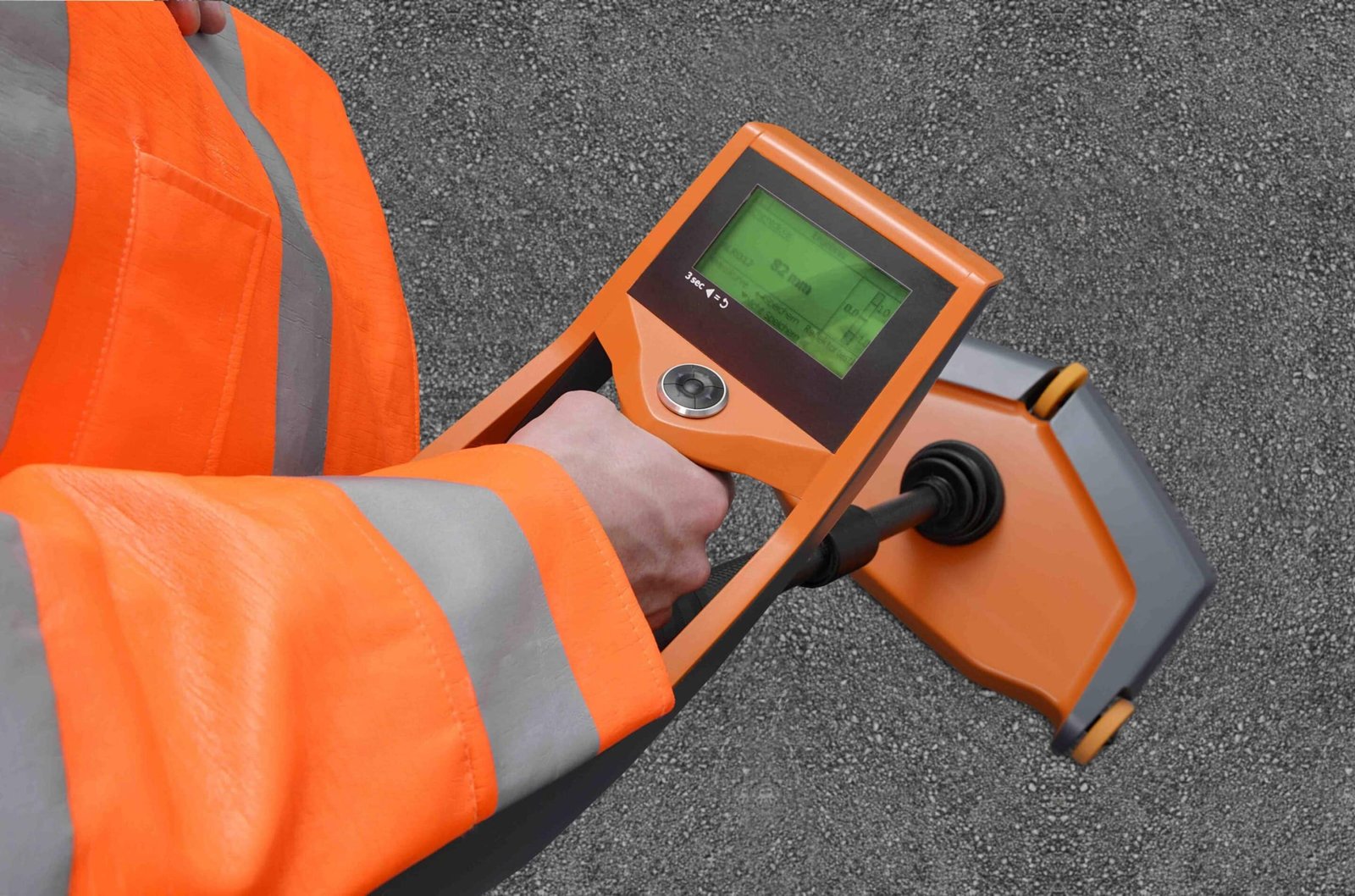
Roughness is measured using the International Roughness Index (IRI), a quarter-car simulation model that converts a longitudinal profile into a single value, in metres per kilometre. New asphalt highways typically target an IRI of 1.5 m/km or lower, according to FHWA’s technical guidance on pavement smoothness, one of the more demanding pavement testing standards a finished road must meet. Rutting, the accumulated deformation in wheel paths, is measured with a straightedge or automated profiler and is often the earliest sign of sub-base or mix failures that proper road construction quality control should have been caught earlier, tracing back to one of the common road construction failures that consistent testing is designed to prevent.
Further Reading: Road Construction Failures: 7 Common Causes and Proven Fixes
Documentation and Site Procedures
Test results only protect a project if they are recorded, traceable, and acted on. An untested layer and a tested layer with lost paperwork carry the same risk under road construction inspection, because neither can be proven compliant if a dispute arises later. This is where quality control procedures in road construction either hold up under scrutiny or quietly fall apart.
Inspection and Test Plans
An inspection and test plan sets out, layer by layer, which tests apply, at what frequency, against which standard, and who holds authority to approve or reject work. A well-built plan ties directly to the specification, so every hold point, the moment work cannot proceed until a result is approved, is unambiguous to all parties. Poor drainage detailing is one of the most common items a plan should flag early, and Construction Frontier’s analysis of road drainage design failures shows how much pavement distress traces back to water ingress that proper site quality control procedures would have caught at the sub-grade stage.
Non-Conformance Reporting
When a result falls outside specification, a non-conformance report captures the failure, the remedy, and the retest that confirms it worked. Strong systems close the loop fast: reject, remediate, retest, record. Weak ones let verbal agreements substitute for documented sign-off, the gap that turns a manageable defect into a warranty dispute, and why disciplined site quality control procedures matter as much as the tests themselves. Anyone unsure how to test road construction quality after a failed result should treat retesting as mandatory.
Governing Standards and Specifications
Road construction quality control draws on a mix of American and international standards, and most national road authorities across Africa build specifications around AASHTO and ASTM test methods, sometimes alongside British Standard references. Knowing the correct standards for road construction quality assurance before materials arrive on site avoids disputes over which test method governs acceptance.
Table: Governing Standards by Test Category
| Test Category | Governing Standard(s) |
| Aggregate abrasion resistance | AASHTO T96 / ASTM C131 |
| Soil moisture-density relationship | AASHTO T99, T180 / ASTM D698, D1557 |
| Field density, sand cone | ASTM D1556 |
| Field density, nuclear gauge | ASTM D6938 / ASTM D2950 |
| Asphalt sampling and coring | ASTM D5361 |
| Marshall stability and flow | ASTM D6927 / AASHTO T245 |
| Roughness computation | ASTM E1926 / AASHTO R43 |
Technical Block: Applying Quality Control Across the Pavement Structure
These pavement testing standards only deliver value when applied at defined frequencies, and consistent frequency is what separates real quality control procedures in road construction from paperwork assembled after the fact. Testing frequency benchmarks give contractors and engineers a shared basis for how much work a given number of tests must cover, and answer whenever a site team asks how to test road construction quality without over- or undersampling the work.
1. Testing Frequency Benchmarks by Layer
Table: Indicative Testing Frequency by Pavement Layer
| Layer/Activity | Typical Test | Indicative Frequency |
| Sub-grade | Field density (sand cone/nuclear) | 1 test per 1,000–2,000 m² or per lot |
| Sub-base | Gradation, Proctor, field density | 1 gradation test per 500–1,000 m³; density per lot |
| Base course | LA abrasion, CBR, field density | 1 abrasion test per source change; density per lot |
| Asphalt mix | Marshall/Superpave, extraction | 1 set per 500–1,000 tonnes produced |
| Compacted asphalt layer | Core sampling, nuclear density | 1 core per 200–400 m of lane |
| Concrete pavement | Compressive/flexural strength | 1 set per 50–100 m³ placed |
| Finished surface | IRI, rutting | Continuous profiling over completed sections |
These figures vary by specification and road authority, and the exact frequency written into an inspection and test plan should always govern over any general benchmark. What does not vary is the principle: standards for road construction quality assurance exist to make testing frequency a matter of contract, not judgement calls.
Conclusion: Quality Control as Risk Management
Road construction quality control is, at its core, a risk management function dressed up as a testing programme. Every test in this article exists because someone, somewhere, skipped it and watched a road fail years ahead of its design life, at a cost far higher than the testing would have cost. Aggregate and mix testing catch problems before construction; compaction and thickness testing catch problems during construction; roughness and rutting measurement catch anything that slipped through. Together, they are the key tests for road construction quality control that separate a pavement built to last from one built to pass its first inspection.
Contractors and engineers who treat these six road construction quality tests as non-negotiable, rather than boxes to tick for handover, are the ones whose roads still perform within specification a decade later. Getting road construction quality control right does not guarantee a perfect road, since design, drainage, and traffic loading play their part, too. It does guarantee that when something goes wrong, the cause is traceable through documented road construction inspection records, responsibility is clear, and the fix does not require rebuilding a structure that should have been right the first time.
Deliver Better Roads Through Quality Engineering
Explore more technical road engineering analyses, quality assurance reviews, and pavement construction deep dives on Construction Frontier: Risk, Safety & Compliance, where road testing methods, construction standards, material performance, and proven quality control practices are examined through practical civil engineering insight.