10 Largest Construction Companies in Morocco: Rising Leaders Powering Growth
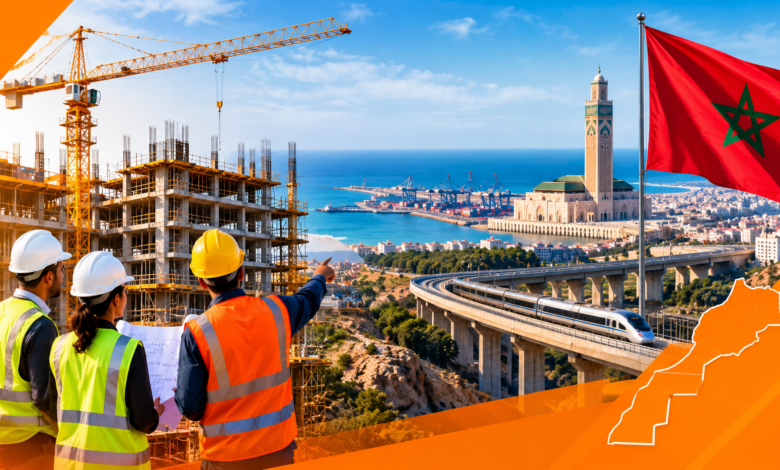
Morocco’s construction sector is now dominated by ten firms that build the country’s rail lines, deep-water ports, and solar plants, and several of them trade openly on the Casablanca Stock Exchange. SGTM and TGCC lead the pack, both running order books worth tens of billions of dirhams. The largest construction companies in Morocco are exporting their expertise into Sub-Saharan Africa and the Gulf, while still anchoring Morocco’s position as the shortest sea crossing between Africa and Europe.
Technical Snapshot: Morocco’s Construction Sector at a Glance
| Metric | Detail |
| Number of Companies Ranked | 10 |
| Top-Ranked Company | SGTM (Société Générale des Travaux du Maroc) |
| Flagship Sector | Rail, port, and renewable energy infrastructure |
| Role as Europe-Africa Gateway | Tanger Med, the busiest port on the Mediterranean, sits 15km from Spain |
Morocco’s largest contractors are no longer building for the domestic market alone. They have become genuine North African infrastructure companies, competing for work from Dakar to Riyadh, while racing to deliver a construction programme worth close to USD 20 billion ahead of the 2030 FIFA World Cup.
Introduction: Morocco’s Construction Industry Leaders
Anyone researching the largest construction companies in Morocco quickly discovers a market that has spent the past decade turning itself into one of Africa’s busiest construction sites. A high-speed rail line now links Tangier to Casablanca, Tanger Med has grown into the continent’s largest port, and Ouarzazate hosts one of the world’s biggest concentrated solar complexes. Behind every one of these projects sits a contractor, and a handful of firms now capture most of the country’s largest public and private contracts.
This article ranks the largest construction companies in Morocco by revenue, market capitalisation, and the scale of the infrastructure they deliver. It sits alongside our broader look at the 20 largest construction companies in the world, which tracks how firms like these compare against the global majors building on every continent. Morocco’s own leaders are smaller than the multinational giants, but they punch well above their weight for a country of 37 million people. Most of the top construction firms in Morocco share one address: nearly every name on this list either has its headquarters in Casablanca or runs its largest regional office there, making the city the undisputed commercial capital of the country’s building industry.
What makes the Moroccan market distinctive is the mix of ownership structures at play. State-linked holding companies, family-founded contractors, and European joint-venture partners all compete for the same tenders, often on the same project. That blend shapes every entry on this list of Moroccan construction industry leaders, and it explains why no single company dominates the way a national champion might in a smaller market.
How We Ranked These Moroccan Construction Companies
Ranking the largest construction companies in Morocco is harder than ranking firms in markets with full corporate disclosure. Many of the country’s largest contractors remain privately held, so this list draws on a combination of published revenue where available, Casablanca Stock Exchange market capitalisation for listed firms, confirmed project values, and the geographic spread of a company’s active work.
Casablanca Stock Exchange filings provided the clearest data points for SGTM, TGCC, and Jet Contractors, three of the top construction firms in Morocco that publicly report financial results. For unlisted firms such as Somagec and Delattre Levivier Maroc, project awards, contract values disclosed by clients like ONCF and the Tanger Med Port Authority, and decades of continuous operating history filled the gap. The same blended methodology underpins our ranking of the 25 largest construction companies in Africa, where private company disclosure is similarly patchy across the continent.
Two additional filters shaped the final list. First, a company needed a track record of delivering large-scale civil works, not just residential or commercial fit-out. Second, active or recently completed flagship projects in rail, ports, or renewables were weighted more heavily than historical reputation alone. Together, these filters separate the largest engineering firms in Morocco from the thousand-plus small contractors registered with OMPIC that build single housing blocks or local roads.
The 10 Largest Construction Companies in Morocco
The list below runs from the country’s largest contractor by revenue down to a European joint-venture partner whose Moroccan footprint is measured in ports rather than balance-sheet disclosures. Eight of the ten are homegrown Moroccan companies, several of them publicly listed; the final two operate in Morocco through international consortium structures rather than as standalone national firms. Every figure below comes from company filings, Casablanca Stock Exchange disclosures, or dated press reporting, cited beneath each entry. Taken together, these are the largest construction companies in Morocco by revenue, market capitalisation, and confirmed order book value as of 2026.
Summary Table: Morocco’s 10 Largest Construction Companies at a Glance
| Rank | Company | Sector Focus | Scale Indicator |
| 1 | SGTM (Société Générale des Travaux du Maroc) | Rail, ports, stadiums, public works | MAD 15.2bn (USD 1.52bn) 2025 revenue, up 36% year-on-year |
| 2 | TGCC (Travaux Généraux de Construction de Casablanca) | Buildings, industrial, infrastructure | MAD 12.4bn (USD 1.24bn) 2025 revenue, first time past MAD 12bn |
| 3 | Colas Maroc / GTR (Grands Travaux Routiers) | Roads, rail, earthworks, catenary systems | Subsidiary of Colas Group; €430m in Kenitra-Marrakech HSR contracts alone |
| 4 | Jet Contractors | Building envelopes, steel structures, solar EPC | MAD 3.66bn (USD 366m) 2025 revenue, up 17.3% year-on-year |
| 5 | Somagec | Maritime and port infrastructure | Privately held; built or expanded almost every major Moroccan port since 1966 |
| 6 | STAM (Société de Travaux Agricoles Marocains) | Roads, dams, water infrastructure | MAD 3.7bn (USD 370m) 2024 revenue; 60%-acquired by TGCC in 2025 |
| 7 | CGI (Compagnie Générale Immobilière) | Housing, tourism, and public real estate | MAD 2.53bn (USD 253m) 2021 revenue; CDG Développement subsidiary |
| 8 | Delattre Levivier Maroc (DLM) | Steel structures, industrial fabrication | Approximately USD 63m 2025 revenue; listed on the Casablanca Stock Exchange |
| 9 | BSTM (Besix-Somagec joint venture) | Port and marine civil engineering | Built the Tanger Med 2 container quays and storage areas |
| 10 | Bouygues Travaux Publics Maroc | Marine and heavy civil works | Led the original Tanger Med port consortium with Somagec and Saipem |
1. SGTM (Société Générale des Travaux du Maroc)

- Founded: 1971, in Casablanca
- Founders: Brothers Ahmed and M’hamed Kabbaj, both engineers
- Ownership today: Kabbaj family; approved for a MAD 5 billion (USD 541m) Casablanca Stock Exchange listing in December 2025
- 2025 revenue: MAD 15.2 billion (USD 1.52 bn), up 36% year on year
- Workforce: More than 8,000 employees and a fleet of over 900 machines
- Major projects: Kenitra-Marrakech high-speed line, AFCON stadium upgrades, Casablanca airport terminal consortium, Hassan II Mosque civil works, Mohammed V Airport
SGTM tops the ranking of the largest construction companies in Morocco on the strength of a 2025 revenue jump that pushed the group past MAD 15 billion. Its contract wins span the Kenitra-Marrakech high-speed line, stadium upgrades, including the Prince Moulay Abdellah Stadium, and a lead role in the consortium that won the contract for Casablanca’s new airport terminal. Managing director Hamza Kabbaj, the founders’ successor, has pushed the group toward an IPO and deeper expansion into Sub-Saharan Africa.
2. TGCC (Travaux Généraux de Construction de Casablanca)
- Founded: 1991, in Casablanca
- Founder: Mohammed Bouzoubaa, a civil engineer and former SGTM employee
- Ownership today: Bouzoubaa family; listed on the Casablanca Stock Exchange since December 2021
- 2025 revenue: MAD 12.4 billion (USD 1.24 billion), first time crossing MAD 12 billion
- Major projects: Tour Mohammed VI, Casa Port railway station, Anfa Place, STAM acquisition
TGCC is following closely, having crossed MAD 12 billion in annual revenue for the first time in 2025, on the back of its own rail and construction work. The company’s USD 430 million acquisition of a controlling stake in STAM folded a major public-works specialist into its group, a consolidation pattern that is becoming common among Morocco’s top construction firms.
3. Colas Maroc / GTR (Grands Travaux Routiers)
- Founded: 1962, in Casablanca
- Parent company: Colas Group (France, founded 1929)
- Leadership today: Faiçal Lahmamsi, General Director
- Revenue: Not separately disclosed; reported within Colas Group’s consolidated accounts
- Workforce: More than 1,300 employees
- Major projects: €430 million in Kenitra-Marrakech HSR contracts (2025), Agadir bus rapid transit line, national road and motorway network
GTR has operated in Morocco for over six decades as the Colas Group’s local roads and rail subsidiary, and it remains one of the top construction firms in Morocco for road building and rail earthworks. Its Colas Rail division alone won contracts worth nearly €430 million for the Kenitra-Marrakech line in 2025, covering track, catenary, and civil engineering.
4. Jet Contractors
- Founded: 1992, as Jet Alu Maroc; renamed Jet Contractors in 2015
- Founder: Mohamed Adil Rtabi
- Ownership today: Rtabi family; listed on the Casablanca Stock Exchange since December 2011
- 2025 revenue: MAD 3.66 billion (USD 366m), up 17.3% year-on-year
- Order book: MAD 11.1 billion at end-2025, up 25% year-on-year
- Major projects: Building envelope and facade contracts nationwide, domestic solar panel manufacturing since 2012
Jet Contractors has carved out a niche in complex building envelopes and now manufactures solar panels domestically, giving it a foothold in Morocco’s renewable energy construction firm segment. Sub-Saharan Africa now accounts for roughly 16% of group revenue, and export markets make up 27% of its order book, reflecting a deliberate push beyond Morocco’s borders.
5. Somagec
- Founded: 1966, in Casablanca
- Founder: Rizkallah Riad Sahyoun
- Ownership today: Sahyoun family; led by the founder’s son, Roger Sahyoun, as President since 2007
- Revenue: Privately held; not publicly disclosed
- Workforce: Approximately 3,500 employees in Morocco
- Major projects: Tanger Med, Marchica lagoon development (Nador), Dakhla Atlantique port, Casablanca marina, Tarfaya wind farm port works
Somagec has quietly built or expanded nearly every significant port on the Moroccan coast since its founding, from Tanger Med to the Marchica lagoon development near Nador. Nigeria’s contractor sector shows a similar pattern of family-founded firms scaling up to become national champions, as detailed in our ranking of the 15 largest construction companies in Nigeria.
Further Reading: 15 Largest Construction Companies in Nigeria: Powerful Firms Fueling Growth
6. STAM (Société de Travaux Agricoles Marocains)
- Founded: 1965, in Meknès
- Founder: Louis Baudrand
- Ownership today: Baudrand family (chaired by the founder’s son, Louis-Raymond Baudrand) alongside TGCC, which acquired a 60% stake in 2025
- 2024 revenue: MAD 3.7 billion (USD 370m)
- Major projects: FASK Dam (southern Morocco’s largest), Rabat-Salé and Casablanca tramways via subsidiary VIAS
STAM brings six decades of dam, water-supply, and road-building experience to the ranking, and its VIAS subsidiary delivered the Rabat-Salé and Casablanca tramways. TGCC’s 2025 acquisition of a controlling stake, worth MAD 4.3 billion in enterprise value, gave the group a stronger foothold in public works and transport infrastructure.
7. CGI (Compagnie Générale Immobilière)
- Founded: 1960, in Casablanca
- Ownership: Subsidiary of CDG Développement, the investment arm of Morocco’s state pension fund CDG
- 2021 revenue: MAD 2.53 billion (USD 253m)
- Major projects: Housing developments, tourism resorts, and administrative buildings across Casablanca and Rabat
CGI has focused on housing and public real estate since 1960, rather than heavy civil works, giving it a different profile from the contractors around it on this list. Among the largest construction companies in Casablanca and Rabat specifically, CGI and TGCC together account for a disproportionate share of active residential and administrative building permits.
8. Delattre Levivier Maroc (DLM)
- Founded: 1951, in Casablanca (as Société d’Études et de Montage pour l’Afrique; renamed DLM in 1970)
- Founder: André Levivier
- Leadership today: Eric Cecconello, Chief Executive Officer
- 2025 revenue: Approximately USD 63 million
- Major projects: Steel structures and equipment for mining, oil and gas, solar thermal plants, and phosphate handling
Delattre Levivier Maroc (DLM) supplies the steel structures behind much of the country’s industrial and port infrastructure, a role that rarely makes headlines but underpins nearly every project above it on this list. It ranks among the largest engineering firms in Morocco in heavy boilermaking and metal fabrication, exporting equipment to clients in Africa and the Middle East alongside its domestic work.
9. BSTM (Besix-Somagec Joint Venture)
- Formed as: A project joint venture, not an independently founded company
- Partners: Besix (Belgium, founded 1909) and Somagec (Morocco, founded 1966)
- Revenue: Not disclosed independently of parent companies
- Major project: Tanger Med 2 container quays and storage terraces
Morocco’s largest marine and port projects have rarely been built by a single firm, and BSTM reflects that pattern. Formed between Belgium’s Besix and Somagec, it delivered the quays and storage terraces of Tanger Med 2, one of the largest port extensions in Africa, with Dutch dredging specialist Boskalis working as a subcontractor on the breakwaters and reclaimed land that carries the terminals.
10. Bouygues Travaux Publics Maroc
- Parent company: Bouygues (France, founded 1952 by Francis Bouygues)
- Revenue: Not disclosed separately for Moroccan operations
- Major project: Original Tanger Med port consortium, alongside Somagec and Italy’s Saipem
Bouygues Travaux Publics led the original Tanger Med port consortium alongside Somagec and Saipem, establishing the template that later port and rail joint ventures in Morocco have followed. These European partners bring technical capacity that the biggest engineering firms in Morocco are still building internally, particularly in deep-water marine works and high-speed rail systems engineering. Egypt has followed a comparable path on its own giga-projects, pairing domestic contractors with European and Gulf partners, a dynamic covered in our review of the 12 largest construction companies in Egypt.
Further Reading: 12 Largest Construction Companies in Egypt: Leading Firms Driving Success
Why Morocco Is Emerging as a Construction Growth Market
Three forces are driving Morocco’s construction boom at once, and each is reshaping the order books of the largest construction companies in Morocco. Rail expansion, port capacity expansion, and a fast-moving renewable energy pipeline are turning Morocco into one of the continent’s most active construction sites.
Rail sits at the centre of the push. ONCF’s Rail Morocco 2040 plan aims to double the number of cities served by 2040, and the flagship Kenitra-Marrakech high-speed line, a 430km extension of the existing Al Boraq route, is under construction with completion targeted before 2030. The list of top contractors building Morocco’s rail network now includes Moroccan, French, and Chinese firms working side by side on adjoining lots. Colas secured three contracts worth nearly €430 million on the project in early 2025 alone, while Moroccan firms, including SGTM, TGCC, and Jet Contractors, each won separate lots, and Chinese state contractors picked up several more. Few single projects illustrate the country’s contractor mix as clearly as this one.
Port capacity tells a similar story. Tanger Med has grown into the busiest port on the Mediterranean and the largest in Africa, and Nador West Med is now under construction farther along the coast to relieve pressure and secure Morocco’s hydrocarbon supply chain, with support from an additional €57 million in African Development Bank financing. Together, these projects have made Moroccan rail and port contractors some of the busiest specialist firms on the continent, and Moroccan port infrastructure contractors such as Somagec and BSTM now rank among the most experienced marine builders anywhere in Africa. South Africa’s ports face comparable expansion pressures, a theme explored in our ranking of the 15 largest construction companies in the country.
Renewable energy adds a third growth axis. The government has set a target of 52% renewable generation by 2030, and construction is now underway on the 305 MW Noor Atlas solar programme, six plants spread across the country, following the earlier 580 MW Noor Ouarzazate complex. Jet Contractors and several European EPC specialists are already positioning around this pipeline, and the roster of construction companies driving Morocco’s renewable energy build-out is widening every year as new tenders are announced. East African markets are pursuing renewables at a similarly fast pace, as our coverage of the Top 20 construction companies in Kenya shows.
Layered on top of all three is the 2030 FIFA World Cup, which Morocco co-hosts with Spain and Portugal. Government and private commitments now approach USD 20 billion across rail, roads, airports, stadiums, and urban infrastructure, giving every contractor on this list a multi-year pipeline of confirmed work regardless of how the broader economy performs.
Challenges Facing Morocco’s Largest Contractors
Scale and momentum have not removed the structural problems facing the largest construction companies in Morocco. Access to financing remains the most persistent constraint. Domestic bank lending for large infrastructure projects is tightly underwritten, and public contracts often carry long payment cycles that strain contractor cash flow during multi-year builds. Morocco has increasingly turned to international bond markets to bridge the gap, a pattern that filters down into how contractors structure their own working capital and equipment financing, an issue our guide to financing construction equipment in Africa examines in more depth. It is a challenge shared by North African infrastructure companies well beyond Morocco’s borders, wherever public procurement cycles run longer than contractors’ credit lines.
Competition from established regional and international players is the second major pressure point. Chinese state contractors, including Sinohydro, China Civil Engineering Construction, and China Railway, have won substantial lots on Morocco’s high-speed rail programme and competed hard for the new Casablanca airport terminal, a USD 1.28 billion contract ultimately awarded to a Moroccan consortium led by SGTM and TGCC after fending off nearly thirty international bidders. Chinese firms have expanded their footprint across the continent in a similar fashion, as we detail in our analysis of Chinese construction firms in Africa. Spanish, Turkish, and Gulf contractors add further pressure, pushing margins down even as order books grow.
Where Morocco’s Top Contractors Are Building
Three sectors account for most of the activity that generates the scale figures for the largest construction companies in Morocco by revenue. Each draws on a different mix of contractors, and each is scheduled to remain a priority well past 2030.
1. Rail and Transport Infrastructure
The Kenitra-Marrakech high-speed line dominates current rail spending, with 346km of new high-speed alignment and 112km of upgraded conventional track under construction, targeting completion in 2029 at speeds up to 320km/h. SGTM, TGCC, Jet Contractors, Mojazine Group, and STAM each hold Moroccan-led lots, while Colas Rail and GTR handle track, catenary, and civil engineering work, and Chinese contractors, including Gezhouba and CRCC 20, delivered other sections. Casablanca and Rabat’s tramway networks, built substantially by STAM’s VIAS subsidiary, continue to expand alongside the intercity network.
2. Ports and Maritime Infrastructure
Tanger Med anchors this category, with Somagec, BSTM, and Bouygues Travaux Publics responsible for successive expansion phases that have pushed capacity toward 11 million containers annually. Nador West Med is adding a second major deep-water hub farther east, while smaller upgrades continue at the ports of Casablanca and Agadir to support both cargo growth and the passenger traffic expected around the 2030 World Cup.
3. Renewable Energy Infrastructure
Morocco’s renewable build-out spans concentrated solar, photovoltaic, and wind. The Noor Ouarzazate complex remains the flagship, and the newer Noor Atlas programme is spreading capacity across six sites from Boudnib to Tan-Tan. Jet Contractors’ domestic solar panel manufacturing and a rotating cast of Spanish and Chinese EPC specialists, including Sener, TSK, and Sepco III, continue to compete for these contracts as Morocco pushes toward its 52% renewable energy target.
Conclusion: Morocco’s Contractors Anchor North Africa’s Next Growth Phase
Morocco’s largest construction companies have moved well past the point of simply executing government contracts. SGTM and TGCC now behave like regional platform companies, acquiring specialist subsidiaries such as STAM and pursuing work beyond Morocco’s borders, a consolidation trend consistent with what we describe in mergers and acquisitions in construction megafirms. That shift matters more than any single project total because it signals that contractors are building the balance sheets needed to bid on the next generation of North African infrastructure work.
As one of the more mature markets for North African infrastructure companies, Morocco offers a template that other governments in the region are already studying. The next five years will test whether this growth holds. Rail, ports, and renewables all carry firm deadlines tied to the 2030 World Cup and Morocco’s decarbonisation targets, leaving little room for delay. The contractors on this list, backed by financing structures still maturing and facing genuine competition from Chinese, Spanish, and Gulf rivals, will decide whether Morocco cements its position as North Africa’s leading construction market or cedes ground to faster-moving neighbours.
Explore Morocco’s Construction Powerhouses
Discover more construction industry insights, major infrastructure projects, and leading contractor profiles on Construction Frontier: Construction Markets & Industry, where Africa’s construction markets, engineering firms, megaprojects, and industry leaders are examined through practical analysis.