15 Types of Cement: Proven Uses and Applications in Modern Construction
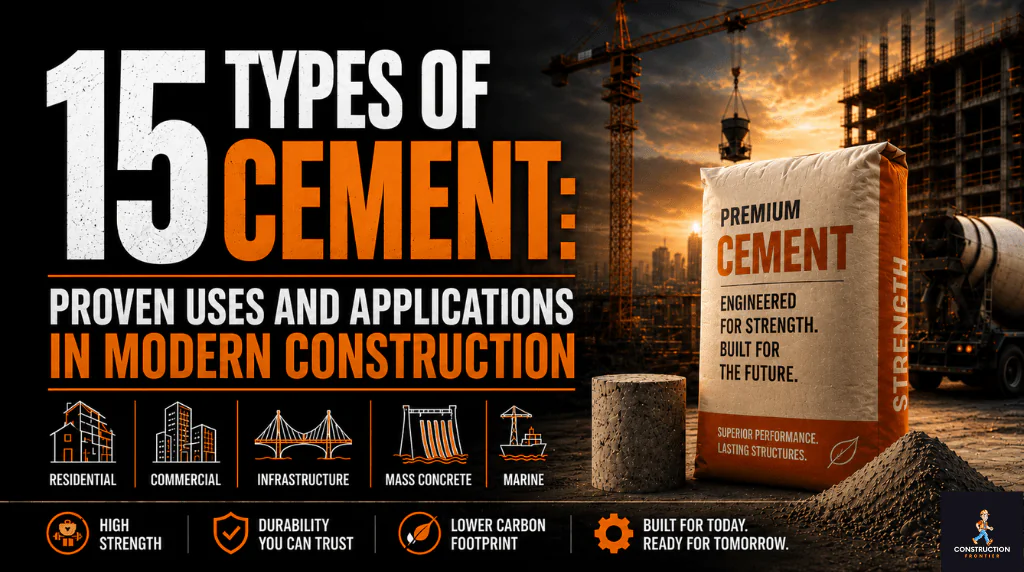
Cement is the binding force behind every structure engineers design and contractors build, from residential foundations to high-rise frames, marine wharves, and mass concrete dams. Understanding the 15 types of cement active in modern construction, their chemical composition, compressive performance, and the project conditions each addresses separates specifiers who build right from the first pour from those who fix problems after the fact. This article maps each cement type to its proven construction applications, providing the technical depth required for confident material selection on projects across Africa and emerging global markets.
Technical Snapshot: Core Cement Classification
| Classification | Detail |
| Primary Standard | ASTM C150 (Portland Cement), ASTM C595 (Blended Cement), BS EN 197-1 (European) |
| Governing Clinker Phases | C₃S (strength), C₂S (long-term durability), C₃A (heat/reactivity), C₄AF (colour/flux) |
| Standard Grades (OPC) | 33, 43, and 53 MPa at 28 days |
| Global Consumption | Approximately 4.1 billion tonnes annually (2024 estimate) |
| Most Widely Used Type | Ordinary Portland Cement (OPC): >70% of global production |
| Emerging Segment | Blended and geopolymer cements driven by low-carbon construction targets |
Selecting the wrong cement type does not merely affect cost. It compromises structural integrity, accelerates material degradation, and eliminates the margin of safety that engineers and project owners depend on. These 15 types of cement define the full selection range available to every modern construction professional, making material decisions that will outlast the project programme.
Introduction: Cement Technology, Types, and Applications
Cement is not a single material. It is a family of binders, each engineered around a specific set of chemical reactions, curing conditions, environmental exposures, and performance thresholds. The clinker compounds at the core of every Portland-based product, tricalcium silicate (C₃S), dicalcium silicate (C₂S), tricalcium aluminate (C₃A), and tetracalcium aluminoferrite (C₄AF), appear in varying proportions across the types of cement, and those proportions govern everything from early strength gain to sulphate resistance to heat generation. When a structural engineer specifies a cement, that specification must account for the chemistry, not just the grade on the bag.
The global construction industry consumes approximately 4.1 billion tonnes of cement per year, a figure the USGS Mineral Commodity Summaries tracks annually, with the majority of this consumption concentrated in China, India, and rapidly urbanising sub-Saharan Africa. As African infrastructure programmes accelerate, driven by the African Union’s Agenda 2063 targets and major corridor development programmes, demand for technically precise selection across all types of cement is increasing.
Choosing OPC for a coastal marine structure or specifying standard Portland for a mass concrete dam foundation are not acceptable engineering decisions. The types of cement covered in this article each address a distinct structural reality, and the distinction between them can mean the difference between a 50-year service life and a 10-year remediation programme. This pillar article covers all 15 types of cement used in residential, commercial, and infrastructure construction, the technical basis for each type’s performance, and the specific project conditions where each delivers its intended function. It cross-references the critical variables of grade, procurement format, pozzolanic blending, and environmental exposure that the broader cement selection process demands.
| Property | OPC (Type I) | PPC | SRC (Type V) | Low Heat | Rapid Hardening |
| 28-day Strength | 33–53 MPa | 33–43 MPa | 33–43 MPa | 28–35 MPa | 53+ MPa |
| Heat of Hydration | Moderate | Low | Very Low | Very Low | High |
| sulphate Resistance | Low | Moderate | Very High | Moderate | Low |
| Setting Time (Initial) | 30–45 min | 30–60 min | 30–60 min | 60–90 min | 10–20 min |
| Primary Application | General construction | Mass concrete, plastering | Foundations in sulphate soils | Dam cores, large foundations | Precast, cold-weather repairs |
The Portland Cement Family: Core Types in Construction
The Portland cement family forms the backbone of global construction. All types in this category derive from Portland clinker, with variations in grinding fineness, clinker composition, and additive content producing the distinct performance profiles that serve different construction contexts. These types of cement in construction dominate specification sheets from residential housing to major infrastructure procurement, and understanding each requires more than reading a bag label.
1. Ordinary Portland Cement (OPC)
Ordinary Portland Cement is the most widely produced and specified cement type worldwide. Its clinker typically contains 50–70% C₃S, which drives early and ultimate strength gain, alongside 10–25% C₂S, which contributes to longer-term durability. C₃A content sits at up to 10%, producing the initial reactivity that enables a moderate setting time of 30–45 minutes for the initial set and 10 hours or less for the final set under standard conditions. ASTM C150 defines eight Portland cement types, each with distinct chemical limits that govern the phase proportions.
OPC is available in three grades: 33, 43, and 53, each designating the minimum compressive strength in megapascals at 28 days under standard cube test conditions. Grade 53 OPC, with its higher C₃S content and finer grind, serves high-load structural applications including reinforced concrete columns, post-tensioned beams, and precast elements where early stripping strength is commercially necessary. Grade 33 suits mortar and plaster work. Grade 43 covers the broadest range of general concrete production, road construction, and masonry applications.
OPC performs predictably in low-sulphate environments with controlled moisture exposure. Its limitation is the absence of chemical modification for aggressive conditions: it has no inherent sulphate resistance, generates moderate to high heat of hydration that can cause thermal cracking in thick pours, and lacks the secondary pozzolanic reactivity that produces denser, less permeable concrete over time. Projects in chemically neutral soil and atmospheric environments, protected from persistent moisture or salt exposure, represent OPC’s natural domain. The complete classification framework for Portland and blended cement types, published by the American Cement Association, maps each type’s standard applications and the conditions that warrant moving beyond general-purpose cement.
The specification decision between OPC and its blended alternatives, particularly Portland Pozzolana Cement, often determines both cost efficiency and long-term performance. The detailed technical and commercial comparison of OPC and PPC for contractors by Construction Frontier identifies nine critical differences that govern this decision across project types.
| OPC Grade | Min. 28-Day Strength | Primary Use Case |
| Grade 33 | 33 MPa | Mortar, plaster, non-structural concrete |
| Grade 43 | 43 MPa | General construction, roads, masonry, and concrete |
| Grade 53 | 53 MPa | High-load structures, precast, post-tensioned elements |
2. Portland Pozzolana Cement (PPC)
Manufacturers produce Portland Pozzolana Cement by intergrinding OPC clinker with 15–35% pozzolanic material, most commonly fly ash, calcined clay, volcanic tuff, or rice husk ash, plus gypsum for set regulation. The pozzolanic fraction does not contribute directly to strength during early hydration. Instead, it reacts with the calcium hydroxide (Ca(OH)₂) liberated during OPC hydration in a secondary reaction that progressively densifies the concrete matrix, closing capillary pores and reducing permeability over 28–90 days.
The consequence of this chemistry is a cement type with a lower heat of hydration than OPC, moderate early strength (PPC typically reaches OPC-equivalent strength by 28–56 days), and substantially improved resistance to chemical attack from chlorides, sulphates, and seawater. PPC’s reduced heat output makes it suitable for mass concrete placements where thermal gradients must stay below 20°C to prevent thermal cracking. Its long-term strength development and densified microstructure make it the preferred choice for hydraulic structures, marine retaining walls, and foundation work in chemically aggressive soils.
PPC is also the more cost-competitive cement type in most African markets, given that fly ash and volcanic pozzolans are produced as industrial by-products and are available at a lower procurement cost than additional Portland clinker. For contractors managing volume, the logistics and cost dynamics between bulk and bagged cement procurement directly affect whether PPC’s economic advantage translates to project-level savings.
3. Portland Blast Furnace Slag Cement (PBSC)
Portland Blast Furnace Slag Cement, classified as Type IS under ASTM C595, replaces a portion of OPC clinker with ground granulated blast furnace slag (GGBS), a glassy by-product of iron smelting. The slag content typically ranges from 25% to 70% by mass of the finished cement. GGBS is a latent hydraulic material that requires activation by the alkaline environment created during OPC hydration, after which it contributes its own cementitious reaction to build strength and density. Under blended cement designations governed by ASTM C595, specific sulphate-resistance grades and air-entrainment properties can also be appended to the Type IS classification, enabling highly targeted specifications for aggressive service environments.
PBSC produces concrete with very low heat of hydration, excellent resistance to both sulphate attack and chloride penetration, and superior long-term strength compared to OPC under equivalent water-to-cement ratios. Its reduced permeability makes it particularly effective in environments where reinforcement corrosion is the primary durability risk, including coastal infrastructure, marine piers, and underground water-retaining structures. The slag’s role as a supplementary cementitious material also reduces the clinker factor per cubic metre of concrete, lowering CO₂ emissions relative to pure OPC-based mixes.
The role of GGBS and other industrial by-products in cement production is examined in detail in the technical review of supplementary cementitious materials (SCMs) and their effects on concrete performance, which covers reactivity mechanisms, optimum replacement rates, and the specific durability gains each SCM provides.
4. Rapid Hardening Cement (RHC)
Rapid Hardening Cement, corresponding to ASTM C150 Type III, achieves its performance through two modifications to standard OPC: a higher C₃S content (typically 60–70%) and finer clinker grinding, which increases specific surface area from the OPC range of 300–350 m²/kg to 450–600 m²/kg. Both changes accelerate the hydration reaction, producing concrete that, at 3 days, reaches the strength OPC achieves at 28 days under comparable conditions.
The engineering value of RHC is concentrated in time-critical applications. Precast concrete manufacturers use it to achieve stripping strength within 8–16 hours, enabling rapid turnover of expensive forms. Road repair teams specify it for carriageway patching, where lane closures must be kept to a minimum and traffic can resume within hours of placement. Cold-weather construction uses RHC because the higher heat of hydration offsets the thermal energy lost to ambient temperatures, maintaining adequate curing conditions without external heating.
The trade-off is thermal risk. The elevated C₃S content and finer grind produce significantly higher heat of hydration than OPC, making RHC unsuitable for mass concrete pours exceeding 500mm depth, where thermal gradients can cause internal cracking. Sulphate resistance is also inferior to Type II or Type V cements, so its use in sulphate-rich soils without additional protective measures creates a long-term durability liability.
5. Low-Heat Cement (LHC)
Low-Heat Cement, corresponding to ASTM C150 Type IV, achieves its defining characteristic through precise control of clinker mineralogy: C₃A is limited to a maximum of 7%, and C₂S is maintained at a minimum of 40%. C₃A is the most reactive and thermally productive of the four main clinker compounds. Reducing it sharply drops the heat released during the first 72 hours of hydration, which is the critical window for thermal cracking risk in mass concrete.
The practical application of low-heat cement is specific and high-consequence. Dam construction, large gravity foundations, thick raft slabs exceeding 1,500mm, and nuclear containment structures all involve concrete masses, and the differential between peak internal temperature and surface temperature must remain below 20°C to prevent thermally induced cracking. The ACI 207 Guide to Mass Concrete defines this temperature-differential limit and the conditions under which thermal control plans are mandatory, establishing low-heat cement selection as a design-level decision, not a site-level one. At the Hoover Dam and subsequent large-scale concrete dam projects, engineers used precursor low-heat formulations to manage this risk, demonstrating that the thermal control properties of this cement type have direct consequences for structural integrity over 100-year design lives.
The extended initial setting time of low-heat cement (typically 60–90 minutes) and its slower strength development require adjustments to construction sequencing. Formwork stripping schedules are extended; pour lifts must be spaced farther apart to allow thermal dissipation, and concrete temperature monitoring during placement becomes a contractual requirement rather than a precaution.
6. Sulphate Resisting Cement (SRC)
Sulphate-Resisting Cement targets the mechanism of sulphate attack directly. Sulphate ions in soil water or groundwater react with C₃A in Portland cement to form ettringite, an expansive compound that exerts pressure within the concrete matrix, causing cracking, delamination, and ultimately structural disintegration. SRC limits C₃A content to a maximum of 5% under the ASTM C150 Type V standard, a threshold the NPCA’s detailed analysis of Portland cement types I through V confirms as the definitive boundary between moderate and high sulphate resistance. That C₃A ceiling constrains the formation of ettringite and calcium aluminate hydrate compounds susceptible to sulphate conversion.
The engineering consequence is a cement type that maintains structural integrity in soil and groundwater environments with sulphate concentrations exceeding 0.2% by mass (moderate exposure class), and is the mandatory specification for environments exceeding 0.5% (severe exposure class) or for continuous seawater sulphate exposure. Foundation work in marine coastal zones, sewage treatment plant structures, irrigation infrastructure in saline soils, and retaining walls in gypsiferous ground all fall within the SRC application territory.
SRC’s very low heat of hydration, a secondary benefit of the reduced C₃A content, also makes it appropriate for thicker foundation pours where thermal cracking risk accompanies the chemical exposure risk. Its compressive strength development is slower than that of OPC Grade 53 but ultimately comparable. The extended curing period required should be built into programme schedules, particularly in African markets, where premature foundation loading remains a common cause of early structural distress.
Further Reading: Cement Selection Guide for Construction Projects: Strength, Performance, and Cost Considerations
Specialty and Performance Cement Types
Beyond the Portland family, specialised cements address construction conditions that standard Portland formulations cannot address. These types of cement in construction are not interchangeable with OPC for general work; their chemistry, setting characteristics, and performance envelopes define specific applications where their use is not optional but engineering-mandatory.
7. White Portland Cement
Manufacturers produce White Portland Cement to the same ASTM C150 or BS EN 197-1 standards as grey OPC but with raw material selection and kiln management that reduces iron oxide and manganese oxide content to trace levels. Iron oxide, which provides the characteristic grey colour of standard Portland cement through the C₄AF phase, must stay below 0.4% by mass in white cement production. The absence of iron as a flux raises the kiln sintering temperature to 1,600–1,700°C, up from the 1,450°C standard, making white cement production more energy-intensive and commensurately more expensive.
The construction applications of white cement differ from those of structural work. Architectural precast cladding panels, where colour consistency and aesthetic finish quality are design-critical, demand white cement as the matrix material. Decorative concrete paving, GRC (glass-reinforced concrete) facades, exposed concrete feature walls, and tile grout formulations requiring colour brightness all specify white cement. When combined with inorganic pigments, white cement produces saturated reds, yellows, greens, and blues that grey OPC cannot achieve, regardless of pigment quantity.
Structural use of white cement is technically sound but economically unjustifiable in most projects. Where a client requires an exposed concrete finish with a specific colour or reflectance specification, white cement as a structural binder becomes viable, but engineers must account for its slightly higher water demand and the premium pricing compared to grey cement.
8. Coloured Cement
Cement manufacturers produce coloured cement by blending ordinary Portland cement with 5–10% mineral pigments during grinding. Iron oxide pigments are the most common: haematite (Fe₂O₃) produces red, limonite (FeO(OH)) yields yellow, and chromite or chromium oxide delivers green. Black is achieved by adding manganese oxide. The pigment must be alkali-stable and UV-resistant to maintain colour integrity in the alkaline curing environment of Portland cement and subsequent weathering.
The structural performance of coloured cement matches the grey OPC base product, as pigment additions at these percentages do not materially alter hydration kinetics or strength development. Its application concentrates on decorative and finishing work: coloured concrete floors, patterned paving systems, architectural feature elements, and tile adhesive formulations where grout colour must coordinate with tile selection. White cement is preferred for bright and pastel colours, while grey OPC limits achievable colour saturation to earthy tones.
Project specifications that require coloured cement must define the pigment type, percentage, and the reference standard against which consistency is measured across multiple deliveries, as batch-to-batch variation in OPC colour and pigment grind fineness can produce visible differences in finished surfaces.
9. High Alumina Cement (HAC)
Cement producers manufacture High Alumina Cement, also known as calcium aluminate cement (CAC), by fusing or sintering limestone and bauxite at approximately 1,600°C. The primary compounds are calcium aluminate phases (CA, CA₂, C₁₂A₇) rather than the calcium silicate phases dominant in Portland cement. This chemistry produces a cement type with fundamentally different performance characteristics: extremely rapid strength development, very high early compressive strength (up to 80 MPa at 24 hours under standard conditions), and excellent resistance to temperatures up to 1,000–1,500°C depending on aggregate selection.
The high temperature resistance of HAC derives from the absence of calcium hydroxide in its hydration products, which begin to dehydrate and convert to ceramic bonding at elevated temperatures rather than losing strength as Portland-based binders do. This makes HAC the correct specification for refractory concrete applications: furnace linings, kiln floors, flue structures, and industrial process environments exposed to sustained heat above 300°C.
HAC does carry a critical limitation for structural use in temperate or humid construction environments. The initial hydration products (metastable aluminate hydrates) undergo a conversion process in warm, moist conditions that increases porosity and reduces strength by 40–60% over time. This conversion phenomenon caused documented structural failures in the United Kingdom during the 1970s in buildings where HAC was used for structural beams, and its use in structural applications requires careful engineering assessment, controlled environments, and explicit acknowledgement of long-term strength reduction.
10. Expansive Cement
Expansive Cement is formulated to produce controlled expansion during and after setting, counteracting the normal shrinkage that Portland cement undergoes during hydration and drying. The expansion mechanism is chemical: sulfoaluminate compounds or calcium sulfoaluminate clinker phases generate ettringite in controlled quantities, and the volumetric growth of ettringite within the setting cement matrix produces outward pressure that offsets shrinkage strain.
The construction applications of expansive cement address the most damaging consequence of normal cement shrinkage: cracking at connections, joints, and interfaces. Grouting anchor bolts into predrilled holes demands a grout that expands into contact with the bolt and parent structure rather than pulling away as it cures. Post-tensioned concrete duct grouting requires complete void filling without shrinkage gaps that could allow moisture ingress to prestressing tendons. Structural concrete repair patches that must bond tightly to a rigid parent structure without cracking also benefit from controlled expansion.
Expansive cement requires precise control of the water-to-cement ratio. Excess water reduces the effectiveness of expansion by diluting the sulfoaluminate reaction, while insufficient water limits workability. Curing must be carefully managed: premature drying truncates the expansion phase, leaving the product still shrinking relative to its intended performance.
11. Hydrophobic Cement
Cement producers grind OPC clinker with water-repelling chemical additives, typically metal stearates (calcium or aluminium stearate) or oleic acid, at a concentration of 0.1–0.3% by cement mass to create hydrophobic cement. The additive coats individual cement particles with a hydrophobic film that prevents water absorption during storage and initial contact. When the cement is mixed, mechanical shearing disrupts the film, releasing the particles for normal hydration.
The primary engineering benefit is storage durability in humid environments. Standard Portland cement progressively absorbs atmospheric moisture, initiating partial pre-hydration that reduces the available clinker content and, therefore, concrete strength. In humid tropical construction environments across West and East Africa, cement stored in open warehouses or exposed to monsoon humidity can lose 10–20% of its potential strength within 6–8 weeks of manufacture. Hydrophobic cement resists this deterioration and maintains its specified performance during extended storage.
In construction, hydrophobic cement also reduces the permeability of the finished concrete and mortar, making it applicable in water-retaining structures, basement walls in high water-table conditions, and surface rendering exposed to persistent rainfall. Its workability characteristics differ from those of standard OPC: the water demand is slightly lower for equivalent workability, and the mix benefits from an extended mixing time to ensure complete coating disruption and uniform hydration.
12. Masonry Cement
Masonry Cement is a factory-blended product that combines Portland cement clinker with plasticising materials, typically ground limestone, hydrated lime, or air-entraining agents, to produce a cement type optimised for mortar workability, board life, and bond strength in masonry applications. Its compressive strength targets are lower than those of structural Portland cement, standardised under ASTM C91 as Types N, S, and M, corresponding to 5.2 MPa, 12.4 MPa, and 17.2 MPa, respectively.
The addition of plasticisers to masonry cement produces mortar that remains workable over longer periods, conforms more readily to irregular masonry surfaces, and develops a good suction bond with clay brick, concrete block, and stone. The air-entraining component improves freeze-thaw resistance in cold-climate masonry. Masonry cement eliminates the need for the mason to batch separate lime and OPC on site, reducing mixing variability and ensuring consistent mortar properties across large masonry programmes.
Masonry cement is not appropriate for structural concrete: its lower strength and the presence of plasticisers reduce the concrete matrix density required for reinforced structural elements. Its domain is mortar for bricklaying, blocklaying, stone masonry, and external plastering and rendering, where workability and bond quality determine performance, not compressive strength under structural loading.
Further Reading: Best Cement for Home Construction: 7 Proven Choices Based on Cost and Strength
Blended and Next-Generation Cement Types
The third category of cement types relevant to modern construction reflects both the environmental pressures on the industry and the engineering demands of increasingly complex infrastructure projects. These types of cement in construction blend Portland clinker with supplementary materials or depart from Portland chemistry entirely, producing performance profiles unavailable from any conventional product.
13. Portland Limestone Cement (PLC)
Portland Limestone Cement, designated Type IL under ASTM C595 or CEM II/A-L and CEM II/B-L under BS EN 197-1, replaces 5–15% (Type IL) or up to 35% (CEM II/B-L) of OPC clinker with finely ground limestone. The limestone filler increases particle packing density and provides nucleation sites that accelerate cement hydration, producing concrete with early strength comparable to standard OPC at standard replacement levels.
The primary driver for PLC adoption in global markets is carbon reduction. Cement production contributes approximately 7–8% of global CO₂ emissions, with the calcination of limestone to produce clinker (CaCO₃ → CaO + CO₂) accounting for approximately 60% of those emissions. Reducing clinker content per tonne of finished cement proportionally reduces process CO₂ per unit of construction output. The American Cement Association’s Portland-limestone cement carbon reduction initiative confirms that PLC at 10–15% limestone replacement produces concrete with equivalent structural performance to OPC while reducing greenhouse gas emissions by up to 10% relative to standard Portland, with further gains available at higher replacement levels where exposure conditions permit.
Specifiers must recognise that higher limestone replacement levels (above 15%) begin to reduce sulphate resistance and long-term strength performance, particularly in aggressive chemical environments. PLC at 5–15% replacement is appropriate for general structural concrete, floor slabs, and above-grade elements in low-aggression environments. For foundations in sulphate-bearing soils or marine structures, the sulfoaluminate risk from limestone addition at higher levels requires engineering assessment before specification.
Understanding how different grades translate to concrete design strength requirements informs which cement type and replacement level delivers the required characteristic compressive strength. The complete technical framework for cement grades, strengths, and mix ratios is a prerequisite reference for specifiers working with blended cements, where grade-to-strength relationships differ from those of pure OPC.
14. Oil Well Cement
Oil Well Cement is a purpose-engineered product for the cementing of casing strings in oil and gas wells, regulated under API Specification 10A, the governing standard for cements and materials used in well-cementing operations worldwide. The American Petroleum Institute defines nine classes (A through J) based on well depth, temperature, and pressure conditions. Class G and Class H are the most widely used base cements, capable of use at depths up to 2,440 metres and 2,740 metres, respectively, without additives, and extended to greater depths through the addition of retarders, accelerators, weighting agents, and fluid-loss control additives.
The technical demands on oil well cement bear no resemblance to those of surface construction. Slurry must remain pumpable at downhole temperatures that may reach 200°C and pressures exceeding 1,400 bar and be placed within 1–3 hours. After placement, it must set rapidly and develop sufficient compressive strength to isolate pressure zones, support casing strings, and prevent fluid migration between reservoir formations. API 10A specifies a minimum compressive strength of 3.5 MPa at initial set, with 24-hour strengths of 20+ MPa required for most well conditions.
Oil well cement achieves these properties through a low C₃A content (which limits thickening time sensitivity to temperature), controlled C₃S to ensure adequate strength development, and the absence of the calcium aluminate phases present in high alumina cement, which could cause uncontrolled set acceleration. Retarder additives extend pumpability at downhole temperatures, while accelerators such as calcium chloride reduce set time in cold-water shallow sections.
15. Geopolymer Cement
Geopolymer Cement represents the most fundamental departure from Portland chemistry in the 15 types of cement used in modern construction. Rather than relying on calcium silicate hydrate (C-S-H) gel as the binding matrix, geopolymer cement uses an alkali activation process: aluminosilicate-rich materials such as fly ash, GGBS, or metakaolin react with an alkaline activator solution, typically sodium hydroxide (NaOH) and sodium silicate (Na₂SiO₃), to form aluminium silicate polymer networks (geopolymers) that bind aggregates and develop compressive strength.
Geopolymer concrete at standard mix designs achieves 28-day compressive strengths of 40–80 MPa, with ultra-high-performance geopolymer formulations exceeding 100 MPa where silica fume and steel fibres are incorporated into the matrix. The heat of hydration is substantially lower than that of Portland cement, typically 200–400 kJ/kg against 400–600 kJ/kg for OPC, making geopolymer suitable for mass concrete applications without the thermal cracking risk associated with Portland-based systems.
The environmental case for geopolymer cement is compelling. A 2025 peer-reviewed review of geopolymer concrete across over 500 publications confirms reductions in CO₂ emissions of 40–80% relative to OPC-based concrete when fly ash and GGBS are used as the binder precursor, as these materials are industrial by-products that avoid the calcination emissions inherent to clinker production. The chemical resistance of geopolymer concrete to acids, sulphates, and chlorides also exceeds that of Portland-based systems, making it directly relevant to wastewater infrastructure, marine construction, and industrial floor applications.
Current limitations on geopolymer adoption centre on the handling requirements of alkaline activator solutions (which present occupational health risks requiring controlled handling procedures); inconsistency in fly ash or GGBS source material quality across different production batches; and the absence of fully standardised specification frameworks in most African national standards systems, though ASTM C1786 and Australian standard AS 3972 are advancing the regulatory context.
| Cement Type | CO₂ Relative to OPC | Key Advantage | Primary Limitation |
| OPC | Baseline (100%) | Universal application | No chemical resistance |
| PPC | ~80% | Durability, cost | Slower early strength |
| PBSC | ~70–80% | Very low permeability | Activation dependence |
| PLC | ~85–95% | Minor carbon reduction | Limited aggression resistance |
| Geopolymer | ~20–60% | Low carbon, chemical resistant | Activator handling, supply variability |
How to Choose the Right Type of Cement
Selecting among the 15 types of cement used in construction requires a structured decision process that moves from environmental characterisation through structural demand to supply chain reality. The ACI 225R Guide to the Selection and Use of Hydraulic Cements is the industry’s definitive reference for this process, covering cement chemistry, admixture interactions, exposure classification, and the factors that determine when a general-purpose cement performs adequately versus when conditions require a cement meeting additional requirements.
The selection process is sequential: an error at the first stage propagates forward through every subsequent decision, and correcting it after construction has commenced is invariably more expensive than the upfront specification effort. Engineers and procurement teams who understand the full range of types of cement before a soil investigation report arrives are better positioned to convert that data into a defensible specification.
Step 1. Characterise the Exposure Environment
Environmental classification precedes cement chemistry selection. The key variables that determine which of the types of cement is appropriate are sulphate concentration in soil or groundwater (determining the necessity for SRC or PBSC); chloride exposure from seawater or deicing salts (favouring low-C₃A and pozzolanic blends); thermal conditions at the concrete mass scale (driving low-heat cement or geopolymer specification for mass pours); and ambient temperature during construction (favouring rapid-hardening cement in cold climates or night placements).
Soil investigation reports must include sulphate content by mass and sulphate class determination in accordance with BS 8500 or ASTM standards. Sites rated Class DS-2 (moderate sulphate exposure) require OPC Grade 53 with a water-cement ratio below 0.5, or PPC as the standard specification. DS-3 and above require SRC or PBSC as mandatory selections. Coastal projects within 1 km of the shoreline default to PPC or PBSC unless there is a compelling reason to use OPC.
Step 2. Define Structural Performance Requirements
Compressive strength class and characteristic strength drive grade selection within a chosen cement type. A residential beam-and-block floor in a standard residential project may require C20/25 concrete, achievable with OPC Grade 33 or PPC at a w/c ratio of 0.55. A post-tensioned bridge girder specifying C50/60 requires OPC Grade 53 or a blended cement with Grade 53 equivalence, and the mix design must account for the difference in early-strength development rates between the different types of cement at equivalent 28-day targets.
The complete framework for matching cement type to home construction requirements, covering residential foundations, columns, floor slabs, and plastering, provides a practical application of this selection hierarchy for the residential sector, where procurement decisions are often made without formal engineering input, and the consequences of misspecification are most directly borne by the occupant.
Step 3. Account for Construction Method and Programme
The construction methods introduce constraints that cement chemistry alone cannot satisfy. Precast operations with rapid form cycling require RHC or a Grade 53 OPC with an accelerating admixture. Mass concrete pours exceeding 1,000 mm in depth require low-heat cement or PPC with a maximum cement content and a supplementary cooling strategy. Road repair projects with 6-hour traffic return requirements specify RHC or rapid-setting proprietary products. Underwater foundations demand hydrophobic cement or anti-washout admixture systems. Knowing the full range of types of cement in use on a given project before mobilisation prevents substitution errors that compromise structural performance.
Procurement format also matters. Bulk cement supply suits large, continuous pours on infrastructure sites where daily consumption exceeds 10 tonnes and silo storage infrastructure is available. Bagged cement remains the standard for residential construction, smaller commercial projects, and remote sites in Africa and emerging markets where bulk logistics infrastructure is lacking. The technical and commercial analysis of bulk versus bagged cement decisions covers the seven factors that determine which procurement format delivers better project outcomes across different scales and logistics contexts.
Step 4. Validate Against Local Standards and Supply
African national standards vary in their classification of cement types in use. South Africa’s SANS 50197, Kenya’s KS EAS 18, and Nigeria’s NIS 444 align broadly with BS EN 197-1, while many other markets still reference older British Standards or Indian Bureau of Standards frameworks for OPC grades. The engineer’s responsibility is to confirm that the specified cement type is available in the local market in accordance with the applicable standard, that the manufacturer’s certification is current, and that the supply chain can deliver consistently throughout the full project duration.
Inconsistency in cement supply, including brand switching mid-project or sourcing from multiple manufacturers with different clinker chemistry, introduces variability into concrete strength and durability that no admixture programme can fully correct. Specifying a cement type without locking down the supply source is incomplete engineering.
Further reading: 6 Cement Grades: The Ultimate Guide to Types, Strengths, and Uses in Construction
Technical Framework: Cement Chemistry and Performance Mechanisms
Understanding the types of cement without reference to their underlying chemistry yields superficial specifications that fail at the boundaries of their intended applications. The clinker phase relationships that govern cement performance are not arcane chemistry; they are the engineering basis for every decision covered in this article, and every construction professional working above the level of a site tradesperson needs to understand them.
1. C₃S and Early Strength Mechanisms
Tricalcium silicate (3CaO·SiO₂, commonly abbreviated C₃S) constitutes 50–70% of OPC clinker and is the dominant source of early and intermediate concrete strength. C₃S hydrates rapidly: within the first 3–7 days, it reacts with water to form calcium silicate hydrate gel (C-S-H), the primary binding product of Portland cement, and calcium hydroxide (Ca(OH)₂). The rate and completeness of C₃S hydration determine 7-day and 28-day concrete strength outcomes.
Rapid hardening cement achieves its early strength advantage by maximising both C₃S content (60–70%) and specific surface area through finer grinding, providing more reactive surface area per unit of cement mass and accelerating C₃S hydration in the first 24–72 hours. The cost is higher heat generation, as C₃S hydration is exothermic, and the accelerated reaction produces more heat per unit time than standard OPC.
2. C₃A, sulphate Vulnerability, and Resistance Mechanisms
Tricalcium aluminate (3CaO·Al₂O₃, C₃A) drives early-age reactivity but creates the principal chemical vulnerability in Portland cement-based concrete. When concrete is exposed to sulphate ions in solution, C₃A hydration products (calcium aluminate hydrates) react with sulphate to form ettringite (3CaO·Al₂O₃·3CaSO₄·32H₂O), a compound that occupies roughly three times the volume of the reacting materials. Within the constrained pore geometry of hardened concrete, this volumetric expansion generates tensile stresses exceeding the tensile strength of the concrete matrix, initiating cracking that progressively opens the concrete to further sulphate penetration and accelerating deterioration.
Sulphate-Resisting Cement limits C₃A to 5% maximum, cutting the available reactant for ettringite formation to a level that cannot generate structurally damaging expansion even under sustained sulphate exposure. This is not a partial measure; it is a direct elimination of the primary degradation mechanism, which is why SRC is a mandatory specification rather than a preferred option in high-sulphate environments.
3. Pozzolanic Reaction and Permeability Reduction
The pozzolanic reaction underpins the durability performance of PPC, PBSC, and geopolymer cements. Portland cement hydration liberates calcium hydroxide (Ca(OH)₂) as a by-product, accounting for approximately 25–30% of hydration products by mass. In OPC concrete, this calcium hydroxide remains in the pore structure as a relatively soluble and chemically vulnerable compound: it dissolves in acidic environments, is susceptible to carbonation, and does not contribute to binding efficiency.
Pozzolanic materials, fly ash, GGBS, silica fume, and volcanic ash react with this calcium hydroxide in the presence of water to form additional C-S-H gel, filling pore spaces that would otherwise remain open in OPC concrete. The result is a progressively denser concrete matrix with measurably lower total porosity and chloride diffusion coefficients. At 90 days, PPC concrete at an equivalent w/c ratio demonstrates 20–30% lower chloride diffusion than comparable OPC concrete. For structures designed for 50–100-year service lives in chloride-aggressive environments, this difference in long-term permeability determines whether reinforcement corrosion occurs during the intended service life.
4. Selection Decision Matrix
| Project Type | Recommended Cement Type | Critical Specification Parameter |
| Residential foundations (low sulphate soil) | OPC Grade 43 or PPC | w/c ≤ 0.55 |
| Residential foundations (moderate sulphate) | PPC or SRC | w/c ≤ 0.50, min. 300 kg/m³ cement |
| Marine retaining walls and piers | PPC or PBSC | Min. cover 60mm, w/c ≤ 0.45 |
| Mass concrete dam foundations | Low Heat Cement or PPC | Max. cement temp. 30°C at placement |
| Precast structural elements | OPC Grade 53 or RHC | 8-hour stripping strength target |
| Road pavement concrete | OPC Grade 43 or PPC | w/c ≤ 0.45, min. 350 kg/m³ |
| Decorative architectural concrete | White Portland or Coloured Cement | Pigment stability standard |
| Industrial floors (acid/chemical exposure) | Geopolymer or High Alumina | Chemical exposure classification |
| Oil/gas well casing | Oil Well Cement (API Class G/H) | API 10A thickening time compliance |
| Anchoring and grouting | Expansive Cement | Expansion range specification |
| Refractory/high-temperature structures | High Alumina Cement | Service temperature classification |
Conclusion: Applying the Right Cement to the Right Problem
The 15 types of cement discussed in this article are not interchangeable materials but engineered solutions designed for specific chemical, thermal, structural, and environmental conditions. While Ordinary Portland Cement remains the industry standard due to its versatility and reliable performance, selecting between OPC, PPC, SRC, low-heat cement, or geopolymer cement is an engineering decision that must align with project requirements, exposure conditions, and construction methods. Effective specification begins with understanding the environment, defining structural demands, and matching cement chemistry to the intended performance outcome.
Across Africa and emerging markets, this approach is increasingly important as projects face both diverse performance demands and supply chain limitations. Marine infrastructure requires sulphate-resistant solutions such as PBSC or SRC; mass concrete works demand low-heat cement, while fast-growing urban housing programmes benefit from the durability and cost advantages of PPC. At the same time, the industry is steadily shifting toward blended and geopolymer cements as carbon reduction targets tighten and sustainable construction practices mature. For engineers, contractors, and developers delivering infrastructure with 50–100-year design lives, understanding these evolving cement technologies is no longer optional; it is essential to future-ready construction specifications and long-term project performance.
Build with Confidence Using Expert Cement Knowledge
Explore Construction Frontier: Construction & Building Materials for authoritative insights on cement technology, material performance, durability engineering, and modern construction applications. From OPC and blended cements to advanced low-carbon solutions, access expert guidance that helps engineers, contractors, and developers make smarter material decisions for long-lasting infrastructure and building projects.
Topic Cluster:
Cement Technology, Types & Applications