Cement Manufacturing Process: 7 Proven Key Stages from Quarry to Bag
The cement manufacturing process converts limestone and clay into Portland cement in seven stages: quarrying, crushing and pre-homogenisation, raw meal grinding, preheating and precalcining, kiln burning, cement grinding, and packaging. Modern dry-process plants heat raw meal to approximately 1,450°C in a rotary kiln, forming clinker nodules that mills grind with gypsum into cement. New kilns consume 2,900–3,300 MJ of heat per tonne of clinker, and limestone calcination alone releases approximately 0.52 tonnes of CO₂ per tonne of clinker.
Technical Snapshot: Core Process Specifications
| Parameter | Specification |
| Process type | Dry process with multistage cyclone preheater and precalciner |
| Key stages | 7 (quarry to bag) |
| Peak material temperature | Approximately 1,450°C in the kiln burning zone |
| Thermal energy intensity | 2,900–3,300 MJ per tonne of clinker (new dry kilns) |
| Electrical energy intensity | Approximately 90–130 kWh per tonne of cement |
| Process CO₂ | Approximately 0.52 tonnes per tonne of clinker |
| Intermediate product | Clinker nodules, 1–25 mm |
| Output form | Fine grey powder, shipped in bulk or in 50 kg bags |
Every stage of the cement manufacturing process fixes something the bag can never correct later: chemistry, fineness, energy cost or carbon load. The seven sections below trace those decisions from quarry face to loaded bag.
Introduction: Cement Manufacturing Process from Quarry to Bag
The cement manufacturing process chains size reduction, blending, chemical conversion and fine grinding into one continuous flow, and each link sets a ceiling on what the finished bag can deliver. A plant that holds its quarry chemistry and kiln stability delivers consistent strength; a plant that does not burns margin on fuel and rejects batches. That discipline matters across Africa’s cement industry, where integrated lines and grinding units keep adding capacity to serve infrastructure demand.
This guide walks through the cement manufacturing process step by step and explains how cement is made in the dry process, which European regulators name as the best available technique for new kilns because it burns far less fuel than the wet process. Seven cement manufacturing stages carry limestone from quarry blast to sealed bag, and a closing technical block covers quality control and emissions engineering. Each section states the equipment, the operating window, and the control limit that a process engineer would check, so the article works as a step-by-step reference and not only as an overview.
Cement Manufacturing Stages at a Glance: From Quarry Face to Sealed Bag
Each stage hands a defined product to the next: rock becomes blended stone, stone becomes fine raw meal, meal becomes hot calcined feed, feed becomes clinker, and clinker becomes cement. The table below maps that hand-off, and the sections that follow examine each stage in detail.
The Seven Stages: Core Operation and Output
| Stage | Core operation | Output |
| 1. Quarrying and raw material extraction | Drilling, blasting, loading and hauling | Limestone, clay and correctives at the plant |
| 2. Crushing and pre-homogenisation | Size reduction, stacking and reclaiming | Blended crushed stone |
| 3. Raw meal grinding | Drying, grinding, proportioning and silo blending | Homogenised raw meal, a fine powder |
| 4. Preheating and precalcining | Cyclone heat exchange and calcination | Hot meal, 85–95% decarbonised, at approximately 900°C |
| 5. Clinker production in the kiln | Burning at 1,400–1,500°C, then cooling | Clinker nodules |
| 6. Cement grinding and additive blending | Grinding clinker with gypsum and mineral additions | Cement by type and strength class |
| 7. Packaging, storage and distribution | Silo storage, bagging and bulk loading | Bulk cement and 50 kg bags |
1. Quarrying and Raw Material Extraction
Cement starts as rock, and every one of the stages of cement manufacturing from quarry to bag inherits the quality of that rock. A dry-process plant needs a calcium source, a silica-alumina source and small corrective materials, and it mines them close to the kiln because the tonnage is enormous. Integrated producers, including the leading African cement producers, therefore treat control of limestone reserves as a strategic asset.
Limestone supplies calcium carbonate, while clay, shale or marl supplies silica, alumina and iron. Where the main rocks run short of one oxide, plants add silica sand, iron ore or bauxite as correctives. Crews drill and blast the rock or rip it with heavy machinery, and wheel loaders and dump trucks then haul it to the crushers. Quarry planners map chemical variation across the deposit, separate low-grade and high-magnesia layers, and watch alkali and chloride content, because those elements later drive kiln build-up and emission problems.
The chemistry sets the tonnage. Calcite sheds 44% of its mass as CO₂ during calcination, so even pure calcium carbonate would need approximately 1.16 tonnes for each tonne of clinker at 65% CaO. Real quarries need more, because natural limestone carries clay, silica and other impurities. That mass balance shapes the whole cement production process: a plant is, in effect, a quarry with a kiln attached.
2. Crushing and Pre-Homogenisation
Blasted rock arrives in blocks far too large for any mill. Crushers reduce it in one or two stages to pieces measured in centimetres, and the crushed stone then enters a storage system whose job is statistical: it averages out the chemical swings that quarry faces always produce. The cement manufacturing process cannot repair that variability later, so this stage works as cement production quality assurance.
Primary crushing uses jaw, gyratory or impact machines, and a secondary crusher trims the output to mill feed size. A stacker then lays the crushed stone in thin, overlapping layers along a long pile, and a reclaimer cuts across those layers to draw a blended slice. That pre-blending step mixes material from many truckloads and narrows the variation in calcium carbonate reaching the raw mill. Plants without a stacker-reclaimer rely on tighter quarry sequencing and proportioning software instead.
Crushing and stockpiling generate the plant’s most visible dust. Covered conveyors, enclosed storage and water sprays on stockpiles keep it down, and Kenya’s air quality rules impose duties on fugitive emissions, material handling and stockpiling.
3. Raw Meal Grinding
Raw meal grinding turns crushed stone into a fine, chemically exact powder, and it is the point where the cement manufacturing process becomes a recipe. The raw mill dries, grinds and proportions limestone, clay and correctives in a single circuit, and its output feeds the kiln system directly. Two routes exist for this step, and the difference between them explains most of the energy gap in the industry.
Dry Process vs Wet Process Cement Manufacturing at the Raw Mill
The dry process cement manufacturing grinds the proportioned mix while hot kiln gas dries it. A gas-swept vertical roller mill needs approximately half the grinding energy of a ball mill and can dry material carrying up to 20% moisture, which explains why it became the raw mill of choice. Electricity drives that mill, so producers facing grid reliability pressures treat mill efficiency as a margin variable, not a housekeeping item.
Wet-process plants mix the same materials with water into a pumpable slurry. The kiln then has to evaporate that water, which is why wet kilns need such long shells and burn far more fuel. New kilns use the dry route, although quite a few wet kilns still operate.
Dry Process vs Wet Process: Raw Meal Preparation and Energy Comparison
| Parameter | Dry process (preheater and precalciner) | Wet process (long kiln) |
| Raw meal form | Fine dry powder | Slurry with about 40% water |
| Drying step | Hot kiln gas dries material inside the raw mill. | The kiln evaporates the slurry water. |
| Thermal energy (MJ per tonne of clinker) | About 3,000 | 5,000–6,000 |
| Kiln size for 2,800 t/day | 5.0 m × 80 m | 6.5 m × 200 m |
| Meal temperature entering the kiln | About 900°C with a precalciner | Ambient |
| Position under EU BAT conclusions | Specified for new plants and major upgrades | Not specified for new plants |
Wet kilns, therefore, burn up to twice the fuel of a modern dry line and need a far larger steel structure for the same output. Older textbooks credit the wet route with better blending, because slurry mixes easily, but modern air-fluidised silos now homogenise dry meal effectively.
Further Reading: Cement Industry in Africa: Complete Guide to Markets, Manufacturing and Growth
Proportioning and Silo Blending
Raw mill feeders proportion limestone, clay and correctives against a target chemistry, and online analysers on the mill product feed data to a raw mix controller that trims the feeder ratios continuously. Fineness matters too, because a finer meal reacts more readily in the kiln and exchanges heat faster in the preheater. The ground meal then enters a homogenising silo, where compressed air fluidises the powder so that layers mix before the meal reaches the kiln.
4. Preheating and Precalcining
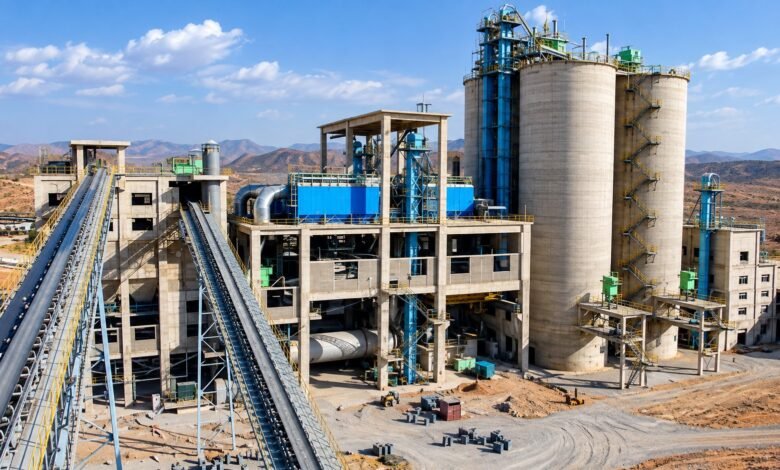
Preheating and precalcining recover heat that a bare kiln would waste and move most of the limestone decomposition out of the rotary kiln. Raw meal falls through a tower of cyclones while hot kiln gas rises through it, and a second burner in the precalciner completes the reaction. This arrangement explains why almost every new line in the cement manufacturing process uses the dry route.
A modern tower holds four to six cyclone stages. In each stage, fast-moving gas suspends the meal powder, and the large surface area of the fine particles lets them reach almost the gas temperature within moments. A simple preheater decarbonises 30% to 40% of the meal before it enters the kiln, while a precalciner, which adds a burner in the tower, lifts that share to between 85% and 95%, so the meal reaches the kiln at approximately 900°C instead of ambient temperature.
Because the rotary kiln no longer decomposes the limestone, it can be shorter and narrower for the same output, which cuts capital cost. Thermal efficiency improves as well: the best precalciner kilns reach around 3,300 MJ per tonne of clinker under optimised conditions, and the best available technique range for new lines sits at 2,900 to 3,300 MJ.
Fuel choice at the precalciner is where plant economics meet strategy. The precalciner burns a large share of the kiln system’s fuel, so engineers treat it as the natural entry point for replacing coal or petcoke with alternative fuels. Captive power, alternative fuels, and in-house clinker capacity now sit among the cement manufacturing strategies across Africa that separate resilient producers from exposed ones.
5. Clinker Production in the Kiln
The rotary kiln is where the clinker production process happens, and it is the hottest point in the cement manufacturing process. Meal travels down an inclined, slowly rotating steel cylinder lined with refractory brick, meets a flame at the lower end, and leaves as grey nodules that hold every strength-giving mineral in the finished cement. Two subsections follow: the reaction sequence inside the kiln, and the clinker phases it produces.
From Calcination to Clinkering: The Reaction Sequence
Calcination finishes in the precalciner and the lower kiln, and the released lime then reacts with silica, alumina and iron oxide. Between approximately 1,000°C and 1,200°C, intermediate compounds form. In the burning zone, at 1,400°C to 1,500°C, a partial melt appears: at peak temperature, approximately a quarter of the material is liquid, and that liquid acts as a flux that lets lime and belite combine into alite.
Clinker then drops from the burning zone into the cooler. A grate cooler blows air through the hot bed, sends the recovered heat back to the preheater and precalciner, and brings the clinker down to handling temperature. Faster cooling also improves silicate reactivity, so cooler performance shows up later as cement strength.
Clinker Phases and What They Do
Clinker Phases: Formula, Role, and Measured Range
| Phase | Formula | Role in cement | Share in certified reference clinkers |
| Alite (C₃S) | Ca₃SiO₅ | Drives early strength over the first days | 58–65% |
| Belite (C₂S) | Ca₂SiO₄ | Reacts slowly and adds strength beyond the first week | 17–25% |
| Aluminate (C₃A) | Ca₃Al₂O₆ | Hydrates fastest and releases heat; gypsum must control it | 4–10% |
| Ferrite (C₄AF) | Ca₄Al₂Fe₂O₁₀ | Fluxes the burn and colours the cement; adds little strength | 6–12% |
A plant steers these proportions through the raw mix. Raising the lime saturation factor increases alite at the expense of belite, and a low-aluminate clinker underpins sulphate-resisting products, one of the common cement types used in construction.
6. Cement Grinding and Additive Blending
Clinker becomes cement in the finish mill. Grinding multiplies its surface area so that it reacts with water at a useful rate, and the mill also blends in the gypsum and mineral additions that set the product’s identity. The clinker-to-cement grinding process, therefore, controls both setting behaviour and the carbon footprint of every tonne shipped, which makes the finish mill the last point in the cement manufacturing process where chemistry can still change. Two subsections cover setting control and clinker substitution.
Gypsum and Setting Control
Ground alone, clinker would set within minutes, because aluminate hydrates almost instantly. Plants therefore add gypsum, a few per cent by mass, to regulate setting. The standard limits what they can add: sulphate content limits for a CEM I 52.5 R reach 4.0% as SO₃, with chloride capped at 0.10%. High-early-strength products also need finer grinding, and one CEM I 52.5 R reports Blaine values of 4,000 to 5,500 cm²/g.
Finish mills range from ball mills to vertical roller mills and roller presses. The roller-based finish grinding systems developed since the 1980s use less electricity per tonne than ball mills, and operators weigh that saving against capital cost and product characteristics.
Clinker Substitution at the Mill
The mill is also where producers lower the clinker factor. EN 197-1 defines 27 common cements that differ in how much clinker they contain and which mineral additions replace it. The European BAT conclusions list reducing clinker content through additions in the grinding step as a direct way to cut primary energy use.
Blending explains much of the difference between OPC and PPC, since pozzolana replaces part of the clinker in the latter and changes early strength, heat of hydration, and price.
The same logic drives the use of slag, fly ash, and pozzolana, which plants add at the mill and concrete producers add at the mixer. Each tonne of clinker replaced avoids the calcination CO₂ that dominates the plant’s carbon footprint.
7. Packaging, Storage and Distribution
The last stage of the cement manufacturing process moves cement from the mill to the customer without damaging the quality that the previous six stages built. Silos hold each cement type and strength class separately, and the plant then loads product in bulk or in bags. Bulk shipment moves cement from terminals onto rail, road and ship, while bagging serves retail and small-project buyers.
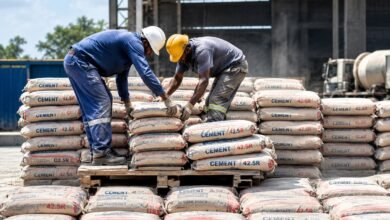
Rotary packers fill 50 kg bags, and automatic palletisers stack them for dispatch. Storage discipline matters at this point: moisture triggers partial hydration and lumps, so bags need dry, raised storage and first-in, first-out rotation. Clinker silos give producers a buffer as well, since a clinker store often holds several weeks of supply and keeps deliveries flowing while the kiln stops for relining.
Laboratories test each silo before release, checking strength, setting time and fineness, and the central control room links plant and laboratory data so that batch records follow product to the customer. Dust extraction at loading points protects both workers and product yield. Contractors compare bulk and bagged formats on handling speed, waste and cost, so the choice belongs to the project, while the plant’s job is to deliver the same tested cement in either form.
Further Reading: Cement Manufacturing in Africa: 8 Powerful Strategies Driving Market Growth
Technical Block: Quality Control and Emissions Engineering in Cement Production
The cement production process explained above leaves four technical topics for engineers who audit or specify a plant. Cement production quality control runs through all seven cement manufacturing stages, and the emissions controls sit on the same equipment: raw mix control, clinker and cement testing, stack emissions, and carbon.
1. Raw Mix Control: Lime Saturation Factor and Kiln Feed Consistency
Quality control starts with three ratios. The lime saturation factor compares lime with the silica, alumina and iron oxide available to combine with it, and modern clinkers run at 0.92 to 0.98. Two further ratios, silica and alumina, fix the balance between silicates and the aluminate and ferrite phases, and the alumina ratio in ordinary Portland clinker usually falls between 1 and 4. A lime saturation factor above 1.0 signals free lime. Online X-ray analysers and a raw mix controller adjust feeder ratios continuously to hold these targets.
2. Clinker and Cement Testing: Free Lime, Phases and Standards
Laboratories test kiln clinker routinely for free lime, and X-ray fluorescence and diffraction give the oxide and phase analyses that the Bogue calculation converts into estimated phase contents. Excess free lime threatens soundness, so cement standards test expansion directly: a CEM I 52.5 R must show expansion of 10 mm or less and an initial setting time of at least 45 minutes. Cement is then classified by minimum 28-day compressive strength in class 32.5, 42.5 or 52.5, and these classes translate into the cement grades that specifiers name in tender documents.
African producers work to the same architecture. The East African standard for common cements draws on EN 197-1 and specifies 27 common cements alongside sulphate-resisting and low early strength blast furnace types, so a cement made in Kenya or Tanzania carries the same class logic as a European one.
3. Stack Emissions: Dust, NOx and SO₂ Limits
Kiln stacks, coolers and mills each need abatement, and regulators define the target as concentration limits at standard reference conditions. The table below sets out the benchmark levels that the European BAT conclusions attach to cement kilns.
Kiln Emission Benchmarks: BAT-Associated Emission Levels for Cement Kilns (10% O₂, Dry Gas)
| Pollutant | BAT-AEL | Averaging basis |
| Dust (kiln flue gas) | <10–20 mg/Nm³ | Daily average |
| NOx, preheater kilns | <200–450 mg/Nm³ | Daily average |
| NOx, Lepol and long rotary kilns | 400–800 mg/Nm³ | Daily average |
| SOx as SO₂ | <50–400 mg/Nm³ | Daily average |
| HCl | <10 mg/Nm³ | Daily or sampling average |
| HF | <1 mg/Nm³ | Daily or sampling average |
| Mercury | <0.05 mg/Nm³ | Sampling average |
| PCDD/F | <0.05–0.1 ng I-TEQ/Nm³ | Sampling average |
Fabric filters, electrostatic precipitators or hybrid filters capture the dust. Staged combustion in the precalciner and selective non-catalytic reduction cut NOx, while absorbent addition or wet scrubbing controls SO₂, and a well-run raw mill also absorbs SO₂ from the kiln gas. The BAT-associated emission levels further require continuous measurement of dust, NOx, SOx and CO at the kiln.
4. Carbon Emissions: Calcination, Substitution and Capture
Carbon is the hardest emission to abate because most of it originates in the chemistry, not the fuel. Calcination releases approximately 0.52 tonnes of CO₂ per tonne of clinker, and the cement sector accounts for about 7% of global CO₂ emissions. Switching fuel cannot remove that share.
Three levers work. Kiln efficiency gains have largely run out, since the dry process with multistage preheating and precalcination already sets the state of the art. Clinker substitution comes next, and calcined clay blends can cut emissions by up to 40% against conventional Portland cement while matching its strength. Capture completes the toolkit: the Brevik plant in Norway, inaugurated in June 2025, captures around 400,000 tonnes of CO₂ per year, approximately half of the plant’s emissions.
Conclusion: Process Discipline Turns Limestone into Reliable Cement
How factories produce cement comes down to one system of seven linked stages. The quarry and pre-blending pile fix the chemistry, the raw mill and silo hold it, the precalciner and kiln decide energy cost and carbon, and the finish mill decides what the product is. Anyone judging a plant should ask three questions: how it controls raw mix variability, how close its kiln runs to the 2,900–3,300 MJ per tonne benchmark, and what share of clinker its mill replaces. Specifiers who turn those answers into product choices can weigh strength, performance and cost through a framework for choosing cement for projects.
For investors and policymakers, the stage-by-stage view shows where capital works hardest: precalciner kilns, alternative fuel handling and blending capacity at the mill. Buyers gain more from asking about kiln stability and testing regimes than from comparing bag prices, and that applies to every supplier, including the leading Kenyan cement producers. A plant that measures, blends and controls at every stage of the cement manufacturing process ships cement that performs the same way in the last bag as in the first.
Take Your Cement Engineering Knowledge Beyond the Kiln
Cement plants reward engineers who study the cement manufacturing process stage by stage, from quarry chemistry to stack limits. Construction Frontier’s Cement & Concrete coverage carries that technical education further, with guidance on raw mix design, kiln performance, cement standards, clinker substitution and low-carbon binders. Engineers, investors, policymakers and project professionals use it to specify, source and evaluate cement with confidence.