Construction Equipment Maintenance: Complete Guide to 8 Proven Strategies for Reliable Uptime
Construction equipment maintenance is the discipline of setting service intervals by machine class, inspecting every machine daily, controlling fluids and filters, and logging every intervention, so that African fleets remain available amid heat, dust, uncertain fuel supply, and remote-site logistics. Engine oil intervals run from 250 hours on a CAT 950GC loader to 500 hours on a CAT D6 XE dozer and a Komatsu PC200-8M0 excavator, and CAT moves oil analysis from optional to strongly recommended once fuel sulphur passes 500 ppm. The undercarriage alone accounts for approximately half of a tracked machine’s owning and operating costs.
Technical Snapshot: Core Maintenance Specifications
| Parameter | Specification |
| Primary Scope | Construction equipment maintenance across maintenance types, service intervals by machine class, daily walk-around inspection, fluids and filters, records and logs, and African operating conditions |
| Engine Oil Interval Range | 250 h (CAT 950GC loader) to 500 h (CAT D6 XE dozer, Komatsu PC200-8M0 excavator); 8,000 km on a HOWO 371 hp tipper after a first service at 2,000 km |
| Hydraulic Oil Interval Range | 2,000 h (CAT D6 XE standard, XCMG XE210C) to 5,000 h (Komatsu PC200-8M0); up to 6,000 h on CAT machines using HYDO Advanced with oil analysis |
| Oil Analysis Trigger | Strongly recommended above 500 ppm fuel sulphur; required above 5,000 ppm (0.5%) |
| Undercarriage Cost Share | Approximately 50% of the tracked machine owning and operating costs |
| Binding Constraint | Parts and technician lead time at remote sites, which turns a late service into a long stoppage |
| Fastest Levers | Daily walk-around, air intake and cooling-core discipline, oil sampling, hammer-duty derating |
| Benchmark Metric | Services completed on or before the due hour or kilometre mark, as a share of services due |
| Budget Planning Range | 2% to 5% of replacement value a year, recalibrated against the fleet’s own cost records |
| Regulatory Anchor | South Africa requires a daily mobile-plant inspection register; Tanzania requires registers kept available for inspection for 30 years or a shorter prescribed period |
| Ownership Shift | From reactive repair budgets to hour-tier planned work with a written record for every machine |
Construction equipment maintenance pays back through availability: a written interval, a daily check and a dated record for every machine turn a manufacturer’s schedule into a site schedule that survives African conditions. The eight strategies below convert unplanned stoppages into planned workshop hours.
Introduction: Construction Equipment Maintenance
Construction equipment maintenance determines whether a fleet earns revenue or sits idle in the yard. One excavator, loader, or tipper that stops on a critical-path activity strands the crews, trucks, and materials that depend on it, and the costs compound well beyond the repair invoice. Contractors who track lifetime ownership costs find that maintenance falls between the purchase and resale decisions, so every service interval either protects residual value or erodes it.
The difficulty is not knowing that machines need servicing. Intervals vary by manufacturer, engine generation, and duty cycle, and published figures assume clean air, specification-grade fuel, and a workshop within reach. African sites rarely offer all three. Heat loads the cooling pack, dust chokes air filters, fuel of uncertain quality contaminates oil, and a remote location turns a missing filter into a week of downtime. Risk concentrates where the manual’s assumptions and the site’s reality diverge.
This guide serves fleet managers, plant engineers, and contractors who handle maintenance of construction machinery across mixed fleets in Africa. It sets out eight strategies, from maintenance types and hour-based intervals to fuel planning and budgeting. Each strategy carries a decision rule backed by manufacturer schedules and statutes. The standard it sets is simple: every machine has a written interval, a daily check, a record and an owner.
How the Eight Strategies Build One Maintenance System
Construction equipment maintenance operates as a single system, with strategies running in sequence. The first three decide what work is done and when: the maintenance type, the interval, and the daily check. Strategies four to six decide how well that work holds up: fluids and filters, records, and climate adjustment. Fuel and logistics planning, followed by budgeting and measurement, protect the system against African constraints and against drift.
Eight Strategies, Control Points, and the Record Each Produces
| Strategy | Control point | Record it produces |
| 1. Match the maintenance type | Which machines run to a plan, to condition or to failure | Maintenance policy per machine class |
| 2. Set service intervals | Hours or kilometres between services | Service schedule per machine |
| 3. Walk around daily | Condition at shift start | Signed daily inspection sheet |
| 4. Control fluids and filters | Oil, coolant and filter condition | Oil analysis reports and change log |
| 5. Keep records and logs | Evidence that work happened | Machine history file |
| 6. Adjust for heat and dust | Cooling and air-intake margins | Cleaning log and temperature notes |
| 7. Plan fuel and remote sites | Contamination risk and parts availability | Fuel checks and critical spares list |
| 8. Budget and measure | Spend and on-time service rate | Monthly maintenance cost report |
Strategy 1: Match the Maintenance Type to the Machine
Scheduled work, condition-based work and run-to-failure coexist in every working fleet, and assigning each machine to the right one sets the cost base for construction equipment maintenance across the programme. The first part places each type; the second decides where predictive tools earn their cost.
Where Each Type Fits
Revenue machines with engines, hydraulic pumps, and drivetrains require scheduled preventive maintenance because their failures can damage neighbouring components and halt the activity they support. Run-to-failure suits only inexpensive, redundant items such as lamps and wiper blades. The full cost comparison between planned and breakdown work covers preventive versus reactive maintenance savings in detail, so this guide keeps the argument brief and devotes its pages to execution.
Maintenance Types by Machine Role
| Type | Trigger | Best suited to | Risk if misapplied |
| Scheduled preventive | Hours, kilometres or calendar limit | Engines, hydraulics and drivetrains on revenue machines | Over-servicing machines with very low utilisation |
| Condition-based | Oil analysis, temperature or hour-meter trend | High-value machines with variable duty | Missed trends when sampling lapses |
| Run-to-failure | Failure itself | Lamps, wiper blades, hand tools | Secondary damage to anything with an engine or hydraulic pump |
Further Reading: Preventive vs Reactive Maintenance in Construction: 5 Proven Savings
Where Predictive Tools Earn Their Cost
Condition-based work replaces a fixed interval with evidence. Oil analysis, coolant sampling and telematics hour counts supply that evidence, and each pays back fastest on the dozers, loaders and tipper trucks that carry the critical path. Smaller machines with low utilisation stay on hour tiers, because sampling would cost more than the interval extension it could justify.
Strategy 2: Set Service Intervals by Machine Class
Interval questions open every construction equipment maintenance audit, and how often to service construction equipment depends on the machine class, the manufacturer and the duty. Hour-based tiers, distance-based tipper schedules and the adjustment that turns a manual interval into a site interval each get their own treatment below.
Hour-Based Tiers on Tracked and Wheeled Machines
Manufacturers publish service tiers at 250, 500, 1,000 and 2,000 hours, but each tier holds different work from one class to the next. On a CAT D6 XE dozer, the 250-hour tier samples fluids and checks levels, the 500-hour tier drains engine and final drive oil, and the 2,000-hour planned maintenance stop drains the powertrain and hydraulic oils and replaces both fuel filters. Any heavy equipment maintenance schedule has to start from the tier contents of the specific model.
Typical Service Intervals by Machine Class (Reference Models)
| Machine class | Reference model | Engine oil | Hydraulic and driveline oil | Air and fuel filters |
| Tracked excavator | Komatsu PC200-8M0 | 500 h | Hydraulic oil 5,000 h; hydraulic filter 1,000 h | Per manual |
| Tracked excavator | XCMG XE210C | Per manual | Hydraulic oil or suction filter 2,000 h | Fuel filter 250 h; outer air element cleaned at 250 h or on the warning lamp |
| Crawler dozer | CAT D6 XE | Drained at the 500 h tier | Hydraulic oil 2,000 h; up to 6,000 h with HYDO Advanced and oil analysis | Fuel filters at the 2,000 h tier |
| Wheel loader | CAT 950GC | Oil and filter at 250 h or 1 month | Axle oil sample 500 h; differential and final drive oil 2,000 h or 1 year | Per manual |
| Tipper truck | HOWO 371 hp | Every 8,000 km after a 2,000 km first service | Transmission and differential oil: 60,000 km or 10 months | Air cleaner cleaned every 4,000 km |
Engine oil intervals, therefore, span 250 to 500 hours across five machines, so no single fleet-wide heavy equipment maintenance schedule fits all of them. Motor graders and compactors follow the same tier logic, and their manuals set the figures. When a dealer contract or an independent workshop performs these tiers, the choice between OEM versus third-party servicing shapes warranty terms, parts sourcing and response time.
Distance-Based Schedules on Tipper Trucks
Tipper trucks run on distance, so the schedule follows kilometres with a calendar backstop. The HOWO service schedule for the 371 hp truck sets a first service at 2,000 km, or two months, then oil and filter changes every 8,000 km, or six months, whichever comes first. It also tells owners to shorten the oil filter interval under severe working conditions, which is appropriate for quarry and haul-road duty.
Turning a Manual Interval into a Site Interval
Treat the manual interval as a ceiling. CAT operation and maintenance manuals carry a separate 250-hour line for machines in severe applications, and dust, hammer work and unverified fuel all qualify. Shorten the interval first, and lengthen it only when oil analysis results support the extension.
Strategy 3: Run a Daily Walk-Around Inspection
Construction equipment maintenance starts each shift: a daily walk-around inspection of heavy equipment catches the failures that scheduled service cannot, because leaks, loose guards and cracked hoses appear between tiers. The inspection by the system comes first, then the ownership that makes it stick.
What the Inspection Covers
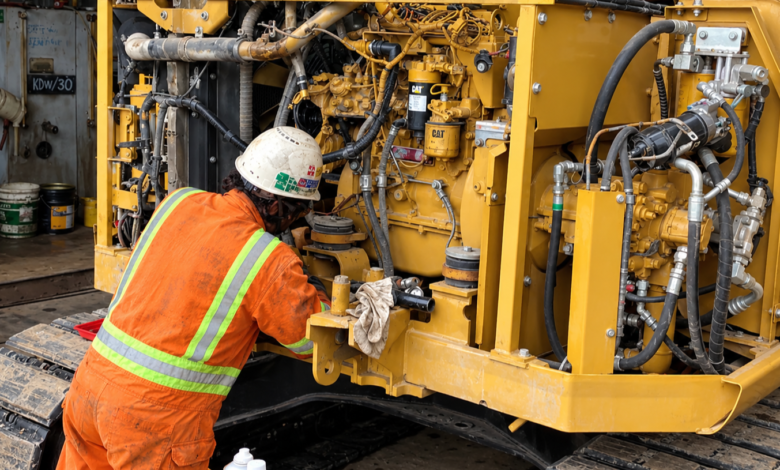
CAT instructs its technicians to walk around the machine before any service and look for leaks, rust and damage. The same habit belongs at the start of every shift, and a written equipment maintenance checklist keeps it consistent across operators and sites.
Daily Walk-Around Checklist by System
| System | Check at shift start | Failure it prevents |
| Engine bay | Oil and coolant level, belt tension, fresh leaks | Engine seizure from low oil or coolant loss |
| Hydraulics | Hose ends, cylinder rods, tank level | Sudden hose burst and pump starvation |
| Undercarriage or tyres | Track tension and rollers; tyre pressure and wheel nuts | Track derailment, tyre blowout |
| Cooling and air intake | Radiator fins, pre-cleaner, restriction indicator | Overheating and dust ingestion |
| Structure and guards | Pins, bucket teeth, ROPS bolts, guards | Attachment loss and structural cracking |
| Safety systems | Lights, horn, reverse alarm, brakes, seat belt | Collisions and brake failure |
Who Owns the Sheet
Ownership matters more than the list. The operator completes and signs the sheet, the supervisor reviews defects before work starts, and the workshop closes each item with a dated entry. Operators who understand why a hydraulic hose weeps or a coolant level drops report faster and more accurately, which is why heavy equipment operator training for safer sites belongs in the same programme as the inspection sheet.
Strategy 4: Control Fluids and Filters
Fluids and filters account for the largest share of routine maintenance for construction machinery and determine how long engines, pumps, and final drives last between overhauls. Oil sampling and the sulphur-linked sampling duty come first, then the filters that guard the air, fuel and hydraulic paths.
Engine and Hydraulic Oil
Take oil samples with the engine running and the compartments at operating temperature. Drain a little fluid before filling the bottle so the sample reflects circulating oil rather than stagnant fluid in the sampling line. CAT allows the hydraulic oil change interval to be extended from 2,000 to 6,000 hours on machines running HYDO Advanced, provided oil analysis is performed at the recommended intervals.
Fuel sulphur sets the sampling duty. The manufacturer’s machine fluid recommendations call for no additional sampling up to 500 ppm, strongly recommend oil analysis between 500 and 5,000 ppm, and require it above 5,000 ppm (0.5%). Regular samples turn a fuel-quality worry into a trend the workshop can act on.
Filters
Air, fuel and hydraulic filters fail in different ways, so each gets its own rule. The XCMG XE210C manual calls for cleaning the outer air element at 250 hours or when the warning lamp lights, and replacing it after six cleanings or one year. HOWO trucks clean the air filter every 4,000 km using compressed air at below 5 bar. Fuel filters need one habit above all: never prefill a new filter with unfiltered diesel, because the contamination goes straight into the injection system. Hydraulic filters on the Komatsu PC200-8M0 change every 1,000 hours.
Strategy 5: Keep Equipment Maintenance Records and Logs
Equipment maintenance records and logs turn a service into evidence. They trigger the next interval, trace premature failures to a supplier and satisfy an inspector. A useful log comes first, then what African regulators expect to see.
vWhat a Useful Log Record
Construction equipment maintenance records can be maintained on paper, in a spreadsheet, or in maintenance software, provided that every service and every equipment maintenance checklist feeds into the same fields. Paper suits small fleets and remote sites; a spreadsheet suits a depot with dozens of machines; and software earns its cost once the fleet outgrows a spreadsheet’s reliability.
Maintenance Log Fields and What Each Delivers
| Field | Entry | What it delivers |
| Machine ID and meter reading | Fleet number, hours or kilometres | Triggers the next service on time |
| Service tier and tasks | For example, 500 h tier, oil and filters | Proof of the work happened |
| Parts and fluids fitted | Part numbers, oil grade, supplier | Traces premature failure to a source |
| Oil analysis result | Wear metals, fuel dilution, viscosity | Supports interval extension or shortening |
| Defects and close-out | Description, photo, closing date | Completes the loop from the daily walk-around |
| Signatures | Technician and supervisor, with date | Audit trail |
Start the history file on the day the machine arrives. For secondhand units, the findings from a pre-purchase tipper inspection serve as the baseline, providing a reference point for later wear.
What African Regulators Expect to See
South Africa’s construction vehicle and mobile plant rules require the authorised operator to inspect the plant daily against a checklist and record the findings in a register kept with the machine. That explicit daily register is the clearest statutory model for the inspection sheet in Strategy 3.
Kenya’s workplace premises registration rules of 2022 list premises where building operations or engineering construction take place, and workplaces that hold lifting equipment and forklifts as among those that cannot claim exemption from registration. A contractor with a plant on site should expect an inspector to ask for the machine’s file.
Tanzania’s occupational health and safety law goes further on lifting plant: authorised inspectors examine cranes at least every 12 months and lifting tackle every six months; owners keep a register of lifting machines, and the registers remain available for inspection for 30 years or a shorter period prescribed by the Chief Inspector. The same Act makes a false register entry an offence. Across these regimes, explicit examination and register duties cover lifting plant, while an explicit daily register for mobile plant appears in South Africa’s rules.
Strategy 6: Adjust for Heat and Dust
Construction equipment maintenance faces its hardest test in African heat and dust because it attacks the two systems a machine cannot run without: cooling and air intake. Heat on the cooling pack comes first, then dust on the air path.
Heat and the Cooling Pack
The HOWO schedule inspects the radiator core for blockage and the coolant level at every service, maintains the coolant concentration between 40% and 60% by volume, and replaces the coolant immediately if it turns brown or cloudy. Hot sites need more than that. Record coolant temperature on the daily sheet, because a rising trend under constant load signals a loaded core before the alarm trips. New trucks need the same discipline from the first kilometre, and the running-in period and early service points appear in the guide to new tipper truck care.
Dust and the Air Path
Dust shortens air filter life, and manuals already reflect that: XCMG cleans on the restriction lamp rather than the hour mark, HOWO cleans every 4,000 km, and CAT lists severe-application lines at 250 hours. Clean the fill points before opening them, because dust entering through a filler cap bypasses the air filter entirely.
Hot and Dusty Site Adjustments
| Item | Manual baseline | Site adjustment |
| Outer air filter element | Clean at 250 h or on the warning lamp (XCMG XE210C) | Inspect daily; clean at the lamp, not the hour mark |
| Tipper air cleaner | Clean every 4,000 km (HOWO 371 hp) | Clean at every service on dusty haul roads |
| Engine oil and filter | Standard tier | Move to the severe-duty line where the manual lists one |
| Coolant and radiator core | Inspect at each service | Log temperature daily; clean the core at every service |
Strategy 7: Plan for Fuel Quality and Remote Sites
Fuel quality and distance are the two African constraints that manufacturers never factor into pricing for construction equipment maintenance. What reaches the engine comes first, then how to keep parts and consumables within reach of a remote site.
Fuel Quality and What Reaches the Engine
Legal fuel ceilings move with supply conditions. Kenya’s authorities introduced relaxed fuel quality rules for six months from 30 April 2026, lifting the permitted sulphur ceiling to 50 mg/kg from stricter prior standards because compliant cargoes proved hard to source. The review falls due at the end of October 2026. A ceiling of 50 mg/kg equals one-tenth of the 500 ppm line where CAT’s sampling advice begins, so specification-grade fuel is not the sulphur risk. Off-specification cargoes, poorly kept bulk tanks and drum fuel are.
A handful of habits limit the exposure: keep delivery certificates, buy from fewer suppliers, drain water separators at every walk-around, sample bulk tanks, and fit a second filter stage where site fuel varies. Any batch that fouls filters early deserves a sample before the next delivery.
Remote Sites and Parts Lead Times
On a remote site, construction equipment maintenance fails first at the parts counter, because a missing filter becomes a stoppage measured in days. Kit every service tier in advance, so filters, seals and oil for the next two tiers travel with the machine, and stock a short critical list: belts, hoses, wheel nuts and the wear items that stop work. Supplier routes, genuine versus aftermarket grades, and stocking logic are covered in the guide to smarter spare parts-sourcing.
Hour counts need a plan when connectivity fails. A photo of the hour meter at shift end, logged each day centrally, keeps the service clock accurate without telematics.
Further Reading: Heavy Equipment Spare Parts in Africa: 7 Proven Ways to Source Smarter
Strategy 8: Budget, Measure and Close the Loop
A construction equipment maintenance programme survives only if the budget funds it and the metrics expose drift. The cost benchmark and its African drivers come first, then the measures that close the loop.
Budget Benchmarks and Construction Equipment Maintenance Cost in Africa
A common planning range puts annual maintenance spend at 2% to 5% of replacement value, which each fleet should recalibrate against its own records. Construction equipment maintenance costs in Africa are higher because imported parts, clearing time, and scarce technicians lengthen every repair. Undercarriage deserves its own line: CAT puts it at about half of a tracked machine’s owning and operating cost, so undercarriage management belongs in every tracked-machine budget.
Maintenance Cost Drivers in African Fleets
| Driver | Mechanism | Control |
| Imported parts and clearing | Lead time turns a short repair into a long stoppage | Kit by tier; stock critical spares |
| Technician availability | Machines wait for a visiting fitter | Train site fitters on daily and 250-hour tasks |
| Fuel and lubricant quality | Oil degradation and filter blockage | Oil sampling; filter discipline |
| Undercarriage wear | About half of the tracked machine owning and operating costs | Track tension, clean packing, wear measurement |
| Hammer and abrasive duty | Shorter filter and oil intervals | Derate intervals by hammer share |
Measures That Close the Loop
Four numbers tell a fleet manager whether construction equipment maintenance works: the on-time service rate, the ratio of planned to unplanned work orders, the mean time between failures, and the cost per operating hour. Each stoppage also carries a revenue cost, and the economics of protecting profit from downtime show why the planned-to-unplanned ratio deserves a permanent place on the monthly report.
Technical Block: Interval Arithmetic, Oil Analysis Triggers and Duty-Cycle Derating
Three calculations turn construction equipment maintenance strategy into workshop numbers: the service load a fleet carries, the oil analysis duty that fuel quality demands, and the filter derating that hammer work forces. Each uses figures from the manufacturer’s schedules cited earlier.
1. Service Load Across a Mixed Fleet
Take a machine working 2,000 hours a year, which is 8 hours a day over 250 days. A 500-hour engine oil interval produces four oil services a year, and a 250-hour severe-duty interval produces eight. Across ten such machines, the workshop moves from 40 to 80 oil services a year before it touches a filter or a grease point. Hydraulic oil at 2,000 hours falls due once a year, while the 6,000-hour extension with HYDO Advanced and oil analysis stretches that to one change every three years.
Tipper trucks follow distance. At 2,000 km a month, an 8,000 km interval arrives every four months, ahead of the six-month calendar limit. Slower trucks flip the order: at 1,000 km a month, the calendar limit arrives first, at six months.
2. Oil Analysis Decision Rule by Fuel Sulphur Band
Sulphur in ppm converts to percentage by weight by dividing by 10,000, so 500 ppm equals 0.05% and 5,000 ppm equals 0.5%. Perkins sets a minimum new-oil TBN of 10 times the fuel sulphur percentage for direct-injection engines, with an absolute floor of 5 and shorter intervals for fuels above 0.5% sulphur.
Oil Analysis Duty by Fuel Sulphur Band
| Fuel sulphur | Percentage by weight | CAT sampling guidance | Perkins’ new oil TBN rule |
| Up to 500 ppm | Up to 0.05% | No additional sampling | Floor of 5 governs |
| 500 to 5,000 ppm | 0.05% to 0.5% | Oil analysis is strongly recommended | Floor of 5 governs |
| Above 5,000 ppm | Above 0.5% | Oil analysis required | At least 10 times the sulphur percentage; 1.0% needs TBN 10 |
3. Hammer Duty Derating on Filter Intervals
A compact excavator, Kubota KX057-4 workshop manual, reduces the return-filter interval from 1,000 hours to 800 hours once hammer use exceeds 20% of working time, then to 400, 300, and 200 hours at 40%, 60%, and 80%, respectively. On a machine working 2,000 hours a year, filter changes rise from two a year at baseline to ten a year at 80% hammer use, a five-fold increase.
Conclusion: Maintenance Discipline Decides Fleet Availability
Three variables decide how a heavy equipment maintenance schedule performs: the interval, the duty, and the fuel. The manual sets the interval ceiling; the duty cycle shortens it; and fuel quality determines whether oil analysis remains optional or becomes compulsory. Reading only the manual misses two of the three. Fleets that add a daily walk-around, a signed log, and an honest view of site conditions close the gap between the published schedule and the machine in the yard.
The answer to how often to service construction equipment fits on one page. Service at the manual’s hour or kilometre mark or its calendar limit, whichever arrives first. Halve engine oil intervals where the manual lists a severe-duty line, which moves from 500 hours to 250 hours. Sample oil at every tier; once fuel sulphur exceeds 500 ppm, make sampling compulsory above 5,000 ppm. Derate hydraulic filters by hammer share, and budget 2% to 5% of replacement value a year as a starting point.
Construction equipment maintenance rewards the fleet that runs it as a production system with owners, numbers and records. Fleets that hold that standard move work from the breakdown bay to the planned workshop, and their machines reach the next overhaul on the manufacturer’s clock, not the failure’s.
Keep Your Fleet Available Across African Sites
Construction Frontier: Equipment Ownership & Maintenance follows the practices that keep African fleets earning: service intervals, inspection routines, fuel and parts strategy, operator capability and lifecycle cost. Follow the vertical for engineering-led analysis aimed at fleet managers, plant engineers, contractors and investors.