Europe’s Mega Tunnels: 8 Remarkable Next-Generation Projects Redefining Cross-Border Infrastructure
Europe’s mega tunnels are reshaping how the continent moves freight, commuters, and political ambition across mountains, seabeds, and national borders. From the 57.5-kilometre Lyon-Turin Base Tunnel to the proposed rail crossing beneath the Strait of Gibraltar, eight next-generation projects are rewriting the rules for Europe’s cross-border tunnels, shaping trade and mobility. Combined investment across these schemes already exceeds €70 billion.
Technical Snapshot: Core Project Specifications
| Project | Countries | Length | Status (2026) | Target Completion |
| Lyon-Turin Base Tunnel | France, Italy | 57.5 km | Under construction, ~29% excavated | 2032–2033 |
| Semmering Base Tunnel | Austria | 27.3 km | Excavation complete, fit-out underway | End of 2029 |
| Koralm Tunnel | Austria | 32.9 km | Operational | Opened December 2025 |
| Helsinki–Tallinn Tunnel | Finland, Estonia | ~92–100 km (proposed) | Advanced planning and funding stage | Undetermined |
| Stad Ship Tunnel | Norway | 1.7 km | Funding restored, contract pending | Construction from 2027 |
| Grand Paris Express | France | 200 km network | Under construction, phased openings | 2026 into the 2030s |
| Suðuroy Tunnel | Faroe Islands (Denmark) | 24.3 km | Route and tender agreed | Construction spans 8 years |
| Strait of Gibraltar Tunnel | Spain, Morocco | ~65 km (~40 km under Spain) | Feasibility and preliminary design | 2035–2040 realistic window |
These eight schemes confirm that Europe’s mega tunnels no longer cluster around single flagship crossings. They now form an interconnected programme of underground infrastructure in Europe that will define freight corridors, commuting patterns, and continental politics for the next two decades.
Introduction: Europe Mega Tunnels
Europe’s mega tunnels have shifted from engineering curiosities to continental necessities. The European Union’s TEN-T transport network, national rail modernisation programmes, and a wave of subsea engineering ambition have pushed cross-border tunnel projects in Europe well past the symbolic precedents set by the Channel Tunnel and the Gotthard Base Tunnel. Eight projects now under construction, recently completed, or in feasibility illustrate how underground infrastructure in Europe has become the default answer for crossing Alpine ranges, fjords, straits, and national borders alike.
This piece sits within Construction Frontier’s wider coverage of bridge and tunnel megaprojects, and it follows directly from our examination of the construction methods that make undersea tunnelling possible in the first place. Each scheme below has its own geology, financing structure, and political backstory, but together they reveal a continent betting heavily on tunnels rather than bridges or ferries to solve its hardest connectivity problems.
Why Europe Is Building Underground at This Scale
Three forces are driving the current wave of next-generation tunnel construction across the continent: European Union corridor funding, the economics of shifting freight from road to rail, and a political appetite for permanent fixed links over ferries.
TEN-T Corridor Funding and Continental Politics
The EU’s Trans-European Transport Network earmarks billions of euros for nine core corridors, several of which run through the tunnels covered in this article. The Mediterranean Corridor funds the Lyon-Turin Base Tunnel; the Baltic-Adriatic Corridor funds the Semmering and Koralm tunnels in Austria. Co-financing of this kind turns national infrastructure decisions into continental ones. Firms such as VINCI and Webuild, profiled among Europe’s largest construction companies, now treat these corridors as a multi-decade pipeline.
Decarbonising Freight: The Economics Behind the Boom
Shifting freight from lorries to rail is the single biggest argument behind almost every project in this list. The Lyon-Turin Base Tunnel alone is projected to remove roughly one million truck journeys a year from Alpine roads. Ferry-replacement tunnels, such as Stad and the Faroese subsea network, deliver a similar logic at a smaller scale: fewer crossings exposed to the weather and lower emissions per tonne moved. This same economic case underpins Italy’s preference for some crossings to be solved with bridges rather than tunnels, as seen in the Strait of Messina Bridge project now advancing in parallel.
Alpine Rail Tunnels Closing Europe’s Last Gaps
The Alps remain Europe’s most stubborn geographic barrier, and three projects are closing the gaps left even after the completion of the Brenner Base Tunnel and the Gotthard Base Tunnel. Lyon-Turin, Semmering, and Koralm together form a near-continuous high-speed and freight spine running from France through Austria and onwards to the Adriatic.
Lyon-Turin Base Tunnel: Europe’s Longest Rail Tunnel Takes Shape
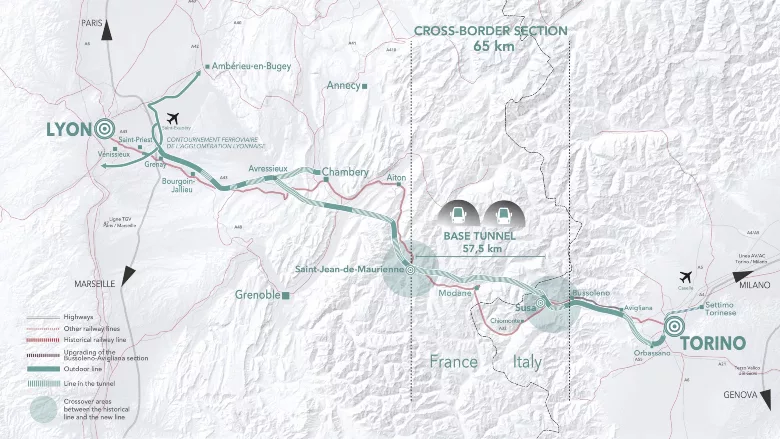
The Lyon-Turin Base Tunnel, officially the Mont d’Ambin Base Tunnel, will stretch 57.5 kilometres between Saint-Jean-de-Maurienne in France and Susa in Italy, marginally longer than the Gotthard Base Tunnel. As of February 2026, engineers had excavated more than 47 kilometres of the 164 kilometres of tunnels required for the full cross-border section. Seven TBMs are deployed across the route, with the first of two giant machines for the Italian side delivered from Germany in March 2026. TELT expects civil works to conclude around 2032, cutting Turin-Lyon journey times from three hours and 47 minutes to under two hours. The total cost sits near €9 billion, with over half funded through EU co-financing.
Semmering Base Tunnel: Austria’s Final Alpine Bottleneck
South of Vienna, the historic Semmeringbahn, a UNESCO World Heritage line opened in 1854, is finally being bypassed. The 27.3-kilometre Semmering Base Tunnel completed full excavation in November 2024, and in May 2026, officials made the first complete transit of the twin-bore structure between Gloggnitz and Mürzzuschlag. The tunnel has now entered its technical fit-out phase, with slab track and electromechanical systems due to be installed ahead of commercial operation at the end of 2029. Cost has risen from an original €3.1 billion to roughly €4.2 billion. Once open, it will cut Vienna-Graz journey times by 46 minutes and let freight trains cross the Alps using a single locomotive instead of two.
Further Reading: Brenner Base Tunnel: 9 Extraordinary Engineering Achievements Powering Europe’s Deepest Alpine Crossing
Koralm Tunnel: The Corridor’s Already-Open Backbone
While Semmering finishes its fit-out, its sister project has already opened. The 32.9-kilometre Koralm Tunnel, Austria’s longest, entered service in December 2025 as the centrepiece of the new Koralm Railway between Graz and Klagenfurt. Combined with Semmering once it opens, the two tunnels will let trains run from Vienna to Klagenfurt in two hours and 40 minutes and from Graz to Klagenfurt in just 45 minutes. Both form the backbone of the Baltic-Adriatic Corridor, one of the TEN-T network’s nine priority axes linking the Baltic states through Austria to Italy.
Undersea and Coastal Engineering Pushing Past Precedent
While Alpine engineers tunnel through rock, a separate group of projects is testing how far tunnelling technology can go beneath open water and how creatively it can be applied. These three schemes show the longest tunnels under construction in Europe in 2025 and 2026, climbing fast, alongside one project that has nothing to do with trains or cars at all.
Helsinki–Tallinn Tunnel: Europe’s Most Ambitious Undersea Concept
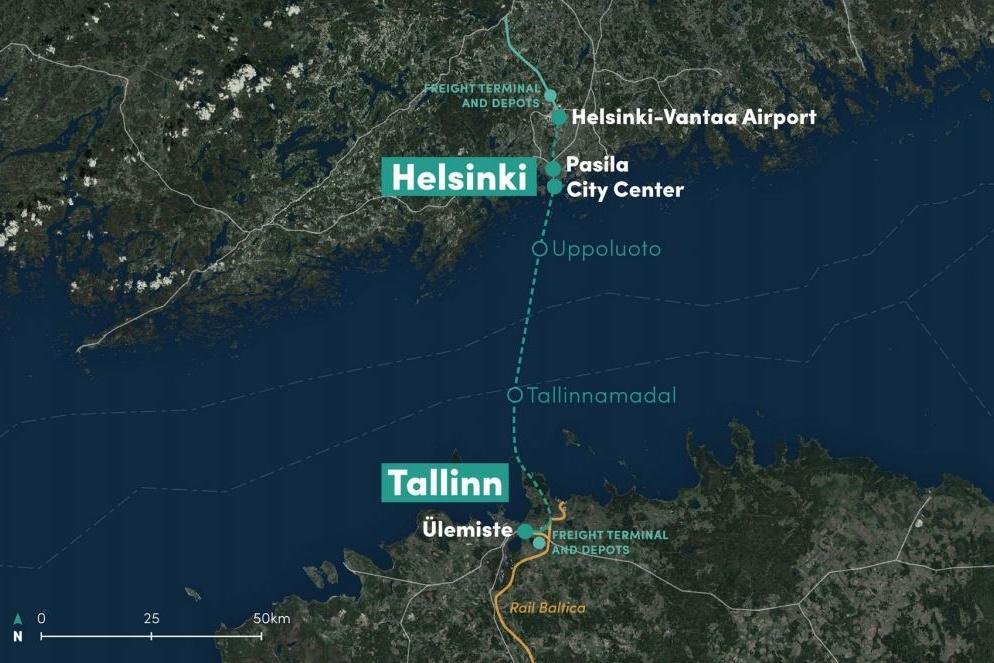
No project on this list carries more ambition or more uncertainty than the proposed rail tunnel connecting Helsinki and Tallinn beneath the Gulf of Finland. At roughly 92 to 100 kilometres, it would dwarf the Channel Tunnel and become the longest undersea tunnel ever attempted, linking two capital cities that already function as a twin-city economic region.
Cost estimates range from €13 billion to €20 billion, and as of mid-2026, the project remains in advanced planning and funding negotiations led by FinEst Bay Area Development, with no confirmed construction start. The economic case, a thirty-minute crossing replacing a two-and-a-half-hour ferry route carrying 3.8 million tonnes of freight annually, keeps the proposal alive even as financing questions persist.
Stad Ship Tunnel: The World’s First Tunnel Built for Ships
Norway’s Stad Ship Tunnel is not a transport tunnel in the conventional sense: it is built for vessels rather than vehicles. Cutting 1.7 kilometres through the Stad Peninsula, the structure will stand 49 metres high and 36 metres wide, large enough for coastal liners such as Hurtigruten to bypass one of Norway’s most dangerous stretches of open water. The project’s path to construction has been turbulent: the government suspended funding in October 2025 over rising costs, only for the revised 2026 budget to restore approximately NOK 150 million in start-up funding that June.
The Norwegian Coastal Administration now expects to award the construction contract ahead of a 2027 start, several years later than first planned. Designed by Snøhetta, the rock-hewn portals are intended to double as a tourist attraction, much as the engineering covered in our analysis on the Rogfast Tunnel has become a subject of public fascination in its own right.
Suðuroy Tunnel: The Faroe Islands’ Next Subsea Leap
Having already connected most of its main islands through subsea tunnels, the Faroe Islands has approved its most ambitious crossing yet. The Suðuroy Tunnel will run approximately 24.3 kilometres from Sandoy to Suðuroy, finally linking every major Faroese island by road for the first time in the nation’s history. All parties in the Faroese parliament agreed on the route and tendering process in late 2025, with an estimated cost of €625 million and construction expected to span roughly eight years.
Underground Megaprojects Beyond the Alps and Fjords
Two final projects expand the definition of European tunnel engineering beyond rail crossings into urban transit and intercontinental ambitions. Both illustrate how subsurface transport infrastructure in Europe now serves purposes well beyond connecting one country to another.
Grand Paris Express: Europe’s Largest Underground Construction Site
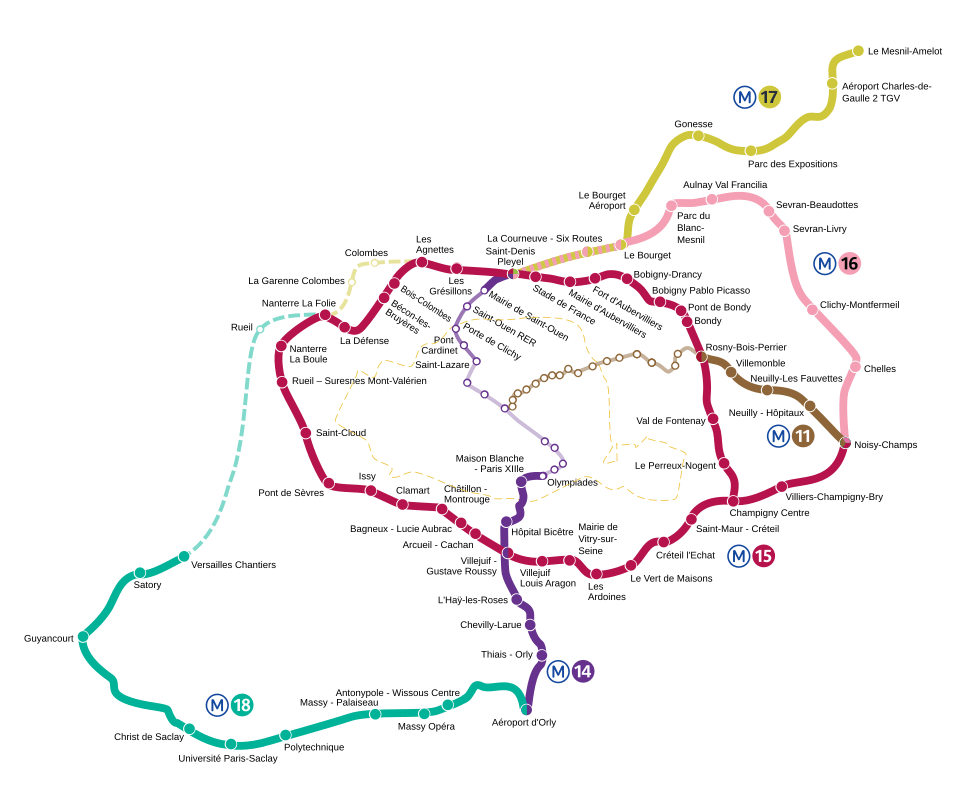
The Grand Paris Express is, by most measures, the largest infrastructure project under construction anywhere in Europe. The €36.1 billion programme will add 200 kilometres of new automated metro line around Paris, roughly 90 per cent of it underground, served by 68 new stations and excavated using 27 tunnel boring machines supplied by Herrenknecht. Line 14’s extension opened in June 2024, and Line 18’s central section is scheduled to enter service by late 2026, connecting Orly Airport with the Paris-Saclay research cluster.
The remaining lines will open in phases through the early 2030s. The scale of simultaneous urban tunnelling bears comparison with the TBM deployment seen on Saudi Arabia’s Riyadh Metro, though Paris’s century-old subsurface of utilities, catacombs, and quarries makes the geotechnical challenge considerably more complex.
Strait of Gibraltar Tunnel: The Most Ambitious Cross-Border Concept on the Table
No project on this list carries higher stakes than the proposed rail tunnel beneath the Strait of Gibraltar, linking Spain’s high-speed network to Morocco’s Al Boraq line and, by extension, Europe to Africa. German tunnel boring specialist Herrenknecht confirmed the project’s technical feasibility in 2025, estimating total costs near €8.5 billion for a roughly 65-kilometre twin-bore rail tunnel modelled on the three-bore configuration pioneered by the Channel Tunnel.
Spain’s Ineco was commissioned in November 2025 to deliver a full preliminary design by August 2026, while a geological survey of the treacherous Camarinal Sill runs through the first half of the year. Realistic timelines point to preliminary works from 2030 and main construction in the 2035–2040 window, a horizon that mirrors the patience already shown on Italy’s Strait of Messina Bridge and China’s Huajiang Grand Canyon Bridge, proving that ambitious cross-border links eventually move from study to steel.
Further Reading: Strait of Messina Bridge: 7 Remarkable Engineering Challenges Behind Italy’s Most Ambitious Megaproject
Technical Block: Engineering and Investment Data Across the Eight Projects
Read together, the eight projects above show that major tunnelling projects in Europe now weigh cost and timeline on a continental rather than national scale. EU corridor funding ties Lyon-Turin to Semmering and Koralm, and Nordic ferry economics tie Stad to the Faroese tunnels. The two tables below set out the boring methods and funding structures behind each project, followed by a final judgement on what they mean for the continent.
1. Tunnelling Methods and Equipment
| Project | Primary Method | Boring Equipment | Bore Configuration |
| Lyon-Turin Base Tunnel | TBM with drill and blast sections | 7 TBMs deployed across the route | Twin single-track tubes |
| Semmering Base Tunnel | Drill and blast, roadheaders | Conventional excavation rigs | Twin-bore, fit-out underway |
| Koralm Tunnel | TBM and drill and blast | Multiple TBMs (now demobilised) | Twin-bore, operational |
| Helsinki–Tallinn Tunnel | TBM (proposed) | 17-metre diameter TBMs (proposed) | Twin tubes plus service tunnel (proposed) |
| Stad Ship Tunnel | Drill and blast | Conventional rigs, no TBM | Single large-bore ship channel |
| Grand Paris Express | TBM (EPB shields and multi-mode) | 27 Herrenknecht TBMs, 7.7–9.8 m diameter | Twin-bore per line |
| Suðuroy Tunnel | Drill and blast | Conventional Faroese tunnelling method | Single-bore, two-lane |
| Strait of Gibraltar Tunnel | TBM (proposed) | Herrenknecht-confirmed feasibility, ~7 m diameter | Twin-rail tubes plus service gallery (proposed) |
2. Investment and Funding Structure
| Project | Total Investment | Primary Funding Source | TEN-T or Corridor Link |
| Lyon-Turin Base Tunnel | ~€9 billion | EU co-financing, France, Italy | Mediterranean Corridor |
| Semmering Base Tunnel | ~€4.2 billion | ÖBB (Austrian state), EU | Baltic-Adriatic Corridor |
| Koralm Tunnel | Up to ~€15 billion (full railway) | ÖBB (Austrian state), EU | Baltic-Adriatic Corridor |
| Helsinki–Tallinn Tunnel | €13–€20 billion (estimated) | FinEst Bay Area Development, private capital | Proposed Scandinavian-Mediterranean Corridor link |
| Stad Ship Tunnel | Under revision after 2025 suspension | Norwegian state budget (Kystverket) | Not TEN-T, but the national E39/coastal route programme |
| Grand Paris Express | €36.1 billion | Société du Grand Paris, French state and local taxes | Not TEN-T; national urban transit priority |
| Suðuroy Tunnel | ~€625 million | Faroese government budget | Not TEN-T; national programme |
| Strait of Gibraltar Tunnel | ~€8.5 billion (tunnel), up to ~€15 billion (total) | SECEGSA (Spain), Morocco, EU Recovery Plan funds | Proposed Euro-Mediterranean transport network link |
Conclusion: Europe’s Tunnels Are Now a Single Engineering Programme
No single government or contractor controls the trajectory of Europe’s mega tunnels, yet the financing and engineering data above show a continent moving in the same direction. EU corridor money, national decarbonisation targets, and the economics of replacing ferries are pulling Alpine rail projects, Nordic subsea schemes, and the Gibraltar concept into a shared investment logic, even where no formal coordination exists between them.
The projects furthest along, Koralm, Semmering, and Lyon-Turin, prove the model works when EU funding and political will align. The projects still in planning, Helsinki-Tallinn and Gibraltar, show what happens when ambition outpaces financing. Either way, the direction is set: cross-border tunnel infrastructure in Europe will keep expanding, and the eight schemes profiled here are the clearest current evidence of where that expansion is heading next.
Explore Europe’s Next-Generation Tunnel Megaprojects
From deep Alpine crossings to ambitious subsea links, discover the engineering analysis, construction strategies, and technical innovations shaping the future of underground infrastructure. Continue exploring in-depth megaproject reviews and global engineering insights with Construction Frontier: Global Mega Projects.