Harbin Opera House: Stunning Organic Architecture Built for China’s Extreme Climate
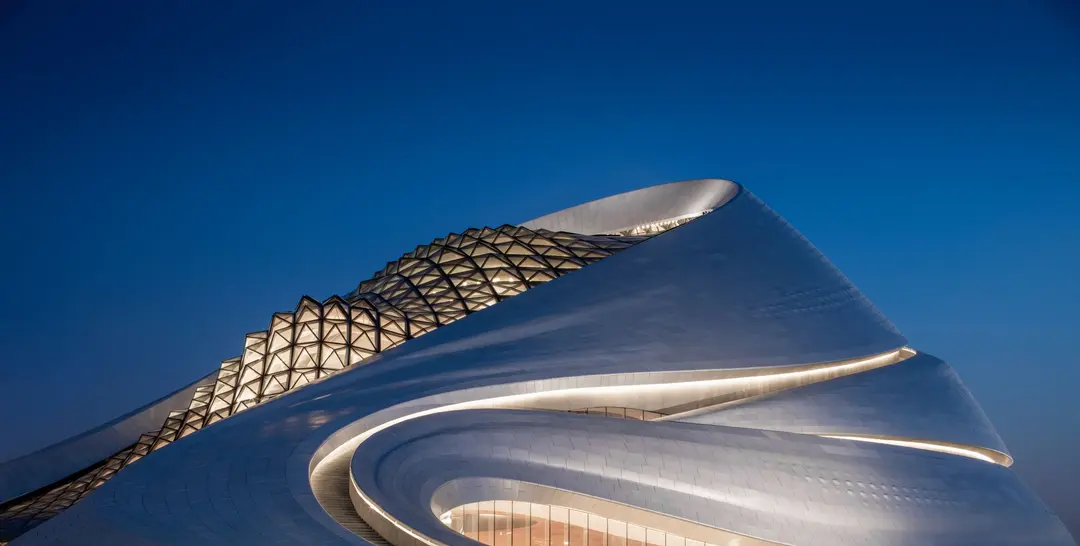
The Harbin Opera House stands as one of the most technically demanding examples of organic architecture China has produced. Completed in 2015 by MAD Architects on a 444-acre wetland island along the Songhua River, this 78,967 m² complex confronts winter temperatures down to -38°C through an engineering system built into every layer of its fluid form. It is not merely a concert hall: it is a building that fights the climate every day it stands.
Technical Snapshot: Core Project Specifications
| Specification | Detail |
| Project Name | Harbin Opera House (Harbin Grand Theatre) |
| Location | Harbin Cultural Island, Songhua River, Harbin, China |
| Architect | MAD Architects (Ma Yansong, Dang Qun, Yosuke Hayano) |
| Structural Engineers | Beijing Institute of Architectural Design |
| Gross Floor Area | 78,967 m² (850,000 sq ft) |
| Site Area | 444 acres (Harbin Cultural Island) |
| Grand Theatre Capacity | 1,538 seats |
| Small Theatre Capacity | 414 seats |
| Peak Height | 56 m (183 ft) |
| Primary Cladding | Smooth white aluminium panels |
| Temperature Range | -38°C (winter) to +40°C (summer) |
| Construction Period | 2011–2015 |
| Client | Harbin Songbei Investment and Development Group |
| Awards | ArchDaily Building of the Year 2016, WAN Performing Spaces Award 2016, IALD Award 2017 |
The Harbin Opera House redefined contemporary opera house design in China’s extreme climate, proving that organic architecture can address environmental hostility without sacrificing structural ambition or cultural identity.
Introduction: Where Organic Architecture Meets Extreme Climate
Harbin is not a forgiving building site. The capital of Heilongjiang Province sits in China’s northeast, where Siberian air masses drive temperatures below -30°C for weeks and annual snowfall buries conventional infrastructure. Buildings in this region tend toward the defensive: thick, insulated, structurally conservative. MAD Architects chose the opposite approach.
The Harbin Opera House is situated on an artificial island in the Songhua River wetlands, a site with no natural shelter and full exposure to northerly winds. Rather than resist the landscape, MAD Architects’ design submits to it formally while fighting it technically. The building’s undulating aluminium skin mimics the wind-sculpted snowfields of the surrounding terrain. Beneath that skin, an intricate combination of prefabricated steel, engineered sealants, radiant heating, and climate-responsive glazing keeps 79,000 m² of cultural space functional in conditions that would disable most buildings.
Understanding the engineering behind the Harbin Opera House design requires accepting that its curves are not decorative choices applied after structural decisions: the form and the engineering are one and the same. While the global conversation around architectural ambition tends to focus on the world’s most iconic structures redefining engineering limits through sheer scale or height, the Harbin Opera House makes an equally significant case through horizontal spread and climate intelligence rather than vertical dominance.
This article examines how the design of Harbin Opera House in extreme weather conditions produced a building whose approach to organic architecture China had not previously attempted at this scale or in this climate, and what that achievement means for sustainable architectural design in subarctic environments.
The Harbin Opera House Site Strategy and Climate Context
The Harbin Opera House’s location on an alluvial wetland island in subarctic northeastern China imposed structural, climatic, and cultural constraints that shaped every design decision before any formal choice was made. Those constraints explain why the building looks the way it does and why its engineering is as specific as it is.
A UNESCO City of Music in Subarctic Conditions
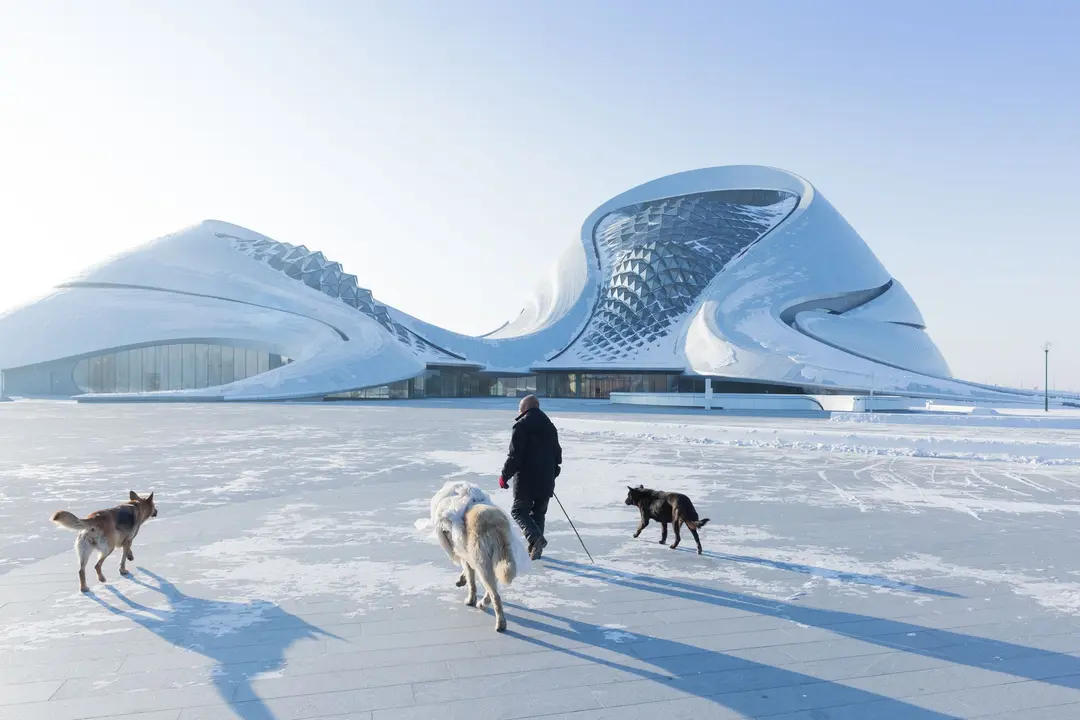
Harbin, the capital of Heilongjiang, China, holds the distinction of being one of the coldest major cities on earth. Winter temperatures average -18°C in January, with recorded lows near -38°C. Ground frost penetrates several metres below the surface, and seasonal flooding of the Songhua River affects bearing capacity and settlement behaviour across the wetland site. In the engineering behind the Harbin Opera House design, foundation piling had to account for differential settlement due to non-uniform mass distribution across an organic, asymmetric footprint. No standard cold-climate architecture specification covers a building profile this complex on an alluvial site this unstable.
Environmental Parameters and Structural Design Criteria for the Harbin Opera House
| Climate Parameter | Value | Engineering Implication |
| Mean January temperature | -18°C | Sustained sub-zero structural loading; frost-line foundation design |
| Recorded minimum | -38°C | Sealant and glazing specification lower bound |
| Mean July temperature | +23°C (peak +40°C) | 80°C annual envelope thermal swing |
| Annual snowfall | ~100–140 cm | Asymmetric roof snow load; heated drainage required |
| Ground frost depth | ~1.5–2.0 m | Pile founding depth below the active freeze-thaw zone |
| Prevailing wind | North/northwest (Siberian) | Full site exposure; curved form reduces peak wind pressure |
| Songhua River flood season | June–September | Alluvial bearing capacity variation; long-term settlement monitoring |
Harbin is also a UNESCO-designated City of Music, home to China’s oldest orchestra, the Harbin Symphony Orchestra, founded by Russian émigrés in the early twentieth century. The cultural expectation placed on this project was precise: as a contemporary opera house design, the Harbin Opera House needed acoustic credentials that could stand alongside its visual ambition, making acoustic engineering a first-order design constraint rather than a finishing specification. The design of the Harbin Opera House to withstand extreme weather conditions could not be achieved solely through climate engineering.
MAD Architects won the international competition for Harbin Cultural Island in 2010. The 444-acre master plan covered the opera house, a cultural centre, and the surrounding wetland edge. Construction ran from 2011 to 2015. The building’s twin volumes sit at the convergence of a formal civic plaza and a natural river edge, functioning as topography as much as architecture.
Engineering the Envelope: Surviving an 80°C Annual Swing
Three interconnected systems carry the building’s climate performance: the primary steel structure, the aluminium cladding assembly, and the glass skylight and curtain wall. Each carries specific performance specifications driven by Harbin’s temperature extremes, and each is discussed below.
Steel Structure and Prefabrication
MAD worked with the Beijing Institute of Architectural Design to develop the steel space frame supporting the building’s mountainous double-hump profile. Steel was selected for its resilience to the thermal cycling Harbin experiences year-round, and the frames were coated with zinc silicate to resist corrosion from condensation, freeze-thaw cycles, and road salt. Construction relied heavily on prefabrication: assembling components off-site reduced worker exposure to extreme cold climates and maintained quality control over complex curved geometries that would have been unachievable in sub-zero on-site conditions.
| Structural Parameter | Specification |
| Primary frame type | Steel space frame (custom nodes, non-repeating geometry) |
| Steel corrosion protection | Zinc silicate coating |
| Foundation system | Deep piles, founded below 1.5–2.0 m frost penetration depth |
| Soil condition | Alluvial wetland; variable bearing capacity, seasonal saturation |
| Snow load design | Asymmetric loading across curved roof profile; heated drainage at all downpipe entries |
| Fabrication strategy | Prefabrication off-site; cold-weather curing and fit-up tolerances specified |
| Interior walls | Precast concrete (Beijing Leinuo); curved form carries structural and spatial loads |
The roof structure accounts for asymmetric snow loading across the curved profile and carries electrically heated drainage systems at every downpipe entry to prevent freeze blockages that could unpredictably increase structural loads.
Aluminium Cladding and Sealant Engineering
The smooth white aluminium panel cladding is the design element most closely associated with the Harbin Opera House and the most technically demanding. The design of Harbin Opera House in extreme weather conditions posed a thermal challenge for the cladding that no off-the-shelf aluminium system could meet: panels must accommodate up to 10mm of linear thermal expansion across the 80°C annual temperature range without buckling or joint failure.
This level of sustainable architectural design specificity, where every material is performance-specified against a climate envelope rather than selected from a catalogue, defines the engineering approach throughout the building. Sika supplied high-performance silicone sealants bonding both the aluminium skin and the crystalline glass curtain wall, qualified to maintain watertightness performance across surface temperatures from -40°C to +50°C, the extreme temperature the facade reaches when its embedded snow-melting system activates.
A snow-melting system at the base of the aluminium cladding rapidly raises the facade temperature in winter, preventing snow accumulation and ice dam formation at critical junctions. The facade’s glass curtain wall, composed of faceted transparent pyramids, required an additional sealant specification: the bonding system had to accommodate stress and deformation while preventing condensation formation within the insulating glass units under sustained sub-zero temperatures.
| Envelope Component | Specification | Performance Requirement |
| Aluminium panel cladding | Custom curved panels, smooth white finish | Up to 10mm linear expansion per panel across an 80°C swing |
| Primary sealant | Sikasil® high-performance silicone (Sika AG) | Watertight from -40°C to +50°C surface temperature |
| Glass curtain wall | Faceted transparent pyramid units | Condensation prevention in IGU under sustained sub-zero |
| Facade snow-melt system | Embedded heating at the cladding base | Prevents ice dam formation; activates facade thermal excursion |
| Skylight drainage | Custom snow-melt circuits to concealed channels | Clears snow load; maintains glazing clarity in short winter days |
| Downpipe heating | Electrically heated elements at all entries | Prevents freeze blockage under asymmetric snow accumulation |
Skylights and Lobby Engineering
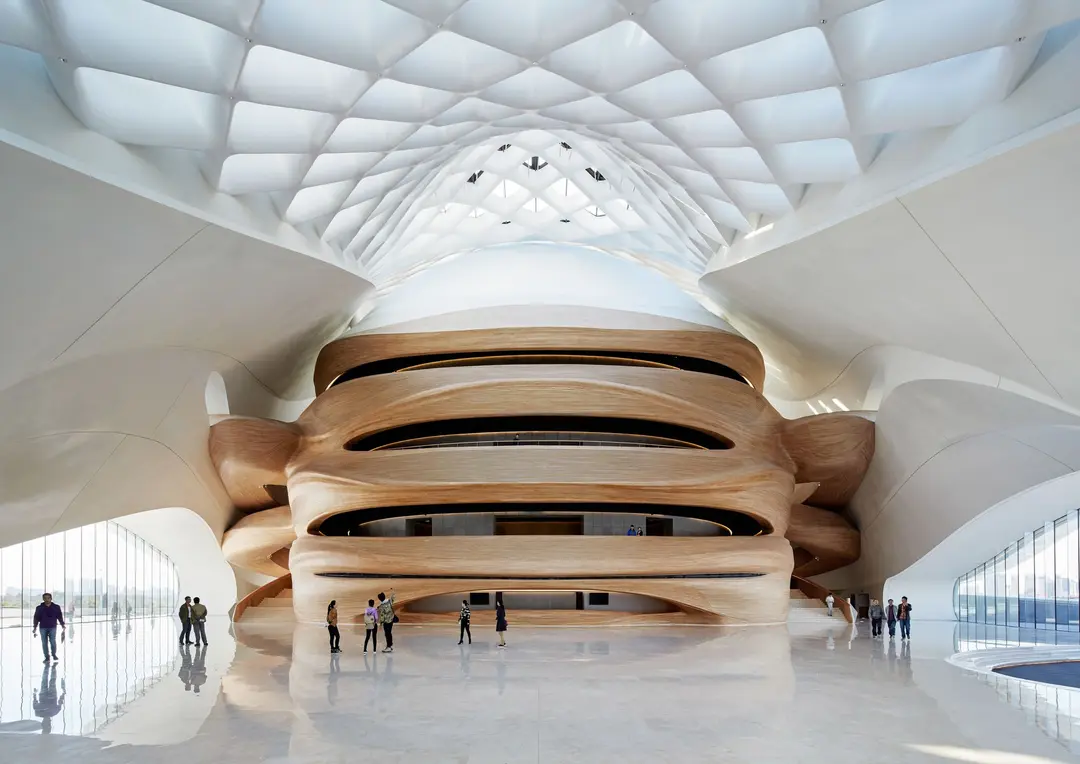
Faceted glass skylights spanning the grand lobby incorporate a custom snow-melting and drainage system directing meltwater into concealed channels. In Harbin’s short winter days, these skylights are the primary natural light source for the lobby, and their thermal management system keeps the glazing clear under sustained snow loading. The precast concrete lobby walls, formed by Beijing Leinuo, create the spatial and thermal transition between exterior conditions and conditioned performance spaces, their curved geometry compressing and releasing visitors as they approach the theatre volumes.
Harbin Opera House Acoustic Design: Engineering the Interior
Climate engineering does not stop at the facade. Inside the Harbin Opera House, two performance venues with fundamentally different acoustic requirements occupy a single building, each resolved through material selection, geometry, and thermal specification.
Grand Theatre
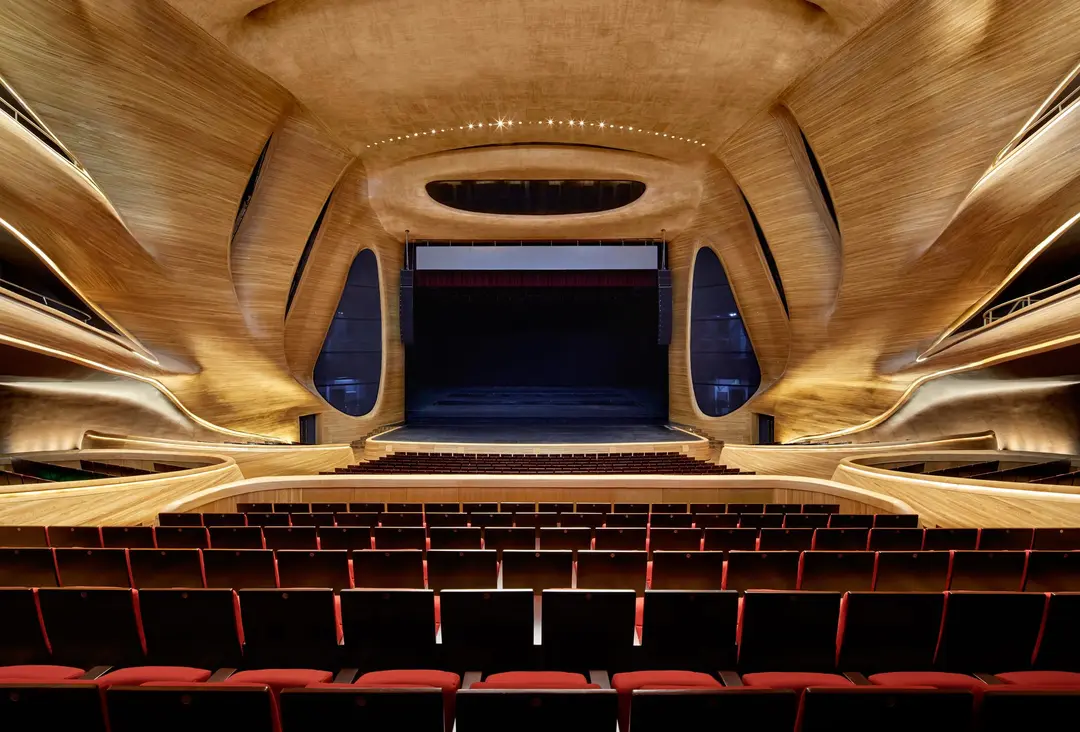
The 1,538-seat grand theatre operates across two acoustic modes: unamplified for Western classical repertoire and amplified for Chinese opera. As a piece of contemporary opera house design, delivering concert-hall standard acoustics and microphone-amplified Chinese opera in a single room at this scale is technically demanding. The entire interior surface, from the proscenium to the mezzanine, is clad in Manchurian ash, a local hardwood MAD selected for its acoustic absorption profile and its reference to the region’s material culture. The Harbin Symphony Orchestra performed shortly after opening and confirmed the acoustic performance as exceptional.
Polished marble floors throughout the lobby and public areas, supplied by FuJian Huahui, incorporate radiant heating circuits embedded in the screed. Radiant floor delivery is more energy-efficient than forced-air systems in high-volume spaces and eliminates the acoustic contamination that fan-driven HVAC introduces into a performance environment.
Small Theatre
The 414-seat small theatre uses alternating perforated and solid grey wood panels for variable acoustic absorption, tuned for intimate performance. The back wall of the stage is a full-height panel of soundproof glass that opens to reveal the wetland exterior as a live visual backdrop or closes for complete acoustic isolation. This glass back wall is thermally specified to maintain surface temperatures above the condensation point under stage lighting in winter, preventing moisture ingress into the stage environment during the coldest months.
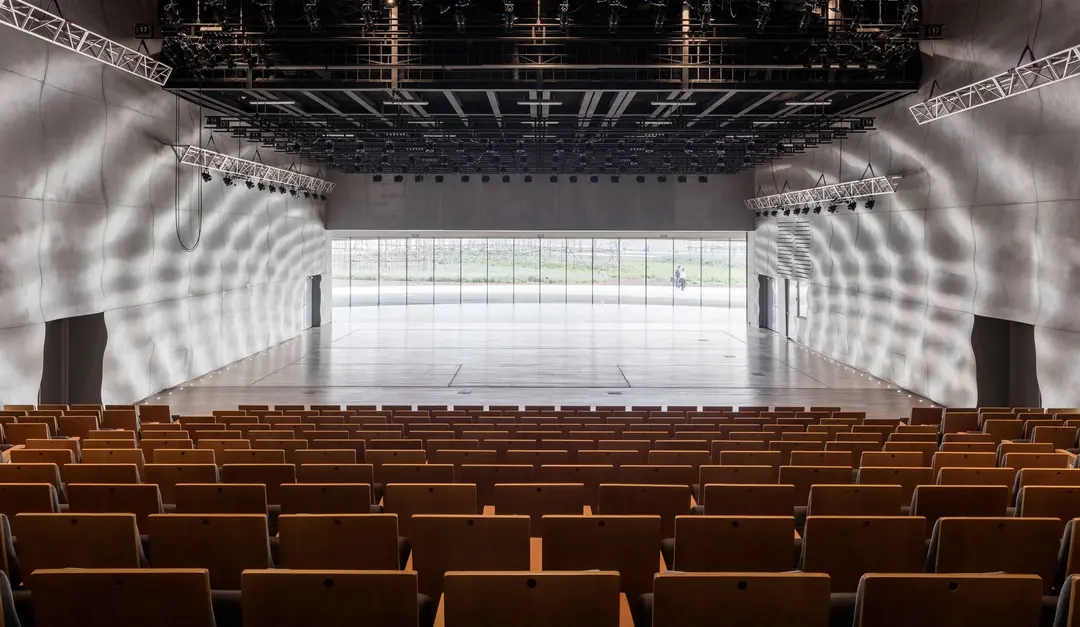
| Parameter | Grand Theatre | Small Theatre |
| Seating capacity | 1,538 | 414 |
| Acoustic mode | Dual: unamplified classical; amplified Chinese opera | Intimate amplified and acoustic performance |
| Wall and ceiling material | Manchurian ash (full interior surface) | Alternating perforated and solid grey wood panels |
| Floor finish | Polished marble with embedded radiant heating | Timber performance floor |
| Heating system | Radiant floor (no forced-air; acoustic isolation maintained) | Radiant floor |
| Special feature | Dual-mode proscenium geometry; variable reverberation profile | Full-height soundproof glass back wall; opens to wetland exterior |
| Winter thermal spec | Radiant floor prevents HVAC acoustic contamination | Glass back wall maintained above the condensation point under stage lighting |
Organic Form as Climate Strategy
The curvilinear geometry of the Harbin Opera House is not arbitrary. Structures without corners or flat horizontal parapets shed snow more efficiently than rectilinear buildings, and wind loads distribute more evenly across curved surfaces, reducing peak pressures that determine structural sizing. The smooth aluminium skin offers fewer ice-nucleation sites than articulated or textured cladding. This convergence between aesthetic intent and climate performance positions the Harbin Opera House among the most rigorous examples of organic architecture in China.
Among organic architecture examples in China built since 2010, few have gone as far in resolving formal decisions with climate engineering simultaneously. Organic architecture examples in China that attempt to address extreme weather conditions at the scale of the Harbin Opera House typically either compromise the formal ambition for structural conservatism or compromise the structural performance for visual effect. How the Harbin Opera House adapts to cold-climate architectural conditions is the clearest demonstration of what organic architecture achieves when climate is a design generator rather than a constraint: every curve carries structural and environmental logic that holds up under engineering scrutiny.
The Harbin Opera House stands among the landmark buildings in China that justify their formal ambition entirely through engineering: buildings of comparable civic presence rarely resolve their climate exposure with the same depth. Sustainable architectural design in this register demands that resolution, and the Harbin Opera House delivers it at every scale from the building profile to the sealant joint.
Cultural Authority and Awards
MAD Architects founder Ma Yansong describes his “Shanshui City” concept as proposing that buildings create emotional relationships with nature rather than dominating it. The Harbin Opera House is the most complete expression of that position. Its double-hump silhouette reads from the approach bridge as snow-capped terrain emerging from the wetland, a formal outcome that is simultaneously the product of climate engineering and cultural intent.
For a contrasting expression of Chinese architectural authority through vertical ambition, China’s supertall tower pipeline demonstrates how the country pursues global recognition through height. The Harbin Opera House achieves comparable authority through integration rather than scale.
The ArchDaily Building of the Year Award in 2016, the WAN Performing Spaces Award in 2016, and the IALD Award in 2017 confirmed its standing across architectural, typological, and lighting disciplines. Among the landmark buildings in China built during this period, the Harbin Opera House received major recognition across multiple technical categories. It anchors the global conversation about what contemporary opera house design delivers in extreme climate architecture and does so as one of the most technically specific examples of sustainable architectural design China has produced.
Landmark buildings in China that succeed across both extreme-climate architecture and contemporary opera-house design criteria are rarer than the volume of construction activity suggests; the sustainable architectural design logic of the Harbin Opera House holds precisely because it refused to compromise either priority. As China expands cultural infrastructure into northern provincial cities, cold climate architecture informed by the Harbin Opera House’s engineering logic will define the next generation of landmark buildings in China’s subarctic regions.
The engineering behind the Harbin Opera House’s design has been cited in cold-climate architecture specifications across northern China and Central Asia since the building opened. Organic architecture examples in China that followed have adopted elements of its envelope and acoustic approach; organic architecture examples in China that preceded it offer no equivalent precedent at this scale or in this climate range. For readers interested in how extreme site conditions drive architectural ingenuity underground rather than above it, our coverage of the InterContinental Shanghai Wonderland examines another Chinese project that treated an impossible site as a design brief.
Further Reading: InterContinental Shanghai Wonderland: Astonishing Hotel Engineering Inside a Cliff Face
Technical Block: Harbin Opera House Engineering Systems
The subsections below summarise the four primary engineering systems that allow the Harbin Opera House to function as a world-class performance venue in one of China’s most hostile climates, each addressing a specific failure mode introduced by the site’s thermal, structural, or acoustic conditions.
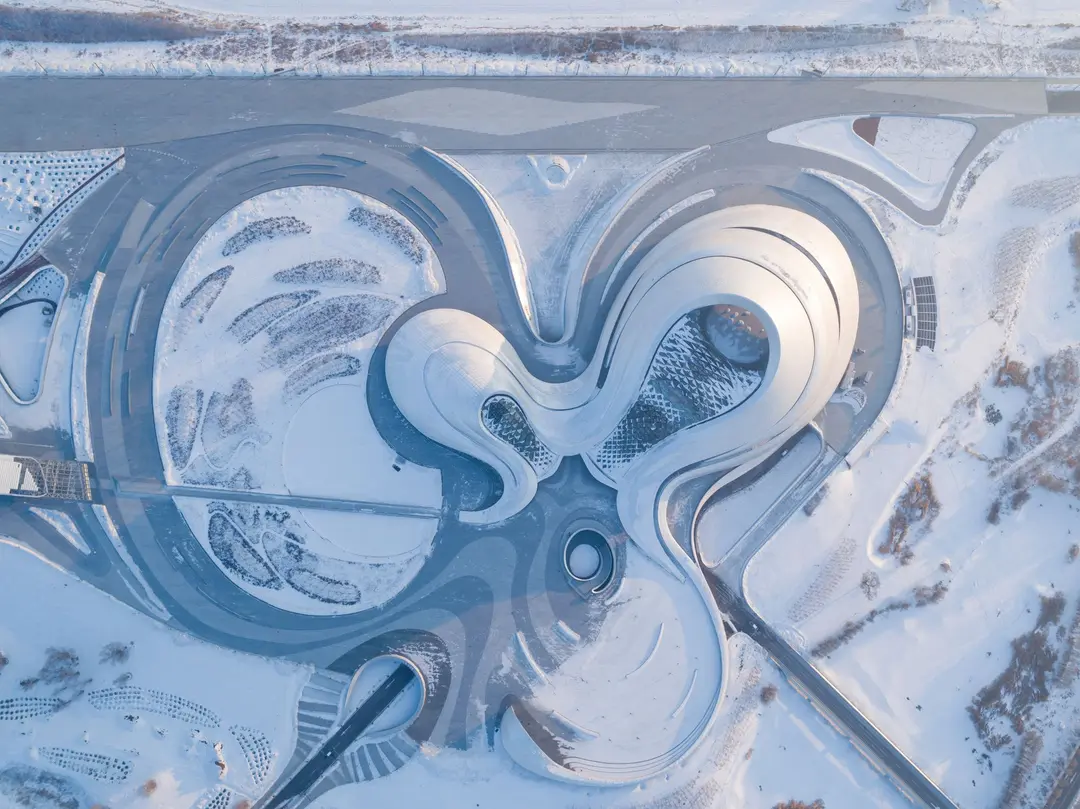
1. Primary Structure
Steel space frame designed with the Beijing Institute of Architectural Design, carrying the double-hump profile across deep piles founded below frost penetration depth. Frames coated with zinc silicate. Precast concrete walls by Beijing Leinuo carry structural and spatial loads in the lobby and public circulation.
2. Thermal Envelope
Smooth white aluminium panels sealed with Sikasil® silicone sealants, specified for up to 10 mm linear expansion tolerance across a -40°C to +50°C surface temperature range. A faceted glass curtain wall uses the same sealant platform, with additional specifications to prevent condensation. Electrically heated drainage systems at all downpipe entries. Embedded snow-melting circuits at the facade base and skylight drainage channels.
3. Acoustic Treatment
Grand theatre fully clad in Manchurian ash for dual-mode acoustic performance. The small theatre uses perforated and solid grey wood panelling with a soundproof glass back wall. Radiant floor heating throughout the lobby and public spaces, embedded in marble screed, eliminates forced-air acoustic contamination in performance environments.
4. Public Access Roof
Granite steps set into the metal roof cladding provide a publicly accessible circuit from the base to a 56-metre apex observation platform, serving civic access and enabling maintenance inspection of drainage and heating systems without mechanical access equipment.
Conclusion: Form, Climate, and Engineering as One Decision
The Harbin Opera House sits on unstable alluvial soil conditions, in one of China’s most hostile climates, wrapped in a material system that must survive an 80°C annual temperature swing without failure. It does this while housing acoustically world-class performance spaces and functioning as a public landscape. The engineering behind the Harbin Opera House design makes that combination possible, and the fact that every formal decision carries a rationale for cold-climate architecture makes it a genuine contribution to extreme climate architecture rather than a sculptural spectacle.
Among examples of organic architecture in China, it remains the most rigorous case study of what happens when form and environmental engineering are the same problem rather than competing priorities. As a model of sustainable architectural design and contemporary opera house design resolved simultaneously, the engineering behind Harbin Opera House’s approach sets a standard that subsequent landmark buildings in China’s northern regions have yet to surpass.
Explore Landmark Architecture and Extreme Climate Engineering
Explore Construction Frontier: Global Mega Projects for in-depth analysis of organic architecture, climate-responsive design, and groundbreaking engineering projects transforming modern construction across Africa and emerging global markets.