Dubai Opera House: Spectacular Structural and Acoustic Engineering in a Desert Megacity
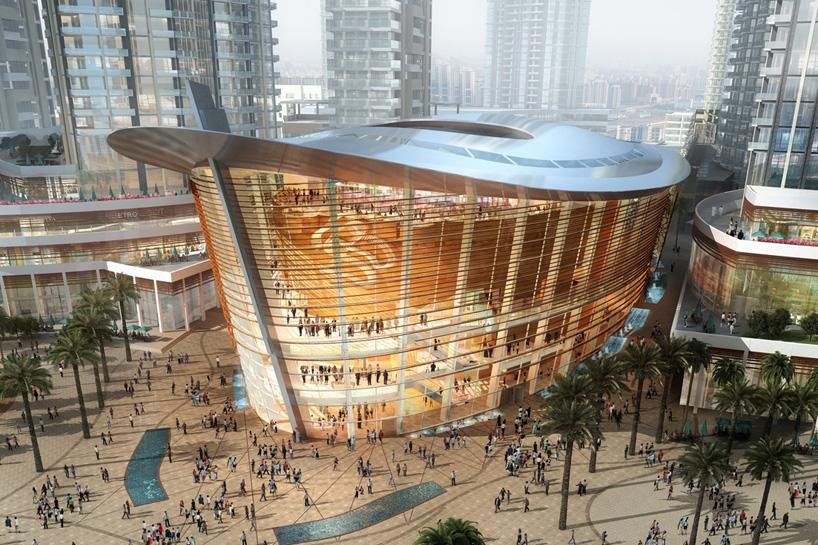
The Dubai Opera House is a 2,000-seat multi-format performing arts centre in Downtown Dubai, opened in August 2016 and designed by Atkins’ principal architect Janus Rostock. Conceived in the form of a traditional Arabian dhow, the 60,000 m² structure combines long-span steel engineering, a transformable auditorium, and variable acoustic systems to function as a world-class venue in one of the world’s most demanding desert climates. It stands as the centrepiece of the Dubai Opera District, adjacent to the Burj Khalifa, and represents the most technically ambitious performing arts centre engineering project ever undertaken in the Middle East.
Technical Snapshot: The Dubai Opera House Core Project Specifications
| Specification | Detail |
| Location | Sheikh Mohammed bin Rashid Boulevard, Downtown Dubai |
| Developer | Emaar Properties |
| Architect | Janus Rostock, Atkins |
| Structural Engineer | Atkins / OPS Structural Engineering (Simon Ho, lead) |
| Facade Engineer | Werner Sobek AG |
| Acoustic Consultant | Sandy Brown Associates |
| Stage Engineering | ThyssenKrupp |
| Main Contractor | Consolidated Contractors Company (CCC) |
| Construction Period | April 2013 – August 2016 |
| Total Area | 60,000 m² |
| Seating Capacity | 2,000 (theatre/concert); 1,800 m² flat floor mode |
| Roof Steel | 3,600 tonnes |
| Building Height | 44 metres |
| Construction Costs | $191 million (AED 700 million) |
The Dubai Opera House delivers something rare: a performing arts centre engineered to world-class acoustic and structural standards inside a desert megacity that routinely exceeds 45°C. Its dhow-inspired form, transformable auditorium, and inner-box acoustic construction make it one of the most technically sophisticated iconic buildings in Dubai.
Introduction: Performing Arts Centre Engineering in a Desert Megacity
The Dubai Opera House stands out as a category of its own among performing arts venues worldwide. Most major concert halls benefit from temperate climates, established construction supply chains, and decades of institutional acoustics knowledge accumulated nearby. The Dubai Opera House had none of those advantages when construction began in April 2013. Structural engineering in Dubai requires every external system to survive sustained heat above 45°C, high ambient humidity from the Gulf coast, sand infiltration, and thermal expansion cycles that would stress conventional facade and roofing assemblies to failure.
Simultaneously, the acoustic engineering in opera houses demands near-total isolation from external noise and vibration, precise internal reverberation control, and mechanical systems so quiet they are inaudible from any seat. The project team, led by AtkinsRealis, with Sandy Brown Associates for acoustics and Werner Sobek AG for facade engineering, resolved both sets of requirements within a single building envelope shaped to evoke Dubai’s maritime history. The sections below cover the structural geometry and its engineering consequences, the thermal and climate engineering strategy, the acoustic design in detail, and the technical specifications that define the building’s performance across all three operational modes, hence making it among the world’s most iconic buildings.
The Dhow Form: Structural Geometry and Its Engineering Consequences
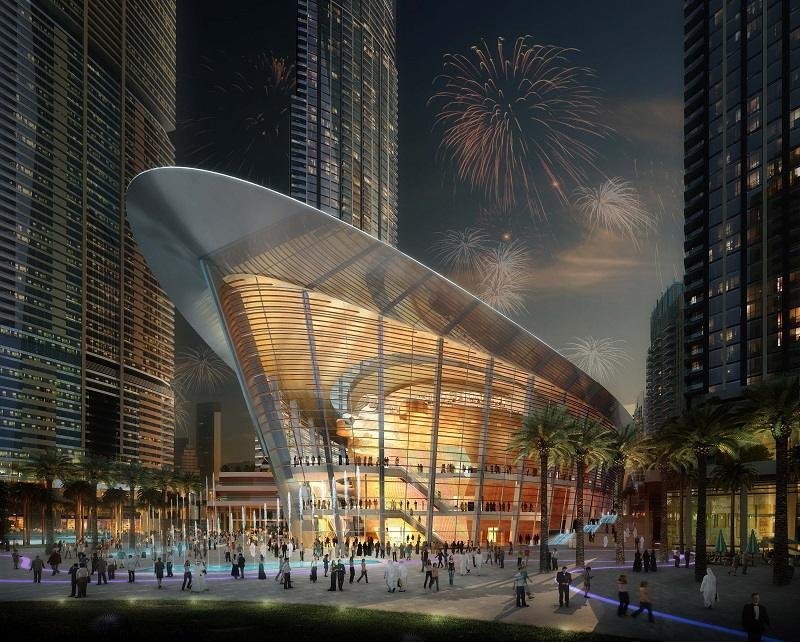
Every engineering decision in the Dubai Opera House flows from the architectural brief: replicate the hull profile of a traditional Arabian dhow at civic scale. Janus Rostock’s concept ties the building directly to Dubai’s history as a trading and pearling port, with the hull representing the main stage area and the bow and stern extensions housing the restaurant and public viewing decks. The form is achieved through a series of multi-curvature surfaces, and the structural team at Atkins and OPS Structural Engineering had to resolve fabrication, assembly, and thermal performance against that geometry without compromise. This section covers the roof structure, the concrete subframe, and the excavation strategy that together underpin the building.
Long-Span Steel Roof
OPS Structural Engineering, led by Simon Ho, carried out the structural design of the long-span steel roof and perimeter support structures. The steelwork trusses forming the roof had to sit within curved surfaces defined simultaneously by the architect and Werner Sobek’s facade engineering team, which meant standard orthogonal fabrication tolerances were insufficient from the outset. Every truss connection was unique in geometry, and the entire assembly had to accommodate thermal movement across a 60°C differential between winter nights and peak summer afternoons in the UAE.
Eversendai Engineering LLC, the steel fabricator, built a detailed 3D parametric model of the 3,600-tonne roof structure to understand its three-dimensional form and complex node connections before fabrication began. That model was then federated with the reinforced concrete frame, the facade cladding system, and the theatre staging packages to identify clashes and eliminate rework on site. Given the compressed construction timeline of just over three years for a 60,000 m² building, pre-construction clash resolution was not optional.
Reinforced Concrete Subframe
The Dubai Opera House’s main floor slabs, shear walls providing lateral stability, and the raking external columns up to the upper balcony level are cast in reinforced concrete. The concrete frame provides the lower structure with the mass it needs to absorb low-frequency sound, which is critical to the acoustic strategy described below. The steel roof sits atop this concrete base, spanning the full auditorium volume without intermediate columns, enabling the transformable interior configuration that defines the venue’s commercial model. The combination of a heavy concrete base and a lightweight, curved steel roof is not common in performing arts centre engineering; at this building, it was the only structural logic that satisfied both the acoustic brief and the architectural form.
Excavation and Ground Engineering
The Opera District plot sits adjacent to existing residential towers and an underground car park, requiring stringent monitoring of adjacent foundations throughout the dig. Secant pile walls were installed at the boundary closest to the boulevard car park; diaphragm walls with two levels of ground anchors controlled lateral soil movement at the edge facing the Standpoint residential towers. Open excavation was only feasible at boundaries clear of existing structures. Despite challenging ground conditions and proximity constraints, Atkins completed the substructure without affecting the adjacent buildings’ foundations.
Desert Climate Engineering: Facade, Thermal Control, and HVAC
No element of the structural and acoustic engineering of the Dubai Opera House can be fully understood without reference to the operating environment. Downtown Dubai registers summer temperatures above 45°C, coastal relative humidity frequently exceeding 80 per cent, and annual solar radiation loads that disqualify most conventional glazing specifications used in European performing arts design. These are not marginal conditions; they define every system boundary in the building from foundation to roof. This section covers facade engineering, the energy modelling strategy, and the HVAC approach, which together manage those conditions without compromising acoustic performance.
Facade Engineering and Geometry Optimisation
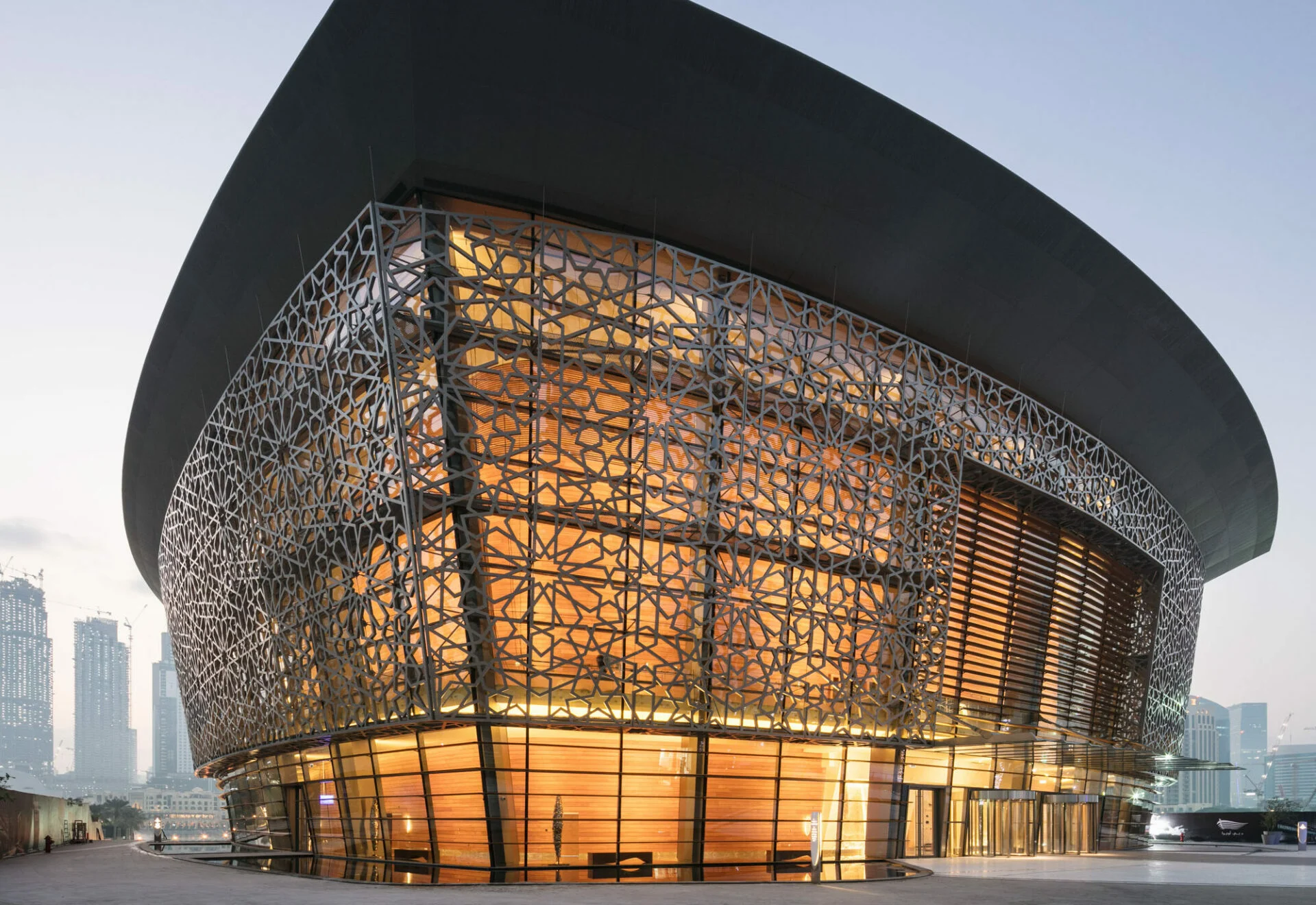
Werner Sobek AG undertook the full facade engineering scope: exterior facade geometry optimisation in Rhino, roof cladding design, sun shading development, and specification of all sliding glass door systems and interior wood panelling. The total building height reaches 44 metres, and the curved enclosure presented fabrication and thermal expansion challenges that a rectilinear building avoids entirely. Werner Sobek’s work translated the architect’s free-form dhow profile into a buildable, thermally performant envelope that remains the building’s most visible engineering achievement from the street.
Energy Modelling and Glass Specification
The Dubai Opera House glass specification for the foyer enclosure, which wraps the front and sides of the building and forms the public’s first visual impression of the structure, was derived from collaborative energy modelling. Analysts simulated solar gains hour by hour across the curved facade form because different orientations experience peak solar loads at different times of day. The modelling identified the optimum glass performance and shading geometry to limit foyer cooling loads and informed the client with numerical clarity. The proposed HVAC setup is connected to Downtown Dubai’s Tabreed district cooling infrastructure via an energy transfer station, thereby avoiding the noise, spatial footprint, and maintenance burden of a building-level chiller plant.
HVAC, Noise Control, and the Acoustic Boundary
Delivering chilled air silently is a distinct engineering problem from delivering it efficiently. Any fan, pump, or airflow-induced sound that penetrates the auditorium envelope destroys the acoustic environment that Sandy Brown Associates spent years engineering. Theatre equipment noise control and building services noise and vibration isolation were explicit components of Sandy Brown’s scope, covering every mechanical plant room, duct penetration, and pipe connection in the building.
Atkins technical director Richard Smith confirmed that the stringent theatrical design requirements of the Dubai Opera House demanded four types of advanced virtual modelling to predict building services performance before construction began. The engineering challenges of building in Dubai’s desert climate are, at their core, the same as keeping a precision acoustic instrument operational inside a furnace.
Janus Rostock’s approach to the rooftop courtyard addresses this tension directly: cold air is pumped to the outdoor rooftop space so visitors can experience the building’s exterior even during summer, without the impracticality of cooling open air at full ambient conditions. This is Dubai cultural architecture at its most pragmatic: the solution acknowledges the climate rather than pretending it away.
Acoustic Engineering: The Inner Box, Variable Configuration, and Electronic Systems
Acoustic engineering in opera houses reaches its greatest complexity when a single auditorium must serve opera, orchestral concerts, ballet, amplified pop performances, corporate conferences, and banquet events, each requiring a different acoustic character. The Dubai Opera House was purpose-built to cover that entire range. Sandy Brown Associates, the acoustic consultant of record, developed a strategy built on three interdependent layers: the physical construction of the auditorium shell, a mechanical variable-geometry system, and an integrated electronic audio system. Each layer is described below.
The Inner-Box Auditorium Construction
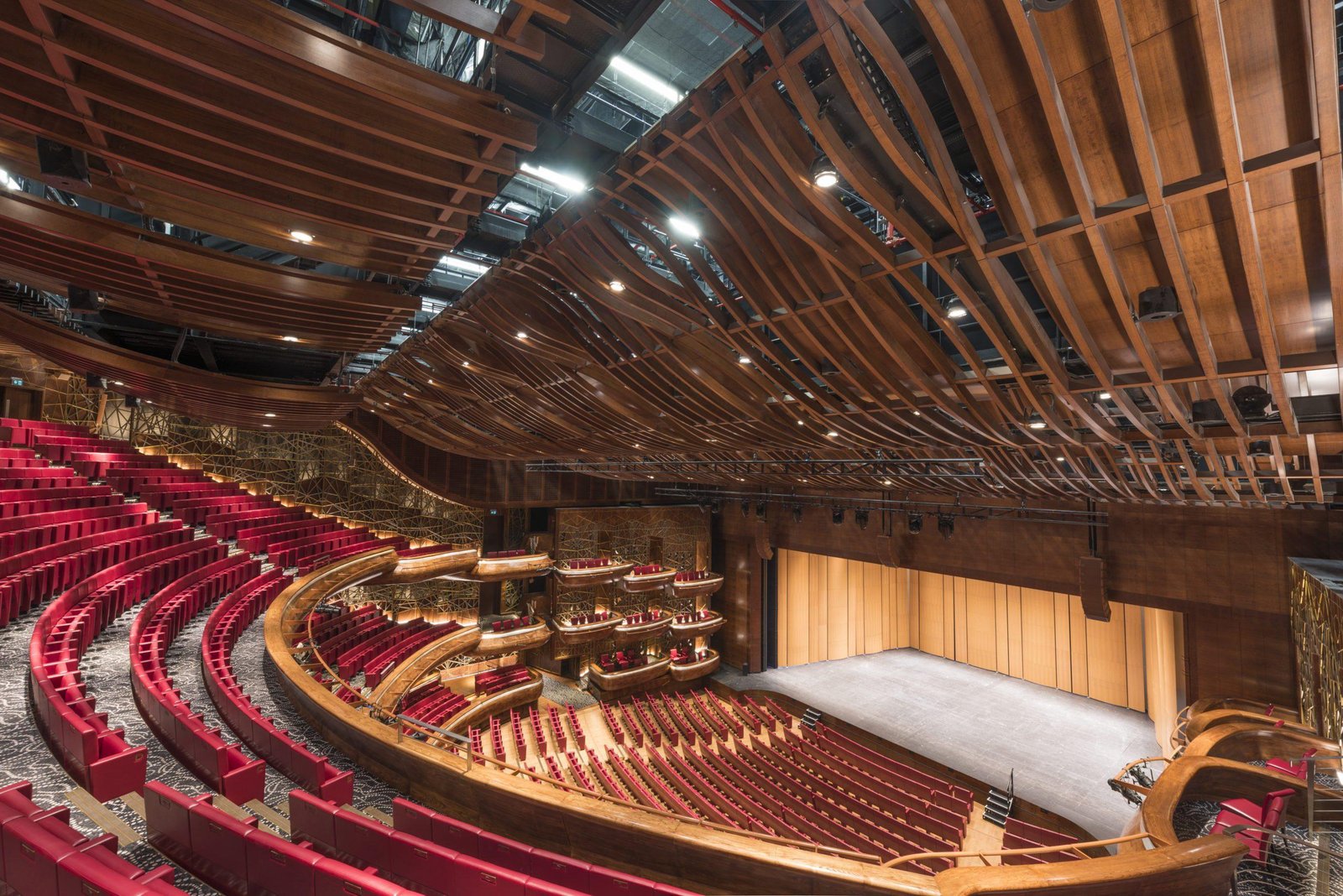
How the Dubai Opera House was designed for performance acoustics begins with a fundamental structural decision: the auditorium is constructed as an inner box within the outer building shell, using masonry and concrete for the internal surfaces. Masonry and concrete provide high mass, which helps resist sound transmission from the outside world into the auditorium. The same materials produce negligible resonance at the frequencies where classical music and operatic voice are most sensitive, which is the failure mode of lightweight panel systems that unpredictably absorb bass energy.
Open truss steelwork supports the auditorium roof within this inner box, and that open configuration carries a specific acoustic benefit: sound in the upper auditorium volume transfers freely from front to rear, producing the envelopment and spaciousness that audiences and performers associate with great concert halls. Shallow balcony overhangs ensure every seat remains within the direct and early-reflected sound field, eliminating the acoustic shadow cast by deep overhangs in older hall designs.
Variable Geometry and Mode-Switching
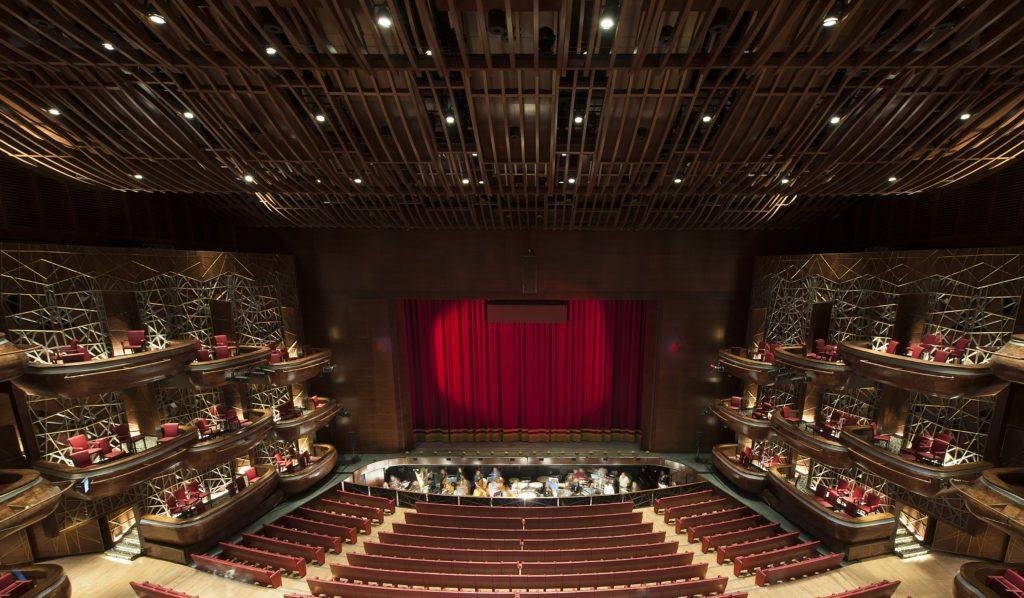
The variable configuration system operates across three interacting mechanisms. Movable risers change the stalls’ floor between raked seating and flat. Rotating side balconies alter the auditorium’s plan shape between theatre and concert modes. In concert mode, an orchestral shell closes off the fly tower and brings the orchestra into the hall’s acoustic volume, with stage towers and overhead reflectors completing the enclosure.
In theatre mode, the fly tower remains open, the shell is retracted, and high-level inflatable baffles deploy to add low-frequency absorption that would otherwise compromise speech intelligibility. Variable banners and drapes provide supplementary mid- to high-frequency control across both primary modes and their transitions. Sandy Brown’s scope extended to reverberation time targets for each configuration, control of early reflections through reflector geometry and surface material specification, and detailed computer modelling of finishes and sound reflections to refine the schematic design before any surface material was committed.
Electronic Audio Systems and Long-Term Performance
The electronic audio system, designed by Theatre Projects and installed by LSI Projects, uses a d&b audiotechnik loudspeaker array with ArrayProcessing. The system handles amplified performances and conferences and has been expanded since opening, with additional subwoofers and front-fill speakers as the programming scope broadened. The Head of Sound’s assessment, with several years of full-scale programming behind him, confirms that the electronic system and the natural acoustic base are genuinely complementary: the hall performs well without amplification for orchestral and operatic work, and the electronics extend that performance to amplified genres without compromising intelligibility or coverage uniformity.
This performing arts centre engineering approach, where natural and electronic acoustic systems are designed in parallel from the outset, contrasts with older venues where electronics were retrofitted into acoustics designed only for unamplified performance. The architectural design features of Dubai Opera House make that integration possible precisely because every discipline worked within a single coordinated model from the first stage of design.
Contextual Significance: Dubai Cultural Architecture and the Opera District
The Dubai Opera House did not emerge from a long tradition of civic investment in performing arts. Emaar Properties funded it privately and constructed it as the anchor of a new cultural district within a city that had, until the early 2000s, prioritised commercial and hospitality infrastructure over the arts. Jasper Hope, recruited directly from the Royal Albert Hall, where he served as Chief Operating Officer, was appointed Chief Executive in January 2015 to establish the venue’s programming identity before it opened. This section examines what the building represents in Dubai’s urban and cultural development and its place relative to other iconic performing arts engineering projects worldwide.
A Privately Funded Cultural Landmark
Dubai’s cultural architecture in this period reflects a deliberate national strategy: cultural infrastructure as a marker of global city status. The Dubai Opera House sits within that strategy, but its technical execution goes beyond symbolism. A 2,000-seat auditorium with world-class acoustic credentials is difficult to build anywhere. Doing so adjacent to the world’s tallest building, Burj Khalifa, on a constrained urban plot, in three years, against a backdrop of 45°C summer temperatures and strict noise criteria, required a level of multi-disciplinary coordination that most major performing arts projects do not face. The project demonstrates that the engineering challenges of building in Dubai’s desert climate are solvable, but only when every discipline is integrated from the first design iteration.
Performance as the Measure of Success
Among the iconic buildings in Dubai, the Opera House is unusual in that its significance lies in its acoustics and structure rather than its dimensions. The Burj Khalifa commands attention through height. The Dubai Frame commands attention through its concept. The Dubai Opera House commands attention because it performs: every seat hears clearly, every configuration works, and the building has sustained a world-class programme since the day it opened. That is a harder standard to meet than a height record, and it is the standard that separates performing arts centre engineering from architectural statement-making.
Global Comparisons in Extreme-Climate Performing Arts Engineering
The performing arts world has produced a handful of buildings over the past two decades that address extreme climate conditions through structural and acoustic engineering rather than by avoiding them. MAD Architects’ Harbin Opera House in northeast China addresses temperatures that fall below -30°C, embedding the building in its wetland landscape and using radiant floor heating and a sculpted Manchurian ash interior to deliver acoustic quality under conditions as extreme as Dubai’s, but at the opposite end of the thermometer. Both buildings confirm that climate hostility is not a barrier to world-class acoustic engineering when the brief demands it and the budget supports it. The Dubai Opera House is the warmer proof of that proposition.
Further Reading: Harbin Opera House: Stunning Organic Architecture Built for China’s Extreme Climate
Technical Block: Engineering Systems of the Dubai Opera House
The five subsections below detail the principal engineering systems that define the structural and acoustic engineering of the Dubai Opera House, from substructure through to integrated audio and stage systems. Each system presented discrete engineering challenges, and each solution was shaped by the constraints imposed by the others. Together, they constitute one of the most technically integrated performing arts centre engineering packages built during this period.
1. Facade and Thermal Envelope
Werner Sobek AG optimised the entire building enclosure geometry in Rhino to reconcile the dhow’s free-form curves with fabrication tolerances and thermal performance targets. The glazed foyer facade incorporates performance-specified glass selected through hour-by-hour energy modelling, with integrated sun shading designed to manage solar angle variations across the curved surface throughout the day. The district cooling connection via an energy transfer station provides the cooling capacity to maintain auditorium and foyer conditions throughout Dubai’s nine-month cooling season. The architectural design features of Dubai Opera House in its facade system represent some of the most technically complex glass-and-steel enclosure work completed in the region.
| System Component | Engineering Specification & Technologies | Project Partner | Design Intent & Operational Function |
| Enclosure Geometry | Free-form curved envelope optimised in Rhino software | Werner Sobek AG | Reconciles complex dhow-inspired curves with fabrication tolerances and thermal targets. |
| Glazed Foyer Facade | Performance-specified glass with integrated sun shading | Werner Sobek AG | Manages dynamic solar angle variations based on hour-by-hour energy modelling. |
| Climate Control | District cooling connection via an Energy Transfer Station | BK Gulf | Maintains strict auditorium and foyer conditions throughout Dubai’s nine-month cooling season. |
2. Structural Frame and Foundation System
The substructure uses secant piles and diaphragm walls with ground anchors, selected by Atkins based on plot boundary conditions and proximity to adjacent structures. All main floor slabs and lateral shear walls are cast-in-situ reinforced concrete. External raking columns up to the upper balcony level are also concrete, providing the lower structure with the thermal and acoustic mass the building requires. The long-span steel roof, comprising 3,600 tonnes of structural steelwork, spans the full auditorium volume and was fabricated to multi-curvature geometry by Eversendai Engineering using a fully coordinated 3D parametric model. No straight structural line appears on the exterior of the building.
| System Component | Engineering Specification & Materials | Project Partner | Design Intent & Structural Function |
| Substructure | Secant piles, diaphragm walls, and ground anchors | Atkins | Manages plot boundary constraints and protects adjacent structures. |
| Superstructure | Cast-in-situ reinforced concrete slabs, lateral shear walls, and external raking columns | Atkins | Provides primary structural support, thermal mass, and critical acoustic mass. |
| Roof Structure | 3,600 tonnes of structural steelwork fabricated to multi-curvature geometry | Eversendai Engineering | Spans the full auditorium volume using a fully coordinated 3D parametric model without straight lines. |
3. Auditorium Configuration Modes
The three operational modes, theatre, concert hall, and flat floor, are enabled by movable stall risers, rotating side balconies, and a deployable orchestral shell. Theatre mode accommodates 2,000 seats with raked stalls and an open fly tower. Concert mode deploys the acoustic shell, closing the fly tower and adding reflector towers and overhead reflectors to create the enclosed acoustic volume required by an orchestra. Flat floor mode removes all seating risers, revealing 1,800 m² of unobstructed floor space for galas, fashion shows, exhibitions, and conferences. The transformation between modes is a mechanical and acoustic operation, not a cosmetic one: each mode represents a different physical and acoustic room.
| Operational Mode | Physical Capacity & Floor Area | Mechanical & Structural Alterations | Acoustic Configuration |
| Theatre Mode | 2,000 seats | Raked stalls deployed; open fly tower utilised. | Configured for spoken-word clarity with inflatable low-frequency baffles deployed. |
| Concert Hall Mode | 2,000 seats | Movable stall risers adjusted; side balconies rotated. | Deploys a full acoustic shell, closes the fly tower, and adds reflector and overhead towers. |
| Flat Floor Mode | 1,800 m² of unobstructed space | Seating risers fully removed and stored. | Transforms the room into a flat multi-purpose volume for galas, fashion shows, and exhibitions. |
4. Acoustic Systems Integration
Sandy Brown Associates’ acoustic strategy for the design of the Dubai Opera House centres on the inner-box masonry and concrete auditorium, an open-truss roof for upper-volume sound transfer, variable-geometry reflectors and absorbers, inflatable low-frequency baffles for theatre mode, and shallow balcony overhangs for full audience coverage. The d&b audiotechnik electronic audio system provides even coverage in all modes, with ArrayProcessing enabling the clarity that distinguishes professionally installed audio from conventional point-source systems. The brief required the electronic system to complement rather than compensate for the natural acoustics, and the years of programming since opening confirm that it has met the brief.
| Acoustic Subsystem | Technology & Components | Project Partner | Design Intent & Performance Metric |
| Room Acoustics | Inner-box masonry, concrete auditorium, and open-truss roof | Sandy Brown Associates | Maximises upper-volume sound transfer while providing absolute structural isolation. |
| Variable Acoustics | Variable-geometry reflectors, absorbers, and inflatable low-frequency baffles | Sandy Brown Associates | Optimises the physical environment between live orchestral reverberation and deadened theatre acoustics. |
| Electronic Audio | d&b audiotechnik system featuring ArrayProcessing technology | LSI Projects | Delivers even acoustic coverage and high speech clarity across all seating layouts. |
5. Stage Engineering and Building Services
ThyssenKrupp provided the full stage engineering package, covering all mechanical stage systems, including the fly tower, orchestra pit lift, and acoustic shell deployment. BK Gulf executed the MEP contract. LSI Projects supplied and installed audio and lighting systems. Building services noise and vibration control were governed throughout by Sandy Brown’s acoustic criteria, with every mechanical service penetration and plant room connection isolated to prevent structure-borne and airborne noise transmission into the auditorium. The integrated approach to performing arts centre engineering, where acoustic criteria drive MEP design rather than the reverse, is the defining feature of the building’s mechanical systems strategy.
| System Component | Engineering Specification & Scope | Project Partner | Design Intent & Isolation Method |
| Stage Mechanics | Fly tower rigs, orchestra pit lifts, and acoustic shell deployment mechanics | ThyssenKrupp | Executes rapid mechanical transformations between the three core auditorium modes. |
| MEP Systems | Integrated mechanical, electrical, and plumbing infrastructure | BK Gulf | Subordinates all climate control power to strict auditorium noise criteria. |
| Noise & Vibration Control | Isolated mechanical service penetrations and plant room connections | Sandy Brown Associates | Prevents structure-borne and airborne noise transmission into the performance space. |
Conclusion: What the Dubai Opera House Proves
The structural and acoustic engineering of Dubai Opera House proves a straightforward but demanding proposition: world-class performing arts infrastructure is achievable in any climate, on any urban site, within a compressed programme, provided the engineering disciplines are integrated from the first design iteration. The building’s acoustic quality has been confirmed by international performers and by the technical teams who have operated it since 2016. Its structural and thermal performance, a free-form 3,600-tonne steel roof over a masonry acoustic box in a 45°C desert city, ranks among the more technically exacting building engineering achievements of the decade.
The project’s legacy for structural engineering in Dubai extends beyond the building itself: it demonstrated that complex cultural buildings could be delivered at international standards within the emirate’s construction ecosystem, and it anchored a cultural district that has since grown around it. Just as the InterContinental Shanghai Wonderland Hotel turned a 100-metre-deep abandoned quarry into a functioning structure through disciplined engineering integration, the Dubai Opera House transformed a blank boulevard plot into one of the most acoustically sophisticated venues in the world. Among iconic buildings in Dubai, it stands apart precisely because the ambition was acoustic and structural rather than dimensional.
Stay Updated on the World’s Most Iconic Structures
Stay ahead of the world’s most ambitious architecture and engineering with Construction Frontier: Global Mega Projects. Explore deep technical insights, expert analysis, and investment intelligence shaping the future of global iconic structures and performing arts infrastructure.