Chesapeake Bay Bridge-Tunnel: 5 Proven Engineering Feats Behind America’s Longest Sea Crossing
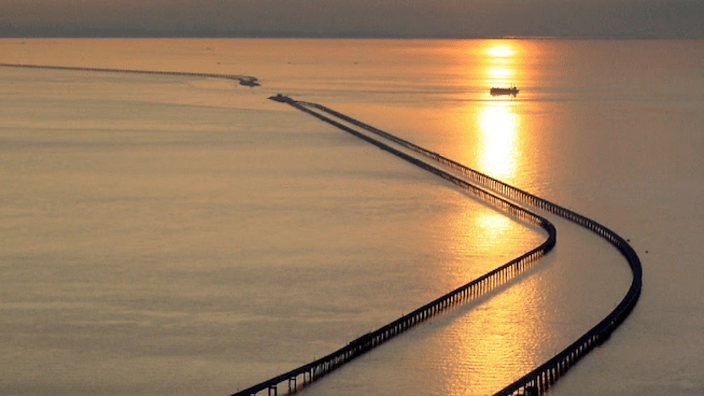
Stretching 17.6 miles across the mouth of the Chesapeake Bay, the Chesapeake Bay Bridge-Tunnel remains the longest sea crossing in the United States and one of only fourteen bridge-tunnel systems on Earth. Built in just 42 months for $200 million in revenue bonds, with zero tax funding, the Chesapeake Bay Bridge-Tunnel combines low-level trestle, high-clearance bridges, twin mile-long tunnels, and four artificial islands into a single continuous roadway between Virginia’s Eastern Shore and Hampton Roads.
Technical Snapshot: Chesapeake Bay Bridge-Tunnel
| Total length | 17.6 miles (28.3 km) shore to shore; 23 miles including approach roads |
| Location | Mouth of Chesapeake Bay, Virginia, USA |
| Opened | April 15, 1964 |
| Tunnels | Two, each over 1 mile long: Thimble Shoal and Chesapeake Channel |
| High-level bridges | North Channel Bridge (75 ft clearance), Fisherman Inlet Bridge (40 ft clearance) |
| Artificial islands | Four, each approximately 5.25 acres |
| Original cost | $200 million in revenue bonds, no tax funding |
| Owner/operator | Chesapeake Bay Bridge and Tunnel District, Commonwealth of Virginia |
| Official name | Lucius J. Kellam Jr. Bridge-Tunnel |
That combination is what makes the crossing more than a regional curiosity. It set the template for how an American sea crossing megaproject can be financed without tax dollars, sequenced for decades of traffic growth, and rebuilt piece by piece without ever closing to traffic, lessons now playing out again as the Parallel Thimble Shoal Tunnel nears completion.
Introduction: Chesapeake Bay Bridge-Tunnel
Most engineers studying global sea crossings gravitate toward Europe and Asia, where megaprojects like the Øresund Bridge and the Hong Kong-Zhuhai-Macau Bridge dominate headlines for sheer scale and budget. Yet tucked along the mid-Atlantic coast of the United States sits a structure that quietly outclasses nearly all of them in one specific category: total length. The Chesapeake Bay Bridge-Tunnel is not the newest or the most expensive sea crossing on the planet, but it is the longest bridge-tunnel crossing in the United States, and it has held that distinction since it opened in 1964.
This is the longest sea crossing in the United States, and understanding how the Chesapeake Bay Bridge-Tunnel was engineered says as much about engineering judgement as it does about concrete and steel. It was a calculated response to a narrow set of constraints: a busy shipping channel, a strategic naval base, unpredictable Atlantic storms, and a Virginia General Assembly unwilling to commit a single tax dollar. What emerged is a textbook case study of Virginia bridge-tunnel infrastructure design, and this article breaks down the six engineering feats that enabled the Chesapeake Bay Bridge-Tunnel, along with its length, cost, and construction details, making it among the world’s top sea-crossing engineering projects.
1. The Hybrid Bridge-Tunnel Configuration That Solved a Shipping Problem
Before any concrete was poured, planners faced a fundamental routing decision that would define the entire project. The Chesapeake Bay’s mouth was, and still is, one of the busiest natural harbour approaches on the East Coast, serving the Port of Virginia and the US Navy’s Hampton Roads installations. A continuous, high-level bridge across the full span would have required towers tall enough to clear the largest aircraft carriers, which is unrealistic given the soft, sediment-rich seabed common to bay floors. Engineers chose instead a bridge-tunnel hybrid construction approach, switching between trestle, high bridge, and tunnel based on what each segment of seabed demanded, a defining feature of Chesapeake Bay crossing engineering.
Why Tunnels Replaced Bridges at the Two Main Shipping Channels
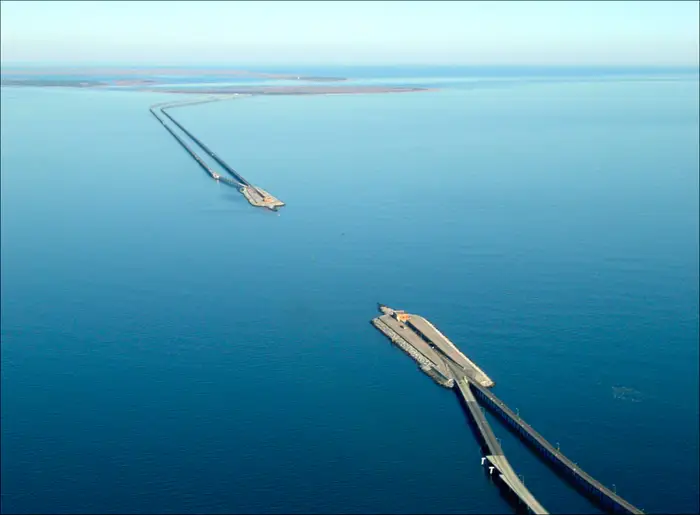
At Thimble Shoal Channel and the Chesapeake Channel, where the largest vessels and naval traffic pass, engineers buried the roadway beneath the seabed rather than building over it. This addressed two risks at once. First, it removed any height restriction on shipping, since submarines, aircraft carriers, and commercial vessels could pass overhead without any clearance calculation. Second, it eliminated the single point of failure that a ship strike on a tall bridge pier would represent. A bridge collapse blocking the channel into Norfolk’s naval yards was a national security liability, and that judgement call shaped the entire Chesapeake Bay Bridge-Tunnel concept.
Why Trestle and High Bridges Handle the Remaining 16 Miles
For the roughly 12 miles of open water where the shipping draft was shallow, engineers used a low-level trestle: a continuous run of concrete piles supporting a flat roadway barely above the waterline. Two further stretches needed a taller profile for smaller commercial traffic, which was solved by the North Channel Bridge at 75 feet of clearance and the Fisherman Inlet Bridge at 40 feet. The result is a structure that changes shape four times along its length, each transition driven by a specific navigational requirement, a defining piece of Virginia bridge tunnel infrastructure.
2. Artificial Islands as the Structural Hinge Points
Connecting a tunnel to a bridge mid-ocean is not a simple matter of pouring concrete where the seabed dips. The transition point needs to manage the geometry shift from an underground tube to an elevated roadway, house ventilation infrastructure for the tunnels below, and survive direct wave and storm exposure with no natural shoreline protection. Virginia’s engineers solved this with four purpose-built artificial islands, one at each tunnel portal, among the most distinctive visual features of the entire Chesapeake Bay Bridge-Tunnel.
Engineering the Islands in 25 to 100 Feet of Water
Each island covers roughly 5.25 acres and was constructed in water depths ranging from 25 to 100 feet, built up from dredged fill contained within steel and rock-armoured perimeters before the roadway and tunnel portals were installed on top. Building stable land from scratch in open water exposed to Atlantic swell required careful sequencing of dredging, fill placement, and slope protection to prevent erosion before the structure above could even begin.
The islands also needed enough surface area to house ventilation buildings and maintenance facilities and, in later decades, the visitor amenities and fishing piers that have become a minor tourist draw in their own right, all part of the wider Chesapeake Bay crossing engineering programme.
Why the Islands Double as Critical Infrastructure Hubs
Beyond their structural role, the artificial islands serve as ventilation and life-safety hubs for the tunnels beneath them, a function that became more important once a second Thimble Shoal tunnel began construction decades later. Without these islands, there would be no practical way to manage fresh air exchange, emergency egress, or maintenance access for tunnel sections lying more than a mile out from either shore. This is precisely the kind of structural problem Construction Frontier readers researching the Brenner Base Tunnel’s binational ventilation strategy will recognise: long undersea passages live or die on how well their access points are engineered, not merely on the tunnel boring itself.
Further Reading: Øresund Bridge: 8 Brilliant Engineering Achievements Behind Scandinavia’s Most Iconic Sea Crossing
3. Financing a Megaproject With Zero Tax Dollars
What sets the Chesapeake Bay Bridge-Tunnel apart from most infrastructure of its era is not a construction technique, but a financial one. In 1960, the Chesapeake Bay Ferry Commission sold $200 million in revenue bonds to private investors, promising the project would be repaid purely from future toll collections. No tax revenue went into construction or ongoing maintenance, a financing model considered genuinely risky at the time, given that the bay’s ferry traffic was the only existing proof of demand.
The Toll-Revenue Bond Structure That De-Risked the Project for Investors
Commission chairman Lucius J. Kellam Jr., for whom the crossing is now officially named, pushed the bond sale through despite vocal opposition from sceptics who argued that storms or off-course vessels could damage the crossing and erase any chance of repaying investors. The structure that won out tied bond repayment directly to projected toll revenue, with traffic studies modelling commuter and freight demand along the Eastern Shore corridor. It is a model that still underpins how this American sea crossing megaproject self-funds expansion today, more than six decades after the original bonds were issued.
Why the Self-Funding Model Still Matters for Expansion Projects
A 2002 Joint Legislative Audit and Review Commission study examined whether the Commonwealth of Virginia could realistically take over future capital funding for the crossing and concluded that the existing toll-based structure should continue operating the Chesapeake Bay Bridge-Tunnel in perpetuity. That conclusion has held: the 1999 parallel bridge expansion and the tunnel-boring project running through the late 2020s have both been financed through revenue bonds, federal infrastructure loans, and the district’s own toll reserves, never through general taxation.
For readers tracking how the Strait of Messina Bridge plans to fund its substantially larger crossing, the Chesapeake Bay Bridge-Tunnel model offers a smaller-scale precedent for what toll-backed infrastructure financing can sustain over multiple decades and for what an American sea-crossing megaproject can achieve without public money.
4. Doubling Capacity Without Doubling the Footprint
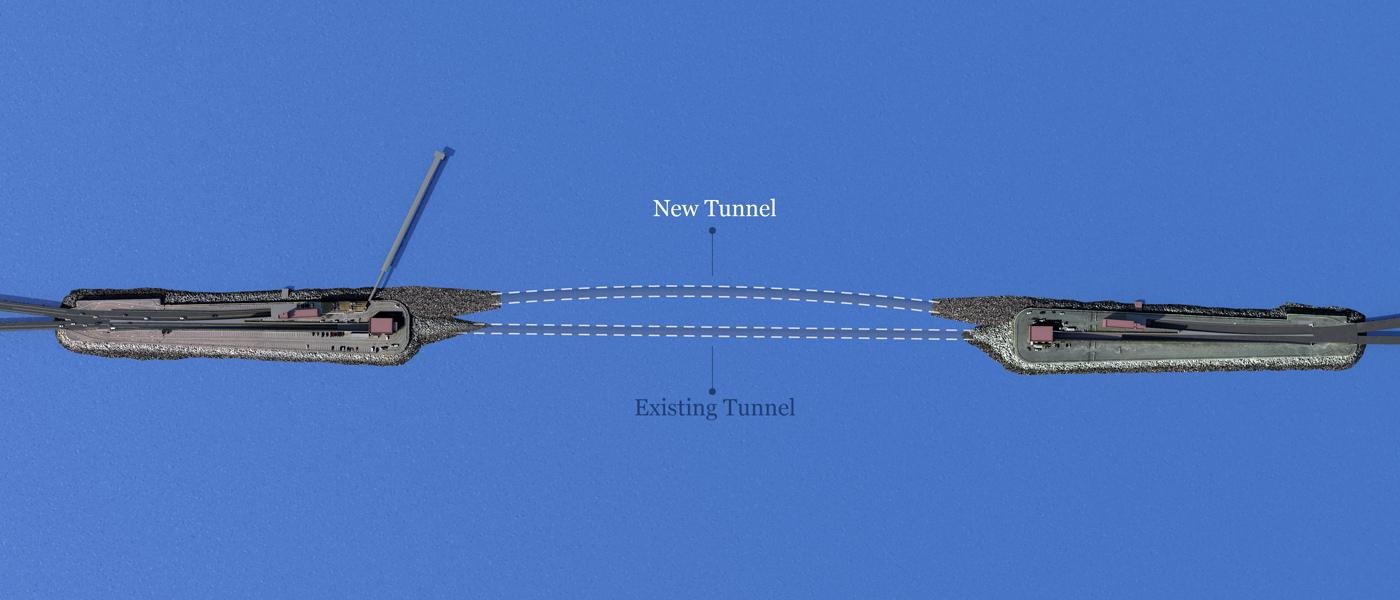
By the late 1980s, the original two-lane Chesapeake Bay Bridge-Tunnel was carrying far more traffic than its 1964 designers had anticipated, and the narrow lanes running directly alongside oncoming traffic in the tunnels had become a genuine safety concern. Rather than build an entirely new crossing alongside the old one, engineers chose a parallel expansion strategy that reused existing islands and alignment wherever possible, a hallmark of efficient Virginia bridge-tunnel infrastructure planning.
How the 1999 Parallel Bridge Expansion Was Sequenced
Construction on the parallel bridge sections began in 1995 and opened to four-lane traffic in April 1999, adding a full second set of trestle and high-level bridge spans alongside the original 1964 structure. Crucially, this expansion did not affect the tunnel sections, meaning the two original mile-long tunnels at Thimble Shoal and Chesapeake Channel continued to carry two-way traffic even after the bridge sections had been fully dualised. That left an obvious bottleneck that planners knew would eventually need its own solution, but the bridge dualisation alone bought the crossing several more decades of usable capacity at a fraction of full-replacement cost.
| Original crossing | $137M, 42 months, opened April 15, 1964 |
| Parallel bridge expansion | $250M, 46 months, opened April 19, 1999 |
| Parallel Thimble Shoal Tunnel | ~$850M projected, expected completion in the late 2020s |
| Parallel Chesapeake Channel Tunnel | Planned for the future |
Lessons From the Sequencing for Future Brownfield Crossings
The decision to dualise bridges first and tunnels later reflects a pragmatic engineering principle worth noting for anyone managing brownfield infrastructure: fix the cheaper, lower-risk bottleneck first, and defer the more complex underwater work until funding and technology both improve. By the time planners turned to the tunnel problem in the 2010s, tunnel-boring machine technology had advanced enough to make a bored solution, rather than another immersed-tube structure, the more practical choice for the second Thimble Shoal crossing and a clear answer to how the Chesapeake Bay Bridge-Tunnel was engineered and built for its second life.
5. Tunnel Boring Machine “Chessie” and the Modern Capacity Fix
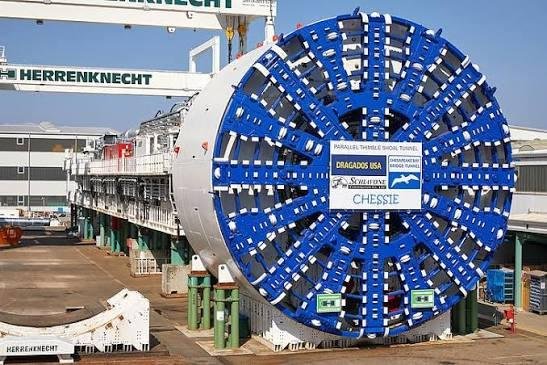
The most technically ambitious chapter in the Chesapeake Bay Bridge-Tunnel’s history is still being written. In 2017, the Chesapeake Bay Bridge and Tunnel Commission broke ground on the Parallel Thimble Shoal Tunnel Project, contracted to the Chesapeake Tunnel Joint Venture, a partnership between Dragados USA and Schiavone Construction, with Mott MacDonald serving as lead designer. It marked the first time a transportation tunnel anywhere in the Mid-Atlantic region had been built using a dedicated tunnel boring machine rather than the immersed-tube method used for the original 1964 tunnels, and it stands as one of the clearest answers to how the Chesapeake Bay Bridge-Tunnel was engineered and built for twenty-first-century traffic demand.
Specifications of the Herrenknecht TBM Driving the New Tunnel
The machine assigned to the job, nicknamed Chessie by local sixth-grade students, is a 43.5-foot-diameter Herrenknecht earth pressure balance TBM measuring roughly 308 feet in overall length. Mining began in February 2023 and was designed to bore a two-lane tunnel roughly one mile long beneath Thimble Shoal Channel at a maximum depth of 105 feet below the water surface, connecting Island One to Island Two. Once finished, the new bore will carry two lanes of southbound traffic while the original 1964 tunnel converts to two lanes northbound, finally separating opposing traffic for the first time in the crossing’s history.
| TBM name | Chessie |
| TBM type | Herrenknecht earth pressure balance (EPB) |
| Cutterhead diameter | 43.5 ft (13.26 m) |
| Overall machine length | ~308 ft (93.88 m) |
| Tunnel length bored | ~1 mile (6,300+ ft / 1,920 m) |
| Maximum tunnel depth | 105 ft below the water surface |
| Mining start | February 2023 |
| Breakthrough | January 27, 2025 |
| Design-build contractor | Chesapeake Tunnel Joint Venture (Dragados USA and Schiavone Construction) |
| Lead designer | Mott MacDonald |
The Unexpected Obstacle That Delayed the Schedule
In May 2023, Chessie’s progress halted abruptly when the machine struck a large ship’s anchor manufactured in England around the turn of the twentieth century, an obstruction nobody on the project had anticipated. Removing it safely added roughly eight months to the schedule, and mining did not resume until May 2024, after which Chessie advanced at an average rate of around 50 feet per day.
The TBM finally broke through into the receiving pit at Island Two on January 27, 2025, completing a drive of more than 6,300 feet, with the surrounding fit-out work continuing toward an expected completion in the late 2020s. It is a useful reminder, also evident in Construction Frontier’s case studies of Europe’s mega-tunnel engineering projects, that even the most carefully engineered bore is still at the mercy of whatever was lost at sea generations earlier.
Further Reading: Hong Kong-Zhuhai-Macau Bridge: 10 Brilliant Engineering Feats Behind the World’s Longest Sea Crossing
Technical Block: Engineering Specifications of the Chesapeake Bay Bridge-Tunnel
Beyond the headline statistics, the Chesapeake Bay Bridge-Tunnel’s engineering design holds up component by component. The figures below summarise the Chesapeake Bay Bridge-Tunnel length, cost, and construction facts that matter most to engineers and infrastructure planners assessing comparable sea crossing projects elsewhere in the world, alongside the Chesapeake Bay Bridge-Tunnel specifications and engineering design that underpin them.
Structural Composition Breakdown
The crossing comprises roughly 12 miles of low-level trestle, two one-mile tunnels, two pairs of high-level bridges, nearly two miles of causeway, and four artificial islands, totalling 17.6 miles shore to shore and 23 miles including land approaches. Original construction relied on hollow concrete piles driven into the bay floor along a deliberately curved alignment chosen for stability against current and storm loading, a routing decision that still defines how the Chesapeake Bay Bridge-Tunnel handles wind and wave forces today.
| Low-level trestle | ~12 miles (19 km) |
| Thimble Shoal Tunnel | ~1 mile (1.6 km) |
| Chesapeake Channel Tunnel | ~1 mile (1.6 km) |
| High-level bridges | North Channel Bridge (75 ft) and Fisherman Inlet Bridge (40 ft) |
| Causeway | ~2 miles (3.2 km) |
| Artificial islands | 4, ~5.25 acres each |
| Approach roads | ~5.5 miles (8.9 km) |
| Total facility length | 23 miles (37 km), 17.6 miles shore to shore |
Construction Timeline and Workforce Achievement
The original two-lane crossing was built in just 42 months, opening on April 15, 1964, a remarkably fast timeline for a project combining four distinct structure types across open ocean conditions. The joint venture behind the build, comprising Tidewater Construction Corporation, Merritt-Chapman & Scott, Peter Kiewit & Sons, and Raymond International, deployed floating cranes and pile-driving equipment to construct the trestle sections segment by segment, while prefabricated tunnel elements were fabricated onshore and lowered into dredged channel trenches at sea.
Conclusion: The Lasting Engineering Legacy of the Chesapeake Bay Bridge-Tunnel
No single span, tunnel, or island explains why the Chesapeake Bay Bridge-Tunnel still matters six decades later. What explains it is sequencing: a 1964 team that refused to force one structure type onto a seabed that demanded four, a financing board that bet the megaproject on toll revenue nobody could yet measure, and a 1999 generation that doubled capacity without ever shutting the crossing down. Each decision solved the problem in front of it rather than chasing a more impressive design, and that discipline is why the Chesapeake Bay Bridge-Tunnel has outlasted most assumptions made about it in 1956.
That same discipline shows in Chessie’s drive beneath Thimble Shoal Channel, where a modern tunnel boring machine is finishing a job the original engineers deliberately left for later technology to solve. Once the Parallel Thimble Shoal Tunnel opens, the crossing will have spent more than sixty years proving that a sea crossing does not need to choose between a bridge and a tunnel when the geography refuses to choose for it, a lesson now being tested on a far larger scale on projects like the Hong Kong-Zhuhai-Macau Bridge.
Explore More Bridge and Tunnel Engineering Breakthroughs
From record-setting sea crossings to complex tunnel systems built beneath extreme environments, the world’s most ambitious infrastructure projects reveal how engineering innovation turns impossible connections into reality. Continue exploring Construction Frontier: Global Mega Projects’ technical deep dives into bridge and tunnel megaprojects, construction methods, and the decisions shaping the future of global connectivity.