Hong Kong-Zhuhai-Macau Bridge: 10 Brilliant Engineering Feats Behind the World’s Longest Sea Crossing
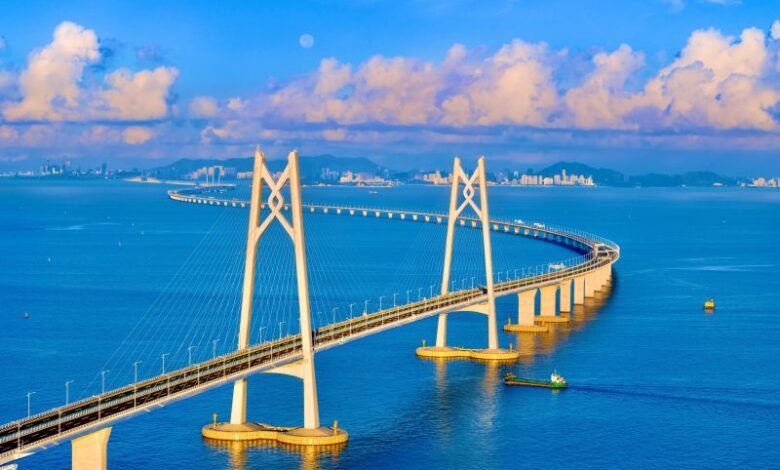
The Hong Kong-Zhuhai-Macau Bridge is a 55-kilometre bridge-island-tunnel system that crosses the Pearl River Estuary, linking Hong Kong, Zhuhai, and Macau over open water, once served only by slow ferry routes. It is recognised as the longest sea-crossing bridge on record, combining three cable-stayed navigation bridges, a 6.7-kilometre immersed tunnel, and four engineered artificial islands designed to withstand typhoons, ship collisions, and seismic loading. Completed after nearly nine years of construction at a cost of roughly RMB 126.9 billion, the Hong Kong-Zhuhai-Macau Bridge cut the road journey between Hong Kong and Zhuhai from more than three hours to under fifty minutes.
Technical Snapshot: The Hong Kong-Zhuhai-Macau Bridge Core Project Specifications
| Specification | Value |
| Total length | 55 kilometres (34 miles) |
| Main Bridge section | 29.6 kilometres |
| Immersed tunnel length | 6.7 kilometres |
| Hong Kong Link Road | 12 kilometres |
| Zhuhai Link Road | 13.4 kilometres |
| Design service life | 120 years |
| Seismic design threshold | Magnitude 8 |
| Wind design threshold | Level 16 typhoon |
| Construction period | December 2009 to October 2018 |
| Total project cost | Approximately RMB 126.9 billion (~US$18.8 billion) |
Few single structures concentrate this much risk in one corridor, which is why the Hong Kong-Zhuhai-Macau Bridge sets the reference standard for sea-crossing infrastructure in China and for the longest sea-crossing bridge category worldwide.
Introduction: Why the Pearl River Delta Needed This Crossing
The Pearl River Estuary separates Hong Kong from the western Pearl River Delta by a stretch of water that, before 2018, demanded a three-hour land-and-ferry detour. The Hong Kong-Zhuhai-Macau Bridge permanently closed that gap. Conceived in the 1980s by Hopewell Holdings founder Gordon Wu, the route stalled for two decades due to financing and political coordination among three jurisdictions before construction began in December 2009. By the time it opened on 24 October 2018, the Hong Kong-Zhuhai-Macau Bridge had become the longest sea-crossing bridge ever built and the most ambitious Hong Kong bridge-tunnel project on record.
This article unpacks ten engineering feats behind the project: its scale, the cable-stayed bridge design across three navigation channels, four artificial islands built by non-dredge reclamation, the immersed tunnel beneath one of the busiest shipping lanes on earth, and the cost and programme decisions holding the Hong Kong bridge-tunnel project together across three legal systems. Where the Chesapeake Bay Bridge-Tunnel pioneered the bridge-tunnel hybrid concept that inspired Wu’s original pitch, and the Øresund Bridge demonstrated a comparable island-tunnel transition in Scandinavia, the Hong Kong-Zhuhai-Macau Bridge scaled those ideas to a different order of magnitude.
A few comparisons of the world’s longest overseas bridge engineering facts include another corridor that combines three cable-stayed spans, four reclaimed islands, and a record tunnel within a single Hong Kong bridge-tunnel project.
How Long Is the Hong Kong-Zhuhai-Macau Bridge? Breaking Down Its Record-Setting Scale
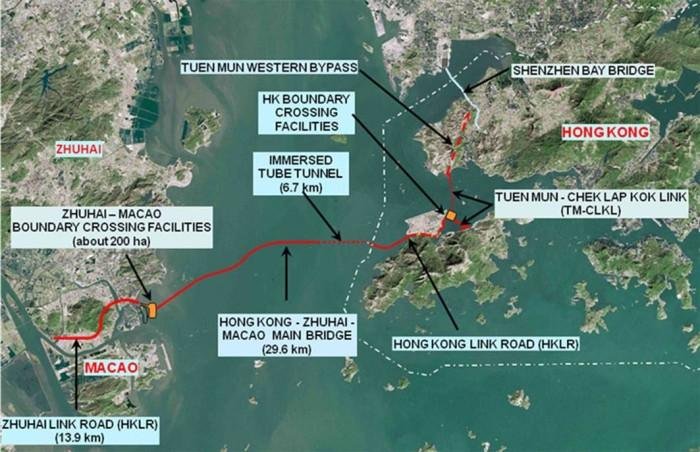
Anyone asking how long the Hong Kong-Zhuhai-Macau Bridge is is really asking about three connected structures, not one span. The system runs 55 kilometres from Lantau Island to Zhuhai and Macau, earning its record from the combined length of bridges, tunnels, and link roads rather than a single longest span. Readers comparing the longest sea-crossing bridge in the world: specifications across regions will find that the combined-length methodology is the detail most outlets get wrong.
Main Bridge and Link Road Breakdown
The Main Bridge, built by mainland authorities across the Pearl River Estuary, measures 29.6 kilometres and houses the heaviest engineering: three cable-stayed bridges, two artificial islands, and the 6.7-kilometre immersed tunnel between them. The Hong Kong Link Road runs 12 kilometres eastward to Hong Kong Port near the airport, while the Zhuhai Link Road covers 13.4 kilometres westward into Zhuhai and on to Macau. Combined, these sections form a structure roughly 20 times the length of the Golden Gate Bridge, putting the scale of the world’s longest sea-crossing bridge into perspective. Drivers asking how long the Hong Kong-Zhuhai-Macau Bridge is, in practical terms, should note that the full run takes around 45 minutes at design speed.
| Section | Length |
| Main Bridge (open-water section) | 29.6 kilometres |
| Immersed tunnel (within Main Bridge) | 6.7 kilometres |
| Hong Kong Link Road | 12 kilometres |
| Zhuhai Link Road | 13.4 kilometres |
| Total system length | 55 kilometres |
Design Speed and Traffic Capacity
The Hong Kong-Zhuhai-Macau Bridge carries six lanes of dual three-lane traffic at a designed top speed of 100 kilometres per hour and operates 24 hours a day. Because the bridge technically lies within Zhuhai’s jurisdiction for most of its length, drivers cross from left-hand traffic at the Hong Kong and Macau ends to right-hand traffic across the mainland section, requiring purpose-built crossover viaducts at each boundary. This detail shaped boundary-crossing facility layouts on both artificial islands and added real complexity to an already unprecedented Hong Kong bridge-tunnel project, one reason the HZMB engineering design team is regularly cited in reviews of the world’s longest sea-crossing bridge: in specifications and case studies.
Further Reading: Øresund Bridge: 8 Brilliant Engineering Achievements Behind Scandinavia’s Most Iconic Sea Crossing
HZMB Engineering Design: Building Three Cable-Stayed Bridges Over One Estuary
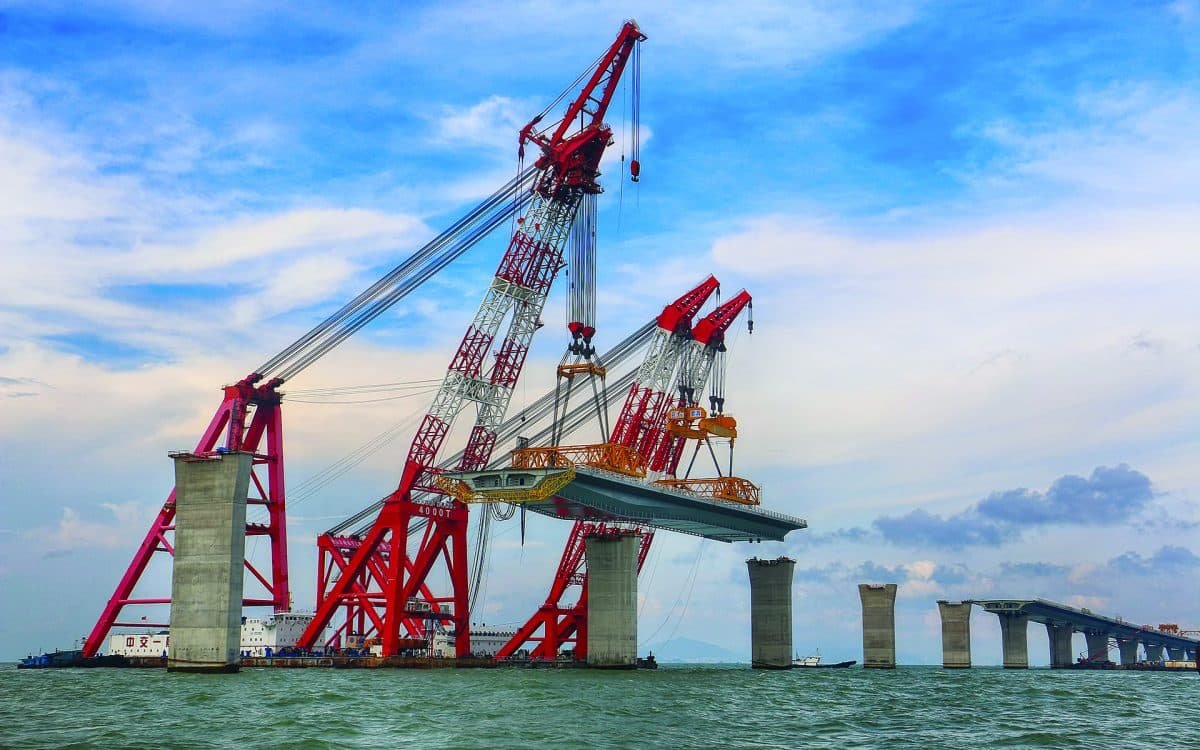
The HZMB engineering design is based on three independent cable-stayed bridges, each assigned to a navigation channel where commercial shipping cannot be denied access. Rather than force vessels through a single corridor, the design teams, including Arup and the China Highway Planning and Design Institute, placed the Jiuzhou, Jianghai, and Qingzhou navigation bridges at separate crossings, each shaped to read as a distinct visual landmark from sea, land, and air. This distributed approach is now treated as a textbook example of HZMB engineering design thinking applied to a contested, high-traffic waterway.
Span Geometry and Tower Design
Spans range from 280 to 460 metres, with central towers of differing silhouettes, including the retained sail-type towers on the Jiuzhou Bridge, chosen to avoid a repetitive appearance across 22.9 kilometres of viaduct. This variation was not cosmetic: aesthetic differentiation helps pilots and mariners distinguish channels at a glance, a navigational safety function disguised as architecture. The design team also coordinated tower height and cable geometry against flight paths into Hong Kong International Airport, since the eastern end sits within minutes of active runways.
| Navigation Bridge | Span Range |
| Jiuzhou Bridge | Up to 280 metres, sail-type towers |
| Jianghai Bridge | Up to 320 metres |
| Qingzhou Bridge | Up to 460 metres |
Hazard Design Thresholds
Every component was engineered to a 120-year design life, well above the 100-year standard common on most major bridges. The structure must withstand a magnitude-8 earthquake, a level-16 super typhoon, and an impact from a 300,000-tonne vessel without failure. These thresholds exist because the South China Sea generates some of the most destructive typhoons on the planet, and the estuary carries enormous container traffic bound for Hong Kong, Shenzhen, and Guangzhou. No precedent structure had combined seismic, typhoon, and ship-impact criteria at this scale, forcing engineers to build new modelling approaches rather than adapt existing codes, a major reason the longest sea-crossing bridge title still belongs to this corridor.
Inside the Hong Kong-Zhuhai-Macau Bridge Artificial Islands Construction
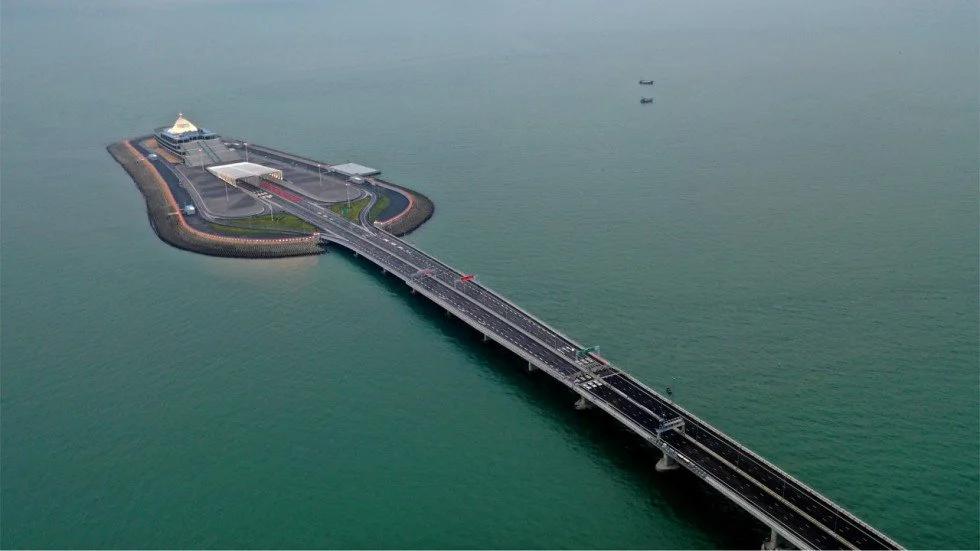
Four artificial islands anchor the Hong Kong-Zhuhai-Macau Bridge: two mid-sea islands transitioning the main bridge into the immersed tunnel, plus the Hong Kong Port island and the Zhuhai-Macao Port island housing boundary-crossing facilities. The construction of the Hong Kong-Zhuhai-Macau Bridge artificial islands had to solve a problem that dredging-based reclamation could not. The western estuary is home to a vulnerable population of Chinese white dolphins, and conventional dredge-and-fill methods would have devastated their feeding grounds.
Non-Dredge Reclamation Method
Engineers used a non-dredge reclamation technique instead, lowering steel cylinders directly into the seabed to form an enclosed perimeter before filling the interior, avoiding the sediment plumes dredging generates. This preserved water clarity and dolphin habitat while still creating islands large enough for boundary infrastructure; the Hong Kong Port reclamation alone covers roughly 150 hectares. It remains one of the more transferable lessons from the project for sea-crossing infrastructure in China, since marine ecological constraints only grow stricter in later Pearl River Delta mega-bridge schemes.
Boundary Facilities as Island Architecture
The Hong Kong Port’s passenger clearance building covers more than 90,000 square metres and is assembled from dozens of prefabricated roof modules, the largest of which weighs over 670 tonnes and is larger than an Olympic-size swimming pool. Building boundary infrastructure on reclaimed islands rather than along the existing coastline lets planners separate cross-border clearance from each city’s domestic road network. This phase of HZMB engineering design also provided Guangdong’s planning authorities with a proven model for future Hong Kong bridge-tunnel project proposals still on the drawing board.
Solving the Hong Kong-Zhuhai-Macau Bridge Tunnel Design Challenges
The 6.7-kilometre immersed tunnel between the two mid-sea artificial islands is the component most responsible for the project’s reputation as an engineering breakthrough. It is the longest immersed tube tunnel built for road traffic anywhere in the world, sitting beneath one of the busiest shipping channels on the planet, a combination that defined nearly every design challenge the Hong Kong-Zhuhai-Macau Bridge tunnel faced.
Immersed Tube Installation at Record Depth
Each segment was prefabricated on land, floated into position, then sunk and joined underwater to the previous segment, demanding millimetre-level precision in currents, tides, and shipping traffic that could not be paused for construction. The tunnel had to sit deep enough to clear the draught of the largest vessels using the channel while staying shallow enough to limit the gradient at both portals. This single sequence accounts for most of the documented tunnel design challenges of the Hong Kong-Zhuhai-Macau Bridge referenced in post-project engineering reviews.
Geotechnical and Schedule Risk
Soft marine clay beneath the estuary posed settlement risk, which engineers modelled precisely before sinking each section, as uneven settlement threatened the watertight joints that held the tunnel together. Crews worked around a live shipping lane throughout, coordinating installation windows with maritime authorities to avoid collisions. These constraints are why the tunnel is cited most often in discussions of the world’s longest bridges as an example of overseas engineering, since immersed tube construction at this length and depth had no true precedent. It is also why every design challenge analysis for the Hong Kong-Zhuhai-Macau Bridge tunnel starts with geotechnical data rather than structural drawings.
Hong Kong-Zhuhai-Macau Bridge Construction Cost and Timeline: What It Took to Build
Understanding the Hong Kong-Zhuhai-Macau Bridge’s construction cost and timeline matters as much to finance specialists as engineering does to structural engineers, since the funding structure shaped what got built and when.
Budget Allocation and Financing Structure
Total investment reached approximately RMB 126.9 billion, with mainland China, Hong Kong, and Macau financing 42 percent directly, and the remaining funds raised through bank loans, including roughly USD 3.23 billion from the Bank of China. Costs are split across the Main Bridge, the Hong Kong Link Road and Port, and the Zhuhai Link Road, each under separate jurisdictional authority. This financing model is studied alongside the Chesapeake Bay Bridge-Tunnel whenever analysts assess the Hong Kong-Zhuhai-Macau Bridge’s construction costs and timeline against those of other major sea crossings.
| Financing Component | Share / Value |
| Government direct funding (China, Hong Kong, Macau) | 42 percent of the total cost |
| Bank loan financing | 58 percent of the total cost |
| Bank of China loan contribution | Approximately US$3.23 billion |
| Total project cost | Approximately RMB 126.9 billion (~US$18.8 billion) |
Nine-Year Construction Programme
Main construction began in December 2009 and lasted roughly nine years, with completion in February 2018 and opening to traffic that October. That timeline reflects the scale of materials involved, over 400,000 tonnes of steel plate and close to a million cubic metres of marine concrete, and the coordination overhead of three governments approving design changes and boundary protocols in parallel. The Hong Kong-Zhuhai-Macau Bridge’s construction cost and timeline records remain the benchmark that Guangdong planners cite first when scoping the next Hong Kong bridge-tunnel project.
Further Reading: Chesapeake Bay Bridge-Tunnel: 6 Proven Engineering Feats Behind America’s Longest Sea Crossing
Sea Crossing Infrastructure in China: How the Bridge Reshaped the Greater Bay Area
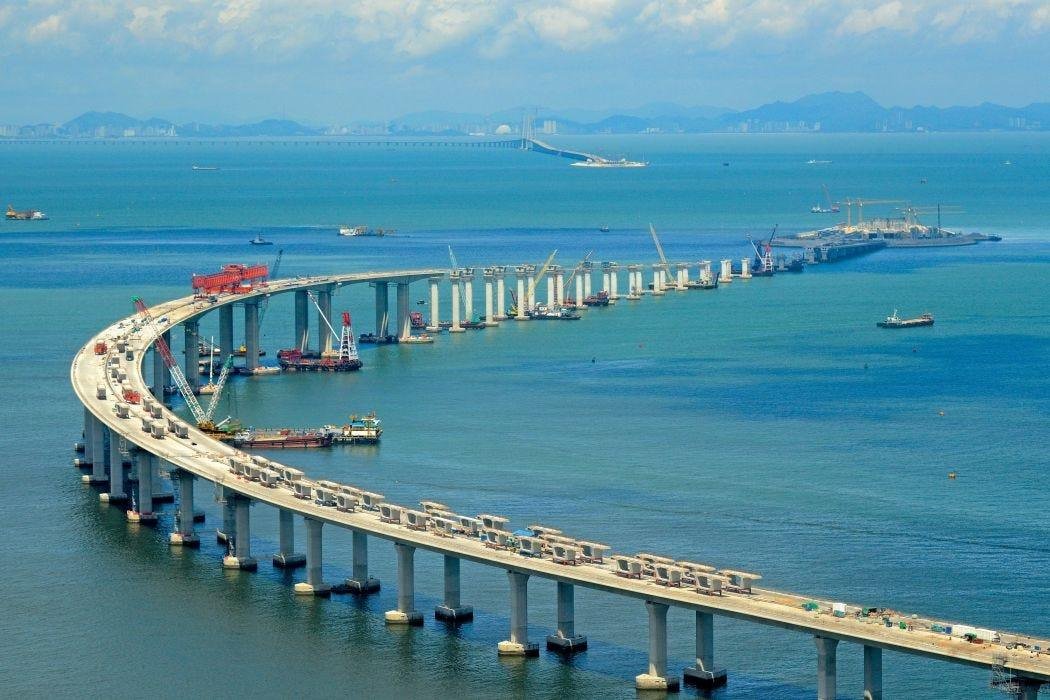
The Hong Kong-Zhuhai-Macau Bridge was never just a transport fix; it was conceived as connective tissue for the Greater Bay Area, a Chinese government strategy that integrates Hong Kong, Macau, and nine Guangdong cities into a single cluster. Sea-crossing infrastructure in China is increasingly evaluated against that regional ambition rather than solely on traffic volume.
Greater Bay Area Integration
Cutting the Hong Kong-to-Zhuhai journey from roughly three hours to around forty-five minutes created what planners call a one-hour living circle across the western Pearl River Delta. Travel time between Zhuhai and Hong Kong’s Kwai Chung container terminal dropped by more than 60 percent, and access to Hong Kong International Airport improved by over 80 percent, figures that matter to logistics operators moving freight through Hong Kong’s port and air cargo hubs. Those gains are the practical answer whenever someone asks how much time the Hong Kong-Zhuhai-Macau Bridge saves in regional travel, not just kilometres.
Template for Future Pearl River Delta Mega Bridge Projects
As a Pearl River Delta megabridge precedent, the Hong Kong-Zhuhai-Macau Bridge set a financing and construction template that subsequent regional crossings have directly referenced, from tri-jurisdictional cost-sharing to non-dredge reclamation for sensitive sites. It also set a documented hazard-design benchmark that exceeds what most international codes require, and every new Pearl River Delta mega-bridge feasibility study now opens by citing the Hong Kong-Zhuhai-Macau Bridge as its baseline.
Hong Kong-Zhuhai-Macau Bridge Technical Block: Specifications, Materials and Verdict
This section consolidates the material quantities and hazard performance data for the Hong Kong-Zhuhai-Macau Bridge, the longest sea-crossing bridge in the world, as a reference structure: specifications, discussions, and case studies on Hong Kong-Zhuhai-Macau Bridge tunnel design challenges return to the first.
1. Materials and Quantities
Construction consumed approximately 420,000 tonnes of steel plate, 330,000 tonnes of steel reinforcement bars, and close to one million cubic metres of concrete, quantities often compared to dozens of Eiffel Towers’ worth of steel and several Burj Khalifa towers’ worth of concrete. Marine-grade admixtures were developed to resist chloride penetration in the saline estuary, since standard mixes could not guarantee a 120-year life under constant tidal exposure, a quantity profile typical of the longest sea-crossing bridge category rather than a conventional viaduct.
| Material | Quantity |
| Steel plate | Approximately 420,000 tonnes |
| Steel reinforcement bars | Approximately 330,000 tonnes |
| Marine concrete | Close to 1,000,000 cubic metres |
2. Hazard Resilience Benchmarks
These benchmarks place the bridge among the most conservatively engineered marine structures in the world, a direct response to the frequency of typhoons and the shipping density in the estuary.
| Hazard | Design Threshold |
| Earthquake | Magnitude 8 |
| Typhoon | Level 16 (super typhoon) |
| Vessel impact | 300,000 tonnes |
| Service life | 120 years |
Conclusion: Setting the Global Benchmark for Sea-Crossing Engineering
The Hong Kong-Zhuhai-Macau Bridge earned its record as the longest sea-crossing bridge not through one spectacular span but through the disciplined integration of three cable-stayed bridges, four artificial islands, and a record-length immersed tunnel into one 55-kilometre corridor built to outlast a typhoon, an earthquake, and a direct ship strike for 120 years.
None of that was accidental: the construction of the artificial islands for the Hong Kong-Zhuhai-Macau Bridge protected an endangered dolphin population, the tunnel solved a navigation conflict no comparable project had faced at this depth, and the tri-jurisdictional financing structure absorbed political risk that would have stalled a less disciplined programme. Each Hong Kong-Zhuhai-Macau Bridge tunnel design challenge, from settlement risk in soft marine clay to installation within a live shipping lane, was solved without a precedent to follow.
The project’s legacy lies in proving that megaprojects spanning three legal systems can be financed, designed, and delivered on a fixed schedule without compromising hazard performance. That discipline is what separates the Hong Kong-Zhuhai-Macau Bridge from the merely large and keeps it cited first whenever the question is how long the Hong Kong-Zhuhai-Macau Bridge is, or the longest sea-crossing bridge in the world; its specifications are documented in technical literature. Every Pearl River Delta megabridge proposal that follows will be measured against what this bridge already achieved.
Explore More Bridge and Tunnel Megaproject Engineering
The world’s greatest sea crossings reveal how bold design, advanced construction methods, and engineering precision overcome the toughest geographic barriers. Continue exploring Construction Frontier: Global Mega Projects’ technical deep dives into bridge and tunnel megaprojects, record-breaking infrastructure, and the innovations redefining global connectivity.