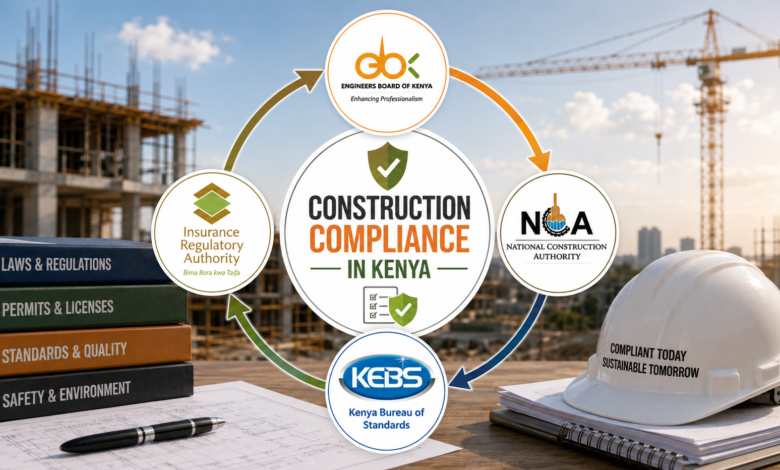
Construction Compliance in Kenya: 7 Essential Steps for Successful Certification
Construction compliance in Kenya rests on three interlocking pillars: engineer registration with the Engineers Board of Kenya, contractor licensing through the National Construction Authority, and, increasingly, ISO certification as a signal of competitiveness layered atop statutory law. A firm or professional who skips any pillar carries direct legal exposure and risks disqualification from public and donor-funded tenders. The National Construction Authority alone classifies contractors into eight categories, NCA1 through NCA8, each tied to a specific project value ceiling, meaning a contractor’s compliance status determines the size of the project it may legally pursue.
Technical Snapshot: Kenya Construction Compliance Framework
| Compliance Area | Regulatory Body | Core Requirement | Enforcement Mechanism |
| Engineer registration | Engineers Board of Kenya (EBK) | Graduate, Professional, Consulting, or Accredited Checker registration under the Engineers Act 2011 | Annual practising licence; unregistered practice is a criminal offence |
| Contractor licensing | National Construction Authority (NCA) | Registration in one of eight categories, NCA1 to NCA8, matched to contract value | Site inspections, blacklisting, work stoppage orders |
| Project registration | National Construction Authority (NCA) | Project-specific registration before construction begins, separate from firm licensing | Suspension of works for unregistered sites |
| ISO certification | Kenya Bureau of Standards (KEBS) via accredited certification bodies | Voluntary certification to ISO 9001, ISO 14001, ISO 45001, or related standards | Tender prequalification scoring, not a statutory penalty |
| Building permitting | County governments, under the Physical and Land Use Planning Act | Approved architectural and structural drawings before groundbreaking | Demolition orders, stop-work notices |
| Insurance compliance | Insurance Regulatory Authority (IRA), professional boards | Professional indemnity insurance for licensed practice and tender eligibility | Licence suspension, tender disqualification |
Treat these six rows as a single compliance chain rather than six separate errands: a gap in one area of construction compliance in Kenya routinely blocks progress in another, since county offices, NCA reviewers, and tender evaluators all cross-check the same documents.
Introduction: The Three Pillars of Construction Compliance in Kenya
Kenya’s construction sector operates under one of the more layered regulatory regimes in East Africa, and for good reason. A country building highways, high-rise developments, and geothermal plants at the pace Kenya has sustained over the past decade cannot afford unqualified engineers signing off on structural drawings or unlicensed contractors underbidding registered firms on public works. The result is a system of construction compliance in Kenya built around three statutory or quasi-statutory pillars: who may call themselves an engineer, who may legally contract construction works, and, increasingly, who can prove process discipline through independent certification.
This article works through each pillar of construction compliance in Kenya in turn, then layers on the permitting and insurance obligations that sit alongside them. For readers building a step-by-step roadmap toward full licensing, the companion guide on getting licensed for construction work in Kenya walks through the process in seven stages; this piece goes deeper into the regulatory logic behind each stage and why regulators enforce it as they do.
Construction compliance in Kenya is not a single checkbox. It is a layered obligation that follows a project from the moment an engineer signs a drawing to the day a completed structure receives occupation certification, and treating any one layer as optional invites the kind of legal and commercial exposure that regulators are specifically designed to catch.
Engineer Registration Compliance in Kenya
Every structural drawing, every signed-off design, and every engineering decision on a Kenyan construction site traces back to a single question: Is the engineer behind it registered? This section covers the legal mandate behind that requirement, the categories engineers move through as their careers develop, and what happens when someone bypasses registration altogether.
EBK’s Role and Legal Mandate
Engineer registration in Kenya sits at the top of the compliance chain, since every downstream approval depends on it. The Engineers Board of Kenya was established under Section 3 of the Engineers Act No. 43 of 2011, and its mandate is broad by design. Section 6 of the Act tasks the Board with developing and regulating engineering practice across the country, a mandate the Act’s drafters framed as a direct enabler of Kenya’s Vision 2030 development goals. In practice, that means EBK sets the rules for who can call themselves an engineer, accredits the university programmes that produce them, and disciplines those who fall short of professional standards.
The legal force behind this is unambiguous. A person may not practise engineering without a licence and without meeting all associated requirements, a rule that applies equally to Kenyan citizens and to foreign nationals working on Kenyan sites. This is the starting point for engineering registration in Kenya, which is why every serious construction project begins with a registration check before a single drawing is approved. Understanding how engineer registration works in Kenya, category by category, is the fastest way to understand why EBK’s checks are so difficult to bypass.
The Board does not confine itself to paperwork. EBK conducts construction site inspections to verify that on-the-ground professional services match the qualifications on file, closing the gap between registration on paper and registration in practice. A firm cannot simply list a registered engineer as a figurehead while unregistered staff run the actual design work; site inspections are built to catch exactly that pattern.
Registration Categories and Practising Certificates
How engineer registration works in Kenya becomes clearer once the categories are laid out in sequence. EBK structures registration as a career pathway rather than a single certificate. The Engineers Act establishes three core registration categories: Graduate Engineer, Professional Engineer, and Consulting Engineer, as well as a newer Accredited Checker grade for senior specialists who review the safety-critical work of other engineers. A Graduate Engineer registers after completing an accredited degree, then works under the supervision of a Professional Engineer while accumulating the experience needed to progress.
Advancement from Graduate Engineer to Professional Engineer requires at least 3 years of supervised practice in design, project management, engineering analysis, or construction supervision. The step is not automatic. Candidates submit a professional report and logbook, and undergo an interview before the Board grants full registration, at which point they may legally sign and take responsibility for engineering works.
Registration is not a one-time event either. Every registered professional engineer receives an annual practising licence, renewed each year upon payment of the prescribed fee and continued good standing. The full step-by-step process, including document checklists and typical timelines, is covered in detail in our guide to registering as an engineer in Kenya, which maps each category against the documents EBK expects at every stage.
EBK Registration Categories at a Glance
| Category | Entry Requirement | Supervision Status | Legal Authority |
| Graduate Engineer | Accredited engineering degree; administrative review, no interview | Works under a Professional Engineer | Cannot sign or take responsibility for engineering works |
| Professional Engineer | At least 3 years of supervised practice, a professional report, a logbook, and a Board interview | Fully independent | May sign and take responsibility for engineering works |
| Consulting Engineer | Professional Engineer status plus further practice as an independent consultant | Fully independent, firm-level | May establish and lead an engineering consultancy |
| Accredited Checker | Senior, specialised Professional Engineer status | Reviews other engineers’ work | Checks the safety-critical aspects of another engineer’s submissions |
Consequences of Practising Without Registration
Skipping engineer registration in Kenya is one of the fastest ways to fall foul of construction compliance in Kenya altogether. The penalties for bypassing EBK are not theoretical. Practising engineering without registration is a criminal offence under the Engineers Act, and beyond the legal exposure, unregistered work carries practical consequences that ripple through an entire project. Government agencies, banks financing developments, and international contractors routinely refuse to engage anyone who cannot produce a current EBK certificate, which locks unregistered engineers out of the most lucrative segments of the market entirely.
There is also a liability dimension that outlasts the project itself. If a structure fails and investigators trace the design back to an unregistered individual, the developer, the contractor, and anyone who knowingly engaged that person share in the resulting exposure. Registration exists precisely to prevent this scenario, and Kenyan courts and insurers treat unregistered practice as a serious aggravating factor when liability is assessed after a failure.
Contractor Licensing Compliance in Kenya
Where EBK governs the people who design a project, the National Construction Authority (NCA) governs the firms that build it. This section covers how NCA contractor licensing works as a category system, the distinction between firm-level and project-level registration, and the penalties that follow unregistered contracting.
NCA’s Regulatory Framework and Categories
Contractor licensing is the second pillar of construction compliance in Kenya, and the NCA sorts contractors into eight tiers. Understanding these tiers is the fastest way to understand NCA contractor categories explained in full. NCA1 through NCA8 run from an unlimited project value ceiling at the top down to entry level at NCA8, and each tier applies separately across three classes of work: general building contractors, specialist contractors, and roads and civil works contractors.
The value ceilings attached to each category are specific and enforced. The value ceilings attached to each NCA category run from KES 500 million for an NCA2 building contractor down through NCA3 at KES 300 million to NCA8 at KES 10 million, with the specialist and roads-and-civil-works tracks carrying their own separate ceilings. A contractor cannot simply take on a project that exceeds the ceiling of its registered category, regardless of how confident the firm is in its capacity.
NCA Contract Value Ceilings by Category (KES)
| NCA Category | Building Contractors | Specialist Contractors | Roads and Civil Works |
| NCA1 | Unlimited | Unlimited | Unlimited |
| NCA2 | Up to 500,000,000 | Up to 250,000,000 | Up to 750,000,000 |
| NCA3 | Up to 300,000,000 | Up to 150,000,000 | Up to 500,000,000 |
| NCA4 | Up to 200,000,000 | Up to 100,000,000 | Up to 300,000,000 |
| NCA5 | Up to 100,000,000 | Up to 50,000,000 | Up to 200,000,000 |
| NCA6 | Up to 50,000,000 | Up to 20,000,000 | Up to 100,000,000 |
| NCA7 | Up to 20,000,000 | Up to 10,000,000 | Up to 50,000,000 |
| NCA8 | Up to 10,000,000 | Up to 5,000,000 | Not applicable |
Foreign participation is deliberately restricted at the top end. Foreign contractors face an NCA1 category bar, a rule designed to protect local contractors from being crowded out by larger international firms on the country’s highest-value work. This protection shapes how joint ventures between local and foreign firms are typically structured on major Kenyan infrastructure projects.
Project-Level vs Firm-Level Registration
NCA contractor licensing operates on two levels that new entrants routinely conflate. Firm-level NCA registration establishes that a contractor exists and qualifies to operate within a given category. It does not, on its own, authorise construction on any specific site. Kenyan law adds a second requirement: NCA project registration, a separate process that must be completed for each project before groundwork begins.
This distinction catches many first-time developers off guard. A fully NCA-registered contractor with an active practising licence still cannot legally start work on a new site until that specific project has been registered with the authority, complete with its own drawings, bills of quantities, and staffing documentation. The two-tier system exists so that the NCA can verify not just that a contractor is generally qualified, but also that the specific team, drawings, and site conditions for this particular job meet the required standard.
The documentation overlap between the two processes is substantial but not identical. Project registration typically draws on the same professional credentials verified during firm registration, as well as county approvals and site-specific technical submissions. As a result, contractors who keep their firm-level documents up to date tend to move through project registration considerably faster than those scrambling to assemble everything at once.
Penalties for Unregistered Contracting
NCA contractor licensing carries real teeth once a contractor operates outside its registered category or without registration entirely. Under the Construction Authority Act No. 41 of 2011, a person may not carry on the business of a contractor unless registered by the board and holding a valid practising licence. This is not a soft guideline; it is the statutory basis for every enforcement action NCA takes against unlicensed operators.
The practical consequences extend well beyond the contractor itself. County governments and NEMA retain the authority to shut down unapproved or non-compliant construction, while NCA can independently suspend works that fail to meet safety or registration requirements, so a single compliance gap can trigger enforcement action from multiple agencies at once. For a full breakdown of the documentation and category-matching process, the guide to NCA contractor registration requirements sets out the complete checklist contractors need before applying.
Further Reading: NCA Contractor Registration Requirements: 8 Essential Steps for Successful Registration
ISO Certification as a Compliance and Competitiveness Tool
ISO certification for construction companies occupies a different regulatory space from EBK and NCA licensing. Nobody is legally required to hold it, yet in practice, it has become nearly essential for firms competing for larger or donor-funded work. This section covers which standards matter most in construction, why voluntary certification has become an expected baseline, and how it affects tender outcomes.
Which ISO Standards Matter Most for Construction
Understanding ISO certification for construction companies starts with knowing which standards actually carry weight with Kenyan clients and tender panels. A handful of ISO standards specifically dominate the construction sector. ISO 9001 covers quality management and is the most commonly requested certification in Kenyan tenders. ISO 14001 addresses environmental management, which is increasingly relevant as county and national policies push toward greener building practices. ISO 45001 covers occupational health and safety, a standard that speaks directly to site-accident liability, a persistent risk on Kenyan construction sites.
ISO Standards Relevant to Kenyan Construction Firms
| Standard | Management Focus | Why It Matters for Construction |
| ISO 9001 | Quality management | Most commonly requested certification in Kenyan tenders; signals process consistency |
| ISO 14001 | Environmental management | Aligns with Kenya’s green building policy direction and NEMA expectations |
| ISO 45001 | Occupational health and safety | Addresses site-accident liability, a persistent risk on construction sites |
| ISO/IEC 27001 | Information security management | Protects digital designs, contracts, and project data |
| ISO 22301 | Business continuity management | Demonstrates resilience for large or multi-year infrastructure contracts |
KEBS itself holds multiple ISO certifications, including ISO 9001, ISO 27001, ISO 22301, and ISO 37001, which signals the range of standards KEBS considers relevant across sectors, including construction and the built environment. KEBS runs training through its National Quality Institute, covering ISO/IEC 27001, ISO 9001, and ISO 22301, providing Kenyan firms with a domestic pathway toward certification readiness rather than relying solely on international consultants.
ISO Certification vs Statutory Licensing: Voluntary but Increasingly Expected
The benefits of ISO certification for construction firms extend well beyond the certificate itself, which is what makes its voluntary status easy to misread as optional in practice, too. It is not. Certification remains generally voluntary in Kenya, though large buyers, public tenders, and export-oriented supply chains increasingly prefer or outright require it from shortlisted vendors, effectively mandating it for any firm pursuing government contracts or multinational partnerships.
Certification demonstrates continued compliance with KEBS standards and, progressively, with international standards more broadly, giving certified firms a credibility marker that unregistered competitors simply cannot produce, regardless of their actual capability. Specifically in construction, this credibility gap tends to widen on larger projects, where clients have less appetite for unverifiable claims about process discipline.
How Certification Affects Tender Eligibility
Among the clearest benefits of ISO certification for construction firms is tender scoring, where certification earns its keep most directly. Many open and donor-supported tenders now treat ISO 9001 as a basic prequalification requirement, meaning uncertified firms are screened out before technical scoring even begins, regardless of price competitiveness. The advantage compounds over time. Certified firms tend to win a disproportionate share of repeat government and institutional work, since evaluators default to certification as a proxy for lower delivery risk.
Permitting and Environmental Compliance Layered on Top of Licensing
Engineer registration and contractor licensing establish who may design and build. They do not, on their own, authorise a specific structure on a specific plot of land. That authority sits with county governments and, for larger or environmentally sensitive projects, with the National Environment Management Authority (NEMA).
County Approvals as a Parallel Compliance Track
Building permits in Kenya fall entirely outside the EBK and NCA frameworks and are instead issued by the county government. County government planning departments issue building permits under the Physical and Land Use Planning Act, and approvals confirm that architectural and structural designs meet the National Building Code. This is a genuinely separate track from NCA and EBK compliance, run by a different tier of government, with its own fee schedules and processing timelines.
Timelines vary meaningfully by county and project complexity. Straightforward county approval timelines may run 30 to 90 days, while projects requiring NEMA or fire safety clearance typically take longer. Fees are frequently calculated as a percentage of construction costs rather than a flat rate, which means county building permit requirements in Kenya can vary substantially depending on where a project is located.
Permitting Stage Timelines and Fees
| Approval Stage | Issuing Body | Typical Timeline | Fee Basis |
| County plan approval | County government planning department | 30 to 90 days for straightforward projects | Percentage of construction cost, county-specific |
| EIA licence | NEMA | 45 to 90 days once the application is complete | 0.1 percent of project cost, minimum KES 10,000 |
| NCA project registration | NCA | Runs alongside county and NEMA approval | Free below KES 5 million; 0.5 percent of the contract value above that |
| Fire safety approval | County fire department | Concurrent with plan approval for commercial or multi-storey builds | County-specific |
County offices also cross-check professional credentials as part of their review. Only registered architects and engineers may prepare submission drawings, and county planning departments verify that registration directly with the Architectural Association of Kenya and the Engineers Board of Kenya before approving anything, which ties this permitting layer directly back to the engineer registration pillar covered earlier.
NEMA’s Role in Large-Scale Projects
Building permits in Kenya rarely stand alone once a project crosses a certain scale, since environmental clearance sits atop county approval for any project likely to have a meaningful environmental footprint. An Environmental Impact Assessment (EIA) is a legal requirement before any qualifying project may begin, and the assessment must be carried out by a NEMA-registered and licensed expert, not just any consultant claiming environmental expertise.
The financial and procedural obligations are specific. NEMA charges a prescribed EIA licence fee of 0.1 percent of the total project cost, with a minimum of KES 10,000 and no upper cap, and commits to issuing licences within 45 to 90 days once an application is complete, as set out under the 2003 EIA and Audit Regulations.
This clearance is not merely advisory. No licensing authority in Kenya may issue a trading, commercial, or development permit for a project that requires an EIA unless the applicant has already secured a NEMA licence, which makes NEMA clearance a genuine gatekeeper rather than a parallel formality that developers can defer indefinitely.
Risk Management and Insurance as the Final Compliance Layer
Registration, licensing, and permitting establish who may legally design, build, and occupy a structure. None of them, on their own, protects a firm or a client from the financial consequences of a genuine professional error. That protection lies with insurance, specifically professional indemnity cover.
Why Licensing Alone Doesn’t Cover Liability
A registered engineer or a licensed contractor can still make a design error, misjudge a load calculation, or specify the wrong material. Registration confirms competence at the point of licensing; it does not compensate anyone when competence fails on a specific project. That gap is precisely what Kenyan professional indemnity insurance regulators and clients increasingly demand to close.
The financial stakes are not modest, which is why contractors need professional indemnity insurance in Kenya long before a dispute ever reaches a courtroom. Construction disputes routinely run into tens of millions of shillings once demolition, rebuilding, and compensation costs are factored in, and a single uninsured claim can end a firm’s operations outright. This is why professional boards increasingly treat insurance as a condition of continued practice rather than a discretionary business decision left entirely to the professional.
Professional Indemnity Insurance Requirements in Practice
The case for professional indemnity insurance Kenya-wide has moved well past theory. Regulatory boards across Kenya’s professional services sector have moved decisively on this point. The Law Society of Kenya requires practising advocates to maintain mandatory professional indemnity cover as part of their practising licence, and engineers and architects face equivalent mandates from their own regulatory boards; non-compliance exposes professionals to disciplinary action, loss of their licence, or direct financial liability.
Tender processes reinforce the same requirement from the demand side. Professional indemnity insurance now functions as a baseline requirement for tender participation and licensing across Kenya’s professional sectors, and firms that cannot produce valid coverage documents are typically disqualified before technical evaluation even begins. This is why contractors need professional indemnity insurance in Kenya well before they submit a bid, not as an afterthought once a project is awarded.
Applying for cover follows a fairly consistent process across insurers. Applicants provide a signed proposal form, current practising licences or certificates, identification and tax documents, and details of annual turnover and claims history, with premiums set against the scale of liability exposure and the type of engineering or construction work involved. The full breakdown of coverage tiers, cost drivers, and the specific protections a policy should include is covered in the guide to professional indemnity insurance in Kenya.
Further Reading: Professional Indemnity Insurance in Kenya: 5 Protections for Contractors
How the Compliance Pieces Fit Together
Taken individually, each pillar of construction compliance in Kenya looks manageable. Taken together, in the correct sequence, they form a roadmap that most successful Kenyan construction firms and professionals follow with only minor variation. This section lays out that sequence and flags where local firms and foreign entrants tend to diverge.
A Sequential Compliance Roadmap for New Entrants
The logical starting point for construction compliance in Kenya is professional registration. An engineer or architect needs EBK or equivalent professional board registration before their name can appear on any submission, since every downstream approval, from county permits to NCA project registration, checks for that credential first.
Firm-level NCA registration typically follows, matched to the category the firm’s technical staff and financial capacity can genuinely support rather than the highest tier available. From there, county building approval and, where applicable, NEMA clearance run in parallel, since both depend on the same underlying drawings and both feed into the NCA project registration that must precede groundbreaking. Professional indemnity insurance should be in place before any of this, not arranged retroactively once a claim is already looming.
ISO certification sits outside this strict sequence since it is voluntary, but firms serious about public tenders or donor-funded work generally pursue it once their statutory compliance is stable, treating it as the next competitive step rather than a foundational requirement.
Compliance Differences Between Local and Foreign Firms
Foreign entities face additional layers at nearly every stage. Foreign engineers working in Kenya for up to one year or for the duration of a specific project must apply for temporary EBK registration and provide a current practising licence from their home country, along with employer confirmation of prior practice.
The cost differential for firms is substantial. Local firms pay a fraction of the foreign firm registration fees (KES 30,000 versus KES 500,000 to register, KES 30,000 versus KES 750,000 annually), a gap that reflects Kenya’s broader policy of protecting local capacity while still permitting foreign expertise on qualifying projects. Foreign contractors face a parallel restriction at the NCA level, where the NCA1 category, reserved for the highest-value work, remains entirely closed to them.
Local vs Foreign Engineering Firm Registration Costs (KES)
| Cost Component | Local Firm | Foreign Firm |
| Processing fee | 2,000 | Included in registration fee |
| Registration fee | 30,000 | 500,000 |
| Annual licence fee | 30,000 | 750,000 |
| NCA1 category access | Open | Closed, all cases |
Kenya Construction Compliance Benchmarks and Enforcement Data
Construction compliance in Kenya is not a set of abstract rules; it generates measurable enforcement activity, real cost differentials between categories, and recurring gaps that regulators flag repeatedly. This section pulls those figures together.
Registration and Licensing Statistics
The numbers behind construction compliance in Kenya illustrate why the system is structured the way it is. NCA’s eight-category structure creates a wide range of registered contractor capacity, from unlimited-value NCA1 firms down to NCA8 entrants capped at KES 10 million in building work. The specialist contractor track runs a parallel but lower set of ceilings, from unlimited at NCA1 down to KES 5 million at NCA8, while the roads and civil works track carries higher ceilings than either at every tier below NCA1.
On the engineering side, EBK’s registration requirements include an accredited engineering degree, roughly 2.5 to 3 years of supervised experience, professional interviews, and a written examination, along with an application fee of approximately KES 10,000 and an equivalent annual licence fee. These figures give both new entrants and clients evaluating a firm’s credentials a concrete baseline for what genuine compliance costs and requires.
Common Compliance Gaps Identified by Regulators
Recurring gaps in construction compliance in Kenya show up across all three pillars. On the engineering side, firms sometimes list a registered Professional Engineer as a nominal supervisor while unregistered staff handle the substantive design work, a pattern EBK’s site inspections are specifically designed to catch. On the contracting side, firms occasionally undertake work that exceeds the value ceiling of their registered NCA category, particularly when a project’s scope expands after the initial contract is signed.
Environmental and permitting gaps follow a similar pattern. County submissions without prior NEMA clearance are routinely rejected outright, since NEMA licensing functions as a prerequisite to county approval rather than a parallel, independent process. Developers who submit county applications before securing NEMA clearance frequently lose weeks resubmitting once the rejection comes back, a delay that a correctly sequenced application avoids entirely.
Comparative Compliance Costs by Category
Compliance costs scale sharply with contractor category and project ambition. An NCA8 contractor pursuing modest residential renovation work faces a fundamentally different cost structure than an NCA1 firm bidding on national infrastructure, both in registration fees and in the professional indemnity cover a lender or client will demand before releasing funds. Foreign engineering firms, as covered above, face registration costs many times higher than those of their local counterparts, a differential that shapes how joint ventures are typically structured on Kenya’s larger projects.
ISO certification adds a further, though voluntary, layer of cost. Firms pursuing certification budget for gap analysis, documentation overhaul, external audit fees, and annual surveillance audits to keep the certificate active, costs that smaller firms sometimes defer until a specific tender opportunity makes the investment clearly worthwhile.
Conclusion: Compliance as a Competitive Advantage in Kenya’s Construction Sector
Construction compliance in Kenya is frequently framed as a burden, a set of fees and forms standing between a firm and the work it wants to do. That framing misses the more useful way to read the system. Every pillar covered in this article, engineer registration, contractor licensing, ISO certification, permitting, and insurance, exists because Kenya’s construction sector has, at various points, paid a real price for skipping each one: collapsed structures traced to unregistered designers, unlicensed contractors underbidding on projects they lacked the capacity to deliver safely, and uninsured firms unable to survive the fallout from a genuine professional error.
Firms and professionals who treat construction compliance in Kenya as infrastructure rather than obstruction consistently outperform those who treat it as a checkbox. They win tenders that uncertified competitors are screened out of before evaluation begins. They access financing that lenders will not extend to unregistered contractors. They survive claims that would end an uninsured practice outright. In a sector where reputational damage compounds quickly and where regulators cross-check the same documents across multiple agencies, full compliance with Kenya’s construction regulatory framework is not merely the legally defensible position; it is the commercially rational one.
Stay Ahead of Kenya’s Construction Compliance Requirements
Explore more construction compliance, licensing, certification, and regulatory insights on Construction Frontier: Engineering Practice & Professional Development, covering engineer registration, NCA requirements, project approvals, ISO certification, and the standards that keep construction businesses legally and professionally compliant.