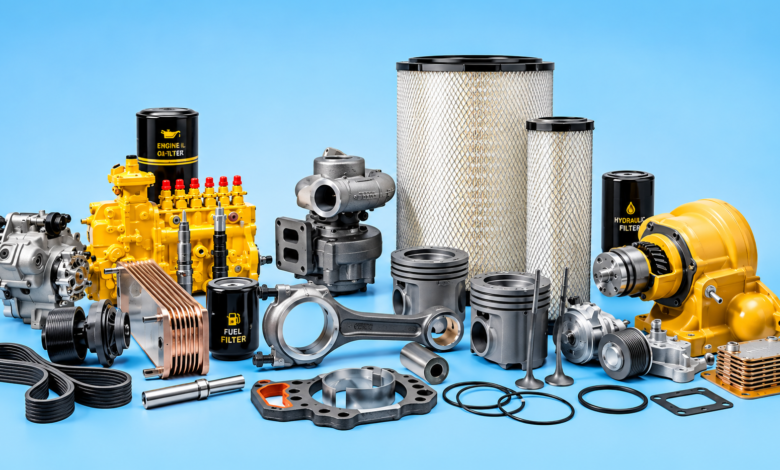
Heavy Equipment Spare Parts in Africa: 7 Proven Ways to Source Smarter
Heavy equipment spare parts in Africa reach contractors through dealers, regional stockists and direct imports, and the best route depends on the part, the port and the daily cost of downtime. Cargo spends 10 to 12 days clearing at Tema and 9 to 12 days dwelling at Dar es Salaam, so lead time often outweighs the price gap between part grades. Contractors who set a part-grade policy, qualify suppliers before a failure and stock critical spares remove most of that exposure.
Technical Snapshot: Core Sourcing Specifications
| Parameter | Detail |
| Primary question answered | How to source heavy equipment spare parts in Africa by grade, supplier route, lead time and verification |
| Part grades compared | Genuine, aftermarket, reconditioned and remanufactured |
| Remanufacturing benchmark | 45 to 85% of the new price with core return; same-as-new 12-month warranty on Cat Reman |
| Binding constraint | Clearing and dwell time: 10 to 12 days at Tema, 9 to 12 days at Dar es Salaam |
| Fastest levers | Part-grade policy, pre-cleared paperwork, critical spares held on site |
| Benchmark metric | Aftermarket parts must reach 63.6% of their genuine service life to match the cost per operating hour |
| Freight break-even | Air freight pays when it saves more than 0.82 days of tipper truck downtime |
| Stocking payoff | One USD 6,000 pump spare cuts the expected annual loss from USD 49,500 to USD 6,642 |
| Counterfeit exposure | Estimates reach 75% of automotive spare parts in Nigeria |
| Structure shift | From reactive single-supplier buying to a tiered panel with contracted availability |
Sourcing heavy equipment spare parts in Africa pays back fastest when lead time, grade and verification receive the same scrutiny as price.
Introduction: Heavy Equipment Spare Parts in Africa
Heavy equipment spare parts in Africa decide whether a machine earns or idles. A failed turbocharger on a remote haul route leaves a tipper truck stranded for days, even though the repair itself takes only hours. Most of the delay sits in sourcing: finding the part, importing it, clearing it and trusting that it is genuine. Fleets that follow sound construction equipment maintenance strategies reduce failure rates, yet every fleet still needs a dependable source for the remaining parts.
The exposure grows with fleet size. Africa’s construction equipment market is putting more excavators, loaders and tipper trucks on sites far from dealer depots, and each additional machine creates spare parts demand that someone must meet in a hurry. Genuine, aftermarket and remanufactured parts each suit different components. Supplier routes differ by country, import rules differ by port, and counterfeit risk follows the cheapest quote.
This guide covers construction equipment spare parts sourcing in seven steps, with examples from Nigeria, South Africa, Egypt, Ghana and Tanzania. A technical block at the end shows the arithmetic behind each decision, from cost per operating hour to the break-even point for air freight.
Seven Proven Ways to Source Smarter: Overview
Seven levers control the cost of sourcing heavy equipment spare parts in Africa, and they work in sequence: policy first, then suppliers, paperwork, freight, stock, verification and contracts. Each one lowers the total cost of keeping a machine working because a part’s price is only one input, alongside its service life, lead time and the downtime it prevents. The table below lists what each lever controls and which risk it removes.
Table: Seven Sourcing Levers and the Risk Each One Removes
| Way | What it controls | Risk it removes |
| 1. Set a part-grade policy | Genuine, aftermarket or remanufactured, by component | Early failure and warranty disputes |
| 2. Build a tiered supplier panel | Dealer, regional stockist, direct importer | Single-source dependency |
| 3. Pre-clear the paperwork | Country import gates | Port delay and rejected cargo |
| 4. Match freight mode to downtime cost | Air or sea | Paying for speed you do not need, or waiting when you cannot afford to |
| 5. Stock critical spares by criticality | Minimum stock levels | Parts wait on remote sites |
| 6. Verify every part before fitting | Receiving inspection | Counterfeit failure and warranty loss |
| 7. Write availability into contracts | Supplier performance targets | Unmeasured supplier performance |
Way 1: Set a Part-Grade Policy for Genuine, Aftermarket and Remanufactured Parts
Part grade decides the cost per operating hour of heavy equipment spare parts in Africa, along with warranty cover and failure risk. A written policy removes the debate from every breakdown and lets workshop staff order without waiting for approval. The three sections below separate the grades, explain how remanufactured and reconditioned parts differ, and answer the warranty question that stalls most aftermarket decisions.
Genuine vs Aftermarket Parts: What Each Delivers
Genuine parts come from the equipment manufacturer or its approved supply chain and match the original drawing, material and tolerance. Aftermarket parts come from independent makers who copy fit and function, with quality that ranges from excellent to dangerous. The genuine vs aftermarket parts decision, therefore, turns on the component, not the badge. Filters, ground-engaging tools and undercarriage suit aftermarket supply. Injectors, main hydraulic pumps and turbochargers are best supplied as genuine or remanufactured, because a tolerance error there can destroy the surrounding system.
Table: Part-Grade Decision Matrix for African Fleets (Editorial Assessment)
| Component group | Genuine | Aftermarket | Remanufactured | Default choice |
| Filters, belts and hoses | Optional | Good value | Not applicable | Aftermarket from a verified supplier |
| Undercarriage and ground-engaging tools | Longest proven life | Good value if life is tracked | Rebuilt rollers only with test data | Aftermarket with life records |
| Injectors and fuel pumps | Best fit | High risk | Strong value | Genuine or OEM remanufactured |
| Main hydraulic pumps and motors | Best fit | High risk | Strong value | Genuine or OEM remanufactured |
| Engines, transmissions and final drives | Best fit | Rare | Strong value on older machines | Remanufactured with a written warranty |
| Brakes, steering and safety systems | Required | Avoid | Avoid | Genuine |
The matrix answers the two most common comparison questions directly. For aftermarket vs OEM parts for excavators, genuine or remanufactured supply wins for high-pressure systems; the same holds for OEM vs aftermarket hydraulic parts, because contamination from one failed pump spreads through the circuit. On aftermarket vs. genuine undercarriage parts, aftermarket parts win whenever the supplier can demonstrate a track record of service life.
Reconditioned vs Remanufactured Heavy Equipment Parts
Reconditioned and rebuilt parts repair the failed feature and leave the rest of the worn component as it was. Remanufacturing strips the unit down to its core, replaces every part that does not meet the new specification, and tests the result. The remanufacturing difference sets the benchmark: CAT Reman products carry a same-as-new 12-month warranty and cost 45 to 85% of the cost of new parts with core return. Independent shops use “reman” loosely, so demand the test report and warranty terms in writing before buying remanufactured engine parts for construction equipment.
Are Aftermarket Parts Safe for Heavy Equipment, and When Should You Use Them?
Aftermarket parts are safe when the supplier proves the grade and the component tolerates the risk. Use them on wear items and externals, and avoid them on high-pressure and safety-critical systems. That answers when to use aftermarket parts on construction equipment: after the warranty expires, on components where a failure costs hours, not days.
Warranty terms are contractual, so whether aftermarket parts void the equipment warranty depends on the specific terms of the warranty. Manufacturers set their own conditions, and a counterfeit part renders a Caterpillar machine ineligible for the coverage a genuine part would provide. During the warranty period, buy genuine parts and keep the invoices. Ask the dealer for its written position before the first aftermarket fit.
Way 2: Build a Tiered Supplier Panel
Where to buy heavy equipment spare parts in Africa has no single answer because spare parts in Africa move through three tiers of supply. Dealers carry genuine stock and provide warranty support; regional stockists offer multi-brand depth; and direct importers ship from manufacturing hubs in Asia. A panel with one qualified supplier in each tier protects the fleet when any single route stalls. The sections below profile each tier and compare them side by side.
Dealer Networks for Genuine Parts
Authorised dealers anchor the genuine tier. Cat dealer spare parts in Africa and Komatsu spare parts from authorised suppliers arrive with the manufacturer’s part-number database, fitment checks against the machine serial number and warranty support. Dealer depots cannot sit beside every site, so agree on a delivery time in writing before the first order and confirm which items the depot holds in stock.
Regional Stockists and Independent Suppliers
South Africa hosts the deepest multi-brand aftermarket stock. Several heavy equipment spare parts suppliers in South Africa operate from Johannesburg and serve neighbouring markets; one advertises more than 35,000 line items in stock, and another runs branches into Eswatini. Ghana has its own base: heavy equipment parts dealers in Ghana, such as an Accra-based industrial supplier, list engine parts, injectors, seal kits and batteries for Cat and Volvo machines.
Marketplaces add a further option. Browsing spare parts on PlantBridge Africa lets buyers compare listings from various African and international suppliers before requesting quotes, shortening the search for a part that no local stockist has.
Direct Import from India and China
Spare parts from India and China to Africa travel by container, and the price advantage is real for wear parts, Chinese excavator spare parts and other Chinese-brand fleet components. Some Indian exporters quote 12 to 16 days of sailing time to Mombasa and arrange pre-export conformity verification for Kenya through accredited inspectors. Chinese-brand owners should pair every parts order with a machine check; used Chinese tipper inspection checks catch hidden faults that later become urgent parts orders.
Table: Supplier Routes Compared
| Route | Best for | Main risk | Verification step |
| Authorised dealer | Genuine and remanufactured critical parts | Higher price and depot distance | Written delivery time and part-number confirmation |
| Regional multi-brand stockist | Wear parts and fast aftermarket supply | Variable grade quality | Sample order and traceable batch records |
| Direct importer from Asia | Volume wear parts and Chinese-brand fleets | Long lead time and compliance paperwork | Pre-shipment inspection and country documents |
| Online marketplace or broker | Hard-to-find parts | Counterfeit and payment risk | Pay on inspection for the first orders |
Finding a reliable spare parts supplier for heavy equipment comes down to four checks. Request the supplier’s dealer authorisation or manufacturing credentials, ask for three references from fleets of similar size, place a small trial order, and independently confirm trade licences and bank details. Heavy equipment parts suppliers that refuse any of the four checks have answered the question for you.
Way 3: Pre-Clear the Paperwork Before the Part Ships
Heavy equipment spare parts import lead times in Africa depend as much on paperwork as on freight. Each market has a gate that must open before the vessel sails or the container clears, and a missing document strands the part at port. The sections below cover Nigeria, Egypt, Ghana, Tanzania and South Africa, then the tariff classification that applies to all five.
Importing Heavy Equipment Spare Parts into Nigeria: Form M and PAAR
Heavy equipment parts suppliers in Nigeria sell into a documented gate: an electronic Form M, which an authorised dealer bank processes before Customs issues the pre-arrival assessment report. Revaluation and reclassification queries at the assessment stage regularly delay clearance, as Nigeria’s cargo clearing procedures show. Raise Form M before the supplier ships, describe the part and its HS code exactly, and keep the pro forma consistent with the final invoice.
Construction Equipment Spare Parts in Egypt: Advance Cargo Information
Egyptian customs rejects cargo that arrives without an Advance Cargo Information Declaration number. The importer enters pro forma invoice data on the national single-window portal; the system issues a declaration number within 48 hours, and that number must appear on every shipping document. Sea shipments have needed it since October 2021, and air freight followed on 1 January 2026, which matters for urgent spares. The exporter must also upload shipping documents at least 48 hours before arrival, as advance cargo pre-registration is in Egypt.
Spare Parts Clearing Time at Tema Port in Ghana
A customs study in Ghana found that the time for clearing goods at ports averaged 10 to 12 days at Tema, 7 days at Kotoka International Airport, and 3 days at land borders. That gap makes air freight into Accra the sensible route for urgent spares, and it explains why the Tema number belongs in every sea-freight lead time.
Importers must also watch the legal clock. General cargo left uncleared for 21 days forfeits to the state under Section 53 of the Customs Act 891, so clearing goods on time protects both the party and the duty already paid.
Spare Parts Clearing Time at Dar es Salaam Port in Tanzania
Dar es Salaam is Tanzania’s main maritime gateway, so every excavator spare parts supplier in Tanzania and every import agent depends on its performance. Average cargo dwell time runs 9 to 12 days, more than double the global benchmark of under four days. A programme running from 2025 to 2029 aims to digitise clearance and close that gap, as work on improving Tanzania’s trade corridors shows, but contractors should plan on current performance rather than targets.
South Africa: Durban Volatility
South Africa’s clearing system works well when the port does. Durban’s main container terminal slowed sharply in 2026: average port calls, including waiting and berth time, rose from under five days in late June to more than 12 days by late August, and carriers charged storage and demurrage on containers that nobody could collect. Rising container delays at Durban justify holding air freight as a fallback for critical spares and asking forwarders about alternative ports.
Import Duty on Construction Equipment Spare Parts: Classify the Part Correctly
Parts for earthmoving and lifting machinery fall under HS heading 8431, which covers parts suitable for use solely or principally with machinery of headings 8425 to 8430. The machinery parts tariff classification shows the structure. Duty rates then follow each country’s own tariff schedule, and a wrong code invites queries, revaluation and delay. To avoid customs delays on spare parts, quote the machine model and part number on the invoice so that customs can assign the part to its parent machine.
Table: Import Gates and Published Clearing Evidence by Country
| Country | Gate before shipping or clearing | Published clearing evidence | Planning response |
| Nigeria | Form M through an authorised dealer bank; pre-arrival assessment report | Queries on value and HS code delay clearance | Raise Form M before ordering; match description and HS code |
| Egypt | Declaration number from the importer’s pro forma; documents 48 hours before arrival | Cargo without the number is rejected | Obtain the number before the supplier books the vessel or flight |
| Ghana | Customs declaration within the 21-day window | 10 to 12 days at Tema; 7 days at the airport; 3 days at the land borders | Air freight critical spares to Accra; clear inside 21 days |
| Tanzania | Customs declaration at Dar es Salaam | Dwell of 9 to 12 days against a benchmark of under 4 | Add 12 days to every sea-freight lead time |
| South Africa | Customs declaration and carrier release | Durban port calls rose from under 5 to over 12 days in 2026 | Hold an air freight fallback and ask about alternative ports |
Way 4: Match Freight Mode to Downtime Cost
Freight mode converts transit days into money. For heavy equipment spare parts in Africa, sea freight is cheap and slow, air freight is fast and expensive, and the right choice depends on what a day of downtime costs. Transit time carries a real price: time as a trade cost averages 0.6 to 2.2% of a good’s value per day, and parts and components show time sensitivity 60% higher than that of other goods.
Air Freight vs Sea Freight for Spare Parts
Sea freight transit times typically range from 20 to 45 days, port to port. Use ocean freight for planned replenishment, wear parts and kits, where a 40-day pipeline is a known input to the reorder point. Use air freight for a stranded machine. Air pays when the premium, divided by the daily downtime cost, is less than the days saved, and the technical block below calculates that sum.
How to Reduce Spare Parts Lead Times
Reducing spare parts lead times starts before the order is placed. Send the machine serial number and part number together, ask the supplier for a pro forma invoice with the HS code, and appoint a clearing agent who already holds the importer’s registration and documents. Consolidate planned orders into fewer shipments, and pre-alert the agent the day the supplier books freight. A fast flight followed by a week at the airport wipes out the premium.
Way 5: Stock Critical Spares by Criticality
How to stock spare parts for heavy equipment starts with one fact: stocking is the only lever that eliminates parts waiting, and remote sites make it the top priority for heavy equipment spare parts in Africa. A fleet cannot hold everything, so criticality determines what earns shelf space: components whose failure would stop a machine and whose replacement lead time exceeds what the site can absorb. The sections below build the list, set minimum stock levels and use consignment arrangements to lighten the cash load.
Build the Critical Spares List
A critical spares list for construction equipment ranks components by three factors: downtime cost per day, replacement lead time and failure frequency. Turbochargers, hydraulic pumps, starters, air dryers, hoses and filters usually top the list for critical spares for excavators and dump trucks. Published equipment downtime costs supply the daily figures: USD 851 for a tipper truck and USD 4,810 for a critical-path excavator in that article’s model.
Set Minimum Stock Levels
Minimum stock levels for heavy equipment spares follow a reorder-point rule: expected demand over the replenishment lead time, plus a safety margin. A single high-value item with a 45-day lead time and one expected failure a year needs one unit on the shelf, and a new order is triggered the moment it is fitted. Consumables need more units and a monthly review. Preventive rather than reactive maintenance sharpens the forecast because planned replacement makes demand predictable.
Further Reading: Preventive vs Reactive Maintenance in Construction: 5 Proven Savings
Use Consignment Stock and Fleet Pooling
Consignment stock for heavy equipment parts lets a supplier hold the item on or near the site while the contractor pays for use. New fleets benefit first: maintaining new tipper trucks to the manufacturer’s schedule makes wear-part demand easy to predict and consignment easy to size. Spare parts inventory management for contractors also benefits from pooling across sites, so that a single critical unit can cover several machines of the same model.
Way 6: Verify Every Part Before Fitting
Counterfeit heavy equipment parts in Africa travel the same routes as genuine ones, so verification must happen at receipt, not at purchase. Automotive data show the scale: estimates for Nigeria put the share of automotive spares at approximately 75%, and regulators there now rely on counterfeit-product authentication labels. Tippers and trucks share filters, brake parts and electrical items with the aftermarket, so heavy fleets carry the same exposure.
How to Spot Fake Excavator Parts and Verify Genuine CAT Parts
Verifying genuine CAT parts begins with the packaging. Genuine CAT parts and CAT Reman components arrive in high-quality packaging, often with holograms or security seals that counterfeiters struggle to copy, and the part number must match the dealer’s records. Avoiding counterfeit parts also means comparing weight and finish against a known genuine unit and reporting suspected fakes to an authorised dealer.
Risks of Counterfeit Hydraulic Parts
Hydraulic pumps, motors and injectors operate within tight tolerances and at high pressure. A counterfeit unit that wears early sheds metal into the circuit and contaminates every downstream component, so one fake pump can turn a component replacement into a full-system flush and rebuild. For this reason, the grade matrix above keeps hydraulic pumps and injectors with genuine or remanufactured supply.
How to Avoid Counterfeit Spare Parts When Importing
Avoiding counterfeit spare parts when importing requires three controls: a supplier with traceable batch records, third-party pre-shipment inspection for high-value orders, and a receiving routine that quarantines every part until it passes inspection. Pay on inspection for the first orders, and photograph packaging and labels before opening.
Table: Receiving Inspection Checks for Imported Parts
| Check | What to confirm | Action on failure |
| Part number and label | Matches the order and the dealer catalogue | Quarantine and query the supplier |
| Packaging and seals | Consistent print, intact security features | Photograph and reject |
| Weight and finish | Matches a known genuine reference unit | Reject and report to the dealer |
| Supplier paperwork | Batch record, test report and warranty terms | Hold payment |
| Invoice against pro-forma | Same description, HS code and value | Correct before customs queries arise |
Way 7: Write Parts Availability into Service Contracts
Supply performance improves when someone measures it, and sourcing spare parts for construction equipment is no exception. Contracts with dealers, workshops and heavy equipment parts suppliers should specify parts availability, response times and verification duties in numerical terms. The two sections below set the clauses and the scorecard.
Contract Clauses That Protect Uptime
Set a parts availability target, such as 95% of listed critical items delivered within 24 hours, and tie it to remedies. Require traceable batch numbers, return rights for non-conforming parts and genuine-part certification where the grade policy demands it. The same clause set applies whether OEM or third-party maintenance supplies the parts, because the contract, not the badge, determines who bears the risk.
Further Reading: OEM vs Third-Party Maintenance: 7 Proven Factors for Smarter Choices
Track Supplier and Part Performance
Record the part number, supplier, installation date, hours to failure and delivery time for every replacement. After a year, the data show which suppliers deliver on time and which aftermarket brands meet the life assumed in the grade policy. Trained operators strengthen that record, because heavy equipment operator training teaches them to report abnormal noise, heat and leaks before a failed part damages the machine.
Technical Block: Grade Break-Even, Freight Break-Even and Stocking Arithmetic
The numbers below turn the seven ways of sourcing heavy equipment spare parts in Africa into decisions a procurement manager can defend. All inputs are planning assumptions for a remote African site; replace them with your own price quotes, payroll and fleet records. The first calculation compares part grades by cost per operating hour; the second tests when air freight pays off; and the third prices the expected loss with and without a critical spare.
1. Part-Grade Break-Even: Cost per Operating Hour
Cost per operating hour equals part price plus fitting labour, divided by service life in hours. The table applies that formula to a main hydraulic pump on a 20-tonne excavator.
Table: Hydraulic Pump Cost per Operating Hour by Grade (Illustrative, USD)
| Grade | Part price | Fitting labour | Service life (hours) | Cost per hour |
| Genuine | 6,000 | 600 | 8,000 | 0.83 |
| Aftermarket | 3,600 | 600 | 5,000 | 0.84 |
| Remanufactured (65% of new, core returned) | 3,900 | 600 | 8,000 | 0.56 |
The aftermarket pump must reach (3,600 + 600) ÷ (6,000 + 600) = 63.6% of genuine life to match genuine cost per hour, which is 5,091 hours here. At 5,000 hours, it falls just short, and a single early failure adds an excavator outage that wipes out the savings. Remanufactured units win when they match genuine life and carry a written warranty, and 65% of the new price sits inside the 45 to 85% band quoted for CAT Reman.
2. Freight Break-Even: When Air Pays
Air freight pays off when the premium, divided by the daily downtime cost, is less than the number of days saved. Take a USD 1,800 turbocharger for a tipper truck costing USD 851 per day of downtime and an air premium of USD 700. The break-even is 700 ÷ 851 = 0.82 days.
Table: Illustrative Lead Time to Accra, Sea vs Air (Days)
| Stage | Sea | Air |
| Order and export preparation | 5 | 3 |
| Main transit | 30 | 7 |
| Clearing (Tema 11-day midpoint; airport 7 days) | 11 | 7 |
| Inland delivery | 2 | 1 |
| Total | 48 | 18 |
Air saves 30 days. At USD 851 per day, the stranded tipper costs USD 40,848 by sea and USD 15,318 by air, a difference of USD 25,530 against a USD 700 premium. The time cost of the goods adds more: at 0.6 to 2.2% of value per day, 30 days on a USD 1,800 part equals USD 324 to USD 1,188.
3. Stocking Arithmetic: Expected Loss with and without a Spare
Consider a fleet that expects one hydraulic pump failure a year. Replenishment takes 45 days, and hiring cover for a stopped excavator costs USD 1,100 per day. Without a spare, each failure costs 45 × 1,100 = USD 49,500. With one USD 6,000 spare on the shelf, the fleet carries a 15% annual holding cost of USD 900 and faces a second failure during the 45-day replenishment window. Demand over that window is 1 × 45 ÷ 365 = 0.123 failures, so the probability of at least one is 1 − e^(−0.123) = 11.6%, and the expected loss is 0.116 × 49,500 = USD 5,742.
Table: Critical Pump Spare, Expected Annual Cost With and Without Stock (Illustrative, USD)
| Item | No spare | One spare on site |
| Expected downtime loss | 49,500 | 5,742 |
| Holding cost (15% of USD 6,000) | 0 | 900 |
| Total expected annual cost | 49,500 | 6,642 |
The spare saves USD 42,858 a year before delay damages, which this model excludes. A simple spare outperforms a well-negotiated discount on the part itself, and that comparison drives every stocking decision in this article.
Conclusion: Plan the Part Before the Failure
Heavy equipment spare parts in Africa cost the most when they are missing, and the arithmetic in this article shows it. One USD 6,000 pump spare cuts the expected annual loss from USD 49,500 to USD 6,642. Air freight repays its USD 700 premium within one day of tipper downtime. An aftermarket pump that reaches only 63.6% of genuine life erases its own savings. Grade, lead time and stock therefore decide the bill far more than unit price and contractors who negotiate hard on price while ignoring all three are optimising the smallest line in the account.
Lead time then decides which route wins. Cargo spends 10 to 12 days clearing at Tema and 9 to 12 days dwelling at Dar es Salaam. Durban port calls more than doubled in 2026, and Egypt rejects cargo that lacks its declaration number. Paperwork opened before the order saves more days than any freight upgrade. Raise Form M in Nigeria, secure the declaration number in Egypt, clear within 21 days in Ghana, and add a 12-day allowance in Tanzania, so that no part waits at the port for a document.
Start with the last ten replacements on the fleet. Record the grade, supplier, lead time and hours to failure of each, rank them by downtime cost and place the top five on the critical spares list. Write the grade policy and availability targets into every supplier contract, and verify each part at receipt. Run that routine for one quarter, and the fleet stops buying parts in a crisis. Genuine, aftermarket or remanufactured, the right part is the one that arrives verified, on time and priced before the machine stops.
Source the Right Part First Time: Build a Spares Strategy That Holds
Spares decisions shape uptime, cost per operating hour and warranty exposure on every machine in the fleet. Follow Construction Frontier: Equipment Ownership and Maintenance for field-tested analysis on part grades, supplier routes, customs lead times and the economics of keeping African fleets earning.